
Influence of Retail Music on Consumer Dwell Time and Spending
Theoretical Foundations of Retail Atmospherics
Sensory marketing within physical retail spaces relies on the strategic manipulation of environmental cues to shape consumer perception, cognitive processing, and subsequent purchasing decisions. Within this domain, auditory atmospherics - specifically background music - operate as a primary environmental stimulus capable of bypassing conscious cognitive filters to elicit immediate psychological and behavioral responses 12. The foundational study of these auditory inputs is largely anchored in the Stimulus-Organism-Response (S-O-R) framework. This paradigm posits that external environmental stimuli, such as music tempo, volume, and genre, trigger internal organismic evaluations, including arousal, pleasure, and cognitive load 23. These internal states, in turn, dictate behavioral responses such as approach or avoidance, physical dwell time, and spending velocity.
Background music in retail spaces transcends mere aesthetic overlay; it functions as an architectural element of the "servicescape" or, more specifically, the "musicscape" 45. Subtle variations in musical characteristics alter the pace at which consumers navigate aisles, the amount of time they perceive has elapsed, and their overall likelihood of making impulse purchases 667. In physical commerce environments characterized by high competition and narrow margins, the precise calibration of auditory stimuli serves as a hidden lever for maximizing the commercial value of a physical footprint. The atmospheric elements of an environment prompt cognition regarding an organization, its merchandise, and its service quality, forming a holistic experience that can either facilitate or disrupt consumer decision-making 8.
As retail markets transitioned through the post-pandemic recovery phase into 2025 and 2026, consumer expectations for brick-and-mortar spaces shifted significantly. While online shopping efficiently fulfills utilitarian transaction needs, physical stores are increasingly evaluated on their experiential and social value 91012. Consequently, retailers must curate highly intentional auditory environments that align with overarching brand identities while tactically managing consumer flow, cognitive resources, and spatial density 1112.
Physiological and Psychological Mechanisms of Tempo
Cognitive Perception of Time and Movement
Tempo, typically measured in beats per minute (BPM), is the most heavily researched musical variable influencing physical movement and time perception in commercial environments 513. Foundational research by Milliman in the early 1980s demonstrated that consumer pacing aligns unconsciously with the rhythm of background music. In a seminal 1982 field experiment observing 216 grocery store shoppers, Milliman established that fast-tempo music accelerates the physical speed at which consumers walk through a store, thereby reducing their overall dwell time 171415. Conversely, slow-tempo music decelerated the consumer's physical movement, encouraging a more leisurely exploration of the retail environment and generating a significant increase in daily gross sales volume compared to fast-paced conditions 514.
This physical deceleration directly correlates with increased dwell time, which is frequently associated with higher total sales volume, particularly in environments where browsing drives impulse purchases or secondary add-on sales 616. The effect of tempo on time perception is equally critical, operating on principles of cognitive psychology. Fast tempos can cause shoppers to overestimate the amount of time they have spent in a store, accelerating their departure and subjective feelings of impatience 617. Conversely, slow tempos distort the perception of time in the opposite direction, signaling to the brain that less time has passed than reality dictates 6. This cognitive distortion increases consumer tolerance for waiting in lines, improves evaluations of waiting duration, and sustains prolonged browsing without triggering fatigue 717.
Arousal and Variety-Seeking Behavior
Beyond physical pacing and temporal distortion, tempo actively modulates consumer arousal levels. Experimental data indicates that fast-tempo background music elevates physiological and psychological arousal, driving subsequent shifts in consumer choice 1318. This heightened state of arousal acts as a mediating mechanism that triggers variety-seeking behavior. When exposed to fast-paced music, consumers demonstrate a higher propensity to abandon routine purchasing habits in favor of exploring new, varied, or unconventional products 1319.
However, this variety-seeking response is heavily bounded by consumer familiarity with the auditory stimulus. The correlation between fast tempo and variety-seeking is statistically significant primarily when consumers recognize and are highly familiar with the background music being played 131819. If the fast-tempo music is entirely unfamiliar, the cognitive load required to process the novel auditory stimulus diminishes the arousal effect, muting the variety-seeking impulse 1323. Therefore, retailers seeking to disrupt habitual buying patterns and promote product discovery are best served by utilizing upbeat playlists composed of highly recognizable tracks.
Transaction Speed and Spending Velocity
In the context of retail operations, tempo is a primary driver of the micro-velocity of transactions. Spending velocity, while macroeconomically defined as the rate at which money circulates through a broader economy, has a highly localized equivalent in physical retail: the speed at which a customer converts from a browser to a buyer and exits the physical space 242021.
For retail models that rely on high-volume, rapid-turnover transactions, fast-tempo music is a strategic necessity. The accelerated rhythm pushes consumers through the purchasing funnel, minimizes lingering, and increases the total number of transactions per hour or "spending per minute" (SPM) 2223. Conversely, in environments where the average transaction value is more important than the raw volume of transactions, a slower tempo acts to deliberately reduce spending velocity, allowing for upselling, consultative sales, and deeper product engagement 61416.
The Role of Volume in Consumer Behavior
Arousal Modulation and Cognitive Load
While tempo dictates pacing, the volume, or sound pressure level, of background music serves as an independent variable modulating intensity and cognitive capacity. High-volume music operates as a potent environmental stressor that artificially enhances excitement and energy levels 818. In specific retail contexts, this excitement translates into rapid, impulse-driven decision-making. High-volume environments suppress elaborate cognitive processing, driving consumers toward automatic or heuristic-based choices rather than deliberate, comparative evaluation 819.
In dining and grocery contexts, the suppression of cognitive control induced by high-volume music has been empirically linked to shifting consumption choices. High volume tends to enhance excitement levels, which frequently leads to an increase in unhealthy food choices and alcohol consumption 161824. Consumers subjected to loud environments process less informational detail, meaning they are less likely to read nutritional labels, evaluate long-term consequences, or compare price-per-unit metrics, defaulting instead to immediate hedonic desires. Furthermore, some studies indicate that loud music decreases shoppers' rates of spending per minute compared with soft music, potentially due to the desire to escape the overwhelming acoustic environment 5.
Conversely, low-volume or soft music fosters a relaxed psychological state characterized by high impulse control, low arousal, and elevated concentration 19. Soft music minimizes cognitive distraction, allowing consumers to devote full attention to product evaluation, brand recall, and spatial navigation. This auditory state moderates negative moods and reduces the friction associated with complex decision-making, resulting in higher reported levels of customer satisfaction and a heightened perception of service quality 614. Studies show sales have increased by 8 to 10 percent when slow, low-volume music is deployed in appropriate retail environments, facilitating thorough examination and comparison of goods without a sense of urgency 14.
Interaction Effects of Tempo and Volume
The interplay between tempo and volume creates distinct psychological matrices that govern shopper behavior. Analyzing these factors in isolation often yields incomplete conclusions, as the human organism processes auditory cues holistically.
The combination of fast tempo paired with high volume yields maximum arousal and minimum impulse control. This auditory environment heavily taxes cognitive bandwidth, leading to short attention spans and low product information recall, which can moderate negative product evaluations simply because the consumer is not processing the environment deeply 19. While this state is suboptimal for complex or high-involvement purchases, it can be effective at driving rapid, low-involvement impulse buying and accelerating store traffic flow in crowded environments 219.
Conversely, slow tempo paired with low volume minimizes arousal and maximizes impulse control. It facilitates high attention, detailed product recall, and significantly longer dwell times 19. By actively moderating negative affective states and preventing choice overload, this combination is particularly effective in retail scenarios requiring long-term, high-involvement decision-making.
As illustrated in the atmospheric interaction matrix, the deliberate pairing of tempo and volume allows retailers to engineer specific cognitive environments.
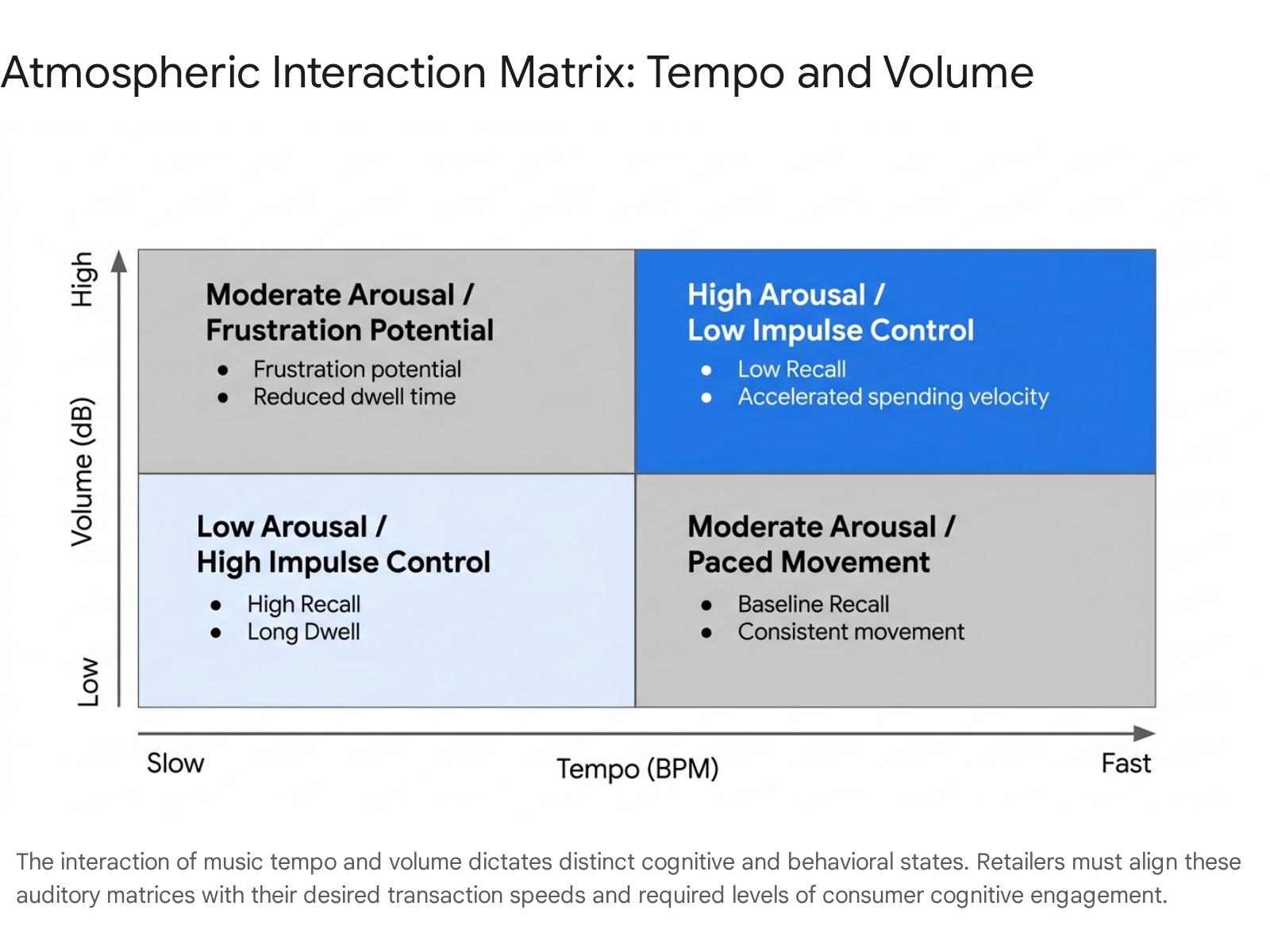
Misalignment between these two variables can lead to suboptimal store performance or active consumer avoidance.
Genre Preferences, Musical Mode, and Brand Congruence
The Concept of Brand-Music Fit
While tempo and volume alter physiological and pacing responses, musical genre dictates brand positioning, cultural resonance, and perceived product value 611. The concept of "brand-music fit" or sensory congruence refers to the degree to which the background music aligns with the visual, structural, and conceptual identity of the retail brand. Empirical evidence demonstrates that a high degree of brand-music fit significantly amplifies commercial outcomes. According to retail data analyses, playing brand-congruent music rather than random or uncurated playlists can increase average sales by up to 37 percent and extend in-store dwell time by approximately 42 percent 6.
Congruent music facilitates cognitive fluency. When the auditory cues match the visual and structural cues of the store - such as sophisticated jazz playing in a high-end boutique or classical music in a wine shop - consumers experience a holistic, unified sensory environment 711. This congruence enhances purchase-related self-confidence, making consumers more decisive and favorably inclined toward the merchandise 17. Classical music, in particular, carries associations of sophistication and prestige, leading consumers to subconsciously select more expensive items and increasing their overall willingness to pay 5711. Conversely, incongruent music creates cognitive dissonance. This sensory mismatch distracts the consumer, degrades the perception of service quality, and frequently results in avoidance behaviors or premature store exits 31117.
Structural Mode and Consumer Affect
The structural mode of the music - whether a piece is composed in a major or minor key - adds a profound layer of complexity to genre selection. Mode interacts intrinsically with tempo to influence sales outcomes, often overriding tempo's baseline effects. Research has identified a significant interaction effect wherein the "Milliman effect" - the established principle that slow tempo increases sales - is highly pronounced for music in a minor mode but is largely eliminated for music in a major mode 1517.
Music in minor keys paired with high complexity can intensify negative moods or lead to negative product evaluations if not carefully calibrated. However, major keys combined with low complexity generally act as mood stabilizers, moderating negative states and promoting positive evaluations regardless of minor tempo fluctuations 19. Therefore, retail operators cannot rely on slow tempos alone to increase dwell time; the structural composition and key signature of the selected tracks play a definitive role in how the tempo is received emotionally.
Comparative Retail Environments
The application of auditory atmospherics diverges sharply depending on the retail sector's economic model. Fast fashion, luxury retail, and the hospitality sector represent distinct points on the sensory strategy spectrum, with differing objectives regarding dwell time, spending velocity, and brand equity.
| Retail Variable | Fast Fashion Environments | Luxury Retail Environments |
|---|---|---|
| Primary Economic Goal | High-volume transactions, rapid inventory turnover. | High-margin individual purchases, brand equity building. |
| Target Dwell Time | Short to moderate. Consumers must move quickly to avoid bottlenecks. | Long. Consumers are encouraged to linger, consult, and evaluate. |
| Target Spending Velocity | High. Quick conversion from browsing to point-of-sale. | Low. Deliberate, paced consideration prior to high-ticket purchase. |
| Optimal Music Tempo | Fast (108 - 130+ BPM) to encourage rapid pacing and arousal 213. | Slow (under 90 BPM) to encourage relaxation and lower physical pace 714. |
| Optimal Music Volume | High to Moderate. Masks crowd noise, raises excitement 224. | Low to Soft. Facilitates intimate conversation and consultation 625. |
| Typical Genres | Pop, Electronic Dance Music, Top-40, Hip-Hop 23126. | Classical, Ambient, Jazz, bespoke custom soundscapes 71131. |
| Social Density Strategy | High density is normalized. Fast music helps alleviate crowding stress 227. | Low density is maintained. Slow music amplifies the perception of exclusivity 34. |
Fast Fashion Auditory Strategies
Fast fashion retailers depend on rapid inventory turnover and trend-driven consumption 2829. The physical environments are typically characterized by high visual complexity, vast product assortments, and dense human crowding. To manage this environment, fast fashion brands deploy highly stimulating auditory atmospherics - frequently consisting of fast-tempo, high-volume Pop, Rock, or Electronic Dance Music (EDM) 2. For example, brands like Abercrombie & Fitch historically utilized dynamic, high-volume electronic and pop-rock music paired with strong ambient scents to create an energizing, club-like atmosphere 2.
This auditory profile serves several functional purposes. First, the high tempo accelerates consumer movement, preventing severe bottlenecks in aisles and fitting rooms, thus maintaining a high transaction velocity 613. Second, the high arousal induced by upbeat music encourages impulse buying and variety-seeking, which aligns perfectly with the fast fashion model of discovering novel, low-cost trends 131823.
However, this strategy carries inherent risks. Fast fashion stores suffer from a high baseline of "product overload." If the auditory environment becomes too chaotic, or if the music is perceived as incongruent or overly aggressive, the high cognitive load tips into "consumer confusion" 330. This confusion triggers avoidance behaviors, leading shoppers to abandon their baskets and exit the store without browsing adequately. To mitigate this, successful fast fashion retailers utilize highly familiar pop tracks, as musical familiarity buffers the cognitive strain and maintains the variety-seeking effect without crossing into overwhelm 713.
Luxury Retail Auditory Strategies
Luxury retail operates on an antithetical model, prioritizing low-volume, high-margin transactions anchored in exclusivity, superior service, and craftsmanship 1131. In the post-pandemic landscape, as luxury consumers normalize their spending after periods of volatile "revenge buying," they have become highly discerning, favoring "quiet luxury" and demanding deeper experiential value from physical boutiques 323341.
To align with these expectations, luxury environments deploy auditory strategies that emphasize slow-tempo, low-volume music. This combination lowers physiological arousal, encourages extensive dwell time, and supports a high degree of impulse control, which paradoxically leads to greater confidence when authorizing massive expenditures 19. The extended dwell time allows for prolonged engagement with sales associates, building the interpersonal trust necessary for luxury transactions.
Genre selection is heavily curated to convey cultural capital. Classical music is a traditional staple, as it has been empirically proven to increase consumer willingness to purchase expensive, high-quality merchandise 742. However, modern luxury brands increasingly rely on custom-produced soundscapes, ambient genres, or even bespoke acoustic profiles that personify the brand's unique identity rather than relying on generic classical associations 1143. The objective is to use sound as a marker of sophistication, seamlessly integrating with the visual and spatial elements of the boutique to prevent any disruption in the consumer's high-end experience.
Dynamics in the Hospitality Sector
The hospitality and restaurant sector provides some of the clearest empirical data regarding the financial impact of music tempo and volume. The strategic goals of a restaurant shift depending on the time of day, day of the week, and specific service model, requiring dynamic auditory management.
| Restaurant Variable | Slow Tempo Music (<90 BPM) | Fast Tempo Music (>110 BPM) |
|---|---|---|
| Dwell Time | Extended. Average stay increases significantly (e.g., 80 minutes vs. 57 minutes) 16. | Reduced. Customers eat faster and leave sooner 16. |
| Table Turnover | Low. Ideal for fine dining where turnover is secondary to total bill size. | High. Ideal for fast-casual, lunch rushes, or high-capacity periods 22. |
| Consumer Spending | Higher total bill. Increases secondary purchases like alcohol, desserts, and coffee 162224. | Lower baseline bill, but higher volume of total customers served per hour 22. |
| Tipping Behavior | Baseline tipping rates based on service quality. | Evidence suggests an increase in tipping rates associated with high arousal 1622. |
Field experiments reveal that patrons dining under slow-tempo conditions spend up to 40 percent longer in the establishment compared to those listening to fast-tempo music 16. This extended stay duration directly correlates with increased spending on high-margin items such as alcohol and desserts 52224. Conversely, when a restaurant requires high table turnover - such as during a busy lunch service - increasing the tempo effectively accelerates dining speed and shortens the overall duration of the visit, thereby maximizing revenue through sheer volume 1622.
Environmental Moderators and Cross-Modal Interactions
Moderating the Effects of Social Density
Retail environments are not static spaces; the efficacy of auditory atmospherics is heavily moderated by the fluctuating presence of other human beings, referred to as social density or perceived crowding. High human density typically introduces negative psychological effects, including stress, feelings of spatial violation, and a desire to flee the environment 2827.
However, ambient music can act as an environmental intervention to recontextualize crowding. Research demonstrates a powerful interaction effect between music tempo and social density. In highly crowded conditions, playing slow-tempo music exacerbates negative evaluations, as the slow pace conflicts with the consumer's urgent desire to navigate the dense space, creating cognitive friction 234. Conversely, broadcasting fast-paced, upbeat music in a densely crowded store effectively alleviates the negative psychological impact of the crowd. The energetic music reframes the dense environment in the consumer's mind, transforming it from a stressful bottleneck into a stimulating, popular, and vibrant social event, thereby retaining shoppers and recovering lost spending potential 2827.
In contrast, when social density is low - such as in an empty store or an exclusive boutique - consumers exhibit a strong preference for soft, slow-tempo music. Under low-density conditions, the absence of crowds acts as a signal of high value and calm. Soft music amplifies this perception, while fast, loud music in an empty store feels jarring, highly incongruent, and negatively impacts the perception of service quality 34.
Cross-Modal Sensory Integration
Consumer perception is multisensory. The impact of music is magnified or diminished depending on its interaction with other environmental stimuli, most notably ambient scent and lighting. Studies assessing the "musicscape" alongside the "smellscape" reveal that congruency between senses is paramount. For example, the positive effects of music on retail equity and satisfaction are significantly strengthened when the music aligns with a carefully selected ambient scent 12. A mismatch between an elegant, slow-tempo track and an aggressive, energetic scent creates sensory dissonance, which disrupts cognitive processing and reduces dwell time 24. Retailers successfully employing sensory marketing ensure that auditory inputs are calibrated alongside olfactory and visual merchandising to present a unified brand narrative 35.
Demographic Vulnerabilities and Familiarity
Consumer reactions to music are heavily segmented by demographic variables and prior exposure. Age acts as a significant differentiator in tempo and volume tolerance. Older demographics generally exhibit a lower threshold for high-volume, fast-tempo background music. When exposed to highly stimulating soundscapes, older shoppers report decreased satisfaction and frequently accelerate their store exit 523. Younger consumers, particularly Generation Z and Millennials, demonstrate higher baseline tolerance for dense auditory environments and are more responsive to the arousal-inducing effects of fast-paced pop music in retail settings 324636.
Furthermore, as previously established, musical familiarity serves as a critical moderating boundary. Music that is familiar to the consumer requires less cognitive processing to assimilate. This familiarity enhances positive affective responses, makes perceived wait times feel shorter, and acts as the necessary catalyst for tempo-induced variety-seeking behavior 5713. Retailers must meticulously analyze their core demographic to ensure the selected playlists register as familiar and culturally relevant to their specific target audience, rather than relying on generic ambient tracks.
Post-Pandemic Behavioral Shifts
Omnichannel Integration and Phygital Spaces
Consumer behavior underwent a radical transformation during the COVID-19 pandemic, forcing a rapid acceleration of digital adoption and shifting baseline shopping expectations. In the 2024 - 2026 post-pandemic era, consumers have enthusiastically returned to physical retail, yet their evaluative criteria have been permanently altered 101237. Shoppers now demand an integrated "phygital" environment - a seamless blending of physical and digital commerce where the physical store functions less as a pure inventory warehouse and more as a sensory-rich brand embassy 9.
In this evolved landscape, auditory atmospherics have taken on heightened importance. Because digital channels easily fulfill functional purchasing requirements, consumers visit physical stores specifically for the tactile, social, and sensory experiences that cannot be replicated online 912. Retailers are utilizing advanced acoustic profiling, artificial intelligence-driven music biometrics, and data-driven playlist generation to ensure the in-store auditory experience regulates emotional states, reduces stress, and justifies the physical trip 623. Furthermore, the principles of brand-music fit are increasingly being extended into digital spaces. Luxury brands and digital storefronts have begun embedding curated, slow-tempo soundscapes into their e-commerce platforms and virtual reality showrooms to artificially induce the calm, extended dwell-time behaviors traditionally reserved for physical boutiques 1141.
Engineering the Micro-Velocity of Retail Spending
The broader macroeconomic environment in the post-pandemic period, marked by periods of inflation, dynamic monetary policy, and shifting money supply indices, has brought acute focus to consumer "spending velocity" 2449. While central banks monitor broad economic velocity, retail operators have become intensely focused on manipulating the micro-velocity of consumer capital within the physical store layout 202150.
Consumers in the 2025 - 2026 timeframe exhibit more cautious, value-based purchasing behaviors compared to the reactive "panic buying" or "revenge spending" seen in the immediate aftermath of the pandemic 1041. With consumers strategically pausing spending ahead of major sales events, retailers must maximize the yield of every footfall 2021. Music tempo and volume serve as primary tactical tools in this effort. By dynamically adjusting these variables throughout the day - deploying fast tempos and higher volumes during peak traffic hours to clear congestion and maximize transaction speed, and transitioning to slow, soft music during off-peak hours to artificially inflate basket sizes and encourage upselling from a smaller pool of shoppers - retailers can directly engineer their transaction velocity to protect profit margins against broader economic headwinds 61422.
Methodological Considerations and Uncertainty
While the profound impact of auditory atmospherics is well-documented, the application of this research requires calibrated uncertainty. Studies exploring retail music frequently report conflicting findings, largely due to variances in field versus laboratory settings, differing measurement metrics (e.g., self-reported satisfaction versus actual point-of-sale data), and the subjective nature of musical preference 41638.
For instance, while early laboratory studies suggested loud music universally decreases shopping time, subsequent field studies indicate that when volume is paired with highly preferred genres, it can actually increase engagement for specific demographics 523. Furthermore, the emergence of AI-driven biometrics to measure consumer mood in real-time presents new methodological frontiers, but long-term data on the efficacy of dynamically shifting music in response to live facial analysis remains nascent 23. Therefore, while broad correlations regarding tempo, volume, and dwell time hold true at a macro scale, retailers must rigorously A/B test auditory interventions within their specific environments to account for localized demographic and architectural variables.
Conclusion
The deployment of background music in retail environments is a highly sophisticated behavioral engineering tool that operates at the intersection of psychology, sensory science, and economics. Through the precise manipulation of tempo, volume, and genre, retailers exercise unconscious influence over the speed at which consumers move, the amount of time they perceive has elapsed, and their propensity for impulsive, variety-seeking purchases.
Fast-tempo, high-volume music acts as an atmospheric accelerant. It drives high physiological arousal, fast physical pacing, and rapid transaction speeds, making it the optimal strategy for fast fashion, high-density environments, and volume-centric retail models. Conversely, slow-tempo, low-volume music operates as a decelerator. It minimizes arousal, fosters deep cognitive engagement, extends physical dwell times, and increases average transaction values - a strategy vital for luxury brands, consultative retail, and high-margin dining.
Crucially, these auditory elements do not function in a vacuum. Their effectiveness is strictly governed by brand congruence, the structural mode of the musical compositions, and real-time environmental factors such as social density. As retail operations continue to evolve in an omnichannel, post-pandemic landscape that demands rich experiential value, the ability to architect an optimal, data-driven "musicscape" is no longer an ancillary aesthetic choice. It is a fundamental requirement for regulating consumer spending velocity, maximizing the utility of physical retail spaces, and driving sustained commercial success.