
Consumer self-consciousness and the spotlight effect in retail
Theoretical Foundations of the Spotlight Effect
The spotlight effect represents a well-documented cognitive bias in which individuals systematically overestimate the extent to which their actions, physical appearance, and behavioral choices are noticed, remembered, and evaluated by others 1234. Formally identified and quantified in empirical psychological literature by Thomas Gilovich, Victoria Medvec, and Kenneth Savitsky in 2000, the phenomenon underscores a pervasive and durable egocentric bias in human social cognition 345. Because humans process their environments from an inherently first-person perspective, their own internal states, anxieties, and behavioral anomalies are highly salient to their conscious awareness 13. This internal salience leads individuals to erroneously project their subjective focus onto the external audience, operating under the assumption that bystanders, peers, and service workers are equally focused on these minutiae.
The Anchoring-and-Adjustment Heuristic
The cognitive architecture of the spotlight effect relies predominantly on the anchoring-and-adjustment heuristic 4. When individuals attempt to gauge the social evaluations of others, they naturally anchor upon their own rich phenomenological experience. For example, in foundational psychological experiments, participants who were asked to wear an embarrassing t-shirt into a room of peers drastically overestimated the number of observers who would subsequently be able to recall the image on the shirt 34. The wearer, experiencing heightened physiological arousal and cognitive load regarding the garment, anchors on this intense internal state. The individual then attempts to adjust this perception downward to match the perspective of a disinterested third-party observer. However, this cognitive adjustment is routinely insufficient 4. The individual fails to adequately discount their own hypersensitivity, leading to the durable illusion that the "social spotlight" shines significantly brighter upon them than empirical reality dictates 5.
The Illusion of Transparency
Closely linked to the spotlight effect is the "illusion of transparency," wherein people overestimate how accurately external observers can read their internal emotional states 56. When individuals experience anxiety, hesitation, or embarrassment, they falsely believe these complex emotional states leak outward and are highly visible to strangers. In public settings, this creates a persistent environment of perceived surveillance, fundamentally altering how decisions are executed. Because human decision-making relies heavily on social identity maintenance and the avoidance of negative social judgment, the spotlight effect imposes a hidden psychological friction that governs behavior across highly visible environments 12. Furthermore, individuals frequently exhibit a "bias blind spot," remaining largely unaware of their own susceptibility to these egocentric projections, even when informed of the psychological mechanisms at play 5.
Transposition to Consumer Environments
Within consumer psychology and behavioral economics, the spotlight effect provides a critical theoretical lens for understanding non-rational purchasing deviations. Traditional rational choice models assume that consumers evaluate products based primarily on objective utility, price, and functional attributes 6. However, the spotlight effect reveals that a significant portion of consumer behavior is dedicated to managing perceived social scrutiny. Purchasing choices are frequently treated by the consumer as public declarations of identity, socioeconomic status, moral alignment, or personal competency 17.
When consumers operate under the influence of the spotlight effect, their focus shifts from maximizing functional utility to minimizing psychological threat. The behavioral economics of this invisible anxiety are profound: self-consciousness compounds across the customer journey, functioning as a hidden transaction cost 1. As a result, retailers frequently witness gradual drop-offs in consumer engagement, unexplained product abandonment, and highly specific modifications to shopping cart contents, all driven by the consumer's imperative to maintain social standing in a perceived audience's eyes 1810.
Drivers of Consumer Embarrassment in Retail
The application of the spotlight effect to retail environments requires examining the specific situational, cultural, and product-based triggers that elevate a consumer's self-consciousness. Embarrassment in a consumer context is defined as a socially experienced negative emotion resulting from a perceived threat to one's presented public identity, often characterized by a psychological state of awkward self-consciousness 8910.
Product Prominence and Identity Threats
The degree of self-consciousness a consumer experiences is heavily mediated by the product prominence hypothesis, which posits that embarrassment depends on the extent to which the object of transaction is perceived to be salient and identity-revealing 910. Highly sensitive or stigmatized items - such as condoms, adult incontinence products, anti-fungal creams, or hair-regrowth treatments - trigger acute self-consciousness because their purchase communicates private, potentially undesirable information to a public audience 8101311. The anticipation of purchasing such items induces apprehension long before the consumer enters the retail space.
However, embarrassment is not limited to biologically sensitive products. Brand-based embarrassment occurs when consumers interact with items that are incongruent with their desired social image 910. For example, the purchase of heavily discounted items, private label brands, or counterfeit goods may trigger self-consciousness if the consumer fears these choices will signal financial insolvency or lower socioeconomic status to onlookers 1012.
The Tension of Preloved and Sustainable Fashion
A contemporary manifestation of identity-inconsistent consumption is the expanding market for "preloved" or secondhand clothing. While frugal consumers and environmentally conscious shoppers increasingly favor sustainable fashion, the purchase of preloved items frequently collides with public self-consciousness 13. Secondhand clothing is historically associated with sanitary concerns and social risks, threatening an individual's curated reputation 13. Research indicates that while consumers may possess high purchase intent for preloved items due to environmental beliefs or economic utility, they become highly self-conscious at the point of acquisition 13. The fear of social stigma reduces their motivation to act on their purchase intentions, particularly for new consumers entering the secondhand market who are highly sensitive to aesthetic and psychological risks 13.
Social Presence Theory and Observer Familiarity
The spotlight effect is activated by social presence, but importantly, this presence does not need to be physically immediate or actively observing. Under social impact theory, any influence on an individual's feelings or thoughts exerted by the real, implied, or imagined presence of others constitutes a social impact 914. Research indicates that mere awareness of an employee's presence, the ambient noise of other shoppers in adjacent aisles, or even the imagined judgment of a future observer is sufficient to trigger identity-protection behaviors 131415.
The nature of the audience further dictates the intensity of the scrutiny. Consumers report differing levels of embarrassment depending on whether the perceived audience consists of retail employees, unacquainted peer shoppers, or familiar acquaintances. Paradoxically, intense embarrassment is often most severe in the presence of familiar individuals or in retail environments where relationship closeness is high 1016. A consumer may feel intensely evaluated by a neighborhood store clerk with whom they have a recurring rapport, triggering complete avoidance of sensitive purchases in that specific venue 1016.
Subjective Norms and Cultural Tightness
The manifestation of the spotlight effect is also deeply intertwined with sociocultural norms. In collectivist societies or regions exhibiting "cultural tightness," the pressure to maintain social harmony and save face significantly elevates the perceived risks of identity-inconsistent consumption 10. For example, studies examining consumer behavior in the Indian retail sector highlight how intense sociocultural normative forces make the public purchase of sexual wellness or personal hygiene products profoundly uncomfortable 1016. In these contexts, the threat of social sanction amplifies the consumer's internal spotlight, making the execution of routine purchases an exercise in high-stakes impression management.
Retail Formats and Physical Architecture
The structural format of the physical retail environment fundamentally shapes how the spotlight effect manifests. The layout, scale, and operational flow of a store determine the baseline level of privacy afforded to the shopper, either mitigating or exacerbating their feelings of public exposure.
Traditional Versus Modern Retail Environments
There is a stark divergence in perceived scrutiny between traditional, smaller-format retail stores and modern large-format supermarkets. Traditional stores, such as mom-and-pop shops, pharmacies, or Kirana stores in emerging markets, inherently increase physical proximity and necessitate direct, conversation-intensive interactions 1016. In these confined spaces, the lack of anonymity exacerbates the spotlight bias. Consumers are deprived of the physical space needed to conceal items, and the proximity of other patrons at a shared counter maximizes the perception of public observation 16. Furthermore, traditional formats often lack intermediate privacy buffers such as shopping baskets or changing rooms, forcing consumers to physically hold embarrassing items while waiting in close quarters 10.
In contrast, modern large-format supermarkets and big-box retailers offer substantial environmental buffers. Extended, high-shelved aisles provide temporary visual isolation from other shoppers. The sheer scale of the environment contributes to a diffusion of attention, allowing consumers to blend into the ambient crowd 16.
Pop-Up Retail and the Alleviation of Luxury Scrutiny
The physical format of a store also impacts the scrutiny felt when purchasing high-end goods. While luxury flagship stores are designed to be opulent and exclusive, their formal atmospheres can induce a specific form of performance anxiety or "luxury embarrassment," where consumers feel hyper-evaluated by highly trained staff regarding their wealth or status 20. Research indicates that pop-up brand stores successfully mitigate this discomfort. Because pop-up retail formats are transient and structurally unconventional, they are perceived as less formal and less intimidating than traditional luxury retail environments 20. This relaxed physical architecture lowers the baseline of anticipated embarrassment, fostering a higher hedonic shopping value and encouraging consumers to engage more freely with luxury brands without the intense pressure of social scrutiny 20.
Spatial Crowding and In-Aisle Displays
Beyond the macro-format of the store, the micro-layout of fixtures fundamentally dictates consumer mobility and their sense of territorial control. Retailers traditionally utilize secondary, mid-aisle displays to boost product visibility and drive impulse purchases 1718. However, empirical field experiments demonstrate that these displays can severely backfire by artificially inducing spatial crowding 171823.
Spatial crowding occurs when the navigable environment restricts freedom of movement, elevating psychological stress and prompting purchase-avoidance tendencies 1723. When aisles are cluttered with secondary fixtures, consumers are forced into uncomfortable proximity with one another, increasing the likelihood of unwanted social observation and amplifying the spotlight effect 18.
This environmental restriction profoundly amplifies self-consciousness, particularly for shoppers utilizing shopping carts. A shopping cart expands a consumer's peripersonal space - the physical space immediately surrounding the human body that is cognitively mapped as an extension of the self 18. When navigating narrow aisles, cart users experience significantly higher sensitivity to spatial constraints, leading to a sharp drop in perceived control. Supermarket field data confirms that removing secondary in-aisle displays increased the frequency of cart users stopping to physically handle products by a factor of 7.05, and lifted overall aisle sales by roughly 11.5% 171823.
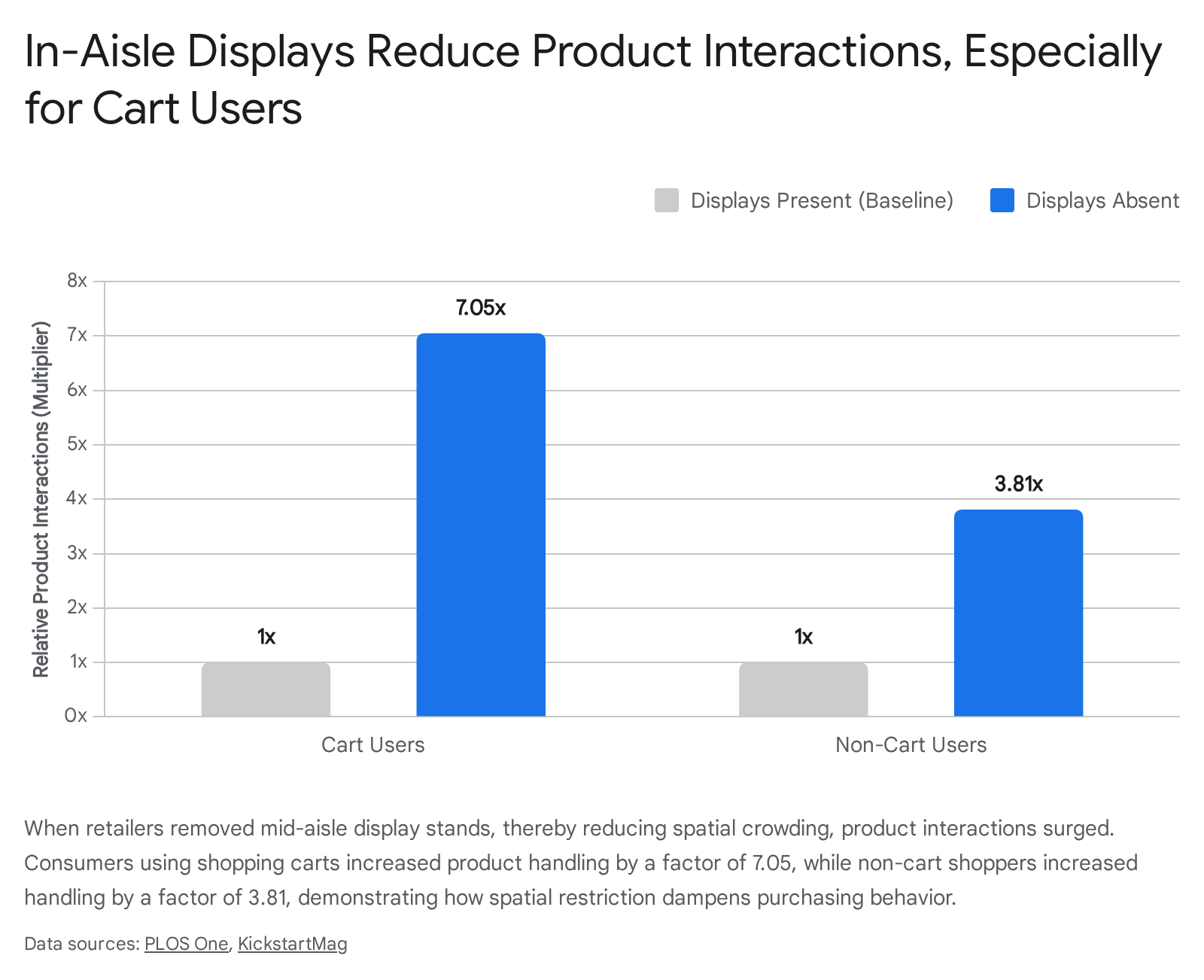
When the physical environment feels less congested, the perceived intensity of the social spotlight dims, restoring the consumer's cognitive capacity to browse, evaluate, and interact with merchandise 18.
Sensory Moderation of Perceived Scrutiny
While the spotlight effect is fundamentally a psychological internal state, it is highly reactive to the sensory architecture of the retail environment. Elements such as illumination strategies and auditory exposure heavily moderate the intensity of self-consciousness, governing whether a consumer feels aggressively exposed or safely insulated.
Ambient Illumination and Visual Comfort
Sensory marketing, particularly the application of retail lighting, directly influences the psychological and emotional states underlying consumer self-consciousness 192520. Light possesses both biological and psychological properties that dictate visual comfort, emotional valence, and physiological arousal 252021.
Consumers exhibit differing tolerances for social exposure depending on the correlated color temperature (CCT) and the Color Rendering Index (CRI) of ambient lighting. Extremely cool, bright lighting (high CCT) mimics institutional or clinical settings, creating an over-illuminated environment that can induce feelings of sterility and high exposure 2520. In these environments, the spotlight effect is physically realized; shoppers feel overly visible and heavily scrutinized, increasing anxiety and purchase-avoidance when examining sensitive items.
Conversely, warmer color temperatures, especially when paired with colored lighting elements or controlled shadowing, can foster a more relaxed, private atmosphere. Warmer light reduces the cognitive load associated with public scrutiny, diminishing anxiety and promoting extended browsing times, though excessive warmth can occasionally induce fatigue 2520. Retailers must carefully calibrate general overhead illumination against targeted display lighting to balance accurate product visibility (high CRI) with the consumer's fundamental need for psychological shelter 25.
Auditory Boundaries and Personal Sound Environments
Alongside visual factors, the auditory environment heavily dictates the perception of social presence. A rapidly rising phenomenon in public consumer spaces is the deliberate creation of "private sound environments" through the continuous use of headphones or earbuds 282922.
Wearing headphones serves as an acoustic shield, allowing individuals to navigate high-density public spaces - such as grocery stores and shopping malls - while conceptually insulating themselves from the surrounding social reality 2822. By maintaining an internal auditory narrative (e.g., music, podcasts, or white noise), consumers artificially shrink their perceived social environment, effectively dampening the spotlight effect. The earbuds function as a highly visible "do not disturb" signal, establishing a boundary that wards off salesperson approaches, clipboard volunteers, and unsolicited peer interactions. This significantly reduces the pressure of social etiquette and the anxiety of continuous evaluation 2829. For consumers with sensory sensitivities or high public self-consciousness, headphones serve as a vital self-regulation tool rather than an expression of antisocial intent 29.
However, this coping mechanism introduces complex trade-offs for retail dynamics. While headphone usage reduces self-consciousness and defends against environmental crowding, it simultaneously severs the consumer's connection to ambient retail stimuli. Shoppers utilizing private sound environments are insulated from atmospheric store music, promotional announcements, and the spontaneous social interactions with staff that traditionally foster brand affinity and unplanned product discovery 282922.
Behavioral Coping Strategies and Impression Management
When confronted with the spotlight effect, consumers do not act as passive subjects; they deploy highly specific behavioral and cognitive coping strategies designed to manage environmental stress and mitigate perceived social threats 1015. These mechanisms directly impact critical retail metrics, significantly altering basket composition, conversion rates, and the time spent on the premises.
Product Abandonment and Purchase Delay
One of the most immediate responses to heightened self-consciousness is avoidance behavior. If the perceived social threat outweighs the immediate functional utility of the product, consumers will engage in purchase delay or complete product abandonment 132324. E-commerce data illustrates the fragility of consumer commitment: while approximately 80% of online consumers display purchase intent by adding items to a cart, the global cart abandonment rate routinely hovers between 70% and 75% 2325.
In physical retail settings, this avoidance translates to "checkout dumping." Consumers experiencing emotional ambivalence, sudden exposure to crowded checkout lines, or fear of judgment frequently dump their previously selected items at or near the checkout point rather than proceed with the transaction 1626. Checkout abandonment is also heavily influenced by the decoy effect and comparison shopping; when consumers feel rushed or heavily scrutinized while evaluating an asymmetrically dominated option, they may drop their initial purchase decision entirely to flee the high-pressure environment 26. This phenomenon imposes high operational costs on retailers through necessary reshelving, product deterioration due to multiple handling, and general store disorder 26. The abandonment represents a failure to overcome the psychological friction introduced by the spotlight effect; when a consumer calculates that their purchase will invite public scrutiny or negative evaluation, walking away becomes the most viable method of identity protection.
Shopping Basket Composition and Masking Behavior
When abandonment is not an option - because the product is a vital daily necessity - consumers resort to sophisticated impression management tactics. The most prominent of these is "masking," a coping strategy wherein shoppers intentionally purchase additional, non-embarrassing products to obscure or distract from an embarrassing item 81010.
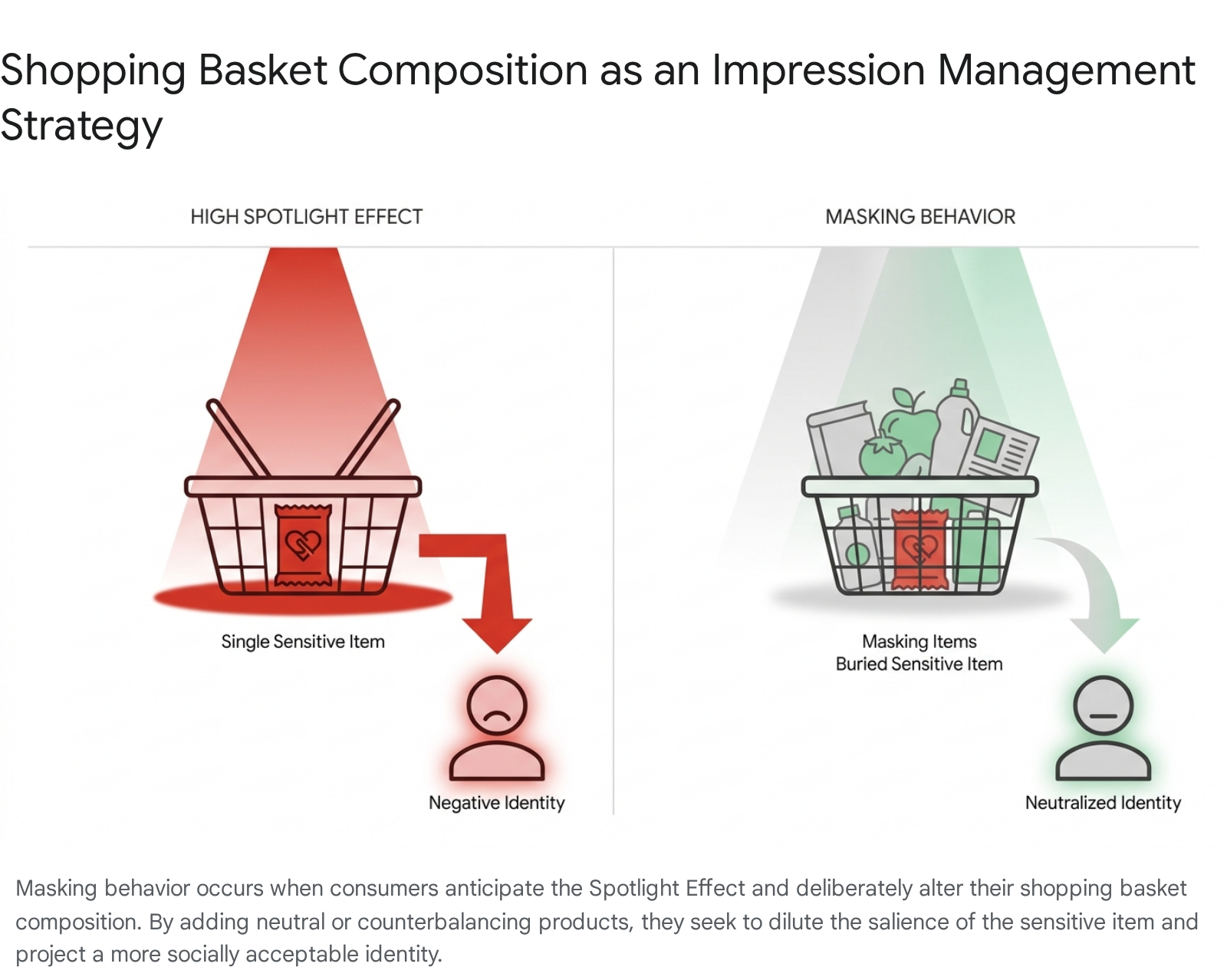
Research targeting millennial consumer demographics reveals that masking effectively enhances both the total shopping basket size (raw number of items) and the overall monetary value of the basket 82736. Millennial consumers, who display a heightened baseline susceptibility to social evaluation compared to older cohorts, actively curate their baskets to bury sensitive items physically beneath neutral items, or to dilute their proportional salience on the checkout belt 8. Consequently, the emotional discomfort generated by the spotlight effect paradoxically drives incremental sales volume for the retailer, as the consumer purchases unplanned peripheral goods (such as magazines, gum, or staple groceries) purely as defensive camouflage 8.
The Counterbalancing Hypothesis
The mechanics of masking behavior are not indiscriminately driven by volume. In a rigorous exploration of basket composition, Blair and Roese (2013) demonstrated that non-embarrassing additional purchases do not automatically attenuate anticipated embarrassment, and can occasionally exacerbate it 1010.
If a consumer purchases an embarrassing item and attempts to mask it by purchasing items that complement the undesired identity, the embarrassment intensifies. For example, purchasing an unhealthy, highly indulgent food item alongside other overtly lazy or indulgent products reinforces the negative identity the consumer is trying to escape. Masking is only successful when the additional purchases counterbalance the undesired identity 101336. If the sensitive product signals a lack of control or a health failing, the consumer must strategically purchase items that signal extreme health, responsibility, or normalcy to offset the perceived judgment of the cashier or bystander 10. This counterbalancing act requires the consumer to engage in rapid, heuristic-based decision-making in the aisles, entirely overriding planned purchasing behavior to manage the intense feeling of being watched.
Dehumanization of Retail Personnel
When environmental or basket modifications fail to provide sufficient privacy, consumers alter their cognitive perception of the retail personnel. Shoppers facing embarrassing transactions frequently dehumanize service providers as a cognitive defense mechanism 1637. By attempting to perceive the employee as a mechanistic entity incapable of judgment, emotional reaction, or memory, the consumer reduces the psychological weight of the interaction 16. While this allows the transaction to proceed, it degrades the interpersonal rapport that traditional retail models rely upon to build long-term brand loyalty.
| Coping Strategy | Mechanism of Action | Retail Outcome |
|---|---|---|
| Product Abandonment | Consumer halts the transaction to completely remove the source of anticipated social judgment 1626. | Lost revenue, increased operational costs due to reshelving, degraded inventory 26. |
| Purchase Delay | Consumer defers the purchase to an off-peak time or switches to a perceived anonymous channel (e.g., online) 11. | Channel shifting, potential loss of immediate sale if the consumer's need is resolved elsewhere 16. |
| Masking (Counterbalancing) | Consumer curates the shopping basket with unrelated, identity-restoring goods to dilute the salience of the sensitive item 1036. | Increased basket size (item count) and artificially elevated total transaction value 8. |
| Dehumanization | Consumer cognitively reframes the retail employee as an automaton incapable of rendering social judgment 16. | Transaction completion, though potentially paired with diminished long-term store loyalty 16. |
The Spotlight Effect in Digital and E-Commerce Settings
The migration of retail to digital channels initially suggested a solution to public self-consciousness, offering consumers the anonymity lacking in physical stores. However, the architecture of the modern internet has not eliminated the spotlight effect; rather, it has transformed and amplified it through pervasive data collection, social media metrics, and algorithmic surveillance 1328.
Online-to-Offline Contagion and Algorithmic Surveillance
In digital spaces, the spotlight effect manifests as the nagging sensation that a user's choices, clicks, and purchases are being continuously watched, judged, and catalogued by an invisible audience 1. This feeling is exacerbated by social media marketing, where algorithms feed users highly personalized content that inflates their sense of visibility. Behavioral data indicates that as consumers receive attention or engagement online, they experience heightened egocentrism 282930.
This algorithmic reinforcement strengthens their internal spotlight bias, causing an "online-to-offline contagion." Elevated self-consciousness derived from digital platforms spills over into physical reality, causing heavy digital users to inaccurately perceive abnormally high levels of scrutiny in their offline, physical retail environments 282930. Furthermore, digital social proof mechanisms - such as notifications stating "50 other people are viewing this item" - can severely backfire for consumers experiencing the spotlight effect. While intended to signal popularity, for the self-conscious consumer, these metrics simulate a massive, judging audience, raising the stakes of the purchase decision 13.
The Privacy Paradox and Web Personalization
E-commerce fundamentally relies on web personalization, utilizing browsing history to display highly targeted recommendations. However, when purchasing embarrassing or sensitive products online, personalization triggers intense emotional distress 31.
Consumers realize that the system is permanently recognizing and cataloging their sensitive needs. The traditional physical coping mechanism of masking (adding random items to a basket) is ineffective online because the algorithm definitively links the user's profile to the sensitive category, stripping away plausible deniability 31. Consequently, online buyers develop entirely different coping strategies. When interacting with highly embarrassing products online, consumers drastically reduce the time spent shopping and minimize their overall clickstream activity 31. They seek to complete the transaction as rapidly as possible to limit the system's tracking exposure, actively bypassing personalization features and up-sell recommendations in a rush to flee the digital spotlight 31.
Artificial Intelligence and Human-Free Interventions
To counteract the pervasive feeling of being watched by evaluating humans, consumers actively seek interactions devoid of emotional judgment. Artificial intelligence and robotics present highly effective interventions for mitigating consumer embarrassment 1132.
Consumers exhibit a strong preference for interacting with AI chatbots or self-service algorithms when processing sensitive transactions (such as processing credit applications, inquiring about medical products, or navigating financial insolvency) 1132. Because machines lack agency, emotional capacity, and the social standing required to render judgment, the threat of social evaluation is nullified 1132. The consumer no longer anchors on the fear of another human's disapproval. Studies indicate that human-free interactions significantly lower anticipated embarrassment and result in higher overall satisfaction rates when processing stigmatized or highly personal requests, particularly for consumers with lower emotional intelligence who struggle to regulate their social anxieties during human-to-human contact 1532.
Strategic Implications for Retail Operations
Understanding the mechanics of the spotlight effect provides retailers with actionable frameworks to structurally redesign their environments. By minimizing the psychological friction of social scrutiny, retailers can directly improve conversion rates, reduce product abandonment, and elevate customer satisfaction.
Modifying Checkout Architecture
Because the checkout counter represents the apex of the spotlight effect - the moment of mandatory public transaction - retailers must prioritize privacy at this juncture. Providing varied checkout options is essential. The widespread implementation of self-checkout kiosks allows consumers to scan and bag their own items, circumventing the need for employee interaction and shielding their basket composition from queueing peers 1016.
In environments where self-checkout is unfeasible or culturally uncommon, widening the spacing between registers or providing opaque shopping bags early in the store journey can alleviate the anticipatory anxiety that leads to checkout dumping 16. Furthermore, ensuring that shopping baskets are readily available upon entry prevents the acute embarrassment of carrying sensitive items by hand, allowing consumers to effectively execute their masking strategies while navigating the store 1011.
Optimizing Store Layouts and Self-Concept Clarity
Retailers must rigorously evaluate spatial crowding. The removal of non-essential secondary displays, particularly in aisles housing sensitive personal care items, expands the navigable peripersonal space 1718. This environmental relief diminishes the sensation of physical restriction, which in turn lowers the perceived intensity of external observation 1718.
For products inherently prone to triggering self-consciousness, strategic placement in lower-traffic zones, away from end-caps or high-visibility promotional platforms, affords the consumer the necessary psychological safety to browse and evaluate 810. Additionally, marketing messaging should aim to bolster consumers' Self-Concept Clarity (SCC). Research indicates that consumers with high SCC are more confident in purchasing identity-linked products and are less susceptible to the anxiety of external social evaluation 7. Fostering strong, clear brand identities helps consumers feel anchored in their choices, reducing their vulnerability to the spotlight effect.
The spotlight effect remains a foundational architecture that dictates consumer behavior across all retail formats. Operating on an egocentric bias, consumers systematically overestimate the social scrutiny directed toward their purchasing decisions. Whether manifested through the costly operational burden of checkout abandonment, the defensive curation of counterbalancing products, or the panicked acceleration through a personalized web portal, the anxiety of public evaluation frequently overrides rational utility. By accommodating the consumer's imperative to protect their social identity through environmental buffers, human-free technologies, and privacy-centric architectures, modern retail can neutralize the spotlight effect, transforming defensive shopping environments into spaces of psychological safety and reliable conversion.