
Conspiracy theories and radicalization to political violence
The proliferation of conspiracy theories and their intersection with political extremism has emerged as a central concern in contemporary security studies, political psychology, and sociology. While historical instances of conspiracy-driven violence are well documented, the modern digital ecosystem has fundamentally altered the speed, scale, and nature of radicalization. The process by which individuals internalize conspiratorial narratives and subsequently mobilize toward violent extremism involves a complex interplay of psychological vulnerabilities, ideological hybridization, algorithmic amplification, and sociological triggers. This research report synthesizes peer-reviewed literature, institutional data, and global case studies to examine the precise mechanisms through which conspiracy theories radicalize individuals toward extremism and political violence.
Psychological Mechanisms of Radicalization
The adoption of extremist ideologies is rarely a spontaneous occurrence; rather, it is the culmination of distinct psychological processes that make violence appear logically necessary and morally justified to the individual. Radicalization is best understood not as an innate pathology, but as a cognitive and behavioral trajectory influenced by contextual stressors.
The Needs, Narratives, and Networks Framework
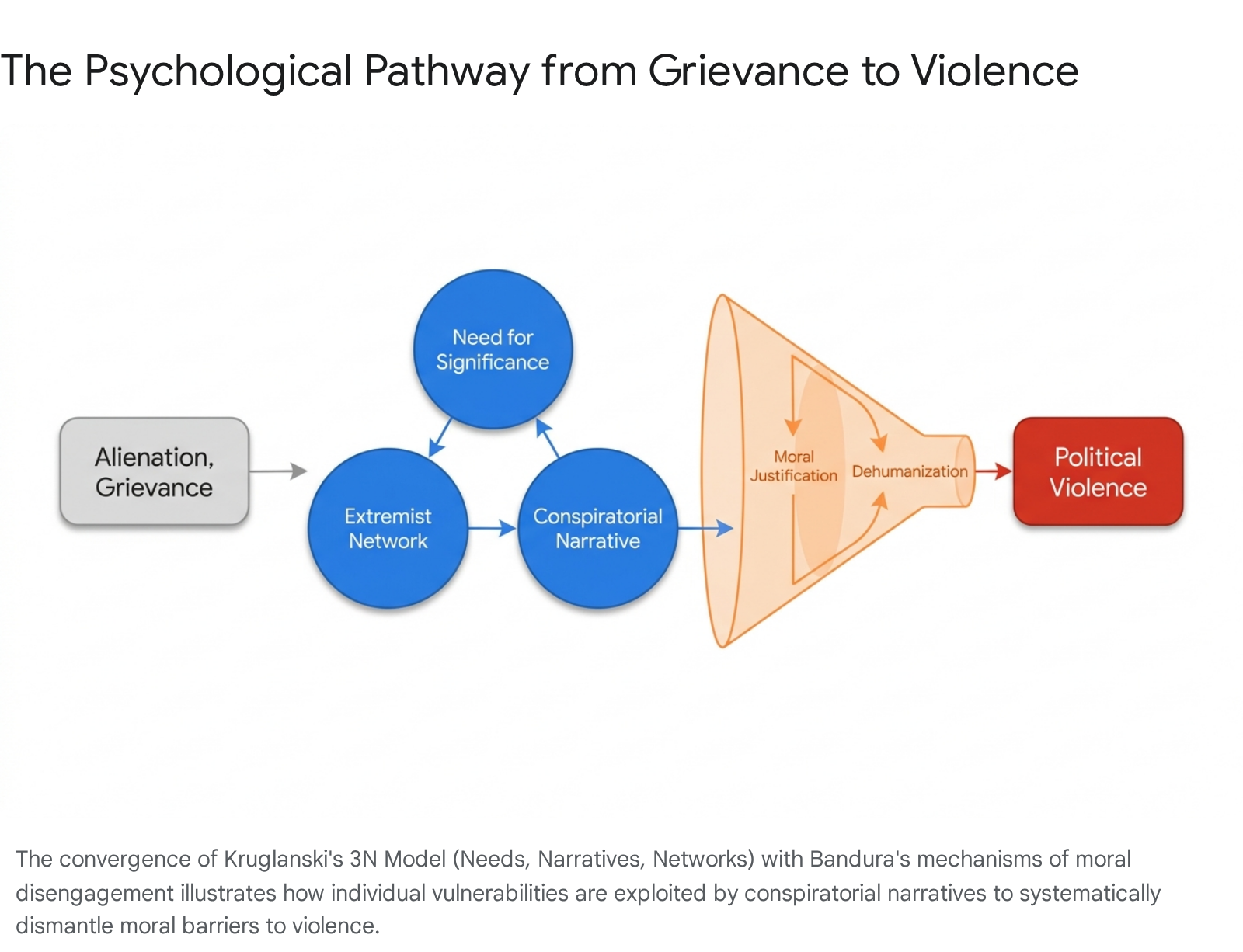
A foundational framework for understanding ideological radicalization is the "3N Model," developed by Kruglanski and colleagues, which posits that extremism emerges from the convergence of Needs, Narratives, and Networks 12. The primary psychological driver in this model is the "need for significance" - the fundamental human desire to matter, be respected, and possess a clear sense of purpose within a social hierarchy 23.
When individuals experience profound personal or collective grievances - such as social alienation, economic disenfranchisement, discrimination, or perceived government overreach - they often suffer a critical loss of significance 1. This psychological distress creates a "cognitive opening," a state of heightened receptivity to novel, unconventional, or extreme belief systems that promise to restore the individual's sense of self-worth and agency . Conspiracy theories provide highly effective "narratives" in this context. They offer unambiguous, totalizing explanations for complex societal problems, cleanly dividing the world into an in-group of enlightened victims and an out-group of malevolent conspirators 4. Finally, extremist "networks" (operating both online and offline) provide the social validation and camaraderie necessary to reinforce the narrative, satisfy the individual's need to belong, and isolate the target from moderating influences 3.
Threat Perception and Cognitive Openings
Conspiracy theories frequently operate by artificially elevating threat perceptions to an existential level. By suggesting that a shadowy cabal is actively working to destroy, subjugate, or replace the in-group, these narratives cultivate a pervasive sense of imminent danger 5. This heightened threat perception elicits strong, mobilizing emotional responses, primarily anxiety, outrage, and anger.
Research analyzing the linguistic and behavioral patterns of anti-government extremists indicates that anger and perceived government illegitimacy serve as powerful mediating variables bridging conspiracy beliefs and support for political violence 6. As believers consume narratives detailing ongoing, secretive injustices perpetrated by the state, electoral systems, or elite institutions, the perceived legitimacy of these authorities erodes. Once an authority is deemed fundamentally illegitimate and inherently hostile, violence transitions from being a taboo transgression to a necessary, defensive measure 6.
Processes of Moral Disengagement
A critical psychological barrier to mass violence is the human capacity for self-regulation and moral sanction. To commit acts of political violence, individuals must bypass their internalized ethical standards without suffering debilitating psychological dissonance. Albert Bandura's theory of moral disengagement outlines specific cognitive restructuring techniques that allow individuals to perform harmful acts while maintaining a positive self-concept 789.
Extremist networks and conspiratorial milieus systematically employ these mechanisms to prepare adherents for violence. The mechanisms are generally categorized into three distinct psychological domains: the cognitive restructuring of the behavior itself, the obscuring of personal agency, and the alteration of the perception of the target 1011. The convergence of the 3N Model and these mechanisms highlights how individual vulnerabilities are exploited by conspiratorial narratives to systematically dismantle moral barriers to violence, as illustrated in the following diagram.
Cognitive Restructuring of Behavior
The first domain involves altering how the violent act is perceived by the perpetrator. The most potent mechanism is moral justification, wherein destructive behavior is framed as serving a sacred, noble, or socially necessary purpose 79. Conspiracy theories excel at this; if an individual believes they are fighting a literal cabal of child abusers or preventing a global genocide, violence is redefined as a heroic necessity 11. This is frequently accompanied by euphemistic labeling, which uses sanitized or abstract language to mask the severity of violent acts - referring to mass casualty events as "cleansing operations," "kinetic actions," or "surgical removals" 911. Additionally, advantageous comparison is utilized to contrast the individual's violence against a supposedly much worse atrocity committed by the conspirators, making the extremist's actions seem trifling or defensive by comparison 79.
Obscuring Personal Agency
The second domain involves minimizing the perpetrator's sense of personal responsibility for the harm inflicted. Displacement of responsibility allows the actor to shift the blame to an authority figure, a dictating ideology, or even the algorithm itself, arguing that they were merely following necessary imperatives and had no alternative 911. Diffusion of responsibility dilutes personal accountability by embedding the action within group dynamics; when an individual acts as part of a mob, a militia, or a decentralized online swarm, the psychological weight of the violence is distributed, meaning no single individual feels entirely responsible for the outcome 911.
Alteration of Target Perception
The third domain focuses on the victims of the violence. Dehumanization is a pervasive feature of conspiracy-driven extremism. It involves stripping the target of human qualities, often portraying them as demonic, parasitic, or animalistic 789. For example, the QAnon movement frequently framed political elites as literal demons or parasitic entities, entirely removing the psychological barriers associated with harming another human being 58. This is complemented by the attribution of blame, wherein the victim is viewed as the true aggressor whose covert, conspiratorial actions necessitated the violent response 79.
| Psychological Domain | Specific Mechanism | Application in Conspiracy Extremism |
|---|---|---|
| Restructuring Behavior | Moral Justification | Framing violence as an absolute necessity to prevent a fabricated atrocity (e.g., preventing a "Great Replacement" or stopping a deep-state cabal) 7911. |
| Euphemistic Labeling | Using sanitized, bureaucratic, or pseudo-military terminology to describe the murder or assault of perceived conspirators 911. | |
| Advantageous Comparison | Justifying immediate violence by comparing it to an exaggerated or entirely fictional ongoing threat 79. | |
| Obscuring Agency | Displacement of Responsibility | Shifting moral culpability to ideological leaders, anonymous online figures (e.g., "Q"), or divine imperatives 911. |
| Diffusion of Responsibility | Participating in mob violence or decentralized network harassment where individual accountability is masked by the collective 911. | |
| Altering Target Perception | Dehumanization | Portraying target groups as subhuman, parasitic, or demonic, thereby removing natural empathetic restraints 789. |
| Attribution of Blame | Reversing the roles of victim and aggressor, claiming the targets brought the violence upon themselves through their alleged conspiratorial actions 79. |
The Attitude-Behavior Gap in Extremism
While the psychological mechanisms facilitating violence are well documented, a central paradox remains in extremism research: the vast majority of individuals who hold extreme conspiracy beliefs never engage in physical violence 11213. Understanding this attitude-behavior gap is crucial for accurate risk assessment and the allocation of counter-terrorism resources.
Critiques of Linear Radicalization Models
Historically, radicalization was conceptualized as a highly predictable, linear progression. Fathali Moghaddam's "Staircase to Terrorism" (2005) remains a highly influential metaphor in policy circles 1415. Moghaddam envisioned a narrowing staircase where entire populations begin on the ground floor, experiencing feelings of material deprivation or perceived systemic injustice. As individuals seek to address these grievances, a progressively smaller subset ascends to higher floors, passing through stages of displaced aggression, moral engagement with extremist ideologies, and socialization into a terrorist network, until the only remaining perceived option is the commission of a violent act 31516.
While the Staircase model is heuristically useful for illustrating how contextual, population-level grievances can be funneled into focused aggression, contemporary empirical research heavily critiques its deterministic, sequential assumptions 14. Empirical studies indicate that radicalization is frequently non-linear and highly idiosyncratic. Individuals may adopt profound cognitive radicalization (holding extreme, violence-justifying beliefs) without ever progressing to behavioral radicalization (committing violent acts). Conversely, some individuals may engage in extremist violence with minimal prior ideological commitment, driven instead by social pressures, thrill-seeking, or acute personal crises 413.
Catalysts for Behavioral Mobilization
Quantitative scoping reviews of literature from 2000 to 2023 reveal that the association between belief in conspiracy theories and actual violent behavior is highly complex and conditionally dependent 17. Cross-sectional surveys consistently demonstrate a statistically significant but generally weak-to-moderate positive correlation between conspiracy ideation and attitudinal support for political violence 1217. However, moving from attitudinal support to actual mobilization requires specific external or internal catalysts 1.
Research suggests that conspiracy theories act primarily as a "radicalizing multiplier" rather than a standalone cause of terrorism 18. Conspiracism provides the ideological scaffolding that justifies violence, but the physical manifestation of that violence usually depends on individuals who possess intersecting risk factors. These factors include high baseline aggression, a history of criminality, ongoing psychological distress, specific psychosocial vulnerabilities, or exposure to immediate triggering events (such as highly contested elections or severe public health mandates) 192021. Consequently, law enforcement risk assessments are increasingly shifting focus from the mere presence of extreme beliefs to the identification of these specific mobilization catalysts 17.
The Emergence of Composite Violent Extremism
The landscape of political violence has shifted dramatically over the past decade. Traditional counter-terrorism paradigms relied heavily on discrete ideological categories, such as ethno-nationalism, Salafi-jihadism, or structured right-wing extremism. However, modern digital radicalization has fostered a high degree of ideological hybridization, rendering traditional taxonomies increasingly obsolete.
Evolution of Ideological Hybridization
Security agencies initially adopted colloquial terms to describe attackers who cherry-picked disparate, historically contradictory beliefs. In the United States, the Federal Bureau of Investigation (FBI) utilized the term "salad bar extremism," while British counter-terrorism officials created the "Mixed, Unstable, or Unclear" (MUU) designation to categorize offenders who defied traditional bucketing 222324. This shift is heavily driven by digital consumption habits, where algorithms serve users a fragmented mosaic of extremist content, allowing young individuals to venerate the operational tactics of Salafi-jihadism while simultaneously adopting the aesthetic and rhetoric of white nationalism 25.
Taxonomies of Composite Extremism
Recognizing the need for a rigorous academic framework to replace colloquialisms, researchers developed the concept of Composite Violent Extremism (CoVE) [cite: 15-18]. CoVE provides a structured taxonomy for categorizing attackers whose worldviews challenge established silos. This framework is essential for threat assessment, as the underlying motivations dictate the potential targets and operational methods of the attacker.
| CoVE Subtype | Defining Characteristics | Operational Examples & Indicators |
|---|---|---|
| Ambiguous | Lacks any coherent ideological system. Driven by a chaotic amalgamation of subcultures, prejudices, and personal grievances (e.g., misogyny, antisemitism, fascination with mass violence) 2326. | Often resembles non-ideological mass shooters. Attackers may display contradictory symbols simultaneously without demonstrating any understanding of their historical context 23. |
| Mixed | Adheres to multiple, distinct, and recognizable ideologies at relatively equal levels of conviction, merging them into a bespoke worldview 2326. | An attacker combining deep ecological extremism with Salafi-jihadist tactics and explicit sovereign-citizen rhetoric 2324. |
| Fused | Oriented primarily around a single core ideology, but incorporates sentiments or language from other distinct ideologies that complicate immediate categorization 2326. | A right-wing extremist who adopts extensive anti-capitalist, far-left rhetoric to express grievances against specific corporate entities or tech platforms 26. |
| Convergent | Adheres to a distinct ideology but actively coordinates or expresses solidarity with entirely different ideological groups based on a shared immediate goal or enemy 2326. | Anti-government domestic militias attempting to align with foreign designated terrorist organizations based on a shared desire to destabilize the federal government 23. |
The COVID-19 pandemic acted as a mass accelerator for this ideological convergence 2728. Global disruption, combined with widespread physical isolation, forced millions to navigate digital platforms where health anxieties were rapidly weaponized. Anti-lockdown and anti-vaccine sentiments seamlessly merged with deep-state conspiracy theories (such as QAnon) and sovereign citizen ideologies, creating a generalized anti-system, anti-government milieu 29. In this environment, the specific ideology became secondary to the overarching meta-narrative: that a corrupt, hidden elite was orchestrating crises to subjugate the population 28. This broad anti-institutional framing allows extremists from across the political spectrum to find common cause, further accelerating the CoVE phenomenon.
Digital Infrastructure and Algorithmic Amplification
The mechanism of modern radicalization cannot be separated from the digital infrastructure that facilitates it. Conspiracy theories and extremist propaganda no longer rely solely on active, peer-to-peer offline recruitment; they are passively accelerated by the fundamental architecture of the modern internet.
Recommendation Algorithms and the Attention Economy
Social media platforms deploy machine-learning recommendation algorithms designed to maximize user retention and engagement, the core metrics of the attention economy 3031. These systems do not inherently evaluate content for truth, nuance, or societal benefit; they optimize for watch time, shares, and comments. Because human psychology is naturally biased toward threat detection and high-arousal emotions, content that triggers outrage, fear, and intergroup hostility consistently outperforms neutral, factual information 3233.
This dynamic results in "algorithmic amplification," wherein recommendation engines autonomously push users toward increasingly extreme content 3134. A user initially exploring mainstream political conservatism, alternative health practices, or gaming content may be algorithmically guided down an "ideological rabbit hole" toward white nationalism, incel forums, or QAnon conspiracies, as the system attempts to serve progressively more stimulating content to maintain engagement 303536. This creates a positive feedback loop that solidifies echo chambers, normalizes previously fringe concepts, and artificially inflates the perceived social consensus surrounding conspiracy theories 332.
Migration to Alternative Technology Platforms
As major platforms (e.g., Facebook, YouTube, X) face regulatory pressure and implement stricter content moderation policies, extremist communities have increasingly migrated to "alt-tech" ecosystems 37. Platforms such as Telegram, Gab, and Rumble explicitly market themselves as free-speech alternatives, adopting highly permissive or completely hands-off moderation approaches [cite: 63-65].
Telegram, in particular, has evolved into a crucial digital infrastructure for both international terrorism and domestic political extremism 3739. Its hybrid functionality - combining encrypted, private direct messaging with massive, public one-to-many broadcast channels - makes it an ideal staging ground for radicalization 37. On these platforms, disinformation, conspiracy theories, and accelerationist propaganda (which advocates for the intentional collapse of modern society through mass violence) circulate unchecked, providing a safe haven for cross-pollination among global extremist networks 3940. Research indicates that following major deplatforming events on mainstream sites, these alt-tech platforms experience massive surges in user acquisition, effectively consolidating highly radicalized individuals into concentrated digital enclaves 3941.
Mechanisms of Stochastic Terrorism
The synthesis of algorithmic amplification and pervasive, unchecked conspiracism has given rise to the phenomenon of "stochastic terrorism" 3839. Originally a statistical concept applied to risk modeling, the term has been adapted to describe a specific, mass-mediated form of modern political violence.
Probabilistic Violence and Mass Communication
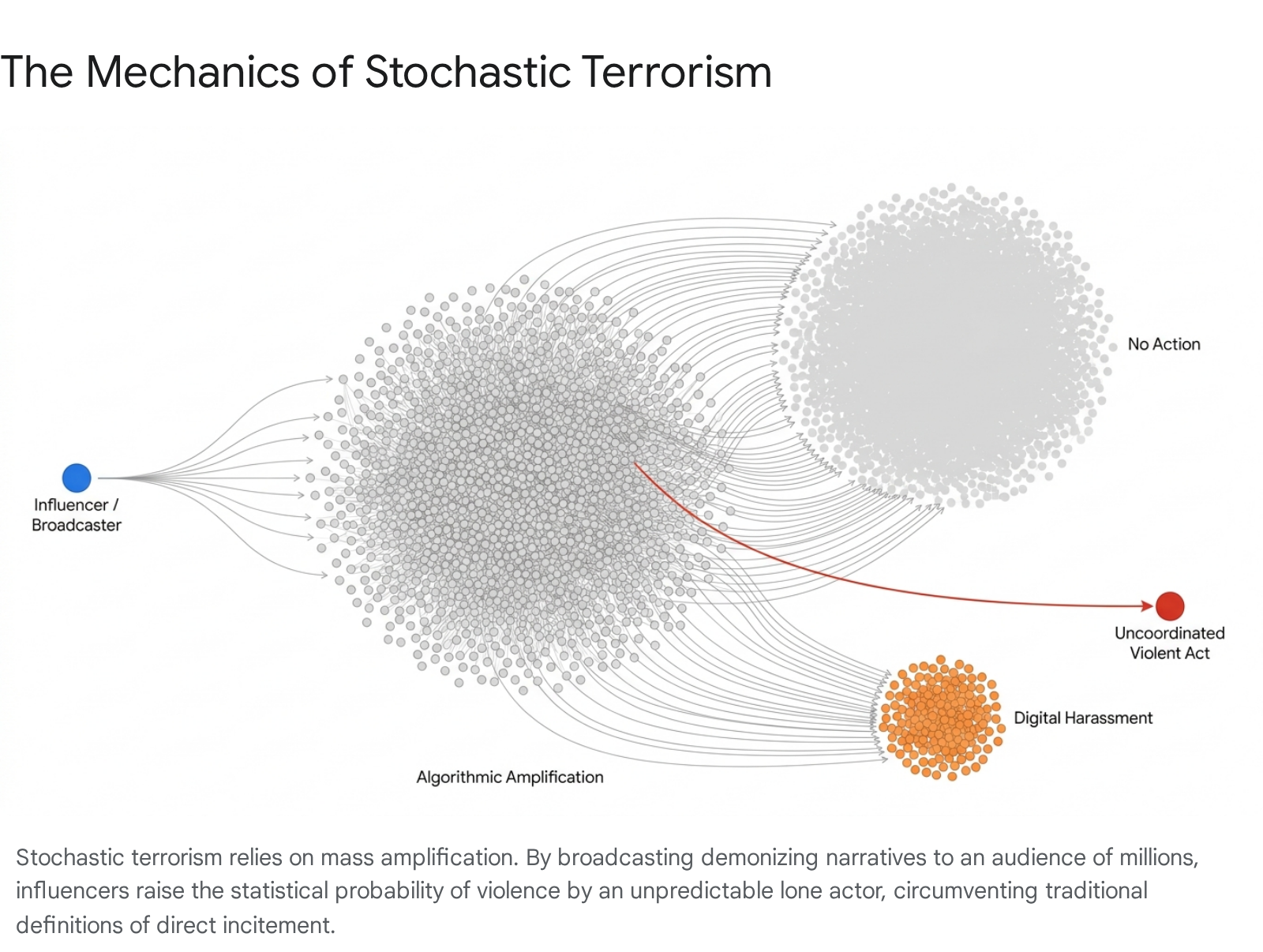
Stochastic terrorism refers to the use of mass communications to demonize an individual, group, or institution to such an extent that it predictably provokes random acts of ideologically motivated violence, even without direct coordination or explicit orders [cite: 42-45]. By repeatedly broadcasting dehumanizing conspiracy theories - such as framing political opponents as literal demons, or a minority demographic as an existential, invasive threat - to an audience of millions, the communicator effectively raises the statistical background risk of violence.
While the vast majority of the audience will merely consume the content or engage in non-violent digital harassment, the sheer volume of exposure makes an eventual violent act by a susceptible lone actor statistically probable 3940. The following flowchart illustrates this probabilistic dynamic.
Legal Distinctions from Direct Incitement
Stochastic terrorism represents a significant challenge for legal and security frameworks because it circumvents traditional thresholds for criminal incitement. In many Western legal doctrines (such as the Brandenburg v. Ohio standard in the United States), incitement requires the speaker to explicitly direct imminent, lawless action against a specific target 3840. Stochastic terrorism, by contrast, operates on plausible deniability. The speaker can claim they were merely engaging in hyperbolic political rhetoric or protected free speech, maintaining distance from the unpredictable, uncoordinated actions of the "lone wolf" perpetrator 41. This asymmetric dynamic allows highly influential figures to effectively weaponize unstable individuals against political targets without incurring direct legal liability.
Distinctions Between Ideological Radicalization and Psychopathology
When acts of politically or conspiratorially motivated violence occur, public and media discourse frequently defaults to explanations centered on psychopathology. However, the academic consensus firmly rejects the premise that mental illness is a primary, sweeping cause of radicalization or terrorism 4243.
Psychiatric Prevalence in Extremist Populations
Systematic reviews of radicalized populations establish that extremists, taken as a whole, are generally no more likely to suffer from severe mental illness than the general population 4445. In fact, members of highly organized, formal terrorist groups often exhibit lower rates of mental illness than the general public. Clandestine organizations actively screen out individuals whose instability, impulsivity, or impaired reality testing might compromise operational security and group cohesion 4243.
Attempting to explain the complex, multifaceted process of radicalization through the singular lens of a psychiatric diagnosis is highly reductive. Mental illness does not possess the ideological specificity required to target discrete political entities, nor does it account for the vast majority of non-violent individuals managing similar psychiatric conditions 4246. Evidence suggests that socio-economic variables, such as a history of criminal behavior or unemployment, are often stronger statistical predictors for group-based extremism than clinical psychopathology 45.
Psychosocial Profiles of Lone-Actor Extremists
While mental illness does not cause terrorism writ large, crucial distinctions emerge when stratifying extremists by their operational profile. Empirical studies consistently demonstrate a significantly higher prevalence of psychopathology among "lone-actor" terrorists compared to group-based actors, as highlighted in the data visualization below.
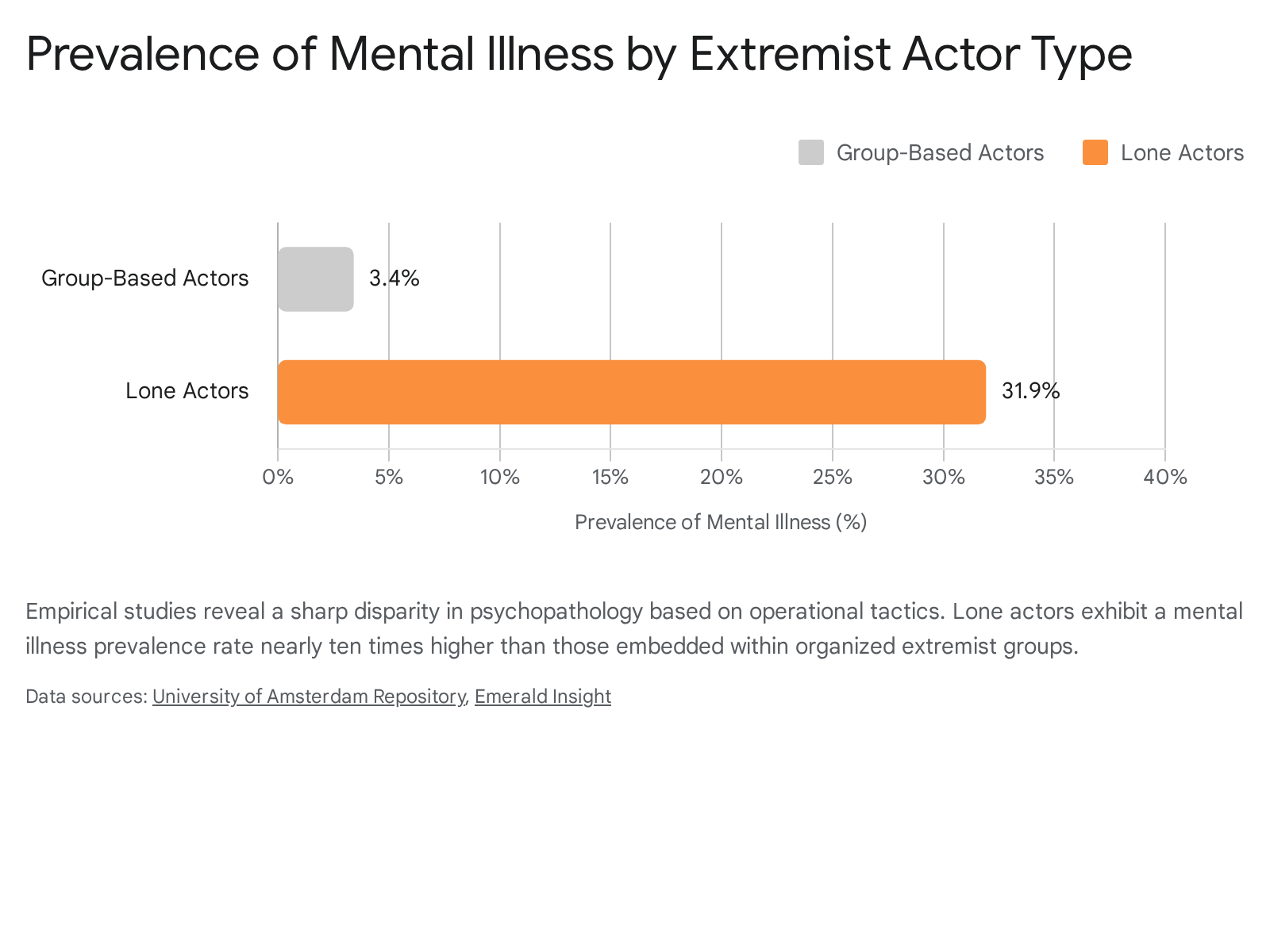
Lone actors - who often self-radicalize online without physical affiliation to an established group - report higher lifetime prevalence rates of specific disorders, notably schizophrenia, delusional disorders, and autism spectrum disorders, compared to both the general population and group actors 214647. In these specific sub-cohorts, psychological distress or neurodivergence may interact disastrously with social isolation, rendering the individual highly susceptible to the rigid, black-and-white certainty offered by online conspiracy theories 4448. Consequently, forensic mental health practitioners increasingly view clinical mental illness in these cases not as the primary genesis of the extremism, but as a critical vulnerability factor that amplifies susceptibility to toxic online narratives 4748.
| Offender Characteristic | Group-Based Extremists | Lone-Actor Extremists |
|---|---|---|
| Prevalence of Mental Illness | Extremely low (~3.4%), often lower than general population averages due to operational screening 4346. | Comparatively high (~31.9%), representing a significant vulnerability factor, though still a minority of the total cohort 4346. |
| Social Integration | High integration into a distinct subculture; reliant on strong peer networks and offline social bonds 342. | Characterized by high rates of social isolation, unemployment, and deep reliance on digital parasocial relationships 4245. |
| Ideological Coherence | Generally strict adherence to established organizational doctrines and strategic collective goals 49. | High tendency toward Composite Violent Extremism (CoVE); idiosyncratic blending of personal grievances with disparate ideologies 2326. |
Global Manifestations of Conspiracy-Driven Violence
The weaponization of conspiracy theories is a distinctly transnational phenomenon. While specific narratives heavily adapt to local historical and cultural contexts, the underlying mechanisms of algorithmic amplification and moral disengagement remain remarkably consistent across the globe.
Electoral Disinformation and Institutional Destabilization in Brazil
The destructive capacity of election-denial conspiracy theories was starkly demonstrated in Brazil during and after the 2022 presidential election. Former President Jair Bolsonaro and his political platform systematically cultivated a pervasive narrative termed the "Grand Collusion" [cite: 30-32]. This theory alleged that a vast network comprising the Brazilian Left, the Supreme Federal Court, and mainstream media was conspiring to manipulate the nation's highly reliable electronic voting system to ensure his defeat 5051.
Bolsonaro's digital campaigns utilized massive networks of bots and social media platforms to radicalize supporters, heavily mirroring the rhetoric and tactics of the 2020 US election denial movements 5052. This multi-year campaign of delegitimizing state institutions successfully activated the psychological mechanism of perceived government illegitimacy. When Bolsonaro was defeated, his supporters, viewing the democratic process as a fraudulent coup, established semi-permanent encampments outside military bases demanding intervention 5354. On January 8, 2023, this conspiratorial mobilization erupted into stochastic violence as thousands stormed and ransacked the Presidential Palace, Congress, and Supreme Court in Brasília 5053. The event underscored how state-level actors can weaponize disinformation to direct violence against democratic infrastructure.
Religious Conspiracism and Political Assassination in Japan
Japan has historically been viewed as relatively insulated from Western-style conspiracy extremism, yet recent events highlight significant underlying vulnerabilities. In July 2022, former Prime Minister Shinzo Abe was assassinated by Tetsuya Yamagami. The attacker was motivated by Abe's deep political ties to the Unification Church, a global religious sect founded in South Korea known for highly exploitative fundraising practices 5556. Yamagami's actions were solitary, but his underlying grievance regarding the covert, historical collusion between the ruling Liberal Democratic Party (LDP) and controversial religious organizations resonated with long-standing domestic suspicions 5556.
Simultaneously, Japan has experienced a rising tide of imported and hybridized conspiracy movements. "Yamato Q," a Japanese offshoot of the American QAnon movement, has successfully blended global deep-state conspiracies with anti-vaccine rhetoric and domestic spiritualism 57. In 2022, members of Yamato Q transitioned from online radicalization to direct action, resulting in arrests for invading and sabotaging COVID-19 vaccination clinics in Tokyo under the guise of protecting children from a globalist depopulation plot 57. Furthermore, historic xenophobic conspiracies continue to thrive online, particularly narratives targeting the Zainichi (ethnic Koreans in Japan), accusing them of secretly controlling the media and government to subjugate the native population 57.
Ethno-Religious Supremacy and Communal Violence in Asia
In South and Southeast Asia, disinformation and conspiracy theories are actively utilized to validate ethno-religious supremacy and incite widespread communal violence 5859. Given the region's massive youth demographic and rapid mobile internet penetration, digital platforms like WhatsApp, TikTok, and Facebook have become volatile accelerators for extremism 365859.
In India, Hindu nationalist movements frequently utilize social media to amplify the "Love Jihad" conspiracy theory, which alleges a highly coordinated Islamic plot to seduce and convert Hindu women to systematically alter the nation's demographics 60. This narrative has been directly linked to widespread vigilantism and lethal mob violence against the Muslim minority 60. Similar dynamics exist in Sri Lanka and Myanmar, where Buddhist extremist groups - such as the Bodu Bala Sena (BBS) and the 969 Movement - have systematically propagated rumors via social media claiming that Muslim populations are conspiring to eradicate Buddhism through economic monopolization and higher birth rates. These coordinated disinformation campaigns have repeatedly precipitated deadly riots, state-sanctioned persecution, and the burning of minority businesses 5960. In Indonesia, digital pathways have accelerated radicalization toward jihadist groups like Jamaah Ansharut Daulah (JAD), bypassing traditional offline indoctrination entirely and facilitating plots by radicalized youth 366162.
Agricultural Protests and Far-Right Co-optation in Europe
Throughout 2023 and 2024, significant farmer protests erupted across the European Union, initially driven by legitimate socioeconomic grievances. These included low wholesale prices, inflation, unfair trade competition from non-EU imports, and the bureaucratic burdens of EU environmental regulations (such as stringent nitrate emissions targets) 6364.
However, these organic protests were quickly co-opted in the digital sphere by far-right political entities (e.g., the AfD in Germany and Rassemblement National in France) and transnational conspiracy networks 6566. Independent fact-checking networks identified a massive influx of disinformation surrounding the protests, specifically narratives alleging that the EU was intentionally destroying agricultural infrastructure to force the population to consume synthetic, lab-grown meat or insects as part of a globalist control mechanism 6566. This deliberate mapping of a genuine economic dispute onto a broader "Great Reset" conspiracy framework served to obscure the farmers' actual policy demands, instead channeling agrarian frustration into a generalized, radicalized hostility toward climate action and European democratic institutions 66.
Strategies for Preventing and Countering Violent Extremism
As the mechanisms of radicalization have evolved from physical organizational recruitment to decentralized digital immersion, strategies for Preventing and Countering Violent Extremism (P/CVE) must adapt accordingly. Security-dominated, punitive approaches are insufficient for addressing the deep sociological and psychological roots of conspiracy-driven extremism 6768.
Public Health Approaches and Cognitive Inoculation
Contemporary P/CVE frameworks increasingly advocate for a "public health" approach to extremism 2036. Rather than solely targeting individuals who are already mobilizing toward violence, this model focuses on primary and secondary prevention by building community-wide resilience against manipulative narratives 68.
A highly promising psychological intervention is "attitudinal inoculation" (frequently termed "prebunking"). Drawing on epidemiological concepts, inoculation theory suggests that exposing individuals to weakened, deconstructed forms of extremist logic and disinformation tactics before they encounter the actual propaganda builds cognitive resistance 536. By educating populations on how conspiracy theories manipulate fear, exploit confirmation bias, and deploy logical fallacies, practitioners can reduce the efficacy of the narrative, closing the cognitive opening before radicalization can take root. Furthermore, effective P/CVE programs must develop localized counter-narratives that acknowledge genuine societal grievances without validating conspiratorial conclusions, providing vulnerable youth with alternative, non-violent avenues to achieve a sense of significance and community belonging 2036.
Platform Regulation and Algorithmic Auditing
Addressing the supply side of extremism requires direct, sustained intervention in the digital infrastructure that amplifies it. Voluntary self-regulation by technology companies has consistently proven insufficient due to the fundamental misalignment between public safety imperatives and engagement-driven corporate business models.
Legislative frameworks are shifting away from relying on platforms to moderate individual posts toward mandatory algorithmic accountability. The European Union's Digital Services Act (DSA), fully applicable in 2024, represents the most comprehensive effort to date. The DSA legally mandates that "Very Large Online Platforms" (VLOPs) conduct rigorous, independent risk assessments to determine how their recommendation algorithms might amplify systemic societal risks, including civic discourse manipulation, election interference, and the spread of illegal hate speech 3133. Similarly, the UK's Online Safety Act imposes duties of care regarding algorithmic design 31. Future global regulatory efforts must focus on auditing and restricting the automated amplification mechanics that transform fringe conspiracies into mass-market radicalization funnels, ensuring that platforms share accountability for the stochastic violence their systems facilitate 303369.
Conclusion
The radicalization of individuals via conspiracy theories is a multi-dimensional threat that transcends traditional geographic and ideological boundaries, driven heavily by the architecture of the modern digital ecosystem. Exploiting the innate human need for significance, vulnerable individuals are drawn into digital networks that provide clear, albeit fabricated, narratives of existential conflict. Through the well-documented psychological mechanisms of moral disengagement and dehumanization, the fundamental taboo against violence is systematically dismantled. This cognitive trajectory is vastly accelerated by social media algorithms designed to optimize engagement through outrage, resulting in an environment conducive to stochastic terrorism, where mass demonization guarantees eventual, uncoordinated violence. Addressing this escalating global threat requires a profound paradigm shift: moving beyond reactive counter-terrorism tactics toward proactive public health strategies, cognitive inoculation, and stringent, international regulatory oversight of the algorithmic amplification systems that facilitate modern extremism.