
Cognitive impacts of artificial intelligence on human expertise
The integration of artificial intelligence into professional and educational workflows has accelerated a shift in how human beings interact with information, solve complex problems, and acquire specialized skills. While earlier technological milestones, such as calculators and search engines, automated discrete computational or retrieval tasks, the advent of large language models and generative artificial intelligence introduces a qualitatively different dynamic 123. Modern artificial intelligence systems are capable of mimicking higher-order cognitive functions, including analytical reasoning, code generation, and complex qualitative synthesis 31. Consequently, an extensive body of research has emerged regarding the long-term impact of these tools on human capital, specifically concerning the risk of cognitive deskilling - the atrophy of foundational human capabilities due to an overreliance on automated systems 23459.
Foundational Mechanisms of Human Learning
The biological foundation of human learning and skill acquisition is neuroplasticity, the brain's inherent capacity to reorganize itself by forming and pruning neural connections in response to environmental demands, repeated experiences, and sustained cognitive effort 61112. The human brain constantly remodels its physical architecture based on the principles of use-dependent plasticity 6.
Neuroplasticity and Memory Formation
When cognitive tasks are repeatedly offloaded to external devices, the neural pathways traditionally engaged by those tasks undergo structural changes, often weakening through a process known as synaptic pruning or competitive plasticity 6127. Long-term potentiation, the strengthening of synapses through repeated and focused activity, is a primary mechanism behind functional neuroplasticity 12. Key anatomical areas, such as the hippocampus, which is crucial for memory formation, and the prefrontal cortex, which governs executive decision-making and self-regulation, continually remodel based on human action and environmental stimuli 12. Brain-derived neurotrophic factor supports this neural growth, while dopamine facilitates learning through reward-based feedback 12.
However, studies utilizing functional magnetic resonance imaging and electroencephalography indicate that interactions with highly automated systems can fundamentally alter these activation patterns. For instance, electroencephalography analysis during human interactions with machine learning tools has revealed significantly reduced neural engagement, characterized by suppressed alpha and beta brain connectivity 1. When artificial intelligence is heavily utilized for problem-solving, specific brain regions associated with memory formation, analytical reasoning, and creative thinking show diminished activation 8. Extended reliance on artificial intelligence systems appears to reduce activity in prefrontal regions associated with executive control and working memory maintenance, while simultaneously increasing cognitive load in areas that manage task-switching 5.
Desirable Difficulties and Deliberate Practice
Cognitive science establishes that expertise is not formed through the passive reception of information but through "desirable difficulties" - conditions that introduce friction into the learning process, making it feel harder and less efficient in the short term, but ultimately yielding durable long-term retention and mastery 791011. The acquisition of expert performance relies heavily on deliberate practice, a framework defined by focused effort, rigorous error correction, explicit goal-directed activities, and iterative refinement 111819.
Neuroscience identifies an optimal challenge level for effective learning, often referred to as the "Eighty-Five Percent Rule," which suggests that learning is maximized when individuals achieve approximately 85% accuracy during practice, thereby balancing productive struggle with cognitive overload 10. When artificial intelligence systems remove this friction by instantly providing polished outputs, they can inadvertently eliminate the productive struggle necessary for skill consolidation and the formation of robust neural engrams 91020. Research indicates that achieving an astonishingly high-quality result with minimal user effort weakens the causal link between the outcome and the user's internal skill development 7. Over time, the brain learns to pursue the affective reward of task completion while bypassing the rigorous cognitive work required to build authentic competence, leading to a phenomenon where tasks feel artificially easy and deep learning subsequently shuts down 7.
The Theory of Cognitive Offloading
The psychological framework defining this phenomenon is "cognitive offloading," defined as the reliance on external environmental scaffolding to reduce the cognitive demand of a task 1239. While offloading can effectively manage cognitive load and free up mental resources for higher-order strategic thinking, excessive offloading transforms artificial intelligence from a learning scaffold into a permanent substitute or cognitive crutch 912. Extended cognitive offloading frequently results in "metacognitive laziness," where the automation of analytical tasks reduces the user's inclination to engage in deliberate, independent reasoning 123. This dynamic is further compounded by automation bias, the psychological tendency to trust machine or algorithmic outputs over independent human judgment, even when the human user possesses contradictory specialized knowledge 359.
Historical Precedents in Technology Integration
The study of cognitive offloading and its subsequent impact on skill retention is not a novel pursuit. Previous technological shifts provide measurable historical precedents that illuminate the potential trajectory of the current artificial intelligence transition.
Spatial Memory and Navigation Assistance
The ubiquitous adoption of the Global Positioning System serves as a heavily researched analog for technological deskilling. Prior to pervasive digital navigation, spatial knowledge acquisition relied heavily on the development of internal cognitive maps, a process intrinsically linked to increased hippocampal volume 113. Studies utilizing virtual navigation tasks, such as the Concurrent Spatial Discrimination Learning Task and the 4-on-8 virtual maze, demonstrate that individuals with greater lifetime experience using the Global Positioning System exhibit diminished spatial memory and reduced cognitive mapping abilities when forced to navigate without digital assistance 123.
Longitudinal research further isolated the causal direction of this phenomenon. A follow-up assessment conducted three years after initial testing observed that increased reliance on digital navigation correlated with a steeper decline in hippocampal-dependent spatial memory 23. Crucially, participants who used navigational assistance extensively did not do so because they inherently possessed a poor sense of direction; rather, the extensive use of the technology actively induced the cognitive decay 23. Further assessments of long-term spatial memory retention, conducted two years after a single map-aided navigation episode, confirmed that increased reliance on navigational aids directly predicted poorer spatial memory for distances 24.
Orthographic Mapping and Automated Correction
The widespread adoption of spell-check and autocorrect technologies provides a second distinct historical precedent. Research indicates that frequent reliance on these automated editing tools can measurably impact literacy development and orthographic mapping 142615. Orthographic mapping is the cognitive process that enables the reading brain to store visual images of correctly spelled words in long-term memory, allowing for automatic retrieval during encoding and decoding 14.
When automated tools circumvent these cognitive processes, students are hindered from developing a large internal repository of correctly spelled words 1426. A 2021 study revealed that students who utilized spell-check frequently demonstrated reduced attention to word structure and proofreading, inherently trusting the tool to fix structural issues 26. This dynamic builds passive learners who miss the opportunity to internalize transferable linguistic rules and morphological structures 26. Furthermore, a 2024 academic study measuring the impact of mobile auto-correction tools on first-year Master's students of English linguistics revealed an increase in orthographic and cross-linguistic errors during post-tests where the technology was restricted, indicating that while the tools aided immediate task completion, they fostered long-term dependency and skill diminishment 15.
The Distinct Scale of Generative Automation
While the erosion of spatial navigation and arithmetic fluency provides clear historical parallels, researchers emphasize a critical qualitative distinction regarding modern generative artificial intelligence. Tools like calculators and digital spreadsheets were designed to assist in specific, bounded tasks without fundamentally altering human information processing; users were still required to understand the underlying formulas, the logic of the problem, and the desired output 23. Calculators substituted computational ability, the Global Positioning System substituted spatial cognition, and search engines substituted memory retrieval 3. In contrast, large language models target a substantially broader spectrum of cognitive domains, effectively attempting to substitute the core processes of reasoning, creative synthesis, and critical thinking 31.
Artificial Intelligence and Professional Skill Erosion
The theoretical risks of cognitive offloading are currently materializing as measurable skill erosion across multiple high-stakes professional sectors. The deployment of generative models in these domains reveals a consistent paradox: short-term productivity gains and rapid task completion frequently mask the long-term decay of foundational competencies.
Software Engineering and Mental Model Atrophy
In the field of software development, artificial intelligence coding assistants have gained rapid and widespread adoption. These tools enable junior developers to generate functional code at unprecedented speeds, significantly accelerating product delivery 16. However, this automation has led to a documented rise in what developer communities term "vibe coding" - a phenomenon where functional code is rapidly generated without the developer possessing the underlying structural understanding necessary to maintain, scale, or debug it 16.
This dynamic causes an erosion of the "mental model of the system." Mental models in software engineering encompass more than basic syntax knowledge; they include deep system architecture understanding, debugging intuition, and the ability to predict code behavior across service boundaries 1629. When cognitive work is offloaded to automated generation, developers miss critical opportunities to practice breaking down complex problems into manageable components, leading to severe architectural blindness 16.
Rigorous empirical evidence supports these industry observations. A 2026 randomized controlled trial conducted by Anthropic evaluated 52 relatively junior software engineers attempting to learn Trio, an asynchronous Python programming library previously unfamiliar to all participants 303117. The experimental cohort was granted access to an artificial intelligence assistant, while the control group coded manually. The study revealed that developers utilizing artificial intelligence scored 17% lower on subsequent comprehension tests encompassing debugging, code reading, and conceptual understanding, averaging 50% compared to the control group's 67% 303117. Notably, the assisted group finished the task only approximately two minutes faster, a minor efficiency gain that failed to reach statistical significance 303117.
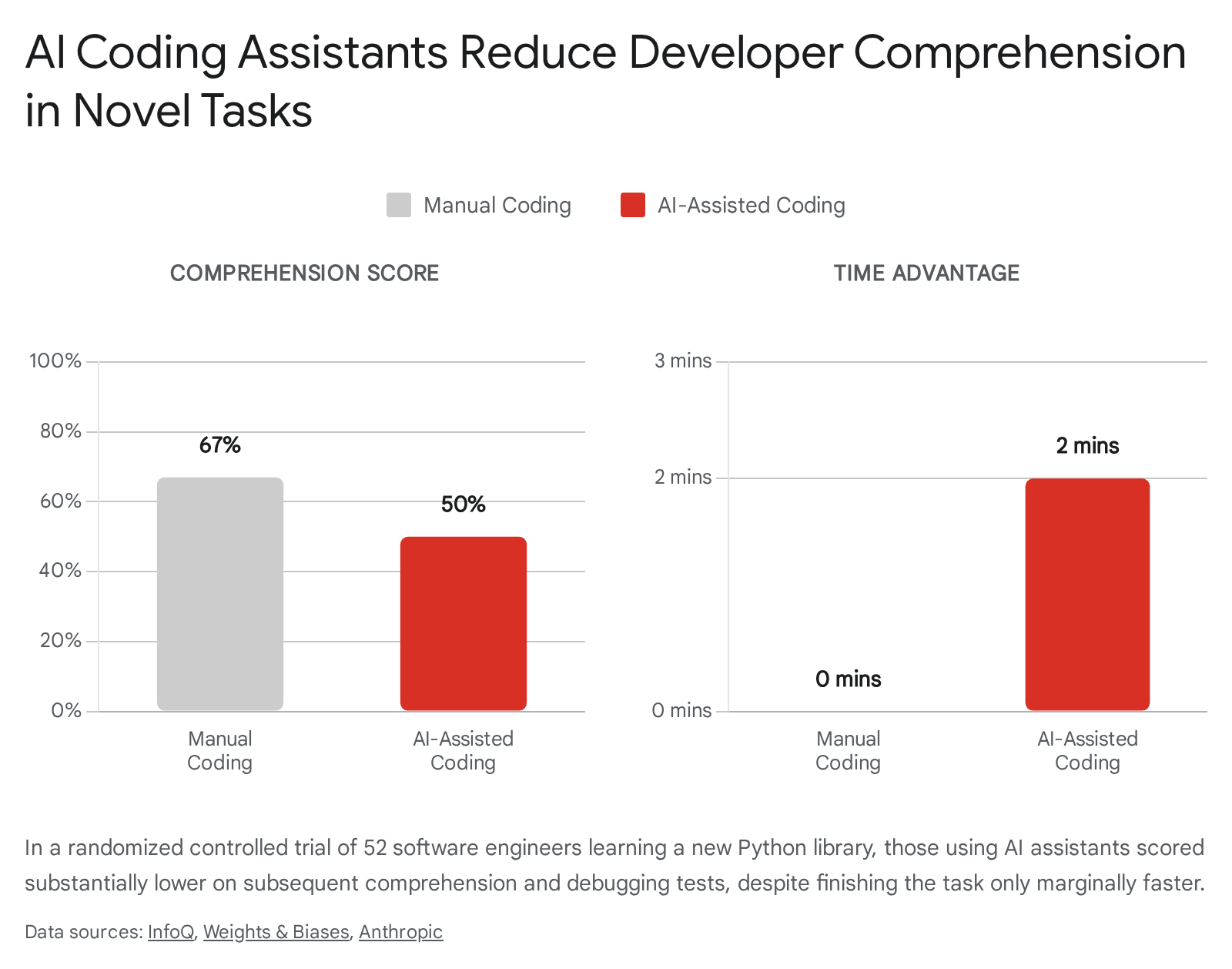
The largest performance deficit was observed in debugging questions, indicating that reliance on automated generation explicitly impairs the ability to identify why code fails and how to resolve unexpected errors 3117.
Medical Diagnostics and Epistemic Sclerosis
In the healthcare sector, the integration of advanced decision-support systems introduces severe risks regarding clinical competency and diagnostic deskilling. Diagnostic deskilling manifests when persistent reliance on automated recommendations diminishes the frequency, independence, and depth of a clinician's own hypothesis generation and hypothesis testing 53334.
A highly illustrative 2025 study published in The Lancet Gastroenterology & Hepatology observed endoscopists operating across four medical centers in Poland 18. The research tracked experienced physicians utilizing an artificial intelligence tool designed to detect potentially cancerous colorectal polyps. The findings demonstrated that after only three months of algorithm assistance, the experienced endoscopists became significantly less adept at independently identifying the lesions when required to perform the procedure without technological support 331819. The measurable degradation of baseline clinical skills persisted even when researchers controlled for external variables 33. Furthermore, studies focusing on automation bias demonstrate that when artificial intelligence systems present incorrect diagnostic predictions, the accuracy rate of inexperienced practitioners can plummet from nearly 80% down to roughly 20%, while veteran doctors experience a drop from 82% to 45% 3.
Beyond individual capability erosion, the systemic overreliance on medical algorithms introduces the threat of "epistemic sclerosis," defined as the gradual ossification of medical knowledge 33. As artificial intelligence systems persistently reinforce existing diagnostic patterns and established norms, they risk freezing medical knowledge in time. To innovate and identify novel pathologies, human physicians must retain the cognitive capacity to challenge prevailing wisdom and detect anomalies that do not conform to historical patterns 33.
Legal Practice and the Foundational Apprenticeship
The legal profession faces parallel structural challenges regarding its traditional apprenticeship model of expertise acquisition. Historically, junior lawyers developed their legal instincts, drafting precision, and case law comprehension through thousands of hours of repetitive document review, contract analysis, and brief writing 202139. Modern legal technology, including specialized platforms like CoCounsel and Lexis+AI, is rapidly automating these foundational, time-consuming tasks 2139. Research by Goldman Sachs in 2023 estimated that 44% of legal work could be undertaken by automated systems, severely impacting the traditional training ground for junior associates 39.
A 2026 Mentorship Gap report by LexisNexis, which surveyed nearly 900 United Kingdom lawyers, highlighted the complex reality of this transition. While 58% of respondents acknowledged that artificial intelligence accelerated their output, an overwhelming 72% identified deep legal reasoning and complex argumentation as an accelerating skills gap among junior lawyers 20. Furthermore, 69% noted dangerously weak verification and source-checking abilities among the junior cohort 20. The rapid generation of legal text allows associates to bypass the intellectual rigor of legal interpretation, risking a profound deficit in their ability to apply nuanced legal reasoning to unprecedented situations 2021.
Consequently, the profession is experiencing a fundamental structural pivot. The role of the junior lawyer is necessarily shifting away from the repetitive drafting of text toward operational, technical, and strategic evaluation. Firms are exploring new hybrid positions, such as "AI compliance specialists" and legal data analysts, who are tasked with evaluating the validity, ethical boundaries, and strategic alignment of machine-generated outputs rather than producing the initial drafts from scratch 22.
Theoretical Frameworks for Human-Machine Collaboration
Understanding the exact boundary between beneficial productivity enhancement and harmful cognitive deskilling requires robust theoretical frameworks. Researchers are increasingly applying established cognitive and educational models to the human-machine interaction paradigm to standardize the assessment of these emerging technologies.
The Dreyfus Model of Skill Acquisition
The Dreyfus Model of Skill Acquisition provides a critical analytical lens for evaluating how technological intervention impacts professional development. Created by Stuart and Hubert Dreyfus, the framework charts the progression of human learning through five distinct stages: Novice, Advanced Beginner, Competent, Proficient, and Expert 23242526. The impact of artificial intelligence varies drastically depending on the user's baseline stage within this model, dictating whether the technology functions as a beneficial scaffold or a detrimental substitute.
| Dreyfus Stage | Learner Characteristics | Impact of AI Reliance |
|---|---|---|
| 1. Novice | Relies strictly on context-free rules and explicit step-by-step instructions. Lacks discretionary judgment 232425. | High Risk. If AI provides immediate solutions, novices bypass the foundational struggle to learn basic rules. AI must act strictly as a guided tutor rather than an answer generator 71229. |
| 2. Advanced Beginner | Begins recognizing situational nuances and applying experience-based maxims, but still struggles to prioritize complex information 232445. | Moderate Risk. While AI can assist with pattern recognition, overreliance prevents the internal mapping of independent problem-solving strategies, leading to superficial competency 1645. |
| 3. Competent | Capable of independent troubleshooting, goal planning, and selecting approaches based on a holistic understanding of the context 232445. | Neutral/Beneficial. AI highly accelerates standard workflows. The user possesses enough baseline knowledge to verify outputs, though they remain vulnerable to automation bias if rushed 3926. |
| 4. Proficient | Intuitively grasps complex situations and makes rapid decisions based on deep experiential maxims and situational discriminations 232445. | Highly Beneficial. AI serves as a powerful accelerator. Proficient users leverage the technology to explore alternative edge cases and optimize execution, easily identifying logical errors or hallucinations 2924. |
| 5. Expert | Demonstrates seamless integration of perception and action. Operates as a primary source of domain knowledge and intuition 2345. | Transformative. AI functions as a sophisticated analytical instrument. Experts dictate the overarching strategy and utilize the system for massive-scale execution without suffering deskilling 292445. |
For individuals at the Novice and Advanced Beginner stages, independent practice devoid of excessive automated assistance is essentially non-negotiable for long-term development. If a junior professional utilizes artificial intelligence to entirely bypass the rigorous competence-building phases, they achieve a highly fragile facade of productivity without acquiring the underlying structural knowledge required to reach true proficiency 121626.
Task Automation versus Cognitive Deskilling
Within professional literature, a clear taxonomy differentiates the acceptable parameters of artificial intelligence usage.
- Task Automation refers to the intentional delegation of routine, high-volume, or computationally demanding processes to artificial intelligence. This practice successfully manages cognitive load, frees up human mental resources for higher-order strategic thinking, and vastly accelerates productivity without degrading the user's core specialized expertise 3446.
- Cognitive Deskilling refers to the gradual erosion of fundamental analytical, diagnostic, or creative skills due to continuous, unmitigated cognitive offloading. This deterioration occurs when users delegate the actual internal processes of reasoning, hypothesis generation, and critical evaluation to the machine 23459.
The transition from beneficial automation to deskilling generally hinges on the user's interactive intent. A 2023 joint study by Harvard Business School and Boston Consulting Group analyzed 758 consultants and identified highly distinct collaboration archetypes. The "Centaur" approach features a clear division of roles between human and machine, while the "Cyborg" approach fully integrates the technology across complex tasks 3. However, researchers found that over 25% of participants exhibited "Self-Automator" behavior - fully delegating tasks to the artificial intelligence and stepping back entirely. While these self-automators experienced rapid short-term productivity gains, the fundamental foundation of their expertise was actively eroding 3.
System-Level Thinking and Orchestration
As artificial intelligence systems increasingly assume responsibility for discrete, task-level execution - such as writing specific code blocks, drafting standard commercial contracts, or generating preliminary lesson plans - the human cognitive imperative shifts upward 47484927. Future professional expertise will depend not on the manual execution of singular tasks, but on complex "system-level thinking" 47484927.
Research conducted by scholars at the Massachusetts Institute of Technology Sloan School of Management argues that the true economic and functional value of artificial intelligence emerges not from localized task automation, but from the radical redesign of entire workflows 28. Work fundamentally occurs as sequences of interdependent, chained tasks. Accordingly, human professionals must transition from isolated production to broad orchestration 28.
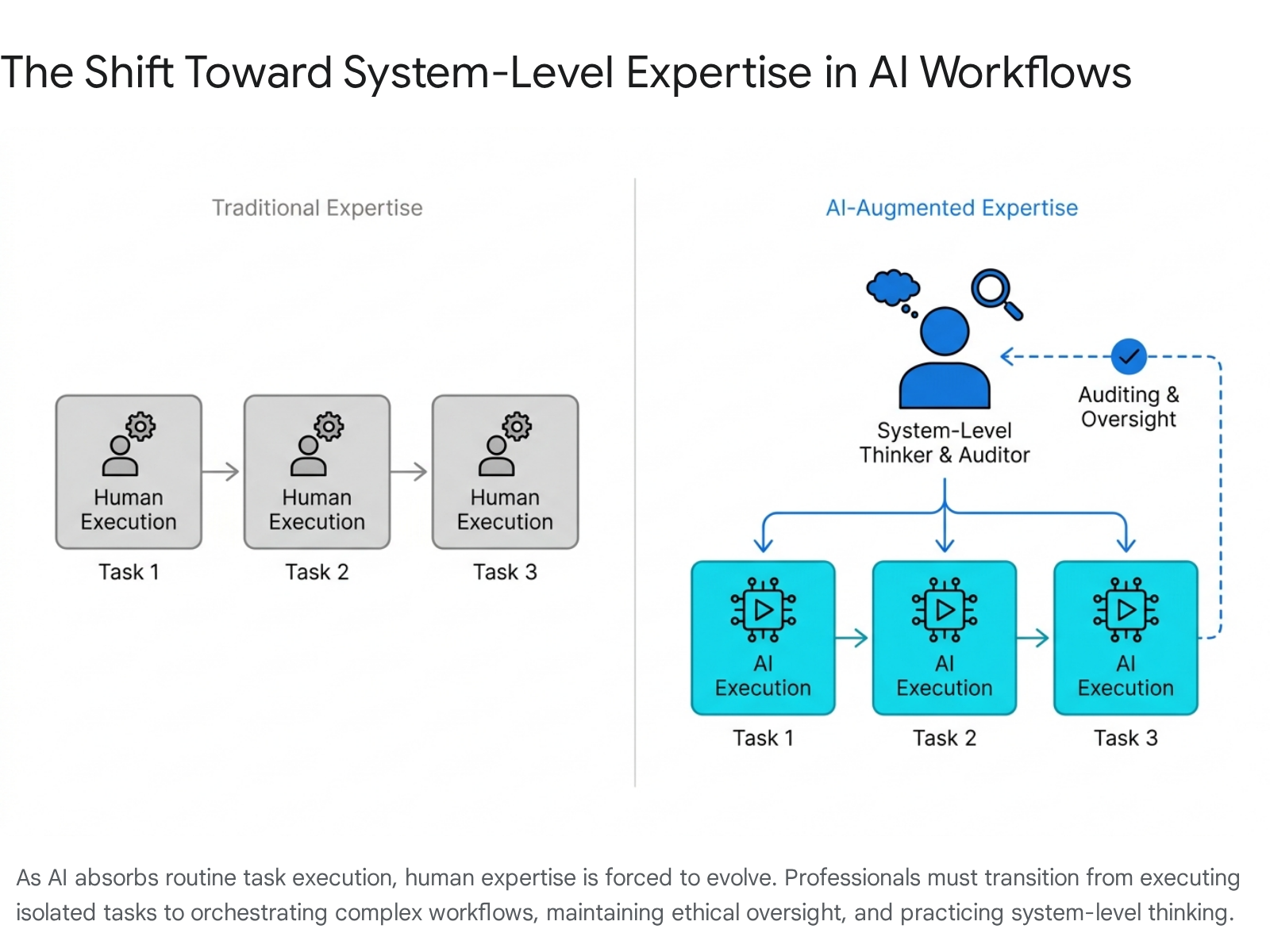
This paradigm shift necessitates an advanced capacity to evaluate complex data architectures, understand the adjacency of various tasks, integrate machine outputs across interconnected systems, and rigorously audit algorithmic decisions for ethical alignment, privacy compliance, and factual grounding 482829. Professional training programs and continuous education initiatives must therefore pivot from teaching isolated technical syntax to fostering algorithmic literacy, rigorous artificial intelligence auditing, and dynamic workflow management 474853.
Standardized Metrics and Capability Indicators
To navigate this systemic transition, international bodies are developing standardized frameworks to quantify the evolving relationship between human skill and machine capability. In June 2025, the Organisation for Economic Co-operation and Development (OECD) introduced the AI Capability Indicators framework, designed to help policymakers and researchers assess the progress of automated systems against a spectrum of human abilities 5430.
The OECD framework establishes a five-level scale across nine distinct categories, including Language, Social Interaction, Problem Solving, Creativity, Vision, and Metacognition, mapping progression toward full human equivalence 5430. Level 1 represents basic rule-based capabilities, while Level 5 denotes the most challenging capabilities involving open-ended, adaptive reasoning.
| OECD AI Capability Category | Level 1 Characteristics | Level 5 Characteristics | Current Assessed Capability (2025) |
|---|---|---|---|
| Language | Basic keyword recognition. | Contextually aware discourse generation and open-ended creative writing. | Level 3: Reliable understanding and generation of semantic meaning using multi-modal language 54. |
| Problem Solving | Rule-based, rigidly structured task execution. | Adaptive reasoning in novel scenarios, long-term planning, and multi-step inference. | Level 2: Integration of qualitative and quantitative reasoning to address complex problems, handling multiple states 54. |
| Social Interaction | Basic interpretation of discrete social cues. | Sophisticated emotional intelligence and multi-party conversational fluency. | Level 2: Basic social perception, limited social memory, and adaptation based on experience and detected tone 54. |
By quantifying the exact threshold of machine capability, organizations can better design educational and professional roles that leverage uniquely human traits - such as Level 5 multi-step inference and social empathy - that automated systems cannot reliably replicate, thereby insulating the workforce from total obsolescence and systemic deskilling 543132.
Educational Policy and Strategic Responses
Recognizing the profound duality of generative artificial intelligence - its unprecedented potential for massive economic empowerment alongside its inherent capacity to induce systemic cognitive deskilling - global education ministries and international bodies have aggressively begun formulating regulatory frameworks and curriculum mandates. These approaches reveal a philosophical divide between centralized industrial strategies prioritizing rapid workforce scaling and decentralized models prioritizing ethical oversight, equity, and market-driven experimentation.
Centralized Curricula and Industrial Scaling in Asia
Several Asian nations exhibit a rapid, top-down integration of artificial intelligence into their educational systems, heavily focused on securing long-term economic dominance and industrial capacity, albeit with growing institutional reservations regarding the cognitive side effects on younger populations.
The Chinese strategy is characterized by a highly centralized, state-mandated approach aimed at achieving absolute global artificial intelligence leadership by 2030 3360. As early as 2018, the Chinese Ministry of Education began rolling out standardized artificial intelligence curricula across primary and secondary schools, focusing heavily on computational logic, data handling, and project-based engineering 63. However, the state is acutely aware of the risks associated with cognitive offloading. In 2025, the Ministry issued strict new guidelines explicitly prohibiting primary school students from independently utilizing generative artificial intelligence tools for open-ended assignments 34. The policy mandates that middle and high school students may only use the technology for inquiry-based learning and structural analysis, enforcing rigid guardrails to ensure the tools complement rather than replace human-led cognitive development and critical thinking 3435.
South Korea initially adopted a similarly aggressive posture, announcing an ambitious mandate to introduce artificial intelligence-powered digital textbooks across core subjects - including mathematics, English, and computer science - starting in March 2025 3668. These personalized platforms were designed to dynamically adjust lesson pacing, provide real-time analytical feedback, and free educators from routine grading to focus on mentorship 3668. However, this highly publicized rollout encountered severe political and social headwinds. Intense pushback from parents and teaching unions regarding excessive screen time, data privacy concerns, the potential for deep technological dependency, and widespread feelings of pedagogical unreadiness effectively stalled the initiative 69. By mid-2025, usage rates hovered below 30% nationwide, forcing the government to adopt a significantly slower, more deliberate integration timeline 69.
Singapore uniquely balances its aggressive national technological initiatives with a highly localized awareness of deskilling risks. The Ministry of Education's EdTech Masterplan 2030 emphasizes a pedagogy-first approach that explicitly aims to "minimize cognitive offloading" within its national Student Learning Space platform 3738. By implementing strict systemic guardrails in early education and subsequently introducing mandatory "AI-free periods" in advanced professional domains like the National University Health System, Singapore deliberately focuses on augmenting existing expertise rather than supplanting the human cognitive baseline 181937.
Regulatory Safeguards in the European Union
The European approach heavily emphasizes ethical oversight, the preservation of human dignity, and strict categorical risk management over unfettered market deployment. The landmark European Union Artificial Intelligence Act, fully enforceable by 2026, transforms voluntary ethical guidelines into a binding legal framework that establishes education as a special-protection domain 394075.
Under the Act, educational artificial intelligence systems utilized for critical administrative or pedagogical functions - such as determining academic admissions, evaluating learning outcomes, grading, or tracking student behavior - are explicitly classified as "high-risk" 394076. This designation demands rigorous transparency, mandatory post-market monitoring, continuous risk assessments, and guaranteed human oversight to prevent algorithmic bias and discrimination 4076. Crucially, the legislation outright prohibits the use of emotion-inference systems within educational institutions, banning tools that attempt to detect a pupil's stress, attention, or engagement via biometric data, unless strictly required for specific medical or safety reasons 394076. The Council of the European Union has further stressed that artificial intelligence tools must be designed to support the professional autonomy of educators, rather than reducing teachers to mere administrative supervisors of automated systems 7677.
Decentralization and Equity in the United States
In stark contrast to centralized national mandates, the United States relies on a highly decentralized, bottom-up approach characterized by piecemeal adoption led by individual states, local school districts, universities, and private tech corporations 336063. This market-driven model rapidly fosters elite innovation hubs but presents severe risks regarding educational equity 3363.
While the U.S. Department of Education issued 2025 guidance encouraging the use of federal grant funds to responsibly integrate artificial intelligence into classroom instruction and career pathway exploration, there remains no unified national curriculum 3341. Education researchers warn that this fragmented policy landscape risks drastically exacerbating the digital divide. Wealthier, well-resourced districts are able to rapidly adopt premium tools and provide extensive algorithmic literacy training, while rural and under-resourced schools fall further behind due to systemic teacher shortages and infrastructural deficits 63. Consequently, a disjointed rollout threatens to leave significant portions of the student population lacking the essential system-level thinking and digital fluency required to compete in a highly automated future labor market 3363.
Institutional Mitigation Strategies and Guardrails
To harness the capabilities of generative algorithms without sacrificing the human cognitive foundation, institutions are beginning to shift from unconstrained technology adoption to deliberate "cognitive redistribution" - the intentional reallocation of cognitive work that offloads lower-yield, routine tasks to machines while fiercely protecting and exercising the domains of human judgment, empathy, critical analysis, and structural learning 20.
Mitigating cognitive deskilling requires structural, evidence-based interventions at both the organizational and classroom levels. Research demonstrates that unconstrained access to generative models frequently yields negative long-term learning outcomes. A notable randomized controlled trial conducted in a Turkish high school compared students utilizing a baseline generative model (a standard chatbot interface) against those using a "tutor" model engineered with specific learning guardrails, such as hinting and scaffolding 7. While both groups showed massive performance surges during the assisted practice phase, the subsequent unassisted exam revealed that students who relied on the unguarded baseline tool actually performed 17% worse than the control group that received no artificial intelligence assistance at all 7. The guarded tutor condition successfully mitigated this damage by forcing the students to engage in the computational steps necessary for memory encoding 7.
To prevent systemic deskilling, organizations must design tools as "guarded tutors" rather than "completion engines," intentionally designing desirable difficulties back into the workflow 710. Furthermore, professional sectors must enforce mandatory unassisted practice - similar to the medical sector's AI-free periods - ensuring that junior professionals continually build the independent cognitive architecture required to audit, verify, and ultimately govern the automated systems they deploy 18192021.
Future Trajectories of Human Expertise
The intersection of artificial intelligence and human cognition represents a critical inflection point for global workforce development. The brain's inherent neuroplasticity dictates that our physical cognitive architecture will inevitably adapt to the digital tools we utilize 612. If artificial intelligence is deployed merely to bypass the productive struggle inherent in learning and complex problem-solving, human expertise will inevitably hollow out, producing a workforce capable of operating advanced systems but functionally incapable of understanding, debugging, or strategically evolving them.
Conversely, if artificial intelligence is systematically governed to challenge human assumptions, accelerate vast data synthesis, and eliminate administrative burdens, it possesses the profound potential to elevate human cognition. By carefully mitigating the risks of cognitive offloading and diagnostic deskilling, society can redirect human capital toward unprecedented levels of strategic, system-level orchestration, ensuring that technological advancement amplifies rather than erodes the foundational elements of human expertise.