
Generative AI and New Models of Educational Assessment
Introduction to the Assessment Crisis
The rapid integration of generative artificial intelligence (GenAI) into global academic workflows marks a critical inflection point for higher education, effectively dismantling decades-old assumptions regarding student evaluation, knowledge production, and academic integrity 1. Between 2023 and 2026, educational technology moved decisively beyond incremental digitization, introducing systems capable of mimicking high-level cognitive tasks, synthesizing scientific literature, and producing polished academic prose. This widespread availability of GenAI has created an environment where traditional, product-focused assessments are inherently vulnerable to automation, forcing institutions to rethink how they measure genuine learning outcomes 23.
Rather than acting merely as a peripheral software utility, GenAI is now recognized as a constitutive force actively reshaping pedagogy 1. The initial institutional reflex - characterized by prohibitive policies and a reliance on algorithmic plagiarism detection - has largely failed, undermined by the statistical unreliability of detection software and the ubiquitous, unrestricted access students have to advanced models 46. Consequently, a profound paradigm shift is underway across the global higher education sector. Educators and policymakers are transitioning from a detection-as-deterrent model toward structural assessment redesigns that prioritize the learning process over the final artifact 675. This analysis examines the precise nature of these vulnerabilities, the emerging evaluation models designed to measure authentic cognitive development, the profound equity implications of AI integration, and the evolving landscape of university and national governance policies.
Adoption Trends Across Higher Education
Student Utilization and Academic Workflows
The speed at which students have adopted generative AI has vastly outpaced institutional policy formulation and faculty integration. Surveys conducted across 2024 and 2025 demonstrate near-universal exposure to these tools among higher education cohorts. Global data indicates that approximately 86% of university students use AI in their studies, with 54% utilizing it on a weekly basis and nearly a quarter engaging with it daily 6. In highly digitized regions, such as the United Kingdom, undergraduate adoption reached 92% in 2025, representing a rapid escalation from 66% the previous year 66. A survey of 11,706 undergraduate students across 15 countries mirrored this trend, identifying an 80% global utilization rate 6.
Students deploy AI across the entirety of the academic workflow. Generative models serve as on-demand cognitive assistants utilized primarily for concept explanation (58%), long-form article summarization (48%), research ideation (41%), and the drafting or reviewing of assignments (34%) 610. Demographic analysis of four-year college students in the United States reveals distinct usage patterns: adoption is notably higher among students at high-tuition private institutions, male students, and those majoring in STEM fields, particularly engineering and psychology .
Despite this widespread use, a significant "support gap" persists. While students are fluent in basic prompting, approximately 50% report not knowing how to maximize the educational benefits of AI, and 59% express active concern that over-reliance on these tools may degrade their own critical thinking and long-term cognitive skills 66.
Institutional and Faculty Integration
Faculty adoption and institutional integration have historically lagged behind student utilization, though 2025 marked a transition from isolated experimentation to strategic deployment. Data indicates that institution-wide AI adoption surged from 49% in 2024 to 66% in 2025 7. Furthermore, 43% of higher education institutions reported that AI is now explicitly included in their formal strategic plans, and the share of administrators citing the absence of AI strategy as a barrier dropped to just 5% 7.
However, pedagogical integration remains uneven. While 91% of administrators report using AI for operational efficiency, a 2025 global survey found that although 61% of faculty have utilized AI in their teaching, 88% of those users do so only minimally 67. This hesitancy is rooted in concerns over academic integrity, algorithmic bias, and an unfamiliarity with how to fundamentally redesign curricula 6. Among institutions that are actively developing their workforce, 69% are focusing on upskilling and reskilling existing faculty rather than hiring new AI-specific roles, recognizing that subject-matter experts must be the ones to contextualize AI within their respective disciplines 8.
The Breakdown of Traditional Academic Integrity Protocols
Misconduct Statistics and Behavioral Shifts
The ubiquity of generative AI fundamentally broke the traditional enforcement model for academic integrity, triggering a sharp escalation in formal misconduct cases. By late 2024, Turnitin reported that out of 280 million papers reviewed, over 9.9 million were flagged as containing at least 80% AI-generated writing 10. In the United Kingdom, Freedom of Information data revealed that nearly 7,000 university students were formally caught cheating with AI tools in the 2023 - 2024 academic year, equating to 5.1 cases per 1,000 students - a more than threefold increase from the prior year's rate of 1.6 per 1,000 109.
Similar trends are evident in the United States. Institutional conduct offices have reported massive backlogs; for example, academic integrity cases at specific universities surged by 47% between spring 2023 and spring 2025, driven almost entirely by AI-related academic misconduct 10. Beyond formal cases, self-reported data highlights a normalized culture of unauthorized assistance, with 18% of UK undergraduates explicitly admitting to submitting AI-generated text in their assignments, and up to 20% of students globally admitting to using AI tools to write essays without authorization 10916.
The Statistical and Ethical Failure of AI Detection
Initially, higher education institutions relied heavily on automated AI detection software to maintain the validity of written assignments. However, peer-reviewed research and real-world deployment data from 2024 and 2025 have thoroughly debunked the efficacy, reliability, and fairness of these detection algorithms 417.
The core challenge lies in the mechanics of detection. Software vendors evaluate text based on metrics such as "perplexity" (the statistical predictability of word choices) and "burstiness" (the variation in sentence length and structure) 417. Because AI models generate highly predictable, formally structured text, they exhibit low perplexity. However, this metric inadvertently captures human writing styles that are naturally formulaic or simplified.
Major vendors initially claimed document-level false positive rates of 1% to 2% 411. Independent testing revealed severe discrepancies. The tool GPTZero, while claiming 99% accuracy, was found by National Institutes of Health (NIH) researchers to have a 10% false positive rate in medical writing contexts - five times higher than advertised - while simultaneously missing 35% of actual AI-generated text 4. Turnitin, possessing a dominant market share with over 70 million student users, quietly revised its false positive estimates from 1% to 4% at the sentence level following real-world deployment, noting even higher error rates when analyzing documents containing less than 20% AI-generated material 412.
The most critical failure of AI detection lies in its systematic algorithmic bias against linguistic diversity. A landmark study by Stanford University demonstrated that seven widely used AI detectors falsely flagged 61.22% of genuine essays written by non-native English speakers as AI-generated 4.
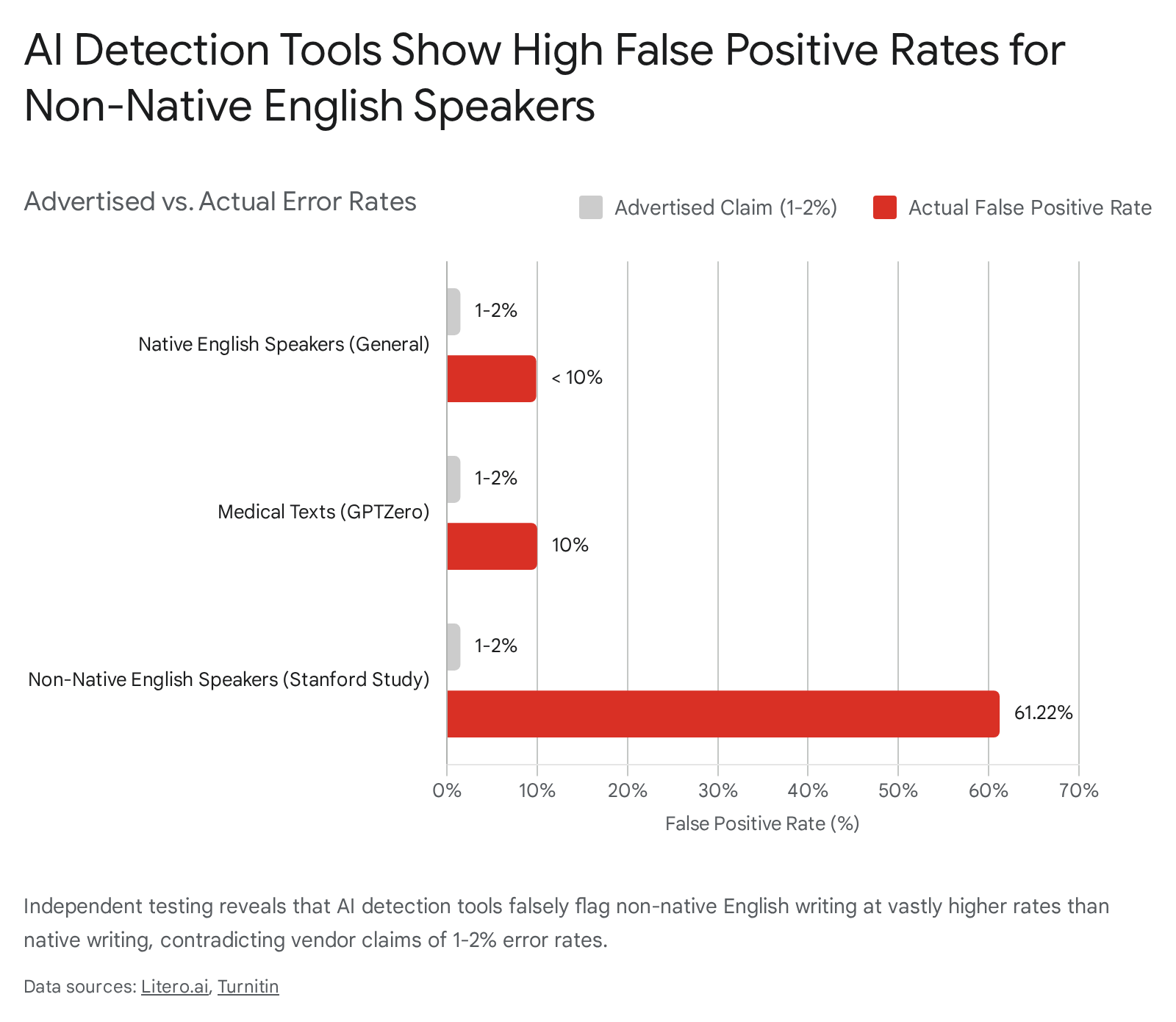
In effect, the algorithms treat the linguistic patterns of marginalized cohorts, neurodivergent students, or international students mastering academic English as evidence of cheating 4.
The consequences of these false positives are severe, leading to unwarranted academic misconduct charges, psychological distress, and long-term academic damage based on algorithmic errors 4. Consequently, leading institutions - including Vanderbilt University, Cornell University, and the University of Cape Town - have actively disabled AI detection features in their learning management systems, citing unreliability, equity concerns, and the fundamental breakdown of student trust 413.
Vulnerability Analysis of Standard Assessment Formats
The inability to accurately detect AI assistance means that certain traditional assessment formats are no longer valid measures of student competency. Generative AI easily exploits predictable task structures, highly defined rubrics, and prompts focused on final textual products 3. The vulnerability of an assessment is inversely proportional to the level of contextual human involvement, real-time adaptation, and continuous process monitoring it requires 14.
Structural Susceptibilities
Educational researchers have mapped the vulnerability of various assessment types to establish a risk taxonomy. Assessments that test the application of knowledge in isolated, unmonitored digital environments are fundamentally compromised, whereas those rooted in physical environments or live interpersonal interactions remain highly resilient 14.
| Assessment Format | Vulnerability Level | Rationale & AI Capabilities |
|---|---|---|
| Uninvigilated Quizzes / Tests | Very High | AI seamlessly handles knowledge recall, multiple-choice, and basic application tasks. Real-time generation negates the security of short completion windows. 14 |
| Traditional Take-Home Essays | High | AI excels at mimicking academic writing styles, summarizing literature, and integrating broad concepts into polished prose, often bypassing standard plagiarism checkers. 14 |
| Technical Reports | High | AI quickly processes large data volumes to create structurally accurate reports, though it may lack deep analysis or misinterpret complex methodological limitations. 14 |
| Reflective Journals | Medium | Susceptible to surface-level mimicry of reflection. However, AI struggles to replicate genuine introspection or the lived experience of overcoming specific contextual challenges. 14 |
| Practical & Lab Assessments | Low | Requires physical manipulation, real-time adaptation, and original creativity. Difficult for AI to synthesize without direct human sensory input and physical presence. 314 |
| Synoptic Assessments | Low | Requires connecting diverse ideas across multiple modules or disciplines. AI struggles with nuanced, open-ended problems that bridge disparate domains organically. 14 |
| Oral Vivas / Interviews | Low | Relies on dynamic interaction, unscripted responses, and spontaneous real-time dialogue, making algorithmic outsourcing functionally impossible. 31415 |
Expanding Threat Taxonomies
The vulnerability of educational systems is not limited merely to student plagiarism. As universities increasingly integrate AI into their own grading, administrative, and research infrastructures, they face complex cybersecurity vulnerabilities. The National Institute of Standards and Technology (NIST) and MITRE ATLAS have expanded their adversarial machine learning taxonomies to categorize risks unique to generative AI 231617.
In an educational context, these vulnerabilities manifest through data poisoning, prompt injection, and model inversion 1618. If a university utilizes an AI model to assist in grading or curriculum design, a malicious actor could theoretically employ indirect prompt injection - embedding hidden instructions within a submitted essay - to manipulate the AI into awarding a high grade or leaking underlying grading rubrics 1617. Furthermore, as autonomous AI agents are granted access to institutional databases to perform administrative tasks, the risk of shadow AI (the unsanctioned use of AI tools by faculty or students outside of IT oversight) creates severe data privacy exposures, necessitating robust quantitative risk assessment frameworks 2317.
The Pedagogical Shift from Product to Process
Perhaps the most significant theoretical shift in modern educational evaluation - accelerated by the advent of AI - is the transition from product-focused to process-focused assessment. Education is fundamentally about cognitive development; however, traditional assessment has historically captured only a static snapshot: the final essay, the finished code, or the completed exam 19.
Limitations of Product-Oriented Evaluation
Product-oriented assessments evaluate the final tangible output created by the student, judging its quality, structure, and factual accuracy against a defined rubric 202921. Because modern generative AI excels at producing polished final products, evaluating the product alone can no longer guarantee that the student underwent the necessary cognitive struggles to learn the material 1922. If an AI generates a flawless essay, a product-focused rubric will award it high marks, effectively measuring the capability of the software rather than the student's learning journey 22.
Furthermore, educational psychology research demonstrates that product-focused feedback is often underutilized by students, who tend to focus predominantly on the final summative grade rather than the instructional comments 19. In contrast, feedback targeting the learning process - highlighting strategic approaches, effort, and iteration - is demonstrably more memorable and useful for long-term skill acquisition and independent problem-solving 1920.
Process-Oriented Assessment Frameworks
Process-oriented assessment evaluates the strategies, critical thinking, and iterative steps a student takes to arrive at a solution 2029.
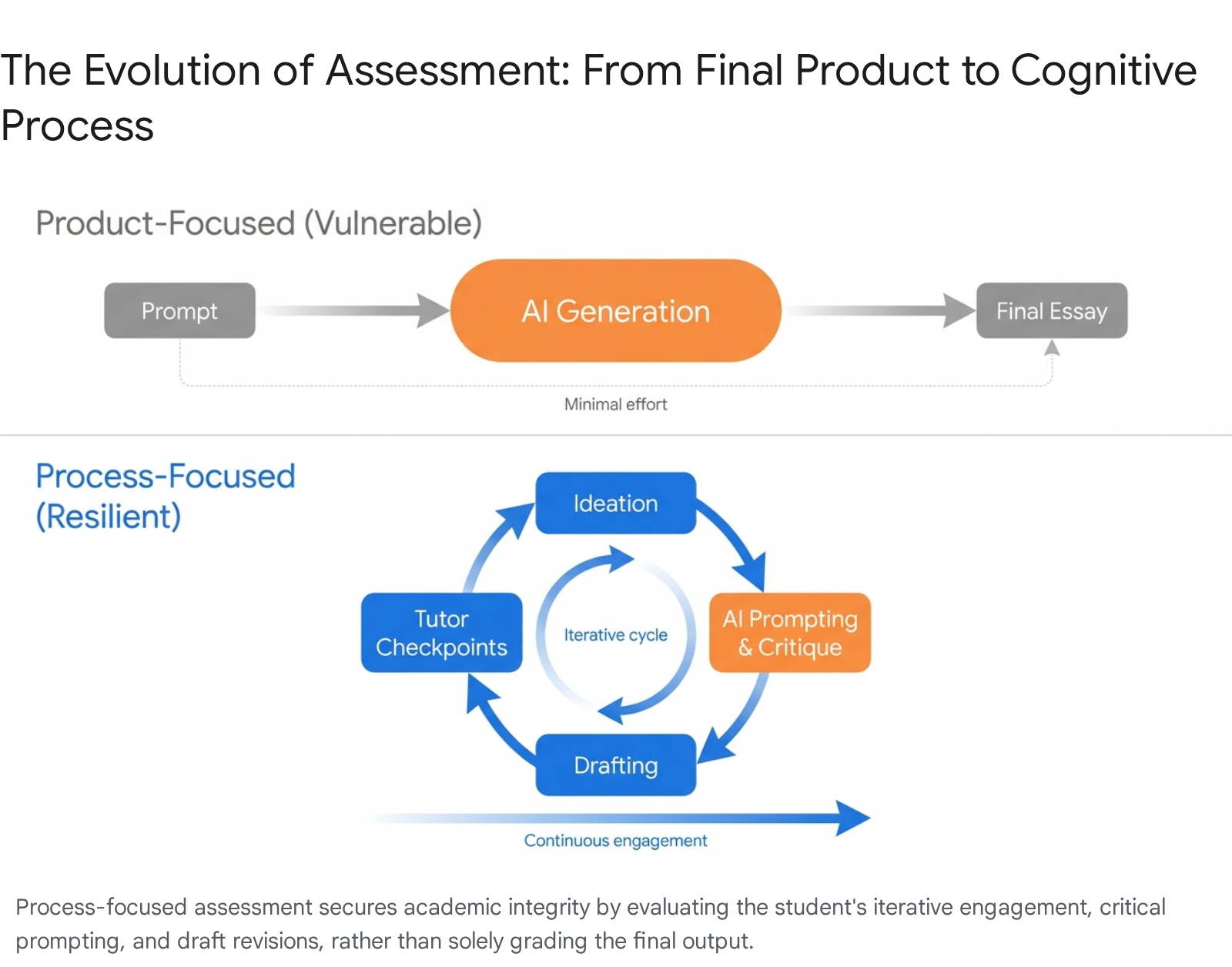
By shifting the evaluative lens to the steps taken to achieve the outcome, educators drastically reduce the risk of academic dishonesty while fostering deeper engagement 22.
In practice, process-focused frameworks require students to submit evidence of their intellectual journey. This includes authenticated live checkpoints, annotated bibliographies, interaction logs with AI chatbots, and reflective journals detailing how their thinking evolved based on AI or peer feedback 523. Grounded in theories like "Black Box Thinking," this approach makes the evolution of practice a core source of assessment evidence, rewarding transparency and the ability to learn from iterative mistakes 19.
One notable emerging framework is the DRIVE (Directive Reasoning Interaction and Visible Expertise) method, developed specifically to evaluate student-GenAI interaction logs 2324. Rather than grading the final essay, educators grade the dialogue between the student and the AI. DRIVE assesses two distinct components: 1. Directive Reasoning Interaction (DRI): Evaluates how effectively the student critically steers the AI, corrects its hallucinations, and guides the output toward academic rigor. 2. Visible Expertise (VE): Identifies how the student articulates their own domain knowledge within the prompts to elevate the AI's baseline capabilities, preventing passive delegation 2324.
Research analyzing these taxonomies reveals that assessing the process rewards entirely different behaviors than assessing the product. Where product grading tends to reward systematic text refinement and polished integration (a "targeted improvement partnership"), process grading surfaces original idea development and active intellectual engagement (a "collaborative intellectual partnership") 2324. Students who rely on "passive task delegation" to the AI consistently score poorly under process-based evaluations 24.
| Evaluative Feature | Product-Focused Assessment | Process-Focused Assessment |
|---|---|---|
| Primary Metric | Correctness, polish, and completion of the final artifact. 2029 | Formulation of strategies, iteration, effort, and critical engagement over time. 1920 |
| Rubric Structure | Task-specific (e.g., grammar, thesis clarity, conclusion formatting). 21 | Competency-based (e.g., progression of thought, response to feedback, evaluation of sources). 21 |
| Vulnerability to AI | High. AI can generate the final artifact with minimal student comprehension or input. 319 | Low. Demands real-time demonstration, authenticated checkpoints, and documentation of visible thinking. 7522 |
| Feedback Timing | Summative (delivered predominantly after task completion). 3 | Formative (delivered continuously during drafting and development phases). 320 |
| Pedagogical Value | Measures task compliance and synthetic integration at a specific point in time. 23 | Builds long-term capacity for independent problem-solving, metacognition, and self-regulation. 20 |
Emerging Evaluation Paradigms: AI-Immune and AI-Integrated Models
Recognizing that punitive detection is a flawed strategy, the higher education sector's structural assessment redesign generally bifurcates into two complementary philosophies: "AI-immune" models that isolate human cognition, and "AI-integrated" models that measure human-machine collaboration 25.
The Development of AI-Immune Assessments
AI-immune assessments are designed to evaluate distinctly human traits - such as physical dexterity, spontaneous critical thinking, and real-time ethical judgment - where current AI offers no competitive advantage 25.
A primary manifestation of this approach is the resurgence of the oral examination, or viva voce. Historically limited by the sheer logistical burden of examining large undergraduate cohorts, oral assessments have been reframed as one of the most authentic ways to verify student comprehension 153526. Oral examinations demand real-time reasoning, active listening, and industry-specific communication skills, making algorithmic outsourcing functionally impossible 3526.
Ironically, artificial intelligence itself is providing the solution to the scalability problem of oral vivas. Pilot studies conducted in 2025 and 2026 have demonstrated the viability of fully automated, AI-assisted oral examinations. Utilizing multi-agent voice AI architectures, institutions have successfully deployed systems that generate dynamic questions based on a grading rubric, conduct live voice interviews with students, and assess the transcripts using a deliberation round among multiple language models 35. In one major university study, 36 oral examinations were conducted for an undergraduate machine learning course at a total compute cost of $15 (approximately $0.42 per student), achieving a high inter-rater reliability (Krippendorff's alpha of 0.86) 35. While 70% of students reported that the format accurately tested their genuine understanding, 83% found it significantly more stressful than written exams, highlighting the necessity for student acclimatization to this revived, high-stakes format 35.
Other AI-immune strategies include in-person invigilated examinations, clinical evaluations (such as OSCEs in medicine), supervised laboratory work, and performance-based tasks 222627. These assessments force students to demonstrate their evolving thinking without digital mediation, ensuring that the outcome reflects the student's true cognitive abilities rather than the output of a prompt 2228.
The Implementation of AI-Integrated Assessments
Conversely, AI-integrated models operate on the premise that GenAI is a permanent fixture of the modern workplace, and higher education has a duty to teach students how to utilize it critically 27. Rather than banning the tools, these assessments build AI directly into the pedagogical design, treating it as a baseline utility rather than an unauthorized advantage.
In these frameworks, students are often tasked with using AI to generate an initial draft, which they must then critique, fact-check, and refine. The assessment grade is derived from the student's ability to evaluate the AI's output, identify hallucinations, and enhance the depth of the argument 2729. This methodology effectively shifts the student's role from a primary creator of text to an editor, curator, and critical reviewer 29.
Furthermore, educators are adopting "collective agency" models, where students collaborate with GenAI to solve complex, community-based problems 29. In advanced scientific disciplines, this integration is already occurring at the highest levels. For example, in computational immunology and medical education, integrated AI-human hybrid pipelines - such as Vaxi-DL - are used to simulate immune responses, predict vaccine outcomes, and optimize drug formulation by combining digital machine learning models with biological reality like organ-on-a-chip systems 303132. Students and researchers assessed in these cutting-edge environments are evaluated on their ability to steer the AI, interpret complex multimodal datasets, and apply human ethical judgments to algorithmic outputs, representing the pinnacle of AI-integrated evaluation 253033.
Digital Equity and the Socioeconomic Implications of AI Integration
While generative AI possesses the potential to democratize education through personalized tutoring and adaptive learning, early macroeconomic indicators suggest it is actually exacerbating existing educational inequities 3445. The integration of AI into educational assessment creates severe new dimensions of the digital divide.
Global Infrastructure and Access Disparities
The fundamental baseline for AI integration is robust digital infrastructure. Students in underfunded districts or the Global South often lack the high-speed internet, modern devices, and baseline digital literacy required to leverage advanced AI platforms 344535. Furthermore, a pronounced disparity exists between premium (paid) AI models and free tiers. As AI developers restrict their most capable, reasoning-heavy models behind paywalls, wealthier students gain a significant cognitive advantage over lower-income peers who are relegated to older, less accurate models prone to severe hallucinations 353637.
Recent global data from late 2025 highlights this macroeconomic divide: 24.7% of the working-age population in the Global North actively uses GenAI tools, compared to only 14.1% in the Global South 38. While free open-source tools like DeepSeek have initiated massive surges in usage across Africa and parts of Asia - bypassing geopolitical restrictions on U.S. services and bridging immediate cost barriers - the broader disparity in institutional capacity to support AI literacy remains stark 38. In poorly resourced schools, AI is sometimes adopted as a cheap replacement for human instruction to fill resource gaps, whereas elite institutions utilize it as a supplementary tool to enhance high-quality pedagogy, leading to fundamentally unequal educational experiences 34.
Algorithmic Bias and Linguistic Discrimination
Beyond basic infrastructure access, the AI systems themselves harbor inherent biases that impact equitable assessment. Large language models are trained predominantly on datasets reflecting the linguistic, cultural, and contextual norms of the Global North, frequently failing to serve diverse, multilingual, or indigenous populations equitably 3439.
This algorithmic divide becomes highly problematic when AI is utilized in institutional evaluation. When educators use AI to grade essays or provide feedback, the systems may inadvertently penalize students whose writing styles, cultural references, or rhetorical structures diverge from standard Western academic English 43940. If policies mandate that educational technology vendors prove their tools do not exacerbate inequities faced by marginalized students, widespread adoption of automated grading models will be significantly delayed until these foundational biases are rectified 3036.
Comparative Policy and Governance Frameworks
The regulatory environment governing generative AI in education is highly fragmented. Navigating this landscape requires an understanding of both sweeping national frameworks and localized university policies, which range from prohibitive stances to comprehensive integration guidelines.
National Regulatory Approaches
National approaches to AI governance reflect divergent cultural priorities regarding innovation, market dominance, safety, and human rights 4142. * The European Union: The EU AI Act operates on a strict, top-down, risk-based framework. Crucially, AI systems utilized in educational assessment, vocational training, and student admissions are explicitly classified as "High-Risk." Providers of these systems face stringent requirements for conformity assessments, human oversight mechanisms, and rigorous bias testing before deployment, prioritizing student safety and fundamental rights over rapid commercial innovation 41425455. * The United States: The U.S. lacks a single comprehensive federal AI law, relying instead on a patchwork of sector-specific rules, voluntary guidelines (such as the NIST AI RMF), and state-level legislation. Executive Order 14179, issued in early 2025, prioritized deregulation to remove barriers to U.S. AI dominance and innovation, creating a highly decentralized environment where educational tech vendors face varying compliance rules depending on the jurisdiction 414256. * China: China regulates the underlying algorithms and generated content directly. AI systems must align with state ideologies, and there are strict, targeted regulations specifically for generative AI and recommendation algorithms, emphasizing content control and state supervision 414256. * Japan: Japan has adopted an agile, "soft-law" approach. Seeking to close the adoption gap with the U.S. and China, the 2025 AI Promotion Act offers non-binding guidelines to foster public trust and encourage rapid innovation across society, explicitly avoiding the severe financial penalties seen in the EU model 3843.
Institutional Guidelines and Disciplinary Adaptations
At the institutional level across the globe, universities are actively moving away from absolute bans - which have proven unenforceable - and toward nuanced, conditional use policies that demand transparency and focus heavily on developing AI literacy 74445.
- University of Oxford (United Kingdom): Oxford enforces strict, traditional boundaries regarding summative assessment. While students may use GenAI to support general study and research ideation, utilizing AI in summative (graded) assessments is strictly prohibited unless explicitly authorized by the specific course instructions. Any permitted use requires a formal declaration, and unauthorized use is aggressively prosecuted as academic misconduct 4446.
- Harvard University (United States): Harvard's guidelines emphasize data security and broad instructor autonomy. Students are warned against inputting confidential university data (Level 2 and above, including research and student records) into public AI tools to prevent corporate data scraping. The university delegates the ultimate decision of whether to allow AI to individual faculty members, demanding clear communication on syllabi 4447.
- Brazilian State Universities (USP, Unicamp, Unesp): Leading public universities in Brazil have instituted highly structured ethical frameworks based on transparency and human agency. AI cannot be listed as a co-author under any circumstance. If AI is used in academic work, students must explicitly declare the specific tools, software versions, and exact prompts used, often reproducing them in footnotes or methodology sections. Furthermore, researchers are strictly required to cross-check AI outputs against multiple primary sources to mitigate hallucinations, aligning with Brazil's strict LGPD privacy laws 486449.
- Indian Institute of Technology (IIT) Delhi (India): Following internal surveys revealing that over 80% of students use GenAI, IIT Delhi implemented robust disclosure rules. Any text, images, or data visualizations generated with AI assistance must be explicitly noted. Crucially, recognizing the economic reality of the technology, the institute mandated that all graduates must attain proficiency in AI and machine learning, integrating AI literacy directly into every academic program's curriculum 50675152.
- University of Cape Town (South Africa): UCT's 2025 AI in Education Framework focuses heavily on systemic equity and AI literacies. Recognizing the empirical flaws in algorithmic detection, UCT formally banned the use of Turnitin's AI similarity score for disciplinary purposes, prioritizing student trust over flawed policing. The institution's framework prioritizes the redesign of curricula to accommodate AI, focusing on ensuring equitable access to these technologies for all students regardless of socioeconomic background 1353.
A unifying theoretical thread across these diverse institutional policies is the shifting of ultimate responsibility onto the human user. Whether in Tokyo, Texas, or Cape Town, the global academic consensus dictates that students and researchers must act as the ultimate arbiters of truth, taking full responsibility for the accuracy, ethical biases, and intellectual integrity of any AI-assisted submissions 64515455.
Conclusion
The widespread availability of generative artificial intelligence has irreversibly compromised the traditional architectures of educational assessment. Systems designed to evaluate final written artifacts in unmonitored environments can no longer reliably distinguish between student cognition and algorithmic generation. Furthermore, attempts to police this boundary through automated AI detection software have proven technically flawed and ethically hazardous, disproportionately harming marginalized and non-native student populations.
In response, higher education is undergoing a necessary and profound evolution. By diversifying assessment methods - incorporating AI-immune practices like automated oral vivas alongside AI-integrated tasks that demand critical curation of algorithmic output - institutions are successfully reclaiming the validity of their evaluations. More fundamentally, the transition from product-focused rubrics to process-oriented frameworks ensures that the complex, iterative, and inherently human journey of learning remains the focal point of education. As global policy and university guidelines continue to mature, the central institutional goal is no longer to prevent AI usage, but to cultivate a digitally equitable environment where students are trained to wield artificial intelligence responsibly, critically, and with absolute transparency.