
How Your VO2 Max Relates to Age, Fitness, and Longevity
VO2 max is the single strongest predictor of long-term survival, vastly outperforming traditional health risk factors like smoking, diabetes, and high blood pressure in predicting all-cause mortality. While aerobic capacity naturally declines as we age, moving from the bottom 25 percent of fitness into the average range can cut your mortality risk in half. Tracking and improving this metric provides a direct window into your cellular health, cardiovascular resilience, and likelihood of maintaining physical independence in later life.
What Is VO2 Max, Exactly?
Cardiorespiratory fitness (CRF) is a measure of how efficiently your body takes oxygen from the air and delivers it to your muscles to create energy. The gold standard measurement for this capacity is VO2 max, which stands for maximal oxygen volume 12. First described by British physiologists A.V. Hill and H. Lupton in 1923, VO2 max is defined as the point at which your body's oxygen consumption plateaus despite a continuing increase in exercise intensity 13.
The metric is typically expressed in relative terms: milliliters of oxygen consumed per kilogram of body weight per minute (mL/kg/min). This weight-normalized figure allows for accurate comparisons between individuals of different sizes, which is why it is favored in both clinical settings and endurance sports 346.
Achieving a high VO2 max requires a complex symphony of biological systems functioning at peak efficiency 45. Your respiratory system must effectively extract oxygen from the air into the blood. Your heart must forcefully pump that oxygen-rich blood through clean, flexible arteries, maximizing stroke volume (the amount of blood pumped per beat) and cardiac output. Finally, your skeletal muscle mitochondria - the powerhouses of the cells - must efficiently extract that oxygen from the capillaries to synthesize ATP, the body's energy currency 669.
When you track VO2 max, you are not merely tracking your ability to run a fast 5K. You are measuring the structural integrity and metabolic efficiency of your entire cardiovascular and cellular engine 711. When any of these systems begin to fail due to aging, inactivity, or chronic disease, VO2 max is often the first and most noticeable metric to decline 11.
The Shift from Athletics to Clinical Vital Sign
For decades, VO2 max was relegated to the realm of elite endurance sports. Professional cyclists, rowers, and marathon runners used it to gauge performance potential, with some elite athletes registering staggering scores. For context, Norwegian triathlete Kristian Blummenfelt holds one of the highest recorded VO2 max scores in history at 101.1 mL/kg/min, while elite cyclists frequently test above 80 mL/kg/min 412.
However, the medical community's perspective on this metric has shifted dramatically. In 2016, the American Heart Association formally published a scientific statement recommending that cardiorespiratory fitness, measured by VO2 max, be classified as a clinical "vital sign" that should be routinely assessed in patient evaluations 358. This shift occurred because large-scale epidemiological data proved that aerobic capacity is not just a measure of athletic talent, but a profound indicator of human longevity and disease resistance.
The Mortality Data: Why Fitness Outperforms Disease Risk
The link between cardiorespiratory fitness and lifespan is well-established, but the sheer magnitude of the effect often surprises patients and clinicians alike. The data suggests that low fitness is a more dangerous chronic condition than many heavily medicated diseases.
The Cleveland Clinic Cohort
The most cited and robust evidence stems from a landmark 2018 study conducted by Dr. Wael Jaber and colleagues at the Cleveland Clinic, published in JAMA Network Open. The researchers followed 122,007 adult patients over a median of 8.4 years. The patients, with an average age of 53, underwent symptom-limited treadmill exercise testing and were subsequently stratified by their fitness levels 6914.
The researchers found a stark, inverse relationship between VO2 max and all-cause mortality, with no observed upper limit to the benefit. Simply put, the higher the fitness level, the lower the risk of death 141516.
To understand the power of this metric, it helps to compare the hazard ratios (the relative risk of dying) of poor fitness against conditions universally recognized as dangerous within the exact same patient cohort: * A history of smoking increased mortality risk by 41% 9159. * Type 2 diabetes increased mortality risk by 40% 9159. * Coronary artery disease increased mortality risk by 29% 915. * High blood pressure increased mortality risk by 21% 915. * Low cardiorespiratory fitness (the bottom 25% of the population) increased mortality risk by approximately 400% (a 5-fold difference) compared to elite fitness levels 91510.
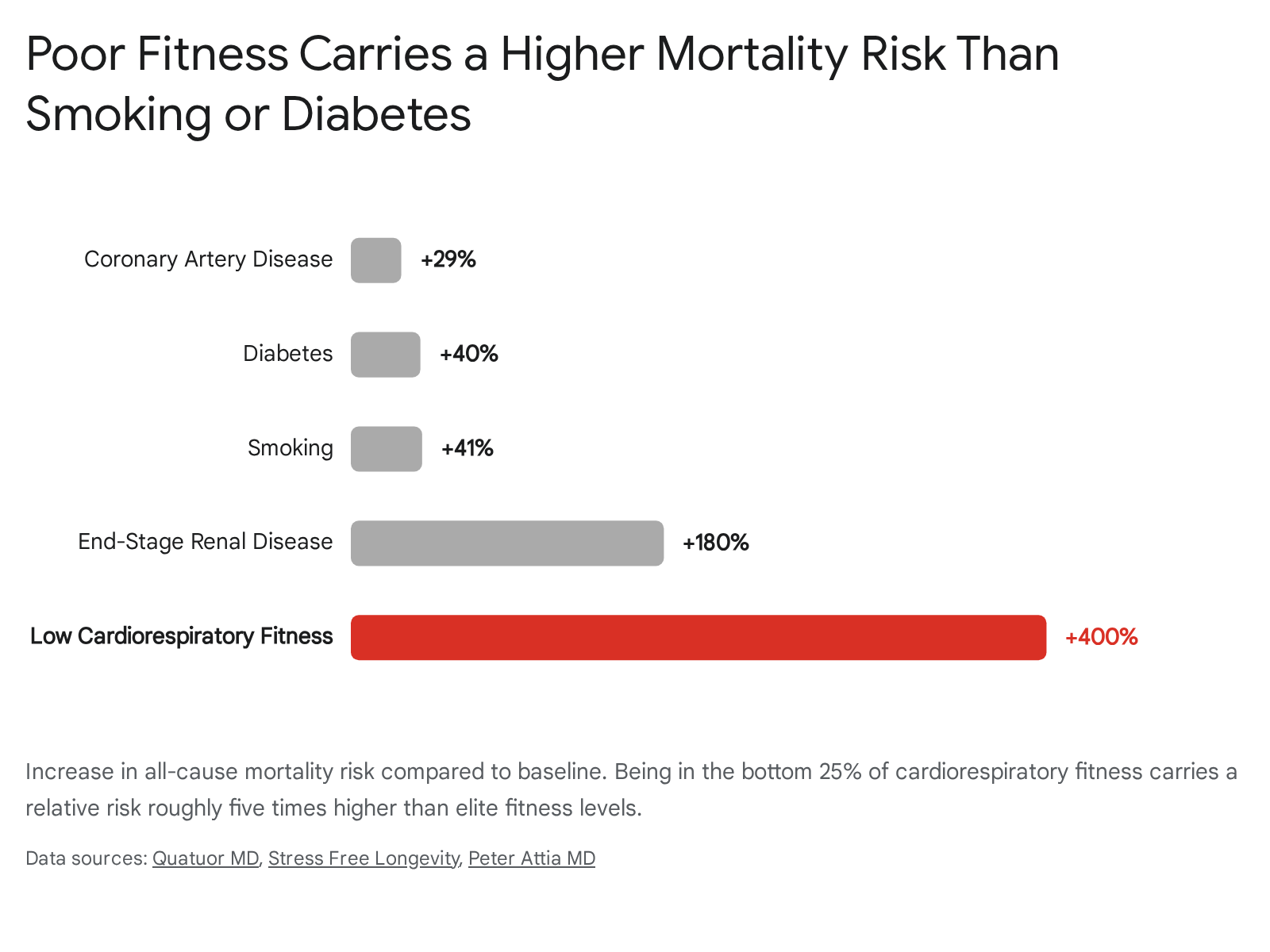
Even more encouraging is how quickly the risk drops with moderate improvement. An individual does not need to become an elite athlete to see transformative health benefits. The Cleveland Clinic data showed that merely climbing out of the bottom 25% of fitness into the "below average" category (the 25th to 50th percentile) was associated with a 50% reduction in mortality risk over a decade 91211. Moving one tier higher, to the "above average" group, resulted in a 60% to 70% reduction in mortality risk 12. The steepest part of the benefit curve, where the most mortality risk is removed per unit of fitness gained, occurs precisely at the bottom 16.
The Veterans Affairs Study
These findings are corroborated by a massive 2022 study by Kokkinos and colleagues published in the Journal of the American College of Cardiology. This study analyzed over 750,000 U.S. veterans aged 30 to 95, making it the largest cardiorespiratory fitness dataset ever assembled 1412.
The researchers found a graded, independent association where every 1-MET increase in fitness (roughly a 3.5 mL/kg/min increase in VO2 max) resulted in a 13% to 15% drop in mortality risk 714. This protective effect held true regardless of the patient's age, sex, body mass index, or preexisting comorbidities. No group, at any age, was "too old" or "too far gone" to benefit from an improvement in aerobic capacity 14.
Long-Term Changes in Fitness
While baseline measurements are powerful, tracking changes in VO2 max over time reveals even more about longevity. A long-term study by Laukkanen et al. tracked 579 middle-aged men over an 11-year period, using direct respiratory gas exchange to measure VO2 max at the beginning and end of the decade. The researchers found that for every 1 mL/kg/min that a participant's VO2 max increased over that decade, their relative risk of all-cause mortality dropped by 9% 1314. Conversely, individuals who allowed their aerobic capacity to steeply decline faced significantly higher mortality rates.
Beyond the Heart: Cancer, Dementia, and Immunity
The protective halo of a high VO2 max extends far beyond simply preventing heart attacks. A 2015 meta-analysis pooling 71 cohort studies found that high cardiorespiratory fitness was associated with a 16% reduction in cancer-specific mortality and a 21% reduction in cancer incidence, particularly for colon, breast, and lung cancers 23.
The underlying mechanisms are multifaceted. Individuals with higher VO2 max levels typically exhibit better insulin sensitivity, lower levels of chronic systemic inflammation, improved immune surveillance, and healthier blood vessel function 2324. Furthermore, high aerobic capacity is associated with improved cognitive function and a significantly lower risk of developing dementia and Alzheimer's disease 525. In practical terms, better oxygen delivery to the brain preserves neurological tissue and delays cognitive decline 25.
The "Fat vs. Fit" Paradox: Why Fitness Trumps BMI
For decades, body mass index (BMI) has been a primary metric used by physicians and public health officials to gauge health risk. However, recent evidence suggests that aerobic capacity is a far more powerful and accurate predictor of longevity than body weight alone.
A comprehensive 2025 meta-analysis published in the British Journal of Sports Medicine evaluated cardiorespiratory fitness and BMI across nearly 400,000 adults. The findings challenged conventional wisdom: individuals with higher VO2 max levels possessed significant protection against cardiovascular disease and early mortality, regardless of which BMI category they fell into 2627.
Crucially, the study showed that individuals classified as "overweight" or "obese" who maintained a high level of cardiovascular fitness showed no statistically significant increase in mortality risk compared to "normal weight" individuals who were physically fit 26. In contrast, unfit individuals - irrespective of whether they were normal weight, overweight, or obese - exhibited a two- to three-fold greater risk of mortality compared to their fit counterparts 2627.
This data underscores a critical clinical reality: while maintaining a healthy body composition is undoubtedly beneficial, the metabolic and cardiovascular adaptations forged by aerobic exercise offer protective survival benefits that a low body weight cannot replicate on its own 27. From a health perspective, the risks of being severely unfit are far more dangerous than the risks associated with carrying extra weight.
What Is a "Good" VO2 Max? (Normative Ranges by Age and Sex)
Evaluating your VO2 max requires comparing it against normative data for your specific age bracket and biological sex. An absolute score of 35 mL/kg/min represents entirely different health outlooks depending on who achieved it: it is considered poor for a 20-year-old male, average for a 40-year-old female, and excellent for a 75-year-old man 28.
The Impact of Age
Physiologically, VO2 max naturally declines as we age. This is driven by several biological factors, including a gradual decrease in maximum heart rate, a stiffening of the cardiovascular system, and a gradual loss of muscle oxidative capacity and lean mass 91530.
For the average sedentary adult, this decline is quite steep, averaging about 10% per decade after the age of 30 72515. However, this rate of decay is not fixed. A large portion of the decline is driven by lifestyle and deconditioning rather than pure biological aging. Individuals who maintain consistent, structured endurance training can cut this decline in half, losing only about 5% per decade 71616. As a result, a highly active 60-year-old can easily maintain a VO2 max that exceeds that of a sedentary 30-year-old 1630.
The Impact of Biological Sex
Women generally exhibit VO2 max values that are 10% to 15% lower than men of the exact same age and relative fitness level 2830. This disparity is not due to a lack of effort or cardiovascular health, but rather physiological differences. Men typically possess a higher percentage of lean muscle mass (which consumes oxygen), larger heart sizes (which increases stroke volume), and higher concentrations of oxygen-carrying hemoglobin in the blood 2830. Therefore, a female scoring 35 mL/kg/min is biologically performing at the same relative fitness percentile as a male scoring roughly 40 mL/kg/min.
Normative Data Tables
The tables below synthesize the widely used normative classifications from the American College of Sports Medicine (ACSM) and the Cooper Institute. These percentiles are the standard references used in clinical exercise testing and by modern wearable devices 2830.
Men: VO2 Max Classifications (mL/kg/min)
| Age Range | Poor (Bottom 25%) | Below Average | Average (50th) | Above Average | Excellent (75th+) | Superior (95th+) |
|---|---|---|---|---|---|---|
| 20 - 29 | < 33.0 | 33.0 - 36.4 | 36.5 - 42.4 | 42.5 - 46.4 | 46.5 - 52.4 | > 52.4 |
| 30 - 39 | < 31.5 | 31.5 - 35.4 | 35.5 - 40.9 | 41.0 - 44.9 | 45.0 - 49.4 | > 49.4 |
| 40 - 49 | < 30.2 | 30.2 - 33.5 | 33.6 - 38.9 | 39.0 - 43.7 | 43.8 - 48.0 | > 48.0 |
| 50 - 59 | < 26.1 | 26.1 - 30.9 | 31.0 - 35.7 | 35.8 - 40.9 | 41.0 - 45.3 | > 45.3 |
| 60+ | < 20.5 | 20.5 - 26.0 | 26.1 - 32.2 | 32.3 - 36.4 | 36.5 - 44.2 | > 44.2 |
Women: VO2 Max Classifications (mL/kg/min)
| Age Range | Poor (Bottom 25%) | Below Average | Average (50th) | Above Average | Excellent (75th+) | Superior (95th+) |
|---|---|---|---|---|---|---|
| 20 - 29 | < 23.6 | 23.6 - 28.9 | 29.0 - 32.9 | 33.0 - 36.9 | 37.0 - 41.0 | > 41.0 |
| 30 - 39 | < 22.8 | 22.8 - 26.9 | 27.0 - 31.4 | 31.5 - 35.6 | 35.7 - 40.0 | > 40.0 |
| 40 - 49 | < 21.0 | 21.0 - 24.4 | 24.5 - 28.9 | 29.0 - 32.8 | 32.9 - 36.9 | > 36.9 |
| 50 - 59 | < 20.2 | 20.2 - 22.7 | 22.8 - 26.9 | 27.0 - 31.4 | 31.5 - 35.7 | > 35.7 |
| 60+ | < 17.5 | 17.5 - 20.1 | 20.2 - 24.4 | 24.5 - 30.2 | 30.3 - 31.4 | > 31.4 |
Note: While being "Average" means you are at the population midpoint, the general population in Western countries is largely sedentary. For general health and optimal longevity protection, sports medicine professionals recommend aiming for the "Above Average" or "Excellent" categories 2428.
The Independence Threshold: Preparing for Your 80s
While elite athletes use VO2 max to predict marathon times, the most critical application of this metric for the general population involves the concept of the "independence threshold."
Activities of daily living require a baseline level of oxygen consumption. Simply walking at a normal pace, climbing a single flight of stairs, or carrying groceries requires the body to operate at a specific aerobic cost. When an individual's VO2 max drops below roughly 18 mL/kg/min, these basic daily tasks shift from being comfortable, sub-maximal efforts to exhausting, near-maximal efforts 149. Below this threshold, an individual crosses into functional disability. They are at high risk for frailty, falls, loss of physical independence, and institutionalization 149.
Because VO2 max reliably declines with age, the aerobic capacity you build in your 40s and 50s acts as a physiological retirement account. Consider a 50-year-old man with a strictly average VO2 max of 32 mL/kg/min. If he remains sedentary and experiences the typical 10% decline per decade, his capacity will drop to roughly 29 in his 60s, 26 in his 70s, and dangerously close to the 18 mL/kg/min threshold by his mid-80s 9.
In contrast, an individual who actively trains and enters their 50s with a VO2 max of 45 mL/kg/min has a much longer "runway." Even with age-related decline, their baseline is high enough to virtually guarantee physical independence well into their 90s, barring severe disease or mechanical injury 9. The goal of fitness in midlife is to raise the ceiling high enough so that the inevitable age-related floor never touches the independence threshold.
The Causality Debate: Does a High Score Actually Extend Life?
Given the overwhelming observational data linking a high VO2 max to extreme longevity, a natural question arises: if we artificially increased someone's VO2 max using altitude tents, testosterone therapy, or red blood cell enhancers (like EPO), would they automatically live longer?
The answer appears to be no, which reveals a fascinating nuance about how we should interpret fitness metrics.
A highly illuminating 2024 Mendelian randomization study published in The Journal of Clinical Endocrinology & Metabolism sought to untangle correlation from true causation. The researchers used genetic variants to predict VO2 max and analyzed its impact on longevity using large genome-wide association studies 3317.
The findings were revealing. While measured VO2 max is an ironclad predictor of mortality in the real world, a genetically predicted high VO2 max showed no direct causal association with longevity or protection against Type 2 diabetes 317. The researchers did find, however, that genetic predispositions to lower body fat and higher physical activity did causally drive longevity 1734.
What this means in practice is that VO2 max itself is not a magical life-extending elixir. Rather, it is an exquisite proxy for the shared causal drivers that actually extend human life: regular physical exertion, low visceral adiposity, and robust lean muscle mass 1734. You cannot "hack" your way to longevity by artificially raising your VO2 max on paper 34.
The profound life-extending benefits do not come from the absolute number itself, but from the rigorous physiological adaptations forged through the hard work required to naturally raise that number 111634. When you train to improve VO2 max, you are simultaneously improving insulin sensitivity, lowering systemic inflammation, reducing blood pressure, and increasing mitochondrial density 233536. Fitness and longevity are not about achieving a high score through shortcuts; they are about hitting the biological levers of movement and body composition that drive both VO2 max and lifespan simultaneously.
How to Improve Your Aerobic Capacity at Any Age
The encouraging reality of exercise physiology is that VO2 max is highly trainable across the entire human lifespan. Even older adults who have been sedentary for decades can safely improve their aerobic capacity by 15% to 20% through structured training within a matter of months 6241518. Improving this metric requires a polarized approach to cardiovascular exercise, targeting both the metabolic foundation and the high-end ceiling of your aerobic system.
Build the Base: Zone 2 Endurance
The foundation of a high VO2 max is built through steady-state, low-to-moderate intensity aerobic exercise, commonly referred to as Zone 2 training 71416. This involves activities like brisk walking, cycling, light jogging, or swimming at an intensity where you are breathing slightly heavier but can still comfortably maintain a conversation 738.
Zone 2 training is critical because it triggers unique cellular adaptations. It stimulates the creation of new mitochondria (mitochondrial biogenesis), improves the efficiency of existing mitochondria to burn fat for fuel, and promotes the growth of capillary networks in skeletal muscle 1714. This increased capillary density enhances the actual physical delivery of oxygen to the muscle tissues. Without a broad aerobic base, the body lacks the cellular infrastructure to support high-end oxygen consumption. Experts recommend accumulating at least 150 to 300 minutes of this low-intensity work per week 719.
Raise the Ceiling: High-Intensity Interval Training (HIIT)
While Zone 2 builds the metabolic foundation, pushing your absolute maximum capacity requires high-intensity interval training (HIIT) 638. HIIT involves short, intense bursts of near-maximal effort followed by periods of active recovery.
Research consistently demonstrates that incorporating one to two sessions of HIIT per week is the most potent stimulus for directly raising VO2 max 26. Intense intervals force the heart to reach its maximum stroke volume, structurally strengthening the left ventricle and increasing overall cardiac output 618. A common, highly effective protocol used in longevity medicine is the "4x4": four minutes of work at a very intense pace (roughly 85-95% of maximum heart rate) followed by three to four minutes of easy recovery, repeated four times 40. Sprint interval training (shorter, all-out efforts) has also been shown to confer major benefits for cardiorespiratory fitness 638.
The Role of Strength Training and "Exercise Snacks"
While aerobic exercise is the primary driver of VO2 max, strength and resistance training play a vital supporting role, particularly as we age. Because skeletal muscles are the primary consumers of oxygen during exercise, maintaining a higher volume of metabolically active muscle tissue directly supports higher absolute oxygen consumption 67.
A 2024 meta-analysis reviewing 38 randomized controlled trials involving older adults confirmed that while aerobic training is vastly superior for improving VO2 max and 6-minute walk test performance, resistance training is significantly better for preserving lean body mass 41. Therefore, a concurrent training model - combining both cardio and weight lifting - yields the best comprehensive aging outcomes 2641.
For those who are completely sedentary and daunted by structured workouts, recent research indicates that "exercise snacks" - brief structured bouts of vigorous activity lasting 5 minutes or less, performed a few times daily (like rapidly climbing stairs) - can significantly improve cardiorespiratory fitness in inactive populations 20.
Wearables vs. Laboratory Testing
The gold standard for measuring VO2 max remains a cardiopulmonary exercise test (CPET) performed in a clinical laboratory, requiring the subject to run on a treadmill or ride a stationary bike to exhaustion while wearing a mask that measures respiratory gas exchange 346.
However, modern wearable technology - such as the Apple Watch, Garmin, and various fitness rings - has made VO2 max estimation accessible to the masses. These devices use algorithms based on age, resting heart rate, and heart rate response to sub-maximal exercise paces (like outdoor running or brisk walking) to estimate aerobic capacity 121636. While these wearables can sometimes underestimate or overestimate absolute numbers by up to 5%, they are highly reliable for tracking trends over time 1224. If your smartwatch shows your VO2 max increasing over a six-month period of consistent training, your true aerobic capacity and your underlying cellular health are genuinely improving.
Bottom line
VO2 max is much more than a metric of athletic performance; it is the most powerful objective marker of your cardiovascular health and overall mortality risk, dwarfing the impact of traditional risk factors like smoking or high blood pressure. While aerobic capacity naturally declines with age, a large portion of that drop is driven by physical inactivity rather than pure biology, meaning it is highly reversible. By combining consistent, moderate-intensity base training with occasional high-intensity intervals, individuals of any age can significantly boost their VO2 max, thereby extending their lifespan, preserving their independence, and drastically reducing their risk of chronic disease.