
How Your Muscles Build Strength Day by Day
When you lift weights, you do not build strength in the gym; instead, you inflict microscopic tears and neurological fatigue upon your tissues. True strength is built entirely during the subsequent 24 to 72 hours of recovery as your immune system clears damaged cells and dormant stem cells fuse to muscle fibers to synthesize new, thicker proteins. Concurrently, your central nervous system rewires itself to recruit these muscle fibers more explosively, resulting in a muscle that is both physically larger and neurologically more efficient.
The Illusion of the Gym: Stress Versus Adaptation
The physical act of engaging in resistance training is a catabolic event, meaning it breaks the body down. When an individual steps into a gym and lifts a heavy load, the immediate result is a localized biological crisis. The mechanical tension of the weight stretches and disrupts the structural integrity of the muscle fibers. Simultaneously, the energy demands of the movement deplete the muscle's localized stores of glycogen and adenosine triphosphate, the primary cellular energy sources 121.
If human performance were measured immediately after a strenuous workout, the lifter would be quantifiably weaker, slower, and less coordinated than when they began 2. This initial decline in performance represents the first phase of the stress-recovery-adaptation cycle. The body interprets the mechanical tension and metabolic stress of a workout not as an accomplishment, but as a severe threat to its homeostasis 12.
To ensure the organism survives and is better prepared to handle that specific physical stressor in the future, the human body initiates a robust, multi-day defense mechanism. It does not simply repair the damaged tissue back to its previous baseline state. Instead, it overcompensates. Through an intricate cascade of hormonal signaling, immune responses, and protein synthesis, the body rebuilds the tissue slightly larger and significantly stronger than it was before 12. This phenomenon of supercompensation relies on two distinct physiological processes operating in tandem: upgrading the neurological software and expanding the muscular hardware.
Upgrading the Software: Neural Adaptations
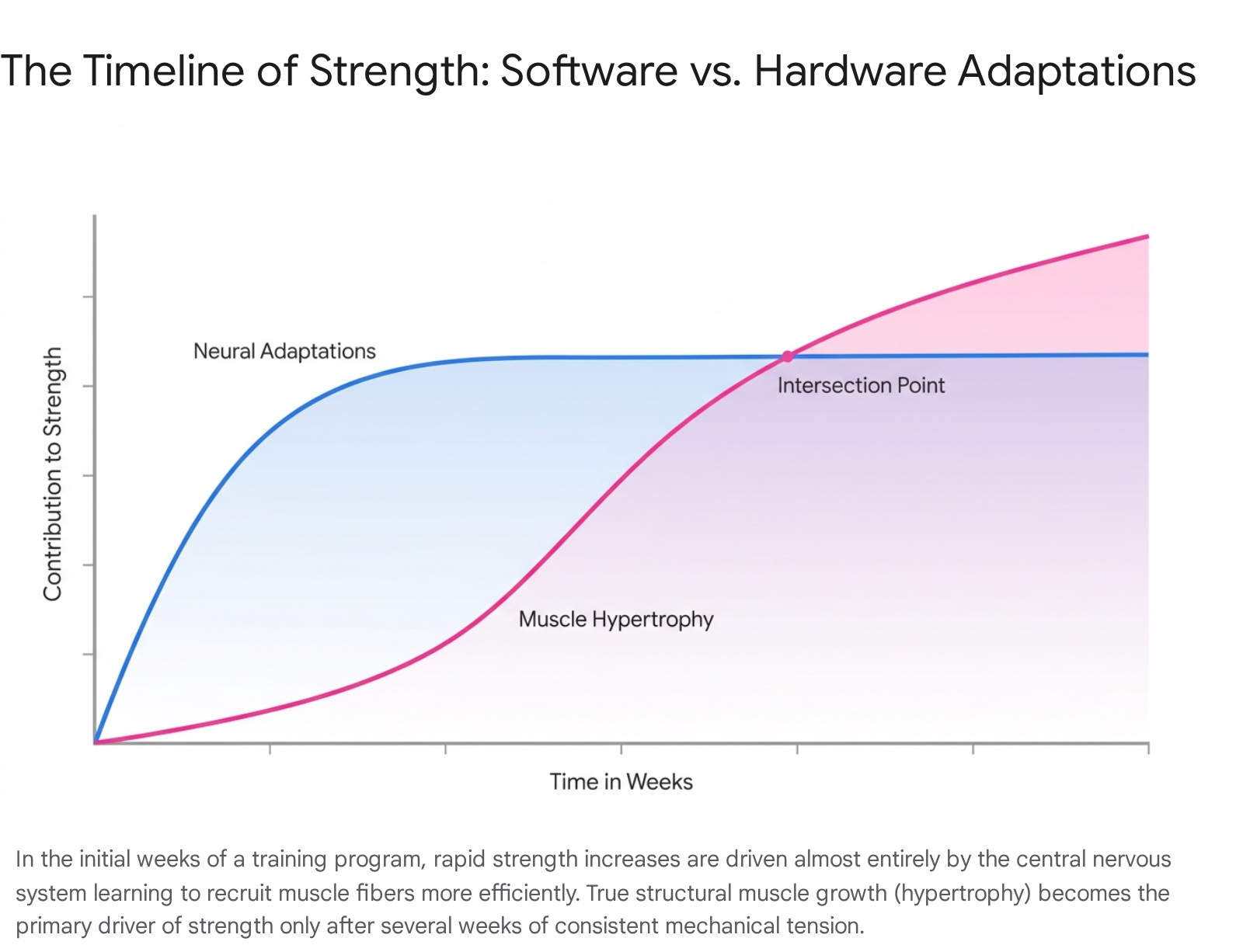
When an individual begins a new resistance training program, they almost always experience rapid and dramatic increases in strength during the first few weeks. Interestingly, if an exercise physiologist were to measure the cross-sectional area of their muscles during this initial period, they would find almost no physical growth 34. These early, rapid strength gains are almost entirely neurological. If muscle fibers are the hardware of the human body, the central nervous system is the software. Resistance training forces the central nervous system to become highly efficient at communicating with muscle tissue, a process known as neural adaptation 47.
One of the primary mechanisms of neural adaptation is improved motor unit recruitment. A motor unit consists of a single motor neuron originating in the spinal cord and all the individual muscle fibers it commands. Untrained individuals cannot voluntarily activate all of their available motor units, particularly the large, fast-twitch muscle fibers capable of generating massive amounts of force 45. In a novice, these high-threshold motor units remain dormant because the brain has never needed to recruit them. Strength training teaches the brain to access these reserves, allowing the lifter to recruit a much higher percentage of their available muscle fibers simultaneously 479.
Strength is dictated not just by how many muscle fibers fire, but by how fast the neurological signals arrive at the tissue. This concept is known as rate coding, or firing frequency. Resistance training increases the frequency of the action potentials sent from the brain to the muscle. When these electrical signals fire in rapid succession, the muscle fibers do not have time to relax between impulses. This results in a summation of force, creating a much stronger, more explosive overall contraction 475. This increase in firing frequency is often visible in research settings as elevated electromyography amplitudes, which measure the electrical activity produced by skeletal muscles 67.
Furthermore, heavy lifting trains the nervous system to synchronize these firings. In an untrained muscle, various motor units fire somewhat asynchronously, leading to a shaky or uncoordinated movement. As neurological adaptation progresses, motor units begin to fire in unison, resulting in a smooth, explosive generation of force that is crucial for heavy compound lifts like squats and deadlifts 479. This synchronization represents a profound enhancement in intramuscular coordination 7.
The body also adapts by removing its own internal limitations. The human neuromuscular system possesses built-in protective mechanisms, such as the Golgi tendon organs located at the junction of muscles and tendons. These sensory receptors detect extreme tension and reflexively inhibit muscle contraction to prevent the muscle from tearing itself off the bone. Consistent exposure to heavy loads gradually desensitizes these inhibitory receptors 477. By reducing presynaptic inhibition and turning down the sensitivity of the Golgi tendon organs, the central nervous system essentially lifts its internal governor, allowing the athlete to access a much greater percentage of their absolute strength potential 77.
Finally, the brain learns to relax opposing muscles through improved intermuscular coordination. When a novice performs a bicep curl or a heavy squat, the antagonist muscles often contract slightly out of an instinct to stabilize the joint, fighting the movement of the primary lifting muscles. Long-term strength training teaches the nervous system to reduce this antagonist co-contraction 989. By relaxing the opposing muscles, the primary movers can operate without internal resistance, instantly increasing the net force applied to the barbell 89.
Upgrading the Hardware: The Physics of Tissue Damage
While neural adaptations maximize the efficiency of existing tissue, sustained mechanical tension eventually forces the body to build more physical tissue. This is muscular hypertrophy, defined biologically as an increase in the cross-sectional area of individual muscle fibers 31011. Hypertrophy is achieved primarily by adding new sarcomeres, the microscopic contractile units of a muscle, in parallel alongside existing ones. By increasing the physical size and density of the contractile proteins actin and myosin, the muscle's absolute physical capacity to generate force increases 101612.
However, the body is highly conservative with its resources. Building new muscle hardware is biologically expensive and calorically demanding. Therefore, the body will only commit to this process if it is forced to do so by localized cellular trauma 13. Understanding how this trauma occurs requires looking at the physics of muscle contraction.
Not all phases of a weightlifting movement trigger the same biological response. When a muscle contracts and shortens to overcome a load, such as the upward pushing phase of a bench press or the standing phase of a squat, it performs a concentric contraction 1420. Conversely, when the muscle actively lengthens while remaining under tension, such as slowly lowering the barbell back to the chest or descending into the squat, it performs an eccentric contraction 1420.
Exercise science has definitively proven that eccentric contractions are responsible for the vast majority of exercise-induced muscle damage 131516. The reasoning lies in the neuromuscular distribution of force. Because eccentric movements are mechanically more efficient, the central nervous system recruits fewer motor units to handle the same amount of weight during the lowering phase 16. Consequently, the mechanical stress and physical load placed on those specific active fibers are drastically magnified 2016.
A highly studied real-world analogy for eccentric loading is walking downhill or descending a steep flight of stairs. During descent, the quadriceps must act as biological brakes, lengthening while actively absorbing the gravitational force of the entire body. Research utilizing motorized escalators has shown that participants subjected to pure stair-descending exercise experience significantly more muscle damage and subsequent strength adaptations than those performing only stair-climbing, which is concentric-dominant 1718.
This active lengthening under heavy loads causes the physical structures within the muscle to fail. The mechanical stress literally stretches the sarcomeres until they pop, physically tearing their structural z-lines and creating micro-lesions in the delicate cellular membranes 161318. This severe, localized architectural disruption is the mandatory initial trigger that initiates the multi-day biological recovery cascade 1616.
The Day-by-Day Cellular Recovery Timeline
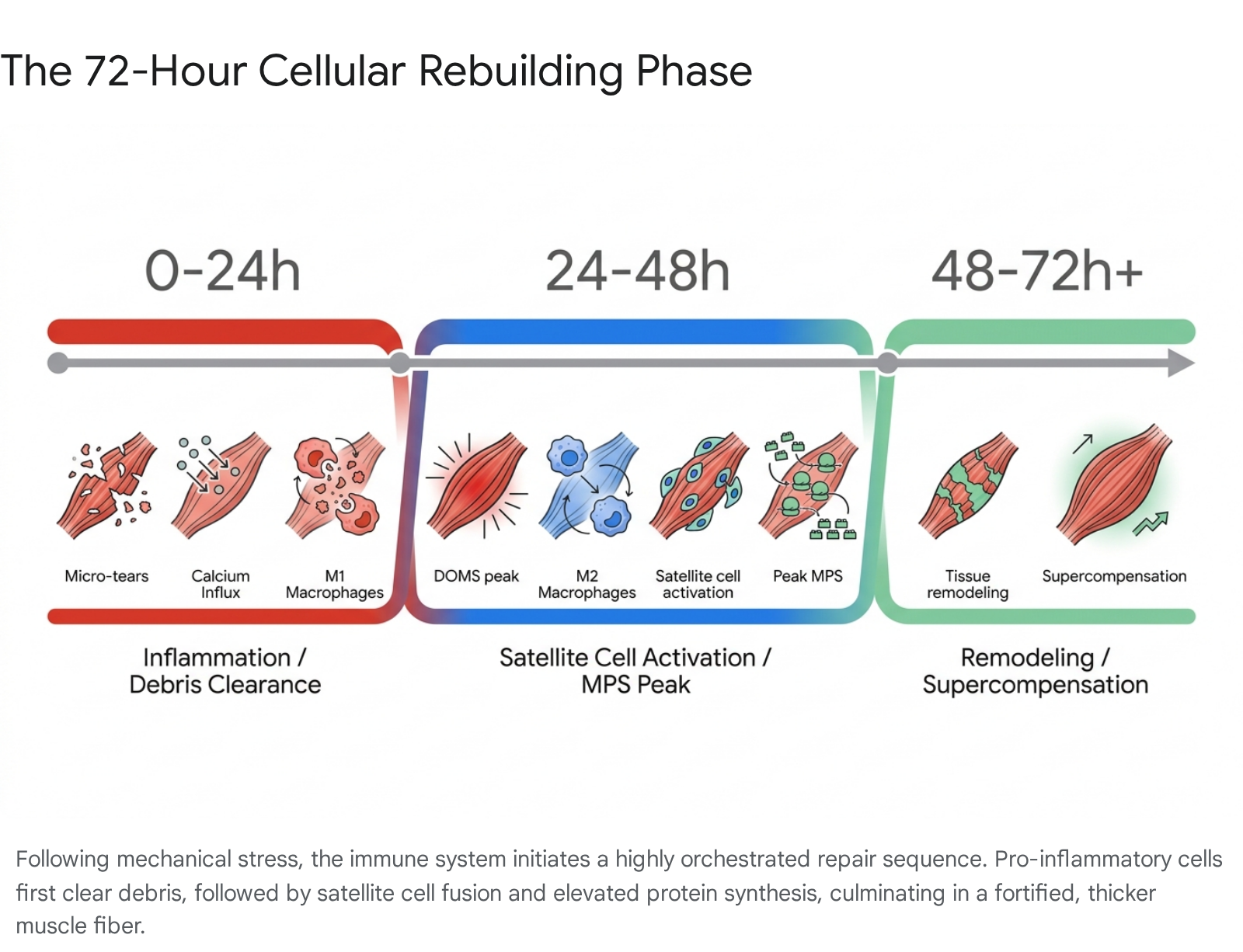
Once mechanical tension and eccentric loading create microscopic tears in the muscle fibers, the body orchestrates an incredibly intricate, time-dependent healing process that unfolds over the next 72 hours and beyond 1213.
Hours 0 to 24: The Inflammatory Clean-Up Crew
Immediately following a grueling workout, the affected muscle fibers are structurally compromised. The micro-lesions in the muscle cell membranes cause a loss of cellular regulation, allowing a massive influx of calcium ions from the extracellular space into the muscle cells 1613. This unregulated calcium flood acts as an emergency distress beacon for the surrounding biology.
The high calcium levels rapidly activate specialized destructive enzymes called proteases and hydrolases. These enzymes act like a microscopic demolition crew, snipping away and degrading the irreparably damaged muscle proteins and contractile filaments so that they can be replaced 1613. Simultaneously, the mechanical damage to the tissue signals the immune system to mobilize.
Within hours of the workout, white blood cells called neutrophils invade the damaged tissue, followed rapidly by highly aggressive, pro-inflammatory M1 macrophages 1613. These immune cells infiltrate the muscle to phagocytize, or consume and clear out, the cellular debris generated by the workout 1613. This localized inflammatory response is intense. The immune activity and the accumulation of metabolic byproducts cause fluid to rush into the muscle cells 25. This increased intracellular pressure, combined with the swelling of the surrounding tissue, begins to physically press against nearby sensory nerve endings, initiating the early, dull sensations of post-workout discomfort 25.
Debunking the Lactic Acid Myth
For decades, both fitness enthusiasts and medical professionals perpetuated the belief that muscle soreness on the days following a workout was caused by a lingering buildup of lactic acid in the muscle tissue 1526. Modern sports science has thoroughly and unequivocally debunked this hypothesis 15252627.
During high-intensity, anaerobic exercise, the body breaks down glucose for rapid energy, producing lactate and hydrogen ions as a metabolic byproduct 12627. While this local acidosis certainly causes the acute, fiery burning sensation felt during the final repetitions of a difficult set, it is an entirely transient phenomenon. The human body is highly efficient at clearing lactate from the muscles and the bloodstream; in fact, lactate is actively recycled by the liver and used as a valuable fuel source by the heart, brain, and the muscles themselves 12527.
Within 30 to 60 minutes after a workout concludes, blood lactate levels return completely to normal, resting baselines 152627. Furthermore, scientific observations note that concentric-only exercises produce significant amounts of metabolic lactate but cause almost zero delayed muscle soreness, whereas eccentric exercises produce less lactate but result in severe soreness 15. Therefore, the pain felt two days after a heavy leg workout has absolutely nothing to do with lactic acid; it is the direct neurological perception of immune-driven inflammation and physical micro-trauma 152526.
Hours 24 to 48: The Macrophage Shift and Myonuclei Addition
By the second day of recovery, the individual typically experiences Delayed Onset Muscle Soreness, commonly referred to as DOMS. This soreness marks the absolute peak of the body's inflammatory response 12526. Underneath the sensation of stiffness, a critical cellular transition is taking place to shift the body from demolition to construction.
The aggressive, pro-inflammatory M1 macrophages that cleared the debris begin to undergo a phenotypic shift, transforming into anti-inflammatory M2 macrophages 1613. This transition is crucial because the M2 macrophages release specific cytokines that signal the inflammation to subside and initiate the true tissue rebuilding phase 1613.
The primary biological agents responsible for actual muscle growth are satellite cells. These are specialized, dormant stem cells that reside silently on the periphery of the muscle fibers, just outside the cellular membrane 1619. Awakened by the shifting immune signals and the mechanical strain, these satellite cells activate, proliferate, and migrate directly to the sites of the micro-tears 161319.
Muscle cells are biological anomalies; unlike most human cells which have a single nucleus, muscle fibers are massive, cylindrical structures that contain hundreds of nuclei 20. Each nucleus can only manage the protein synthesis for a finite volume of the cell, a concept known as the myonuclear domain. In order for a muscle fiber to grow significantly larger, it requires more genetic management 1620. The migrating satellite cells solve this problem by physically fusing their membranes with the damaged muscle fiber, permanently donating their nuclei to the cell 1619. This permanent increase in myonuclei drastically and permanently boosts the muscle cell's long-term capacity to manufacture new proteins 1619.
Fascinating new research has also revealed a secondary, highly efficient repair mechanism that occurs alongside satellite cell activation. Studies utilizing advanced imaging have shown that within hours of exercise-induced damage, the existing nuclei already inside the muscle fiber will physically travel through the cell toward the site of the micro-tears 2021. Once they arrive at the damage site, these nuclei locally deliver concentrated messenger RNA molecules. These localized mRNA strands are rapidly translated into proteins, acting as immediate, on-site building blocks to patch the cellular breaches independently of stem cell fusion 2021.
Hours 48 to 72: Extracellular Remodeling and Supercompensation
As the timeline moves past 48 hours and approaches the 72-hour mark, the acute inflammation fully subsides, and the stiffness associated with delayed soreness begins to rapidly fade 1. The aggressive biological construction project reaches its final stages.
The rates of muscle protein synthesis, which spiked dramatically in the first 48 hours, begin to taper off and return to baseline levels 2232. However, the recovery process is not limited solely to the muscle fibers themselves. The surrounding architecture, known as the extracellular matrix, must also be remodeled. This matrix is the intricate web of connective tissue that encases the muscle fibers and transfers their contractile force to the tendons 2324.
During this late stage of recovery, specialized cells deposit new structural proteins, including collagen types 1 and 3, tenascin-C, and fibronectin, into the extracellular matrix 23. This structural fortification ensures that the connective tissue can withstand the increased force output of the newly enlarged muscle fibers. By the conclusion of this roughly 72-hour phase, assuming the body has been provided with adequate rest and nutritional raw materials, the muscle has completed its supercompensation cycle 1225. The tissue is now physiologically adapted, physically larger, structurally denser, and biologically more resilient than it was on day zero 25.
Muscle Protein Synthesis: The Engine of Growth
For any of these elaborate cellular repair processes to occur, the body must be supplied with the appropriate raw materials. This entire rebuilding phase is governed by a physiological mechanism known as muscle protein synthesis, the biological engine of muscle growth 2226.
Lifting heavy weights acts as the initial spark that turns the protein synthesis engine on, largely by activating a central metabolic signaling pathway known as mTORc1, which regulates cell growth in response to mechanical stress 6. However, turning the engine on is only half the equation; the engine cannot actually run without a continuous supply of fuel. This fuel comes in the form of dietary amino acids circulating in the bloodstream, particularly the essential amino acid leucine, which acts as a powerful nutritional trigger for the mTOR pathway 222637.
When high-quality dietary protein is consumed after a workout, protein synthesis rates elevate drastically. Isotopic tracer studies, which track how the body utilizes amino acids over time, reveal that compared to a resting baseline, muscle protein synthesis can surge by 112% at 3 hours post-exercise. It remains highly elevated by 65% at the 24-hour mark, and continues to hover around 34% above baseline even 48 hours after the training session has concluded 22.
Debunking the 30-Minute Anabolic Window Myth
Because protein synthesis is the key to recovery, fitness culture spent decades promoting the concept of an anabolic window. This theory dictated that there was a strict, 30-to-60-minute countdown immediately following a workout during which a protein shake had to be consumed. The prevailing belief was that if the lifter missed this narrow window, their muscles would go into a catabolic state, and all potential strength and hypertrophy gains from the workout would be permanently lost 3839.
Current sports medicine research has thoroughly dismantled the urgency of the anabolic window 38274142. Modern exercise science views the post-workout period not as a rapidly closing window, but rather as a massive, prolonged elevation in anabolic potential that remains open for 24 to 48 hours 394128.
Extensive meta-analyses reviewing dozens of hypertrophy studies have confirmed that when total daily protein intake is controlled for, the exact timing of the post-workout meal has no significant independent effect on long-term muscle growth or strength gains 44. If an individual has consumed a protein-rich, mixed-macronutrient meal one to two hours prior to their workout, their digestive system is still actively processing that food. Consequently, their bloodstream is already saturated with circulating amino acids that will continue to support muscle repair during and well after the training session concludes, rendering the immediate post-workout shake biologically redundant 392744.
The only scenario where immediate post-workout protein timing becomes critically important is if the individual is training in a completely fasted state, meaning they have not consumed food for several hours prior to the workout. In this specific context, rapidly supplying the body with amino acids helps halt muscle breakdown and kickstart the delayed recovery process 274429. For the vast majority of people, while consuming protein shortly after a workout is an excellent habit, it is an optimization rather than a strict necessity 2742.
Optimal Nutritional Guidelines for 2025 and 2026
The scientific consensus among organizations like the International Society of Sports Nutrition dictates that total daily protein intake is the single most powerful nutritional predictor of muscle recovery and hypertrophy, vastly overshadowing the minutiae of meal timing 38394446.
For individuals engaging in intense resistance training, the recommended daily intake falls strictly within the range of 1.4 to 2.2 grams of protein per kilogram of body weight to maximize muscle protein synthesis and repair 274630. Interestingly, recent 2024 studies from the University of Toronto have demonstrated that high-volume endurance athletes, such as marathon runners and cyclists, require protein intakes at the absolute upper end of this spectrum (roughly 1.85 grams per kilogram) to facilitate the massive remodeling of mitochondrial proteins required for aerobic adaptation 3132.
While hitting the total daily target is the primary goal, how that protein is distributed throughout the day can provide a secondary advantage. Research indicates that the body responds best to regular, evenly spaced protein feedings. The optimal strategy is to consume 20 to 40 grams of high-quality protein every three to four hours 2227463033. This specific dosage contains enough leucine to fully maximize the muscle protein synthesis response. Consuming massive, 100-gram boluses of protein in a single sitting is less efficient, as the muscle reaches a full capacity for synthesis, and the excess amino acids are simply oxidized by the liver for basic energy rather than used for tissue construction 373351.
One specific timing strategy that has shown significant clinical efficacy is the ingestion of pre-sleep protein. Because sleep represents a prolonged fasting period, consuming 20 to 40 grams of a slow-digesting protein, such as casein, approximately 30 minutes before bed has been proven to successfully elevate whole-body protein synthesis rates overnight 343536. This effectively transforms the sleeping hours from a catabolic fasting state into an active, anabolic repair window, augmenting long-term gains in muscle mass and strength 343637.
Modern Training Parameters: How Hard Should You Push?
A pervasive misconception in fitness culture is the belief that muscles must be absolutely annihilated to grow, leading to the assumption that extreme soreness correlates directly with extreme muscle adaptation. In reality, inflicting excessive muscle damage simply prolongs the inflammatory repair timeline, cutting into the time the body could be spending on supercompensation and actual growth 23238.
This paradigm shift in understanding fatigue and recovery is reflected in the landmark 2025 and 2026 updates to the American College of Sports Medicine Resistance Training Guidelines. After synthesizing data from 137 systematic reviews encompassing over 30,000 participants, the organization moved away from its decades-old, rigid percentage-based prescriptions to a highly flexible, individualized metric known as Reps in Reserve 39404160.
The Shift to Reps in Reserve (RIR)
Historically, training intensity was prescribed as a strict percentage of a lifter's one-repetition maximum, suggesting that lifting exactly 75 percent of one's maximum capacity was the only way to achieve optimal growth 39. However, this failed to account for daily fluctuations in fatigue, sleep quality, and joint health. The new guidelines establish Reps in Reserve as the gold standard for tracking effort 39.
Reps in Reserve requires the lifter to estimate how many additional repetitions they could perform before reaching absolute muscular failure. If an individual completes 10 repetitions but feels they could have grinded out exactly two more before the barbell crushed them, they have performed the set at two Reps in Reserve 39.
The comprehensive review found that training to absolute volitional failure - the agonizing point of zero Reps in Reserve where the lifter physically cannot move the weight - is completely unnecessary for maximizing either hypertrophy or strength 4061. Pushing a muscle to absolute failure creates massive central nervous system fatigue, severe structural tissue damage, and elevated joint stress that demands exponentially longer recovery periods 2406142. Instead, the clinical evidence confirms that stopping a set with two to three Reps in Reserve provides the optimal, virtually identical biological stimulus for muscle adaptation, while protecting the nervous system and drastically speeding up recovery times 394061.
| Training Variable | ACSM 2009 Guidelines (Historical) | ACSM 2026 Guidelines (Updated) |
|---|---|---|
| Primary Metric of Effort | Strict percentages of 1-Repetition Maximum (e.g., 70-85% 1RM). 39 | Reps in Reserve (RIR), evaluating proximity to failure regardless of the weight used. 3961 |
| Proximity to Failure | Encouraged pushing to muscular failure to maximize the hypertrophic response. 3942 | Emphasizes 2 to 3 Reps in Reserve; absolute failure is deemed unnecessary and overly fatiguing. 4061 |
| Hypertrophy Load Range | Required moderate to heavy loads (70%+ 1RM) to elicit significant muscle growth. 39 | Load-agnostic; low loads (30% 1RM) are equally effective as heavy loads if the set is taken near failure. 394061 |
| Overarching Philosophy | Complexity and specific repetition bins (e.g., 8-12 reps for size, 1-5 for strength). 4041 | Consistency and accessibility; total weekly volume and effort matter far more than rigid repetition schemes. 404163 |
Rest Intervals and Training Frequency
The optimization of recovery extends to the minutes between sets. Traditional dogma suggested that resting exactly one to two minutes was required for hypertrophy, while resting longer was strictly for powerlifters 6443. However, recent experimental studies have matched total training volume across groups using drastically different rest periods, such as 20 seconds versus two full minutes. The results demonstrated that as long as the total mechanical work performed by the muscle is equalized, extremely short rest intervals produce the exact same hypertrophic and strength adaptations as long rest intervals 6443. Short rest periods simply require the lifter to perform more total sets to compensate for the rapid fatigue, offering a time-efficient alternative for busy individuals 6443.
Because a damaged muscle typically requires 36 to 72 hours to complete its protein synthesis and structural remodeling cycle, conventional programming strongly advises resting a muscle group for at least two days before targeting it again to avoid injury 32254445. Yet, the body possesses a remarkable capacity for adaptation. Studies testing extreme training frequencies have shown that training the exact same muscle group every single day can yield substantial strength and hypertrophy gains, provided the total weekly volume is carefully managed 684647.
If an individual normally performs 15 intense sets for their chest on a Monday, splitting that workload into three sets performed daily from Monday through Friday results in identical, if not slightly superior, muscle growth due to the continuous, daily spiking of muscle protein synthesis 684648. However, the caveat is severe: attempting to perform high-volume, maximum-intensity sessions on the same muscle every day will rapidly outpace the body's macrophage clearance and satellite cell repair mechanisms. This leads to chronic fatigue, impaired neuromuscular coordination, connective tissue inflammation, and eventual injury 456849.
Individual Variability in Recovery and Adaptation
The 72-hour recovery timeline is an average, not a universal biological constant. The speed and efficiency at which muscle tissue repairs itself are heavily modulated by an individual's age, biological sex, and genetic predispositions.
The Impact of Aging and Anabolic Resistance
As human beings age, the cellular recovery process inevitably and measurably slows down. While a healthy 25-year-old might easily recover from a strenuous bout of eccentric resistance training in 48 hours, an older adult in their 60s or 70s may require up to seven full days for the exact same localized repair mechanisms to complete their cycle 4450.
This pronounced delay in recovery is driven by several compounding physiological shifts. The most significant barrier is a phenomenon known as anabolic resistance. As skeletal muscle ages, it becomes blunted and less sensitive to the anabolic signals of both dietary amino acids and mechanical tension 232426. Consequently, the mTOR pathway does not activate as easily. To trigger the same robust muscle protein synthesis response that a young person achieves with 20 grams of protein, an older adult often requires a significantly higher threshold, up to 40 grams of high-quality protein per meal 222326.
Furthermore, the extracellular matrix surrounding the muscle fibers undergoes structural changes with age, accumulating advanced glycation end-products and becoming stiffer and more fibrotic 2324. This stiffening makes the post-workout structural remodeling phase highly inefficient. Combined with elevated baseline levels of systemic inflammation, which disrupts the precise sequential action of the immune system's macrophages, the aging muscle demands significantly more time to clear cellular debris and finalize supercompensation 232444.
Biological Sex Differences in Hypertrophy
Historically, sports science research heavily overrepresented male participants, leaving a gap in understanding female physiology 3151. Modern, inclusive analyses reveal fascinating nuances regarding how males and females build strength.
Due to the massive differences in endogenous testosterone initiated during puberty, postpubescent males possess significantly higher baseline muscle mass and larger skeletal frames 5253. Consequently, following prolonged resistance training programs, men tend to experience slightly greater absolute increases in total muscle volume 5254.
However, when exercise physiologists calculate relative hypertrophy - the percentage of muscle growth relative to the individual's starting size - women and men build muscle tissue at practically identical rates 52. A woman's muscle fibers possess the exact same biological capacity for expansion and supercompensation as a man's when subjected to proportional mechanical tension.
Furthermore, extensive 2024 research evaluating protein metabolism across the menstrual cycle indicates that despite fluctuations in hormones like estrogen and progesterone - which can influence substrate oxidation - the actual dietary protein requirements necessary to maximize post-workout muscle repair are remarkably similar between male and female athletes 313251. Female physiology does not inherently require a different nutritional recovery strategy than male physiology for strength adaptation.
The Genetic Lottery of Muscle Damage
Beyond age and sex, genetic sequencing dictates how violently a human body reacts to exercise. Specific single nucleotide polymorphisms, which are natural variations in the genetic code, heavily influence the severity of exercise-induced muscle damage a person experiences 93878.
For instance, the ACTN3 gene encodes a protein that stabilizes the contractile z-lines within fast-twitch muscle fibers. Variations in this gene, along with variations in the IL6 and TNF genes that control inflammation, dictate the structural stability of the muscle and the aggressive nature of the subsequent immune response 3878. Individuals possessing certain less-favorable genotypes will inherently suffer more severe micro-trauma, experience vastly more painful delayed onset muscle soreness, and require much longer biological recovery periods after performing the exact same workout as their genetically gifted peers 38.
| Biological Variable | Impact on Recovery & Adaptation Timeline | Nutritional & Programming Adjustments Required |
|---|---|---|
| Youth and Peak Adulthood (20s-30s) | Standard recovery baseline; protein synthesis remains elevated for 24 to 48 hours. Rapid mobilization of satellite cells and efficient clearance of inflammatory debris. 223223 | Requires 1.4 to 2.2 grams of protein per kg daily. Generally necessitates 48 to 72 hours of rest before intensely targeting the same major muscle group again. 32252746 |
| Advanced Age (60s and Beyond) | "Anabolic resistance" blunts the protein synthesis response. A stiffer extracellular matrix and systemic inflammation extend the structural repair timeline to 4 to 7 days. 23244450 | Requires a higher protein dose per meal (30-40g+) to successfully trigger the mTOR pathway. Requires extended, planned rest days (72-120 hours) for localized muscular recovery. 22264450 |
| Biological Sex (Female vs. Male) | Relative percentage of muscle growth mirrors males perfectly. Estrogen may offer a slight protective effect against exercise-induced membrane damage. 31515253 | Protein synthesis thresholds and dietary requirements remain virtually identical to similarly trained males, regardless of menstrual cycle fluctuations. 313251 |
Actionable Strategies to Accelerate Muscle Repair
While the complex biological repair process cannot be infinitely rushed or circumvented, it can be severely bottlenecked if the body lacks the proper physiological environment. To optimize the critical 0-to-72-hour window and ensure maximum adaptation, exercise physiologists prioritize several evidence-based recovery interventions.
The most profound, non-negotiable recovery tool in existence is sleep. During the deep, slow-wave phases of sleep, the human endocrine system releases the vast majority of its daily growth hormone, a peptide that directly facilitates physical tissue repair, satellite cell activity, and neurological consolidation 79558182. Chronic sleep deprivation fundamentally disrupts this hormonal cascade, sustains systemic inflammation, and severely impairs the replenishment of muscle glycogen stores, functionally halting the supercompensation process 7982.
Passive rest, such as sitting on a couch for two days following a heavy workout, is rarely optimal for clearing severe soreness. Instead, strategic active recovery is highly recommended. Engaging in low-intensity, non-taxing movements, such as light cycling, dynamic stretching, or brisk walking, stimulates localized cardiovascular blood flow without inflicting further mechanical damage on the tissue 244505582. This circulatory flush delivers oxygen and fresh amino acids to the injury site while simultaneously assisting the lymphatic system in clearing out the cellular debris, metabolic waste, and lingering inflammatory cytokines left over from the macrophage clean-up crew 558182. Similarly, sports massage therapy provides minor but statistically significant reductions in delayed onset muscle soreness by increasing skin and muscle blood flow and downregulating nervous system tension 558256.
Hydration plays an equally critical role. The structural repair of muscle fibers and the cellular synthesis of new proteins are highly water-dependent metabolic processes. Dehydration compromises blood plasma volume, slowing the vascular delivery of essential nutrients to the micro-tears and increasing the likelihood of post-workout cramping 558156.
Finally, athletes must be cautious with the use of cold water immersion. While ice baths and extreme cryotherapy are excellent at reducing acute inflammation and numbing pain for athletes competing in multi-day tournaments, this massive reduction in inflammation is counterproductive for building strength. By blunting the immune system's initial pro-inflammatory macrophage response, routine ice baths disrupt the very cellular signaling required to activate satellite cells, ultimately blunting long-term muscle hypertrophy and strength adaptations 7982.
Bottom line
Building strength is a sequential, two-part phenomenon: an initial neurological upgrade that teaches the central nervous system to fire motor units with explosive efficiency, followed by a slower, structural rebuilding phase that thickens the actual muscle tissue. The physical act of lifting weights creates mechanical tension and cellular micro-trauma, sparking a 72-hour biological response where the immune system clears debris and satellite cells fortify the damaged fibers. While modern sports science has thoroughly debunked the urgency of the 30-minute anabolic window and the necessity of training to absolute failure, securing adequate total daily protein and prioritizing high-quality sleep remain the absolute, non-negotiable foundations for turning workout stress into physical strength.