
Is the brain really just a prediction machine?
For decades, the dominant metaphor in neuroscience, psychology, and public understanding alike has been that of the brain as a sophisticated computer processing inputs from passive peripheral sensors. In this deeply intuitive but fundamentally flawed model, the eyes act as video cameras and the ears as microphones, faithfully recording an objective external reality, translating it into electrical signals, and feeding it upward into the brain for processing, interpretation, and eventual conscious experience 12. According to this view, perception is a process of building a world from the ground up, combining raw pixels of sensory data into edges, edges into shapes, and shapes into meaningful objects, eventually arriving at the prefrontal cortex for conscious thought.
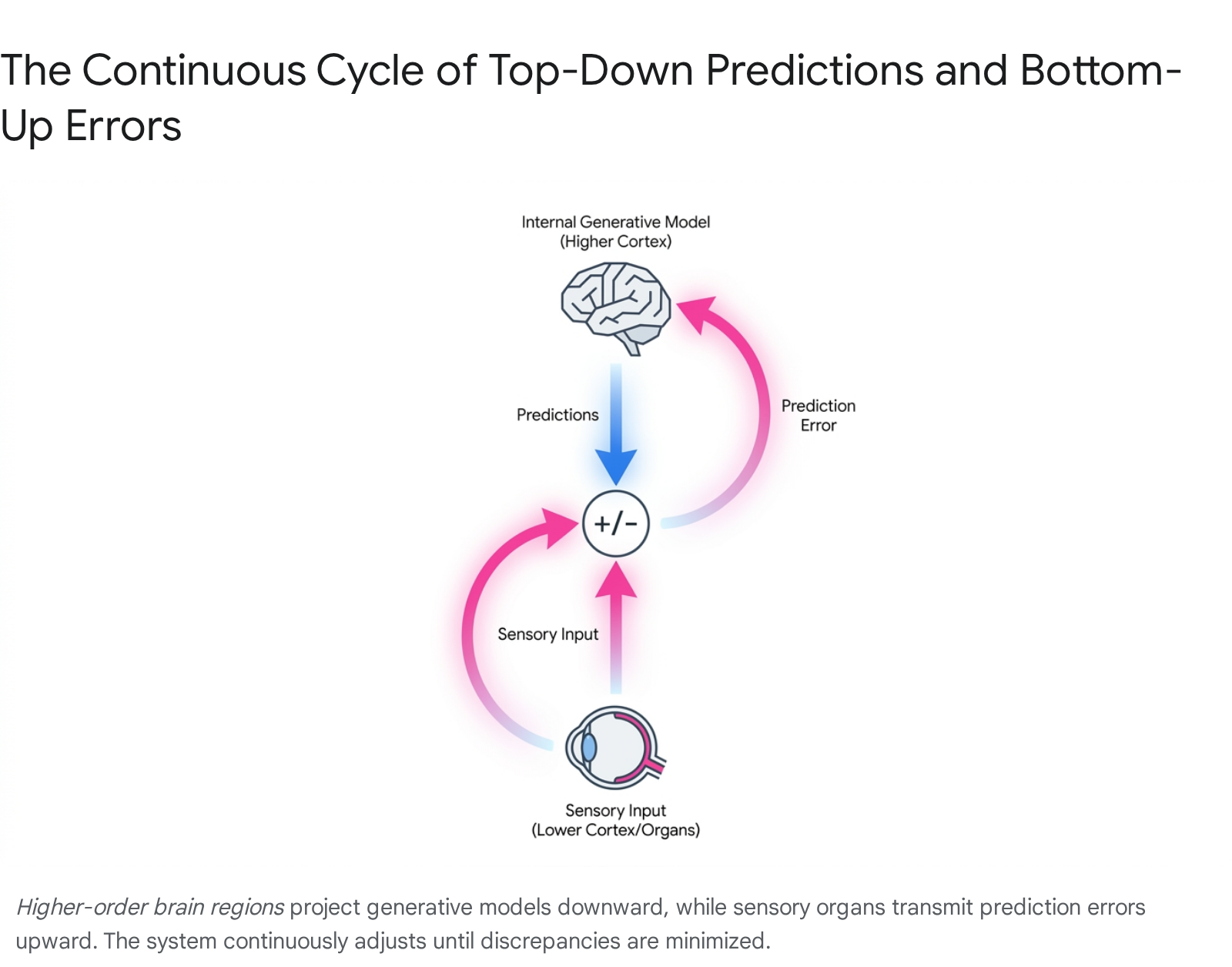
Predictive processing completely inverts this intuitive "passive camera" misconception 123. Instead of waiting for sensory information to build a picture of the world, the brain actively constructs a continuous, running simulation of reality based on memory, context, and past experiences 1. It then projects this simulation downward to the sensory organs as a set of expectations or "priors." The role of the sensory organs is not to transmit a full picture of the world, but merely to report back the differences between what the brain predicted and what is actually occurring in the physical environment. If the sensory input perfectly matches the brain's prediction, the information is largely ignored; the brain's simulation is confirmed, and the individual perceives what was expected. Only when there is a mismatch - a "prediction error" - does sensory data travel upward to update the brain's internal model 12.
Historically, this concept traces its roots back to the 19th-century German physicist and physician Hermann von Helmholtz, who proposed the idea of "unconscious inference" 454. Helmholtz argued that human perception is fundamentally a process of hypothesis testing, where the brain makes educated guesses about the causes of sensory signals based on prior experience. This intellectual lineage continued through 20th-century cybernetics and was mathematically formalized in the late 1990s by computer scientists Rajesh Rao and Dana Ballard, who demonstrated how hierarchical networks could use error signals to continuously update generative models of visual scenes 5. More recently, this concept has been unified into a grand, overarching biological imperative by neuroscientist Karl Friston through the "Free Energy Principle," and widely popularized in philosophy and cognitive science by thinkers like Andy Clark and Jakob Hohwy 148. In his foundational texts, Clark argues that to minimize the immense metabolic cost of constantly processing dense streams of incoming sensory signals, the bulk of what the brain actually does is maintain a predictive model of the body and the world 1.
Through this lens, the brain works much like the autocomplete function on a smartphone or a large language model, but on a vastly more complex, multidimensional, and embodied scale 610. It is constantly guessing the next word in a sentence, the next note in a song, and the next visual arrangement of a room as one turns their head. For instance, when listening to natural speech, the brain does not merely wait for the sound waves to arrive; it continuously forms expectations at multiple hierarchical levels - from overarching semantic meaning and grammar down to specific phonetic sounds 6. The brain does not simply process reality; it hallucinates a highly controlled version of reality, and uses sensory input to keep those hallucinations anchored to the physical world.
To fully conceptualize this paradigm shift, it is highly instructive to directly contrast the classic model of cognition with the predictive framework:
| Feature | Traditional Bottom-Up Processing | Predictive Processing (Top-Down) |
|---|---|---|
| Information Flow | Unidirectional: Sensory organs → Lower brain → Higher cognitive areas. | Bidirectional: Predictions flow down; Errors flow up. |
| Role of Sensory Input | The primary building blocks of perception; constructs reality from scratch. | Merely a feedback mechanism to correct the brain's ongoing simulation. |
| Handling of Ambiguity | Struggles with missing data; must "compute" missing parts after receipt. | Effortlessly "fills in the blanks" using prior expectations and contextual priors. |
| Computational Goal | To accurately represent the external world as a 1:1 map. | To minimize surprise (prediction error) and maintain internal thermodynamic stability. |
| Error Handling | Errors are seen as processing failures, noise, or system glitches. | Errors are the primary currency of learning, adaptation, and model updating. |
| Role of Memory | A passive storage archive accessed retrospectively when recalling the past. | The foundational, active blueprint used to continuously construct the present moment. |
What are prediction errors, and how are internal models structured?
To understand how predictive processing operates mechanically, one must examine the hierarchical structure of the cortex. The brain's processing architecture is highly stratified. Higher-order cognitive areas - such as the prefrontal cortex, which handles complex social dynamics and abstract logic - generate broad, abstract predictions about the environment. Conversely, lower-order sensory areas - such as the primary visual cortex (V1) or the auditory cortex - deal with highly specific, granular details like light contrast, spatial orientation, and pitch 2.
Predictions cascade downward through this neural hierarchy. A high-level expectation, such as a person knowing they are walking into their kitchen, generates a cascade of mid-level predictions, anticipating the presence of a refrigerator and a stove. These mid-level models, in turn, generate low-level sensory predictions, priming the visual cortex to expect a large, white, rectangular shape in a specific spatial location. Simultaneously, raw sensory data enters from the bottom up via the retina. At every individual level of the hierarchy, the descending prediction is compared mathematically to the ascending sensory reality.
When a discrepancy occurs, it generates a prediction error 24. A prediction error is simply the mathematical difference between what the generative model expected and what the sensorium observed. Instead of transmitting the entire visual scene of the kitchen upward, the lower levels strip away everything that was correctly predicted. They only transmit the prediction error - for example, the presence of an unexpected blue mug left on the counter - up to the next hierarchical level 5. This upward-traveling error signal acts as a corrective force, compelling the higher levels to update their internal generative models to account for the new reality. Once the model is updated to incorporate the blue mug, the error is successfully "minimized," or explained away, and the system returns to equilibrium 234. This continuous feedback loop of descending predictions and ascending prediction errors is the core computational mechanism of the predictive brain.
A critical, highly sophisticated nuance in this mechanism is the concept of "precision weighting" 10. The brain cannot treat all prediction errors equally, because sensory input is inherently noisy and internal models are occasionally outdated. The brain must constantly estimate the statistical reliability - or precision - of its sensory inputs versus the reliability of its internal priors. For instance, if an individual is walking through a thick fog at dusk, the visual input is highly uncertain and degraded. The brain will dynamically assign a low precision weight to the ascending sensory prediction errors, choosing instead to rely much more heavily on its top-down prior beliefs and spatial memory to navigate. Conversely, in bright daylight, sensory precision is extremely high, and the brain will readily update its models based on new visual evidence. This dynamic, continuous balancing act between prior beliefs and sensory evidence is formalized mathematically as Bayesian inference 278.
Furthermore, the predictive brain is not merely a passive observer updating its models; it actively changes the world to fit its predictions through a process known as "active inference" 2914. If the brain predicts that its hand is touching a coffee cup, but the sensory data reports that the hand is resting on the table, it faces a prediction error. It can resolve this error in two ways: it can update its model to accept that the hand is on the table (perceptual inference), or it can physically move the arm to grasp the coffee cup, thereby altering the sensory input to match the prediction (active inference). Under this framework, motor control and physical action are simply ways for the organism to fulfill its own sensorimotor prophecies 239.
What happens when our brain's predictions are wrong?
Because the brain relies so fundamentally on its internal models to construct reality, the precise calibration of these models is essential for healthy, adaptive functioning. When the predictive machinery falls out of balance - either by holding onto rigid priors too strongly or by giving far too much weight to noisy sensory errors - the result extends far beyond a momentary perceptual illusion. A growing consensus in computational psychiatry suggests that many clinical and psychological phenomena are rooted in dysregulated predictive processing. Investigating what this theory means for everyday life provides powerful, mechanistic explanations for a range of human experiences, though calibrated uncertainty must be applied, as the precise neurocomputational parameters and the resulting diagnostic classifications remain heavily debated within the global clinical neuroscience community.
Placebo Effects: The Biological Power of Expected Healing
The placebo effect has long been viewed with skepticism, frequently dismissed as a medical nuisance, a statistical artifact of regression to the mean, or a mere psychological curiosity where patients simply "think" themselves into feeling better. The predictive processing framework radically elevates the placebo effect, redefining it as a core biological mechanism of the nervous system 101112.
If the brain is a prediction machine, a medical intervention - even a sham one, such as a sugar pill, a saline injection, or a simulated surgery - operates as a powerful contextual cue that establishes a new, highly weighted prior expectation 1112. When a patient takes a pill that a trusted physician confidently describes as a powerful painkiller, the brain's higher-order cognitive models generate a strong, high-precision prediction that pain will rapidly decrease. To minimize the prediction error between this new, rigid expectation of "no pain" and the incoming sensory signals of physical "tissue damage," the brain does not merely ignore the pain psychologically; it actively alters the body's physiology through top-down signaling to make the prediction come true.
Recent neurobiological research clearly supports this predictive mechanism. Functional imaging reveals that the expectation of pain relief triggers a top-down neural cascade - traveling from the rostral anterior cingulate cortex, through the pontine nucleus in the brainstem, and down to the cerebellum 111314. This pathway stimulates the release of endogenous opioids, dopamine, and cholecystokinin (CCK). The brain essentially manufactures its own pharmaceutical analgesics to forcefully align the body's sensory state with its cognitive predictions. The inverse is equally true: this mechanism perfectly explains the "nocebo" effect, where negative expectations create very real adverse physiological side effects, such as nausea or heightened pain sensitivity, simply because the brain predicted they would occur 1215.
This predictive mechanism is so deeply embedded in human neurobiology that it remains efficacious even when patients are explicitly informed they are receiving a placebo. Recent clinical trials investigating "open-label placebos" have demonstrated significant, sustained symptom relief in conditions like irritable bowel syndrome (IBS), chronic lower back pain, and migraine 1216. As long as the clinical ritual provides enough contextual evidence to positively update the brain's generative model, the physiological predictions will follow. Contemporary research is even utilizing advanced machine learning to predict placebo susceptibility. A 2025 study utilized deep convolutional neural networks (DCNN) on resting-state EEG data from major depressive disorder (MDD) patients, successfully predicting placebo responses with 69% accuracy by identifying neural architectures linked to cognitive processing speed and expectation 10. Similarly, the advent of generative AI in healthcare documentation is raising ethical questions regarding the placebo effect; AI-generated clinical notes that exude extreme confidence and empathy may inadvertently strengthen patient priors, boosting placebo outcomes, while pessimistic AI language could trigger widespread nocebo effects 15.
Anxiety: Hyper-Precision and the Intolerance of Uncertainty
Anxiety disorders are the most common mental health conditions globally. Through the predictive framework, they are increasingly understood not merely as an excess of fear, but as a profound computational failure in the brain's handling of uncertainty and environmental volatility 1718.
In a healthy predictive system, when an individual encounters a novel, ambiguous, or mildly threatening situation, they experience a temporary spike in prediction error. This error prompts a rapid update to their internal model, allowing them to adapt and move forward. However, in pathological anxiety, the brain's predictive machinery becomes paralyzed. Individuals with anxiety disorders are hypothesized to possess hyper-precise threat priors - deeply entrenched, rigid expectations that the environment is fundamentally volatile, unpredictable, and dangerous 1718.
Because these negative priors are assigned an excessively high precision weight, the brain treats them as absolute truth. Consequently, incoming sensory evidence that contradicts these fears - such as a safe environment, a reassuring word, or a neutral facial expression - is computationally dismissed as noisy, unreliable, or irrelevant 1718. The brain fails to update its models, resulting in severe context rigidity.
Furthermore, this dysregulation extends inward to interoception - the brain's ongoing perception of internal bodily states like heart rate, digestion, and respiration 17. In conditions like panic disorder, a normal, mild fluctuation in heart rate (perhaps from walking up a flight of stairs) is computationally misinterpreted against a hyper-precise prior of physical vulnerability. The brain registers a catastrophic interoceptive prediction error, concluding that an impending heart attack is occurring, which triggers a full, systemic physiological panic response 1718. The brain infers the emotion of profound anxiety directly from these dysregulated bodily signals.
From a clinical perspective, this computational view suggests that therapeutic interventions should be precision-tailored to the specific predictive processing profile of the patient 18. For instance, a patient plagued by hyper-rigid, top-down threat beliefs may benefit most from cognitive restructuring techniques (such as those found in Cognitive Behavioral Therapy) to slowly and deliberately loosen the precision of their negative priors. Conversely, a patient plagued by exaggerated bottom-up interoceptive error signals might benefit far more from somatic grounding techniques, deep breathing exercises to reset vagus nerve tone, or targeted exposure therapies designed to recalibrate the precision weighting of raw sensory data 1824.
Autism Spectrum Disorder: Sensory Overweighting and Atypical Updating
The predictive processing framework has provided a highly influential - though still actively and rigorously debated - lens for understanding Autism Spectrum Disorder (ASD). The classical behavioral and psychological views of autism often struggled to unify the seemingly disparate core symptoms of the condition: profound social communication difficulties, intense and restricted interests, a deep preference for strict routines, and intense sensory sensitivities (either hyper-reactivity or hypo-reactivity).
In 2012, cognitive scientists Elizabeth Pellicano and David Burr proposed the seminal "weak priors" (or hypo-priors) hypothesis 18. They theorized that the autistic brain applies an unusually low precision weight to top-down prior beliefs, forcing the predictive system to rely almost entirely on bottom-up sensory likelihoods. If the brain cannot rely on its past experiences and contextual knowledge to "smooth over" and predict incoming data, it experiences the world in an unedited, high-definition, and highly unpredictable state 18.
This computationally explains autistic sensory overload: if the brain cannot efficiently predict the hum of a refrigerator, the complex visual pattern of a crowded room, or the flicker of a fluorescent light to seamlessly filter it out, that sensory data remains a constant, overwhelming stream of unresolvable prediction errors 18. It also elegantly explains the intense preference for routines and repetitive behaviors (stimming). These behaviors are viewed as a highly logical, adaptive strategy to artificially reduce environmental volatility; if the brain's internal prediction models cannot generate stability, the individual must physically enforce stability on the outside world.
However, recent empirical research in 2024 and 2025 has significantly nuanced and updated this view. Rather than suggesting autistic individuals possess an outright inability to form or utilize priors, newer studies utilizing high-volatility duration reproduction tasks suggest a mechanism of "atypical iterative prior updating" 7. These studies demonstrate that individuals with ASD can and do use prior knowledge effectively under stable conditions. However, they display a much stronger, persistent reliance on immediate sensory input to update their beliefs from moment to moment. While neurotypical individuals quickly form a central tendency and rely heavily on the prior, autistic individuals adapt more slowly, resulting in a weaker initial central tendency 7825. This distinct, dynamic interplay between sensory inputs and priors provides a unified computational explanation for both the extraordinary attention to detail and the profound distress caused by unexpected changes that characterize the autistic cognitive profile.
How does predictive processing transform learning and educational strategies?
If prediction error is the brain's primary physiological currency for updating its models, it logically follows that systematically inducing prediction errors is the most efficient, biologically congruent way to facilitate human learning 2627. Educational neuroscience is increasingly recognizing that standard, 20th-century methods of instruction - such as passive lectures, rote memorization, and error-avoidance strategies - are fundamentally misaligned with how the predictive brain is designed to operate.
When a student passively listens to a lecture or highlights a textbook, the brain is rarely forced to make a concrete, forward-looking prediction. Without a prediction, there can be no subsequent prediction error; without a prediction error, the brain interprets the information flow as highly predictable, redundant, and therefore unworthy of the metabolic cost required to encode it into long-term memory.
Conversely, when an educator actively asks a student to make a specific, explicit prediction before demonstrating a scientific concept or revealing a historical fact, the student's brain commits to an internal model 2619. When the actual answer is revealed to be different from the student's prediction, it triggers a sharp, high-precision prediction error. In behavioral terms, this error manifests psychologically as the epistemic emotion of "surprise" 2719. Recent neuroimaging studies utilizing event-related brain potentials (ERPs) and fMRI demonstrate that this surprise response drives rapid synaptic plasticity, dramatically increasing attention to the elaborative feedback, and significantly enhancing the encoding of the correct information into long-term memory networks 271920.
This specific mechanism underpins the well-documented efficacy of educational strategies rooted in "desirable difficulties," such as pre-testing (quizzing students before they have learned the material) and productive failure paradigms. Even when learners are highly confident but entirely wrong - a phenomenon known as the hypercorrection effect - the resulting prediction error is so massive that the subsequent corrective feedback is encoded far more deeply than if the student had simply been handed the correct answer initially 2627. This principle holds true across domains; in machine learning and reinforcement learning, prediction-error signals (often termed temporal-difference errors or reward prediction errors) are the exact mathematical drivers of system optimization and adaptive feature construction 30.
Moving forward, the practical implication for modern instructional design is a fundamental shift away from merely controlling cognitive load through pure direct instruction. Educators are now encouraged to design for "desirable surprise" - actively managing the rate and magnitude of prediction errors learners experience to keep the brain in an optimal state of adaptation 2631. Practical classroom applications include asking for a one-minute written prediction before a science demonstration, incorporating "error management training" where teachers purposefully model making and correcting common mistakes, and utilizing adaptive AI learning systems that track individual student data to personalize the frequency of predictive challenges 2632. In all these contexts, providing immediate, non-judgmental, elaborative feedback following an error is critical; the brain requires the correct data to successfully resolve the prediction error and reconsolidate the memory 2627.
Where are international labs taking predictive neuroscience today?
The investigation of the predictive brain is no longer a niche philosophical pursuit confined to a few theoretical centers; it has evolved into a massive, globally distributed, interdisciplinary scientific endeavor spanning cognitive neuroscience, computational psychiatry, educational psychology, and artificial intelligence. Between 2024 and 2026, the field has seen rapid, paradigm-shifting advancements.
While foundational concepts were largely developed in the UK and Europe by figures like Karl Friston at University College London and Andy Clark at the University of Sussex 14, the modern research landscape is highly decentralized and empirically driven.
In Europe, the Predictive Brain Lab based at the Donders Institute of the Radboud University in the Netherlands, headed by Floris de Lange, is currently producing some of the most disruptive research in the field 3334. One of the most significant theoretical breakthroughs of 2024 and 2025 challenges the strict hierarchical nature of predictive coding. Traditionally, it was thought that early sensory areas (like the primary visual cortex, V1) only computed low-level prediction errors regarding edges, contrast, or orientation. However, recent high-resolution fMRI, EEG, and neural recording studies by researchers in the Netherlands have demonstrated that even the earliest sensory areas reflect high-level, abstract semantic surprise 3421. For example, when a mouse or a human encounters an object that violates a high-level narrative context or a complex spatial rule, strong prediction errors and gamma oscillations are recorded directly in V1 3421. This suggests a new "dendritic" model of hierarchical predictive coding (dHPC), where high-level expectations heavily and directly modulate the very first stages of sensory perception, blurring the line between complex cognition and raw sensation far more than previously believed 21.
In the Middle East, predictive processing is moving rapidly from theoretical modeling to advanced clinical application. Researchers at Israel's Weizmann Institute of Science have utilized vast datasets from the "Human Phenotype Project" to train predictive AI models that serve as "digital twins" of patients 22. By learning how 17 different body systems change over a lifetime, these predictive models can forecast future diseases and flag potential health risks long before biological symptoms emerge, effectively reverse-engineering the predictive mechanisms of the human body 22. Concurrently, at Ben-Gurion University, computational teams are developing the DISCOVER method to make the black-box decisions of AI in medical imaging (such as predicting IVF embryo viability) more transparent, utilizing predictive disentanglement techniques to build essential trust between human clinicians and AI prediction engines 23.
In Asia, Chinese institutions like Peking University and the Chinese Academy of Sciences (CAS) are heavily investing in "NeuroAI" - an emerging discipline that seeks to bridge biological predictive processing with artificial neural network architectures 382425. Researchers at CAS are conducting highly advanced neurophysiological experiments on non-human primates to uncover the precise neuronal processes that mediate sensory working memory and visually guided behavior, mapping how neurons calculate error 26. Similarly, in Japan, researchers at the National Institute for Physiological Sciences (NIPS) discovered in 2025 that macaques possess independent sets of neurons in the medial prefrontal cortex specifically dedicated to encoding their own reward prediction errors (S-RPE) versus the reward prediction errors of others (O-RPE), highlighting the profound social dimension of predictive processing 27. Furthermore, researchers at the University of Tokyo (such as Yukie Nagai) are pioneering the application of embodied predictive processing in developmental robotics, attempting to replicate human "cognitive feelings" and understand neurodiversity by building robotic systems that learn to interact with the world strictly via prediction error minimization 4344.
In Australia, expansive research networks at Monash University and the University of Melbourne (led by researchers like Jakob Hohwy, Marta Garrido, Jason Mattingley, and Daniel Feuerriegel) are utilizing advanced magnetoencephalography (MEG) and machine learning to map how prediction errors are represented across different neural frequencies 828293031. These labs are intensely focused on computational psychiatry, mapping how predictive processes and prior history biases are disrupted in conditions such as schizophrenia, ADHD, and PTSD, moving beyond simple cognitive mapping toward precision psychiatric interventions 293031.
Finally, in South America, critical work is being done to ensure that predictive models of the brain are not solely calibrated on WEIRD (Western, Educated, Industrialized, Rich, and Democratic) populations. Institutions like the Latin American Brain Health Institute (BrainLat) in Chile, the Include Network, and UNSAM in Argentina are leading expansive, multi-national initiatives like the Human Brain Diversity Project and the ReDLat consortium 323334. These teams are combining automated speech and language assessments (ASLA) with predictive machine learning to detect the early linguistic footprints of dementia and Alzheimer's disease across diverse Latin American populations, aiming to reduce diagnostic biases and provide equitable, early interventions in diverse socio-biological contexts 3233.
What are the limitations and competing views of the prediction metaphor?
Despite its immense explanatory power, broad interdisciplinary adoption, and empirical success in both neuroscience and AI, the predictive processing framework is not without its fierce critics. As the theory has expanded its ambition to explain essentially "everything about the mind" 35, it has faced significant pushback from philosophers, radical cognitive scientists, and evolutionary biologists regarding the limitations of the "prediction machine" metaphor and the neurobiological reality of its claims.
The Representation Wars: Internalism vs. Radical Enactivism
The deepest and most contentious philosophical rift within the field today is the debate over mental representations 93654. The orthodox, "cognitivist" view of predictive processing (championed heavily by researchers like Jakob Hohwy) is strictly internalist. It posits that the brain builds literal, structural representations - generative models - of the outside world locked inside the darkness of the skull. In this view, the brain acts as an isolated, Bayesian scientist, inferring the causes of the sensory shadows cast upon its boundaries (the Markov blanket) 45954.
Conversely, the enactivist camp, specifically Radical Enactivism (REC) led by philosophers like Daniel Hutto, Erik Myin, and Shaun Gallagher, forcefully rejects this internalist narrative 365455. Enactivists argue that basic sensorimotor cognition is entirely contentless and non-representational. They argue that applying the math of the Free Energy Principle does not require the brain to build a detailed internal model of the world; rather, the organism's dynamic, physical coupling with the world through action is entirely sufficient for intelligent, adaptive behavior 93654. In this view, cognition is not an internal calculation of probabilities, but an active, embodied engagement with the environment. Researchers attempting a "Third Wave" integration (such as Kirchhoff and Kiverstein) argue that active inference is essentially enactive inference, proposing that consciousness spans the brain, body, and environment seamlessly 954. The debate over whether predictive processing requires internal representations or can exist as a purely embodied dynamic remains one of the most fiercely contested areas in the philosophy of cognitive science 95455.
The Dark Room Problem and Computational Intractability
A persistent, logical challenge to the framework is the famous "Dark Room Problem" 56. The critique is straightforward: if the fundamental biological imperative of the human brain is to perfectly predict its inputs and minimize surprise (prediction error), the optimal strategy for survival would be to find a completely dark, silent room and simply stay there forever, as sensory inputs would immediately become perfectly predictable and error would drop to zero 56.
Clearly, humans and complex animals do not do this. Humans actively seek out novelty, play, risk, extreme sports, and exploration - states that deliberately generate immense sensory surprise and prediction error 56. Proponents of the theory counter this by introducing the concepts of "expected free energy" and hierarchical active inference. They argue that humans have a deep, evolutionary prior belief that they are active, exploring creatures in a changing world. To minimize long-term uncertainty about survival (e.g., preventing starvation), organisms must occasionally explore their environment to map out resources, intentionally trading short-term spikes in prediction error for long-term predictability and survival 3057. Critics, however, remain skeptical. They argue that continually tweaking the mathematical models to encompass both novelty-seeking and novelty-avoidance risks making the theory entirely unfalsifiable; a theory that can mathematically explain any behavior explains nothing specific 23.
Furthermore, there is the "Tractability Problem." Critics argue that it is highly questionable whether the biological brain has the sheer computational capacity required to perform the vast, continuous number of Bayesian probability calculations required by the theory in real-time, especially considering the noise inherent in biological circuits 1058.
The Hard Problem of Consciousness and Metaphorical Limits
Philosophers like David Chalmers point out that predictive processing, for all its structural elegance, still deeply struggles with the "Hard Problem" of consciousness 1. Even if the brain is a perfectly optimized prediction machine seamlessly calculating prediction errors, why should the mathematical minimization of those errors feel like anything from the subjective inside? One could easily imagine an advanced artificial neural network performing flawless active inference as a "philosophical zombie," reacting to the world perfectly without any subjective, phenomenal experience or "cognitive feeling" 1. While prominent researchers like Anil Seth and Jakob Hohwy have posited that predictive processing is an excellent methodological tool for mapping the neural correlates of consciousness alongside other theories (like Global Workspace Theory or Integrated Information Theory), they often concede it may not be a complete, standalone theory of consciousness itself 235960.
Finally, the underlying metaphor itself is under heavy scrutiny. Equating the wet, organic brain to current computational models - such as deep learning algorithms that rely on biologically implausible mechanisms like global backpropagation to adjust weights - is scientifically risky 1437. While AI systems increasingly utilize predictive coding and self-supervised learning, the human brain operates with profound energy efficiency, relying on organic, local message-passing constraints between neighboring neurons that modern silicon machines cannot yet replicate. The prediction machine metaphor is an extraordinarily powerful lens that has revitalized cognitive science, but it is vital to remember that it remains, fundamentally, a metaphor 143762.
Bottom line
The predictive processing framework radically transforms our understanding of the human mind. Rather than viewing the brain as a passive receiver dutifully interpreting an objective reality, it reveals the brain as a relentless architect of experience, hallucinating a predictive model of the world and using the senses only to tether those hallucinations to physical truth. By recasting errors and surprises not as cognitive failures, but as the fundamental, driving mechanisms of learning, adaptation, and perception, this theory offers profound insights. From explaining the biological realities of the placebo effect and the sensory overwhelm in autism, to providing new precision therapeutic avenues for anxiety and revolutionizing educational design, the predictive brain model provides an elegant, albeit highly debated, blueprint for human cognition in the 21st century.