
How Your Package Gets From Click to Doorstep
When you place an online order, your package embarks on a highly choreographed, four-stage journey: order fulfillment, the first mile, the middle mile, and the last mile. This process relies on a complex network of warehouse robotics, long-haul freight hubs, and AI-optimized delivery routes to bridge the gap between digital storefronts and physical reality. Understanding this logistical pipeline explains how global carriers manage millions of daily shipments while navigating unpredictable traffic, weather, and consumer demands.
The High-Stakes Evolution of Delivery Expectations
Modern consumers suffer from what economists and retail psychologists call "time scarcity," leading to rapidly evolving expectations regarding delivery speeds. The psychological shift driven by major retailers has transformed the baseline of online shopping. By late 2024, the average e-commerce delivery time in the United States had dropped to 3.7 days, representing a 27% improvement year-over-year and a massive 44% acceleration compared to the 6.6-day average observed in 2020 123.
Furthermore, data indicates that 41% of global shoppers now expect delivery within 24 hours, and up to 77% of online shoppers expect certain products to be delivered within just two hours 245. Across the globe, approximately 64% of all e-commerce parcels currently arrive within two calendar days, with North America leading at a 72% success rate 26.
To meet these staggering expectations without destroying profit margins, the logistics industry has had to fundamentally re-engineer how physical goods move. The lifecycle of an online order is an intricate, multi-stage relay race involving autonomous robotics, dynamic pricing algorithms, and millions of human workers.
The Journey Begins: Inside the Order Fulfillment Center
The physical journey of your package begins before it ever enters a delivery truck. This internal warehouse phase, officially known as "pick, pack, and ship," is the operational backbone of e-commerce logistics 78. How efficiently a warehouse operates dictates whether an order leaves the facility on the same day it was placed or days later.
The Digital Handshake and Order Allocation
When an online order is confirmed, the data is immediately transmitted to a Warehouse Management System (WMS). The WMS acts as the digital brain of the fulfillment center. It verifies inventory levels, identifies the exact physical location of the product on the warehouse shelves, and generates a digital packing slip 79.
The WMS eliminates the guesswork of finding items. In advanced facilities, it assigns the order to the closest warehouse to the customer - a strategy known as distributed inventory. For instance, many retailers utilize centralized Midwest fulfillment hubs in cities like St. Louis, Chicago, or Indianapolis. Because the Midwest sits near the geographic center of the United States and intersects major freight corridors (like I-70 and I-55), these facilities can reach 96% of American homes within two to three days by truck, dramatically cutting down on cross-country transit times 111.
Picking Strategies: From Manual to Automated
"Picking" is the retrieval of ordered items from storage. A single mis-picked item can cost a retailer more than the actual price of the product due to reverse logistics (returns), eroded customer trust, and wasted shipping fees 7. To manage this, fulfillment centers employ various picking strategies based on their daily order volume and inventory complexity 1213:
- Piece Picking: A worker takes one packing slip and walks the warehouse to pick all items for a single order before moving to the next. This is straightforward but highly inefficient for operations handling thousands of orders 13.
- Batch Picking: A worker selects identical items for multiple different orders at the same time, reducing the number of trips to the same aisle 712.
- Zone Picking: The warehouse is divided into specific geographical zones. Workers stay in their assigned zone and pick only the items located there, passing the order bin down a conveyor belt to the next zone, much like a factory assembly line 13.
- Wave Picking: A hybrid of zone and batch picking, where items are picked across zones in specific timed intervals (waves) to align perfectly with carrier shipping schedules and outbound truck departures 1213.
The Robotic Revolution: A Ballet of Automation
To handle peak volumes - such as Amazon Logistics processing an estimated 17.2 million orders per day in 2024 (roughly 199 orders per second) - relying solely on human walkers is no longer feasible 2. The modern fulfillment center operates as a collaborative environment between human workers and Autonomous Mobile Robots (AMRs) 3.
Amazon, which utilizes a fleet of over 750,000 robots, has transitioned from a "person-to-goods" model to a "goods-to-person" model 4. Rather than humans walking miles through aisles, the warehouse floor resembles an intricate, high-speed ballet: 1. Storage and Retrieval: An inventory storage system called Sequoia houses products in plastic bins. When an order is placed, computer vision identifies the item, and a robotic arm called Sparrow uses suction cups to pick the individual item out of the bin and place it into a tote 45. 2. Heavy Lifting: If larger storage pods are needed, Hercules robots - which can lift up to 1,250 pounds - navigate the warehouse floor by reading grid stickers, fetching entire shelving units and bringing them to human packers 3. 3. Sortation: Once a human or machine packs the box, another robotic arm named Robin places the sealed package onto a smaller, swift robot called Pegasus or Xanthus 35. These robots navigate to specific zip-code-designated holes in the floor, dropping the packages down a chute to the loading dock 36. 4. Dock Loading: A beefy robotic arm called Cardinal grabs the boxes from the chute and stacks them into transport carts 5. Finally, Proteus - Amazon's first fully autonomous mobile robot that uses Simultaneous Localization and Mapping (SLAM) to freely navigate around humans without safety fences - slides under the cart and autonomously drives it straight into the outbound delivery truck 457.
By using machine learning to simulate traffic patterns, scientists prevent robot congestion on the floor, allowing fleets of thousands of robots to replan their routes in milliseconds if a collision is imminent 6.
Packing, Right-Sizing, and the "Label Created" Illusion
For non-automated packing stations, items are placed in appropriately sized boxes. "Right-sizing" the packaging is crucial because major shipping carriers calculate costs based on "dimensional weight." If a small item is shipped in a massive box, the retailer will be charged for the space the box takes up on the truck, directly eroding profit margins 7.
A shipping label containing the vital tracking barcode is then applied. At this exact moment, the customer usually receives an "Order Shipped" or "Label Created" email notification. However, the package is technically still sitting inside the warehouse 2122. It is only when the package is loaded onto an outbound truck that the fulfillment phase concludes, launching the physical transit journey.
The First Mile: Escaping the Warehouse
The "first mile" is the initial stage of the external supply chain. It encompasses the movement of packed goods from the retailer's fulfillment center (or the manufacturer's facility) to a regional distribution hub or carrier sortation facility 8242526.
Despite its name, the first mile can involve moving goods across a city or across an entire state. This stage focuses entirely on bulk movement rather than individual addresses. During the first mile, hundreds or thousands of individual customer orders are grouped together and loaded onto large trailers 824.
Efficiency here is critical. The first mile sets the foundation for the entire delivery process. If packages are loaded onto the wrong truck, or if the handoff to a freight carrier is delayed due to poor documentation, it creates a cascading ripple effect that compromises the rest of the delivery schedule 89. For a smaller e-commerce merchant, the first mile might mean a local postal worker picking up a bin of packages from their loading dock. For major enterprises, it means massive semi-trucks leaving a million-square-foot warehouse on a precise, to-the-minute schedule governed by complex logistics contracts 249.
The Middle Mile: The Long-Haul Logistics Artery
The middle mile is the long-distance artery of the shipping network. It is often considered the backbone of the supply chain, connecting the first and last miles 82425. This phase involves transporting goods between distribution centers, regional hubs, airports, and retail fulfillment centers 2510. Depending on the distance between the origin warehouse and the customer, the middle mile can span hundreds or thousands of miles via long-haul trucking, rail freight, or cargo aircraft 2429.
Because the middle mile deals entirely with consolidated freight - moving massive volumes across long distances between fixed points - it loves economies of scale 29. Filling up a 53-foot trailer and driving it non-stop on an interstate is highly cost-effective per unit 29.
The Hub and Spoke Architecture
To manage the sheer volume of packages traveling in different directions, major logistics carriers (like UPS, FedEx, DHL, and the USPS) rely heavily on the Hub and Spoke distribution model 301112.
Imagine the structure of a bicycle wheel. The center is the "hub" (a massive central sorting facility), and the lines radiating outward are the "spokes" (the transportation routes leading to specific regional centers or local delivery depots) 301133.
In a traditional point-to-point network, every location must connect directly to every other location. If you have fifty cities, establishing direct trucking routes between all of them creates logistical chaos, overlapping routes, and partially empty trucks. The hub-and-spoke model solves this by consolidating freight into central facilities, drastically reducing the total number of necessary routes and allowing carriers to maximize truck capacity 301213. Instead of sending five half-empty trucks from five different cities directly to Lyon, all goods are sent to a regional hub. There, they are combined into one fully loaded trailer (Full Truckload) bound directly for Lyon 13.
Comparing Point-to-Point vs. Hub and Spoke
| Feature | Hub and Spoke Model | Point-to-Point Model |
|---|---|---|
| Routing Structure | Freight moves through a central sorting hub before reaching its final destination 3011. | Freight moves directly from origin to final destination 1133. |
| Package Handling | Involves multiple touchpoints and sorting phases at various hubs 30. | Minimal handling; the package often stays on one vehicle 30. |
| Asset Utilization | High; enables fully loaded trucks and massive economies of scale 1213. | Variable; risks sending partially empty trucks on long, inefficient routes 13. |
| Best Used For | National distribution, massive parcel volumes, standard e-commerce shipping networks 3012. | Highly time-sensitive local deliveries, high-volume predictable direct routes 3011. |
The "Airline Passenger" Routing Analogy
In advanced middle-mile networks, the movement of your package closely mimics commercial airline passenger travel 35. Just as an airline uses dynamic pricing and hub layovers to fill seats on connecting flights, logistics providers dynamically route packages to optimize network capacity 3514.
If you pay for standard 5-day shipping, your package acts like a passenger with a cheap ticket on a layover: it might sit in a sorting hub for 12 hours waiting for the most cost-effective truck to fill up. If you pay for overnight air, your package gets a "direct flight" with priority loading 35. Carriers constantly analyze network patterns, capacity utilization, and backhaul opportunities to route packages through connecting hubs, dynamically rating shipments based on time-of-day risk and loading speed 3514.
Cross-Docking: Movement Without Storage
To keep packages moving swiftly through the middle mile, modern logistics hubs utilize a technique called "cross-docking" 13. When a truck arrives at a regional spoke facility from the main hub, the inventory does not go onto warehouse shelves to rest. Instead, it is immediately unloaded, moved directly across the loading dock, and loaded straight into the smaller local delivery vans waiting on the other side of the building 13.
The Last Mile: The Most Expensive Stretch of Pavement
The last mile (or final mile) is the concluding stage of the shipping process, where a package is transported from a local distribution center directly to the customer's doorstep 241037. While it covers the absolute shortest geographical distance of the entire journey, it is paradoxically the most complex, error-prone, and expensive leg of the global supply chain 241038.
Why the Final Mile Bleeds Money
According to industry data, last-mile delivery accounts for a staggering 53% of total shipping costs 243339. The economics of the last mile shift drastically away from the smooth efficiencies gained in the middle mile.
In the middle mile, a single driver in a semi-truck can move 5,000 packages between two distribution centers over 500 miles on an open highway. In the last mile, a single driver in a box truck or van must make 100 individual stops 2429. They must navigate unpredictable urban traffic, find scarce parking, walk up driveways, dodge loose dogs, and deliver just one or two small packages at a time 2940.
This concept is known as "low stop density," and it utterly destroys economies of scale 40. The cost breakdown of the last mile is heavily weighted toward human effort and vehicular wear-and-tear.
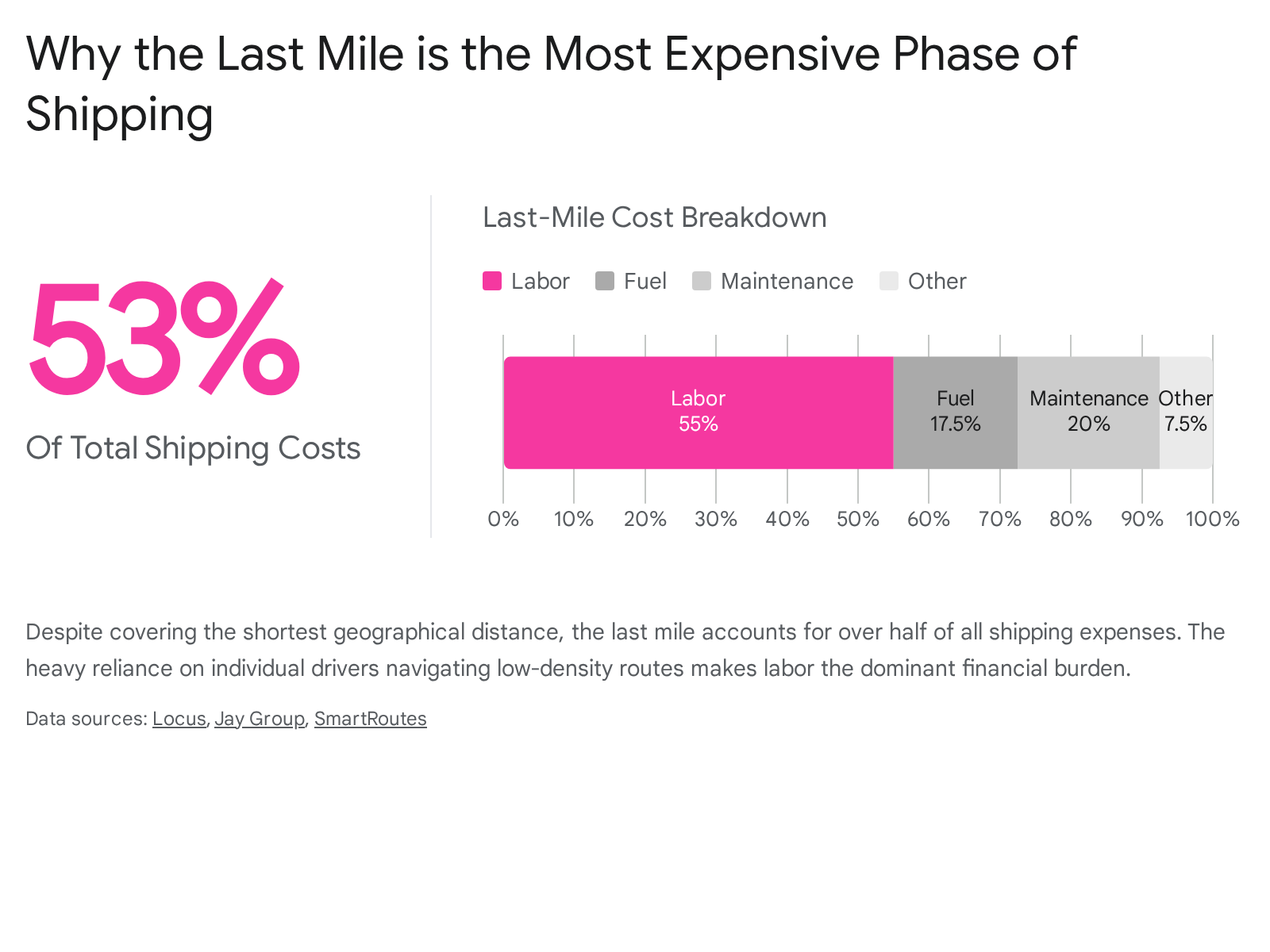
The average cost of a standard package delivery has risen to roughly $10.10 for carriers 439. Because consumers expect free or cheap shipping (the average consumer charge is only $8.08), retailers are forced to absorb this loss directly from their margins 39.
The Heavy Toll of Failed Deliveries
Another massive drain on last-mile efficiency is the failed delivery attempt. A failure occurs when a package requires a signature but the recipient is not home, when an address is illegible, or when an apartment complex lacks secure access 241516.
Globally, 8% to 20% of parcels fail to reach the recipient on the first attempt 16. Every time a driver must load a package back into the van, return it to the depot, and attempt delivery again the next day, the operational cost doubles 4016. Industry data shows that the average cost of a failed delivery attempt reaches nearly $17.78 per occurrence in the United States 43916. Because consumers are not charged for a second attempt, these failures are a hidden crisis destroying logistics profitability 3916.
Artificial Intelligence and the Next-Gen Dispatcher
With e-commerce volumes reaching over $1 trillion annually and driver labor costs soaring, human dispatchers using static maps can no longer manage the complexities of last-mile delivery 4344. The industry is rapidly turning to advanced Artificial Intelligence (AI) and machine learning to salvage their margins 171847.
Dynamic Route Optimization: The ORION Blueprint
Traditional route planning was entirely static; a driver was assigned a specific zip code and followed the same general path every day, regardless of parcel volume or road conditions 1920. Today, AI algorithms perform "Dynamic Route Optimization." These systems ingest vast datasets - including real-time traffic congestion, weather events, delivery time windows, and vehicle capacity - to generate the most efficient path on the fly 381747.
The most famous example of this is UPS's On-Road Integrated Optimization and Navigation (ORION) system. Developed over a decade with operations research experts, ORION analyzes over 200,000 routing options for a single driver every single day 2122. The implementation of dynamic ORION routing allows UPS to reduce individual driver routes by an average of two to eight miles 212223. While a few miles may sound insignificant, at UPS's massive scale, this software saves the company 100 million miles driven per year, cuts 10 million gallons of fuel consumption, and reduces annual operating costs by $300 to $400 million 202123.
Predicting the Unpredictable: Weather, Traffic, and Exceptions
Logistics is inherently vulnerable to the real world. A sudden snowstorm in the Rockies or a multi-car pileup outside Atlanta can derail a week of meticulous planning in seconds 44.
Where traditional GPS simply tells a driver where to go, predictive logistics tells a dispatcher where the problem will be before it happens 44. For example, FedEx utilizes an AI platform that leverages deep learning to predict potential network delays 48 to 72 hours before they occur. By analyzing weather patterns and operational bottlenecks, the system makes automated rerouting decisions without human intervention, improving on-time delivery performance by up to 20% in optimized corridors 40.
Balancing the Gig Economy with Dynamic Pricing
The last mile faces a unique vulnerability known as a "flash surge" - a sudden, unpredictable spike in local delivery demand caused by a holiday, a flash sale, or even a local rainstorm keeping people indoors 53. When demand exceeds the capacity of a traditional professional delivery fleet, the system breaks.
To solve this, AI models treat delivery capacity as a real-time, fluctuating commodity. By utilizing dynamic pricing, AI systems can instantly raise payouts to incentivize gig-economy delivery drivers (such as Amazon Flex or independent couriers) to log in and flood into a specific "hot zone" 53. Conversely, AI serves as a behavioral tool for consumers, offering predictive discounts at checkout to buyers who willingly choose "eco-windows." If an algorithm knows a truck is already scheduled to be in your specific neighborhood on Thursday, it will offer you a discount to delay your package until Thursday, thereby increasing route density and reducing carbon emissions 53.
Predicting Porch Piracy
AI is also quietly combating the growing epidemic of package theft. With an estimated 58 million parcels stolen from U.S. doorsteps in a single year, companies like UPS have developed AI software (like DeliveryDefense) that analyzes historical loss frequencies to identify high-risk zones 24. By predicting where and when thefts are most likely to occur, dispatchers can adjust delivery schedules so packages arrive exactly when residents are expected to be home, minimizing the time a box sits vulnerable on a porch 24.
Decoding Your Package Tracking Statuses
For the consumer, the physical journey of a package is entirely invisible. Their entire experience is dictated by the tracking updates they receive on their phone or computer. Studies show that 91% of consumers actively track their packages, making digital transparency a baseline expectation 3925. However, the terminology used by carriers and retailers can be deeply confusing, leading to customer service complaints and frustration.
Transit Time vs. Delivery Time
The most common point of friction for online shoppers is conflating transit time with delivery time 5657.
- Transit Time only measures the duration a package is physically moving in the carrier's possession (from the exact moment the carrier picks it up at the warehouse dock to the moment it hits your doorstep) 5657.
- Delivery Time is the total clock from the moment you click "buy" on the website to the moment the box arrives 56.
If an e-commerce site promises "2-Day Shipping," that generally refers strictly to the carrier's transit time. If the retailer's warehouse takes 48 hours to process, pick, and pack the order before handing it to the carrier, the actual delivery time the customer experiences will be four days 5658. Understanding these separate, measurable clocks is crucial for managing expectations 56.
What Every Tracking Update Actually Means
Here is exactly what is happening in the physical world when your tracking status updates:
- Order Placed / Confirmed: You have completed checkout. The retailer's system has accepted your payment and validated your address, but no physical action has occurred in the warehouse yet 2225.
- Order Processing / In Fulfillment: The warehouse WMS has generated a digital packing slip. Human workers or robots are actively walking the aisles, picking the items from the shelves, and packing them into cardboard boxes at a packing station 122225.
- Label Created / Shipped: A physical shipping label has been printed and adhered to your box. The retailer's system has electronically pinged the carrier (like UPS or FedEx) to expect the package. Crucially, the carrier does not physically possess the package yet - it is likely sitting on a pallet near a loading dock 2122.
- In Transit / On the Way: The package has finally been handed off to the carrier and scanned into their network. It is traveling via the First Mile or Middle Mile 225759. If your package is traveling cross-country, it may remain "In Transit" for several days without a new scan until it reaches the next major connecting hub .
- Arrived at Local Facility: The package has completed the long-haul Middle Mile. It has arrived at the local distribution center or post office closest to your zip code and is waiting to be sorted onto a local delivery vehicle 22.
- Out for Delivery: This is the most anticipated status, signaling that the Last Mile has officially begun. The package has left the local facility and is physically sitting on the specific delivery truck or van assigned to your neighborhood 602662. Because drivers load their vehicles in the early morning and arrange them by route efficiency, your status may change to "Out for Delivery" at 7:00 AM, even if the driver won't physically reach your street until 6:00 PM 6026.
- Exception / Delayed: Something has unexpectedly interrupted the planned route. This could be due to severe weather, a vehicular breakdown, an illegible shipping label, traffic congestion, or a customs hold for international orders 22.
- Attempted Delivery: The driver arrived at your location but could not complete the drop-off. This usually happens if the package requires a signature and no one is home, or if an apartment gate is locked 2122.
- Delivered: The driver has physically scanned the package at your location and dropped it off. At this exact second, the driver's handheld device pings the central cellular network, sending the final tracking update to your phone 2122.
Bottom line
The journey of a package from the moment an order is placed to its arrival at your doorstep is a marvel of modern engineering, requiring the seamless integration of warehouse robotics, vast long-haul transportation networks, and highly complex local delivery routes. While internal fulfillment automation and middle-mile hub-and-spoke networks have largely been mastered to drive down operational costs, the "last mile" remains a wildly expensive, unpredictable hurdle dictated by traffic, weather, and low-density neighborhoods. Moving forward, the continued evolution of artificial intelligence - powering predictive demand forecasting and real-time dynamic routing - will be the critical factor in ensuring that consumer demands for ultra-fast delivery can be met sustainably.