
How to Use Implementation Intentions to Reach Your Goals
Implementation intentions are specific, predefined "if-then" plans that link a situational cue to a desired behavior. By deciding in advance exactly when, where, and how you will act, you bypass the need for in-the-moment willpower and motivation. Decades of psychological research confirm that this strategy significantly increases the likelihood of achieving goals compared to standard intention-setting, though it must be applied strategically to avoid psychological rigidity or anxiety.
The Intention-Behavior Gap: Why Good Goals Fail
Most goal-setting paradigms rely heavily on motivation, willpower, and positive thinking. People regularly set ambitious targets - to exercise more, save money, learn a language, or finish a creative project - only to abandon them shortly after starting. Psychologists refer to this frustrating discrepancy between what we plan to do and what we actually do as the "intention-behavior gap" 12.
Research indicates that having a positive intention alone is rarely sufficient for complex or long-term behavior change 3. Goal-setting generally increases initial motivation, but motivation tends to wane once the novelty of a new project wears off and the friction of daily life sets in 4. One major issue is that standard goal intentions (e.g., "I intend to eat healthier") focus purely on an outcome. Because outcome goals are binary - you are either succeeding or failing - they offer zero daily guidance and frequently trigger an all-or-nothing mindset 4.
Furthermore, human environments are filled with distractions, competing goals, and cognitive demands. Relying solely on conscious, deliberate choice every time an action is required is cognitively exhausting. Without a pre-determined plan for execution, individuals often fail to seize opportunities to act, forget their intentions entirely, or succumb to more immediate temptations 23. The human brain naturally favors cognitive ease and established habits over effortful self-regulation.
The Architecture of an Implementation Intention
Developed in the late 1990s by psychologist Peter Gollwitzer, the concept of the implementation intention offers a volitional strategy designed specifically to bridge the gap between intention and action 458.
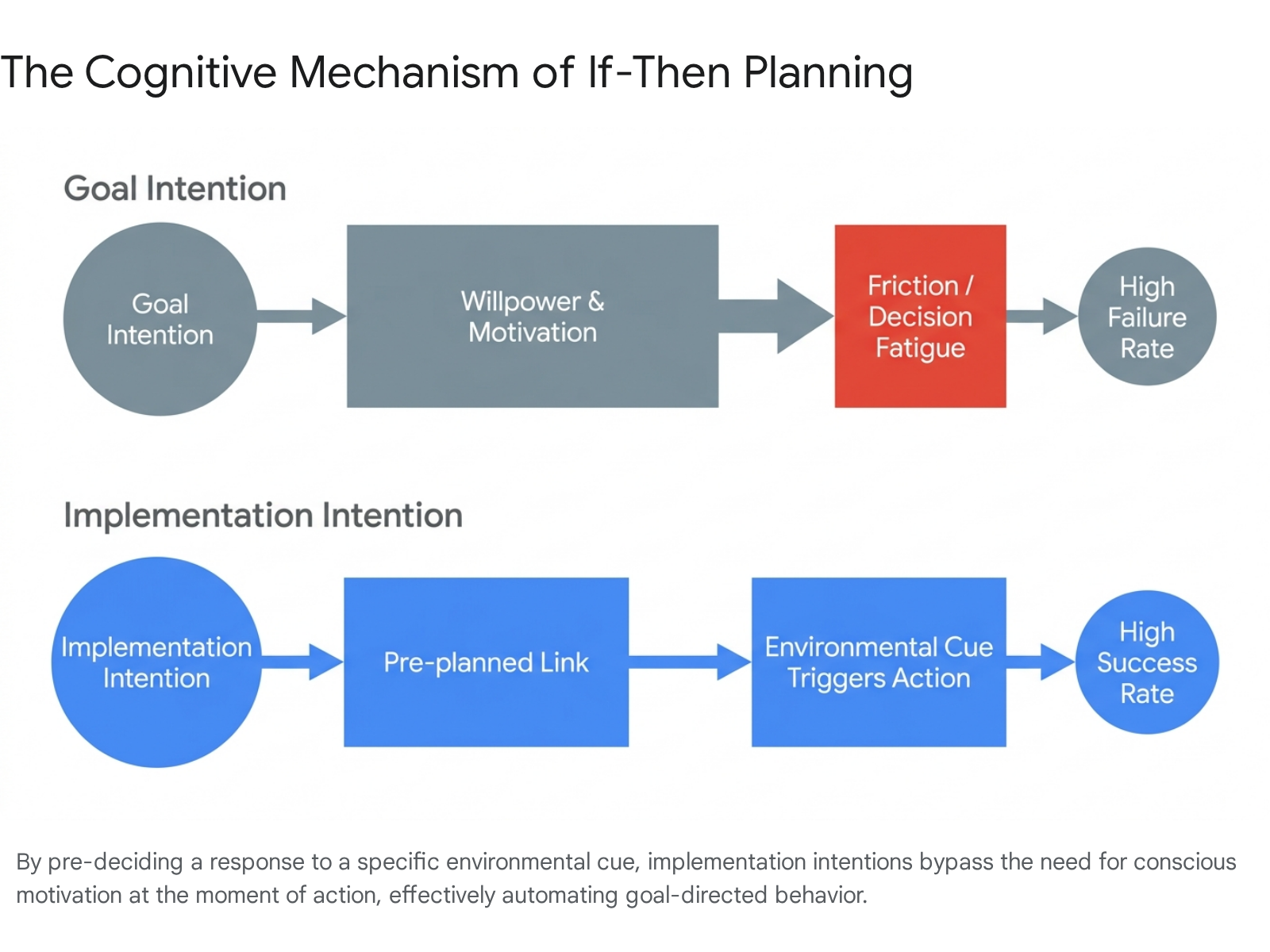
Whereas a standard goal intention specifies what one wants to achieve ("I intend to reach goal Z"), an implementation intention specifies the when, where, and how of goal-directed behavior in a strict "if-then" format: "If situation X arises, then I will perform response Y" 156.
By explicitly linking a situational cue (the "if" component) with a specific, goal-directed behavior (the "then" component), implementation intentions shift the burden of action initiation away from internal motivation and onto external environmental triggers 410. You do not have to "decide" to act; the environment prompts the action for you.
The Neuroscience and Cognitive Mechanisms
Brain imaging studies, physiological correlates, and cognitive psychology research reveal why implementation intentions are so potent. When a person forms an if-then plan, two critical cognitive processes occur to alter how the brain manages behavior:
- Heightened Cue Accessibility: The mental representation of the critical situation (the "if" part) becomes highly activated and accessible in the brain's memory systems. This means that when the situation arises in the real world, the individual immediately recognizes it. They involuntarily attend to the cue, making it nearly impossible to ignore 47.
- Delegation of Control (Strategic Automaticity): A strong associative link is forged between the cue and the intended behavior. Encountering the cue directly triggers the response, bypassing conscious deliberation 712. This operates similarly to classical conditioning, but it is achieved through a single, deliberate mental act rather than thousands of repetitions.
Neurologically, forming a broad goal engages regions associated with effortful self-initiated actions, such as the prefrontal cortex 13. However, once an implementation intention is formed, control over the behavior begins to shift toward more automatic processing systems. The response acquires features of automaticity - it occurs immediately, efficiently, and often without requiring further conscious intent 48. The ACT-R (Adaptive Control of Thought-Rational) theory of cognition supports this, showing that implementation intentions drastically reduce the cognitive effort required to execute a behavior by strengthening the associative memory mechanisms that recall the correct action at the exact right time 9.
Goal-Setting Frameworks: A Comparative Analysis
In corporate, clinical, and educational environments, several goal-setting frameworks exist, with SMART goals (Specific, Measurable, Achievable, Relevant, Time-bound) being the undisputed standard 4. While both SMART goals and implementation intentions advocate for specificity, they function very differently and serve distinct psychological purposes.
To choose the right framework, it is vital to understand their operational differences, ideal use cases, and inherent failure modes.
| Feature | SMART Goals | Implementation Intentions | Open Goals & OKRs |
|---|---|---|---|
| Primary Focus | Defining the exact outcome and parameters of success (the destination). | Defining the specific situational trigger and the behavioral response (the vehicle). | Setting an aspirational, exploratory direction (Open) or ambitious team objectives (OKRs) 16. |
| Best Used For | Tactical execution, project management, and tracking rigid quantitative metrics 16. | Habit formation, behavior change, overcoming procrastination, and routine-building 416. | Creative tasks, learning complex new skills, and brainstorming 16. |
| Core Format | "I will increase product sales by 10% by the end of Q3." | "If it is 9:00 AM on Monday, I will call 5 new sales prospects." | "I will see how many new prospect strategies I can brainstorm today." |
| Common Failure Mode | Can create "tunnel vision," system gaming, or a drop in broader contextual performance 4. | Vulnerable if the specified cue never occurs or if motivation for the underlying goal is absent 410. | Lack of measurable progress can lead to drifting, lack of urgency, or difficulty coordinating large teams. |
The Limitations of SMART Goals
Despite their massive popularity, the scientific underpinnings of the SMART acronym are surprisingly weak, especially in domains requiring behavioral flexibility or creative work 10. A major study analyzing 4,000 employees comparing SMART goals to broader, directional goals found that while SMART goals improved performance on the specific metric being tracked by 8%, they simultaneously caused a 12% drop in performance across the employee's broader role 4. This occurred because SMART goals frequently create tunnel vision, encouraging individuals to optimize for the exact measurement while ignoring wider context.
Furthermore, a 2024 study published in Educational Psychology evaluated 247 participants performing creative tasks. The researchers found that SMART goals were no more effective than exploratory "open goals" or "do-your-best" instructions for creative performance 16. For tasks involving complex problem-solving or creating something original, the rigid parameters of a SMART goal can actively constrain lateral thinking.
Implementation intentions handle the process rather than the outcome. By focusing entirely on a system (e.g., "If it is 7:00 AM, I will write for thirty minutes") rather than an outcome ("I will finish a novel by December"), if-then plans actively build identity and provide consistent daily wins 4. Research suggests that systemic process goals command a significantly higher success rate (67% to 76%) compared to binary outcome goals, which trigger all-or-nothing thinking and suffer from high abandonment rates once initial enthusiasm fades 4.
Do Implementation Intentions Actually Work?
Decades of experimental research show that implementation intentions have a robust, medium-to-large effect size on goal attainment 9. A recent massive meta-analysis aggregating 12 previous meta-analyses covering hundreds of distinct studies found a weighted-average effect size of d = 0.46 . This indicates that the strategy is not a psychological fad, but a highly reliable and efficacious tool for human behavioral control.
The effectiveness spans across domains: health, academic performance, personal finance, and even complex emotional regulation.
Health, Diet, and Physical Activity
The most famous demonstration of the strategy's power comes from a landmark study published in the British Journal of Health Psychology regarding exercise adherence. The researchers divided participants into three cohorts: a control group, a "motivation" group that read detailed literature on the cardiovascular benefits of exercise, and an "intention" group that read the exact same literature but was also instructed to formulate a specific plan of when and where they would exercise over the following week 10.
The results were stark: only 35% of the control group and 38% of the motivation group exercised at least once per week. The motivational materials had virtually no impact on actual behavior. However, an overwhelming 91% of the implementation intention group followed through 10.
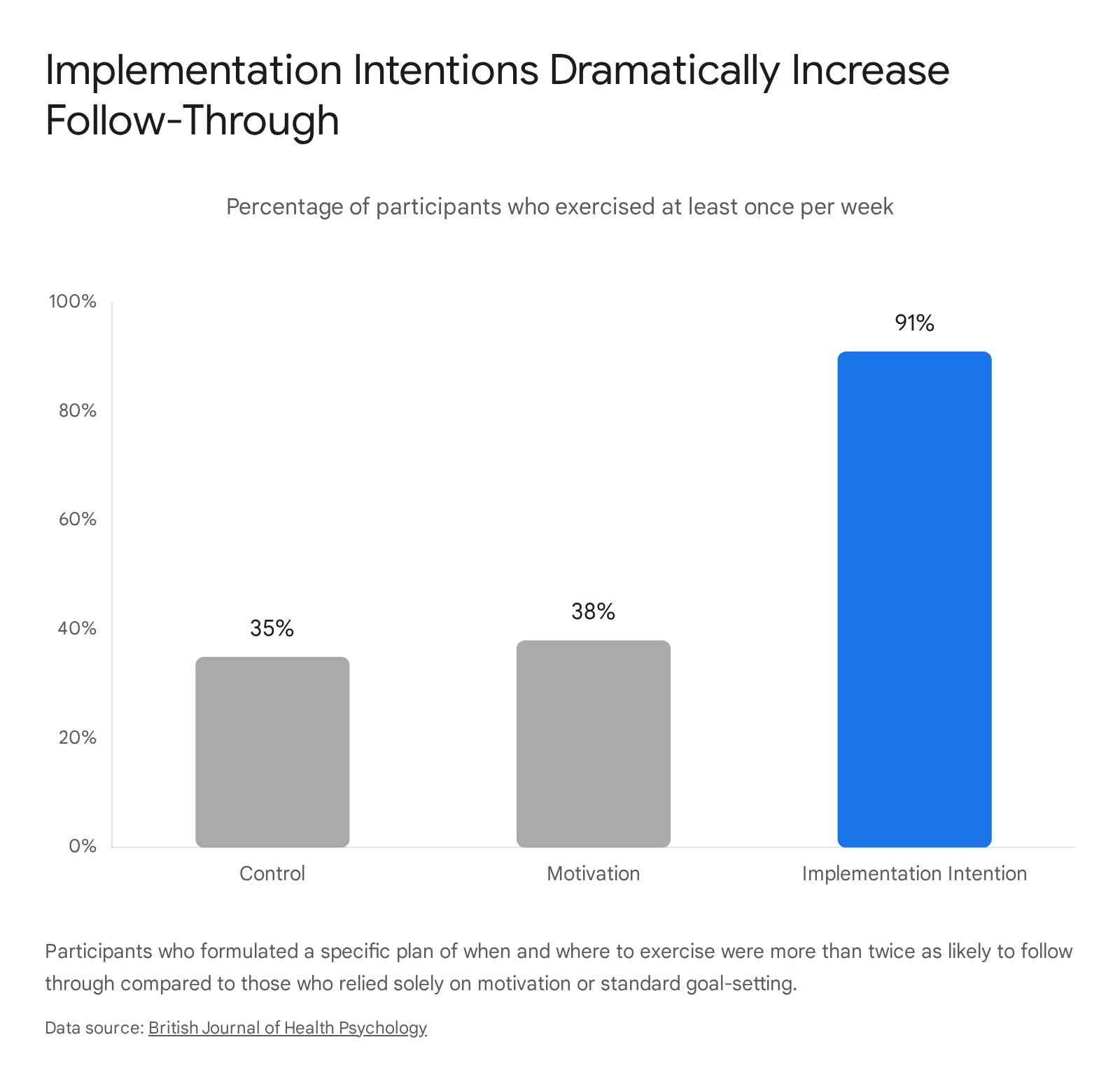
Motivation alone failed to alter behavior significantly, but pairing motivation with an actionable environmental cue nearly tripled the success rate 10.
In medical adherence, the strategy is equally powerful. A study of adults with Type 2 Diabetes in Brazil tested whether implementation intentions could improve adherence to oral anti-diabetic (OAD) medications. Participants who used if-then planning showed significantly higher global adherence to their medication regimens compared to the control group, demonstrating that the strategy functions as a highly effective, low-cost "soft technology" for healthcare interventions 11. Similarly, another Brazilian study on hypertensive women showed that forming if-then plans successfully reduced dietary salt intake, as verified objectively by 24-hour urinary-sodium excretion tests 12.
Education and Academic Procrastination
Students frequently struggle with unstructured time, leading to severe procrastination. Implementation intentions help here by reducing the friction of starting.
A 42-day micro-randomized trial involving 357 fifth and sixth graders tested whether mobile prompts asking them to formulate daily "if-then" plans (e.g., specifying when and where to use a vocabulary app) would improve study habits. The results were highly positive, but they hinged entirely on the quality of the plan. When students created specific, salient, and context-appropriate plans, their likelihood of studying the next day skyrocketed. This highlights that for younger learners, implementation intentions are an excellent metacognitive strategy, provided educators scaffold the process and teach them how to identify strong cues .
Among university undergraduates, research shows mixed results on whether if-then plans can cure deep-seated academic procrastination over a short period. In a three-week experimental study, setting SMART goals or implementation intentions did not unilaterally eliminate procrastination traits; however, initial levels of procrastination were highly predictive of whether students accomplished the goals generated during the exercises 1323. This suggests that while planning is powerful, chronic procrastination may require a blend of therapeutic intervention alongside planning strategies.
Personal Finance and Wealth Building
Financial behavior is deeply intertwined with environmental cues and impulsive decision-making. Implementation intentions can effectively shield individuals from consumer temptation. In one study, volunteers who recited the statement, "If I am tempted to buy something, then I will tell myself I will save my money for important investments!" were much less likely to succumb to sales techniques practiced by experienced salespeople compared to a control group 24.
However, personal finance also highlights a vital caveat regarding if-then planning: the danger of being too rigid. In an experiment involving 600 people in a community-based saving program called "America Saves," researchers split participants into two groups. The first group was asked how likely they were to deposit money into savings. The second group was instructed to form a highly detailed implementation intention: writing down exactly when, how, and the specific dollar amount they would deposit 25.
Surprisingly, the implementation intention group saved less money (around $200 less on average) after four weeks compared to the control group 25. Researchers concluded that the extreme strictness of the plan caused an "all-or-nothing" mindset. If an individual experienced an unexpected expense and could not save the exact dollar amount they had rigidly planned for, they abandoned the plan entirely and saved nothing 25. This indicates that financial "if-then" plans must retain enough flexibility to accommodate income volatility (e.g., "If I receive my paycheck, I will transfer 10% to savings" rather than a fixed dollar sum).
Advanced Applications: Beyond Basic Habits
While often discussed in the context of drinking more water or going to the gym, implementation intentions excel at managing complex cognitive, creative, and emotional tasks.
1. Emotion Regulation and Social Anxiety
Past research reveals that implementation intentions can be used to effectively cope with sudden emotional spikes. In one psychological study, participants were exposed to frightening and disgusting stimuli (e.g., images of blood). Those who formed a simple goal intention ("I will not get disgusted!") experienced high arousal. However, those who formed an implementation intention ("If I see blood, then I will remain calm and collected!") successfully reduced their physiological disgust and fear reactions 614.
This extends to managing social anxiety. Because social anxiety inherently hijacks the brain's attention systems, traditional willpower fails when a person is triggered. By creating if-then plans (e.g., "If I enter a crowded room, then I will focus my attention on the specific conversation in front of me"), socially anxious individuals can pre-program an attentional shift, bypassing the amygdala's panic response and retaining cognitive control 14.
2. Group Decision-Making and Hidden Profiles
In organizational psychology, groups frequently suffer from "hidden-profile problems." This occurs when a team squanders its potential to make a superior decision because members focus only on shared knowledge, failing to capitalize on the unique, unshared information held by individual members 27.
Researchers found that adding a simple implementation intention to the group's process - specifically, "If we are about to make our final decision, then we will first review the advantages of the non-preferred alternatives" - significantly increased the rate at which groups solved complex problems 27. The plan acted as a circuit breaker, overriding the psychological comfort of groupthink and forcing the integration of new data.
3. Creative Projects and Artistic Uncertainty
Writers, artists, and software developers face intense creative ambiguity. Unlike a workout schedule, creative work is not easily quantifiable. Implementation intentions help creative professionals manage risk and maintain momentum by anticipating cognitive roadblocks.
For instance, a writer might use event-based triggers to avoid writer's block: "If I feel stuck while outlining, then I will switch to planning one character arc instead of the full plot," or "If I get overwhelmed planning a big project, then I will break it down into 3 smaller milestones and focus only on the first one" 28. In creative technology projects, artists use if-then planning to manage technological risks, pre-linking situational cues (e.g., a hardware failure) to immediate fallback responses, reducing decision fatigue under pressure 15.
The Flexibility Debate: Do They Create Rigid Habits?
A prominent debate in behavioral neuroscience is whether implementation intentions create "instant habits" that render human behavior inflexible. True habits, formed through thousands of repetitions, are notoriously rigid; if a habitual goal loses its value, animals and humans often continue performing the habit anyway out of sheer conditioning 1617.
Does creating a strong if-then link trap a person into mindlessly executing a behavior even when it is no longer appropriate?
Recent functional magnetic resonance imaging (fMRI) studies tested this using a symmetrical outcome-revaluation task (SORT), where a previously rewarded action is suddenly "devalued." The research confirmed that implementation intentions drastically increased early training efficiency, reflected in higher accuracy, faster reaction times, and decreased engagement of the anterior caudate (a brain region associated with effortful goal-directed control) 3218.
Crucially, however, the researchers found absolutely no evidence that if-then planning reduced behavioral flexibility 3218. When the goals changed during the test phase, participants who used implementation intentions were just as capable of abandoning the old behavior and adapting to the new reality as those who relied on standard goal-setting.
The scientific consensus is that strategic if-then planning allows people to put their goal execution on "automatic pilot" to increase efficiency, but it does not lock them into a rigid, mindless routine that ignores changing consequences 3218. It creates "flexible tenacity" - the ability to relentlessly pursue a goal while retaining the cognitive freedom to pivot if the environment demands it 1920.
When and Why the Strategy Backfires
While often presented as a productivity panacea, if-then planning has scientifically documented failure modes. Knowing when not to use them is as important as knowing how to draft them.
1. The Perfectionism Trap
For individuals high in certain types of perfectionism, implementation intentions can actually be harmful. Psychology delineates perfectionism into three main types: self-oriented (imposing strict standards on oneself), other-oriented (imposing them on others), and socially prescribed (the belief that others demand overly high standards from you) 36.
Across multiple short-term longitudinal studies, researchers found a significant "backfire effect" when individuals high in socially prescribed perfectionism were asked to form implementation intentions 212239. For these individuals, detailed planning aroused intense negative affect (anxiety, dread) and caused them to perform significantly worse at reaching their personal goals compared to a control group that used standard goal-setting 2139.
Because socially prescribed perfectionists view goals through a lens of external pressure and fear of failure, the specificity of an implementation intention transforms a helpful plan into a looming, inescapable threat 13. For individuals with high self-critical tendencies or severe anxiety about others' expectations, cognitive flexibility and self-compassion are often more effective than rigid if-then structures, which may be contra-indicated by therapists 3621.
2. Multiple Goal Overwhelm
Another scenario where implementation intentions fail is when they are applied to too many goals simultaneously. Research published in the Journal of Consumer Research demonstrated that the benefits of implemental planning for a single goal do not automatically extend to multiple goals 2324.
When people attempt to write "if-then" plans for everything - exercising, eating well, tidying up, and career advancement - the sheer volume of planning draws hyper-attention to the difficulty of executing all these tasks. This realization undermines commitment to the goals relative to other desirable activities and decreases the likelihood of success across the board 2324. Implementation intentions are a high-potency tool; they are most powerful when reserved for one or two high-priority objectives where follow-through has historically been a struggle.
3. Replacing Complex Bad Habits
Implementation intentions are generally more successful at helping people initiate a new behavior (e.g., starting to eat more vegetables) than at breaking an entrenched, complex bad habit (e.g., stopping emotional eating or smoking) 3.
When trying to change a complex habitual behavior, the type of cue selected matters immensely. One study found that using traditional situational cues ("If it is 8:00 PM, I will eat an apple instead of chips") was entirely ineffective for individuals who snacked for emotional reasons 3. Because the urge to snack was driven by an internal emotional state rather than the clock, the situational plan missed the root cause. Instead, identifying motivational cues ("If I am feeling stressed or sad, then I will eat an apple") proved significantly more effective at decreasing unhealthy snack consumption 3. For complex behavior change, understanding the "why" behind the bad habit is often more important than targeting the "where and when."
"Manifestation" vs. Psychological Science
In recent years, the concept of "manifestation" - the belief that positive thoughts can bring about real-world outcomes - has gained massive cultural traction 42. While proponents often claim manifestation relies on the same psychological mechanisms as goal-setting, science draws a sharp dividing line between the two.
Magical thinking, toxic positivity, or purely positive visualization without action planning is largely ineffective, and sometimes deeply detrimental. Research by psychologist Gabriele Oettingen demonstrates that pure positive fantasy actually drains the energy needed to pursue a goal because the brain is tricked into feeling as though the goal has already been achieved 424344.
However, when manifestation practices are grounded in behavioral science, they closely resemble implementation intentions. Oettingen developed a framework known as MCII (Mental Contrasting with Implementation Intentions), popularly branded for general audiences as WOOP 1644:
- Wish: Define a meaningful, feasible goal.
- Outcome: Vividly imagine the best positive outcome of achieving it.
- Obstacle: Critically identify the internal or external obstacles that stand in the way (this is the "Mental Contrasting" phase).
- Plan: Formulate an "if-then" implementation intention to overcome the specific obstacle 1644.
Studies across tens of thousands of participants show that MCII/WOOP significantly outperforms positive visualization alone 164344. By forcing the individual to confront the harsh reality of their obstacles, WOOP leverages the optimism of goal-setting alongside the pragmatic reality of obstacle planning. The specificity of the written goal - not its emotional intensity or "vibrational frequency" - is what actually predicts follow-through 43.
Global Efficacy: Does It Work Beyond Western Contexts?
A persistent limitation in behavioral psychology is that over 95% of studies are historically conducted on WEIRD populations (Western, Educated, Industrialized, Rich, and Democratic) 4525. It is vital to ask whether the cognitive mechanisms of implementation intentions hold up in diverse cultural and socioeconomic contexts.
While direct cross-cultural comparative data on if-then planning is still developing, research on the broader Theory of Planned Behavior (TPB) - the framework that implementation intentions build upon - indicates that the core mechanisms operate globally, though they are heavily moderated by cultural values.
Extensive studies in China analyzing dietary habits, pandemic-prevention behaviors (such as adherence to quarantine apps in Hong Kong and Singapore), and adolescent physical activity demonstrate that attitudes and perceived behavioral control significantly predict healthy intentions and subsequent behaviors among Asian populations 2627492829. However, in highly collectivist societies, "subjective norms" - the perceived social pressure to perform a behavior because it benefits the community or family - play a much stronger role in forming initial goal intentions than in highly individualistic Western cultures 285230.
Furthermore, applying psychological interventions in developing regions requires deep systemic integration. An expert review of interventions aimed at improving girls' school attendance across Africa (evaluating data from Kenya, Mauritius, Botswana, and Zambia) found that cognitive and behavioral interventions must address severe structural barriers, such as poverty and inadequate menstrual hygiene facilities 3155. Similarly, a provider behavior change study in Kenyan hospitals found that introducing behavioral interventions only succeeded when the local working environments and societal norms were factored into the co-creation process 32.
In short, while the cognitive mechanism of linking an environmental cue to an action appears universally human, the cues chosen and the underlying motivations driving the goal must be culturally and contextually relevant to be effective 4533. A psychological framing tool cannot override systemic poverty, but when tailored properly, it can drastically optimize behavior within an individual's available resources.
How to Draft an Effective Implementation Intention
To apply this research to your own life, keep the formulation simple but highly specific. The goal is to remove ambiguity so that in the heat of the moment, no decision-making is required.
- Ensure underlying motivation is strong: Implementation intentions cannot force you to do something you do not genuinely want to do. If the goal is externally forced upon you rather than internally desired, the if-then plan will likely fail. The underlying goal intention must be strong and activated 46.
- Identify the critical cue (The "If"): Look back at previous failures to achieve this goal. What normally gets in the way? Is it a specific time, a location, an emotional state, or an action by someone else? Choose a highly specific, unavoidable trigger (e.g., "If I open my laptop on Monday morning..." rather than "If I have free time...").
- Define the precise action (The "Then"): The action must be something fully within your control, immediately actionable, and proportionate.
- Write it down: The physical act of writing the if-then statement increases cognitive commitment and solidifies the associative link in the brain 4334.
Examples of effective structures: * Health: "If I feel the urge to buy a sugary snack at the train station, then I will buy a bottle of sparkling water instead." * Productivity: "If I finish reading a research paper, then I will immediately write three bullet points summarizing it before opening a new tab." * Emotional Regulation: "If I notice myself feeling defensive during a meeting, then I will take one deep breath and ask a clarifying question before responding" 6.
Bottom line
Implementation intentions are a scientifically validated strategy that bridges the gap between having a good goal and actually taking action. By formulating explicit "if-then" plans, individuals can transfer behavioral control to environmental cues, bypassing the need for willpower and significantly boosting success rates across health, finance, and creative pursuits. However, the strategy is not flawless; it can cause overwhelm if applied to too many goals at once, and it frequently triggers counterproductive anxiety in individuals with self-critical, socially prescribed perfectionism.