
Science of adaptive goal setting and SMART goal limitations
For decades, the dominant paradigm in organizational behavior and performance psychology has rested upon a seemingly unassailable foundation: specific, difficult goals drive superior performance. Rooted heavily in Locke and Latham's foundational Goal-Setting Theory, the proliferation of SMART (Specific, Measurable, Achievable, Relevant, Time-bound) goals and forced-distribution performance metrics has shaped the operational architecture of everything from multinational corporate boardrooms to individual health interventions. While corporate performance manuals, human resources blogs, and self-help literature frequently present SMART goals as a universally applicable panacea for productivity, peer-reviewed psychology and organizational behavior literature treats such uncritical endorsements strictly as cultural commentary.
An accumulating body of rigorous empirical evidence across behavioral economics, cognitive neuroscience, and cross-cultural psychology suggests that the universal application of rigid goal-setting architectures is fundamentally flawed. Contemporary research demonstrates that while specific and challenging goals are highly effective for routine, algorithmic tasks, they frequently misfire in complex, heuristic, and dynamic environments 123. The side effects of overprescribing rigid goals - ranging from systemic ethical breaches and severe cognitive depletion to chronic psychological distress - necessitate a paradigm shift 145. By integrating Self-Determination Theory (SDT), recent neurobiological findings on attentional narrowing and dopamine prediction errors, and cross-cultural analyses distinguishing Western individualistic assumptions from collectivist realities, a significantly more nuanced understanding of goal pursuit emerges. This analysis investigates the mechanisms of goal failure, the neurological costs of strict goal adherence, and the structural superiority of adaptive, process-oriented frameworks such as Mental Contrasting with Implementation Intentions (MCII) over traditional outcome-focused models.
The Theoretical Crisis of Rigid Goal-Setting: A Self-Determination Theory Perspective
At the core of the friction between traditional goal-setting frameworks and long-term human motivation lies a fundamental misunderstanding of the locus of causality. According to Self-Determination Theory (SDT), formulated by Deci and Ryan, human motivation, psychological well-being, and sustained behavioral engagement are contingent upon the satisfaction of three innate psychological needs: autonomy, competence, and relatedness 67. When these psychological needs are met, individuals experience intrinsic motivation and subjective vitality, which are associated with higher resilience, sustained effort, and robust mental health 68. Conversely, when these needs are thwarted, cognitive energy is rapidly depleted, and motivation degrades into a controlled, extrinsic state defined by compliance or defiance rather than genuine engagement 69.
Traditional goal-setting architectures, particularly those championed in corporate environments via SMART goals, Key Performance Indicators (KPIs), and Objectives and Key Results (OKRs), frequently operate as profound autonomy-thwarting mechanisms. When specific, rigid goals are externally imposed or heavily incentivized through variable compensation, they shift the individual's perceived locus of causality from the internal, volitional self to an external controller 678. Under these conditions, the pursuit of the goal is no longer an expression of self-directed mastery or intrinsic interest, but rather an extrinsic compliance mandate. SDT posits that this shift from autonomous motivation to controlled motivation requires continuous, effortful self-control, a psychological resource that is notoriously finite and easily exhausted 6. The expenditure of this self-control leads to a state of subjective energy depletion, reducing an individual's long-term resilience and increasing susceptibility to burnout, role overload, and turnover intention 67.
The psychological cost of goal failure under these rigid, outcome-oriented frameworks is remarkably severe. Proponents of traditional goal-setting have historically advocated for establishing "stretch" goals so difficult that only approximately ten percent of participants can realistically achieve them, theorizing that the aspirational stretch maximizes aggregate output 1011. However, this architectural design inherently guarantees a ninety percent failure rate. Recent empirical studies reveal that failing to meet high, specific goals directly damages an individual's self-esteem, broad motivation, and positive affect, creating a destructive negative feedback loop that damages long-term organizational outcomes and personal well-being 1012.
Longitudinal research further validates the necessity of intrinsic need satisfaction in goal pursuit. In a comprehensive six-month longitudinal experimental study investigating sustained changes in subjective well-being, researchers found that participants randomly assigned to pursue self-set goals aligned with autonomy, competence, or relatedness experienced sustained, long-term gains in happiness 1314. By contrast, participants assigned to pursue goals aimed merely at changing their life circumstances (often mirroring the extrinsic, outcome-based structure of SMART goals) failed to maintain any subjective well-being enhancements, demonstrating that sustained psychological gains require goals that nourish innate psychological needs 1314. Similar dynamics have been documented in medical education environments, where top-down, rigidly enforced academic goals fail to foster the professional identity formation seen in environments that utilize coaching models to cultivate learner autonomy and psychological safety 815.
Furthermore, strict adherence to rigid goals creates an outcome-fixation that neglects the psychological benefits of adaptability and goal flexibility. A landmark 2025 review published in Nature Human Behaviour, which analyzed 235 studies encompassing more than 1,400 findings across multiple disciplines, highlighted the profound physical and psychological well-being costs of goal rigidity 4. The researchers found that stubbornly sticking to impossible or fundamentally misaligned goals takes a severe toll on the individual, driving significantly higher levels of chronic stress, clinical anxiety, and depression 4. Crucially, the capacity to let go of unattainable goals and flexibly reengage with new, adaptive objectives was found to rapidly restore life satisfaction and subjective wellbeing 4. This directly challenges the pervasive cultural mythology that "quitting" or goal abandonment is inherently a sign of weakness, establishing instead that strategic goal disengagement is a critical executive function necessary for psychological homeostasis and long-term resilience.
The Systematic Pathology of "Goals Gone Wild"
Treating goal-setting as a universally benign motivational tool ignores its documented capacity to induce systemic, organizational-level harm. Leading behavioral economists and management scholars have increasingly argued that goal-setting should be conceptualized metaphorically as a "prescription-strength medication" that requires careful dosing, consideration of contraindications, and close supervision, rather than an over-the-counter supplement 135. When goals go "wild" - that is, when they are hyper-specific, excessively challenging, and tied to strict temporal deadlines without regard for systemic context - they trigger a predictable cascade of unintended, often destructive, consequences.
The Erosion of Ethics and the End-Means Disconnect
The most alarming and consistently replicated side effect of highly specific, challenging goals is the proliferation of unethical behavior within organizations. By their very cognitive design, specific performance goals create a narrow focus on the ends at the expense of the means 1. This hyper-focus fundamentally alters cognitive processing and moral evaluation, making it increasingly difficult for individuals to recognize the ethical dimensions of their actions. Employees operating under intense goal pressure are significantly more likely to misrepresent their performance or resort to unethical methods to artificially meet targets 15.
This phenomenon is catalyzed and amplified when the actual performance falls just short of the established target, creating a powerful temptation to manipulate data or cheat to cross the threshold and secure the contingent reward 1. The unethical behavior documented in these environments is not necessarily the result of malevolent individuals, but rather the output of an environment where aggressive goal-setting has subtly corroded the organizational climate. Classic examples include Sears auto mechanics performing unnecessary repairs to meet aggressive revenue quotas, or corporate executives utilizing aggressive accounting practices to hit quarterly earnings guidance 1. In these scenarios, systemic blind spots emerge, where management inadvertently rewards visible, often manipulated performance over actual, sustainable value creation 16.
Goal Ceilings, Risk Distortion, and Inhibited Learning
Rigid goals alter behavior in ways that actively undermine long-term organizational strategy and stability. One documented behavioral phenomenon is the "goal ceiling" effect. When individuals operate under strict daily or periodic quotas, the goal acts as a maximum threshold rather than a minimum baseline. Once people hit their target, they tend to relax or cease effort entirely, even if continued effort would be highly productive, efficient, and profitable 1. For example, studies of New York City cab drivers demonstrated that they routinely went home early on rainy days because they reached their daily income goal faster due to high demand, perversely reducing their labor supply exactly when it was most needed 1.
Simultaneously, specific goals severely distort risk preferences and decision-making architectures. Individuals facing a challenging goal deficit are highly prone to engaging in excessively risky behaviors to close the gap, prioritizing short-term target acquisition over long-term stability or risk mitigation 15. Empirical tests utilizing modified risk-taking paradigms, such as the Game of Dice Task, confirm that explicitly assigned, relatively high goals directly induce riskier decision-making strategies compared to control conditions 5.
Moreover, the boundary conditions for goal-setting efficacy are frequently ignored by corporate practitioners. While specific goals consistently enhance performance in routine, algorithmic tasks where the operational steps are well-known, they actively inhibit learning and degrade performance in complex, heuristic, or creative tasks 1. In dynamic environments requiring innovation or the acquisition of new skills, the cognitive bandwidth consumed by anxiously monitoring progress toward a rigid performance goal limits the cognitive resources available for exploration, hypothesis testing, and deep learning 1. In these complex contexts, adopting "learning goals" (goals focused on acquiring a skill) or simple "do your best" instructions consistently outperforms strict performance metrics 12.
Neurobiological and Cognitive Mechanisms of Goal Failure
The failure of rigid goal-setting paradigms is not merely a psychological or organizational phenomenon; it is deeply rooted in human neurobiology and cognitive architecture. Pursuing challenging goals requires significant neurological orchestration, primarily involving the prefrontal cortex for executive planning, logical reasoning, and impulse control, alongside the amygdala for emotional evaluation, arousal, and assigning salience to the goal 17. When goal parameters become too rigid, or the stakes associated with them become too high, this delicate neurological synergy collapses.
Attentional Narrowing and "Tunnel Vision"
The cognitive phenomenon of "tunnel vision," academically framed by Easterbrook's 1959 hypothesis of attentional narrowing, explains why goal-obsessed individuals often miss critical peripheral information, leading to the systemic blind spots mentioned previously 1817. Under conditions of high emotional arousal, stress, or intense motivational desire to achieve a specific target (such as anticipating a substantial monetary reward tied to a SMART goal), the brain automatically prioritizes central, task-relevant cues while actively suppressing and ignoring peripheral inputs 1817. Based on Easterbrook's hypothesis and modern neuroimaging, high motivational intensity or stress causes the amygdala to constrict the perceptual field. This physiological tunneling forces the brain to hyper-process central goal cues while entirely filtering out critical peripheral data, including alternative strategies, environmental shifts, and ethical boundary conditions 1820.
While this involuntary constriction of the perceptual field can enhance efficiency on simple, repetitive tasks by eliminating distraction, it severely impairs performance in complex, dynamic scenarios that require broad situational awareness and relational memory 1818. The amygdala, processing the stress of an impending goal deadline or the threat of failure, reinforces this narrowed focus, effectively blocking the broader analytical capabilities of the prefrontal cortex 1820.
Furthermore, unpredictable threats or extreme stress during goal pursuit actively disrupt the functional connectivity between the amygdala and the ventromedial prefrontal cortex (vmPFC). Neuroimaging studies of military veterans engaged in goal-directed reward tasks under threat conditions revealed that disrupted amygdala-vmPFC connectivity severely impairs the brain's ability to logically regulate emotional responses 19. This traps the individual in a state of hyperarousal where long-term, strategic planning gives way to immediate, reactionary threat mitigation 2019. Conversely, research indicates that the receipt of rewards and positive affect can induce "attentional broadening," a process mediated by beta-endorphins. In placebo-controlled trials utilizing the opioid receptor blocker naltrexone, researchers found that blocking endogenous opioids eliminated the attentional broadening typically associated with goal attainment, highlighting the specific neurochemical pathways required for cognitive flexibility 23.
Control Adjustment Costs and Goal Flexibility
Beyond acute stress responses, the mere act of shifting between different goal parameters incurs heavy, measurable cognitive tolls. A seminal 2023/2025 computational and empirical study published in Psychological Review isolated the "control adjustment costs" associated with goal flexibility 24. The researchers utilized a dynamical systems model across multiple experiments (e.g., color-word Stroop tasks) to demonstrate that cognitive control states - such as the neurological balance of speed versus accuracy - possess psychological inertia 24.
When an individual's environment demands a shift to a new goal, the transition is not instantaneous. The magnitude of the cognitive adjustment cost scales with the distance between the two target states in the control space. For example, shifting between diametrically opposed goals (e.g., maximum speed versus maximum accuracy) incurs significantly higher cognitive costs than shifting between closely related goals 24. If an employee is rigidly fixated on a strict production volume goal and must suddenly pivot to a complex quality-assurance goal, the cognitive inertia causes a measurable performance "undershoot." Participants in the study experienced degraded performance because their cognitive state remained partially anchored to the previous goal's parameters 24. Furthermore, when goal switches are highly frequent, these control adjustment costs increase parametrically, leading to severe cognitive depletion 24. This indicates that rigidly defined goals create cognitive architectures that are highly resistant to change, severely penalizing the cognitive flexibility required in modern, agile knowledge-work environments.
The Empirical Reality of the Intention-Behavior Gap: Drop-Off Curves
The neurobiology of goal pursuit is heavily mediated by the dopaminergic reward system. Initial goal-setting generates a surge of anticipatory dopamine, creating a sensation of high motivation. However, rigid goals set up a binary success/failure paradigm that is highly vulnerable to dopamine prediction errors. If progress is slower than anticipated, or if the effort required exceeds initial estimates, the lack of expected reward signal leads to a rapid collapse in motivation.
This behavioral drop-off is starkly visible in large-scale empirical data across multiple domains. In the digital health sector, where users rely heavily on initial motivation to set physical health goals, fitness applications tracking user goal pursuit observe a brutal, universal decay curve. User retention data from digital health and fitness applications reveals a universal behavioral drop-off curve. Top-tier fitness applications experience a day-one retention rate of 45%, dropping to 30% by day seven, 25% by day 30, and bottoming out around 10% by day 90. Average health and fitness applications fare significantly worse, plummeting from 30% on day one to a mere 3% by day 90 252627. Furthermore, industry data indicates that applications lose up to 77% of their daily active users within just three days of installation, illustrating how rapidly raw goal intention evaporates without structural behavioral support 2527.
Similar intention-behavior gaps plague digital education. Massive Open Online Courses (MOOCs), which require high levels of self-directed goal pursuit and self-regulation, suffer from famously low traditional completion rates. Comprehensive analyses of hundreds of MOOCs reveal a median completion rate of merely 12.6%, ranging from 0.7% to 52.1% 28. However, researchers note that traditional completion metrics often fail to capture "learner intentions," as many participants enroll to extract specific knowledge without the goal of formal completion. When evaluating completion rates based strictly on stated learner intentions, success rates are significantly higher, demonstrating the necessity of aligning organizational metrics with the actual psychological goals of the participant 2030.
These drop-off curves are not evidence of widespread moral failure or lack of willpower; they are the predictable result of relying on cognitive structures that are biologically designed to conserve energy. Longitudinal studies on weight loss, for instance, demonstrate that focusing purely on the end goal (the distance remaining) versus focusing on accomplishments (distance traveled) alters commitment levels, but even optimized focus strategies struggle to maintain long-term behavioral change without automating the behavior 21. This data underscores the futility of relying on initial intent, proving that without structural cognitive support, goal abandonment is the statistical default.
From Intentions to Strategic Automaticity: Advanced Execution Frameworks
As the severe limitations of traditional SMART goals and sheer willpower have become apparent, cognitive psychology has pivoted toward self-regulatory strategies designed to bridge the intention-behavior gap. This transition is marked by a fundamental shift from merely defining the what of a goal (the outcome) to aggressively engineering the how of its execution, specifically by bypassing the easily depleted executive control network.
Implementation Intentions: Engineering Strategic Automaticity
Developed extensively by Peter Gollwitzer, Implementation Intentions (II) represent a major theoretical and practical advancement over standard goal intentions. While a traditional goal intention specifies a desired end-state (e.g., "I will increase my sales output"), an implementation intention creates an explicit "if-then" contingency plan that links a specific environmental or situational cue to a goal-directed response (e.g., "If it is 9:00 AM on Tuesday, then I will call five prospective clients") 223323.
The primary neurobiological mechanism of action here is "strategic automaticity." By explicitly linking the situational trigger to the behavior, the brain's mental representation of the cue becomes highly activated and accessible 242526. When the critical cue is encountered in the real world, the initiation of the intended behavior exhibits features of automaticity: it occurs with immediacy, high efficiency, and a redundancy of conscious intent 25. By delegating the execution trigger to the environment rather than internal willpower, the individual does not need to dip into finite reserves of self-control. Across 94 independent tests in a landmark meta-analysis, Implementation Intentions were shown to yield a medium-to-large effect (d ≈ 0.65) on goal achievement compared to vague or standard goal-setting, operating effectively across health, academic, and interpersonal domains 3338.
However, the peer-reviewed literature is clear that Implementation Intentions are not a flawless panacea and possess distinct boundary conditions. Most notably, they are highly susceptible to ironic rebound effects when formulated as negations to break bad habits 2728. For instance, a plan stating, "If I am offered a sugary snack, I will not eat it," creates a "negation implementation intention." Ironic process theory dictates that this structure actually hyper-activates the cognitive association with the forbidden item, paradoxically strengthening the habit one aims to break and increasing the likelihood of consumption 2728. Furthermore, Implementation Intentions can fail if the overarching goal is excessively difficult and the individual lacks clarity on the precise micro-actions required for success, or if they are applied to highly established, complex daily routines where simple planning prompts are easily ignored 2930.
Mental Contrasting and the WOOP Protocol
While Implementation Intentions efficiently handle the execution phase of a goal, they rely entirely on the presence of a pre-existing, strong goal commitment 2225. Gabriele Oettingen's research on "Mental Contrasting" provides the mechanism for generating this necessary commitment. Mental contrasting requires an individual to vividly visualize a desired future outcome, and then immediately and concretely confront the primary internal or external obstacle standing in the way of that outcome in current reality 3338.
This cognitive juxtaposition forces the brain to run a subconscious expectancy check, creating a physiological and psychological state of "energization." When the brain registers the discrepancy between the desired future and the present reality as bridgeable, it alters systolic blood pressure and dynamically allocates attention and effort toward goal pursuit 38. Crucially, if the brain registers the goal as genuinely unfeasible, the mental contrasting process triggers healthy disengagement, cleanly releasing the goal and conserving cognitive resources that would otherwise be wasted on an impossible pursuit 3338. By contrast, pure positive visualization (a staple of self-help literature) is actively detrimental; without contrasting the obstacle, the brain relaxes as if the goal has already been achieved, resulting in lower effort and poorer outcomes 3338.
The synthesis of these two theories is the WOOP protocol (Wish, Outcome, Obstacle, Plan) - formally known in academic literature as Mental Contrasting with Implementation Intentions (MCII) 223338. WOOP seamlessly stacks the motivational energization of mental contrasting with the behavioral automaticity of if-then planning. The protocol is uniquely effective because it treats the positive visualization of a goal as an inherent risk and immediately counteracts it by grounding the user in reality before wiring the trigger-response pair 3338. Meta-analyses of MCII interventions show reliable, small-to-medium effect sizes (g ≈ 0.34 to d ≈ 0.35) across diverse domains, proving it to be a highly resilient cognitive tool 333831.
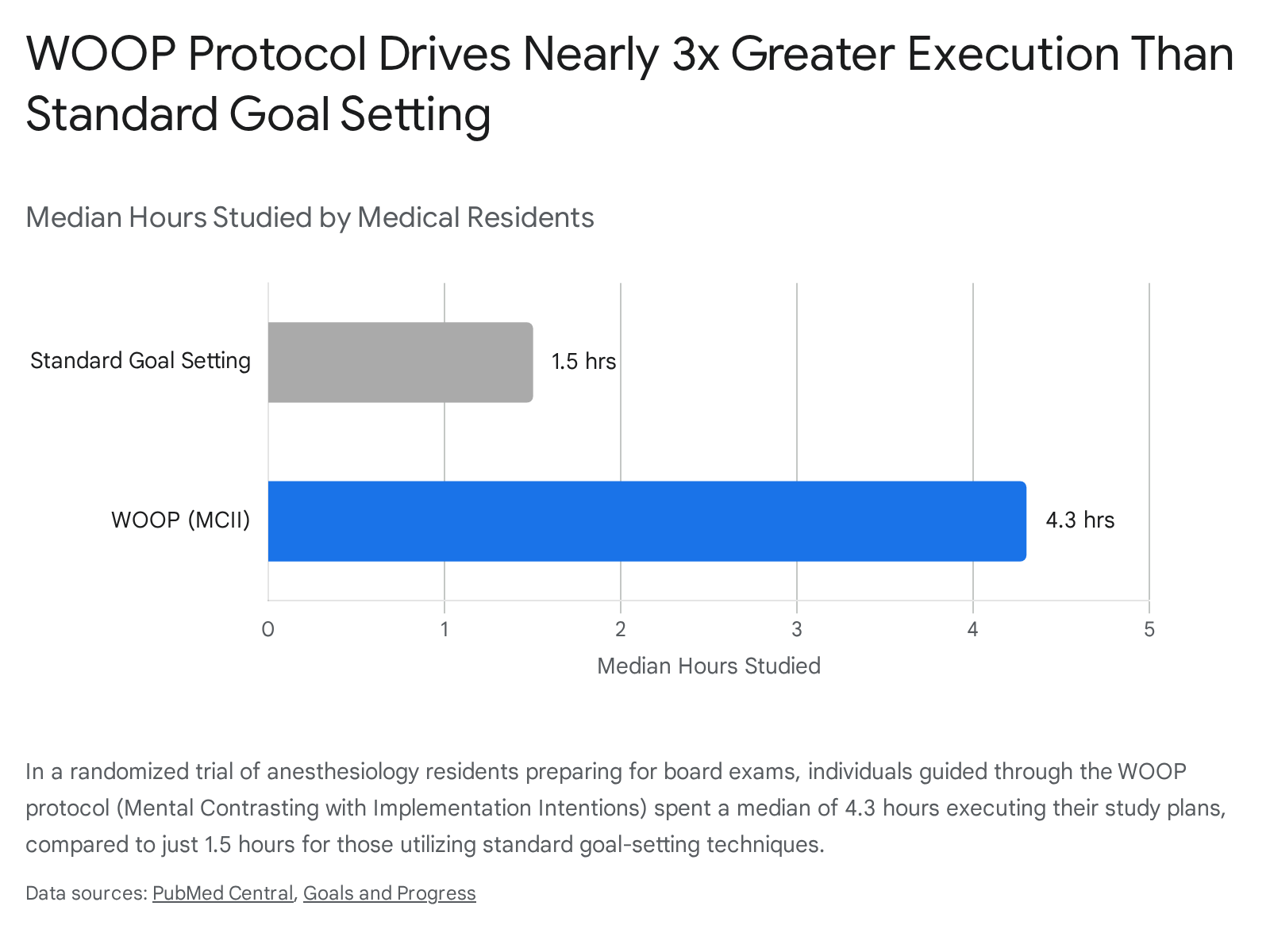
Furthermore, studies demonstrate that MCII operates largely via non-conscious processes once the initial conscious exercise is completed, making it highly effective for complex self-regulation tasks, such as down-regulating severe anger and emotion management 32.
Framework Comparison: Mapping Efficacy
The following table synthesizes the distinct mechanisms, ideal use cases, and boundary conditions of contemporary goal frameworks, contrasting the outcome-focused SMART methodology with process-focused behavioral strategies.
| Framework | Primary Mechanism of Action | Ideal Use Case | Known Limitations & Boundary Conditions |
|---|---|---|---|
| SMART Goals | Clarity & Bounding: Translates vague aspirations into quantifiable, time-bound targets, establishing external parameters for success. | Routine, algorithmic tasks; organizational alignment; project management requiring strict metric tracking 146. | Thwarts autonomy; induces attentional narrowing and unethical behavior; fails in complex/heuristic environments; lacks execution support 16. |
| Implementation Intentions | Strategic Automaticity: Links specific environmental cues to intended actions via "if-then" statements, bypassing conscious executive control 2238. | Habit formation; executing pre-determined actions in chaotic environments; overcoming procrastination 2426. | Prone to "ironic rebound" if formulated as a negative (e.g., "I will not do X"); requires high baseline goal commitment to function 2728. |
| WOOP (MCII) | Energization + Automation: Creates cognitive dissonance by contrasting a positive future with present obstacles, then wires the obstacle as a trigger for an action plan 2238. | Personal development; health behaviors; emotion regulation; situations requiring sustained behavioral change 333132. | Produces reliable but modest effect sizes (d ≈ 0.35); heavily dependent on the user's capacity for deep self-insight regarding internal obstacles 33. |
| ABC Method | Categorical Prioritization: Forces triage of tasks into Must-Do (A), Should-Do (B), and Nice-to-Do (C), mitigating task paralysis 48. | Daily time management; reducing overwhelm when facing an unstructured workload 11. | Purely tactical; lacks a mechanism for generating long-term motivation or addressing psychological barriers to action 4849. |
Cross-Cultural Boundary Conditions: The Individualistic Bias of Goal Theory
A critical, yet historically overlooked, flaw in traditional goal-setting literature is its overwhelming Western bias. Foundational theories of goal-setting, including those by Locke and Latham, were developed almost exclusively within Western, highly individualistic paradigms and tested on predominantly North American or Western European subject pools 3351. In these contexts, goals are intrinsically linked to personal aspirations, individual autonomy, and self-expression. However, translating and applying these individualistic frameworks to collectivist cultures often yields profound friction, active resistance, and significantly diminished efficacy 3435.
Collectivism and the Dynamics of "Mianzi"
In collectivist societies, particularly in East Asia, motivation is not primarily derived from personal achievement or standing out from the crowd, but rather from maintaining group harmony, fulfilling social obligations, and achieving consensus 5134. In these contexts, goals are frequently interdependent and externally regulated by communal expectations. A central psychological and sociological construct governing behavior in Chinese and broader Asian business cultures is mianzi (face), which operates alongside lian (moral standing) 363738.
Mianzi represents a public self-image, capability, and dignity that is continuously negotiated through social interaction 3657. While Western impression management focuses on strategic self-presentation to advance individual goals, mianzi is deeply relational; individuals "give face" to maintain social stability and demonstrate appropriate hierarchical respect 373857. Consequently, aggressively competitive individual performance goals - such as leaderboard-driven sales targets common in Western teams - can be highly disruptive in environments prioritizing mianzi. Such goals inherently risk causing colleagues to "lose face" by creating zero-sum comparative metrics 3658. In these cultures, individuals may intentionally temper their own performance, avoid public disagreement, or utilize avoidance tactics in conflict to maintain group cohesion, rendering individualistic SMART goals ineffective or even offensive 3940.
Hybridizing Leadership and Goals in India
The complex intersection of global business frameworks and local cultural realities is particularly visible in India's rapidly expanding corporate sector. Indian workplaces are characterized by a unique blend of collectivism and high power distance 41. Employees often exhibit deference to authority and value paternalistic, relationship-based mentoring, reflecting deep-seated cultural traditions like the guru-shishya (teacher-disciple) dynamic 4162.
When Western multinational corporations (MNCs) attempt to impose rigid, individualistic performance frameworks - such as forced-distribution bell curves or rank-and-yank systems - they frequently encounter structural cultural rejection. Bell curves force managers to categorize a percentage of their team as "low performers," which violently contradicts the collectivist preference for group harmony and long-term loyalty 416342. Studies of Indian MNCs indicate that high-power distance environments require culturally responsive, hybrid goal-setting. For example, replacing individualistic competitive targets with relationship-based development goals has yielded remarkable results. An initiative at Reliance Industries utilizing jodi (paired) mentoring successfully reduced perceived discrimination by 25% and lowered the turnover of women engineers by 18%, contrasting sharply with organizations where unchecked power distance and rigid individual metrics exacerbated gender pay gaps 41. Furthermore, Deloitte's 2024-25 India Culture Sensing Report, which analyzed over 170,000 employee reviews, demonstrated that Indian organizations prioritizing cultural pillars like "growth and learning" and "empowerment" alongside business goals saw significantly better financial returns, proving that aligning goals with cultural values drives tangible value 43.
Efficacy and Adaptation in Sub-Saharan Africa
Cross-cultural research in Sub-Saharan Africa further challenges the universality of Western goal-setting axioms. In chronic disease management interventions across the region, goal-setting is recognized as a valuable tool for translating health advice into action. However, the socio-economic and cultural realities necessitate significant methodological adaptations 4445. Interventions must account for community-centric living arrangements, distinct communication styles, and varying literacy levels, often shifting the goal-setting process from an individual written exercise (standard in Western clinics) to a facilitator-led, group-based oral dialogue 4446.
Furthermore, empirical testing of goal-setting theory in African organizational contexts reveals fascinating boundary conditions that directly contradict Western tenets. A field experiment involving employees at small cassava processing companies in Ghana found that introducing daily, non-binding production goals successfully increased output by 16% and productivity by 8%, even without any financial incentives attached, proving the efficacy of goals purely as a cognitive focusing mechanism to reduce distraction 47. Conversely, a study analyzing the performance of 100 registered nurses at the Sunyani Regional Hospital in Ghana found that while goal acceptance and goal specificity positively improved performance, the cornerstone Western metric of goal difficulty completely failed to correlate with enhanced performance 48. This suggests that in certain cultural contexts, the "stretch" component of goals is culturally dissonant, and motivation is driven more by role clarity and communal alignment than by the pursuit of supreme difficulty.
Synthesis and Forward Outlook
The overwhelming consensus across modern psychological, neurobiological, and organizational research is that the era of setting rigid, universal goals and expecting linear execution is definitively over. The assumption that raw motivation and sheer willpower can conquer structural, cognitive, and cultural barriers has been falsified by steep longitudinal drop-off data and the systemic ethical and operational failures of forced-ranking performance systems.
The future of goal pursuit lies in continuous, dynamic intervention and precise contextual alignment. Frameworks like Mental Contrasting with Implementation Intentions (WOOP) represent the vanguard of this shift, moving away from static, outcome-obsessed goal declarations toward the active engineering of behavioral triggers and the strategic automation of action. Organizations and individuals alike must recognize that goals are not benign administrative tools; they are powerful cognitive modifiers that can induce tunnel vision, severely deplete executive function, and provoke unethical behavior if they are misaligned with foundational human psychological needs for autonomy and competence.
Ultimately, effective performance architecture requires respecting the neurobiological limits of the human brain and the specific cultural fabric of the environment in which the goals are deployed. By shifting the focus from the rigid definition of an outcome to the flexible, autonomous process of execution, leaders and practitioners can foster environments where sustainable, ethical, and high-level performance becomes an automatic byproduct of a well-engineered, culturally resonant system.