
Efficacy of dual-promotion behavioral interventions
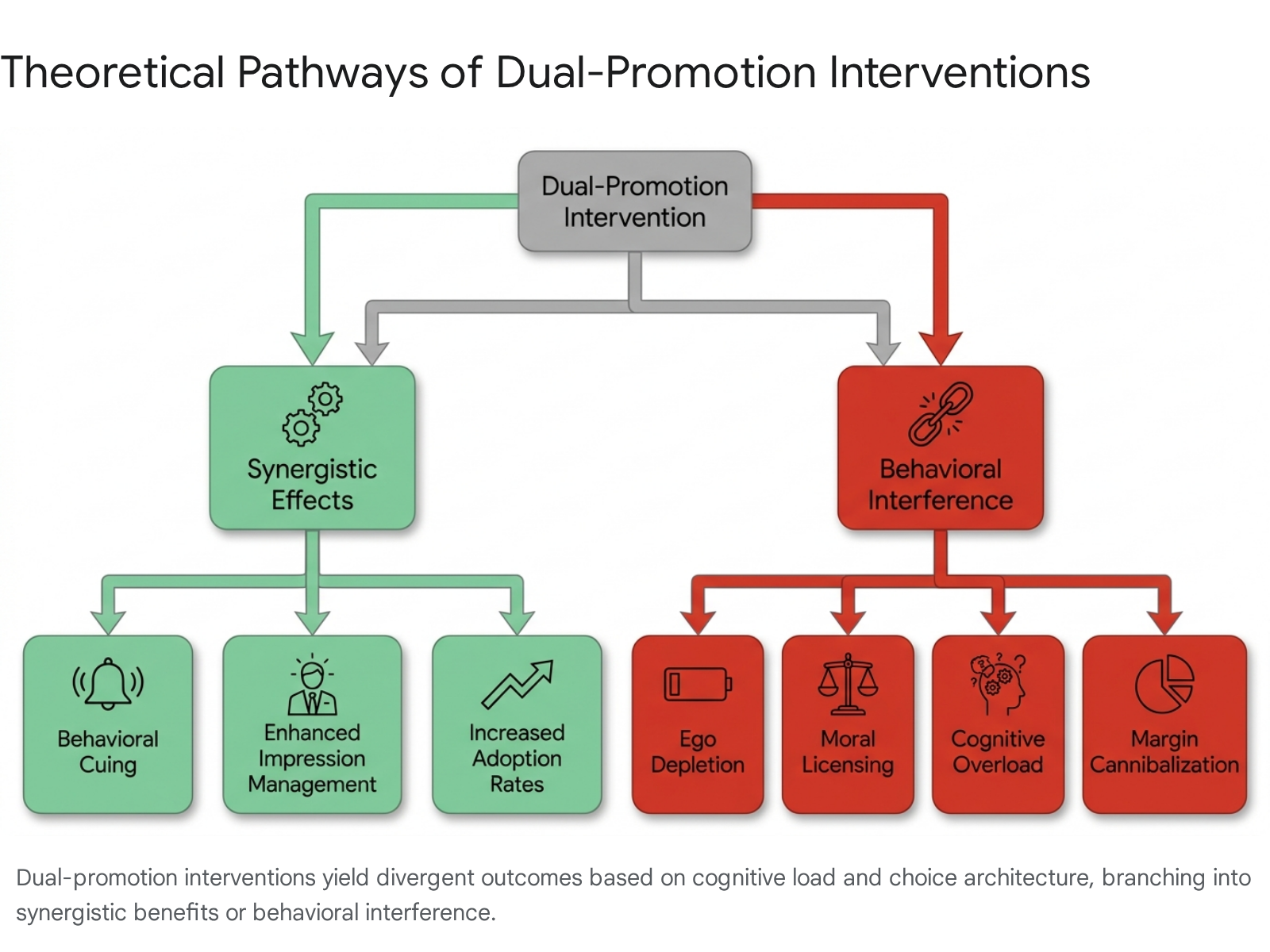
Dual-promotion, as a behavioral intervention and choice architecture strategy, represents a multifaceted approach that targets multiple cognitive, social, or economic outcomes simultaneously. Across distinct disciplines - ranging from public health and clinical psychology to organizational behavior, consumer economics, and cybersecurity - dual-promotion operates on the premise that activating two complementary targets can yield synergistic benefits. However, this theoretical synergy is frequently challenged by human cognitive limitations, resource depletion, and behavioral interference. The efficacy of dual-promotion is highly contingent upon the cognitive load imposed, the sequential versus simultaneous timing of the intervention, and the specific socio-cultural context in which it is applied.
Multiple Health Behavior Change Interventions
A primary application of dual-promotion is found in Multiple Health Behavior Change (MHBC) interventions. Historically, health promotion paradigms operated on a single-behavior model, operating under the assumption that attempting to change too many behaviors at once would overwhelm the individual and backfire 12. Basic principles of behavior modification suggested that making smaller, gradual changes leads to greater long-term success 1. However, epidemiological data indicates that health-risk behaviors - such as poor diet, physical inactivity, smoking, and alcohol consumption - rarely exist in isolation; they co-occur and cluster together 335. Consequently, modern behavioral interventions frequently adopt a dual-promotion or multiple-promotion structure to address interconnected lifestyle factors simultaneously.
Meta-Analytic Divergence on Intervention Scaling
The scientific consensus regarding the optimal number of behavioral targets in a single intervention has evolved significantly over the past decade, driven by conflicting meta-analytic findings. The core debate centers on whether the benefits of dual-promotion scale linearly or if they hit a curvilinear plateau due to cognitive overload.
A landmark 2015 meta-analysis encompassing 150 research reports found a distinct curvilinear relationship between the number of behavioral recommendations and actual clinical change 4. The researchers concluded that a moderate number of recommendations (typically two to three) produced the highest level of behavioral change (effect size d = 0.33), whereas interventions introducing four or more recommendations saw declining efficacy (d = 0.19) 45. This curvilinear plateau was attributed to the dual forces of motivation and cognitive capacity: while multiple targets ensure enough motivational stimulation to engage the subject, excessive targets overwhelm self-regulatory capacity, making the intervention too demanding to sustain 34. This inverted-U curve was found to be most pronounced when samples exhibited low motivation to change, such as in non-clinical settings or when interventions were delivered in group formats by lay community facilitators 4.
Conversely, a comprehensive 2024 meta-analysis comprising 6,878 effect sizes from 186,729 participants directly challenged the curvilinear hypothesis 26. This newer synthesis examined interventions across eight behavioral domains: diet, smoking, exercise, HIV prevention, testing, treatment, alcohol use, and substance use. The results demonstrated a positive, linear effect associated with the number of behavioral recommendations 26. Each additional behavioral recommendation added approximately d = 0.07 of improvement in clinical outcomes 5.
The 2024 data suggests that the linear benefits are mediated not by strict cognitive capacity constraints, but by two primary synergistic mechanisms. First, engaging in multiple health improvements simultaneously elevates overall psychological well-being, which functions as a catalyst for further adherence 6. Second, success in one domain acts as a behavioral cue for success in another. Rather than depleting willpower, executing one healthy behavior serves as a behavioral prime that makes the initiation of the second behavior more fluid 25.
Despite this linear trend, the data noted a critical caveat: 87% of the analyzed interventions included between zero and four behavioral recommendations 6. Therefore, while the effect is linear within standard intervention designs, the practical limits of extreme multi-behavior targeting remain untested. Furthermore, meta-analyses consistently reveal that while dual-promotion interventions successfully improve physical activity, diet, and alcohol moderation (Risk Ratios ranging from 1.026 to 2.247), they frequently fail to produce significant effects for smoking cessation, which often exhibits a negative or null effect size (d = -0.019) within multi-behavior frameworks 3678.
| Metric / Variable | Wilson et al. (2015) Meta-Analysis | Albarracin et al. (2024) Meta-Analysis |
|---|---|---|
| Scope of Study | 150 research reports (Lifestyle domains) | 6,878 effect sizes, 186,729 participants (8 domains) |
| Observed Trajectory | Curvilinear (Inverted-U shape) | Positive Linear |
| Peak Efficacy | 2 to 3 behavioral recommendations | Continues scaling up to 4+ recommendations |
| Primary Mechanism | Bounded by cognitive load and motivation | Mediated by behavioral cuing and psychological well-being |
| Exception Behaviors | N/A (Focused strictly on diet/exercise) | Smoking cessation (null/negative effect within MHBC) |
Simultaneous Versus Sequential Delivery Modalities
A critical architectural decision in dual-promotion interventions is the temporal sequencing of the targets: whether to introduce them simultaneously or sequentially. Systematic reviews comparing these two modalities indicate that, broadly speaking, there is limited statistical evidence to crown one approach as universally superior 910. In an analysis of multiple randomized controlled trials, retention rates did not significantly differ between sequential and simultaneous delivery 910. Both approaches are deemed equally efficacious when compared to minimal care control conditions 910.
However, granular clinical trial data reveals temporary behavioral suppression effects inherent to simultaneous dual-promotion. The CALM (Counseling Advice for Lifestyle Management) trial randomized 200 participants into Exercise-First, Diet-First, and Simultaneous multiple behavior change arms 11. At the 4-month evaluation mark, the Simultaneous arm exhibited a distinct suppression of physical activity compared to the single-target Exercise-First arm. Specifically, the Exercise-First group achieved 190.9 minutes of moderate-to-vigorous physical activity (MVPA) per week, while the Simultaneous group achieved only 130.1 minutes, and the Diet-First group achieved 99.2 minutes 11.
Behavioral scientists attribute this short-term suppression to the differing environmental demands of the behaviors. Eating is an embedded daily routine; modifying it requires altering an existing action. Conversely, increasing physical activity requires scheduling new time blocks and overcoming higher barriers to entry. For stressed individuals, targeting both simultaneously creates a heavy cognitive load that impedes the adoption of the more demanding behavior (exercise) 11. Nevertheless, longitudinal tracking up to 12 months in the same trial revealed that the Simultaneous arm was the only cohort to successfully meet national recommendations for all targeted behaviors (saturated fat reduction, fruit and vegetable intake, and MVPA), indicating that while simultaneous dual-promotion causes initial cognitive friction, it may foster deeper long-term holistic integration 11.
Dynamic Treatment Pathways and Automaticity
Further research into dynamic treatment pathways, such as the Make Better Choices 1 (MBC1) and MBC2 trials, utilized location-scale mixed modeling to assess how targeting multiple risk behaviors impacts habit formation 12. These studies demonstrated that targeting specific behaviors simultaneously not only improves their frequency (location) but also their consistency (scale) 12.
Interestingly, the MBC trials isolated how self-efficacy and automaticity interact with multiple behavioral acquisitions. For behaviors that were initially low (e.g., MVPA and fruit/vegetable consumption), increases in frequency correlated directly with higher self-efficacy and automaticity (rs = .34 to .46) 12. For sedentary behaviors, higher scale (less consistency) correlated with lower self-efficacy 12. This suggests that the successful acquisition of complex, dual-promoted behaviors relies heavily on the individual's baseline self-regulatory skills.
Cognitive Limits and Behavioral Interference
The theoretical boundary of dual-promotion efficacy is defined by human cognitive capacity. When an intervention demands simultaneous adaptation in multiple domains, it risks triggering behavioral interference, ego depletion, and cognitive-motor bottlenecks.
Ego Depletion and Self-Regulatory Fatigue
The strength model of self-control posits that willpower acts as a limited cognitive resource. Acts of volition, choice, and behavioral overriding draw from this finite reservoir, leading to a state of "ego depletion" 1316. In the context of choice architecture and behavioral nudging, targeting a demanding behavior like smoking cessation alongside a physical exercise regimen can cause unintended negative spillovers due to cognitive scarcity 14.
Experimental designs utilizing the Stroop task have demonstrated that prior acts of self-control severely deplete a participant's subsequent ability to stick to a focal physical activity goal 13. For example, ego-depleted individuals plan to participate in less future exercise and display diminished physical work output during bicycle trials 13. Furthermore, chronic ego depletion, measured via the Self-Regulatory Fatigue (SRF) scale, has been shown to increase the likelihood of behavior regulation failure in daily life, demonstrating that individuals in depleted states lean toward affect-driven decisions (such as increasing sugar intake) rather than cognitively effortful decisions 1415.
Latent profile analyses of populations managing chronic conditions, such as older adults with Type 2 Diabetes Mellitus, segment individuals into high cognitive, high behavioral, and high emotional depletion profiles 1617. Those matching the high emotional depletion profile routinely exhibit lower physical activity, poorer stress management, and lower adherence to dietary interventions 1617. Conversely, the high behavioral depletion profile is paradoxically associated with fewer complications and greater health responsibility 16. Consequently, practitioners of dual-promotion must conduct a "willpower-demanding task audit" prior to intervention design to prevent overlapping demands from collapsing the subject's self-regulatory capacity 14. It should be noted, however, that the ego depletion model has faced methodological scrutiny; several meta-analyses suggest the depletion effect may be influenced by motivational deficits or publication bias rather than a strict resource deficit 1615.
Cognitive-Motor Interference in Dual-Task Execution
When dual-promotion involves the simultaneous execution of cognitive and physical tasks, it frequently results in Cognitive-Motor Interference (CMI). Dual-task interference occurs when the simultaneous performance of a cognitive task and a motor task leads to a percentage decrement in one or both tasks, known as the dual-task cost (DTC) 18.
Systematic reviews of randomized controlled trials indicate that cognitive-motor dual-task training has measurable impacts on executive function (Standardized Mean Difference = 1.53), but the integration and timing of the tasks are critical 1920. For physical function parameters like gait performance, muscle strength, and balance, dual motor task training exhibits varying effect sizes (SMD = 0.34, 0.28, and 0.90, respectively) 19. Theoretical models explaining CMI include capacity-sharing theories, bottleneck theories, and cross-talk theories 18. When cognitive resources are exceeded, inhibition of highly automated operations occurs 21. In experiments where participants were subjected to force fields (FF) while managing complex target goals, data showed that individuals struggle to exploit target redundancy during simultaneous task updates, leading to reduced motor adaptation 22.
Neural Correlates of Cognitive Load
Neuroimaging and electrophysiological studies provide a biological basis for this interference. Functional Near-Infrared Spectroscopy (fNIRS) and Functional Magnetic Resonance Imaging (fMRI) studies consistently show an over-additive activation, or increased oxygenation, in the prefrontal cortex during dual tasks compared to single tasks, indicating cognitive resource overload 1821. Electroencephalography (EEG) research demonstrates a reduction in the P300 amplitude during dual-task execution 21.
Furthermore, variations in Theta Band Activity (TBA) and Alpha Band Activity (ABA) track conflict detection and the suppression of task-irrelevant information. TBA in the Supplementary Motor Area (SMA) is linked to conflict resolution, while ABA within the temporal lobes facilitates the inhibition of irrelevant stimuli 2324. Under high interference conditions, increased ABA is required to filter out distracting stimuli, highlighting the mental effort necessary to maintain dual-task performance. The interplay between GABAergic lateral inhibition within the striatum and glutamatergic excitation in the Anterior Cingulate Cortex (ACC) is critical for optimizing this cognitive control 2324.
Economic Choice Architecture and Stacked Incentives
In behavioral economics and market design, dual-promotion takes the form of "stacked incentives" - the deployment of multiple financial or structural rewards to drive a single consumer conversion or technology adoption. While highly effective at overcoming adoption barriers, stacked incentives present unique risks regarding profit cannibalization and diminishing marginal utility.
Consumer Conversion Rates and Cannibalization
From a consumer psychology perspective, separating a single large discount into multiple stacked offers (e.g., "10% off your purchase, plus an extra 15% off with a coupon") is substantially more effective at driving conversion than a singular equivalent discount (e.g., "25% off") 25. This choice architecture exploits human heuristics regarding the accumulation of value. Stacking creates a gamified sense of building value, where each distinct incentive registers as a separate psychological "win" for the consumer 25.
However, uncontrolled incentive stacking introduces severe financial risks for the intervening organization. The primary danger is margin cannibalization. When promotional stacking shifts from being rule-driven to customer-driven, it alters basket composition. Consumers initially attracted by high-margin items utilize stacked coupons to justify adding low-margin essentials to their cart, shifting the gravity of the transaction into negative contribution territory 25. Furthermore, aggressive dual-promotion reduces purchase hesitation, fostering impulsive buying that subsequently inflates return and refund rates 25. Effective economic dual-promotion requires strict SKU-level governance and mathematical limits to ensure the intervention generates incremental profit rather than merely subsidizing a purchase that the consumer would have made at full price regardless.
Public Policy and Plug-In Electric Vehicle Adoption
In the realm of public policy, particularly regarding climate mitigation and the adoption of Plug-in Electric Vehicles (PEVs), stacked incentives are utilized to bridge the gap between marginal and viable consumer choices 2627. Policymakers frequently layer federal tax credits, state rebates, and utility-specific discounts to lower the capital expenditure of PEVs or permanent Carbon Dioxide Removal (CDR) technologies 2728.
While comprehensive studies confirm that financial incentives positively affect PEV sales, the marginal utility of stacked incentives is heavily scrutinized 28. A cost-benefit analysis of Vermont's clean transportation programs evaluated the New PEV, Replace Your Ride, MileageSmart, and eBike programs. The programs collectively achieved greenhouse gas (GHG) emission reductions between 27,400 and 81,900 metric tons of CO2 29. However, when incentives were stacked (e.g., combining the New PEV program with the Replace Your Ride program), the strategy exhibited the largest gap between program costs and GHG reduction benefits 29. The cost of the stacked incentive program was 1.7 to 2.5 times greater than its estimated environmental benefit 29.
This inefficiency is primarily driven by the "free-rider" effect. Consumers who possess the financial capacity to purchase an EV without an incentive are disproportionately capable of navigating complex stacked incentive frameworks, resulting in government funds subsidizing inevitable behavior 29. However, when stacked incentives are specifically targeted at lower-income demographics through strict eligibility tiers, the free-rider effect diminishes, and the cost-effectiveness of the GHG reduction improves significantly 29.
| Transportation Policy Intervention | Estimated Emissions Avoided (Metric Tons CO2) | Cost-Effectiveness Ratio | Risk of Free-Ridership |
|---|---|---|---|
| Single Target (New PEV) | Moderate | High | Moderate |
| MileageSmart (Targeted) | Low | High | Low |
| Stacked (PEV + Replace Your Ride) | High | Low (Cost 1.7x > Benefit) | High |
Environmental Policy and the REDD+ Framework
In global environmental governance, dual-promotion frameworks are utilized to mitigate climate change through mechanisms like REDD+ (Reducing Emissions from Deforestation and forest Degradation). The jurisdictional REDD+ framework stacks multiple incentives - including preferential commodity sourcing, reputational benefits, and carbon crediting - to compel political leaders to prioritize sustainable land use 30.
However, the efficacy of stacked incentives in environmental policy is frequently undermined by issues of additionality and permanence. Additionality refers to the extent to which the program induced environmental benefits beyond what would have occurred naturally 30. Estimates suggest that only 60% to 100% of reported emissions reductions from future jurisdictional REDD+ projects will be genuinely additional, due to the difficulty of targeting actual deforestation offenders 30. In California forest carbon offsets, evidence indicates over-crediting of up to 29.4%, equivalent to 30 million tonnes of CO2 valued at $410 million, further demonstrating the complexity of executing stacked incentives flawlessly in environmental markets 30.
Negative Spillovers and Moral Licensing
The assumption that "more is always better" is a recognized misconception in both behavioral economics and ecological policy 3431. When interventions are stacked, they risk generating negative behavioral spillovers, the most prominent of which is the moral licensing effect.
The Rebound Effect in Resource Conservation
Moral licensing theory dictates that individuals who initially engage in a moral, pro-social, or healthy behavior subsequently feel "licensed" to display behaviors that are problematic or counterproductive 3233. The prior good deed establishes a surplus of "moral currency" in the individual's self-regulation framework, reducing their concern that future actions will be discrediting 3234.
In environmental and energy policy interventions, moral licensing acts as a psychological driver of the "rebound effect" 35. For instance, consumers who adopt a highly visible energy efficiency measure (such as purchasing an efficient car or installing solar panels) may inadvertently increase their overall energy consumption or vindicate wasteful behavior, believing they have already satisfied their moral obligation to the environment 3435. Empirical studies in cross-commodity spillover have demonstrated that the moral licensing effect routinely dominates guilt effects (moral cleansing), resulting in net-negative policy outcomes where the reduction in the target behavior is offset by higher emissions in other domains 3536.
Digital Sharing and Identity Signaling
The architecture of modern digital communication exacerbates this effect. Identity signaling and the social sharing of good deeds on digital platforms alter the internal accounting of moral credits. Research indicates that when individuals broadcast a prior moral behavior on social media, they paradoxically experience a drop in internal moral self-regard, forcing them to engage in subsequent moral behaviors to maintain equilibrium 33. However, according to construal level theory (CLT), if the subsequent decision regards a distant future act, the licensing effect diminishes their likelihood of follow-through 33. Dual-promotion interventions must therefore be calibrated to avoid framing initial successes as moral endpoints, instead structuring them within continuous, identity-aligned commitment frameworks.
Impression Management and Interpersonal Communication
Beyond clinical health and public policy, dual-promotion has been explicitly defined as a specific intervention in organizational psychology and interpersonal communication, specifically within impression management.
The Hydraulic Challenge of Self-Promotion
In social and professional environments, individuals face a continuous mandate to project competence and secure credit for their accomplishments 37. However, self-presentation is notoriously difficult to calibrate. Pure self-promotion (bragging) routinely triggers an actor-target asymmetry: the actor intends to project competence, but the target perceives them as lacking warmth, likability, and humility. Self-promotion operates as a hydraulic challenge wherein tactics that boost perceptions along one dimension fundamentally harm perceptions along another 37.
Dual-Promotion as a Resolution Strategy
To circumvent this backfire effect, researchers conceptualized "dual-promotion" as a distinct behavioral strategy. Dual-promotion is defined as the act of combining self-promotion with other-promotion - specifically, complimenting or giving public credit to a peer or colleague while highlighting one's own achievements 37.
Across seven pre-registered experimental studies (N = 1,448), including analyses of workplace dynamics, political contexts, and congressional annual reports, empirical evidence demonstrates that individuals who engage in dual-promotion successfully project both high warmth and high competence 37. By altering the choice architecture of the communication, the actor signals confidence in their own abilities (competence) while simultaneously signaling pro-sociality and lack of threat to the group hierarchy (warmth). This effect proves robust across both competitive and non-competitive environments, indicating that dual-promotion is a highly effective, low-cost behavioral intervention for interpersonal impression management 37.
| Impression Management Strategy | Primary Focus | Perceived Competence | Perceived Warmth / Likability | Risk of Backfire Penalty |
|---|---|---|---|---|
| Self-Promotion | Highlighting own success | High | Low | High (Arrogance penalty) |
| Other-Promotion | Praising peers only | Low / Neutral | High | Moderate (Invisibility) |
| Dual-Promotion | Combining self & peer praise | High | High | Low (Synergistic signaling) |
Organizational Design and Corporate Governance
The dual-promotion concept extends structurally into corporate governance and organizational design, primarily through dual career pathways and regulatory frameworks.
Dual Career Pathways in Human Resources
Large organizations increasingly utilize "dual promotion pathways" to optimize workforce retention and satisfaction, ensuring that highly skilled professionals are not forced into management roles simply to achieve career advancement. Case studies in major international corporations demonstrate the efficacy of this architecture. For example, Kingsoft Office implemented dual promotion pathways for both management and professionals alongside an equity incentive plan covering 30% of core employees 38. This structural change facilitated cross-departmental development for nearly 100 employees and contributed to achieving 100% employee training coverage 38. Similarly, China Unicom reported significant improvements in corporate development following market-oriented reforms that optimized dual promotion paths for technical talents, driving cost control and efficiency enhancements across their broadband and mobile networks 39.
Public-Private Partnerships and Gatekeeping Conflicts
While dual structures benefit human resources, dual mandates within regulatory bodies can cause severe institutional friction. The International Monetary Fund (IMF) assessed the effectiveness of Public-Private Partnerships (PPPs), noting that granting PPP units both a "promotion function" and a "gatekeeping function" creates profound conflicts of interest 40. When a single institution is tasked with simultaneously promoting investment and reviewing/approving the fiscal risks of those same projects, the likelihood of project distress increases 40. Data indicates that countries with the largest number of canceled PPP projects - including China, India, and Argentina, each exceeding 30 cancellations - often lack sufficient separation between these dual functions 40. The institutional framework must establish firm "Chinese walls" to separate technical promotion support from risk-control gatekeeping 40.
Technological Vulnerabilities and Recommender Systems
The architecture of dual-promotion is not solely a human psychological phenomenon; it has been weaponized within algorithmic recommender systems. As e-commerce and media platforms rely heavily on sequential recommender systems (SRSs) to capture dynamic user interests, they become vulnerable to data poisoning attacks.
Dual-Promotion Poisoning Attacks
Conventional black-box attacks on recommender systems attempt to promote a specific "target item" directly, which requires controlling a large portion (often >1%) of the platform's user base - a resource-intensive endeavor 45. To bypass this, researchers have identified the "IndirectAD" attack, a diversity-aware dual-promotion poisoning strategy 4541.
Rather than directly promoting an unpopular or mismatched target item, the attacker first promotes a highly accessible "trigger item." Once the trigger item gains algorithmic traction, the attacker forces co-occurrence data between the trigger item and the ultimate target item. This indirect, dual-promotion strategy successfully transfers the algorithmic advantage from the trigger to the target. Extensive experiments on multiple datasets prove that this dual-promotion attack can cause a noticeable manipulation impact by compromising only 0.05% of the platform's user base, highlighting a severe vulnerability in sequential recommendation infrastructure 45.
Educational Psychology and Co-Creative Integration
In educational and therapeutic environments, dual-promotion is actively deployed to foster simultaneous cognitive and social development, heavily relying on Self-Determination Theory (SDT) and co-creation paradigms.
Self-Determination Theory in Habit Formation
A recent study involving 138 vocational high school students evaluated a 21-day habit formation intervention based on SDT 42. The intervention targeted four behavioral groups: early sleep, reading, exercise, and skill formation. The objective was the dual promotion of both behavioral improvement and mental health 42. The quantitative results were substantial: 91.3% of students successfully persisted through the 21-day target, leading to significant increases in self-efficacy metrics (from 28.94 to 31.86) 42. Qualitative feedback indicated that the dual-focus on specific behavioral habits alongside psychological self-regulation greatly enhanced students' overarching self-management abilities 42.
Empowerment Pathways in Special Education
Similarly, in special education, dual-promotion is achieved through "co-creative integration" models. An intervention targeting hard-of-hearing university students demonstrated that disability-inclusive co-creation achieves the dual promotion of social integration and mental health 43. The mechanism relies on three interconnected pathways: 1. Driving by a Common Cause: A real-world task overrides physiological labels, providing psychological safety and alleviating social anxiety 43. 2. Reconstruction of Communication Rules: Visual collaboration techniques highlight the strengths of hard-of-hearing individuals, triggering knowledge authority and enhancing self-efficacy 43. 3. Realization of Professional Value: Social validation from the community enables students to adopt positive social identities (e.g., as "designers"), yielding substantial improvements in mental health 43.
These models mirror broader applications of artificial intelligence (AI) in geriatric care. Bibliometric analyses (e.g., CiteSpace mapping of 1,831 publications) confirm that AI technologies successfully achieve the dual promotion of physical activity and mental health in older adults by providing immediate feedback, driving emotional regulation, and influencing biomarkers like BDNF and serotonin 44.
Cross-Cultural Adaptability of Dual Interventions
A critical consideration in evaluating the ultimate efficacy of dual-promotion behavioral interventions is their transportability across diverse cultural, linguistic, and geographical contexts. Behavioral theories historically developed in Anglosphere or Western-centric settings - such as specific cognitive-behavioral therapies (CBT) or parenting interventions - do not automatically map onto global populations 4546.
Transportability Across Cultural Contexts
Meta-analyses assessing the cross-cultural transportability of behavioral interventions reveal that when interventions are culturally adapted, they achieve robust efficacy across diverse socio-economic landscapes. A systematic review of 94 studies comparing culturally adapted interventions to standard Western protocols showed that adapted models consistently demonstrated superior clinical outcomes 45. Individual studies reported effect sizes ranging from d = 0.29 to d = 2.4 when interventions addressed specific cultural concepts 45.
For example, group formats of multiple-behavior interventions show exceptional retention rates in collectivistic Asian cultures, significantly outperforming individualistic delivery methods standard in Western settings (e.g., achieving 84% vs 52% retention in specific refugee populations) 4547. Furthermore, public health interventions in South Asia (Bangladesh, India, and Pakistan) demonstrate that stacked, dual-promotion interventions - such as combining Iron Folic Acid (IFA) supplementation, antenatal care, and tetanus toxoid vaccination - significantly reduce under-5 mortality (OR = 0.66) and maternal mortality rates 4849. Integrating cultural values, localized idioms of distress, and community-specific communication styles into dual-promotion frameworks enhances both treatment acceptance and the maintenance of treatment gains 454750. Thus, the architecture of dual-promotion is highly effective globally, provided the behavioral targets and delivery mechanisms are dynamically calibrated to the specific neurobiological and cultural processes of the target population 4551.
Conclusion
Is dual-promotion truly a highly effective behavioral intervention? The accumulated evidence across behavioral health, organizational psychology, public policy, and cybersecurity indicates that it is highly effective, but its success is strictly conditional upon the careful management of cognitive architecture and systemic design.
In health promotion, targeting multiple behaviors simultaneously drives linear improvements in well-being and utilizes behavioral cuing to foster holistic lifestyle changes, though it may trigger short-term cognitive-motor interference and require high baseline self-efficacy to maintain automaticity 61112. In interpersonal domains, dual-promotion successfully neutralizes the social penalties of self-promotion, allowing individuals to project both warmth and competence 37. Economically, stacked incentives powerfully manipulate consumer heuristics to drive conversion, but without stringent regulatory or margin controls, they rapidly degrade into cannibalization, moral licensing, and inefficient policy subsidies 252932.
Ultimately, the efficacy of dual-promotion interventions rests on a delicate equilibrium. To prevent the collapse of self-regulatory capacity through ego depletion, or the subversion of institutional goals through gatekeeping conflicts, practitioners must ensure that the secondary targets of the intervention act as synergistic catalysts rather than competing cognitive or administrative burdens.