
How Ultra-Processed Food Affects Health
Ultra-processed foods are industrial formulations designed for convenience and hyper-palatability that now account for more than half of the caloric intake in many developed nations. Robust clinical and epidemiological research demonstrates that these foods actively drive caloric overconsumption and are associated with dozens of adverse health outcomes, including obesity, type 2 diabetes, and cardiovascular disease. However, emerging nuance in the scientific literature indicates that not all ultra-processed products are equally harmful, prompting a complex global debate over how modern dietary guidelines should regulate the food supply.
The Paradigm Shift: Moving Beyond Nutritionism
For decades, public health policy and nutritional science operated almost exclusively under a framework known as "nutritionism." Under this model, the healthfulness of a diet was evaluated by its chemical components - specifically the ratios of macronutrients (carbohydrates, proteins, and fats) and the presence of essential micronutrients (vitamins and minerals) 12. Dietary guidelines globally focused on advising populations to limit specific nutrients, such as saturated fats, sodium, and added sugars, while increasing intakes of dietary fiber and essential vitamins 34.
However, by the late 1990s and early 2000s, global health experts observed a paradox. In countries like Brazil, public health interventions were successfully addressing classic nutrient deficiencies, yet the prevalence of obesity, type 2 diabetes, and related metabolic syndromes continued to rise at alarming rates 1. Traditional nutrient-centric models failed to explain the magnitude of this escalating metabolic crisis. The food environment was changing, and it became evident that the missing variable in public health research was not merely what nutrients populations were consuming, but how the food delivering those nutrients was being manufactured 12.
This realization sparked a fundamental paradigm shift. Researchers began to investigate the biological and behavioral impacts of industrial food processing, fundamentally altering how modern science evaluates the global food supply.
The NOVA Food Classification System
In 2009, a team of researchers led by Dr. Carlos Monteiro at the Center for Epidemiological Research in Nutrition and Health at the University of São Paulo, Brazil, introduced the NOVA classification system 156. Rather than categorizing food by its position on a traditional nutritional pyramid or its macronutrient profile, the NOVA framework categorizes all edible substances based on the extent, purpose, and nature of the industrial processing they undergo before consumption 2678.
The system divides the food supply into four distinct groups, providing a standardized lexicon for public health research 15910:
Group 1: Unprocessed or Minimally Processed Foods
This category encompasses the foundational elements of a natural diet. Unprocessed foods include the edible parts of plants (seeds, fruits, leaves, stems, roots) or animals (muscle, viscera, eggs, milk), as well as fungi, algae, and water, acquired directly from nature 158.
Minimally processed foods are Group 1 items that have been altered by industrial processes intended exclusively to extend their shelf life, make them safe for consumption, or facilitate preparation 5610. These methods include cleaning, removal of inedible parts, drying, crushing, grinding, pasteurizing, freezing, chilling, and non-alcoholic fermentation 1510. Crucially, minimal processing maintains the physical integrity of the food and does not involve the addition of salt, sugar, oils, fats, or cosmetic additives 168. Examples include fresh or frozen vegetables, dried legumes (beans, lentils), whole grains, fresh meat, eggs, and plain, unsweetened yogurt 1109.
Group 2: Processed Culinary Ingredients
Group 2 consists of substances extracted directly from Group 1 foods or mined from nature. These ingredients are not typically consumed by themselves; rather, their primary purpose is for use in home or restaurant kitchens to season, cook, and prepare dishes made from Group 1 foods 189. The industrial processes used to create these ingredients include pressing, refining, grinding, milling, and spray drying 9910. Examples include olive oil, butter, lard, cane sugar, honey, maple syrup, starches, and salt 1910. While generally free of additives, some products in this category may contain preservatives to maintain quality or added micronutrients, such as iodized salt 18.
Group 3: Processed Foods
Processed foods are relatively simple products created by combining Group 1 foods with Group 2 culinary ingredients (such as salt, sugar, or oil). The primary purpose of this processing is to increase the durability of whole foods or to modify and enhance their sensory qualities 68910.
These foods typically contain only two or three ingredients and are recognizable as modified versions of the original whole foods 89. The manufacturing processes involve traditional preservation methods like baking, boiling, canning, bottling, and non-alcoholic fermentation 110. Examples include canned vegetables or legumes preserved in brine, fruits preserved in syrup, canned fish in oil, artisanal cheeses, salted nuts, smoked meats, and freshly baked artisanal bread made purely from flour, water, salt, and yeast 9109.
Group 4: Ultra-Processed Foods (UPFs)
Ultra-processed foods are complex industrial formulations that typically contain five or more ingredients, though their defining characteristic is not merely the ingredient count, but the nature of the ingredients and the industrial methods employed 6811.
The purpose of ultra-processing is to create highly profitable, convenient, shelf-stable, and hyper-palatable products that are designed to displace all other NOVA food groups in the modern diet 67812. UPFs are assembled through sophisticated industrial techniques, including extrusion, molding, and the fractioning of whole foods into isolated substances 78.
To be classified as a UPF under the NOVA system, a product typically contains food substances rarely or never used in domestic kitchens - such as high-fructose corn syrup, hydrogenated or interesterified oils, maltodextrin, soy protein isolates, and hydrolyzed proteins 67910. Furthermore, UPFs frequently utilize classes of cosmetic additives designed to disguise undesirable sensory properties created during manufacturing or to artificially enhance palatability 78. These additives include artificial flavors, flavor enhancers (like monosodium glutamate), synthetic colors, non-nutritive sweeteners, emulsifiers, thickeners, humectants, and firming or glazing agents 67910.
Common examples of ultra-processed foods include carbonated soft drinks, sweet or savory packaged snacks, mass-produced packaged breads and pastries, reconstituted meat products (chicken nuggets, hot dogs), instant noodles, sweetened breakfast cereals, and frozen ready-to-heat meals 791011.
To illustrate how a single agricultural origin point can move through the NOVA classification system based on the degree of processing, consider the transformation of the common oat:
| NOVA Category | Level of Processing | Example Product | Ingredient Profile |
|---|---|---|---|
| Group 1 | Minimally Processed | Plain rolled oats or steel-cut oats. | 100% oats (steamed and flattened to reduce cooking time). |
| Group 2 | Culinary Ingredient | Oat oil (rarely used, but conceptually applicable). | Oil extracted from oats via pressing or refining. |
| Group 3 | Processed Food | Homemade baked oatmeal. | Oats, butter (Group 2), sugar (Group 2), salt (Group 2). |
| Group 4 | Ultra-Processed | Commercial instant oatmeal packets or oat-based snack bars. | Oats, high-fructose corn syrup, hydrogenated oils, artificial flavorings, emulsifiers, texturizers. |
The Academic Debate Over the NOVA Framework
While the NOVA classification has become the preeminent tool for nutritional epidemiology, it is frequently contested within the scientific community 111314. Critics argue that the system is overly broad and relies on a binary assumption that processing is inherently deleterious, thereby dismissing established nutritional science regarding the relationship between specific nutrients and human health 13181516.
A primary criticism is that NOVA fails to account for the nutritional composition and fortification benefits of modern foods 91317. For instance, an industrially produced, whole-grain bread fortified with essential vitamins and dietary fiber may be classified as a Group 4 ultra-processed food simply because it contains ascorbic acid or an emulsifier to maintain freshness during transport 131618. Under the strict application of NOVA, this nutrient-dense bread sits in the exact same category as a nutritionally void, sugar-laden soft drink 913.
Furthermore, food scientists note that the criteria for classifying foods can be subjective. The system lacks quantitative cut-offs, leading to inconsistent categorizations in observational studies and difficulties in translating the framework into actionable, localized food policy 111523. Industry groups and some nutritionists argue that many additives targeted by NOVA - such as preservatives that prevent foodborne illness and reduce food waste - are strictly regulated and recognized as safe by authorities like the U.S. Food and Drug Administration (FDA) 101925. Consequently, detractors argue that advising populations to categorically avoid all UPFs could inadvertently steer consumers away from affordable, fortified foods in regions facing food insecurity 131725.
Proving Causality: The NIH Metabolic Ward Studies
For years, the evidence linking ultra-processed foods to adverse health outcomes was purely observational. Epidemiological studies consistently showed that populations consuming high amounts of UPFs experienced higher rates of obesity and metabolic disease, but correlation does not equal causation 10162021. Skeptics hypothesized that the association was driven by confounding lifestyle factors; perhaps individuals consuming large amounts of instant noodles and frozen pizzas were also more sedentary, experienced higher socioeconomic stress, or simply consumed more calories and sugar overall 1821.
To settle the debate, Dr. Kevin Hall, a senior investigator at the U.S. National Institutes of Health (NIH), designed a rigorous, controlled experiment to test whether processing itself directly alters human eating behavior and metabolism 202223.
The 2019 Landmark Trial
In 2019, Hall's team admitted 20 weight-stable, healthy adults (10 men, 10 women) to a highly controlled NIH metabolic ward for one continuous month 202224. The participants lived on-site, could not access outside food, and had every gram of their food intake precisely weighed and monitored by clinical nutrition staff 2022.
The researchers employed a randomized crossover design. Participants were assigned to receive either an ultra-processed diet or an unprocessed diet for two weeks, immediately followed by the alternate diet for the final two weeks 202224.
The experimental design's brilliance lay in the menu engineering. The researchers painstakingly matched the meals presented in both the ultra-processed and unprocessed diets for total available calories, overall energy density, macronutrients (carbohydrates, fats, and proteins), sugar, sodium, and dietary fiber 222324. The only variable manipulated was the proportion of calories derived from NOVA Group 4 ultra-processed foods versus Group 1 minimally processed foods 2223. Participants were instructed to eat ad libitum - consuming as much or as little as they desired until they felt satisfied 222324.
The results fundamentally disrupted conventional nutritional theory. Even though the diets were nutritionally identical on paper, the physical structure and processing of the food dictated profoundly different behavioral responses 23.
- Caloric Intake: During the two weeks on the ultra-processed diet, participants spontaneously consumed an average of 508 additional calories per day compared to their time on the unprocessed diet 222324. This excess intake was driven primarily by increased consumption of carbohydrates (280 extra kcal/day) and fats (230 extra kcal/day), while protein intake remained stable 2324.
- Body Weight: The extra caloric intake quickly translated to physiological changes. Participants gained an average of 0.9 kilograms (approximately 2 pounds) of body weight - primarily fat mass - during the ultra-processed phase. Conversely, the exact same participants lost an average of 0.9 kilograms during the unprocessed phase 20222324.
- Subjective Experience: Notably, participants reported that both diets were equally familiar and equally pleasant 2232. The ultra-processed food was not rated as "tastier." The data indicated that something mechanistically inherent to the processed food was driving individuals to consume the equivalent of an entire extra meal per day without realizing it 2223.
| Metric | Unprocessed Diet Phase | Ultra-Processed Diet Phase |
|---|---|---|
| Duration | 14 Days | 14 Days |
| Dietary Matching | Calories, macros, sugar, sodium, fiber | Calories, macros, sugar, sodium, fiber |
| Average Daily Energy Intake | Baseline | + 508 kcal/day |
| Average Weight Change | - 0.9 kg | + 0.9 kg |
| Average Eating Rate | 11 kcal / minute | 17 kcal / minute |
This trial provided the first definitive, causal evidence that ultra-processed diets directly instigate caloric overconsumption and weight gain, proving that the physical formulation of food matters just as much as the nutrient label 202425.
Unpacking the Mechanisms of Overeating
If participants in the NIH trial did not prefer the taste of the ultra-processed meals, what biological forces compelled them to overeat? Following the 2019 study, researchers globally began isolating the specific mechanical and neurobiological variables engineered into UPFs that hijack the human appetite regulation system.
Eating Speed and Food Texture: The RESTRUCTURE Project
One of the most immediate observations from the 2019 NIH data was the difference in eating speed. Participants consumed the ultra-processed meals at a rate of 17 calories per minute, significantly faster than the 11 calories per minute observed on the unprocessed diet 2223.
The human gastrointestinal tract relies on a sophisticated neuroendocrine signaling cascade to communicate satiety to the brain. When food is ingested, the stomach stretches, and the body modulates hormones like ghrelin (which drives hunger) and leptin (which signals fullness) 262728. This hormonal signaling requires time. When food is consumed too rapidly, individuals ingest a massive caloric load before the gut has the opportunity to transmit the 'stop eating' signal to the brain 2228.
The physical texture of UPFs facilitates this rapid ingestion. Industrial processing techniques, such as extrusion and the destruction of the natural cellular food matrix, result in products that are physically softer and require significantly less chewing than whole foods 2829.
This phenomenon is the primary focus of the RESTRUCTURE project, a public-private research initiative led by Wageningen University in the Netherlands 2830. The project hypothesizes that food texture is a primary driver of UPF overconsumption 2830. In 2024 and 2025, the RESTRUCTURE team conducted a randomized controlled trial involving 41 participants who were placed on two distinct diets consisting almost entirely (over 90%) of ultra-processed foods 31.
However, the researchers manipulated the physical texture of the meals. One UPF diet featured textures known to promote fast eating (e.g., soft buns, liquid yogurts), while the other featured textures designed to require more mastication and slow the eating rate (e.g., hard breads, solid components) 293132. The results were definitive: simply altering the texture of the ultra-processed meals to slow down the eating rate resulted in an average energy intake reduction of 369 calories per day over a 14-day period 31. The researchers concluded that modifying food texture to moderate eating speed offers a highly effective, subconscious method for regulating energy intake 3141.
Energy Density and Hyper-Palatability: The 2025 NIH Follow-Up
While eating speed explains part of the equation, the composition of the food itself plays a critical role. Dr. Kevin Hall's team recently initiated a highly anticipated follow-up metabolic ward study to isolate specific dietary variables within UPFs 274133. Preliminary data presented at scientific conferences in late 2024 and early 2025 points to two main culprits: energy density and hyper-palatability 41.
Energy density refers to the concentration of calories per gram of food. To ensure long shelf lives and prevent bacterial growth, industrial processing frequently involves extracting moisture and deconstructing the natural food matrix, effectively drying out the product 27. This concentration means that consumers ingest a high volume of calories in a physically small package. To achieve the same caloric intake on a minimally processed, water-rich diet, an individual would have to consume a vastly larger mass of food, which promotes early satiety via stomach stretching and vagus nerve signaling 27.
Hyper-palatability refers to the intentional engineering of foods to contain specific, highly rewarding nutrient combinations that are virtually non-existent in nature - most commonly precise ratios of fat and sodium, fat and simple sugars, or refined carbohydrates and sodium 3241.
In the follow-up NIH study, Hall's team created four experimental diets, reformulating UPFs to test these variables 41. The preliminary findings suggest a profound degree of nuance 324133: * When participants consumed a UPF diet that was both high in energy density and highly hyper-palatable, they consumed roughly 950 to 1,000 extra calories per day compared to the minimally processed baseline 3241. * However, when researchers presented a diet that was technically over 80% ultra-processed by NOVA standards, but formulated to be low in energy density and low in hyper-palatable elements, the caloric surplus essentially vanished. Participants consumed an average of only 170 extra calories per day, a difference that did not reach statistical significance 3241.
These results indicate that the negative metabolic impacts of UPFs are not derived from some mystical property of industrial processing itself, but rather from the fact that modern manufacturing systematically weaponizes energy density and palatability to drive consumption 82741.
The Neurobiology of Food Addiction
The engineering of hyper-palatable foods has significant neurobiological implications. Research suggests that repeated exposure to dense combinations of fats and refined sugars triggers abnormal responses in the brain's reward centers, particularly involving the neurotransmitter dopamine 3226.
In a biological state often referred to as "pre-addiction," the consumption of hyper-palatable UPFs induces elevated dopamine signaling and opioid release in reward regions such as the nucleus accumbens and the ventral tegmental area 26. Over time, this intense stimulation can lead to a mild downregulation of dopamine receptors - a neuroadaptive process wherein the brain becomes desensitized to the reward 26. Consequently, individuals must consume increasingly larger quantities of the hyper-palatable food to achieve the same baseline level of pleasure or satisfaction, mirroring behavioral patterns seen in substance addiction 2634. Furthermore, the prolonged consumption of diets high in refined carbohydrates and industrial fats can lead to peripheral insulin resistance and leptin resistance, further dysregulating the body's ability to interpret satiety signals and increasing relentless cravings 26.
The Epidemiological Toll: Chronic Disease and Mortality
While clinical trials prove that UPFs drive short-term overeating, the long-term consequences of this continuous metabolic stress are documented in extensive epidemiological literature. As ultra-processed foods crowd out nutrient-dense whole foods, populations experience increased intakes of saturated fats and free sugars, alongside severe deficiencies in dietary fiber, potassium, zinc, and essential vitamins 82535.
In February 2024, The BMJ published an exhaustive "umbrella review" - the highest tier of evidence synthesis - evaluating the associations between ultra-processed food exposure and adverse health outcomes 363738. Researchers analyzed 45 distinct pooled meta-analyses encompassing nearly 10 million participants worldwide 3638.
The review found direct, consistent associations between higher exposure to ultra-processed foods and an increased risk for 32 different adverse health outcomes, spanning mortality, cardiovascular, metabolic, mental, and respiratory parameters 363738. The researchers applied rigorous classification criteria to grade the credibility of the evidence, categorizing the most robust findings as "Convincing" (Class I) or "Highly Suggestive" (Class II) 3739.
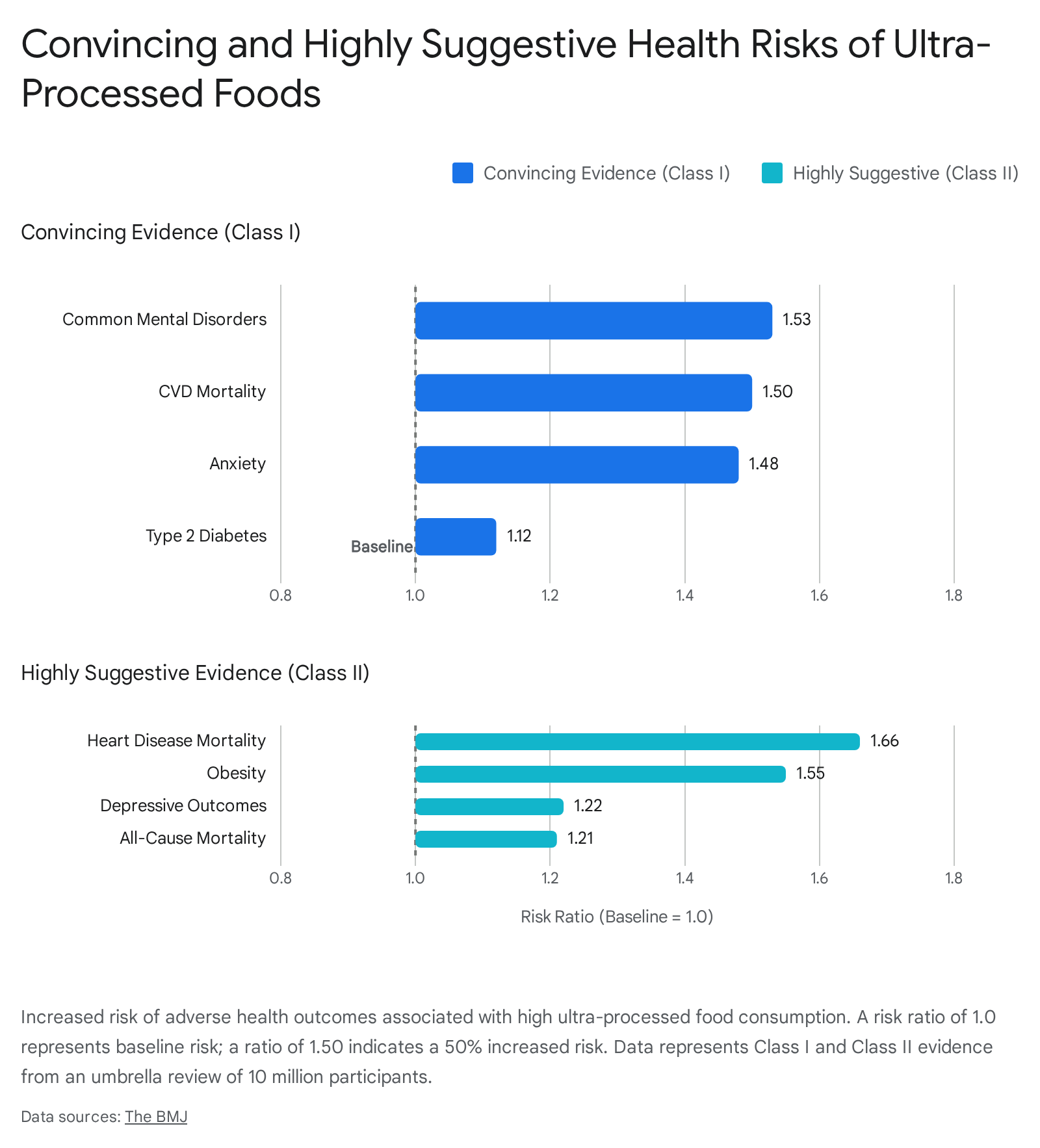
The data indicates that the greatest threats posed by ultra-processed diets are cardiovascular and psychological. The Class I (Convincing) evidence revealed that high UPF intake is associated with a 50% increased risk of cardiovascular disease-related death, a 48% to 53% higher risk of anxiety and common mental disorders, and a 12% greater risk of type 2 diabetes 363740.
Furthermore, the Class II (Highly Suggestive) evidence indicated a 21% greater risk of all-cause mortality, a 66% increased risk of heart disease-related death, a 55% increased risk of obesity, a 41% higher risk of adverse sleep outcomes, and a 22% increased risk of depression 363740. The review concluded that there is an urgent need for population-based public health measures targeting the reduction of UPF exposure to mitigate these severe cardiometabolic and psychological outcomes 3740.
Are All Ultra-Processed Foods Created Equal?
Despite the dire findings of umbrella reviews, high-level nutritional research is increasingly differentiating between sub-categories of UPFs, supporting the critique that the NOVA framework may be overly blunt.
In late 2023, a major multinational cohort study published in The Lancet Regional Health Europe analyzed the dietary histories of 266,666 adults across seven European nations to assess the link between UPFs and multimorbidity (the simultaneous development of two or more chronic diseases, specifically cancer, cardiovascular disease, and type 2 diabetes) 415152.
The baseline results aligned with prior research: for every standard portion increase in UPF consumption (about 260 grams per day), the risk of suffering multimorbidity rose by 9% 5253. However, when researchers disaggregated the NOVA Group 4 classification and looked at specific subgroups of ultra-processed products, a highly nuanced reality emerged 415152:
- High Risk Drivers: The association with multimorbidity was most notably driven by heavily processed animal-based products (such as reconstituted meats and sausages) and artificially or sugar-sweetened beverages 41515253. Condiments, sauces, and spreads also showed a positive association with disease risk 4151.
- Neutral Risk Products: Several major categories of UPFs previously assumed to be harmful - including sweets and desserts, savory snacks, ready-to-heat mixed dishes, and plant-based meat alternatives - showed no significant association with multimorbidity risk in this cohort 415152.
- Inverse (Protective) Risk Products: Most surprisingly, the consumption of ultra-processed breads and cold breakfast cereals showed an inverse relationship with disease risk, meaning higher consumption was actually associated with a reduced likelihood of developing multiple chronic diseases 41515253.
Researchers hypothesize that the protective effects of commercial breads and cereals are largely attributable to their high dietary fiber content, which promotes satiety, feeds beneficial gut microbiomes, and moderates blood glucose spikes, thereby offsetting the deleterious effects of the industrial processing 415254. These findings complicate the public health narrative, suggesting that treating all NOVA Group 4 items as equally hazardous could inadvertently discourage the consumption of accessible, cost-effective sources of dietary fiber and fortified micronutrients 9131854.
The Shifting Landscape of Global Dietary Guidelines
The overwhelming scientific consensus linking ultra-processed diets to chronic disease has forced governments and international health organizations to rapidly reconsider their regulatory frameworks and public dietary advice. Historically, dietary guidelines focused solely on nutrient thresholds; today, processing is taking center stage.
Global Pioneers in UPF Regulation
The World Health Organization (WHO) and the Food and Agriculture Organization (FAO) have become increasingly vocal regarding the dangers of industrial food formulations 4243. The WHO has publicly stated that UPFs, alongside the alcohol, tobacco, and fossil fuel industries, are responsible for millions of premature deaths globally 42. To formalize this stance, the WHO has convened a multidisciplinary Guideline Development Group tasked with publishing definitive, evidence-based global guidelines on the consumption of ultra-processed foods, with final recommendations expected by 2026 42574445.
At the national level, several countries have already integrated processing metrics into their official dietary guidance:
| Country / Region | Policy Stance on Ultra-Processed Foods | Key Recommendations / Actions |
|---|---|---|
| Brazil | Pioneer of the NOVA system. Highly restrictive approach. | Official Golden Rule: "Always prefer natural or minimally processed foods... Avoid ultra-processed products." 46 |
| France | Quantitative reduction targets implemented into national health strategy. | Set a national public health target to reduce population consumption of ultra-processed foods by 20% by 2021 47. Advises consuming fresh or minimally processed foods . |
| Canada | Integration into national dietary guidelines. | Explicitly recommends citizens "Limit highly processed foods. If you choose these foods, eat them less often and in small amounts." 47 |
| United Kingdom | Evaluative stance. Scientific committees acknowledge risks but cite evidence gaps. | UK dietary guidelines encourage reducing foods high in fat, sugar, and salt (which comprise many UPFs), but independent scientific committees have historically called for more mechanistic research before instituting blanket UPF bans 164748. |
The 2025 - 2030 U.S. Dietary Guidelines
In the United States - where ultra-processed products dominate the food supply and account for an estimated 60% of the adult diet - the regulatory environment is undergoing a massive, highly politicized transformation 121949.
In January 2026, the U.S. Departments of Health and Human Services (HHS) and Agriculture (USDA) published the Dietary Guidelines for Americans 2025 - 2030 255051. Framed by the incoming administration under the "Make America Healthy Again" (MAHA) public health agenda, the updated guidelines represent the most aggressive federal departure from historical nutrition policy 51526853. Operating under the core directive to "eat real food," the 2026 guidelines introduce an inverted food pyramid that prioritizes whole, nutrient-dense items such as proteins, full-fat dairy, healthy fats, vegetables, and whole grains 50515455.
Crucially, the 2025 - 2030 guidelines mark the first time the U.S. government has explicitly targeted an entire category of processed products for reduction 506854. The guidelines advise Americans to strictly "avoid highly processed packaged, prepared, ready-to-eat, or other foods that are salty or sweet, such as chips, cookies, and candy that have added sugars and sodium" 51525556. Furthermore, the policy directly advises limiting products that contain artificial flavors, petroleum-based dyes, artificial preservatives, and low-calorie non-nutritive artificial sweeteners 515556.
The "Highly Processed" Terminology Debate
A critical detail regarding the U.S. guidelines is the deliberate absence of the specific phrase "ultra-processed foods." Instead, federal agencies opted for the terminology "highly processed" 235357.
This semantic choice stems from both scientific caution and intense industry lobbying 57. The scientific Dietary Guidelines Advisory Committee, which spent two years reviewing the evidence, concluded that the academic definitions of UPFs (specifically the NOVA framework) remained too inconsistent to serve as the foundation for binding federal policy 57. Concurrently, food and beverage industry advocates, including the International Dairy Foods Association, argued that adopting a blanket condemnation of "ultra-processed" foods would unfairly stigmatize safe, affordable, and heavily fortified products like packaged cheeses and sweetened yogurts 57.
By adopting the term "highly processed," the FDA and USDA circumvented the immediate constraints of the NOVA classification system, buying regulatory time 235053. Building on a massive Request for Information (RFI) launched in 2025, the FDA and USDA are actively working to establish a proprietary, U.S. federal government definition of ultra-processed foods, which is slated as a priority deliverable for late 2026 234958. Until this legal definition is codified, the current federal guidance remains unequivocally focused on steering consumers away from industrial formulations and back toward home-prepared, whole-food dietary patterns 505156.
Bottom line
The scientific consensus confirms that modern diets dominated by ultra-processed foods are primary drivers of the global obesity epidemic and severe cardiometabolic dysfunction. Rigorous clinical evidence proves that these industrial formulations bypass human satiety mechanisms through a combination of soft textures, artificially condensed energy density, and hyper-palatable nutrient engineering, causing individuals to unknowingly overeat. However, significant nuance remains; certain fortified, fiber-rich products within the ultra-processed category appear to offer protective health benefits, complicating blanket policy bans. As global health organizations and national governments shift their focus from single nutrients toward penalizing "highly processed" industrial foods, the next frontier in nutrition science will require establishing precise regulatory definitions that successfully target harmful formulations without exacerbating food insecurity.