
How Transfer and Freshman Admissions Differ
Transfer admissions prioritize proven college-level academic performance and the completion of major-specific prerequisites, largely ignoring the high school grades and standardized test scores that dominate freshman admissions. While national data shows transfer acceptance rates are slightly lower than freshman rates, a hidden advantage exists at several highly selective private universities that accept transfer students at double or triple the rate of their first-year counterparts. However, transfer students must navigate systemic hurdles that freshmen avoid, including the risk of severe credit loss, diminished on-campus housing guarantees, and stricter institutional financial aid policies.
The Philosophy of Evaluation: Potential Versus Proof
The foundational difference between applying to college as a high school senior and applying as a college transfer student lies in what the admissions committee is trying to measure. The philosophy behind freshman admissions is largely predictive. Admissions officers must look at a high school applicant's trajectory, standardized test scores, letters of recommendation, and extracurricular involvement to guess how well that student will adapt to the rigors of independent, college-level academics.
Transfer admissions, by contrast, are fundamentally evidentiary. Colleges no longer have to guess if an applicant can handle college academics because the applicant already possesses a verified college transcript. This shifts the entire weight of the application away from potential and toward documented proof of success.
The 60-Credit Threshold and High School Grades
When evaluating transfer applications, universities generally separate students into distinct categories based on the number of credits they have accumulated. The most common dividing line is the 60-credit threshold, which roughly equates to two full years of undergraduate study.
If a student applies as a lower-level transfer with fewer than 60 college credits - equivalent to one or two semesters of full-time study - universities typically require both high school and college transcripts 1. Because admissions officers have limited college data to review, high school performance still serves as a necessary filter to assess academic readiness 2. For highly selective colleges, high school transcripts remain a critical component for sophomore transfers, and some institutions still require SAT or ACT scores for applicants with minimal college experience to bridge the data gap 23.
However, for students applying as upper-level or junior transfers with 60 or more completed credits, the high school transcript takes a definitive backseat and often becomes entirely irrelevant 33. At this stage, universities evaluate the applicant almost exclusively on their college grades and the rigor of the courses taken since leaving high school 12. Elite universities are looking for undeniable proof of college readiness. Once a student has demonstrated sustained academic excellence over two years of higher education, their previous high school performance is rendered obsolete in the evaluation process 2. Ultimately, the reality of transfer admissions is that high school grades matter exactly as much as the applicant allows them to; accumulating credits shifts the focus entirely to college achievements 2.
Course Completion Ratios and Major Prerequisites
Beyond the raw grade point average, transfer admissions committees heavily weigh an applicant's course completion ratio. This metric represents the percentage of attempted courses that were actually completed with a grade, rather than dropped or withdrawn. A high completion ratio signals academic maturity and the ability to manage a demanding college workload without repeatedly stopping out 1.
Furthermore, transfer admissions are highly major-specific, which creates a different strategic landscape than freshman admissions. First-year students are often admitted to a university's general college of arts and sciences as undeclared majors, allowing them time to explore academic interests. Transfer students do not have this luxury. Because they are entering midway through their degree, they are typically expected to apply directly to a specific major or department.
Admissions committees scrutinize the college transcript to verify whether the applicant has completed the necessary prerequisite coursework to seamlessly enter upper-division, junior-level classes 24. For highly competitive programs like engineering, computer science, or business, failing to complete prerequisite math and science sequences at a community college is often a disqualifying factor, regardless of a student's overall GPA 24. The focus is entirely on academic momentum and immediate readiness for advanced study.
Acceptance Rates: The Hidden Transfer Advantage
A common misconception among applicants is that transferring into a top-tier university is always more difficult than entering as a freshman. When looking at the entire landscape of higher education, this assumption appears partially true. According to recent data, the national average admit rate for transfer students sits at roughly 61%, compared to 66% for first-time freshmen 1. However, these aggregate national statistics obscure massive variations between public university systems, moderately selective institutions, and hyper-selective private colleges.
The Demographic Cliff and Transfer Recruitment
To understand current acceptance rates, it is crucial to recognize the macroeconomic forces shaping university enrollment. Higher education analysts predict a looming demographic cliff, with the consensus view indicating that the number of high school graduates in America will peak at around 3.5 to 3.9 million near 2025 before shrinking by up to 15% over the subsequent decade 56.
Faced with this impending decline in traditional 18-year-old freshman applicants, universities are feeling intense financial pressure. To mitigate the effects of the domestic enrollment decline, colleges are strategically diversifying their applicant pools 5. While some are recruiting more international students, many are quietly expanding their transfer pipelines 5. Transfer enrollment has begun to rise again, growing by 4.4% in the fall of 2024 compared to the previous year, signaling that institutions are increasingly relying on transfer students to maintain their tuition revenues and campus populations 8.
Public University Pathways and the Master Plan
Public state university systems are structurally designed to prioritize transfer students, particularly those coming from in-state community colleges. State legislatures rely heavily on these pathways to promote social mobility, improve bachelor's degree completion rates, and offer affordable alternatives to four-year tuition.
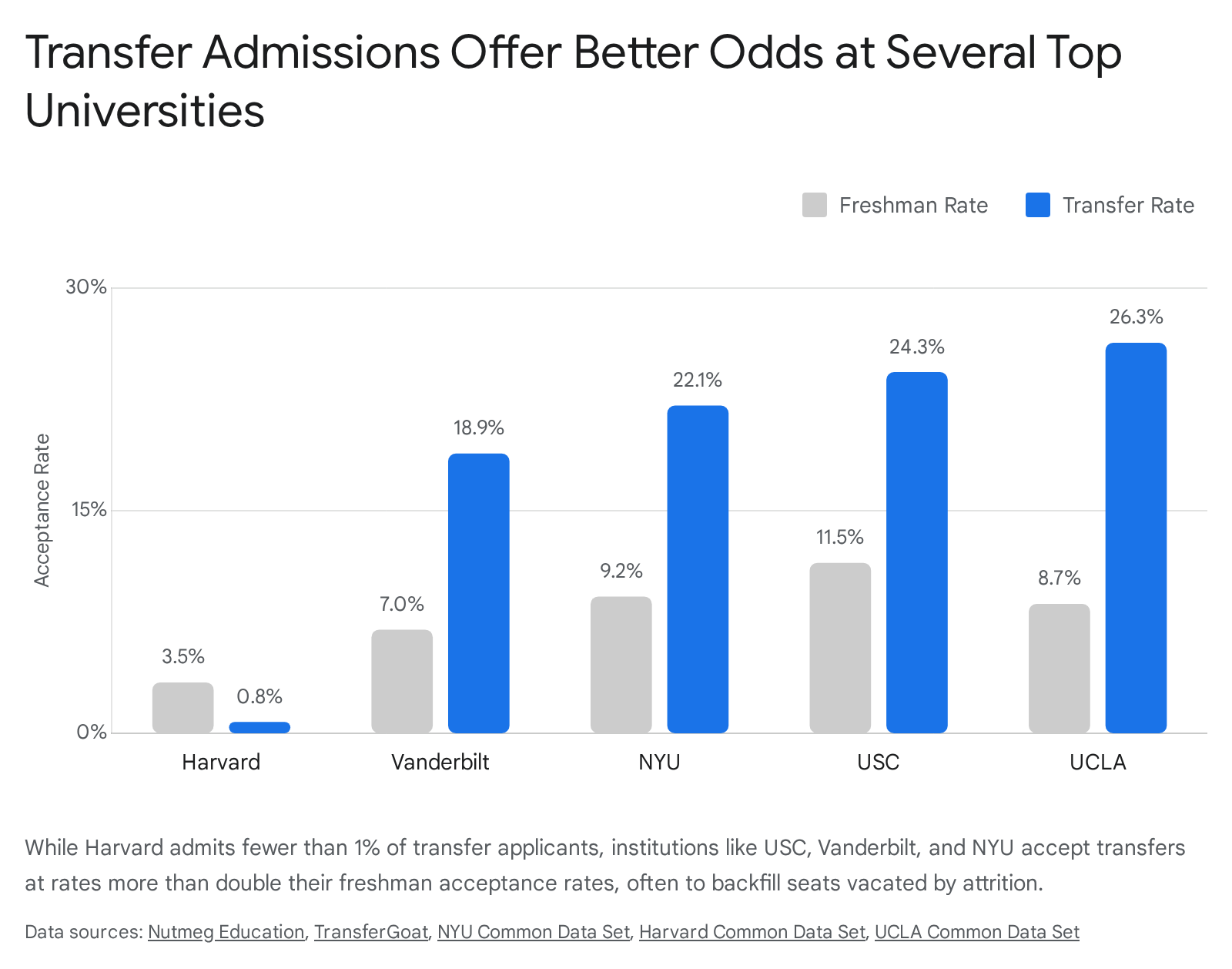
In California, for example, the state's Master Plan for Higher Education guarantees streamlined transfer pathways from California Community Colleges to both the University of California and California State University systems 9. Students who complete an Associate Degree for Transfer are significantly more likely to finish a bachelor's degree, and the UC system intentionally holds upper-division spots open specifically for these students 8. This structural mandate results in dramatically higher acceptance rates for transfers compared to freshmen. For the Fall 2023 cycle, UCLA reported a freshman acceptance rate of roughly 8.7%, admitting 12,737 students out of an enormous pool of 145,910 applicants 7. Meanwhile, its transfer acceptance rate was an impressive 26.3%, admitting 6,352 students out of 24,137 applicants 7.
The Private University Divide
Perhaps the most surprising trend in modern admissions is the distinct transfer advantage found at several highly selective private universities. Schools that reject over 90% of their freshman applicants often lean heavily on transfer students to maintain enrollment revenue, backfill beds vacated by students who drop out or study abroad, and increase the overall maturity of their campus communities.
For the 2023-2024 academic cycle, Vanderbilt University admitted a mere 5.9% of its freshman applicants, making it one of the most exclusive institutions in the country 1112. Yet, its transfer acceptance rate stood at a comparatively generous 18.9%, admitting 553 students out of 2,932 applicants 11. Similarly, the University of Southern California accepts roughly 10% of its freshmen but boasts a transfer acceptance rate of 24.4%, with nearly 74% of those accepted transfers hailing from within California 814. New York University mirrors this exact trend, reporting a freshman admit rate of 9.2% and a transfer admit rate of 22.0% for the Fall 2024 cohort 9.
The Elite Exception: The Ivy League Transfer Lottery
At the absolute peak of institutional prestige - such as Harvard, Yale, Princeton, and Stanford - the transfer advantage vanishes entirely. These institutions experience virtually zero student attrition; practically every freshman who enrolls stays for all four years. Consequently, they have very few empty beds to fill with transfer students, rendering the process highly unpredictable 210.
Harvard College, for instance, admits a tiny handful of transfers each year. In the Fall 2023 cycle, Harvard received 1,892 transfer applications and admitted just 15 students, resulting in a staggering transfer acceptance rate of 0.8% 10. By comparison, its freshman acceptance rate that same year was 3.4% 10. For these hyper-elite schools, transferring is essentially a statistical lottery, usually reserved for non-traditional students, military veterans, or candidates with incredibly unique backgrounds that cannot be found in the standard high school applicant pool.
Comparison of Recent Acceptance Rates
The table below summarizes the profound disparities between freshman and transfer admissions using recent Common Data Set figures from a mix of highly selective public and private institutions. The data illustrates how universities utilize transfer students differently based on their specific enrollment goals and attrition rates.
| Institution | Freshman Applicants | Freshman Admit Rate | Transfer Applicants | Transfer Admit Rate |
|---|---|---|---|---|
| Harvard University | 56,937 | 3.4% | 1,892 | 0.8% |
| Vanderbilt University | 45,409 | 5.9% | 2,932 | 18.9% |
| UCLA | 145,910 | 8.7% | 24,137 | 26.3% |
| New York University | 110,807 | 9.2% | 10,155 | 22.0% |
| USC | ~80,000 | 10.0% | 9,488 | 24.4% |
| SUNY Buffalo | 38,210 | 69.3% | 4,210 | 63.2% |
(Data derived from 2023-2025 Common Data Set reports for the respective universities 791011. Note that SUNY Buffalo represents a more accessible state flagship where transfer and freshman rates are closely aligned).
The Battle for Credits: Evaluation and Articulation
For a freshman, receiving an acceptance letter is the final hurdle of the admissions process. For a transfer student, the acceptance letter is merely the halfway point. The most mechanically complex and frustrating aspect of transferring is the credit evaluation process. The ultimate goal is not just gaining admission, but transferring enough prior learning credits to avoid repeating coursework and delaying graduation.
The Reality of Credit Loss
The current state of credit mobility in the United States is severely flawed, presenting a massive barrier to degree completion. According to recent research highlighted by Inside Higher Ed, nearly 60% of adults who attempt to transfer credit lose some in the process, and a staggering 16% abandon higher education entirely because the administrative friction is simply too difficult to navigate 12. On average, community college students who transfer to a four-year university lose between 12 and 15 credits - roughly equivalent to an entire semester of full-time coursework 8.
Credits are typically lost in one of two ways. First, a receiving institution may simply reject the credit outright because they deem the previous coursework inadequate, unaccredited, or irrelevant to their curriculum. Second, and much more commonly, a university accepts the credits but classifies them as "excess electives" rather than applying them toward the student's specific major or general education requirements 13. This outcome is incredibly disruptive; it forces the student to spend additional tuition money and time retaking classes they believe they have already mastered. Organizations are attempting to build tools to provide students with credit transfer visibility before they enroll, noting that improving the quality of credit application is just as important as the raw volume of credits accepted 13.
Articulation Agreements and Block Transfers
To combat the epidemic of credit loss, public state university systems rely heavily on articulation agreements. An articulation agreement is a formalized, legally binding academic partnership between two institutions - usually a two-year community college and a four-year university - that explicitly maps out exact course equivalencies and degree pathways 14.
These agreements guarantee that students who complete a specific sequence of courses at a two-year college will have those credits recognized seamlessly at the four-year institution, theoretically saving the student time and money 14. In highly integrated states, universities utilize a concept known as "block transfer." Under a block transfer arrangement, a receiving university accepts an entire associate degree bundle in its totality. This allows the institution to satisfy all general education requirements in one sweep, eliminating the need for a tedious, course-by-course administrative evaluation 15. Some states have even mandated common course numbering conventions across all public colleges to completely eliminate confusion over whether a sociology class at a community college matches a sociology class at the state flagship 16.
Elite Institution Credit Policies
While public universities embrace articulation agreements, elite private colleges rarely participate in them. With a few notable exceptions - such as Cornell University's College of Agriculture and Life Sciences, which partners with certain New York state community colleges - prestigious private institutions evaluate transfer credits on a strict, highly individualized basis 414.
The credit transfer rules at these top-tier private universities are notably rigid, ensuring that their institutional rigor is maintained. For example, Harvard strictly requires a minimum grade of B (or its equivalent) for a course to even be considered for transfer credit; a pass/fail grade is immediately disqualified 23. Yale requires transfer students admitted through its Eli Whitney program to achieve a letter grade of A or B in at least 75% of their transferable courses, with absolutely no grades lower than a C in the remainder 1718.
Furthermore, highly selective schools generally only accept credits that align perfectly with their own traditional liberal arts curriculum. They routinely deny credit for pre-professional courses like business administration or criminal justice, vocational training, and physical education 231719. Online coursework is also heavily restricted. Harvard generally does not grant credit for online or correspondence courses 19. Yale allows a maximum of two asynchronous online courses to transfer under very limited conditions, provided there was regular, documented synchronous interaction with an instructor 1820. Finally, even if a student has accumulated three years of credits elsewhere, universities enforce strict residency requirements. Both Harvard and Yale cap incoming transfer credits to ensure that the student spends at least two full academic years studying on their physical campuses before earning a degree 2122.
The Rise of Alternative Credentials
Complicating the credit transfer landscape is the recent explosion of alternative credentials and micro-credentials. As higher education evolves, there is an ongoing debate about how to evaluate non-traditional learning for college credit. While students and employers increasingly value these agile, skill-based micro-credentials, traditional universities struggle to fit them into legacy credit evaluation systems 2324. Establishing a systematic, data-driven approach to assess the creditworthiness of these alternative programs remains a formidable challenge for university registrars, meaning transfer students attempting to use them currently face high rates of rejection 23.
Financial Aid: Diverging Policies and Budgets
While transfer admissions might offer an easier statistical path into certain prestigious universities, the financial reality can be far more punishing. Freshman financial aid packages serve as powerful recruitment tools designed to lock in top talent, but colleges historically reserve fewer institutional grant dollars for the transfer cohort.
Need-Blind vs. Need-Aware Policies
When high-school seniors apply to highly selective colleges, many of those institutions practice "need-blind" admissions. A need-blind policy means an applicant's financial situation and ability to pay tuition have zero impact on whether the admissions committee decides to accept or reject them 32. The school evaluates the student purely on merit and promises to figure out the finances later. However, this level of generosity does not always extend to transfer students.
Because colleges operate with finite financial aid budgets, many institutions shift to a "need-aware" policy for their transfer applicants 33. A need-aware policy means the admissions committee explicitly factors in a student's financial need when making their final admission decision 25. If the university's transfer aid budget is nearing its limit, a highly qualified transfer applicant who requires a full ride might be rejected in favor of a slightly less qualified applicant who can pay the full cost of attendance out of pocket.
For example, Washington University in St. Louis (WashU), Brown University, and the University of Chicago are all strictly need-aware for transfer students, despite practicing need-blind admissions for their domestic first-year applicants 25.
Fortunately, a select group of elite universities with massive institutional endowments maintain entirely need-blind admissions for domestic transfer students. These include Harvard, Yale, Princeton, Stanford, MIT, Columbia, Penn, and Vanderbilt 332526. If a domestic transfer student is admitted to one of these institutions, the university guarantees to meet 100% of their demonstrated financial need without loans 33.
The table below highlights the divergence in financial aid policies between freshman and transfer admissions at several elite institutions. Note that regardless of domestic policy, almost all United States colleges are entirely need-aware or offer absolutely zero institutional aid to international transfer students 25.
| Institution | Domestic Freshman Policy | Domestic Transfer Policy | International Transfer Policy |
|---|---|---|---|
| Stanford University | Need-Blind | Need-Blind | Need-Aware |
| Columbia University | Need-Blind | Need-Blind | Need-Aware |
| Vanderbilt University | Need-Blind | Need-Blind | No Aid Offered |
| Brown University | Need-Blind | Need-Aware | Need-Aware |
| WashU | Need-Blind | Need-Aware | Need-Aware |
| UChicago | Need-Blind | Need-Aware | No Aid Offered |
(Data reflecting institutional financial aid policies for the 2024-2025 application cycle 332526).
Targeted Grants and Guaranteed Transfers
At public institutions, financial aid operates under different pressures. While large merit scholarships are generally less common for transfer students than for freshmen, many state schools implement targeted grants specifically to ease the transfer transition. For instance, the California State University system's Fresno State offers a "Tuition Advantage" program that covers 100% of tuition and mandatory campus fees for new transfer students whose families meet certain income thresholds 27. Similarly, SUNY's Buffalo State provides "Bengal Promise" grants specifically tailored to help transfer students afford non-tuition costs like on-campus housing and meals, provided they maintain a specific GPA 28.
Additionally, a unique phenomenon known as the "guaranteed transfer" or "preferred transfer" has emerged. Instead of outright rejecting a strong freshman applicant or placing them on a hopeless waitlist, a selective university will offer them a guaranteed spot for their sophomore year, provided they spend their freshman year at another institution and maintain a specific GPA 38. USC's Trojan Transfer Plan and Cornell's transfer options are prime examples of this strategy, allowing universities to keep strong applicants in their pipeline without offering them immediate financial aid packages as freshmen 38.
The Campus Experience: Housing Guarantees and Student Life
The difference between freshman and transfer admissions extends far outside the classroom and directly impacts basic living accommodations. At nearly all traditional four-year universities, first-year freshmen are either strictly required to live on campus or are given absolute priority for campus housing. Universities enforce this to foster a sense of community, improve freshman retention rates, and ease the transition away from home.
Transfer students are rarely granted this luxury. Because they are typically older and often enter the university with junior standing, institutions generally expect them to secure off-campus apartments. At New York University, for example, over 85% of first-year students choose to live in campus residence halls 29. However, NYU explicitly warns that incoming transfer students do not receive any guaranteed housing. Instead, transfers are placed on a waitlist and are only offered rooms if space permits, leaving many newly admitted students scrambling to navigate the notoriously expensive and complex New York City rental market entirely on their own 303142.
A notable and pioneering exception to this nationwide trend is UCLA. In 2022, facing a severe housing affordability crisis in the Westwood area of Los Angeles, UCLA became the first University of California campus to implement a comprehensive, multi-year housing guarantee. UCLA now promises four consecutive years of university-owned housing to incoming freshmen, and two consecutive years of guaranteed housing to incoming transfer students 3244. This policy drastically reduces housing insecurity for the transfer cohort and integrates them more deeply into campus life, though it requires them to live continuously in university housing to maintain their guaranteed status 45.
Bottom line
Transferring to a four-year university requires a fundamentally different strategic approach than applying as a high school senior. Admissions committees largely ignore standardized tests and high school transcripts, focusing instead on proven college GPAs and the successful completion of major-specific prerequisites. While students can take advantage of surprisingly high transfer acceptance rates at certain elite private universities and public flagships, they must carefully navigate a system fraught with credit loss, need-aware financial aid policies, and a lack of guaranteed campus housing. Ultimately, success as a transfer student relies on meticulous early planning to ensure that earned credits translate seamlessly into an on-time degree.