
How the 2+2 College Transfer Path Works
The "2+2" transfer pathway is a popular higher education model where a student completes their first two years of coursework at a community college before transferring to a four-year university to earn a bachelor's degree. While this route promises profound tuition savings and increased accessibility, succeeding requires rigorous early planning, a deep understanding of state articulation agreements, and strategic course selection to avoid the devastating financial trap of credit loss.
Understanding the 2+2 Transfer Pathway
Preparing students to transfer to a university and earn a bachelor's degree has historically been a primary mission of the community college system. For millions of students each year, community college serves as a practical, flexible, and affordable starting point on the path to higher education 1. The fundamental premise of the 2+2 model is straightforward: a bachelor's degree typically requires 120 credit hours. A student completes the first 60 credits at a two-year institution, earning an associate degree. These credits usually encompass lower-division general education requirements and introductory courses for a specific major. The student then transfers those 60 credits to a four-year university, entering with "junior" standing to complete their final 60 upper-division credits 234.
The Core Concept and Historical Role
Community colleges in the United States operate under a complex dual mandate. On one side, they function as workforce training engines, offering terminal vocational certificates and Associate in Applied Science (AAS) degrees designed to move students directly into the labor market 56. On the other side, they serve as the ultimate academic stepping stone, offering Associate in Arts (AA) and Associate in Science (AS) degrees explicitly designed for transfer to four-year institutions 6.
This dual mandate sometimes creates tension in state funding and curriculum design. The pivot toward workforce development has reshaped how some community colleges justify their existence to legislators, with states like Texas moving toward outcomes-based funding models that reward colleges for producing credentials aligned with immediate labor market demand 5. Yet, for a vast demographic of students - particularly adult learners, those from low-income households, and first-generation college attendees - the transfer function of the community college is the only viable entry point into a bachelor's degree program 5.
The Aspiration Versus Reality Gap
In theory, the 2+2 pathway is an elegant engine for socioeconomic mobility. It allows students to stay closer to home, benefit from smaller introductory class sizes, and pay significantly less per credit hour. However, the statistical reality of vertical transfer (moving from a two-year to a four-year institution) paints a picture of a system riddled with structural friction.
According to extensive research from the Community College Research Center (CCRC) and the Aspen Institute, approximately 80% of students entering community college state that their ultimate goal is to earn at least a bachelor's degree 78. Yet, the pipeline narrows dramatically at every subsequent stage. Only about 33% of these students actually successfully transfer to a four-year institution 78. Of those who do manage to transfer, fewer than half complete their bachelor's degree within a standard timeframe 89.
Ultimately, only 16% of community college students who aspire to a bachelor's degree earn one within six years of starting their college journey 78. Furthermore, the idealized "2+2" timeline is rarely achieved. Data indicates that only 8% of successful community college transfer students flawlessly execute the strict two-years-to-two-years sequence 7. The vast majority take longer, often due to part-time enrollment, changing majors, stopping out to work, or the pervasive issue of losing credits during the transfer process itself 5710.
Recent Trends in Transfer Enrollment
Despite these systemic challenges, the 2+2 pathway remains a vital artery in American higher education, and recent data shows a rebound in its utilization. The COVID-19 pandemic severely disrupted community college enrollments, leading to unprecedented declines in freshmen, adult learners, and transfer-in enrollments 1112. However, by the fall of 2024, the National Student Clearinghouse Research Center reported that transfer enrollment was making a strong comeback, surpassing pre-pandemic 2020 figures 13.
In fall 2024, the number of students who transferred into a new institution grew by 4.4% compared to the previous year, representing 13.1% of all continuing and returning undergraduates 1013. Nearly 500,000 students transferred from a two-year to a four-year institution during this period 13. This growth indicates that students are actively adjusting their postsecondary goals in response to changing economic and labor market conditions, utilizing the flexibility that the transfer pathway provides 13.
The Financial Equation: Why Students Choose the 2+2 Path
One of the most compelling arguments for the 2+2 pathway is the potential for extraordinary cost savings. The average cost of attending a public two-year college is substantially lower than that of a four-year institution, allowing students to avoid the crushing burden of student loan debt. However, to truly understand the financial dynamics, families must look beyond the published "sticker price" and consider net costs, living expenses, and the financial penalties of inefficient transfer planning.
Tuition Comparisons by the Numbers
According to data compiled by the College Board for the 2023-2024 and 2024-2025 academic years, the cost disparities between institution types remain vast. The cost of college in the United States has skyrocketed over the last three decades, frequently outpacing inflation, making the community college alternative increasingly attractive 1415.
| Institution Type | Average Annual Tuition & Fees (2024-2025) | Estimated Total Annual Cost (Including Housing, Food, Supplies) |
|---|---|---|
| Public Two-Year (In-District) | $3,890 - $4,050 | $13,280 - $20,600 |
| Public Four-Year (In-State) | $11,260 - $11,610 | $28,840 - $30,000 |
| Public Four-Year (Out-of-State) | $29,150 - $30,780 | $46,730 - $49,100 |
| Private Four-Year (Nonprofit) | $41,540 - $43,350 | $60,420 - $63,000 |
Data aggregated from the College Board and related national higher education surveys 1415161718. Figures represent broad national averages.
Tuition and fees at community colleges average roughly 35% of the in-state tuition and fees at public four-year institutions 1618. By completing the first two years of a degree at a community college, an in-state student can save approximately $15,000 in direct tuition alone compared to attending a public university, and up to $80,000 compared to a private nonprofit university.
Sticker Price vs. Net Cost and Financial Aid
It is crucial to distinguish between published tuition rates (the sticker price) and the net cost of college, which is what students actually pay after state, federal, and institutional grants are applied.
For many lower-income students, the net tuition cost of community college approaches zero. In recent years, nearly 39% of full-time, in-state community college students received enough grant aid (such as the federal Pell Grant) to entirely cover their tuition and fees 1617. This includes 71% of students from families with incomes of less than $40,000 16. Furthermore, states are increasingly stepping in to subsidize the two-year path. California, which boasts the least expensive community college system in the nation, offers the California Promise program for tuition-free education, while Georgia provides the HOPE and Zell Miller Grants 18. Massachusetts recently saw community college enrollment grow at two and a half times the national average after investing millions in free community college programs funded by a surtax on high earners 5.
Hidden Costs: Living Expenses and Transportation
While tuition is drastically lower, it is only one part of the total cost of attendance. The total budget for a community college student must include housing, food, transportation, and textbooks. The College Board notes that these ancillary expenses vary less across institutional sectors than tuition does 16.
As a result, while the tuition price at a two-year institution is 35% of a four-year college, the total community college student budget is about 69% of the public four-year in-state student budget 16. Commuter students save drastically on room and board by living at home, but they frequently face higher transportation expenses 1417. Furthermore, if a transfer student loses credits during the transition to a four-year school, the cost of retaking those classes at the higher university tuition rate rapidly erodes the financial benefits of the 2+2 model, making efficient transfer a financial imperative 1.
Navigating the Mechanics of Articulation
The success of a 2+2 pathway relies entirely on how effectively credits move from the sending institution (the community college) to the receiving institution (the university). This transfer is governed by complex policies, state laws, and institutional contracts known collectively as articulation agreements.
Defining Articulation Agreements
In higher education, articulation refers to formal agreements between two or more institutions ensuring that coursework completed at one institution will be accepted and recognized toward degree requirements at another 191718. Articulation agreements are the contractual backbone of the 2+2 system. They are designed to provide a seamless transition, preventing students from unnecessarily repeating coursework they have already mastered and thereby reducing the overall time and cost to degree 1718.
These agreements describe exact coursework equivalencies and define the transfer plans for students transitioning from a two-year to a four-year program 17. Without them, credit evaluation is left to the highly subjective, discretionary review of the receiving university's admissions office or academic departments, which makes the transfer process volatile and unpredictable 119.
Types of Transfer Agreements
Not all articulation agreements offer the same level of protection or guarantee. They generally fall into several distinct structural categories:
- Course-to-Course Agreements: These agreements map specific individual classes at the community college to specific individual classes at the university. For example, they guarantee that a particular "Introduction to Psychology" course at a community college will be accepted exactly as the university's "Psychology 101" requirement 20.
- Block Transfer Agreements (General Education): These allow a student to transfer a bundle of credits simultaneously without individual course-by-course scrutiny 17. Most commonly, this takes the form of a "General Education Block." If a student completes an approved cluster of core courses (covering math, science, humanities, and English), the receiving university accepts the block as fulfilling all of its lower-division general education requirements, even if the specific courses don't perfectly match the university's catalog 317.
- Program-to-Program (Major-Specific) Agreements: These align a specific associate degree program with a related bachelor's degree program. They ensure that a student transfers not just with general education credits, but with the specific prerequisite competencies required for their major, allowing them to enter as a true academic junior in their designated department 1721.
- Guaranteed Admission Programs (Dual Admissions): Many states and colleges offer robust programs where a student who enrolls in a community college and maintains a specific grade point average is guaranteed subsequent admission to a partner four-year university. Examples include Florida's overarching 2+2 system, California's Associate Degree for Transfer (ADT) model, and localized programs like UCF's DirectConnect 31022.
Credit Transferability vs. Credit Applicability
One of the most critical and frequently misunderstood concepts in the entire 2+2 pathway is the nuanced difference between credit transferability and credit applicability 1019. Failing to understand this distinction is the primary reason students spend extra time and money in college.
Transferability simply means the four-year university accepts the course as valid, college-level work and adds the credits to the student's overall institutional transcript 1019.
Applicability means the transferred course actually counts toward the specific graduation requirements of the student's chosen major 10.
For example, a transfer student aiming for a Bachelor of Science in Engineering might transfer a 3-credit community college sociology course. The university evaluates the syllabus and accepts the credits (it is transferable). However, the engineering degree curriculum is highly rigid, requiring strict math and physics sequences, and has no space for sociology in its core requirements. Therefore, the sociology class is relegated to a "free elective" bucket. If the student has already maxed out their allowed free electives with other miscellaneous classes, those 3 sociology credits do not move the student any closer to graduation 101923. They are effectively lost time and money. To succeed in a 2+2 path, students must ensure their courses are both transferable and applicable to their specific intended major.
State Frameworks: Centralized vs. Decentralized Systems
Transfer policies differ wildly depending on the geographic location of the student. Over the past decade, there has been a strong legislative push to standardize transfer rules to protect students from bureaucratic gridlock. According to the Education Commission of the States, at least 31 states now have policies requiring a transferable core of lower-division courses and a statewide guaranteed transfer of an associate degree 24. However, the strength and enforceability of these policies are entirely dictated by whether a state has a centralized higher education system or a decentralized one.
The Centralized Model: Florida and California
States with highly centralized oversight of higher education can mandate smooth transfer pathways by law, forcing compliance from individual universities.
Florida is widely considered a national leader in seamless articulation. Florida statutes mandate a statewide "2+2" articulation agreement 225. Students who earn an Associate in Arts (AA) degree from one of the 28 Florida College System institutions are guaranteed admission to one of the 12 public state universities 23. Furthermore, Florida utilizes a rigorous Statewide Course Numbering System (SCNS). By law, an institution accepting a transfer student must award credit for equivalent courses taken at another participating institution as if the student had taken them at the receiving school 3.
The Florida AA degree acts as a powerful block transfer, guaranteeing the student's 36-hour general education requirement is satisfied with no further coursework required in that area 3. However, it is vital to note the fine print: this policy guarantees general admission to a state university, but it does not guarantee admission to a highly selective limited-access major, nor does it guarantee placement at a student's top-choice campus 322. Furthermore, courses outside the norm - such as applied performing arts, clinical health courses, or remedial prep classes - are excluded from guaranteed transfer 3.
California operates another highly structured system, primarily managing transfers from the 116 California Community Colleges (CCC) to the California State University (CSU) and University of California (UC) systems. California utilizes the Intersegmental General Education Transfer Curriculum (IGETC) to provide a unified general education block that satisfies lower-division requirements across both university systems 2026. More importantly, the state developed the Associate Degree for Transfer (ADT). Students who complete an ADT are guaranteed admission into the CSU system with junior standing and are given a clear, legally protected 60-credit pathway to complete their bachelor's degree 10.
The Decentralized Model: Michigan and Pennsylvania
In states where universities operate with constitutional autonomy or independent governance, state legislatures and boards of education cannot easily dictate transfer rules. This leads to decentralized systems that rely entirely on voluntary cooperation among institutions.
Michigan is a prime example of an extremely decentralized policy environment. The Michigan Constitution grants public colleges and universities autonomous governance, meaning state agencies are fundamentally limited in their ability to mandate universal transfer policies 3031. Instead, transfer initiatives exist through "coalitions of the willing." The Michigan Transfer Agreement (MTA) was created voluntarily by institutions to allow up to 30 semester credits to fulfill general education requirements at participating colleges 3031. While the MTA functions reasonably well as a block transfer, developing major-specific statewide pathways has proven difficult because autonomous university faculties must individually agree to accept specific courses, leading to inconsistency across the state 31.
Pennsylvania represents a hybrid model. State law requires the 15 community colleges and the 10 State System universities to participate fully in the Pennsylvania Statewide Transfer and Articulation System 21. This includes a 30-Credit Transfer Framework for general education. However, major private institutions and massive state-related research universities (like Penn State, Temple, and Pitt) operate with varying degrees of autonomy. They participate in the system voluntarily, usually by agreeing to meet minimum requirements, but they maintain broad discretion over major-specific articulation 21.
A National Comparison of State Architectures
| State | System Structure | Key Frameworks & Guarantees | Core Transfer Planning Tool |
|---|---|---|---|
| Florida | Highly Centralized | "2+2" guaranteed university admission with an AA degree; Statewide Course Numbering System (SCNS); 36-hour block transfer. | FloridaShines |
| California | Highly Centralized | Intersegmental General Education Transfer Curriculum (IGETC); Associate Degree for Transfer (ADT) guaranteeing CSU admission. | ASSIST.org |
| Michigan | Decentralized | Constitutional university autonomy; relies on voluntary agreements like the Michigan Transfer Agreement (MTA) fulfilling 30 core credits. | MiTransfer Network |
| Pennsylvania | Partially Decentralized | Mandated participation for public institutions; 30-Credit Transfer Framework; voluntary participation for state-related colleges. | PA College Transfer |
The Hidden Trap of Credit Loss
Even with articulation agreements in place, the greatest threat to a 2+2 transfer student is credit loss. Earning 60 credits at a community college does not guarantee the university will recognize those 60 credits toward graduation. The failure to seamlessly port credits remains the most pervasive friction point in American higher education.
The Scope and Financial Penalty of Lost Credits
A growing body of research has documented extensive credit loss nationwide. According to research from the U.S. Government Accountability Office (GAO) and the Center for Higher Education Policy and Practice (CHEPP), students who transfer lose an average of 43% of their credits during the transition 132. Furthermore, one in seven students loses all of their credits when transferring 32. Other estimates suggest that nearly two-thirds of transfer students lose at least some pretransfer credits 2728.
Credit loss acts as a massive hidden tax on transfer students. When credits are lost, students are forced to retake classes at the much higher university tuition rate 129. This extends their time to degree, burns through their financial aid eligibility (such as the strict lifetime limit on Pell Grants), delays their entry into the workforce, and significantly lowers their likelihood of ever graduating 1729. Research shows that two out of five learners do not complete their degree after transferring, a statistic heavily driven by the discouragement, academic fatigue, and financial burden of credit loss 32.
Disentangling General vs. Major Credit Loss
Recent advanced modeling by researchers utilizing administrative data from Texas (the Texas ERC study) has shed profound light on the mechanics of credit loss by disentangling it into two distinct categories: general credit loss and major credit loss 272836.
General credit loss occurs when a university rejects a course entirely, refusing to put it on the transcript at all. This often happens with remedial classes, career and technical education (CTE) courses designed for immediate workforce entry, or courses taken at institutions lacking regional accreditation 1336.
Major credit loss occurs when a course transfers into the university but does not apply to the student's declared major, acting merely as excess elective credit 2836.
The Texas research highlights that while both forms of credit loss harm institutional retention, major credit loss is far more damaging to a student's ultimate persistence and likelihood of attaining a bachelor's degree 28. When a student loses major credits, they are forced to repeat the rigorous sequence of prerequisite coursework, fundamentally stalling their academic momentum.
Common Causes of Discarded Credits
Credit loss rarely happens out of malice; it is usually the result of structural misalignment, rigid university policies, and poor advising: 1. Institutional Differences in Syllabi: A community college statistics course may not satisfy a university's quantitative requirement if the university faculty determines the syllabus lacks the required calculus-based rigor or depth of content 119. 2. Changing Majors: A student who completes 60 credits preparing for a nursing degree and then decides to major in business upon transferring will lose dozens of credits, as human anatomy cannot substitute for corporate finance prerequisites 110. 3. Lack of Pre-Transfer Awards: Students who transfer prematurely - before completing their full associate degree or the 36-hour general education block - are subjected to grueling course-by-course evaluations, stripping away the protective umbrella of block transfer agreements 3. Data shows that 67% of transfer students who complete an associate degree before transferring graduate within four years, compared with just 42% of those who transfer without a pre-transfer award 7.
Equity Gaps in Transfer Outcomes
The extreme complexities of the transfer system do not impact all students equally. Navigating course equivalencies, tracking down articulation agreements, and understanding credit applicability requires significant "navigational capital" - an innate knowledge of how bureaucratic academic systems operate. Consequently, severe equity gaps exist within transfer outcomes.
Demographic Disparities in Bachelor's Completion
The Community College Research Center (CCRC) provides detailed statistics on these systemic disparities. While the national average for community college students transferring and earning a bachelor's degree within six years sits at a low 16%, the rates are alarmingly worse for historically underserved demographics 78:
- Low-income students: 11% transfer and complete a bachelor's degree.
- Hispanic students: 13% transfer and complete.
- Black students: 9% transfer and complete.
- Older adult learners (25+): 6% transfer and complete.
Furthermore, a student's socioeconomic background heavily dictates their transfer velocity. Over half (52%) of all successful transfer students originate from the top two quintiles of neighborhood income, while only 27% come from the bottom two quintiles 78. The report notes that adult learners may have lower transfer-out rates because they are seeking immediate workforce credentials rather than academic transfers, but the equity gaps among degree-seeking students remain profound 8.
The Impact of Institutional Destinations
Student outcomes are also heavily influenced by where they choose to transfer.
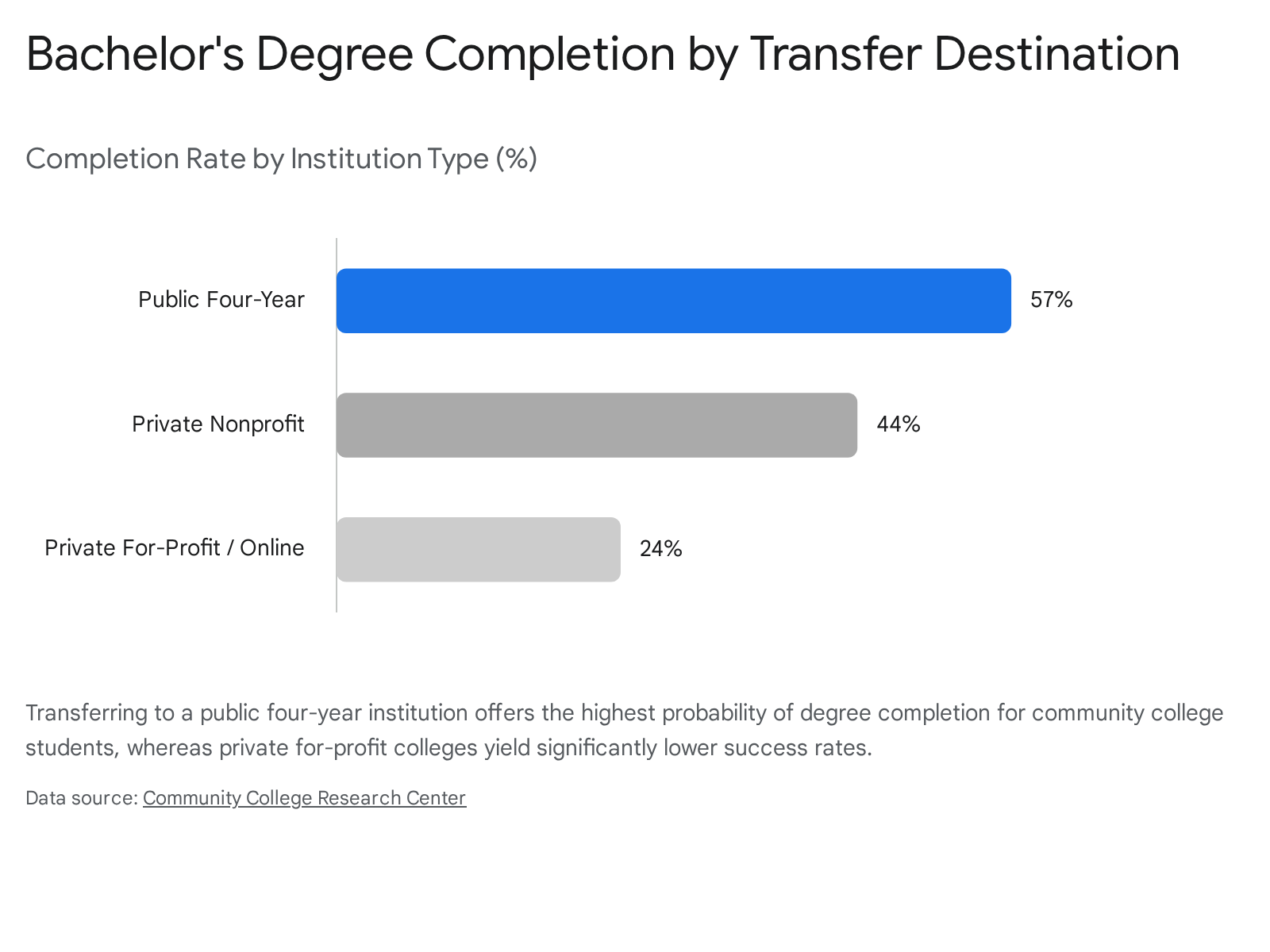
When community college students transfer to public four-year institutions, 57% successfully complete their bachelor's degree within four years of transferring. At private nonprofit universities, that number drops to 44% 7. However, at private for-profit and predominantly online institutions, the completion rate plummets to an abysmal 23% to 25% 7. Disturbingly, Black community college transfers are twice as likely as other student demographics to enroll in these lower-performing for-profit institutions, directly contributing to the wider racial equity gap in bachelor's attainment 7.
Psychological Barriers and STEM Identity
Beyond systemic administrative barriers, psychological and cultural factors play a profound role in a transfer student's persistence. Transfer students - often termed "vertical transfers" - frequently experience what researchers describe as "transfer shock," a temporary dip in GPA during their first university semester as they adjust to new academic expectations.
Research evaluating transfer students in rigorous fields, such as Science, Technology, Engineering, and Mathematics (STEM), indicates that these students often take longer to complete their degrees due to a combination of credit loss, inadequate advising, and perceived "transfer stigma" 37. Transfer students sometimes report feeling unwelcome by faculty and traditional "native" four-year peers. This alienation damages their "STEM identity" - their internal perception of themselves as belonging to the scientific community 37. This lack of belonging can accelerate dropout rates, highlighting the desperate need for universities to provide robust wraparound support services, mental health counseling, and dedicated transfer orientations 530.
Essential Tools for Transfer Planning
To combat credit loss and successfully navigate the labyrinth of articulation agreements, several digital platforms have become indispensable for academic advisors and students. Properly utilizing these tools is the absolute strongest defense against taking unusable courses.
Transferology: A National Equivalency Database
Transferology is a widespread, free national database (utilized by over 400 colleges) that shows how courses taken at one institution have previously transferred to another 3931. Students can create an account and input their community college courses, Advanced Placement (AP) exams, CLEP scores, and military credits into the system to see exactly how specific universities will evaluate them 1939.
However, academic experts note that Transferology should be read with the critical eye of a registrar: it displays past transfer history, not an absolute future promise 19. A match report might show a class transferring as a "direct equivalent" (satisfying a specific requirement), as "elective credit" (accepted but unassigned to a requirement), or as "non-transferable" (no historical match found) 19. While it eliminates massive amounts of guesswork and prevents students from applying blindly, students must still explicitly verify their findings with an advisor at the receiving institution 1932.
ASSIST: Decoding California's System
For students navigating the massive California higher education system, ASSIST.org is the official, legally binding repository of articulation 3343. The platform pulls rules from all 116 community colleges and all UC and CSU campuses, showing exact, course-by-course transfer agreements right down to the specific major level 34.
ASSIST prevents the common but fatal mistake of assuming that a class that transfers to UC Berkeley will also automatically transfer to UCLA for the same major. By searching a specific target campus and major, students receive an articulation agreement that outlines exactly which classes to take 3445. Because many California majors are highly impacted "screening majors" that require specific coursework and GPAs just to be considered for admission, relying on ASSIST is mandatory for success 45.
State-Specific Portals: FloridaShines and PA College Transfer
Centralized and hybrid states offer their own dedicated portals to guarantee transfers. FloridaShines allows Florida students to run sophisticated advising audits, check graduation requirements, and perform an "AA transfer evaluation" to see if their current GPA and completed coursework match a specific state university program's prerequisites 335.
In Pennsylvania, the PA College Transfer site operates as a one-stop-shop where students can search the 30-Credit Transfer Framework and identify active Parallel Program agreements that allow them to step directly into related bachelor's programs as juniors 21.
A Strategic Timeline for 2+2 Success
Successfully utilizing the 2+2 pathway is not a passive process. To ensure all 60 community college credits apply seamlessly to a bachelor's degree, students must treat the transfer process like a strict project timeline, hitting specific milestones well before they ever apply to a university.
0 to 15 Credits: Early Exploration and Gateway Courses
During the first semester, students should establish a strong academic baseline by completing introductory English and Math courses. Taking gateway math and English early in year one is one of the strongest statistical predictors of long-term transfer success 10. At this early stage, students should begin exploring options, meet with a community college transfer counselor, and build a shortlist of three to five target universities based on location, cost, and degree offerings 3036.
16 to 30 Credits: Declaring a Major
By the time a student earns 18 to 30 credits (roughly the end of their freshman year), they must definitively declare an intended major 363738. Because most universities require specific "common prerequisites" for upper-division entry into a major, delaying this choice leads directly to taking the wrong classes 2637. In Florida, for example, students are explicitly required by policy to select a university pre-major by the 30-credit mark to ensure they can work with an advisor on an individual learning plan 3738. Students should also investigate and sign formal Dual Admissions intent forms at this stage if their college offers them 36.
31 to 45 Credits: Narrowing the Focus and Degree Audits
During the sophomore year, students should visit their shortlisted universities, speak to university department faculty to gauge the academic environment, and run rigorous transfer degree audits using tools like Transferology, ASSIST, or FloridaShines 3036. This is the critical phase where students must confirm that their upcoming course schedule perfectly matches the destination university's articulation agreement, ensuring that every single credit will act as an applicable prerequisite or required general education course rather than a discarded elective 2636.
45+ Credits: Finalizing the Transition
In the final semester at the community college, students must confirm their graduation requirements for their associate degree, finalize their transfer applications, secure letters of recommendation, and apply for financial aid specific to transfer students 3036. They must analyze credit evaluations provided by the receiving university before sending a deposit, comparing the net price and accepted credits to make a final, informed decision 30.
Post-Transfer Mechanisms and Policy Reforms
Recognizing the vast inefficiencies and high attrition rates in the current transfer ecosystem, state legislatures and educational advocates have begun implementing targeted policy reforms to streamline the 2+2 path and protect student investments.
The Safety Net of Reverse Transfer
For students who end up transferring before completely finishing their associate degree, many states have instituted highly effective Reverse Transfer policies 2224. If a student transfers to a university with 45 community college credits, takes 15 credits at the university, and then stops out due to life circumstances, they would traditionally have zero degrees to show for 60 hours of collegiate work.
Reverse Transfer solves this by allowing the university to retroactively send those 15 university credits back to the community college. The community college then evaluates the combined transcript and awards the Associate Degree 2224. At least 25 states currently have reverse transfer policies set in legislation or board policy, providing an essential safety net that ensures the student retains a credential holding tangible workforce value even if they never finish their bachelor's degree 24.
Shifting to Outcomes-Based Funding
Historically, community colleges were funded almost entirely based on enrollment - the sheer number of students sitting in seats. This offered no structural financial incentive for the college to ensure students successfully transferred and graduated from a university 5.
States are increasingly rewriting these funding formulas to prioritize outcomes. Texas, for instance, has aggressively incentivized vertical transfer. In the 2024-25 school year, Texas began paying community colleges a premium when their students successfully transitioned to a four-year university with at least 15 transferrable credit hours 29. This shift resulted in nearly $327 million being distributed to two-year schools specifically for fueling the transfer pipeline 529. Furthermore, Texas Senate Bill 25 mandated that universities publish highly transparent recommended course sequences to prevent the state's students from spending time and money on unnecessary credits 29.
The Growing Role of Dual Enrollment
A major bright spot in recent transfer data is the integration of dual enrollment - programs allowing high school students to take community college courses for concurrent credit 2. Research from 2025 indicates that students who enter community college with prior dual enrollment credits have a transfer-out rate of 45.4% and a bachelor's completion rate of 58.6%, which is significantly higher than first-time-in-college students who lack dual enrollment experience 910. States are actively pushing to align high school dual enrollment pathways directly with the 2+2 model, giving students a subsidized, early start on accumulating guaranteed transfer credits and accelerating their time to degree 710.
Bottom line
The 2+2 transfer pathway remains a highly effective mechanism for democratizing access to higher education and drastically reducing the cost of a bachelor's degree. However, success requires students to navigate the system with strategic precision: declaring a major early, utilizing state-specific articulation tools, and completing a full associate degree prior to transferring. Because widespread inconsistencies in credit applicability lead to an average loss of 43% of earned credits, the burden of success still rests heavily on the student's ability to decode complex academic policies, highlighting the ongoing need for clearer state frameworks and robust advisory support.