
How to Tell If Your College Is the Wrong Fit
A poor college fit typically manifests as chronic academic struggles, severe social isolation, or a persistent feeling of systemic mismatch that extends far beyond typical first-year homesickness. While initial adjustment hurdles are completely normal, enduring distress that impacts a student's mental health, academic trajectory, or financial stability suggests it may be necessary to reevaluate the educational environment. Deciding to transfer institutions or change academic majors is not a failure, but rather a strategic, data-driven pivot toward a program that better aligns with a student's long-term developmental and professional goals.
The Prestige Myth vs. True College Fit
Every year, millions of high school students and their families navigate the complex and high-stakes maze of college admissions. Often, this process is heavily overshadowed by a societal obsession with prestige and institutional branding. Driven by the deeply ingrained belief that elite, brand-name institutions are the sole gateways to lifelong career success, students frequently prioritize a college's selectivity, historical ranking, and name recognition over how well the institution actually aligns with their personal, academic, and financial needs 12. The modern landscape of college admissions has conditioned many to view acceptance into a top-ranked school as the ultimate prize, leading to decisions based on external validation rather than internal compatibility.
However, experienced admissions professionals and independent educational planners draw a sharp and critical distinction between prestige and true college fit. Prestige is an external, often superficial measure based primarily on brand recognition, alumni endowments, historical rankings, and artificially low acceptance rates 3. True college fit, on the other hand, is defined as the degree to which a school comprehensively matches a student's specific academic strengths, social requirements, financial realities, and long-term career aspirations 13. Educational consultants emphasize that finding a "good college" means finding the right college for the individual, rather than the most selective one 1.
Chasing prestige without considering fit can lead to unintended, severe academic and social consequences. Some highly ranked, prestigious research universities may actually provide a weaker undergraduate academic experience because their institutional focus is heavily skewed toward graduate students and faculty research 3. In such environments, graduate students often receive the bulk of research opportunities and faculty mentorship, leaving undergraduates to navigate massive, impersonal lecture halls that may not suit their individual learning styles 3. When a student attends a school solely for its recognizable "sweatshirt name" but feels academically overwhelmed, socially alienated, or unsupported by the faculty, they are highly unlikely to thrive, regardless of the institution's national ranking 31.
Conversely, extensive research and professional consensus indicate that students who attend well-matched schools - regardless of how those schools perform in national publications - tend to outperform, out-earn, and out-network their peers who chased rankings alone 35. These students are more likely to be comfortable, confident, and highly engaged in their campus communities, allowing them to build stronger relationships with professors, secure better internships, and graduate with a more compelling professional narrative 35.
Evaluating the Three Pillars of Fit
To determine if a college is genuinely the right fit, educational experts and developmental psychologists suggest systematically evaluating three core pillars of the student experience:
- Academic Fit: Does the institution offer the student's desired major or intended field of study? Are the class sizes and levels of academic rigor appropriate for the student's background? Do the pedagogical styles - such as discussion-based seminars versus large lectures - match how the student learns best? Furthermore, does the school offer undergraduate access to internships, research, and specialized advising? 1.
- Social and Cultural Fit: Does the student feel a genuine sense of belonging on campus? Do the campus culture, geographic location, and student body demographics align with the student's values and social needs? Are there organizations, clubs, and peer groups where the student can find a supportive community? 22.
- Financial Fit: Is the total cost of attendance sustainable without forcing the student or their family to take on crippling, unmanageable debt? Does the school offer adequate, renewable financial aid, grants, and scholarships? 223.
When one or more of these foundational pillars are severely misaligned, it often leads to a phenomenon known as college mismatch. This realization frequently prompts a student to consider either radically changing their academic trajectory or transferring to a new institution altogether.
Normal College Adjustment vs. Systemic Mismatch
Before a student decides to withdraw from their current university, it is critical to distinguish between the normal, expected growing pains of the college transition and a genuine systemic mismatch 45.
The transition from high school to higher education marks a highly critical period of young adult development. This era is often accompanied by significant alterations to a student's living situation, financial independence, social networks, and academic workload, all of which can trigger emotional vulnerability and identity crises 5. According to the widely utilized Student Adaptation to College Questionnaire (SACQ) developed by Baker and Siryk, the process of college adjustment is a multifaceted psychological construct that requires individuals to manage diverse new demands 67.
The Anatomy of College Adjustment
Baker and Siryk's taxonomy divides the collegiate adjustment process into four primary subscales, each representing a different dimension of the student experience: * Academic Adjustment: This refers to the student's ability to cope with the rigorous educational demands of the university environment. Key indicators of positive academic adjustment include intrinsic motivation, self-regulatory study behaviors, degree program satisfaction, and the ability to manage complex class schedules and workloads 567. * Social Adjustment: This dimension measures how well a student handles the social transition. Successful social integration is indicated by the ability to manage the unknown, establish initial connections that gradually grow into deeper friendships, and rely on peer support to mitigate loneliness 56. * Personal-Emotional Adjustment: This subscale evaluates the student's psychological and physical well-being during the transition. It is measured by the frequency of pleasant emotions and high self-esteem versus negative moods such as anxiety, depression, and severe physical stress responses 567. * Institutional Attachment: This measures the student's degree of commitment to the specific institution they are attending, as well as their general commitment to the goal of earning a degree 67.
Distinguishing Homesickness from Deeper Unhappiness
It is incredibly common for first-year students to experience temporary deficits in personal-emotional adjustment, manifesting primarily as homesickness. Studies demonstrate that up to 70 percent of first-year students experience symptoms of homesickness, which can include disrupted sleep, a lack of appetite, gastrointestinal distress, headaches, and a persistent feeling of isolation 4. This emotional response is a natural, biological reaction to leaving behind familiar support systems, childhood homes, long-time friends, and established daily routines 4813.
However, normal adjustment issues are typically temporary. They usually peak during the first few months of the fall semester and gradually fade as students establish new routines, join campus organizations, and form initial friendships 4. Universities generally provide robust resources to help students navigate this phase, such as peer mentoring programs, first-year transition seminars, and psychological counseling centers 8910.
A systemic mismatch, conversely, occurs when a student's distress does not alleviate over time and is deeply rooted in fundamental incompatibilities with the institution's culture, academic rigor, or environment. If feelings of sadness, anxiety, or isolation persist well beyond the first semester, interfere significantly with daily functioning (such as chronically skipping classes or refusing to eat), or if the student actively rejects opportunities to integrate, it often indicates a deeper, structural problem 413.
Systemic mismatch is uniquely characterized by a total failure of "institutional attachment" - a persistent, nagging feeling that the student made a mistake choosing this specific college, accompanied by a distinct lack of pride or connection to the school 67.
| Feature | Normal College Adjustment | Systemic Institutional Mismatch |
|---|---|---|
| Duration of Distress | Peaks in the first few months; gradually subsides as new routines and friendships are formed 4. | Persistent and enduring; lasts beyond the first semester or year despite multiple efforts to engage 45. |
| Academic Impact | Temporary drops in grades while learning new study habits; standard stress during midterms and finals 57. | Chronic underperformance, extreme academic anxiety, or realization that the required learning style simply does not fit 56. |
| Social Integration | Initial loneliness; gradually finding a small group of friends or joining one or two clubs 58. | Deep feelings of alienation, inability to find a community, or severe cultural and values clashes with the student body 51611. |
| Institutional Attachment | Occasional doubts about the college choice during particularly hard weeks or stressful transition periods. | Persistent desire to leave; complete lack of pride in the school; feeling like a permanent visitor or impostor on campus 712. |
| Mental and Physical Health | Mild anxiety, homesickness, missing family or pets, temporary sleep disruptions 813. | Severe depression, chronic sleep disruption, physical illness due to prolonged stress, or feeling fundamentally unsafe 413. |
Academic Red Flags: Course Mismatch vs. Institutional Mismatch
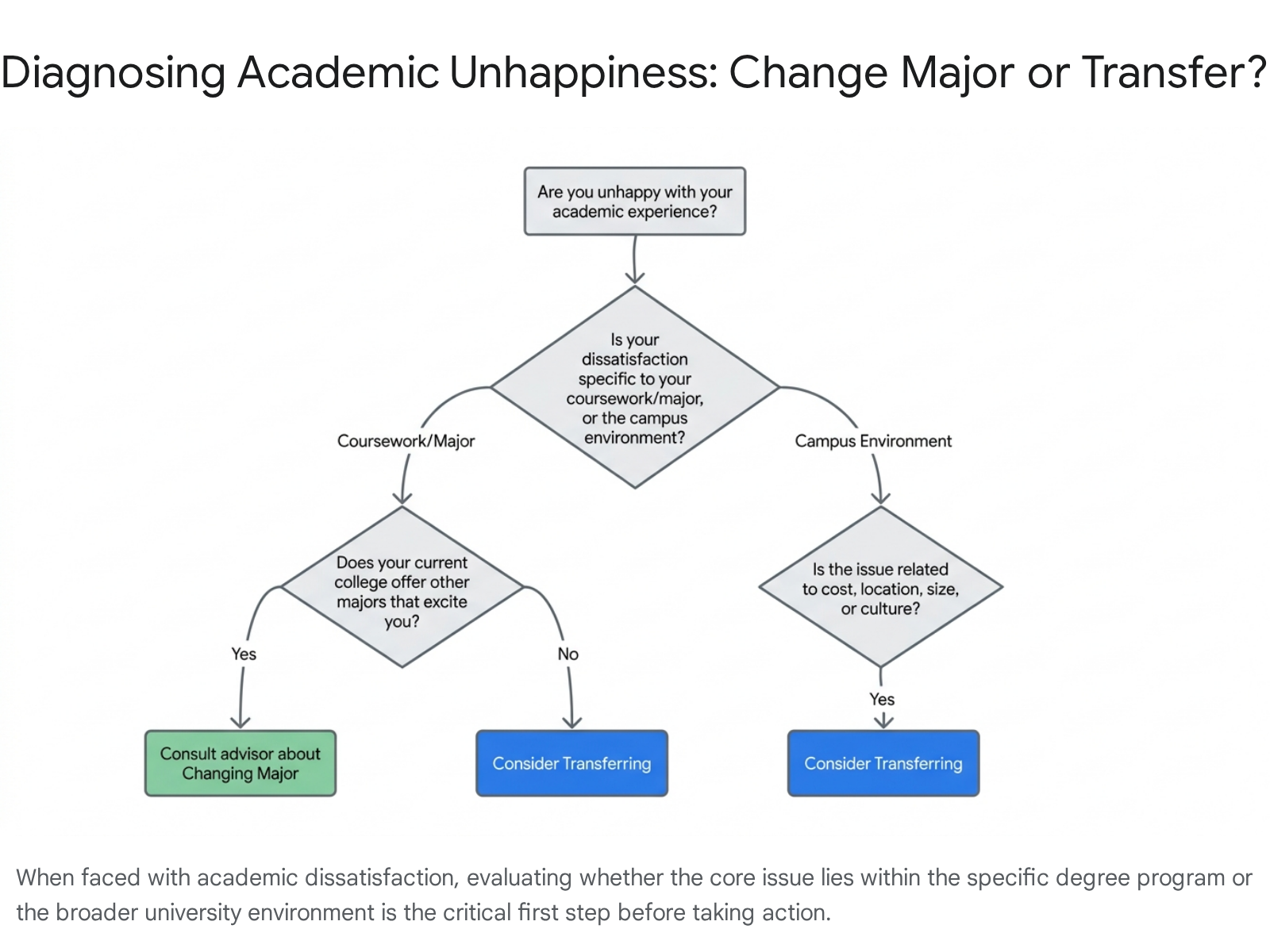
When a student is chronically unhappy or performing poorly, the first diagnostic question educational planners ask is whether the root cause is the specific academic discipline the student has chosen, or the broader institution itself.
The Phenomenon of the Course Mismatch
Research indicates that approximately half of all undergraduate students change their major at least once before graduating, and many change majors two or three times 2021. Choosing a major at age 17 or 18 - when the brain's prefrontal cortex is not fully developed and students have limited exposure to different professional fields - often results in selections based on external pressures rather than internal passions 2022. Students frequently select majors to please parents, chase perceived prestige, or pursue subjects they excelled at in high school, only to find that the university-level rigor is vastly different 2023.
A "course mismatch" occurs when a student realizes that their current academic track does not align with their passions, natural skill sets, or long-term career goals 22. Signs of a course mismatch include a profound sense of dread when attending core classes, feeling consistently unmotivated to complete coursework, and struggling academically despite putting in massive amounts of study time 221415.
Virginia Gordon, a prominent researcher in academic advising, identified six distinct categories of "major-changers" that help explain how students react to course mismatch 16: * Drifters: Students who realize their initial choice of major is a poor fit but lack the motivation to make selecting a new major a priority. * Closet Changers: Students who mentally check out of their major and decide to change paths, but fail to inform their academic advisors or faculty. * Externals: Students who change majors frequently and erratically without systematically exploring their options or long-term goals. * Up-Tighters: Students who may have been denied entry into a highly competitive, secondary-admit major and have extreme difficulty acknowledging the need to pivot. * Experts: Students who perform poorly in a major but stubbornly persist because they falsely believe they have explored all options and assume this major is still their only path to success. * Systematic: Students who recognize the need for a change and logically, methodically seek advice from informed personnel to transition smoothly.
If the problem is purely an academic course mismatch, changing majors is usually the most efficient and cost-effective solution, provided the student does so early enough (ideally before their junior year) to avoid significant graduation delays and the added financial burden of extra semesters 171819.
When the Institution Itself Is the Barrier
If a student genuinely enjoys their chosen field of study but still feels academically stifled or unsupported, the institution itself might be the wrong fit. Institutional mismatch can occur for a variety of structural reasons: * Lack of Specialized Resources: The college may lack the specialized facilities, laboratories, or specific faculty expertise required for the student's precise career niche 2. * Class Size and Pedagogical Structure: A student may thrive in intimate, discussion-based seminars where they can debate ideas, but find themselves at a massive state university that relies entirely on 300-person lectures. Conversely, a student may desire the anonymity and vast resources of a large research university but feel trapped in a tiny liberal arts college 12. * Inadequate Support Services: Students with learning disabilities or those requiring specific tutoring infrastructure may find that their institution lacks the necessary academic success centers to help them thrive 2021.
The Role of Academic Advising and Cultural Mismatches
Academic advising serves as a critical connection point to campus resources and plays a massive role in cultivating a student's sense of belonging. However, institutional norms within advising offices sometimes conflict deeply with a student's expectations, resulting in a damaging "cultural mismatch."
Cultural mismatch theory argues that students' academic performance and well-being depend heavily on an alignment between institutional norms and their own personal and cultural norms 22. A study conducted by researchers at the Stanford Graduate School of Education highlighted how cultural mismatches in advising can thwart student success, particularly for international, immigrant, and first-generation students 2223. The research revealed that conflicts often arise regarding the level of self-advocacy expected in advising sessions, the value placed on "exploration" versus a linear career path, and the uniquely American emphasis on "passion" as the primary motivator for academic decisions 2223. When advisors operate under purely European American norms, students from different backgrounds can feel profoundly alienated, leading to a breakdown in support 2223.
To determine if an institution's advising structure is a good fit, or to diagnose the root of academic unhappiness, students are encouraged to engage deeply with their academic advisors. Higher education utilizes various advising frameworks, ranging from "prescriptive advising" (a traditional, authoritative model focused merely on course scheduling) to "developmental advising" (a holistic, collaborative approach focusing on personal, academic, and career growth) 2435.
| Category | Diagnostic Questions to Ask an Academic Advisor |
|---|---|
| Degree Planning & Graduation | "If I want to graduate by a specific date, what is the best sequence of prerequisites and core courses to get me there?" 2125. |
| Major Requirements | "Are there any notoriously challenging 'stumble courses' in this major, and how should I prepare for them?" 3738. |
| Career Alignment | "What specific internships, co-op programs, or undergraduate research opportunities are available in this department?" 212538. |
| Support Resources | "If I am struggling with my mental health or a specific class, what exact resources (tutoring, accommodations) are available?" 2538. |
| Transferring & Credits | "How are transfer credits handled at this institution, and what is the exact process to evaluate courses from my previous school?" 37. |
If an institution's advising staff cannot provide clear, supportive answers, or if the academic infrastructure simply cannot accommodate a student's goals, transferring to a new college is often the most logical and necessary step 3.
Social, Cultural, and Environmental Indicators of Poor Fit
Beyond the classroom, the campus environment plays an enormous, often decisive role in student well-being. A college is not merely an educational facility; for traditional undergraduate students, it is a primary residence and social ecosystem for four years.
The Post-Pandemic Crisis of Belonging
In recent years, educational researchers have noted a sharp and alarming increase in feelings of isolation and a lack of belonging among college students. The COVID-19 pandemic severely disrupted traditional campus cultures, leading to what researchers describe as a "post-pandemic educational framework" marked by significantly heightened academic anxiety, stress, and loneliness 1611.
Studies utilizing structural equation modeling indicate that stress related to pandemic disruptions and social isolation has adversely affected students' sense of belonging at both the specific degree-department level and the broader collegiate community level 1611. The data reveals that undergraduate students demonstrated greater susceptibility to stress-induced declines in belongingness, while international students experienced notable disruptions in collegiate belonging and heightened levels of loneliness, which served as a significant mediating variable for academic anxiety 1611.
Belonging is not a fixed concept; it is a dynamic reality shaped by institutional culture, social ties, and personal background 26. When students feel they do not belong - whether due to differences in socioeconomic background, political climate, lack of diversity, or a general clash with the campus culture - their motivation, self-efficacy, and academic performance often plummet 2526. An environment where a student constantly feels like an outsider, or where they are unable to find a supportive community that shares their values, is one of the strongest indicators of a poor college fit 2526.
Unsafe or Toxic Campus Environments
In the most severe cases of mismatch, the campus environment may feel actively hostile, toxic, or physically unsafe. A safe school environment is absolutely crucial to healthy academic and social development; when students feel unsafe, their cognitive load is monopolized by survival and anxiety, rendering them unable to focus on learning 27.
Data from the CDC's Youth Risk Behavior Surveillance System (YRBSS) and other educational studies show that a significant percentage of students face bullying, cyberbullying, and relational aggression on school property 27. If a student has experienced trauma, severe bullying, systemic discrimination, or disruptive learning environments characterized by frequent behavioral outbursts in the classroom, and the institution's administrative response has been inadequate, staying at that college can be highly detrimental to their mental and physical health 13274228.
Research indicates that students who feel chronically unsafe in their classrooms or dormitories often exhibit higher absenteeism, lower scores on standardized assessments, and a strong desire to stay home or isolate in their rooms 13. In these severe scenarios, transferring is not merely about finding a "better fit" for extracurricular interests; it is a necessary, urgent step for self-preservation and mental health recovery.
Financial and Logistical Misalignments
Sometimes, a college appears to be a perfect academic and social fit, but operates as a terrible financial fit. The cost of higher education has skyrocketed over the past decade, with public four-year university tuition rates increasing by nearly 40 percent between 2011 and 2023 44.
Financial realities are a primary, inescapable driver of college transfers and dropouts. This is particularly true for "vertical transfer" students moving from two-year community colleges to four-year institutions, where affordability is frequently cited as the top decision-making factor 29.
If paying tuition requires a student to work exhausting, full-time hours that severely compromise their ability to study, or if a student is accumulating private student loan debt at a rate that will financially cripple them post-graduation, the college is fundamentally a poor financial fit 314. Educational planning mistakes - such as underestimating the cost of room and board, failing to account for annual tuition inflation, or misunderstanding financial aid requirements - can quickly snowball into expensive crises 44. In these cases, transferring to a more affordable in-state public university, or dropping down to a community college to complete general education requirements, can relieve immense financial pressure and allow the student to refocus on academic success 329.
Conducting a Personal College Stress Audit
If a student is experiencing deep doubts about their college choice, educational planners and university counseling centers heavily recommend conducting a formal, personal "stress audit" before making any drastic, irreversible decisions 4630.
Psychological frameworks, such as the Conservation of Resources (COR) theory, posit that individuals feel overwhelmed and stressed when they believe their vital resources - such as time, physical energy, and emotional bandwidth - are threatened, depleted, or inadequate to meet environmental demands 48. To measure this objectively, many universities utilize adaptations of the Holmes-Rahe Social Readjustment Rating Scale, specifically modified for college students 4649.
The College Student Stress Checklist
The modified Holmes-Rahe checklist demonstrates that accumulating life changes - even objectively positive ones - can quickly push a student's stress to unhealthy, dangerous levels 4649. The checklist assigns numerical values to various life events. Common stressors include the death of a close family member or friend, serious disagreements with parents, major personal injury or illness, difficulties with roommates, changes in financial status, taking on a heavier workload at school, and the difficulty of identifying a major 4649.
Students are instructed to check off events that have occurred in the past year and total their score. In the clinical model, a cumulative score below 150 indicates mild stress, 150-300 indicates moderate stress, and a score over 300 indicates severe stress, correlating with a high statistical likelihood of developing a stress-related physical illness within the coming year 4649.
To effectively audit stress and evaluate college fit, students should follow a structured process: 1. Identify and Categorize Stressors: Differentiate between temporary, situational stressors (e.g., an upcoming final exam, a single difficult assignment) and chronic, systemic stressors (e.g., deeply hating the chosen major, feeling fundamentally alienated in the dorm, facing ongoing financial crises) 3031. 2. Determine Control and Importance: Evaluate which stressors are under the student's direct control and which are not. Focus energy on manageable issues and utilize deep breathing or mindfulness to cope with unavoidable environmental factors 3031. 3. Seek Institutional Support: Schedule a meeting with an academic advisor or campus counselor. A trained professional can help determine if the student's problems can be solved through "microactions" - small, low-effort changes such as keeping a planner, attending tutoring, or joining a new club - or if they require a massive "macroaction," such as changing majors or transferring institutions entirely 3233. 4. Assess the Realities of Change: Calculate the true cost in time, energy, and money if the student stays versus if they leave. Will changing a major at the current school delay graduation by two years? If so, is the family financially prepared to absorb that extra cost? 2314.
The Path Forward: Transferring Without the Stigma
If the stress audit and consultations clearly point toward leaving, the student will join a massive, growing cohort of mobile learners. According to the National Student Clearinghouse, approximately one-third of all college students transfer schools at least once before earning their degree 34.
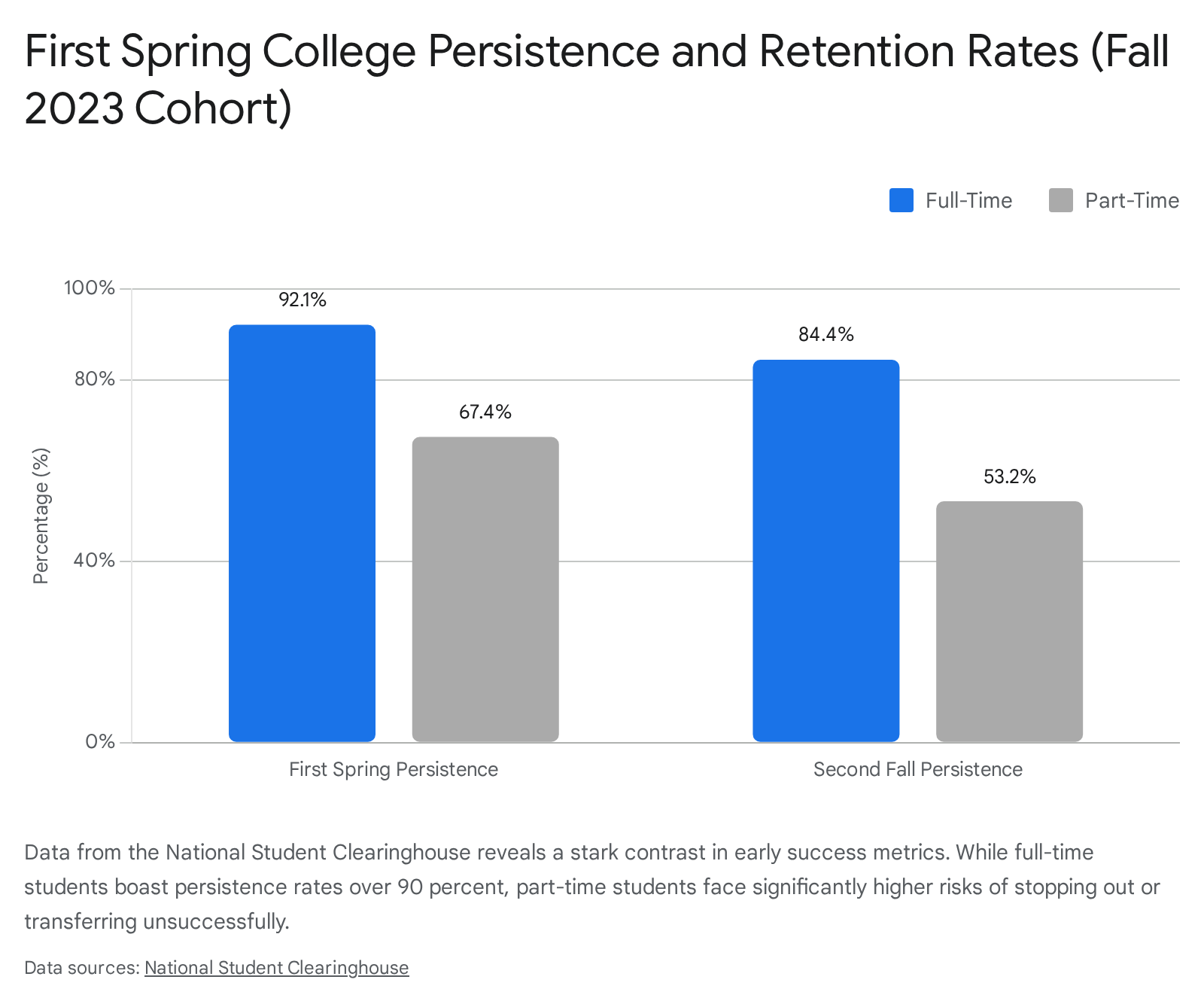
Furthermore, as of fall 2024, transfer students represented over 13 percent of all continuing and returning undergraduates globally 35. Yet, despite how common it is, the transfer process is often shrouded in psychological stigma and logistical myths.
Debunking Common Transfer Myths
Many students hesitate to initiate a transfer because they subconsciously believe leaving their first institution is a public admission of failure 5536. They fear they will be harshly judged by friends and family, or that a transcript showing multiple schools will look negative on a future resume for graduate school or employment 3637. In reality, successfully recognizing a bad fit and taking decisive action to correct it demonstrates high self-awareness and resilience; transferring is a proactive, strategic decision to optimize one's education and future career 3637.
Other common logistical myths that prevent students from transferring include: * Myth: "None of my credits will transfer, and I will start over." While credit loss is a legitimate barrier - especially if a student changes academic disciplines entirely or transfers between highly dissimilar institutions - careful, early planning can mitigate this risk. Working directly with a transfer counselor and utilizing official "articulation agreements" (formal, predetermined course-transfer partnerships between community colleges and four-year universities) can ensure a relatively smooth transition of credits 343859. * Myth: "I definitely won't graduate on time." Transferring can delay graduation if handled poorly, but it is not a guaranteed setback. If a student transfers early in their academic career (such as after freshman year) and aligns their new major closely with their already completed general education coursework, it is highly possible to graduate within the traditional four-year window 143738. * Myth: "Transfer students don't get financial aid." Federal financial aid, granted through the Free Application for Federal Student Aid (FAFSA), follows the student, not the specific school. A student simply needs to update their FAFSA with the new institution's school code. Additionally, many universities offer dedicated, transfer-specific scholarships, particularly for high-achieving community college students involved in organizations like Phi Theta Kappa 3439.
Understanding "Transfer Shock" and Transfer-Receptive Cultures
Even when a transfer is structurally successful, students often experience a phenomenon known in academic literature as "transfer shock" - a temporary dip in academic performance and an increase in psychological stress immediately following a transition to a new, often more rigorous, four-year institution 40.
To mitigate transfer shock, educational theorists like Jain et al. advocate for universities to actively build a "transfer receptive culture." This critical race theory-informed framework urges four-year universities to commit deeply to supporting transfer students through five core elements: establishing transfer students as a high institutional priority, creating targeted resources for transfer-specific needs, providing distinct financial and academic support, recognizing students' intersectional identities, and frequently assessing transfer outcomes 5940. When choosing a new college, students should actively look for institutions that demonstrate this transfer-receptive culture, evidenced by dedicated transfer centers, specific transfer orientations, and pre-enrollment course articulation assistance 5962.
Strategic Planning: Mapping Out Your Transfer Timeline
If a student has definitively decided that transferring is the right move, precise execution and timing are paramount. Many four-year institutions concentrate their outreach and articulation resources on students who are nearing the completion of their associate degrees 29. However, behavioral data shows that vertical transfer students (those moving from two-year to four-year schools) begin planning their transitions much earlier 29.
To ensure a seamless transition and minimize credit loss, educational planners recommend structuring the transfer process around distinct credit-hour milestones 416442.
| Transfer Phase | Credit Hour Milestone | Key Actions Required |
|---|---|---|
| Exploration & Research | 0 - 15 Credit Hours | Identify universities that align with long-term career pathways. Review university catalogs for specific degree requirements. Create accounts on state or university-specific Transfer Admission Planner (TAP) portals to pre-populate coursework 4143. |
| Developing the Plan | 16 - 30 Credit Hours | Research exact transfer admissions requirements, GPA minimums, and application deadlines for the chosen major. Explore transfer-specific financial aid and scholarship options 41. |
| Campus Visits & Prep | 31 - 45 Credit Hours | Visit the prospective universities in person to assess social and cultural fit. Attend transfer fairs. Update the FAFSA (starting October 1st of the year prior to transfer) and add the new school codes 414344. |
| Execution & Commitment | 46 - 60 Credit Hours | Finalize the university choice. Submit transfer applications (e.g., via the Common App for Transfer) and application fees. Send official copies of final transcripts. Advocate for specific credit articulations using saved course syllabi 39414546. |
Seeking External Guidance: Using Educational Consultants Ethically
Navigating the complexities of college transfers, credit articulations, and financial aid can be incredibly overwhelming for families. Consequently, many turn to Independent Educational Consultants (IECs) to help identify right-fit schools and manage the logistics of transfer applications 474849.
If families choose to hire outside help, it is vital to distinguish between ethical, vetted professionals and predatory operations. Reputable consultants are typically members of professional associations that enforce strict ethical standards, such as the Independent Educational Consultants Association (IECA) or the Higher Education Consultants Association (HECA) 4773. These professionals possess deep experience in university admissions, hold appropriate degrees in counseling, and routinely visit hundreds of college campuses to assess real-time campus cultures 24773.
Conversely, families should be highly wary of consultants who exhibit clear warning signs of unethical behavior. Red flags include guaranteeing admission to a specific top-choice school, promising a certain minimum dollar value in scholarships, or offering to ghostwrite the student's application essays 477350. Ethical consultants focus holistically on finding a matching environment and guiding the student's own authentic work, rather than selling false prestige or manufacturing guaranteed outcomes 4750.
Bottom line
Feeling out of place or homesick during the first semester of college is a normal, highly common experience rooted in the massive developmental transition young adults undergo. However, if a student's distress becomes chronic, their academic struggles persist despite utilizing campus resources, or the institutional environment feels actively toxic and unsafe, these are strong, reliable indicators of a systemic mismatch. Deciding to change a major or transfer to a new institution is not an admission of failure, but rather a brave, strategic, and necessary pivot toward securing the academic, social, and financial fit required for long-term collegiate and professional success.