
How to Tell If You're Burned Out or Just Tired
Being tired is a normal physiological state of physical or mental energy depletion that generally resolves with adequate sleep or a weekend off. Burnout, on the other hand, is a chronic occupational syndrome characterized by persistent emotional exhaustion, cynicism, and a reduced sense of professional capability that does not improve with standard rest. If taking a vacation leaves an individual just as physically drained and dread-filled about returning to the workplace as before they left, the evidence suggests they are experiencing burnout rather than simple fatigue.
The modern workplace has increasingly blurred the lines between temporary exhaustion and systemic burnout. In recent years, occupational burnout has evolved from a vague human resources talking point into a measurable global workforce crisis. Recent survey data indicates that an unprecedented number of workers are currently grappling with severe workplace stress. For instance, a 2024 report by Boston Consulting Group revealed that 48% of workers across eight major countries are experiencing burnout 1. Other surveys of global white-collar knowledge workers found that up to 82% reported feeling at least slightly burned out in 2024, navigating a complex web of pandemic recovery, digital overload, and economic pressure 2.
However, the terms "tired," "stressed," and "burned out" are frequently used interchangeably in casual conversation. This semantic blurring presents a significant danger. Misidentifying burnout as normal tiredness leads individuals to push through their exhaustion, often worsening their physiological and psychological state. Conversely, confusing burnout with clinical depression can lead to inappropriate medical interventions. Understanding the precise, research-backed distinctions between these states is the first step toward meaningful intervention and recovery.
The Conceptual Difference: Empty Batteries vs. Damaged Batteries
To grasp the fundamental difference between tiredness and burnout, occupational therapists and chronic illness advocates frequently utilize battery-based analogies 343. This framework helps demystify why individuals experiencing burnout cannot simply "sleep it off" or cure their condition with a weekend spa trip 46.
When an individual is simply tired, their internal state resembles a smartphone with an empty battery. The energy reserves are depleted after a long day of intense cognitive or physical usage. However, the hardware itself remains perfectly intact. If that system is plugged into a charger - equivalent to getting a good night's sleep, eating a restorative meal, or taking a few days off - the battery reliably returns to 100% capacity 36. The individual wakes up restored and ready to tackle a new day of demands.
Burnout, conversely, functions like a damaged battery. Prolonged exposure to chronic workplace stress without adequate recovery periods degrades the system's actual capacity to hold a charge 434. An employee experiencing burnout might take a two-week tropical vacation (attempting to recharge), but because the battery's maximum capacity is compromised, it only charges to 40%. Furthermore, once the individual returns to work, the battery drains abnormally fast, often pushing the body into a "low power mode" characterized by dread and physical ailments 44.
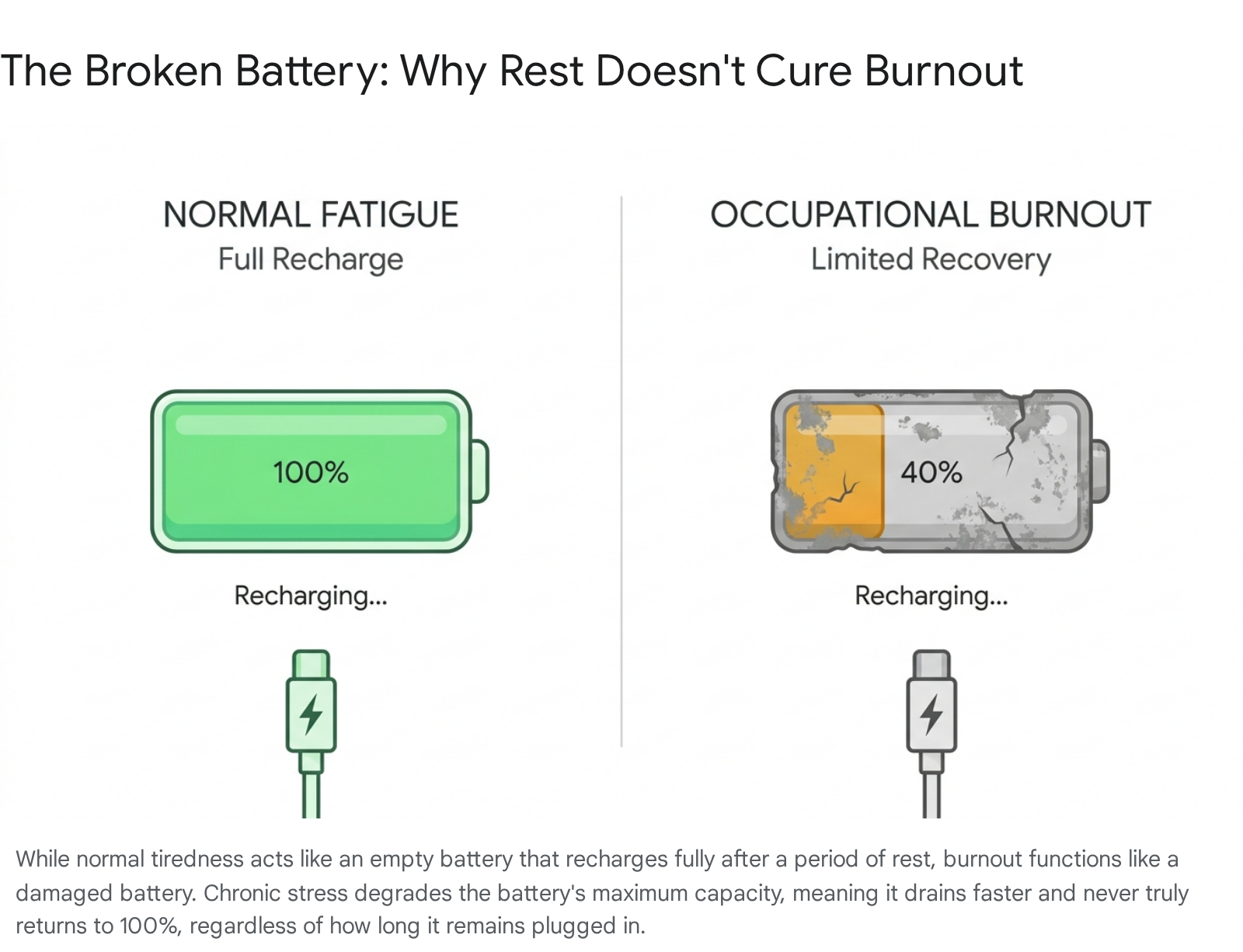
This framework explains why traditional "self-care" advice often feels frustrating to someone in the depths of burnout. A damaged battery cannot be fixed solely by plugging it in; the applications running in the background that are destroying the hardware must be shut down, and the systemic environment must be repaired 46.
The Medical and Psychological Definitions of Burnout
Prior to 1981, burnout was a fuzzy cultural concept, often used loosely to describe individuals who felt generally exhausted at work. This changed when psychologists Christina Maslach and Susan Jackson at the University of California, Berkeley, developed the Maslach Burnout Inventory (MBI) 85. This tool transformed burnout from a vague complaint into a concrete, measurable, and multi-dimensional phenomenon 8.
The Three Dimensions of the Maslach Burnout Inventory (MBI)
Occupational health research does not define burnout simply as working excessively long hours or feeling tired. Instead, the Maslach model identifies three specific dimensions that must consistently emerge for a true state of burnout to exist 867. While the original MBI was designed for human services and medical personnel, subsequent versions, such as the MBI-General Survey (MBI-GS) and the MBI for Students (MBI-GS (S)), adapted the language to apply to any occupation or academic pursuit 58.
The three universally recognized dimensions of burnout are:
- Emotional Exhaustion: This is the core dimension most easily confused with standard tiredness. It involves feeling physically, emotionally, and mentally drained and depleted by workplace demands 859. However, unlike typical fatigue, this exhaustion is chronic and does not improve with standard rest, leading to a constant state of depletion 9.
- Depersonalization (or Cynicism): This dimension separates burnout from severe stress. Workers experiencing burnout begin to emotionally detach from their jobs and their colleagues. They may become increasingly cynical, pessimistic, irritable, or apathetic 8910. In helping professions, such as nursing or social work, this often manifests as a troubling lack of empathy, where patients or clients are viewed as burdens rather than human beings 859.
- Reduced Professional Efficacy (or Personal Accomplishment): Burnout fundamentally impairs a person's sense of achievement. Tasks that once felt routine begin to feel overwhelmingly difficult, and successful outcomes no longer provide satisfaction 810. The individual feels ineffective, unsuccessful, and deeply doubts their own abilities, often despite maintaining stable objective performance metrics 87.
If an individual is experiencing all three dimensions consistently - especially the cynical detachment from people or tasks they once cared about - the evidence strongly points to burnout rather than temporary occupational stress 8.
The WHO and ICD-11 Classification
The global credibility of the burnout concept reached a milestone in 2019 when the World Health Organization (WHO) included it in the 11th Revision of the International Classification of Diseases (ICD-11) 87.
Crucially, the WHO explicitly states that burnout is not a medical condition 71112. Instead, it is classified strictly as an "occupational phenomenon" within the chapter detailing factors influencing health status 711. The ICD-11 defines burnout as a syndrome resulting from "chronic workplace stress that has not been successfully managed" 711. The guidelines strongly emphasize that the term should refer specifically to phenomena in the occupational context and must not be applied to describe experiences in other, non-work-related areas of life 711.
Burnout vs. Clinical Depression: A Critical Distinction
Because emotional exhaustion and a loss of motivation are so pervasive in burnout, the syndrome is frequently confused with clinical depression. While the two conditions share overlapping symptoms, they represent distinct experiences that dictate different paths for treatment and recovery 91314.
Context-Specific vs. Pervasive Symptoms
The most critical difference between the two states is their scope of impact 1315. Burnout is highly context-specific 15. The cynicism, dread, and profound exhaustion are generally tied directly to the workplace, a demanding academic program, or a specific high-stress role, such as caregiving 91016. An individual suffering from burnout might feel entirely depleted and numb while at their desk, but may still find joy, relief, and deep engagement in their weekend hobbies, social life, or family events 913.
Depression, officially diagnosed as Major Depressive Disorder (MDD), is pervasive 101621. It affects how a person thinks, behaves, and feels across almost all domains of life, regardless of their environment or current situational stressors 1415. An individual with depression will typically experience a loss of interest or pleasure (anhedonia) not just in their professional work, but in hobbies, relationships, and activities they previously loved 916. Furthermore, unlike burnout, depression does not disappear or significantly lighten simply by taking time off from work or removing a specific stressor 13.
Diagnostic Criteria (DSM-5 vs. ICD-11)
Major Depressive Disorder is a formal clinical diagnosis outlined in the American Psychiatric Association's Diagnostic and Statistical Manual of Mental Disorders (DSM-5) 141517. Mental health professionals utilize validated screening tools, such as the PHQ-9, to assess these criteria 16.
To be diagnosed with MDD, an individual must experience at least five specific symptoms for a minimum of two weeks, and these symptoms must represent a change from previous functioning 1819. At least one of the symptoms must be either a persistently depressed mood or a marked loss of interest or pleasure in almost all activities 1819. Other DSM-5 criteria for MDD include 14171819: * Significant unintentional weight loss or gain, or sharp changes in appetite. * Severe sleep disturbances (insomnia or hypersomnia). * Psychomotor changes (agitation or retardation observable by others). * Persistent fatigue or profound energy loss. * Feelings of worthlessness or excessive, inappropriate guilt. * Impaired ability to think, concentrate, or make decisions. * Recurrent thoughts of death or suicidal ideation.
Burnout lacks the severe neurovegetative symptoms - such as drastic weight changes, psychomotor retardation, and the overarching feelings of worthlessness - that characterize melancholic or clinical depression 1618. However, the relationship between the two is complex. Chronic, unresolved burnout is widely recognized as a significant risk factor for developing clinical depression over time 91521. Prolonged untreated workplace stress can disrupt brain chemistry, sleep patterns, and emotional regulation to the point where an occupational phenomenon transitions into a pervasive clinical disorder 21.
| Diagnostic Feature | Occupational Burnout (ICD-11) | Major Depressive Disorder (DSM-5) |
|---|---|---|
| Primary Origin | Chronic, unmanaged workplace stress or role-specific pressure. | Biological, psychological, and environmental factors; can occur without external triggers. |
| Scope of Impact | Highly specific to work or caregiving roles. | Pervasive; affects work, home, hobbies, and personal relationships. |
| Response to Distance | Symptoms often lighten when away from the stressful environment. | Symptoms persist despite rest, changes in environment, or removal of stressors. |
| Core Emotional State | Cynicism, detachment, resentment toward colleagues/clients, reduced self-efficacy. | Pervasive sadness, hopelessness, anhedonia (inability to feel pleasure), deep inappropriate guilt. |
| Neurovegetative Signs | Fatigue, occasional sleep disruption due to stress. | Significant weight/appetite changes, psychomotor agitation/retardation, severe insomnia/hypersomnia. |
| Medical Classification | Occupational phenomenon; not a medical condition. | Formal psychiatric diagnosis. |
The Biological Footprint of Burnout
When differentiating between normal tiredness and burnout, examining the underlying physiological reality is vital. Standard fatigue represents a temporary depletion of energy, whereas chronic burnout leaves a distinct, measurable biological footprint on the body's neuroendocrine and cardiovascular stress response systems.
HPA Axis Dysfunction vs. The "Adrenal Fatigue" Myth
For many years, popular wellness literature used the term "adrenal fatigue" to describe the physical exhaustion of burnout, suggesting that the adrenal glands had simply "run out" of stress hormones after being overworked. However, endocrinologists and researchers now widely consider "adrenal fatigue" to be an inaccurate and misleading oversimplification 2021. The adrenal glands do not run out of steam; true adrenal failure (Addison's disease) is a rare, life-threatening autoimmune or structural condition, which is not what chronically stressed workers are experiencing 2021.
Instead, the biological reality of burnout is centered on HPA axis dysfunction 202122. The Hypothalamic-Pituitary-Adrenal (HPA) axis serves as the body's primary stress command center 21. When a stressor is encountered, the hypothalamus in the brain releases corticotropin-releasing hormone (CRH) 2021. This signals the pituitary gland to release adrenocorticotropic hormone (ACTH), which in turn prompts the adrenal glands to secrete cortisol, the primary stress hormone 2021.
In a healthy, non-burned-out system, cortisol rises to meet the acute challenge and promptly falls when the threat passes, signaling back to the brain to halt production through a negative feedback loop 20. However, under conditions of chronic, unrelenting workplace stress, the HPA axis is forced to over-fire continually 21. Over time, the brain becomes desensitized to cortisol's signals. The entire system undergoes a functional recalibration, downregulating its output to protect the body from continuous high-cortisol toxicity 2021. It is a communication breakdown between the brain and the glands, rather than a physical destruction of the glands themselves 21.
The Cortisol Awakening Response (CAR)
Researchers frequently measure this systemic dysfunction by observing the Cortisol Awakening Response (CAR) 2324. In a healthy individual, cortisol levels naturally spike within the first 30 to 45 minutes of waking up, providing the physiological energy required to transition from sleep to alertness 2324.
Research into how burnout affects the CAR has revealed complex, phase-dependent results. Some studies indicate that in the early, highly agitated stages of chronic stress, individuals show a hyper-reactive HPA axis with elevated early morning cortisol levels and a heightened state of "wired but tired" anxiety 212526. However, as burnout becomes deeply entrenched and chronic, the system appears to exhaust its regulatory capacity. Multiple studies and meta-analyses have found that clinical burnout is associated with a blunted or significantly lowered Cortisol Awakening Response, leaving the individual feeling profoundly fatigued from the moment they open their eyes 222728.
Furthermore, studies have shown that specific dimensions of the Maslach Burnout Inventory correlate directly with cortisol suppression. For instance, higher scores in the "exhaustion" and "depersonalization" subscales have been linked to a diminished diurnal cortisol slope, indicating that the core psychological symptoms of burnout physically alter the body's daily hormonal rhythms 2427.
The SAM Axis and Cardiovascular Strain
Burnout also impacts the Sympathetic-Adrenergic-Medullary (SAM) axis, which governs immediate "fight or flight" responses like heart rate and blood pressure 2526. Clinical studies comparing burnout patients to healthy controls have found that those suffering from burnout often exhibit higher resting heart rates, indicative of sustained, inescapable physiological activation 25. The body remains in a constant state of low-grade alarm, which consumes immense energetic resources and explains the pervasive physical exhaustion that sleep alone cannot resolve 26.
The Remote Work Paradox and Digital Exhaustion
The prevalence of burnout has spiked dramatically over the past few years, evolving in tandem with massive shifts in how work is conducted. A 2024 regional assessment found that 62.9% of full-time workers in parts of Asia experienced burnout 29, while 44% of U.S. employees reported feeling burned out at work 30. Much of this modern exhaustion can be attributed to the widespread adoption of remote and hybrid work environments following the COVID-19 pandemic 3132.
The Blurring of Work-Life Boundaries
At first glance, remote work models promise greater flexibility, increased autonomy, and the elimination of physically draining commutes 303334. Indeed, some studies show that hybrid work can have a burnout-reducing effect when it successfully increases employee autonomy 35.
However, remote work has inadvertently removed the physical and psychological boundaries that once naturally separated professional duties from personal life 3141. Without the daily ritual of leaving an office building, employees find it increasingly difficult to disconnect, leading to extended working hours, constant digital communication, and an "always-on" mentality 3041.
Observational studies from 2024 and 2025 demonstrate that blurred work-life boundaries are a massive driver of emotional exhaustion. One study found that remote workers with poor work-life boundaries were nearly three times more likely (adjusted OR 2.67) to experience high emotional exhaustion 31. Working more than 45 hours per week in a remote setting also doubled the risk of severe burnout 31.
Isolation and "Zoom Fatigue"
In addition to longer hours, the reliance on digital collaboration tools has introduced new vectors for fatigue. Remote workers frequently report feelings of social isolation and a lack of spontaneous, restorative interaction with peers 303132. The continuous use of video conferencing platforms requires intense cognitive processing to read non-verbal cues through a screen, leading to a phenomenon commonly referred to as "Zoom fatigue" 41. This digital strain, combined with a lack of senior managerial support and psychological safety in virtual settings, creates a potent recipe for the depersonalization and exhaustion dimensions of burnout 130.
How Cultural Context Shapes the Burnout Experience
Burnout is a global phenomenon, but it does not manifest or trigger in exactly the same way everywhere. Extensive occupational research highlights that cultural factors heavily influence how workplace stress is perceived, internalized, and reported 3644. The divide between individualistic and collectivist cultures plays a major role in the burnout ecosystem 36443738.
Individualistic vs. Collectivist Cultures
In individualistic cultures - predominantly found in North America, Western Europe, and Australia - societal values emphasize uniqueness, autonomy, independence, and personal achievement 443738. In these environments, burnout is frequently triggered by a lack of personal autonomy, stalled career progression, or social exclusion in the workplace 4438. For instance, psychological studies utilizing digital inclusion games found that individuals from individualistic cultures showed significantly higher physiological stress responses (such as spiked heart rates) and psychological distress when subjected to social exclusion compared to their collectivist counterparts 38.
Conversely, in collectivist cultures - predominantly found in Asia and parts of the Middle East - societal values prioritize group harmony, interdependence, and family ties 443738. An individual's identity and perceived worth are heavily intertwined with their role within the collective group 4439. Consequently, burnout in collectivist societies is often driven by "role strain" - the overwhelming pressure to balance academic or professional excellence with deep familial obligations, such as caregiving or financial support 39. First-generation students and workers from collectivist backgrounds frequently experience severe emotional exhaustion as they attempt to navigate Western educational or corporate demands alongside strict collectivist family values 39. Furthermore, cultural expectations of self-sacrifice for the good of the organization can lead to extreme presenteeism and a reluctance to utilize social support or mental health resources 293637.
| Cultural Dimension | Primary Values | Common Burnout Triggers |
|---|---|---|
| Individualistic (e.g., USA, UK, Germany) | Autonomy, self-reliance, personal achievement, independence. | Lack of workplace autonomy, social exclusion, stalled personal career goals, lack of recognition. |
| Collectivist (e.g., Japan, China, India) | Group harmony, interdependence, familial duty, organizational loyalty. | Role strain (balancing work and family duty), extreme presenteeism, toxic hierarchical behaviors, suppressing personal needs. |
Global Trends and Toxic Workplaces
These cultural differences are reflected in global burnout statistics. Research by the McKinsey Health Institute involving nearly 15,000 employees indicates that Asian employees report higher burnout rates than the global average, with nearly one-third of workers in Asia experiencing symptoms 294049.
This elevated rate is largely attributed to deeply entrenched hierarchical workplace cultures, long working hours, and, most notably, toxic workplace behavior 2940. Toxic workplace behavior - defined as environments causing severe stress and instability - accounts for over 60% of burnout and intent-to-leave cases across Asia 40. In India, for example, workplace toxicity was cited as the cause for nearly 90% of burnout cases 40. Meanwhile, in Europe, while burnout remains a top occupational health issue, the rates vary significantly by country; Nordic countries often report lower rates due to cultural contrasts in job design and a higher emphasis on worker autonomy, whereas countries like Ireland report much higher levels of stress 2949.
Evidence-Based Recovery: Moving Beyond "Self-Care"
Because burnout alters both psychological outlook and physiological hormonal rhythms, bouncing back requires strategic, evidence-based interventions. Casual self-care is insufficient; recovery requires a phased approach targeting both individual resilience and systemic workplace reform.
Individual Strategies and Interventions
While placing the entire burden of burnout recovery on the employee is fundamentally flawed, peer-reviewed research shows that specific individual interventions can effectively mitigate symptoms and restore physiological baselines 414252:
- Mindfulness-Based Interventions (MBIs): Meta-analyses examining healthcare workers and nurses consistently demonstrate that structured mindfulness and meditation programs yield significant reductions in emotional exhaustion and improvements in psychological resilience 42524344. Interventions of greater duration, such as 8-to-12-week mindfulness programs, yield more enduring improvements compared to short, two-day workshops, which often show transient benefits that fade over time 4143.
- Boundary Setting and Disconnection: True physiological and psychological recovery requires completely disconnecting from work during off-hours 45. This means establishing rigid time boundaries, turning off email notifications, and resisting the urge to check in. Research on psychological recovery shows that this definitive disconnection allows stress hormones to return to normal baseline levels 45.
- Micro-Breaks and Pacing: Working in focused intervals - such as the Pomodoro Technique of 25 minutes of work followed by a 5-minute break - prevents cognitive overload and mitigates digital fatigue . Establishing a sustainable baseline of activity and avoiding the "boom and bust" cycle of overworking followed by collapsing is critical for energy management 3.
- Digital Therapeutics: Emerging research indicates that delivering cognitive behavioral therapy through relational AI agents (such as the smartphone app Woebot) can be associated with significant reductions in perceived stress and burnout over an 8-week period, offering an accessible tool for individual coping 46.
The Necessity of Organizational Change
Ultimately, burnout is a systemic issue, not a personal failing or a lack of individual resilience. The American Medical Association, the WHO, and occupational health experts universally emphasize that the most effective response to burnout is fixing the workplace, not "fixing the worker" 12.
If an employee's battery is damaged by toxic conditions, teaching them to meditate will not repair the hardware if they are repeatedly plugged back into a faulty outlet. Organizations that successfully reduce burnout must address the root causes 123247. This requires implementing structural changes such as: * Reducing unmanageable workloads and ensuring fair compensation 1229. * Granting employees autonomy over their schedules and how they complete tasks 333548. * Unconditionally eliminating toxic behaviors and enforcing strict standards for professional conduct 40. * Training managers to act as mental health champions and fostering a climate of psychological safety, where workers can express concerns without fear of retaliation or stigma 13047.
Without strong organizational support and structural reform, individual wellness initiatives serve merely as superficial band-aids on a fundamentally broken system 3043.
Bottom line
Tiredness is a temporary physical or mental state that reliably resolves with adequate rest, whereas burnout is a chronic occupational syndrome marked by deep emotional exhaustion, cynicism, and a persistent feeling of professional ineffectiveness. Because burnout fundamentally alters how the brain and endocrine system process stress - often suppressing normal cortisol rhythms and elevating resting heart rates - standard vacations or extra sleep are rarely enough to cure it. Sustainable recovery requires a dual approach: setting strict personal boundaries to physiologically disconnect from work, paired with systemic organizational changes that address toxic workplace cultures and unmanageable demands.