
Differences Between Burnout and Clinical Depression
The clinical demarcation between occupational burnout and major depressive disorder remains one of the most complex diagnostic challenges in contemporary psychiatry and occupational medicine. While the two conditions exhibit profound phenomenological overlap - frequently manifesting through shared symptoms such as chronic fatigue, severe cognitive impairment, and diminished motivation - they are characterized by distinctly different etiologies, neurobiological signatures, and clinical trajectories 12. Accurately distinguishing between these two states is not merely an academic exercise; it has profound implications for patient prognosis and therapeutic intervention. Treating burnout exclusively as a psychiatric mood disorder risks pathologizing a systemic, context-driven phenomenon and may lead to unnecessary pharmacological treatment 345. Conversely, misdiagnosing clinical depression as a simple stress reaction that can be cured by a vacation delays critical medical intervention and exacerbates severe, potentially life-threatening symptomatology 334.
Achieving diagnostic clarity requires a multidisciplinary analysis encompassing international diagnostic taxonomies, cross-cultural epidemiological data, structural and functional neurobiology, psychometric assessments, and neuroendocrine mechanisms.
Conceptual Framework and Nosology
The formal classification of mental health disorders and occupational phenomena dictates how clinicians screen, diagnose, and treat psychological distress. The divergence in how burnout and depression are codified internationally highlights the ongoing debate regarding the medicalization of chronic stress.
Major Depressive Disorder Classification
Major Depressive Disorder (MDD) is a globally recognized psychiatric condition defined by strict clinical criteria. According to the Diagnostic and Statistical Manual of Mental Disorders, Fifth Edition, Text Revision (DSM-5-TR) published by the American Psychiatric Association (APA), MDD is characterized by discrete episodes lasting at least two consecutive weeks 567. During these episodes, an individual must experience either a pervasive depressed mood or profound anhedonia - a marked loss of interest or pleasure across nearly all daily activities 8910.
A formal clinical diagnosis requires the presence of at least five specific symptoms that induce clinically significant distress or functional impairment 78. These symptoms include severe neurovegetative changes, such as significant unintended weight loss or gain, persistent insomnia or hypersomnia, observable psychomotor agitation or retardation, and profound fatigue or loss of energy 910. Furthermore, MDD is characterized by severe cognitive and emotional distortions, most notably pervasive feelings of worthlessness, excessive or inappropriate guilt, a diminished ability to concentrate, and recurrent thoughts of death or active suicidal ideation 910.
The DSM-5-TR explicit guidelines stipulate that these symptoms must be pervasive across multiple domains of the patient's existence and cannot be attributable to the physiological effects of a substance or another general medical condition 69. Recent updates in the DSM-5-TR, specifically to criterion D, further clarify the differential diagnosis between MDD and psychotic disorders, noting that major depressive episodes can be superimposed on conditions like schizophrenia or delusional disorder, provided the core episodic requirements for the mood disorder are met 5. The manual also distinguishes MDD from persistent depressive disorder (formerly dysthymia) and includes newly formalized categories such as premenstrual dysphoric disorder, highlighting the biological and chronic nuances of depressive pathology 11.
Occupational Burnout Classification
In stark contrast to MDD, burnout is not universally recognized as a distinct medical or psychiatric condition. The World Health Organization (WHO) formally addresses burnout in the 11th Revision of the International Classification of Diseases (ICD-11), classifying it explicitly as an "occupational phenomenon" rather than a clinical disorder 121314. Situated within the chapter detailing factors influencing health status or contact with health services, the ICD-11 conceptualizes burnout as a syndrome resulting entirely from chronic workplace stress that has not been successfully managed by the individual or the organization 1213.
The ICD-11 framework restricts the application of the burnout label strictly to the occupational context, explicitly mandating that the term should not be applied to describe fatigue or stress experiences in other areas of life 1215. According to this taxonomy, the syndrome is characterized by three core dimensions: 1. Feelings of profound energy depletion or physical and emotional exhaustion. 2. Increased mental distance from one's job, or feelings of negativism or cynicism related specifically to the occupation. 3. A measurable sense of reduced professional efficacy or accomplishment 12.
While the WHO maintains a firm boundary distinguishing burnout from medical pathology, the reality of clinical practice often forces psychiatrists to navigate the gray area where severe occupational stress triggers systemic physiological and psychological collapse 420. The lack of a formal psychiatric diagnostic code for burnout in the DSM-5-TR means that clinicians often evaluate patients presenting with work-induced exhaustion under the broader umbrella of adjustment disorders or unspecified depressive disorders, further complicating the epidemiological tracking of the phenomenon 416.
Transnational Occupational Stress Paradigms
While the WHO framework provides a standardized international perspective, regional healthcare systems and cultural paradigms have historically approached severe occupational stress through different diagnostic and sociological lenses. These variations demonstrate that while burnout may lack global psychiatric consensus, its physiological and societal ramifications are universally acknowledged.
Exhaustion Disorder in Sweden
The Swedish healthcare system represents a unique departure from the WHO's strict division between psychiatric illness and occupational phenomena. Following intense lobbying by psychiatric research groups, the Swedish National Board of Health and Welfare introduced a specific diagnosis known as "Exhaustion Disorder" (Utmattningssyndrom) into its national version of the ICD-10 (coded as F43.8A) in 2005 161718. This diagnosis allowed clinicians to provide formal medical recognition and long-term sick leave for patients suffering from physical and mental exhaustion subsequent to prolonged, elevated stress 1617.
To qualify for an Exhaustion Disorder diagnosis, patients must have experienced identifiable stressors - primarily in their working life - present for at least six months 17. The diagnostic criteria explicitly require physical symptoms such as muscular pain, chest pain, palpitations, gastrointestinal disturbances, vertigo, or an increased sensitivity to sound, alongside marked cognitive impairment 1617. Crucially, the diagnostic guidelines state that Exhaustion Disorder should only be diagnosed if the patient does not meet the full criteria for major depressive disorder, dysthymic disorder, or generalized anxiety disorder, thus attempting to carve out a distinct clinical space for stress-induced collapse 17.
Epidemiologically, the diagnosis became highly prevalent. Exhaustion disorder evolved into one of the leading causes of long-term sick leave in Sweden, accounting for approximately 20,000 sick leaves annually, with women in care professions exhibiting the highest risk 161920. Despite its utility in providing patient support, the diagnosis faced ongoing scrutiny for its broad criteria and potential to mask underlying depressive subgroups 1921. To align with the WHO's strict guidelines against creating localized national classifications in the new ICD-11 system, the Swedish government has confirmed that the exhaustion disorder diagnosis will be officially removed from the national registry by 2028 192728. While symptoms will still be treated under broader stress or depressive categories, the sunsetting of F43.8A reflects the ongoing global struggle to accurately categorize the medical consequences of occupational stress 2021.
Cardiovascular Collapse in East Asian Work Cultures
In East Asian contexts, extreme unmanaged occupational stress is frequently viewed through the lens of acute physiological collapse and mortality rather than psychiatric symptomatology. In Japan, the phenomenon is termed Karoshi (death by overwork), a socio-medical term referencing sudden occupational fatalities driven by cardiovascular events, such as myocardial infarction, acute cardiac failure, and subarachnoid hemorrhage 222324. These events are explicitly triggered by extreme work hours, chronic fatigue, and high-pressure environments 2325. A parallel phenomenon is formally recognized in South Korea as Gwarosa, which similarly denotes sudden death due to extreme occupational demands and has prompted national legislation to reduce working hours 22. Furthermore, the intense psychological burden of these environments frequently leads to occupational suicide, termed Karojisatsu in Japan 2223.
In China, the prevalence of the "996" work culture - mandating schedules from 9 a.m. to 9 p.m., six days a week - has been heavily scrutinized for yielding widespread burnout, psychological distress, and severe physical health deterioration 26342728. Once viewed as a benchmark of dedication in the technology sector, the 72-hour workweek has been linked to severe sleep disorders, compromised immunity, and chronic anxiety 3428. Public backlash against these conditions culminated in online protests, such as the 996.ICU movement on GitHub, highlighting the literal risk of intensive care admission due to exhaustion 27. The ILO and WHO estimate that working more than 55 hours per week contributes to hundreds of thousands of deaths globally each year, underscoring that occupational burnout is not merely a crisis of employee engagement, but a profound public health emergency with tangible mortality risks 2529.
Clinical Phenomenology and Symptom Differentiation
Differentiating burnout from depression in a clinical setting requires careful, granular evaluation of symptom scope, etiology, cognitive patterning, and responsiveness to environmental modification. While both conditions feature overlapping somatic and behavioral symptoms, the underlying psychological mechanisms diverge significantly, requiring clinicians to assess the contextual nature of the patient's distress 33830.
Pervasiveness of Anhedonia and Hopelessness
The primary differential marker between the two conditions is the situational scope of their impact. Burnout is highly context-dependent and bound to specific environments 338. The fatigue, cynicism, and emotional depletion are intrinsically tied to the occupational environment or a specific demanding role, such as intensive caregiving 3340. Individuals experiencing burnout may feel entirely incapacitated while at the workplace or when contemplating work-related tasks, yet they frequently retain the capacity for joy, engagement, and socialization in environments wholly removed from the primary stressor 440.
In contrast, major depressive disorder is pervasive and systemic 438. The depressed mood and anhedonia bleed across context boundaries, impairing the individual's ability to find pleasure in hobbies, relationships, and leisure activities that were historically rewarding 3831. A patient with clinical depression will exhibit a persistent loss of meaning that "colors" their entire existence, whereas a burned-out patient's distress remains anchored primarily to the dysfunction of their professional life 31.
Cognitive Distortions and Self-Evaluation
Cognitive distortions present differently in the two conditions, particularly regarding self-worth and guilt. In burnout, feelings of inadequacy are generally restricted to a sense of reduced professional efficacy 1240. The individual may harbor intense beliefs that they are failing at their job, that their work is useless, or that their colleagues are incompetent 431. However, this negative self-assessment rarely extends to their fundamental worth as a human being outside of the occupational sphere 4.
In clinical depression, negative self-evaluation is globalized and internalized. Patients frequently suffer from pervasive feelings of worthlessness, excessive guilt over minor perceived shortcomings, and a generalized sense of hopelessness regarding the future 34031. The cognitive distortion in depression dictates that the individual themselves is the failure, rather than the environment or the occupational output 31.
Response to Environmental Modification
A common cultural myth regarding burnout is that a vacation or brief time off serves as a definitive cure 324344. Clinical literature robustly debunks this notion, demonstrating that while a holiday provides temporary relief, emotional exhaustion rapidly returns if the worker is reinserted into the exact toxic, highly demanding, or low-autonomy environment that originally triggered the syndrome 324333. True recovery from burnout requires sustained structural changes in boundaries, workload expectations, and workplace support 4344.
However, the individual's response to rest remains a critical diagnostic heuristic. A patient with pure burnout typically experiences a tangible restoration of baseline energy, mood, and capacity for pleasure during a prolonged absence from the stressor 410. Conversely, an individual suffering from clinical depression will generally not experience significant symptom remission merely by changing environments or taking a vacation. The neurovegetative symptoms - such as disrupted sleep architecture, cognitive fog, and appetite alterations - persist despite the removal of occupational stressors, confirming the presence of a systemic mood disorder requiring clinical psychiatric intervention 341040.
| Clinical Feature | Occupational Burnout | Major Depressive Disorder (MDD) |
|---|---|---|
| Etiology | Driven by chronic, unmanaged environmental and occupational stress. | Multifactorial, including genetic, biological, environmental, and psychological variables. |
| Scope of Symptoms | Context-specific; primarily affects the relationship with work or a specific role. | Pervasive; affects work, interpersonal relationships, leisure, and general existence. |
| Anhedonia | Capacity for pleasure generally retained in contexts outside the stressful environment. | Pervasive loss of interest or pleasure across almost all daily activities. |
| Response to Rest | Symptoms often improve meaningfully during extended rest or removal from the stressor. | Symptoms persist across all contexts; rest alone is insufficient to trigger recovery. |
| Self-Perception | Feelings of inefficacy are isolated to professional competence and output. | Globalized feelings of worthlessness, generalized inadequacy, and excessive guilt. |
| Suicidality | Severe emotional exhaustion increases mortality risk, but suicidality is not a core diagnostic requirement. | Recurrent thoughts of death or active suicidal ideation are core diagnostic criteria. |
Neurobiological and Structural Distinctions
Recent advancements in neuroimaging and structural morphometry have yielded objective biomarkers that distinguish burnout from depression, firmly refuting the hypothesis that burnout is simply a mild, non-clinical variant of MDD. These neurobiological signatures demonstrate that occupational burnout leaves a distinct physiological footprint on the brain.
Structural Morphometry and Hippocampal Volume
Magnetic resonance imaging (MRI) studies analyzing clinical populations from 2023 through 2025 demonstrate distinct structural brain alterations in patients with severe burnout compared to healthy controls and patients with depression.
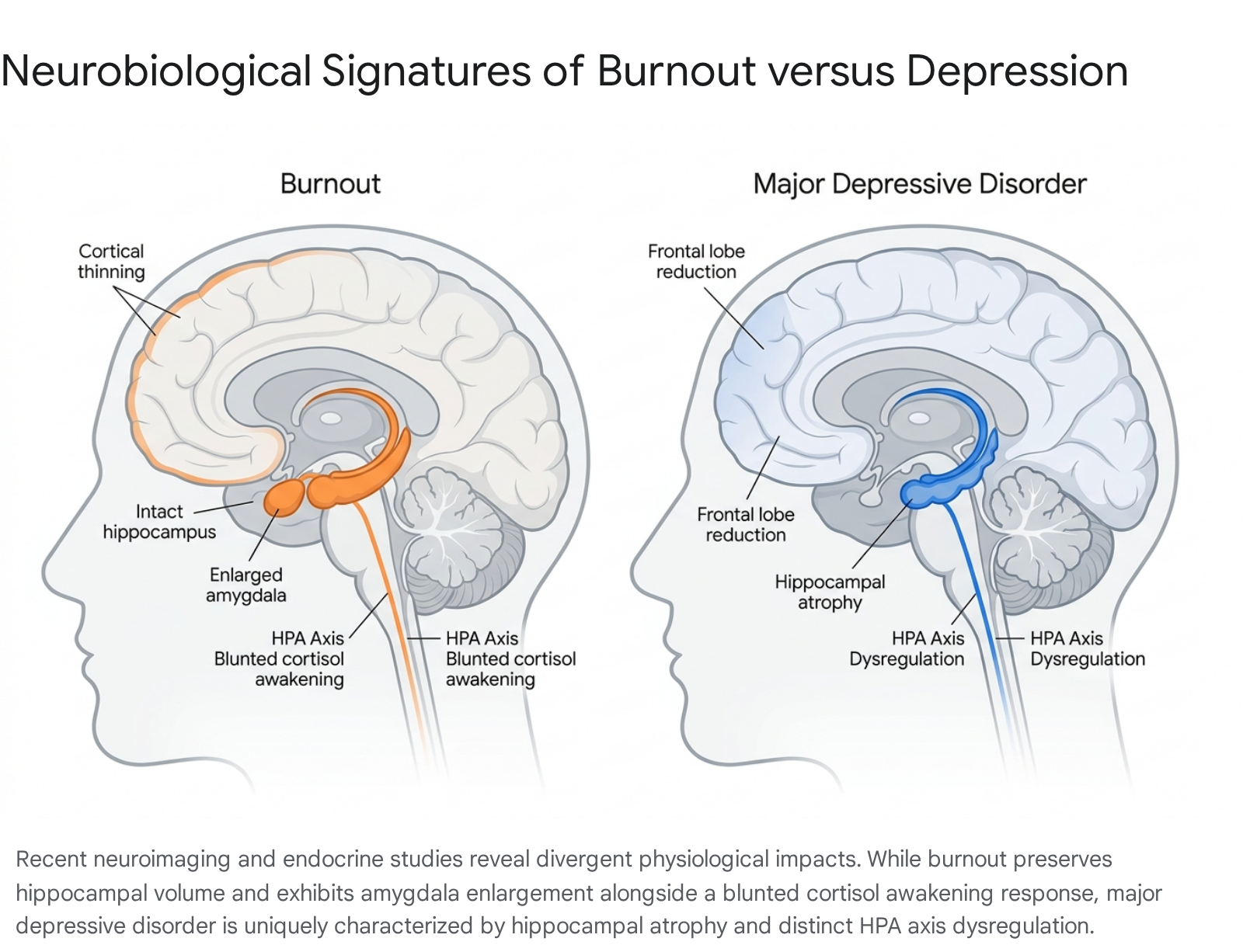
A critical structural distinction lies in the integrity of the hippocampus. In patients with major depressive disorder, chronic hypercortisolemia and stress-induced neuroinflammation frequently result in hippocampal atrophy, leading to measurable volume loss in this region, which correlates with memory deficits and mood dysregulation 343536. In contrast, systematic reviews of structural morphometry studies have consistently shown that individuals with clinically significant burnout do not exhibit hippocampal volume loss 37. The hippocampus remains structurally intact, distinguishing burnout from both MDD and post-traumatic stress disorder (PTSD) 37. However, severe burnout is characterized by other distinct structural changes, including bilateral enlargement of the amygdala - predominantly observed in women - as well as cortical thinning and gray matter reduction in the dorsolateral and ventromedial prefrontal cortex, and the striatal caudate-putamen 3738.
Functional Connectivity and Prefrontal Activation
Functional magnetic resonance imaging (fMRI) reveals further operational divergences between the two states. Task-based fMRI research indicates that burnout is characterized by significant prefrontal hypoactivation 37. During cognitive load tasks, such as memory and executive function evaluations, individuals experiencing work-stress-related burnout demonstrate an absent or weakened prefrontal response, specifically exhibiting hypoactivation in the left ventrolateral and right dorsolateral prefrontal cortex 37. This suggests a neural system driven to global inefficiency and compensatory executive overdrive 37. Conversely, individuals with major depressive disorder often show significant frontal activation during similar cognitive tasks, more closely resembling healthy controls in this specific operational metric 37.
In resting-state fMRI, burnout correlates with a progressive fragmentation of rich-club networks and weakened functional coupling between the amygdala and the anterior cingulate cortex (ACC) 37. Connectome hierarchy analyses further illustrate that major depressive disorder is characterized by a compression of the principal gradient in both hemispheres, whereas the burnout pattern is dominated by a regional expansion of functional eccentricity, particularly within somatomotor and visual networks 37. Notably, longitudinal intervention studies demonstrate that neuroplasticity allows for the partial reversal of cortical thinning and limbic hyper-reactivity in burnout patients following structured interventions such as cognitive-behavioral therapy, mindfulness, and exercise 37.
Neuroendocrine Mechanisms and the HPA Axis
The neuroendocrine system, particularly the Hypothalamic-Pituitary-Adrenal (HPA) axis, plays a central orchestrating role in the body's response to stress. However, the exact pattern of dysregulation diverges sharply between major depressive disorder and chronic occupational burnout, reflecting the difference between an actively distressed system and an exhausted one 394041.
Hypercortisolemia and Glucocorticoid Resistance
In major depressive disorder, particularly within severe or melancholic subtypes, patients frequently exhibit sustained HPA axis hyperactivity 354041. The physiological response to stress normally involves the release of corticotropin-releasing hormone (CRH) from the hypothalamus, which stimulates the secretion of adrenocorticotropic hormone (ACTH) from the pituitary gland, ultimately resulting in the release of cortisol from the adrenal cortex 3440. Under healthy conditions, rising cortisol levels trigger a negative feedback loop to halt further CRH and ACTH production 40.
In MDD, this negative feedback mechanism is profoundly impaired due to glucocorticoid receptor (GR) resistance 343639. Chronic stress and the presence of pro-inflammatory cytokines, such as interleukin-6 (IL-6) and tumor necrosis factor-alpha (TNF-α), interfere with GR signaling, causing the axis to become blunted to the suppressive effects of cortisol 3941. Consequently, the system sustains hypercortisolemia - chronically elevated baseline cortisol levels 3439. This prolonged exposure to toxic levels of cortisol drives the neurodegeneration and hippocampal atrophy characteristic of persistent depressive disorders 343639.
The Cortisol Awakening Response in Occupational Stress
In contrast, severe burnout represents an endpoint of physiological exhaustion rather than active hyper-arousal. While initial, acute workplace stress may elevate cortisol, the chronic, unremitting occupational stress that leads to full clinical burnout eventually depletes the system's reactivity 345442.
Research assessing HPA axis function in burnout frequently utilizes the Cortisol Awakening Response (CAR) - the natural, rapid spike in cortisol levels that occurs 30 to 45 minutes after waking 4243. Extensive meta-analyses and clinical studies indicate that patients with severe burnout often exhibit a diminished or flattened CAR, indicating HPA axis hypoactivity or state of adrenal exhaustion 544344. Prolonged chronic stress alters the system's stress reactivity capacity, essentially inhibiting the physiological response and resulting in lower overall cortisol output during challenge tasks 54. Furthermore, burnout patients frequently demonstrate higher levels of dehydroepiandrosterone-sulfate (DHEAS) and lower cortisol/DHEAS ratios compared to healthy controls, further evidencing a distinctly different endocrine profile from MDD 44. Thus, while depression is heavily marked by an overactive, toxic stress response, burnout manifests biologically as a state of profound physiological depletion 544546.
Psychometric Assessment Instruments
The accurate differentiation of burnout and depression in clinical, occupational, and research environments relies heavily on standardized psychometric instruments. Because the two conditions are conceptualized differently - one as an occupational phenomenon and the other as a pervasive psychiatric disorder - their respective assessment tools are designed to capture entirely different psychological domains.
Depression Screening Tools
Depression screening tools are fundamentally context-agnostic, designed to measure internal affective states regardless of external environment. The Patient Health Questionnaire-9 (PHQ-9) is widely utilized globally and maps directly to the nine DSM-5-TR criteria for major depressive disorder 474849. The instrument evaluates pervasive symptoms over a two-week period, assessing sleep disturbance, psychomotor changes, anhedonia, and, crucially, passive or active suicidal ideation 549. The PHQ-9 asks individuals how often they feel worthless, not why they feel worthless or if it is related to their job 5. Advanced individual participant data meta-analyses confirm the high diagnostic accuracy of the PHQ-9 sum score (where a cut-off of 10 maximizes combined sensitivity and specificity), noting that highly complex latent factor scoring models do not yield clinically relevant improvements over the standard sum score approach 5051.
Other globally recognized tools include the Beck Depression Inventory (BDI) and the Major Depression Inventory (MDI) 4852. These tools are extensively validated across populations and focus on measuring behavioral manifestations, dimensional mood severity, and internalized self-esteem deficits characteristic of clinical depression 4852.
Occupational Exhaustion Inventories
Burnout assessments evaluate psychological distress strictly within the parameters of an occupational framework. The most historically prominent instrument is the Maslach Burnout Inventory (MBI), which operates on an inductively developed three-dimensional model measuring emotional exhaustion, depersonalization (cynicism), and reduced personal accomplishment 14476667. The MBI focuses entirely on the work context; items explicitly reference colleagues, work objects, and professional capacity, and it intentionally omits screening for mood disorders or suicidal ideation 5.
Despite its status as the gold standard, the MBI faces criticism regarding its psychometric structure - particularly the argument that reduced professional efficacy may be a consequence rather than a core component of burnout - as well as practical limitations regarding its proprietary licensing 666753. Consequently, alternative tools have gained traction. The Copenhagen Burnout Inventory (CBI) is a validated, open-access tool that evaluates exhaustion across three granular domains: personal, work-related, and client-related, making it particularly useful for targeted interventions in human services and healthcare 66. Similarly, the Burnout Assessment Tool (BAT) was developed deductively to overcome the MBI's flaws and align more closely with the WHO's ICD-11 conceptualization 666754. The BAT evaluates four core dimensions - exhaustion, mental distance, cognitive impairment, and emotional impairment - while also measuring secondary psychosomatic complaints, providing a comprehensive evaluation of occupational distress 6754.
The Diagnostic Overlap Zone
Diagnostic confusion in clinical practice frequently occurs because patients can score highly on both burnout and depression scales simultaneously 25. Factor analysis consistently confirms that tools like the MBI and PHQ-9 measure statistically distinct constructs; however, high emotional exhaustion scores on the MBI strongly correlate with elevated PHQ-9 depression scores 555. A patient reporting severe fatigue, cognitive fog, and reduced motivation will inherently trigger positive indicators on both types of assessments 5.
Clinical guidelines emphasize that while psychometric tools are valuable for screening, they cannot replace rigorous clinical interviews. The diagnostic interpretation relies on understanding which combinations of symptoms appear together and their relationship to the environment 5. If a patient scores highly on the MBI but remains sub-clinical on the PHQ-9, they are experiencing isolated burnout 5. However, if they score highly on both instruments, and their anhedonia and hopelessness persist independent of occupational demands, they are likely suffering from comorbid major depression 2510. The clinical risk of misclassification is asymmetric: treating a depressed patient merely for burnout delays necessary psychiatric intervention, while pathologizing a burned-out patient as depressed risks medicating a healthy biological response to an inherently toxic work environment 5.
Disease Progression and Mortality Risk
While conceptually and biologically distinct, burnout and depression are not mutually exclusive entities. Clinical literature increasingly recognizes that the two conditions interact dynamically, with one frequently precipitating or exacerbating the other.
Comorbidity Trajectories
Prolonged, untreated burnout serves as a profound longitudinal risk factor for the development of major depressive disorder 31040. When severe occupational stress remains unmitigated, the sustained allostatic load and chronic emotional depletion degrade an individual's psychological and biological resilience, eventually precipitating a clinical depressive episode 210. The neurobiological alterations initiated by burnout - specifically the period of chronic cortisol elevation that precedes adrenal exhaustion, alongside localized cortical thinning - create a neurotoxic biological environment in which clinical depression can readily take root 1037.
Conversely, individuals with pre-existing or sub-clinical depression possess a significantly lower threshold for stress tolerance, making them highly vulnerable to rapid-onset burnout when placed in demanding occupational environments 210. In highly demanding fields, such as healthcare, studies reveal that up to half of the physicians meeting the criteria for a major depressive episode concurrently report severe burnout symptoms, demonstrating that the co-occurrence of these conditions is a widespread clinical reality 5371.
Suicidal Ideation Risk Factors
The intersection of burnout and depression requires urgent psychiatric attention due to the severe mortality risks associated with both conditions. Extensive research, particularly scoping reviews focused on frontline healthcare workers and other high-stress professions, demonstrates that both burnout and depression act as independent predictors of profound psychological distress and suicidality 565758.
Major depressive disorder remains the strongest, most consistent clinical predictor of suicidal ideation and active suicidal behaviors 565759. However, isolated components of occupational burnout - specifically profound emotional exhaustion and depersonalization - significantly elevate the risk of suicidal ideation independently 5660. Multivariate logistic regression analyses indicate that employees experiencing extreme emotional exhaustion have a significantly higher likelihood of reporting suicidal ideation, even after statistically adjusting for the presence of clinical depression and other covariates 5660. For instance, exhausted physicians have been shown to be nearly six times more likely to report suicidal ideation compared to non-exhausted peers 56. Therefore, while pervasive depression is the primary driver of suicidality in the general population, severe occupational burnout alone carries an elevated mortality risk, highlighting the necessity of rapid clinical evaluation and structural workplace reform for affected individuals 585960.