
How the Science of Persuasion and Influence Works
Human persuasion is a complex psychological process driven by a blend of automatic cognitive shortcuts and deep emotional valuations rather than pure logic. Decades of behavioral research reveal that individual decisions are heavily shaped by social dynamics, cultural backgrounds, and the subtle architecture of surrounding environments. While advanced technologies like artificial intelligence are scaling these influence techniques to unprecedented levels, understanding the underlying science allows individuals to recognize manipulation and make more deliberate, informed choices.
The Cognitive Processing of Persuasion
To understand why some arguments completely change an individual's worldview while others fall flat, behavioral scientists often turn to the Elaboration Likelihood Model (ELM). Developed in the 1980s by psychologists Richard Petty and John Cacioppo, the ELM is a dual-process theory that explains how people process persuasive communications 11. The model posits that persuasion occurs via two distinct cognitive pathways: the central route and the peripheral route 12. Which path a message takes depends almost entirely on the recipient's motivation and their ability to process the information 14.
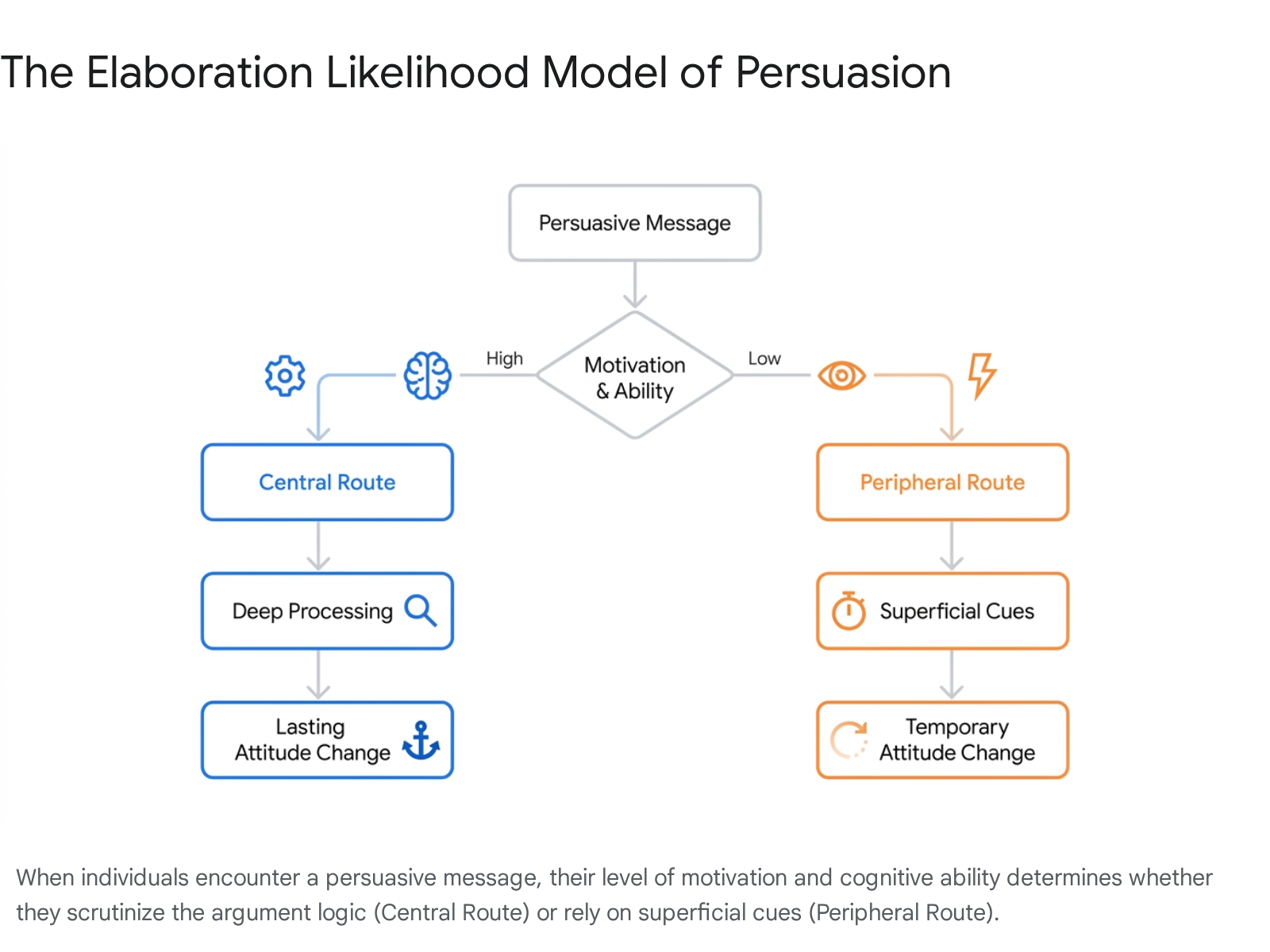
The central route involves careful, deliberate thought and analysis 1. When people are highly interested in a topic and have the cognitive energy to process it, they scrutinize the logic, facts, and quality of the arguments being presented 11. Because this requires high "elaboration" - meaning the individual assesses object-relevant information in relation to schemas they already possess - attitudes formed or changed via the central route tend to be long-lasting, highly resistant to counter-persuasion, and strongly predictive of future behavior 14. For example, a consumer extensively comparing the technical specifications and independent reviews of various laptops is utilizing the central route 1.
Conversely, the peripheral route acts as a mental shortcut 12. When a person is distracted, tired, or simply uninvested in the topic, they rely on superficial cues rather than logical arguments 12. These cues might include the physical attractiveness of the speaker, the perceived authority of the source, or the emotional tone of the message 14. While the peripheral route is highly effective for immediate compliance - such as purchasing a beverage solely because a favorite celebrity endorsed it - the resulting attitude change is generally temporary and fragile 143.
The ELM also highlights a constant trade-off between these two routes. As the motivation to think deeply increases, the influence of peripheral shortcuts naturally decreases 2. However, environmental factors play a massive role; physical exhaustion, cognitive overload, or a simple lack of time will frequently force a highly intelligent individual to fall back on peripheral processing, relying on the charisma of a speaker rather than the substance of their claims 23.
Why Facts Fail to Change Minds
A prevailing misconception in communication strategy is that humans are purely rational actors who will immediately update their beliefs when presented with superior data. In practice, the opposite is often true: human feelings rarely defer to raw facts 4. The human brain is functionally wired to prioritize value, survival, and social cohesion over objective, numerical accuracy 45.
When individuals evaluate risk or form opinions, they rely heavily on an "instinctive mind" governed by affective and emotional factors 48. Neuroeconomic research indicates that persuasion heavily involves the brain's valuation system 5. When individuals evaluate potential losses or persuasive messaging, brain regions such as the insula, the nucleus accumbens, and the mesial prefrontal cortex become highly active 58. This means humans literally assign a subjective biological "value" to their existing beliefs.
This biological reality explains widespread cognitive biases such as belief perseverance - the tendency to stick to initial beliefs even when faced with new, contradicting information - and the illusion of explanatory depth, wherein people believe they understand complex issues far better than they actually do until forced to explain them in detail 8. When a persuasive message directly threatens a deeply held belief, the brain treats the information as a threat to the individual's identity, triggering immediate defensiveness and denial 4. Furthermore, humans tend to exhibit avoidance of complexity, preferring simple but inaccurate explanations over complex, nuanced truths 86. Consequently, the most effective persuasion often bypasses direct factual confrontation entirely. Instead, skilled communicators rely on narratives, pattern recognition, and positive framing that align with the listener's existing values and emotional state 48.
The Seven Pillars of Influence
While the ELM explains how brains process information, the specific psychological triggers that push humans toward compliance were most famously codified by Dr. Robert Cialdini. In 1984, Cialdini published Influence: The Psychology of Persuasion, defining six universal principles based on decades of social psychology experiments and undercover observation of compliance professionals, including car salespeople, fundraisers, and marketers 71189. In 2016, through his follow-up book Pre-Suasion, Cialdini introduced a seventh principle: Unity 71015.
These principles operate primarily on the peripheral route of persuasion. They serve as mental heuristics - rules of thumb - that help humans navigate complex social environments efficiently without suffering decision fatigue 116. However, because they trigger automatic responses, they are frequently engineered by sales and marketing professionals. Understanding the mechanics behind these principles is essential for recognizing when they are being deployed.
1. Reciprocity: The Debt of Uninvited Favors
The principle of reciprocity is based on the deep-seated human obligation to give back to others the form of a behavior, gift, or service that they have received first 16. This evolutionary mechanism ensures social cooperation, but it can be easily manipulated. The rule enforces uninvited debts; people feel pressured to reciprocate even unwanted gifts, and the resulting feeling of obligation is so uncomfortable that individuals will often agree to an unequal exchange just to clear the psychological debt 11.
A classic demonstration of this principle involves restaurant tipping. Studies reveal that if a waiter provides a single mint at the end of a meal, tips increase by roughly 3% 16. If two mints are provided, tips quadruple to a 14% increase 16. Most remarkably, if the waiter provides one mint, walks away, then pauses and returns to offer a second mint specifically because the diners were "nice people," tips surge by 23% 16. The effectiveness lies not just in what is given, but in the personalization and unexpected nature of the gift 16.
2. Commitment and Consistency: The Power of Self-Image
Humans possess an obsessive desire to be, and to appear, consistent with what they have already done or said 111718. Once an individual makes a choice or takes a stand, they encounter personal and interpersonal pressures to behave consistently with that commitment 1117.
In persuasion, this principle is utilized by securing a small initial commitment that alters the individual's self-image 1118. For instance, someone who agrees to sign a petition about environmental protection (a small commitment) begins to view themselves as an environmentally conscious citizen. When approached weeks later for a significant financial donation to an environmental cause, they are far more likely to comply to maintain consistency with their new internal identity 18. Compliance professionals favor commitments that produce inner change because the change grows its own momentum; the persuader does not need to continually reinforce it 11.
3. Social Proof: The Herd Mentality
In situations of uncertainty, individuals look to the actions and behaviors of others to determine their own appropriate behavior 91711. The more people who are engaging in an action, the more correct the action appears to an observer 11.
This principle is heavily utilized in digital environments through "Best Seller" tags, high subscriber counts, and customer reviews 920. It is also evident in physical spaces, such as bartenders salting their tip jars with their own bills at the beginning of a shift to simulate a busy, generous crowd, which influences subsequent customers to tip 9.
4. Authority: The Deference to Expertise
Humans are biologically and socially conditioned to follow the lead of credible, knowledgeable experts 161721. Authority operates as a reliable mental shortcut; rather than researching a complex medical issue, an individual defers to the advice of a doctor 1.
However, the peripheral route of persuasion demonstrates that people often respond to the symbols of authority rather than genuine substance 1. Uniforms, academic titles, and assertive communication styles can trigger compliance even when the authority figure lacks true expertise in the specific domain being discussed 22.
5. Liking: The Friendly Thief
People strongly prefer to say yes to individuals they know and like 1617. Persuasion science identifies several factors that reliably cause liking: physical attractiveness, similarity (sharing names, backgrounds, or hobbies), sincere compliments, and mutual cooperation toward a common goal 1617.
Sales professionals systematically leverage this bias. A common tactic is the "endless chain" method, where a salesperson asks a customer to recommend friends who might benefit from a product. When the salesperson contacts the friend, they drop the initial customer's name, knowing that turning away the salesperson feels psychologically akin to rejecting a friend 11.
6. Scarcity: The Fear of Missing Out
The scarcity principle dictates that things appear more valuable when they are less available 1618. This cognitive bias is deeply tied to loss aversion - the psychological phenomenon wherein losing something hurts roughly twice as much as gaining the equivalent item 917.
When people perceive that access to an item or experience is restricted by limited time or limited quantity, their fear of missing out overrides careful logical analysis 918. This is observed in real estate, e-commerce ("Only 1 item left in stock!"), and subscription models 920.
7. Unity: The Power of "Us"
Introduced by Cialdini in 2016, Unity is distinct from the surface-level similarities of the "Liking" principle. Unity refers to a shared identity - the profound experience of "us" 71023.
While the most potent manifestation of Unity is genetic family ties, it can also be triggered by shared ethnicity, geography, or deeply held abstract values like faith, integrity, and justice 710. When a persuader establishes Unity, the interaction transforms. It is no longer viewed as a sales pitch, but rather as collaborative problem-solving within a trusted group 78. Marketers often trigger Unity through linguistic tweaks. In one study, consumers were asked to review a new restaurant concept. When asked for their "advice" rather than their "opinion," participants were significantly more likely to want to visit the restaurant later. Asking for advice put the consumers in a togetherness frame of mind, merging their identity with the creation of the product 1023.
Defensive Countermeasures: Recognizing and Resisting
Because these principles exploit automatic psychological responses, resisting them requires deliberate, conscious intervention to shift processing from the peripheral to the central route.
| Cialdini Principle | Persuasion Tactic Example | Countermeasure Strategy |
|---|---|---|
| Reciprocity | Offering "free" trials, e-books, or unsolicited gifts to create social debt 917. | Mentally redefine the "gift" as a sales device or compliance trick. This removes the social obligation to repay a benefactor who is actually a profiteer 11. |
| Commitment | Asking for a small public agreement to slowly shift an individual's self-image 1118. | Recognize the feeling of being trapped by a previous statement. Reject the pressure to remain consistent if the initial commitment was manipulated 2122. |
| Social Proof | Displaying manufactured waitlists, fake reviews, or artificial scarcity cues 9. | Actively investigate whether the crowd consensus is genuine or artificially engineered. Focus on objective data rather than peer behavior 922. |
| Authority | Showcasing credentials, lab coats, or leveraging unrelated fame to sell products 2224. | Demand verifiable evidence. Question whether the figure is an actual expert in the specific subject matter being presented 22. |
| Liking | Feigning shared hobbies or mirroring body language to build fast, artificial rapport 119. | Consciously separate the requester from the request. Evaluate the merit of the product or idea independently of your affection for the presenter 11. |
| Scarcity | Creating false urgency via limited-time offers or low-stock warnings 920. | Recognize the physical symptoms of panic or urgency. Pause and assess whether the desire for the item stems from genuine utility or just the fear of loss 918. |
| Unity | Using "us vs. them" rhetoric or invoking shared values to bypass critical thinking 79. | Be highly skeptical of politicians, influencers, or brands that artificially declare "we are a family" to demand unearned loyalty 9. |
Cross-Cultural Differences in Persuasion
A critical and often fatal flaw in global communication strategy is the assumption that psychological heuristics are universally identical. In reality, human brains are molded by their social environments, and the effectiveness of specific persuasive appeals varies drastically across cultural fault lines - most notably the divide between individualism and collectivism 11252627.
The Individualist Approach
Individualist cultures, such as the United States, the United Kingdom, and much of Western Europe, define the self as autonomous, unique, and independent from the broader group 112612. In these societies, persuasion is most effective when it heavily emphasizes personal choice, self-expression, individual benefits, and logical reasoning 252613.
Consequently, the principle of Scarcity is exceptionally powerful in individualist cultures, as it taps directly into a consumer's desire to secure a personal advantage and demonstrate uniqueness 25. Advertising styles tend to be low-context, straightforward, bold, and heavily reliant on "you" language 25261213. For example, American marketing campaigns frequently focus on the individual experience, framing products as tools to help the individual stand out or achieve personal goals 26.
The Collectivist Approach
Conversely, collectivist cultures - including Japan, South Korea, China, Poland, and many African nations - define the self primarily through group membership, family ties, and social harmony 11262730. The traditional roots of these cultures, such as the interdependence required for historical rice farming in Japan, have shaped a psychology that prioritizes the collective over the individual 27.
In a large-scale study exploring susceptibility to Cialdini's principles, researchers found that collectivists are significantly more responsive to Authority, Reciprocity, Liking, and Consensus (Social Proof) than individualists 3031. Because the self is rooted in social roles, the opinions of peers and the directives of recognized authority figures carry immense weight 12. Another study comparing the U.S. and Poland demonstrated that social pressure and Social Proof were far more effective at driving compliance in Poland, whereas self-consistency narratives were more effective in the U.S. 11.
Communication in collectivist societies is typically high-context, relying heavily on subtle emotional appeals, aesthetics, and storytelling rather than aggressive sales pitches 242612. In Japan, the direct, bold messaging common in American advertising is often perceived as brash, unsophisticated, or impolite 2426. Collectivist marketing heavily favors "we" language, emphasizing how a product facilitates togetherness, group harmony, and family values 252612. Furthermore, establishing business relationships in these cultures requires significant time dedicated to discussing seemingly unrelated personal topics (family, hobbies) to build the requisite trust and "face" before any transactional persuasion can occur 24.
Nudge Theory and Choice Architecture
While traditional persuasion relies on active messaging and argumentation, behavioral economists have identified powerful ways to influence behavior without relying on direct communication. In 2008, Richard Thaler and Cass Sunstein introduced Nudge Theory, a concept rooted in the idea of "libertarian paternalism" 203214.
A nudge is defined as an intervention that maintains total freedom of choice for an individual, but structures the decision-making environment - known as "choice architecture" - in a way that gently steers people toward a specific, usually beneficial, outcome 203234. Nudging acknowledges that humans suffer from bounded rationality and frequently default to the path of least resistance 3415.
High-Impact Applications of Nudging
The application of nudge theory has revolutionized public policy, healthcare, and digital commerce by proving that small environmental tweaks can yield massive behavioral shifts without removing human autonomy 2034.
1. Pension Auto-Enrollment: One of the most profound successes of nudge theory is the shift from "opt-in" to "opt-out" defaults in retirement savings plans. Historically, employees had to actively complete paperwork to join a pension scheme. By simply changing the default setting so that new employees are automatically enrolled unless they actively choose to opt out, participation rates skyrocket. Leveraging human inertia, the UK's National Employment Savings Trust witnessed pension participation rise from 61% to 83% within five years of implementing this simple architectural nudge 15.
2. Healthcare and Public Health: Healthcare organizations utilize nudges to overcome patient procrastination. In a massive clinical megastudy involving 689,000 Walmart pharmacy customers, researchers tested various text message reminders for flu vaccines. The most effective message leveraged the psychological concept of the endowment effect by stating, "A flu shot is waiting for you," implying ownership. This simple phrasing tweak increased vaccination rates by 6.8% compared to standard business practices 14. Similarly, placing healthier food options at eye level or near the cash register in school cafeterias dramatically increases the selection of healthy foods without banning junk food 203215.
3. Digital Commerce and UX Design: Technology platforms seamlessly integrate nudges with established psychological principles to drive engagement. LinkedIn uses progress bars indicating a user is close to an "All-Star" profile, nudging them to provide more personal data through the human desire for task completion and consistency 20. E-commerce platforms like Airbnb combine social proof and scarcity nudges by displaying real-time metrics showing how many other users are currently viewing a specific property, subtly pushing the consumer toward an immediate booking 20.
Persuasion in Practice: Public Health and Office Negotiations
Understanding the theoretical frameworks of ELM, Cialdini's principles, and nudging is only half the battle. Observing how these concepts are deployed in high-stakes environments provides deeper insight into the mechanics of human influence.
Public Health Messaging
Public health communication operates in a complex environment where communicators must combat deeply ingrained habits, social norms, and active misinformation 1617. Successful campaigns rely heavily on emotional resonance, clear calls to action, and strategic framing 3818.
The framing of a message - whether it highlights the gains of adopting a behavior or the losses of avoiding it - is highly context-dependent 18. While fear appeals (loss framing) are frequently used, such as highlighting the devastating physical consequences of smoking, they carry a high risk of triggering a "boomerang effect" or psychological reactance 1819. When individuals feel their freedom is threatened or the fear induced is too overwhelming, they may actively resist the message and increase their dangerous behaviors to reassert autonomy 1920.
Conversely, campaigns that successfully leverage community, humor, and simple actions tend to achieve massive scale. The 2014 ALS Ice Bucket Challenge utilized a simple, easily replicable action paired with the social pressure of public nomination, resulting in 17 million videos and $220 million raised for research 38. Similarly, the "Movember" campaign uses humor and the visual disruption of men growing mustaches to act as walking billboards, destigmatizing conversations around men's health 38. The CDC's "Tips from Former Smokers" campaign grounded its message in raw, relatable human stories rather than sterile statistics, resulting in an estimated one million people successfully quitting smoking and saving the healthcare system $7.3 billion 38.
Strategic Office Negotiations
In the corporate boardroom, negotiation is less about forceful coercion and more about applied behavioral science 4243. Skilled negotiators understand that their counterparts fluctuate between systematic processing (analyzing financial logic via the prefrontal cortex) and heuristic processing (relying on emotional triggers and social cues via the limbic system) 42.
To navigate this, effective negotiators prioritize psychological alignment. Active listening and mirroring - repeating back key phrases - help the counterpart feel understood, which biologically lowers their defensiveness and builds essential trust 434445. Furthermore, expert negotiators actively work to mitigate destructive cognitive biases that routinely derail agreements. They must recognize confirmation bias (the tendency of both parties to only hear information supporting their pre-existing beliefs), the sunk cost fallacy (refusing to back down due to past investments of time or money), and the endowment effect (the psychological tendency for a party to drastically overvalue assets or positions they already own) 46. By combining deep emotional intelligence with the ethical application of principles like reciprocity and authority, negotiators shift interactions from combative arguments into cooperative problem-solving sessions 4546.
The Psychology of Resistance and Defense
Because humans are bombarded with persuasive messaging daily, the brain has evolved robust defense mechanisms. Recognizing how to actively resist influence is as important as understanding how to generate it.
To properly contextualize resistance, behavioral scientists draw firm distinctions between various forms of influence based on intent, transparency, and the preservation of free will 2148492251. * Persuasion: The act of guiding someone to a decision through reasoning, framing, and communication, while entirely preserving their free choice. Both parties typically benefit 492252. * Manipulation: The deceptive use of influence techniques to serve a hidden agenda, often exploiting the target's psychological vulnerabilities and hampering their ability to make a rational, informed decision 21484951. * Coercion: Relying on force, threats, or ultimatums ("do this or else"). Coercion actively removes free choice and agency from the equation 48492252. * Brainwashing: Erasing identity to install a new personality, fundamentally altering how reality is perceived to the point where the victim no longer recognizes the pros and cons of an argument 5253.
When individuals encounter messaging they wish to resist, they unconsciously deploy specific psychological strategies. Researchers categorize these into four distinct clusters 2023: 1. Avoidance: Physically or cognitively tuning out the message, such as scrolling past an advertisement or leaving the room 20. 2. Contesting (Counterarguing): Actively generating mental arguments against the message's logic or derogating the credibility of the source. Studies indicate that generating issue-relevant counterarguments is the most effective psychological strategy for durable resistance, as the cognitive effort hardens the individual's original attitude 202324. 3. Biased Processing: Filtering incoming information through a lens that confirms existing beliefs while selectively ignoring or minimizing contradictory data 2024. 4. Empowerment (Self-Assertion): Reminding oneself of one's own confidence, identity, and values. By bolstering their existing attitudes and seeking social validation from like-minded peers, individuals render external opinions irrelevant 202324.
The Frontier of Algorithmic Persuasion
The science of persuasion is currently undergoing a massive paradigm shift driven by Artificial Intelligence (AI) and Large Language Models (LLMs). For decades, persuasion was bound by a strict dichotomy: it was either highly personalized but non-scalable (a one-on-one sales interaction) or highly scalable but generic (a television commercial or billboard). Generative AI fundamentally breaks this limitation, enabling hyper-personalization at scale 56.
AI vs. Human Persuasion
Recent peer-reviewed research indicates that AI-driven persuasion is rapidly matching, and in specific contexts exceeding, human capabilities. A comprehensive 2025 systematic review and meta-analysis of eight studies involving over 20,000 participants found that, overall, LLMs are statistically matched with humans in their persuasive abilities 57. However, when LLMs are integrated with personalization data, their effectiveness spikes dramatically.
A landmark 2025 study published in Nature Human Behavior matched 900 human participants in debates against either other humans or the GPT-4 LLM . When the AI was provided with basic demographic data about its opponent (age, gender, ethnicity, employment status, political affiliation), it successfully adapted its arguments in real-time and was more persuasive than human debaters 64% of the time . Another large-scale pre-registered experiment found that LLM-generated messages were highly effective at changing human attitudes on deeply polarized policy issues, such as carbon taxes and assault weapons bans 5925.
LLMs are highly effective persuaders because they can perfectly calibrate tone, select specific evidence, and deploy emotional appeals targeted to a user's exact psychological profile, all without suffering from cognitive fatigue, impatience, or emotional frustration 5659. In modern digital marketing, AI algorithms process hundreds of behavioral data points to determine the precise moment a consumer is most susceptible to a specific psychological trigger - calculating exactly when to deploy a scarcity nudge versus a social proof nudge 6162.
The Ethical Imperative for 2025 and Beyond
The sheer power of algorithmic influence has sparked intense debate over the ethical boundaries of AI. Consumer advocacy groups, researchers, and new regulatory frameworks (such as the EU AI Act) are demanding strict transparency and accountability to prevent algorithmic manipulation 62636465.
Ethical frameworks being established for 2025 and 2026 mandate several key protections: * Transparency and Disclosure: Users must be explicitly informed when they are interacting with AI-generated content or when AI is making targeting decisions 6263. "AI disclosure labels" are becoming ubiquitous to ensure users understand the origin of the persuasion 62. * Explainable AI (XAI): Algorithms must not operate as black boxes. If an AI system makes a decision to target a consumer, companies are increasingly required to provide "explanation interfaces" that translate the algorithm's logic into understandable language 626566. * Fairness and Non-Discrimination: Marketers must actively audit AI training data and outputs to ensure algorithms do not perpetuate biases, discriminate against vulnerable populations, or exploit emotional distress 2163646566. * Consumer Autonomy: Ethical AI persuasion must respect the user's free will, shifting from manipulative exploitation toward providing relevant information that aids informed decision-making 2163.
Bottom line
The science of persuasion clearly demonstrates that human decision-making is rarely an exercise in pure, emotionless logic. Instead, individuals rely heavily on deep-seated cognitive shortcuts - such as the need for social proof, reciprocity, and consistency - to navigate an increasingly complex world. While the architecture of choices and varying cultural backgrounds subtly steer human behavior, recognizing these psychological levers empowers individuals to resist manipulation. As artificial intelligence makes personalized influence scalable and ubiquitous, cultivating a deep awareness of exactly how human minds are persuaded is no longer just an academic exercise, but a vital necessity for preserving cognitive autonomy.