
How to Spot When You're Anchored on a Number
Anchoring bias is a cognitive trap where your brain unconsciously latches onto the first piece of numerical information it encounters, using it as an invisible baseline that skews all subsequent judgments and estimates. You can tell you are anchored if you find yourself making rapid decisions under stress, fixating on a single reference point while ignoring new evidence, or feeling entirely unable to calculate a fair value from scratch without referencing the initial offer. The most effective way to break this mental tether is not merely to be aware of it, but to actively force your brain to generate concrete reasons why the initial number is wrong.
The Invisible Gravity of Initial Numbers
To understand how to detect anchoring in your own decision-making, it is essential to first understand how the phenomenon hijacks human cognition. First introduced by psychologists Amos Tversky and Daniel Kahneman in their seminal 1974 research, the anchoring effect is a cognitive heuristic - a mental shortcut - used by the brain to make estimates under conditions of uncertainty 123.
When faced with a complex decision, the human brain constantly seeks efficiency to conserve energy. Instead of calculating an answer from a blank slate, the mind grabs the nearest available data point, establishes it as the "anchor," and builds its entire reality around that figure. This psychological phenomenon is so powerful that even completely arbitrary or explicitly random numbers can dramatically alter an individual's financial valuations and legal judgments. In one classic experiment, researchers asked participants for the last two digits of their Social Security number, and then asked them to price a bottle of wine. Even though the Social Security number had absolutely nothing to do with the wine, individuals with higher digits were willing to pay significantly more for the product 4. Similarly, when judges were asked to sentence a hypothetical defendant, those who rolled a nine on a pair of loaded dice proposed an average sentence of eight months in prison, whereas those who rolled a three offered significantly lighter sentences 4.
Behavioral economists often describe anchoring as having a "magnetic pull" on the decision-maker 5345. No matter how irrelevant the initial number is, it establishes a baseline that exerts a gravitational force on the final decision. This is why people tend not to react to their total accumulated wealth, but rather to the immediate differences in their wealth relative to whatever recent financial number they are currently anchored to 6.
The Hidden Mechanics of Anchoring Bias
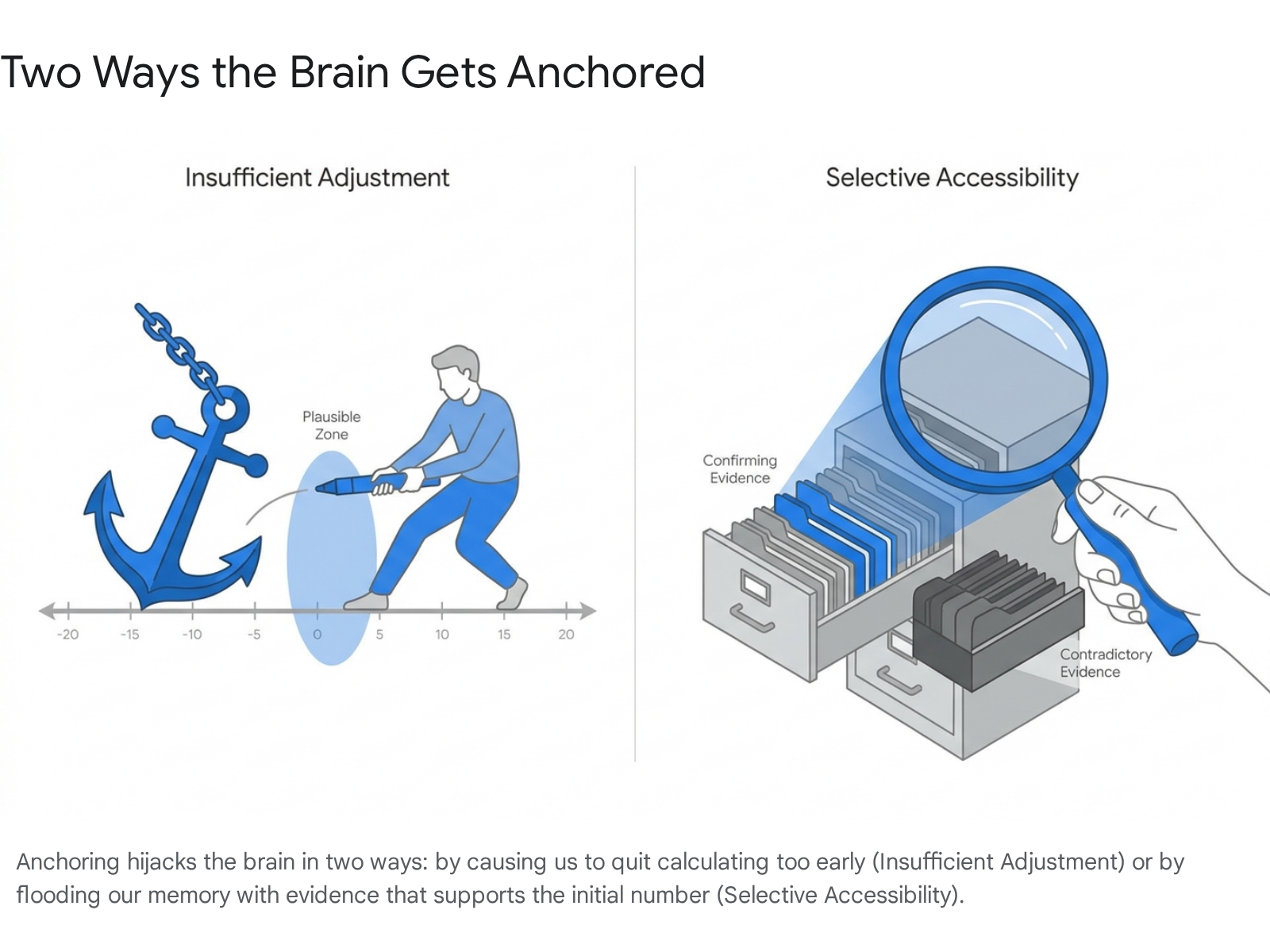
Researchers have identified two primary cognitive mechanisms that explain why anchoring occurs and why it is so difficult to shake off. Understanding these dual pathways is the first step toward recognizing when your own judgment has been compromised.
The Insufficient Adjustment Model
The insufficient adjustment model frames anchoring as a fundamental failure of cognitive endurance. When an individual is presented with an anchor, they usually know intuitively that it is not the exact right answer. Therefore, they begin to adjust away from the anchor toward the true value 17118.
However, adjusting requires deliberate cognitive effort - often referred to as System 2 thinking in dual-process theories of mind, which is analytical, slow, and rule-based 910. Because the brain naturally seeks to minimize cognitive load, the individual stops adjusting as soon as they reach a value that falls just inside the boundary of what seems "plausible" 11516. The result is a final estimate that remains heavily biased toward the initial anchor simply because the mental adjustment process ended prematurely 7118. This dynamic relies on the fact that humans are extremeness averse; we pull toward the center of whatever spectrum has been artificially created for us 2.
The Selective Accessibility Model
The selective accessibility model, conversely, suggests that anchoring is actually a memory retrieval bias. When you are exposed to an anchor, your brain automatically searches your memory for evidence that confirms the anchor might be correct, effectively blinding you to contradictory information 211111812.
For example, if you are told a used car costs $20,000, your brain immediately retrieves attributes that justify a $20,000 price tag, such as the car's leather seats, its brand reputation, or its low mileage. This process is a specific manifestation of confirmation bias 110. By the time you attempt to calculate the car's true intrinsic value, your working memory is already flooded with anchor-consistent knowledge. This makes it neurologically difficult to arrive at a lower, more accurate estimate because the evidence supporting a lower price simply cannot be accessed by your conscious mind 101820. Recent psychophysical research further suggests that anchors can actually distort our baseline ability to discriminate physical quantities, proving that the bias alters not just how we think, but how we perceive reality at a sensory level 8.
Recognizing the Signs: A Metacognitive Diagnostic
Because anchoring is largely an unconscious and automatic process, you cannot simply "feel" yourself being biased in the moment. Instead, you must learn to look for the secondary symptoms of the bias within your own decision-making process. Recognizing anchoring in real-time requires active metacognition - the practice of stepping back and critically evaluating your own thought processes 211324. If you suspect you might be anchored on a number, evaluate your current state against the following diagnostic indicators.
Operating Under High Cognitive Load and Time Constraints
Anchoring thrives on speed and mental fatigue. The heuristic nature of the bias means that it serves as a shortcut to simplify complex decisions when you do not have the energy to process them fully 1725. When individuals are under significant time constraints, their cognitive resources are strained, and their reliance on initial anchors increases dramatically 7. If you are rushing to accept a job offer, close a real estate deal, or make a rapid medical diagnosis, your brain is actively looking for a shortcut. In these moments, you are highly vulnerable to whatever number or metric was presented first, as your mind simply does not have the processing bandwidth to engage in sufficient adjustment away from the anchor.
The Influence of Negative Emotional States
Research indicates a surprising and powerful link between your immediate mood and your susceptibility to anchoring. Individuals who report feeling sad, stressed, or experiencing negative emotions are significantly more susceptible to anchoring bias than those in a neutral or happy mood 1415. The effect is so pronounced that even highly experienced professionals have been shown to fall victim to the bias when making decisions while angry 15. If you are emotionally compromised, your brain is more likely to accept an external anchor to avoid the additional cognitive burden of independent calculation. Recognizing a negative emotional state is often the first clue that your subsequent numerical judgments are compromised.
Fixation Error and Tunnel Vision
A primary clinical indicator of anchoring is focusing on one specific piece of information at the expense of understanding the whole situation - a phenomenon frequently referred to in medical and aviation literature as "fixation error" 1516. If you are buying a house and can only think about the seller's initial asking price while totally disregarding property taxes, long-term maintenance costs, and comparative neighborhood sales, you are experiencing fixation 61515.
This tunnel vision was vividly documented in a 2023 study examining pediatric difficult airway management. The researchers found that fixation error - defined specifically in this context as an anchoring bias where a clinician focuses on a single issue at the expense of the whole clinical picture - occurred in 11.5% of total intubation cases analyzed. It was the most prevalent cognitive error identified and was independently associated with a higher risk of severe patient complications 16. When you cannot pull your attention away from a single metric to look at the broader context, an anchor has taken hold.
The Inability to Zero-Base an Estimate
A powerful metacognitive test to determine if you are anchored is to ask yourself a simple question: If I had never seen that initial number, how would I have arrived at my current estimate?
If you are unable to construct a rational, step-by-step valuation from the ground up - using first principles like discounted cash flow analysis for a stock, or standard market rates for a salary - you are likely anchored. Analysts who find their independent evaluations are far out of alignment with the current stock price often try to manually change their evaluation to match the market, abandoning their own due diligence because they are influenced by the anchor 29. If you find yourself just adding or subtracting a little bit from the initial offer rather than building a case from zero, the anchor is doing the work for you.
The Expert Vulnerability: Does Intelligence Protect You?
A pervasive misconception in professional environments is that intelligence, higher education, or domain expertise immunizes a person against cognitive biases. The empirical research reveals a much more nuanced reality: anchoring affects novices and experts alike, and in some specific contexts, experts are actually more vulnerable 291718.
The Weak Link to Intelligence and Personality
The statistical link between general intelligence and anchoring susceptibility is surprisingly weak. Multiple studies have found that cognitive ability alone does not significantly reduce how likely people are to use anchoring 21417. Standard metrics of broad intelligence - such as fluid intelligence or quantitative ability - only account for a tiny fraction of the variance in how people respond to anchors, showing a correlation of just ~0.12 to 0.16 917.
Personality traits yield equally contradictory results. While some isolated studies suggest that high openness, conscientiousness, and agreeableness can increase susceptibility, comprehensive meta-analyses often find no reliable, overarching correlation between the Big Five personality traits and anchoring 291114.
What does matter, however, is cognitive reflection. Individuals who score high in cognitive reflection - meaning they naturally pause to critically evaluate their own intuitive thoughts rather than accepting their first impulse - show a negative correlation with anchoring. By actively questioning their own decision-making process, highly reflective people are more likely to realize when they are relying on an unreasonable anchor and manually initiate the effortful System 2 thinking required to correct for insufficient adjustments 27917.
Professional Manifestations of Anchoring
Expertise does not eliminate anchoring, though it can sometimes blunt its most extreme effects 291718. The bias remains highly prevalent and dangerous across critical professional fields, proving that simply knowing a lot about a subject does not change the underlying architecture of the human brain.
| Professional Domain | How Anchoring Manifests | Consequences of the Bias |
|---|---|---|
| Medicine & Healthcare | Physicians anchor on a patient's first reported symptom, an initial triage label, or a previous diagnosis from another doctor 103233. | Contributes heavily to the estimated 75% of diagnostic errors caused by cognitive bias. Leads to delayed testing, misdiagnosis, and severe patient harm 101833. |
| Law & Justice | Judges anchor on the initial sentence length requested by a prosecutor, or the first damages number proposed by a plaintiff 3219. | Results in disproportionately harsh or wildly erratic sentencing and financial rulings, compromising the fundamental fairness of legal proceedings 43219. |
| Finance & Investing | Investors anchor to a stock's historical high, its 52-week low, or its initial public offering price when forecasting future performance 112535. | Causes investors to hold onto losing assets too long, misjudge intrinsic value, and make irrational market forecasts based on irrelevant historical benchmarks 112935. |
| Supply Chain & Management | Managers anchor on an employee's or supplier's past performance score in one specific, isolated metric 2037. | Creates a powerful "knock-on effect" where one high or low score artificially inflates or depresses evaluations across entirely unrelated performance dimensions 20. |
A stark example of expert susceptibility was documented in a massive 2023 study published in JAMA Internal Medicine. Researchers analyzed over 108,000 emergency department visits by patients with a history of congestive heart failure (CHF) who presented with shortness of breath. The study found that if the initial triage notes simply mentioned CHF, emergency physicians were significantly less likely to test for a pulmonary embolism (a deadly blood clot). Specifically, the mere mention of CHF was associated with a 4.6 percentage point reduction in pulmonary embolism testing and delayed necessary testing by an average of 15.5 minutes. The physicians unconsciously anchored on the initial CHF label, stalling the investigation of alternative, equally dangerous diagnoses 21.
Furthermore, a 2025 cross-sectional study in the Spanish healthcare system evaluating general practitioners versus specialists revealed a significant interaction between specialization and anchoring. The findings suggested that specialists were actually more prone to anchoring bias than general practitioners, likely because extensive specialized experience can lead to overconfidence in rapid pattern recognition, causing them to anchor prematurely on familiar presentations 18.
In the business sector, a 2024 study on supply chain management demonstrated how anchoring creates dangerous "knock-on effects" in multi-dimensional evaluations. When managers were presented with a supplier who had a historically low evaluation score in just one dimension, the managers consistently assigned that same supplier lower scores in entirely unrelated dimensions (like cost, quality, service, and delivery) compared to a supplier who had a high past score 2022. The anchor of past performance fundamentally distorted their ability to objectively evaluate current reality.
Real-World Triggers and Environmental Anchors
Even if you are not making life-or-death medical diagnoses or ruling in a court of law, anchoring heavily dictates the economic and personal decisions you make every day. The bias is frequently weaponized in retail environments, negotiations, and marketing to manipulate consumer perception and drive specific economic behaviors.
The Pricing Illusion in Retail
Retailers constantly use external anchors to distort consumers' perceptions of value. The most common and effective tactic is the "markdown illusion," where a retailer displays a heavily inflated "original price" directly next to a "sale price" 61325.
If you see a jacket with a $300 price tag crossed out and marked down to $150, the initial $300 serves as the anchor. Your brain evaluates the $150 strictly in relation to the $300, leading you to perceive the jacket as a massive bargain because you are adjusting downward from a high baseline 151325. If that exact same jacket was simply placed on a rack with a standard $150 tag, with no original price listed, you would evaluate its worth objectively and might conclude it is overpriced.
This effect also applies to volume limits. A supermarket sign reading "Limit 12 per customer" sets a high numerical anchor in the shopper's mind. Research indicates this subtly pushes shoppers to buy significantly more units than they would if the sign simply read "On Sale," because the number 12 becomes the new subconscious baseline for a normal purchase quantity 3. Similarly, the ubiquitous "$9.99" price tag anchors the brain on the first digit (9), tricking the consumer into perceiving the price as significantly cheaper than $10, even though the economic difference is negligible 32.
The Danger of the First Offer in Negotiation
In salary negotiations, freelance contracting, and real estate, the first number spoken essentially dictates the entire trajectory of the deal 15143540. If a home is listed for $500,000, that number becomes the unshakeable center of gravity for the negotiation. A buyer who negotiates the price down to $470,000 will feel they have won a major victory, even if the intrinsic market value of the home is only $400,000 615.
Extensive research shows that the party who makes the first explicit monetary offer effectively sets the anchor, and almost always walks away with a significantly more favorable outcome because the counter-offer is inevitably pulled toward that initial number 2414. When individuals lack sufficient information or deep domain knowledge to make a well-informed judgment, the initial anchor becomes a default starting point that heavily influences all subsequent considerations 35.
Interestingly, the source of the anchor matters. Recent studies investigating the "bias blind spot" show that anchoring effects can be slightly reduced when the anchor values are explicitly presented as other people's estimates 20. Because humans generally perceive others as less knowledgeable and more prone to biases than themselves, we are more likely to engage in critical thinking and discount a number if we know it came from a biased competitor or a random participant, rather than an authoritative system 20.
Disambiguation: Cognitive Bias Versus Behavioral Conditioning
When researching anchoring, readers may occasionally encounter the term used in an entirely different context: Neuro-Linguistic Programming (NLP) and behavioral psychology. It is important to disambiguate the cognitive bias of numerical anchoring from the behavioral practice of emotional anchoring.
In NLP and behavioral conditioning, "anchoring" refers to the deliberate creation of a neurological link between a specific physical stimulus (like pressing your thumb and forefinger together, or a touch on the shoulder) and an intense emotional state (like confidence or calmness) 2342432425. By repeatedly pairing the physical action with the emotional peak, individuals can theoretically trigger the desired emotional response on demand to manage stress or improve public speaking performance 2324.
While both phenomena rely on the psychological concept of stimulus-and-response, the cognitive bias of numerical anchoring (the focus of this report) is a passive, unconscious error in quantitative judgment and heuristic processing 746. NLP anchoring is an active, deliberate conditioning technique aimed at altering physical and emotional states.
Evidence-Based Debiasing: How to Break the Anchor
Awareness alone is rarely enough to defeat cognitive biases. Studies routinely show that simply warning people about the anchoring effect or training them broadly on the existence of biases does not stop them from falling for it 162026. The brain's pull toward efficiency is too strong. To genuinely mitigate the bias, you must employ active, friction-inducing debiasing techniques that force the brain out of its intuitive System 1 processing and into analytical System 2 thinking.
1. The "Consider the Opposite" Strategy
The single most robust, evidence-backed defense against anchoring is a technique known as "consider the opposite" or "consider an alternative" 181220202648.
Because anchoring relies heavily on the selective accessibility mechanism - where your brain only retrieves data that proves the anchor is right - you must actively force your brain to retrieve contradictory data. If you are given a starting price for a car or a salary offer, you must consciously list two or three specific reasons why that number is inappropriate, mathematically wrong, or irrelevant to the situation 18122037. By actively arguing with your own initial assumptions and generating reasons for an opposing position, you make anchor-inconsistent knowledge accessible to your working memory. This breaks the magnetic pull of the initial number and significantly reduces the bias 181220.
2. The Asymmetry of High vs. Low Anchors (Mental Mapping)
Recent research from 2024 has revealed a fascinating limitation to the "consider the opposite" technique: it works brilliantly for high anchors, but it is remarkably ineffective at combating low anchors 2022.
If someone anchors you with a severely lowball offer, generating reasons why it is wrong does not sufficiently reset your perception. Instead, for low anchors, decision-makers must use a technique called Mental Mapping 2022.
Mental mapping requires you to completely step away from the anchor and redefine the absolute boundaries of the scale before you make your judgment. You must explicitly define what the absolute highest possible value looks like, and what the absolute lowest possible value looks like in the current context 2022. By visualizing the entire spectrum of possibilities, you recalibrate your distorted perception and stop viewing the low anchor as the center of the universe.
| The Threat Scenario | Ideal Debiasing Strategy | Execution Mechanism |
|---|---|---|
| High Anchors (e.g., Inflated retail prices, exorbitant initial salary demands, unrealistic seller asking prices) | Consider the Opposite | Explicitly write down three concrete reasons why the high number is entirely inappropriate, unjustified, or mathematically flawed 1220. |
| Low Anchors (e.g., Lowball salary offers, historically poor performance metrics, minimal damages requested) | Mental Mapping | Ignore the specific number provided. Redefine the absolute top and bottom limits of the entire scale to regain perspective on what constitutes a fair value 2022. |
3. Seek Independent Baselines
Before you enter a situation where you know an anchor will be dropped - such as walking onto a car lot, opening a salary negotiation, or reviewing a complex legal brief - you must establish your own data-driven reference point 1513. Gather independent market data and formulate your target number before exposing yourself to the opposing party's anchor 151335.
If you find yourself already in the situation without preparation, pause the interaction, introduce a physical time delay, and seek out a second or third opinion from someone entirely removed from the immediate context 211332. Techniques like the Best Worst Method (BWM) in multi-criteria decision-making also help groups mitigate individual anchoring by forcing pairwise comparisons across opposite references rather than relying on a single vector input 48. The broader the range of independent information you expose yourself to, the weaker the initial anchor becomes.
Bottom line
Anchoring bias is an inescapable quirk of human neurobiology that causes us to fixate on the first number we see, distorting everything from retail purchases and salary negotiations to life-or-death medical diagnoses and legal rulings. You can recognize its influence if you find yourself making rapid decisions under stress, fixating on a single metric, or proving unable to mathematically justify your estimates from scratch. While professional expertise and general intelligence offer surprisingly little protection, you can break an anchor's magnetic pull by actively arguing against the initial number, recalibrating your mental scales, and forcing yourself to rely on independent data before a negotiation begins.