
How Solar Geoengineering Could Cool the Planet
Solar geoengineering is a proposed set of planetary-scale technologies aimed at temporarily cooling the Earth by reflecting a fraction of incoming sunlight back into space. However, it is not a cure for climate change, as it merely masks the warming effects of greenhouse gases without removing them from the atmosphere or addressing critical crises like ocean acidification. For the average citizen, the deployment of such unproven technologies could dictate whether their local region experiences reliable rainfall for agriculture or devastating, permanently altered weather patterns, making it one of the most consequential and dangerous gambles in human history.
As the world continues to fall short of the emissions reduction targets established under the Paris Agreement, the international community faces an increasingly volatile climate future 12. The undeniable acceleration of global warming, characterized by unprecedented temperature spikes, melting polar ice, and extreme weather events, has prompted desperate searches for alternative interventions 13. Consequently, solar geoengineering has migrated from the fringes of science fiction into the mainstream corridors of academic research, private venture capital, and international policy debate 45. Yet, this transition has ignited fierce resistance from governments, civil society, and scientists who warn that deliberately manipulating the Earth's climate system introduces unfathomable environmental, geopolitical, and ethical risks 67.
What is solar geoengineering and how does it actually work?
Solar geoengineering, technically referred to as solar radiation management (SRM) or solar radiation modification, encompasses a suite of highly speculative interventions designed to alter the Earth's radiative balance 56. The primary objective is to increase the Earth's albedo - its surface and atmospheric reflectivity - so that a larger percentage of shortwave solar radiation is deflected back into space before it can warm the troposphere and the Earth's surface 78. The most prominently researched method within this category is Stratospheric Aerosol Injection (SAI), followed by Marine Cloud Brightening (MCB) and cirrus cloud thinning 5910.
To understand the mechanism of Stratospheric Aerosol Injection, scientists rely heavily on a real-world natural analogy: major volcanic eruptions, such as the 1991 eruption of Mount Pinatubo in the Philippines 11. When Mount Pinatubo erupted, it blasted approximately 20 million tons of sulfur dioxide ($SO_2$) into the stratosphere. Once in the upper atmosphere, this sulfur dioxide reacted with water vapor to form long-lasting sulfate aerosols 812. Because these aerosols were injected into the stratosphere - an atmospheric layer situated roughly 20 kilometers above the Earth's surface, well above the troposphere where typical weather patterns and rain occur - they avoided being rapidly washed out by precipitation 68. These particles lingered for over a year, spreading across the globe and effectively acting as millions of microscopic mirrors 812. By scattering incoming sunlight, the Pinatubo aerosols resulted in a measurable drop in global average temperatures by approximately 0.5°C for over a year 1113.
Stratospheric Aerosol Injection seeks to artificially mimic this "volcanic winter" effect.
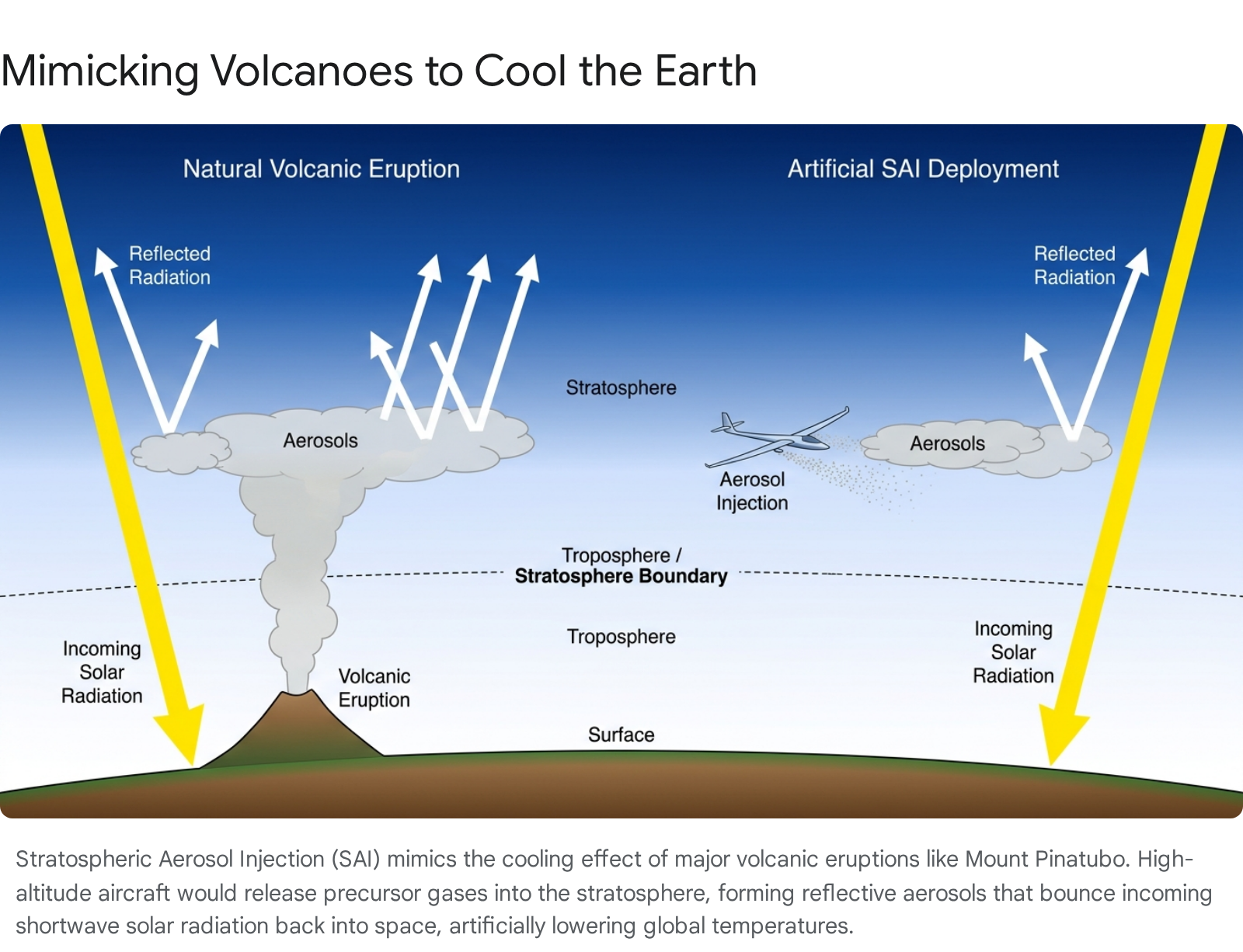
The concept involves utilizing custom-designed high-altitude aircraft or tethered weather balloons to continuously disperse reflective particles into the stratosphere 812. While sulfur dioxide is the most thoroughly modeled precursor gas due to the volcanic precedent, researchers have also explored injecting calcium carbonate, alumina, or engineered nanomaterials like cellulose nanocrystals, which might offer more targeted reflectivity with fewer chemical side effects 1214. Because the injected particles naturally fall out of the stratosphere over a period of months to a few years, any cooling effect would require a continuous, uninterrupted replenishment program on a planetary scale 512.
While Stratospheric Aerosol Injection commands the bulk of academic and policy attention, other methodologies exist within the solar radiation modification portfolio. Marine Cloud Brightening operates at a much lower altitude, proposing to spray microscopic seawater droplets or sea salt aerosols into the marine boundary layer 518. These salt particles would act as cloud condensation nuclei, theoretically increasing the density, longevity, and reflectivity of low-lying marine stratocumulus clouds over the oceans, thereby bouncing more sunlight away from the Earth's surface 1815. Another theoretical proposal, cirrus cloud thinning, focuses on the upper troposphere, attempting to dissipate high-altitude ice clouds that trap longwave terrestrial radiation, thereby allowing more heat to escape into space 610.
However, a critical, pervasive misconception must be explicitly corrected: solar geoengineering does not, in any capacity, solve climate change 2016. It is entirely a compensatory measure - a global painkiller that only masks the warming effect of greenhouse gases 2017. Solar radiation modification does not remove a single molecule of carbon dioxide ($CO_2$) from the atmosphere 7. If human civilization deploys solar geoengineering without drastically and immediately cutting fossil fuel emissions, the underlying concentrations of atmospheric greenhouse gases will continue to rise indefinitely 7. This scenario would create a highly volatile, artificial planetary system where the immense thermal pressure of legacy carbon emissions is held in check only by a fragile, human-engineered sunshade 718.
Why does blocking the sun fail to fix ocean acidification?
One of the most profound dangers of framing solar geoengineering as a holistic climate "solution" is its complete inability to halt or reverse ocean acidification, a devastating ecological crisis intimately tied to anthropogenic carbon emissions 717. The mechanism of ocean acidification is fundamentally a chemical process, occurring independently of the Earth's radiative heat balance or ambient surface temperatures 19. As atmospheric $CO_2$ concentrations relentlessly rise due to the continued burning of fossil fuels, the world's oceans act as a massive, continuous carbon sink, absorbing roughly a quarter to a third of all human-generated carbon emissions 2021.
When $CO_2$ dissolves in seawater, it triggers a chain of aqueous chemical reactions. The carbon dioxide reacts with water molecules ($H_2O$) to form carbonic acid ($H_2CO_3$), which rapidly dissociates into bicarbonate ions ($HCO_3^-$) and free hydrogen ions ($H^+$) 20. This surge in free hydrogen ions fundamentally alters marine chemistry by increasing the ocean's acidity - measured as a decrease in pH - and concurrently depleting the concentration of available carbonate ions ($CO_3^{2-}$) 20. Since the dawn of the industrial revolution, there has already been an average pH decrease of 0.1 units in the global upper ocean, representing a roughly 30% increase in acidity 20.
Carbonate ions are a vital, non-negotiable biological building block for a vast array of marine life. Organisms ranging from massive coral reefs to foundational phytoplankton like coccolithophores, as well as commercially vital species such as mussels, clams, and sea urchins, rely entirely on calcium carbonate ($CaCO_3$) to construct their shells and skeletal structures 2021. When ocean acidity rises and carbonate availability plummets, these calcifying organisms must expend significantly more metabolic energy to build and maintain their shells 21. In highly acidic environments, the surrounding water becomes corrosive, causing existing calcium carbonate structures to literally dissolve 2021.
Because solar radiation management only suppresses the global thermostat by deflecting sunlight, it allows atmospheric $CO_2$ to accumulate unabated 719. Consequently, the chemical diffusion of carbon into the marine environment would continue relentlessly under a geoengineered sky 1920. Projections indicate that continued, unconstrained carbon emissions - even if their warming effects are perfectly masked by solar geoengineering - would further reduce the average upper ocean pH by approximately 0.3 units by the year 2100 20. This chemical shift would push marine ecosystems past critical biological thresholds, potentially triggering mass extinction events across marine species and collapsing entire oceanic food webs that support global fisheries 1821.
Furthermore, attempts to address ocean acidification through complementary geoengineering strategies have proven vastly insufficient. Theoretical carbon dioxide removal (CDR) techniques, such as enhanced chemical weathering (dissolving alkaline minerals like powdered limestone or olivine into the ocean to raise alkalinity), face insurmountable logistical hurdles 722. Computer modeling by the Alfred Wegener Institute demonstrated that dispersing a massive three gigatons of olivine into the oceans would only compensate for roughly nine percent of the planet's current $CO_2$ emissions 22. To fully counteract annual anthropogenic emissions, society would need to mine, grind, and transport over 40 billion tons of mineral dust every year - an operation larger than the entire global fossil fuel industry 722.
Compounding the problem, solar geoengineering introduces secondary chemical risks to the oceans and terrestrial ecosystems. The sulfur dioxide utilized in stratospheric aerosol injection does not remain in the stratosphere forever; it eventually precipitates out of the atmosphere 1219. When these sulfates return to the surface, they can exacerbate acidification locally through acid rain, adding further chemical stress to already fragile ecosystems 1219. Therefore, relying on solar geoengineering while ignoring emissions reductions effectively means handing future generations a cooled but highly acidified, toxic ocean - a profound failure of intergenerational justice that locks humanity into a future of dead coral reefs and collapsing marine biodiversity 1718.
What are the projected environmental side effects and physical risks?
The decision to artificially dim the sun carries a portfolio of planetary-scale risks that are characterized by deep scientific uncertainty and the potential for cascading ecological failures 7. Because the Earth's climate system is highly complex, chaotic, and non-linear, masking greenhouse gas warming with artificial solar reflection introduces novel dynamics that could break the climate in entirely new, unpredictable ways 717.
The most terrifying physical prospect associated with solar geoengineering is the phenomenon known as "termination shock" 1723. Because the aerosols injected into the stratosphere have a relatively short atmospheric lifespan - typically ranging from a few months to two years before gravity and atmospheric circulation pull them down - the cooling effect requires continuous, uninterrupted replenishment 61229. If a large-scale, multi-decade solar geoengineering program were suddenly halted due to a geopolitical conflict, a global economic collapse, sabotage, or simply a shifting political consensus, the artificial sunshade would rapidly dissipate 172330. Because the underlying greenhouse gases would still be present and trapping heat at high concentrations, the Earth would experience an abrupt, violent, and highly compressed rebound in temperatures 718. Global average temperatures could spike by 1°C to 2°C within a mere decade or two 15. This catastrophic, unnatural rate of warming would vastly exceed the evolutionary and adaptive capacity of natural ecosystems and human agricultural systems, triggering mass die-offs, severe weather extremes, and societal collapse far worse than if gradual, unmitigated warming had simply been allowed to run its course 1823.
Furthermore, altering the amount of solar radiation reaching the Earth's surface fundamentally disrupts the global hydrological cycle 1718. Solar heating at the Earth's surface is the primary driver of evaporation and the massive atmospheric circulation patterns that dictate global precipitation. Climate models consistently indicate that while solar geoengineering might successfully lower global average temperatures, the climatological effects would be geographically highly uneven, producing a complex, politically destabilizing map of climate "winners" and "losers" 517. A major concern identified in advanced atmospheric modeling is how stratospheric aerosol injection could shift the Inter-Tropical Convergence Zone (ITCZ) - the equatorial belt of precipitation that dictates weather for much of the developing world 24.
Beyond temperature and rainfall, there are acute chemical and public health risks associated with pumping millions of tons of foreign material into the atmosphere. Injecting sulfur into the stratosphere alters complex atmospheric photochemistry, most notably by accelerating reactions that lead to the destruction of stratospheric ozone 51318. This ozone depletion would delay the recovery of the Antarctic ozone hole by decades and allow higher levels of harmful ultraviolet (UV) radiation to reach the surface, increasing the incidence of skin cancers in human populations and damaging the DNA of terrestrial plant life and marine phytoplankton 5182526.
Additionally, as the stratospheric aerosols eventually sink back into the troposphere, they contribute directly to surface-level particulate matter pollution 132534. Given that fine particulate air pollution (PM2.5) is already a leading cause of global environmental mortality - responsible for millions of premature deaths annually from respiratory and cardiovascular diseases - deliberately adding to this atmospheric burden presents a massive public health liability 2526.
However, the scientific debate regarding these risks requires calibrated nuance. Proponents of continued research argue that the risks of geoengineering must be weighed strictly against the risks of a rapidly warming world without intervention, rather than compared against a pristine, pre-industrial baseline 526. A prominent 2024 modeling study led by researchers at the University of Chicago and Georgia Tech attempted a quantitative risk-risk comparison for sulfate aerosol injection 2526. The researchers found that, despite the genuine health hazards posed by increased ozone depletion and sulfur-based air pollution, the sheer volume of lives saved by reducing extreme heat waves could vastly outweigh the chemical damages 2526. Specifically, the study calculated that the mortality benefits from cooling the planet could be roughly ten times larger than the combined mortality costs of the additional air pollution and ozone loss 2526. Furthermore, because extreme heat disproportionately kills populations in poorer, hotter equatorial regions, the study suggested that the life-saving benefits of solar geoengineering would be highly concentrated in the Global South, countering the narrative that geoengineering only protects wealthy, temperate nations 2526. Nevertheless, these benefit-cost analyses rely on highly idealized models that assume perfect global coordination, masking the messy, unpredictable reality of real-world deployment 726.
How could unilateral deployment disrupt the Global South and vital monsoons?
For the Global South, the meteorological shifts predicted by solar geoengineering models pose an existential threat that transcends simple temperature averages. Unilateral or poorly calibrated deployment could severely suppress or physically displace the vital Asian and African monsoons, leading to devastating rainfall deficits in regions where billions of people depend on predictable seasonal rains for rainfed agriculture, drinking water, and basic food security 151718.
Recent climate simulations warn that if a rogue actor were to deploy solar geoengineering predominantly in the northern hemisphere, the resulting thermal imbalance could push tropical rain belts southward, triggering devastating, multi-year droughts in the Sahel region of North Africa 15. Conversely, a deployment focused solely on the tropics could cause severe drying across the Mediterranean basin 15. Other localized scenarios modeling rogue marine cloud brightening in the south-east Atlantic indicate it could inadvertently trigger a rapid, irreversible dieback of the Amazon rainforest, releasing gigatons of stored carbon into the atmosphere, while deployment in the eastern Pacific could spawn a massive, permanent La Niña phenomenon with devastating global weather consequences 15.
These wildly asymmetric risks highlight why the discourse surrounding solar geoengineering is increasingly viewed through the lens of international justice. Scholars and advocates from the Global South emphasize that the current trajectory of geoengineering research and patent development is heavily skewed toward Northern interests, leading to widespread accusations of "carbon colonialism" or "green colonialism" 2728. This academic framework highlights how wealthy, industrialized nations - the primary architects of historical carbon emissions - are now researching planetary-scale technofixes that could impose disproportionate ecological risks onto marginalized populations in the Global South 2829. Environmental justice advocates argue that the Global North is pursuing atmospheric manipulation to maintain current, highly consumptive economic models and avoid the politically difficult work of rapid decarbonization, effectively treating the territories and skies of vulnerable nations as experimental sacrifice zones 2738.
In response to these fears, organizations like The Degrees Initiative have emerged to fund capacity-building in the Global South, awarding substantial grants to researchers in countries like Ghana, South Africa, and Benin to run their own localized climate models regarding how SRM might affect their regional temperatures, humidity, and rainfall 22930. However, this capacity-building has not translated into political acceptance.
As representatives from Pacific Island nations like Vanuatu have explicitly stated at the United Nations General Assembly and the Science Summit, they categorically refuse to serve as testing grounds for the Global North's technological gambles 40. "We in the Pacific are not your guinea pigs," stated Vanuatu's representative, denouncing the technology as an unacceptable risk to island agriculture, marine ecosystems, and human health 40. This sentiment is shared heavily across the African continent. The African Ministerial Conference on the Environment (AMCEN) has repeatedly and forcefully rejected solar geoengineering. In 2023, and reaffirmed in a sweeping July 2025 declaration, environmental ministers from all 54 African nations issued an "unequivocal rejection" of solar radiation modification, declaring that such technologies have no role in the multilateral environmental agenda due to their profound ethical and geopolitical risks 404142. AMCEN has mandated that African nations actively push for a global non-use agreement in all international forums, signaling a united front against what they view as a dangerous, short-sighted distraction from the urgent need to phase out fossil fuels 4143.
What are the plausible scenarios for global deployment?
Because solar geoengineering alters the fundamental operating parameters of the entire planet, it gives rise to an unprecedented geopolitical dilemma known as the "thermostat problem" 23. If humanity gains the technological ability to artificially set the global average temperature, the immediate, paralyzing questions become: Who gets to keep their hand on the dial? What constitutes the optimal global temperature? How do international bodies weigh the global cooling benefits against severe local or regional risks, such as drought? 23.
Because the impacts of solar geoengineering depend entirely on how, when, and by whom the technology is deployed, researchers have modeled several distinct geopolitical and environmental scenarios to understand the parameters of the thermostat problem.
| Deployment Scenario | Timeline & Status | Geopolitical Risk Profile | Environmental Side Effects |
|---|---|---|---|
| Research & Modeling Only | Currently active. Outdoor field experiments face massive public resistance and are largely stalled, but computer modeling and social science research continue. | Low. The primary geopolitical risk is "moral hazard" - the fear that simply researching the technology normalizes it, giving fossil fuel industries an excuse to delay cutting emissions. | None directly. However, without real-world atmospheric data, the exact climatic responses, particle physics, and chemical interactions remain theoretical and deeply uncertain. |
| Rogue / Unilateral Deployment | Plausible within a decade. Could be initiated by a single desperate nation, a coalition of vulnerable states, or a wealthy private "Greenfinger" billionaire. | Extremely High. Circumvents international law. High likelihood of sparking diplomatic crises, UN disputes, military retaliation against launch sites, or "counter-geoengineering" arms races. | Severe & Unpredictable. Uncoordinated, localized injections cause severe hemispheric imbalances. High risk of altering the ITCZ, suppressing vital monsoons, and triggering catastrophic termination shock if forcibly halted. |
| Coordinated Global Intervention | Unlikely before mid-century. Requires unprecedented global consensus, likely managed through a UN-backed treaty organization analogous to the Montreal Protocol. | Moderate. Mitigates the risk of military conflict, but requires navigating the impossible "thermostat problem" and continuous, fragile diplomatic management over decades or centuries. | Managed but present. Optimized, globally distributed injections could cool the planet relatively evenly. However, ozone depletion, altered regional precipitation, and severe ocean acidification remain unavoidable. |
Note: Scenario frameworks derived from climate modeling literature and global governance assessments 2324.
In the Research Only scenario, governments restrict activities entirely to laboratory studies, computer simulations, and governance debates. While this prevents immediate physical harm and respects the precautionary principle, it leaves policymakers operating in a state of "deep uncertainty" 24. The United Nations Environment Programme (UNEP) has warned that idealizing models without field data creates a sharp contrast with the far messier realities of potential deployment 7.
The Rogue Deployment scenario represents the ultimate nightmare outcome for global security. The technological barrier to entry for stratospheric aerosol injection is shockingly low; estimates suggest a fleet of specialized aircraft could deploy a climatically significant intervention for mere tens of billions of dollars per year - a fraction of the cost of global climate adaptation 524. A single actor facing severe climate impacts, or a private entity acting out of a misguided savior complex, might unilaterally initiate a deployment program 523. Because the intervention would not be globally optimized, a rogue deployment could cause massive hemispheric thermal imbalances, severely disrupting rainfall in regions distant from the deploying nation 24. Furthermore, a rogue program would likely face intense international pressure, sanctions, or even direct military intervention, increasing the likelihood of an abrupt halt and a subsequent, devastating termination shock 2330.
A Coordinated Global Intervention would theoretically represent the safest physical application of the technology. Under a highly structured framework, an international scientific and political body would carefully manage the deployment, optimizing aerosol injection latitudes to minimize regional disruptions 2324. The intervention would be explicitly paired with aggressive carbon dioxide removal (CDR) and immediate emissions reductions, featuring a clear, long-term exit strategy to slowly ramp down the aerosols over decades to safely phase out the technology 1824. However, achieving and sustaining this level of cooperative global governance - without fracture, defection, or conflict - over the span of centuries is viewed by many political scientists as wildly optimistic, if not utterly utopian 129.
Who gets to control the global thermostat?
As the prospect of deployment edges closer to reality, experts in international law and environmental ethics have frantically sought to establish governance frameworks to control a technology that fundamentally defies borders. The core of early governance thinking revolves around the "Oxford Principles," a set of five high-level ethical and political guidelines proposed in 2009 by UK scholars to govern geoengineering research and potential deployment 3132.
The Oxford Principles demand the following: 1. Geoengineering to be regulated as a public good: Interventions must be conducted strictly in the public interest, treating the global atmosphere as a shared commons, and should never be driven by private commercial profit or proprietary patent holding 3133. 2. Public participation in geoengineering decision-making: Governance must include inclusive, global dialogue, particularly involving marginalized communities in the Global South and Indigenous groups most likely to be affected by the physical risks 3133. 3. Disclosure of geoengineering research and open publication of results: All research must be entirely transparent, with open-access data, to prevent secret weaponization or covert rogue deployments 3347. 4. Independent assessment of impacts: Rigorous risk assessments must be conducted by neutral, independent third parties, evaluating both the environmental and socioeconomic consequences of any proposed deployment or large-scale experiment 3147. 5. Governance before deployment: Robust, agreed-upon international legal structures and multilateral rules must be firmly in place before any physical deployment occurs 3347.
Despite the academic elegance of the Oxford Principles, critics argue that they are practically unenforceable in a fragmented geopolitical landscape 16. Consequently, a rapidly growing coalition of over 500 scholars from 67 countries, backed by nearly 2,000 civil society organizations, argues that the technology is inherently ungovernable in the current global political system 64148. They have bypassed the concept of "governing" deployment and instead formally proposed an International Non-Use Agreement on Solar Geoengineering 641.
This proposed Non-Use Agreement calls on national governments and the United Nations to proactively ban public funding for outdoor SRM experiments, deny patent rights for geoengineering technologies, and explicitly prohibit the planetary-scale deployment of solar geoengineering 6. Proponents of the Non-Use Agreement anchor their arguments in existing international law, noting that the UN Convention on Biological Diversity (CBD) established a de facto global moratorium on geoengineering deployment in 2010 due to unprecedented risks to biodiversity 495051. Furthermore, under the UN Convention on the Law of the Sea (UNCLOS) and the London Protocol, marine geoengineering activities that introduce pollutants or alter marine chemistry are already heavily restricted 4950. The advocates for non-use argue that the mere expectation of a future technological fix creates a catastrophic "moral hazard," giving fossil fuel industries and hesitant governments a convenient excuse to delay the urgent, difficult work of decarbonizing the global economy 616.
How are international bodies and national governments responding in 2026?
The global political landscape surrounding solar geoengineering has shifted dramatically in recent years, moving from cautious academic curiosity toward aggressive legislative backlash and calls for strict international prohibition.
The United Nations Environment Programme (UNEP) has exemplified this shift. While a 2023 UNEP report titled "One Atmosphere" controversially left the door open for developing frameworks for open-air experiments and suggested scientific review processes 71634, the consensus rapidly hardened. By May 2026, UNEP released a definitive working paper concluding that current scientific evidence does not support solar radiation modification as a viable climate solution 7. The 2026 paper highlighted the severe limitations of idealized computer models and underscored that SRM merely masks the symptoms of greenhouse gas emissions 735. This shift was reinforced by a critical May 2025 science-policy dialogue hosted by UNEP and the World Meteorological Organization (WMO) in Geneva, which heavily unpacked the unresolved environmental and geopolitical hazards 36.
Regional and national responses have been exceptionally swift and restrictive, driven by a desire to preempt rogue actors.
| Jurisdiction | Timeline | Legislative Action or Diplomatic Stance |
|---|---|---|
| Mexico | Jan 2023 | Enacted a sweeping national ban on solar geoengineering experiments. Initiated by the Ministry of Environment and Natural Resources (Semarnat) and CONACYT after a US startup launched unauthorized sulfur balloons in Baja California. Invoked the CBD moratorium and the precautionary principle 51555637. |
| European Union | Apr 2024 / 2026 | The EU Council issued diplomatic statements expressing grave concern that large-scale climate interventions pose significant risks to global security. Called for the full application of the precautionary principle and an explicit moratorium on deployment 738. |
| African Union (AMCEN) | 2023 / 2025 | The African Ministerial Conference on the Environment issued declarations completely rejecting SRM, stating it has no role in the climate agenda. Urged all 54 African nations to push for a global non-use agreement at the UN 404142. |
| United States (State Level) | 2024 - 2025 | A wave of state-level bans initiated. Tennessee passed the first ban in 2024. Florida (Senate Bill 56, criminalizing deployment) and Montana passed bans in 2025. Over 22 states are currently considering similar anti-geoengineering legislation 39604062. |
The backlash within the United States is particularly notable for its unique political alignment. While environmentalists oppose geoengineering due to ecological risks and moral hazard, the state-level legislative bans in places like Tennessee, Florida, and Montana have been almost entirely driven by conservative lawmakers 604041. These Republican-led efforts are frequently intertwined with long-standing "chemtrails" conspiracy theories, yet they have resulted in very real, highly restrictive laws that classify unauthorized geoengineering as a felony, fundamentally altering the domestic research landscape 406241. Simultaneously, at the federal level, the proposed CLEAR Skies Act seeks to ban all types of weather modification and solar radiation modification across the US 40.
What is the current state of academic research versus private sector commercialization?
This hostile, highly polarized regulatory environment has severely impacted traditional academic research initiatives, leading to high-profile closures and shifts in methodology.
In March 2024, Harvard University officially shuttered its long-running and heavily scrutinized Solar Geoengineering Research Program 91041. The program's flagship project, the Stratospheric Controlled Perturbation Experiment (SCoPEx), had planned to launch a high-altitude balloon over Sweden to release a small amount of calcium carbonate to study aerosol microphysics 102941. However, intense, coordinated opposition from Indigenous groups, specifically the Saami Council, who viewed the experiment as a violation of their rights and a dangerous normalization of the technology, forced the Swedish government to cancel the flight, ultimately leading to the project's demise 941.
Following the collapse of outdoor testing efforts in the US and Europe, major academic institutions have retreated entirely to the safety of computer modeling. In the UK, the University of Cambridge's Centre for Climate Repair secured new funding in 2025 from the Natural Environment Research Council (NERC) and the Advanced Research and Invention Agency (ARIA) to study climate interventions 141842. However, the director, Dr. Shaun Fitzgerald, emphasized that their ECLIPSE project will strictly utilize Earth System Models to evaluate the cooling potential and risks of stratospheric aerosols, explicitly avoiding any outdoor field experiments to bypass the intense governance controversies 144243.
Conversely, the private sector is increasingly ignoring academic caution and testing the boundaries of international law. The US-based startup Make Sunsets gained notoriety in 2022 and 2023 for launching unauthorized weather balloons containing sulfur dioxide from Mexico and the US, attempting to sell "cooling credits" to consumers - a move widely condemned by the scientific community as a reckless stunt that commercialized the atmosphere 3766.
A far more sophisticated and heavily capitalized threat to governance emerged with Stardust Solutions, an Israeli-US startup founded by former government physicists 6667. Stardust successfully raised a staggering $60 million to $75 million in venture capital to develop and patent a proprietary sunlight-scattering particle 76668. In late 2025, the company alarmed the international community by announcing plans to conduct highly controversial outdoor stratospheric tests by April 2026, aiming to have the technology ready for commercial deployment within the decade 76769. However, facing severe public and academic backlash, and accusations that a private, profit-driven company has no right to control the global thermostat, Stardust's CEO was forced to backtrack in May 2026, stating the company would indefinitely delay the outdoor trials and would only proceed in direct collaboration with a government willing to provide established guardrails 76869. This incident underscored the fragility of the current governance landscape, proving that well-funded private actors are highly capable of pushing planetary-scale technologies forward faster than international law can regulate them.
Bottom line
Solar geoengineering is currently viewed by the vast majority of the scientific and policy community not as a substitute for cutting carbon emissions, but as a highly risky, speculative painkiller that merely masks the thermal symptoms of climate change. While computer models suggest it could rapidly reduce global temperatures and potentially save lives from extreme heat, the calibrated uncertainty surrounding its side effects - ranging from the suppression of vital monsoons in the Global South to the continuous, unmitigated acidifying of the world's oceans - makes it a deeply hazardous proposition. The geopolitical reality of 2026, marked by strict bans in nations like Mexico, widespread rejection by the African Union, and growing restrictions across Europe and the United States, underscores a global consensus leaning heavily toward precaution and non-use. Ultimately, flirting with solar geoengineering while delaying the phase-out of fossil fuels risks locking humanity into an artificial, precarious climate system, where any failure in global cooperation could trigger an apocalyptic termination shock.