
How Carbon Removal Could Scale in the Next Two Decades
To stabilize the global climate, humanity must scale carbon dioxide removal from thousands of tons of engineered capacity today to billions of tons per year by 2050. This monumental shift requires slashing the costs of nascent technologies like direct air capture while carefully navigating massive planetary constraints on land, clean energy, and water. Ultimately, carbon removal serves as an essential contingency plan that must work alongside - not replace - aggressive cuts to fossil fuel emissions.
The Gigaton Gap and the Necessity of Carbon Removal
For decades, the global consensus on climate change focused almost exclusively on stopping greenhouse gases from entering the atmosphere. Today, the world finds itself in a deep climate deficit. The first rule of finding yourself in a hole is to stop digging, which translates to aggressively reducing fossil fuel emissions across all sectors 1. However, the reality of accumulated historical emissions, combined with the slow pace of current decarbonization efforts, has forced a critical pivot in global climate science. We can no longer just stop digging; we have to actively fill the hole back in.
The Intergovernmental Panel on Climate Change (IPCC) in its Sixth Assessment Report (AR6) made this starkly clear: deploying carbon dioxide removal (CDR) to counterbalance hard-to-abate residual emissions is now entirely unavoidable if the world is to reach net-zero 234. The math is unforgiving. The report highlights an "emissions gap" of 19 to 26 gigatons of CO2 equivalent (GtCO2e) per year by 2030 between current national pledges and the trajectory needed to stay under 1.5°C 3. Even if global emissions peak before 2025 and are slashed by 43% by 2030, the IPCC finds it is almost inevitable that the Paris Agreement's 1.5°C threshold will be temporarily breached in the decades ahead 5. Bringing temperatures back down by the end of the century will require heavy reliance on net-negative emissions, essentially pulling historical pollution out of the sky 3.
The scale of this requirement is difficult to conceptualize. The scientific consensus indicates that the world must scale CDR capabilities to remove up to 10 gigatons of CO2 annually by 2050 26. To visualize a gigaton, consider that the total municipal solid waste produced globally in 2023 - every piece of trash collected in landfills, compost heaps, recycling facilities, and incinerators worldwide - weighed roughly 2.3 gigatons 6. If global CO2 emissions were compressed into a visible solid waste pile, removing 10 gigatons would mean building a waste management industry several times larger than the entire global trash collection system, building it from scratch, and making it fully operational in two decades 6. The International Energy Agency (IEA) in its 2023 Net Zero Roadmap update corroborates this immense challenge, projecting that 1.7 gigatons of dedicated carbon removal capacity will be required annually by 2050 just to keep the 1.5°C target within reach 78.
The Mitigation Hierarchy: Reduce First, Remove Second
Despite this urgent need to scale, climate scientists and environmental organizations repeatedly emphasize that carbon removal is not a substitute for cutting emissions at the source. The well-established greenhouse gas mitigation hierarchy follows a strict and logical order of priority: avoid, reduce, replace, compensate, and finally, remove 1.
There is a growing fear among environmentalists and policy experts that heavily polluting companies view CDR as a dangerous distraction - a technological loophole that permits the continued burning of fossil fuels 4. Emissions avoided today are significantly more valuable to the climate than emissions removed tomorrow. Removals take decades to reach global scale and do not prevent the near-term accumulation of heat in the atmosphere, nor do they prevent the localized health impacts of fossil fuel combustion 1. Carbon removal must be viewed strictly as the contingency plan. It is a safety net designed to neutralize residual emissions from heavy industry, aviation, shipping, and agriculture that currently lack viable zero-carbon alternatives 299.
This shifting understanding is beginning to restructure corporate sustainability strategies. Historically, the voluntary carbon market was flooded with cheap "avoidance" credits - projects claiming to prevent hypothetical future emissions. A 2024 study revealed that up to 87% of these credits bought by major corporations carried a high risk of delivering no real emissions reductions 11. As a result, frameworks like the Science Based Targets initiative (SBTi) are evolving. Under SBTi's Corporate Net-Zero Standard v2, only verifiable carbon removal credits can be used to neutralize residual emissions for a final net-zero claim, shifting the market imperative heavily toward durable, engineered removals 11.
Understanding Natural Carbon Sinks
Before examining human-engineered solutions, it is crucial to understand the baseline of the planet's natural carbon cycle. A "carbon pool" is any reservoir on Earth where carbon resides, including the atmosphere, oceans, soil, plants, and fossil fuel deposits 10. A "carbon sink" is a specific type of pool that absorbs more carbon from the atmosphere than it releases 1011. Since the dawn of the Industrial Revolution, these natural sinks have essentially provided a free subsidy to humanity, quietly drawing down roughly half of all human-produced carbon emissions 1213.
Oceans represent the largest natural carbon sink on the planet. They operate through a physical pump mechanism, where the surface ocean absorbs CO2 directly from the atmosphere, dissolves it, and pulls it down into deep water layers via global currents 11. While oceans generate half the world's oxygen, they have also absorbed 25% of all human carbon emissions and 90% of the excess heat trapped in the atmosphere 12. However, this comes at a steep environmental cost: the excess CO2 is acidifying seawater, damaging fragile marine ecosystems, and ultimately threatening to reduce the ocean's future capacity to stabilize the climate 12.
Terrestrial sinks are equally vital. Forests, through the simple act of photosynthesis, act as massive terrestrial sinks, sequestering approximately 25% of human carbon emissions annually by storing carbon in roots, stems, branches, and leaves 1016. Grasslands, savannas, and wetlands - particularly peatlands and bogs - also serve as potent CO2 sinks by locking massive volumes of carbon deep within the soil 1116. Additionally, "blue carbon" ecosystems like mangroves, salt marshes, and seagrasses punch far above their weight, storing large quantities of carbon in coastal sediments 10.
The fundamental problem with natural sinks is their vulnerability. As the Earth heats up, these reservoirs are beginning to break down. Rapid deforestation diminishes storage capacity, while climate-induced wildfires, droughts, and pests can instantly transform a forest from a carbon sink into a massive carbon source 1216. Similarly, warming temperatures threaten to thaw permafrost - ground that has remained frozen for years - potentially releasing vast reserves of trapped organic carbon back into the atmosphere 11.
The State of Carbon Removal Today
We are currently far from the required gigaton scale. According to the highly anticipated second edition of The State of Carbon Dioxide Removal report, published in 2024 by an international coalition of academic institutions, humanity currently removes roughly 2 billion tons (2 Gt) of CO2 from the atmosphere each year 41415.
However, looking purely at the top-line number is misleading. Nearly 99.9% of this current removal comes from "conventional" methods, primarily afforestation, reforestation, and the management of existing forests and soils 1415. These conventional methods are widely reported by countries as part of their land-use and forestry activities 4. While vital, they face the severe permanence risks and land constraints mentioned above. In fact, European data from 2024 showed that net removals by natural sinks in the EU were actually decreasing due to a declining rate of carbon stored in trees 16.
In stark contrast, "novel" or engineered CDR methods - such as direct air capture, biochar, and enhanced rock weathering - removed a minuscule 1.35 million tons of CO2 globally in 2023 4. While this is a slight increase from 660,000 tons in 2021, it still represents less than 0.1% of total global CDR 4.
The scientific community refers to this discrepancy as the "CDR gap." Assessments of Paris-aligned climate models reveal that even if ambitious emission cuts are made, there will be a shortfall of up to 5.5 billion tons of CDR per year by 2050 if we rely solely on current national proposals 17. To close this gap and align with net-zero pathways, the deployment of novel CDR methods must increase exponentially, expanding by a factor of 30 to 100 times current levels by 2030, and scaling into the billions of tons by mid-century 22.
Engineered and Hybrid Solutions: A Closer Look
To meet this unprecedented demand, an entire industry of novel carbon removal pathways is being developed. These methods are generally categorized by how they capture carbon and where they store it, resulting in a wide spectrum of technological readiness, economic viability, and environmental permanence 2218.
Biochar: The Early Market Leader
Biochar currently stands out as the most accessible and economically viable engineered CDR technology to deploy today 22. It is considered a hybrid approach, using human engineering to enhance a natural process. Agricultural waste, forestry residues, and other biomass are heated in an oxygen-limited environment - a process known as pyrolysis 242519.
The result is a highly stable, charcoal-like material that resists decay. When integrated into agricultural soils or building materials, biochar can safely store carbon for hundreds to thousands of years 1124. Beyond carbon sequestration, biochar acts as a powerful soil amendment, boosting agricultural fertility, improving water retention, and reducing the need for chemical fertilizers 242520.
Because of its relatively mature technology readiness level, moderate capital expenditure requirements, and low operational energy needs, biochar has dominated early deliveries in the voluntary carbon market 2225. The cost of biochar removal in 2023 and 2024 hovered between $130 and $185 per ton of CO2, making it significantly more affordable than fully engineered alternatives 2420. The primary constraint on scaling biochar to the gigaton level is not technology, but logistics: it is heavily dependent on the sustainable availability and transport of biomass feedstock 221819.
Direct Air Capture (DAC)
Direct Air Capture represents the most high-tech, industrialized vision of carbon removal. DAC facilities essentially function as giant vacuums for the sky. They utilize massive arrays of fans to pull ambient air through chemical contactors - either liquid solvents or solid sorbents - that selectively bind with CO2 molecules 252129. Once saturated, the system applies heat or electricity to release a concentrated stream of CO2, which is then compressed and injected deep into geological formations for permanent, millennial-scale storage 92522.
DAC's greatest advantage is its minimal geographic footprint. It has near-zero land requirements compared to nature-based solutions and can theoretically be built anywhere, particularly over ideal geological storage sites 918. Furthermore, it offers highly measurable, easily verifiable, and virtually permanent carbon removal 918.
The critical barrier to DAC is the laws of thermodynamics. CO2 makes up only about 0.04% (roughly 420 parts per million) of the Earth's atmosphere 1821. Filtering such a dilute gas requires processing colossal volumes of air, making the process extraordinarily energy-intensive. As a result, DAC is currently the most expensive major pathway, with costs in 2023 and 2024 ranging wildly from $500 to over $1,400 per ton 242021. Proponents argue that as the industry moves down the technological learning curve, scales up modular manufacturing, and benefits from long-term policies, costs could fall to between $100 and $300 per ton by 2050 91825.
Bioenergy with Carbon Capture and Storage (BECCS)
Bioenergy with Carbon Capture and Storage (BECCS) sits at the intersection of biological drawdown and industrial engineering. The process begins with plants naturally absorbing CO2 from the atmosphere through photosynthesis as they grow 1821. This biomass - which can include energy crops, wood pellets, or agricultural residues - is then transported to a facility where it is combusted to produce electricity or heat, or processed into biofuels like ethanol 1819. The crucial final step is capturing the resulting CO2 emissions directly from the smokestack and storing them permanently in geological reservoirs 1825.
The economic advantage of BECCS over DAC is significant. Because the CO2 is captured from a concentrated flue gas stream rather than dilute ambient air, the capture process is far more efficient 2521. Furthermore, BECCS theoretically produces net-positive renewable energy as a co-product of carbon removal, creating dual revenue streams 919. Removal costs are currently estimated between $95 and $300 per ton, depending heavily on the purity of the CO2 stream and the distance to geological storage sites 1821.
The IEA anticipates a major step-change in BECCS deployment, noting that projects currently under construction could double global capacity, with first-of-a-kind plants expected soon in Scandinavia and the United States 21. However, BECCS is highly controversial. Scaling it to the gigaton level requires vast, continent-sized tracts of land to grow the necessary biomass feedstocks, putting it in direct competition with global food production and natural biodiversity 918.
Enhanced Rock Weathering (ERW)
Enhanced Rock Weathering (ERW) is an attempt to artificially accelerate the Earth's natural geological carbon cycle. Special silicate rocks, such as basalt, are quarried, finely crushed into dust, and spread over vast areas of agricultural fields or forestry land 2225. As the rock dust reacts with rainwater and the ambient CO2 in the soil, it undergoes a chemical weathering process, forming dissolved bicarbonates 25. These bicarbonates eventually wash into river systems and out to the ocean, securely locking away the carbon for hundreds of thousands of years 2522.
Like biochar, ERW offers agricultural co-benefits, as the mineral dust can replace traditional fertilizers, reverse soil acidification, and improve crop yields 2231. The current average price for ERW is roughly $310 per ton of CO2 24. However, market analysts expect material cost declines, potentially pushing prices below $100 per ton by 2030 as quarrying operations, grinding efficiency, and transport logistics are optimized 25. The main challenge for ERW is Measurement, Reporting, and Verification (MRV) - it is notoriously difficult to precisely measure exactly how much carbon has been sequestered across open agricultural landscapes 2225.
Marine Carbon Dioxide Removal (mCDR)
The ocean is the planet's largest carbon reservoir, and emerging technologies are attempting to leverage this capacity. Methods include Direct Ocean Carbon Capture and Storage (DOCCS), which uses electrochemical cells to split seawater, strip out the dissolved CO2 for geological storage, and return the neutralized water to the ocean to absorb more CO2 from the air 32. Another approach is Ocean Alkalinity Enhancement, which involves adding alkaline substances to seawater to increase its chemical capacity to safely store dissolved carbon 32.
These marine pathways are currently in the earliest stages of experimental pilot testing. They are extraordinarily expensive - often exceeding $850 per ton - and require massive energy inputs to process seawater 2432. More critically, there is significant scientific uncertainty regarding the efficacy of these methods and the potential ecological risks they pose to sensitive marine environments, prompting calls for extensive funded research and at-sea testing before commercial deployment 3223.
Comparing the Pathways
Data indicates a steep cost curve journey for engineered solutions. Direct Air Capture currently faces prohibitive costs exceeding $1,000 per ton in some deployments, but industry projections anticipate learning-curve efficiencies driving this down to the $100-$300 range by 2050, aligning it more closely with the future costs of BECCS and ERW. Nature-based methods remain the cheapest option today but carry lower durability, while biochar currently dominates the mid-market due to its balance of cost, maturity, and multi-century permanence.
| CDR Method | Avg. Cost (2023/2024) | Projected 2050 Cost | Permanence | Key Scaling Constraint |
|---|---|---|---|---|
| Afforestation / Reforestation | $12 - $40 / ton | $10 - $30 / ton | Decades to centuries | High risk of reversal, massive land footprint |
| Biochar | $130 - $185 / ton | $80 - $150 / ton | Centuries | Sustainable biomass supply |
| BECCS | $95 - $300 / ton | $50 - $150 / ton | Millennia (Geologic) | Land for bioenergy crops, water |
| Enhanced Rock Weathering (ERW) | ~$310 / ton | ~$100 / ton | Millennia (Mineral) | Mining logistics, measurement complexity |
| Direct Air Capture (DAC) | $500 - $1,400+ / ton | $100 - $300 / ton | Millennia (Geologic) | Massive clean energy demand, Capex |
Resource Wars: The Land, Energy, and Water Constraints
As carbon removal transitions from specialized pilot plants to global, gigaton-scale infrastructure, it will inevitably slam into planetary resource boundaries. The physical footprint of a gigaton-scale industry is staggering, creating direct competition with human essentials like food production, drinking water, and clean power generation 223124.
The Global Land Rush
Nature-based solutions and BiCRS (Biomass Carbon Removal and Storage) approaches are intensely reliant on land access 1831. According to the Land Gap Report and data from the Land Matrix Initiative, meeting the projected biological carbon removal targets listed in current national climate pledges would require roughly 1.2 billion hectares of land 25. To put the sheer scale of this into perspective, 1.2 billion hectares is an area roughly equivalent to the entire landmass of the United States or China 2536.
Repurposing this volume of land exclusively for carbon sequestration creates a cascading series of macroeconomic impacts. If fertile land is shifted away from traditional agricultural use to support fast-growing timber plantations or dedicated bioenergy crops for BECCS, global commodity supply chains will constrict. This dynamic will inevitably drive up prices for food and timber, directly threatening food security in vulnerable regions and potentially triggering deforestation elsewhere to replace the lost agricultural capacity - a self-defeating cycle 222536.
The Energy and Water Tax
Engineered solutions like DAC sidestep the land-use problem, but they introduce a severe energy problem. The thermodynamic reality of extracting a trace gas from the atmosphere requires immense, continuous inputs of electricity and thermal heat. Current DAC technologies require between 1,000 and 1,289 kilowatt-hours (kWh) of energy to remove just a single ton of CO2 929.
If humanity attempted to fulfill a 10 gigaton annual removal target using only Direct Air Capture, the energy requirement would approach 12,000 terawatt-hours (TWh) per year 29. To contextualize this figure, 12,000 TWh represents nearly 45% of the entire world's total electricity consumption in 2023 29. Supplying this energy using current baseload technology, such as nuclear power, would theoretically require the construction of thousands of new large-scale reactors at a cost of trillions of dollars 29.
Crucially, because DAC must be powered entirely by zero-carbon energy to actually result in net-negative emissions, a massive expansion of DAC infrastructure will actively compete with the broader economy for scarce renewable energy resources 1622. Allocating a wind farm to power a DAC plant means that same wind farm cannot be used to retire a coal-fired power plant, potentially slowing the primary goal of direct decarbonization 922.
Furthermore, many of these processes are highly water-intensive. Producing the massive volumes of biomass required for BECCS, alongside the cooling and chemical processing requirements for certain forms of DAC, can demand up to seven tons of water for every single ton of CO2 removed 22. In an era where climate change is already exacerbating global droughts, ensuring that CDR remains a responsible water user is a critical policy constraint 2226.
The Global South: Carbon Colonialism vs. Community Empowerment
The desperate pursuit of gigaton-scale land for natural carbon offsets has triggered profound social, ethical, and geopolitical controversies. This tension is particularly acute regarding the relationship between the Global North - where the vast majority of historical emissions originated and corporate capital is concentrated - and the Global South, where much of the world's available land resides 3839.
The Threat of the "Green Grab"
A severe, unintended consequence of the booming voluntary carbon market is the acceleration of what human rights organizations and researchers term "carbon colonialism" or "green grabbing" 383927. A comprehensive 2024 report by the nonprofit GRAIN identified that since 2016, foreign corporations and state entities have acquired an estimated 9.1 million hectares of land across the Global South specifically to execute carbon offsetting schemes 38. This represents an area of land roughly the combined size of Portugal 38.
More than half of this acquired land - over 5.2 million hectares - is located in Africa, with nations like the Democratic Republic of the Congo (DRC) and the Republic of the Congo acting as epicenters 3827. In many documented cases, foreign corporations purchase or lease vast tracts of communal land that have been traditionally used by local communities for subsistence farming, pastoral grazing, or foraging. These biodiverse areas are frequently converted into uniform, monoculture plantations of fast-growing trees, such as eucalyptus or acacia, designed solely to rapidly sequester carbon and generate tradable credits 3638.
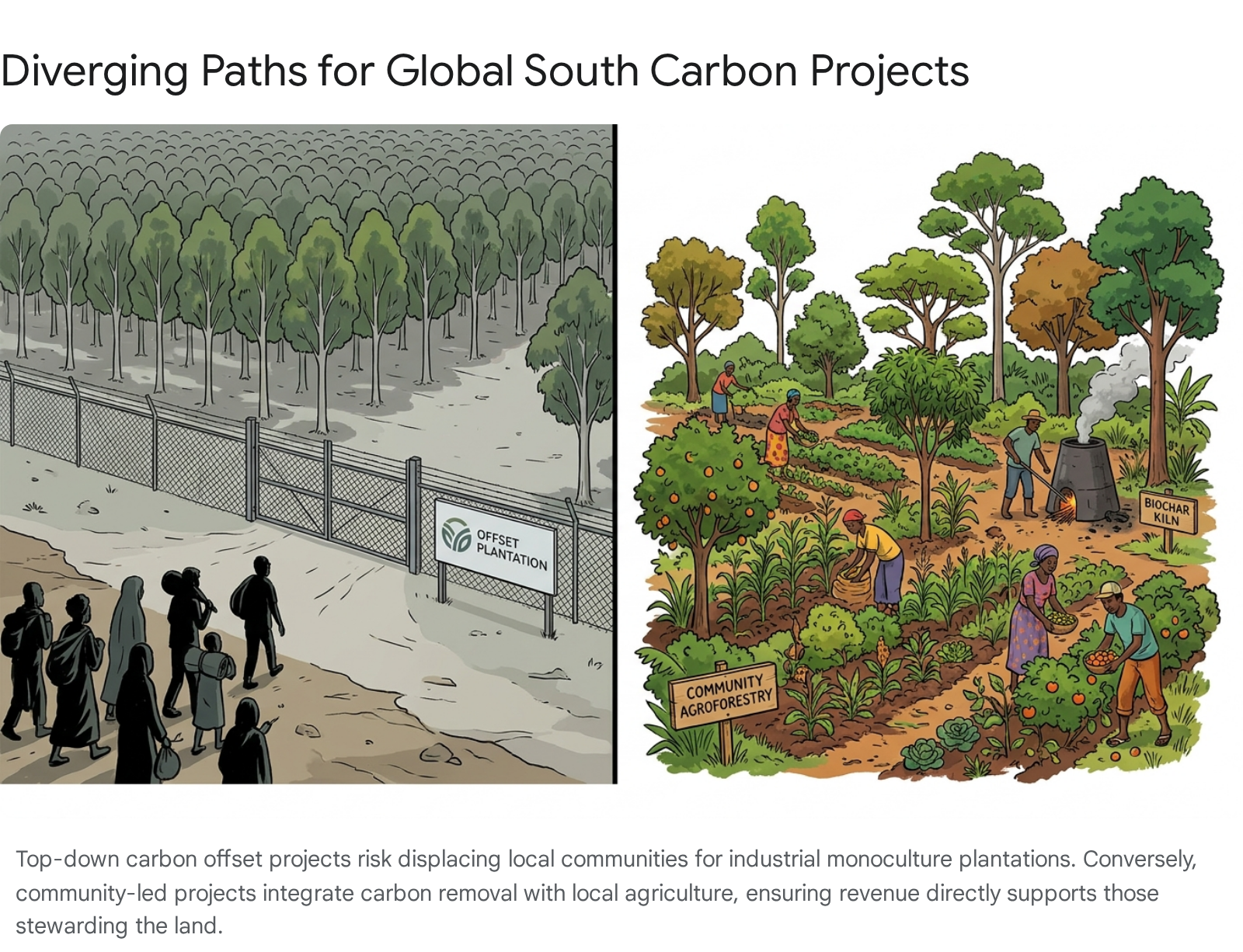
The socio-economic results are frequently devastating for the local populations. In regions with weak land governance systems, long-standing customary land rights are easily overridden by international contracts 27. The Land Matrix report explicitly notes the high risk to pastoralists, whose traditional grazing corridors and dry-season reserves are being fenced off by vast, inaccessible carbon projects 27. Communities face direct displacement, are restricted from ancestral lands, and are forced to travel much longer distances to farm or gather food 3627.
Furthermore, the financial inequities are stark. While major international carbon registries are expected to generate billions of dollars worth of carbon credits over the lifetime of these projects, investigations reveal a systemic opacity 3841. Only a minuscule fraction of that revenue ever trickles down to the marginalized communities actually hosting the projects, with the vast majority of profits captured by project developers, auditors, and corporate brokers in the Global North 41.
The Alternative: Community-Led Carbon Removal
The intense backlash against corporate land grabs has highlighted a crucial reality for the future of the industry: for carbon removal to scale responsibly and sustainably over the next two decades, it must economically integrate and uplift local populations rather than displacing them 362742.
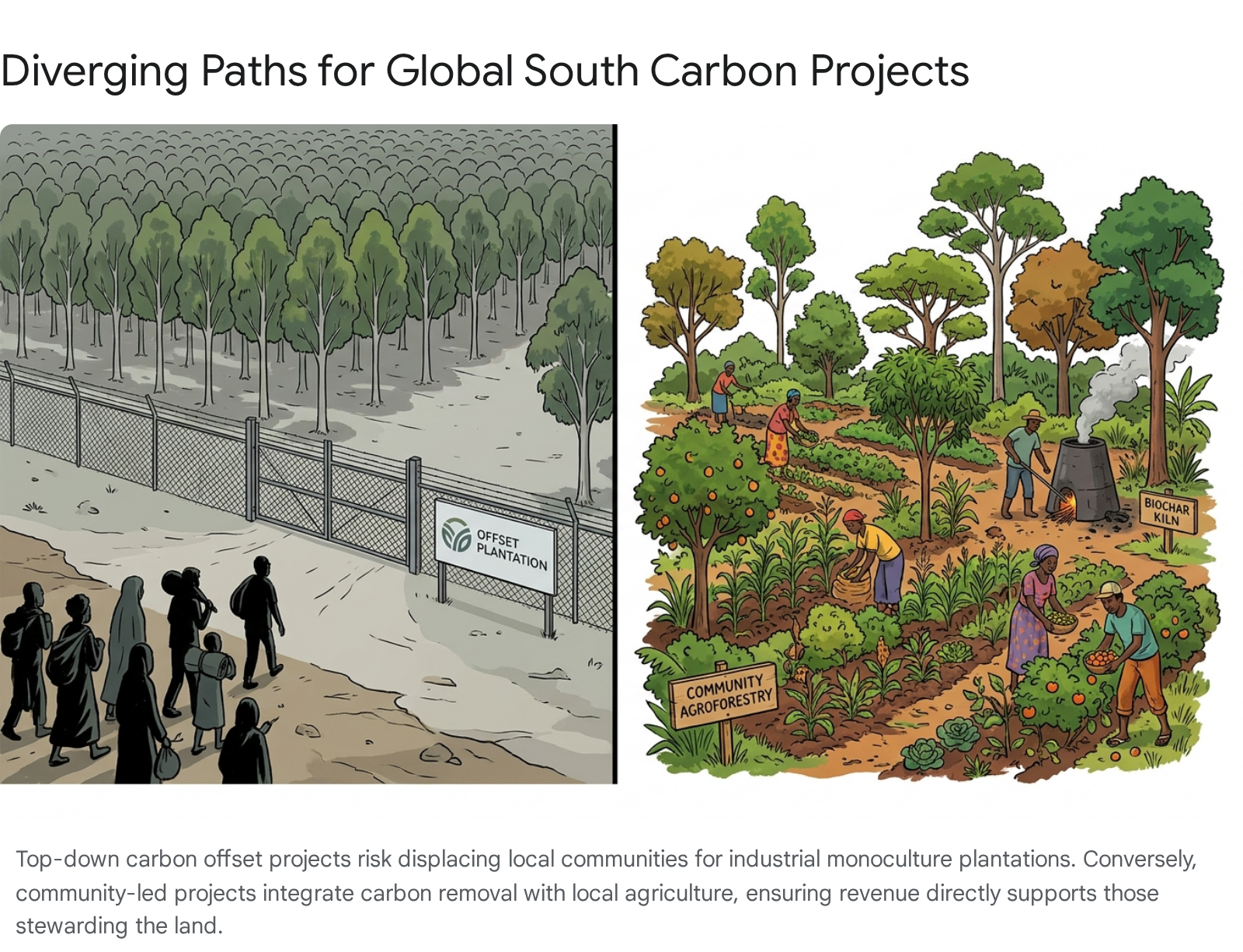
When projects are community-led, culturally aligned, and transparently funded, the outcomes demonstrate the massive potential of carbon finance. For example, data shows that forests managed directly by Indigenous people in the Amazon Biome operated as a massive, stable net carbon sink from 2001 to 2021, removing 340 million tons of CO2 annually - equivalent to the United Kingdom's yearly fossil fuel emissions 42. In contrast, forests outside these Indigenous lands became net carbon sources due to extensive, unmanaged deforestation 42. Recognizing this empirical success, ethical project developers are now intentionally designing high-integrity REDD+ projects that channel voluntary carbon market revenues directly to Indigenous and Afro-descendant communities in Colombia to fund health infrastructure, education, and territorial governance 42.
In Asia, innovative models are proving that engineered removals can also be community-centric. India-based developer Varaha recently secured $20 million in funding to scale affordable carbon removal - specifically biochar and enhanced rock weathering - by partnering directly with thousands of smallholder farmers across the Global South 43. Rather than buying land, the company pays farmers to adopt regenerative practices that enhance their own soil fertility while generating verified carbon credits, resulting in over 2 million tonnes of CO2 removed to date 43.
Similarly, in Nicaragua, community-focused reforestation initiatives are paying thousands of smallholder farmers directly to grow native tree species on underused portions of their land, generating long-term income while projected to remove 4 million tonnes of CO2 28. In Bangladesh, carbon finance is being used to subsidize the cost of the "Bondhu Chula" clean cookstove, massively reducing indoor air pollution for rural families while simultaneously cutting emissions and creating jobs for thousands of local entrepreneurs who manufacture the stoves 28.
Setting the Rules: The EU CRCF and Article 6
For years, the carbon removal industry operated in a regulatory wild west. The voluntary carbon market was plagued by fragmented standards, opaque methodologies, and widespread corporate greenwashing 1141. Moving into the late 2020s, governments and international bodies are actively stepping in to build robust, regulated frameworks that define exactly what counts as a legally recognized "removed" ton of carbon.
The EU Carbon Removal Certification Framework (CRCF)
In Europe, the political and legal debate surrounding carbon removals entered a mature, formalized phase with the official adoption of the Carbon Removal Certification Framework (CRCF) in late 2024 452930. Slated to roll out its first active certification methodologies in 2026 and launch a centralized EU registry by 2028, the CRCF is the world's first comprehensive, government-backed voluntary standard specifically governing permanent carbon removals, carbon farming, and carbon storage in long-lasting products 453132.
The framework establishes a strict, legally grounded baseline across the European bloc. It explicitly defines how a unit of removed carbon must adhere to four foundational quality principles: additionality (proving the removal would not have happened without the specific carbon finance), robust quantification, environmental sustainability, and, critically, long-term permanence 4532.
By setting these uncompromising standards, the CRCF will interact tightly with emerging European corporate reporting mandates, such as the Corporate Sustainability Reporting Directive (CSRD) 31. It effectively signals the end of an era where large corporations could lazily claim "net-zero" using cheap, short-lived, or low-quality forestry offsets, forcing a definitive market pivot toward verifiable, durable removals 114531.
The Global Blueprint: Article 6 of the Paris Agreement
On a global scale, the architecture for an international, state-regulated carbon market is finally coming online through Article 6 of the Paris Agreement. After nearly a decade of complex, often stalled negotiations, landmark decisions reached at recent UN Climate Change Conferences (including COP29 in Baku) have established the rigorous mechanisms required for nations to cooperatively trade carbon credits 3334.
Article 6 fundamentally alters the geopolitical landscape by allowing countries to buy and sell Internationally Transferred Mitigation Outcomes (ITMOs). Under Article 6.2, countries can forge decentralized, bilateral agreements to trade these credits 335335. Crucially, the framework mandates "corresponding adjustments" - meaning when a credit is sold, the emission reduction is transferred from the host country's national ledger to the buying country's ledger, ensuring that no double-counting occurs 3536.
We are already seeing the geographical hubs of this new digital carbon economy take shape. Singapore has rapidly positioned itself as a premier global carbon trading hub, aggressively pursuing and signing bilateral Implementation Agreements with a diverse array of nations across the Global South, including Ghana, Thailand, Papua New Guinea, Chile, and Peru 365637. For a developing nation like Ghana, these government-to-government partnerships provide a highly transparent, blockchain-tracked pipeline to monetize their natural resources, agroforestry, and clean energy projects, effectively channeling massive climate finance from advanced economies into domestic sustainable growth 5638. In early 2024, the market saw its first successful real-world test when Switzerland and Thailand completed the first-ever international transfer of Article 6.2 carbon credits for an electric bus program in Bangkok 3336.
Simultaneously, the UN is working to fully operationalize a centralized global carbon market under Article 6.4 (formerly known as the Sustainable Development Mechanism, now the Paris Agreement Crediting Mechanism), which will oversee private sector and national trading under strict UN Supervisory Body guidelines 333453. A major victory for environmental integrity occurred recently when global negotiators drew a hard line, maintaining that dubious "emission avoidance" credits do not qualify under the Article 6 mechanisms, ensuring that only tangible reductions and genuine, measurable removals can enter the new international registry 3353.
Funding the Gigaton Transition
Reaching gigaton scale by 2050 is not solely a scientific, logistical, or regulatory challenge; it is fundamentally a financial one. Estimates from major consulting firms suggest that delivering the required carbon removal capacity to meet mid-century net-zero targets will require between $6 trillion and $16 trillion in cumulative investment . Currently, the gap between the necessary investment trajectory and actual capital flowing into the sector is measured in the hundreds of billions of dollars .
Corporate advance market commitments have been the vital lifeblood for the nascent engineered removal sector. Multi-million dollar pledges by tech giants and coalitions - such as the World Economic Forum's First Movers Coalition, which aggregates companies committing to purchase $25 million worth of durable carbon removal by 2030 - have been crucial in getting costly startups off the ground and providing the revenue certainty required to secure project financing 92219.
However, voluntary corporate philanthropy and advance market commitments are vastly insufficient for planetary-scale industrial deployment. Bridging the multi-trillion-dollar gap requires a rapid shift from voluntary action to mandatory compliance markets 24. It will require massive federal procurement programs, subsidized government financing mechanisms, and robust, sustained innovation grants designed specifically to drag these technologies down the cost curve 91839. Furthermore, building this industry will require a massive mobilization of human capital; economic models suggest that removing 10 gigatons of CO2 annually could require a newly trained global workforce of up to 10 million people spanning construction, specialized engineering, heavy operations, and logistics 6.
Bottom line
To keep global temperature rise in check, humanity must scale carbon dioxide removal from millions of tons to billions of tons per year over the next two decades, effectively creating a new global waste-management industry from scratch. This unprecedented transition will require massive capital investment to drive down the exorbitant costs of technological methods like Direct Air Capture, while strictly protecting global land and water resources from exploitation. Crucially, carbon removal serves as a vital safety net that cannot replace the urgent need to slash fossil fuel emissions, nor should its deployment be achieved by dispossessing vulnerable communities in the Global South through carbon colonialism.