
How Ride-Hailing Surge Pricing Works
When demand outpaces the availability of drivers in a specific area, ride-hailing algorithms instantly raise fares to suppress rider demand and incentivize drivers to relocate to that zone. The price on your screen is calculated using a complex mix of real-time supply ratios, historical data, route complexity, and increasingly, predictive machine learning models that estimate a rider's personal willingness to pay.
The Mechanics of a Supply and Demand Crisis
At its core, surge pricing is a highly responsive form of dynamic pricing designed to solve a fundamental problem in transportation economics: the severe, localized mismatch between supply and demand. Without a mechanism to adjust prices, a high-demand event - such as a stadium concert letting out, a sudden rainstorm, or a transit strike - would result in wait times stretching into hours, or a complete lack of available vehicles 1234. Ride-hailing platforms like Uber, Lyft, Grab, and Didi Chuxing treat algorithmic pricing as the primary lever to restore equilibrium to the network 457.
When demand spikes, the algorithm acts as a market valve. Raising the price achieves two immediate goals. First, it temporarily suppresses demand by pricing out riders who are unwilling or unable to pay the premium, forcing them to wait for the surge to decay, walk to a different zone, or use public transit 2386. Second, it attracts supply by notifying idle drivers or those in adjacent neighborhoods that they can earn a premium by navigating into the high-demand area 341011.
This system operates on an incredibly granular spatial and temporal level. Ride-hailing engineers map cities into microscopic geographic cells, often utilizing specialized hexagonal spatial indexing grids 81213. Within each of these hexagons, the algorithm continuously calculates the ratio of riders opening the app to available drivers over a rolling time window 1214. If 300 people request a ride in a zone with only 100 available drivers, the system registers a 3:1 ratio and immediately initiates a price surge 10.
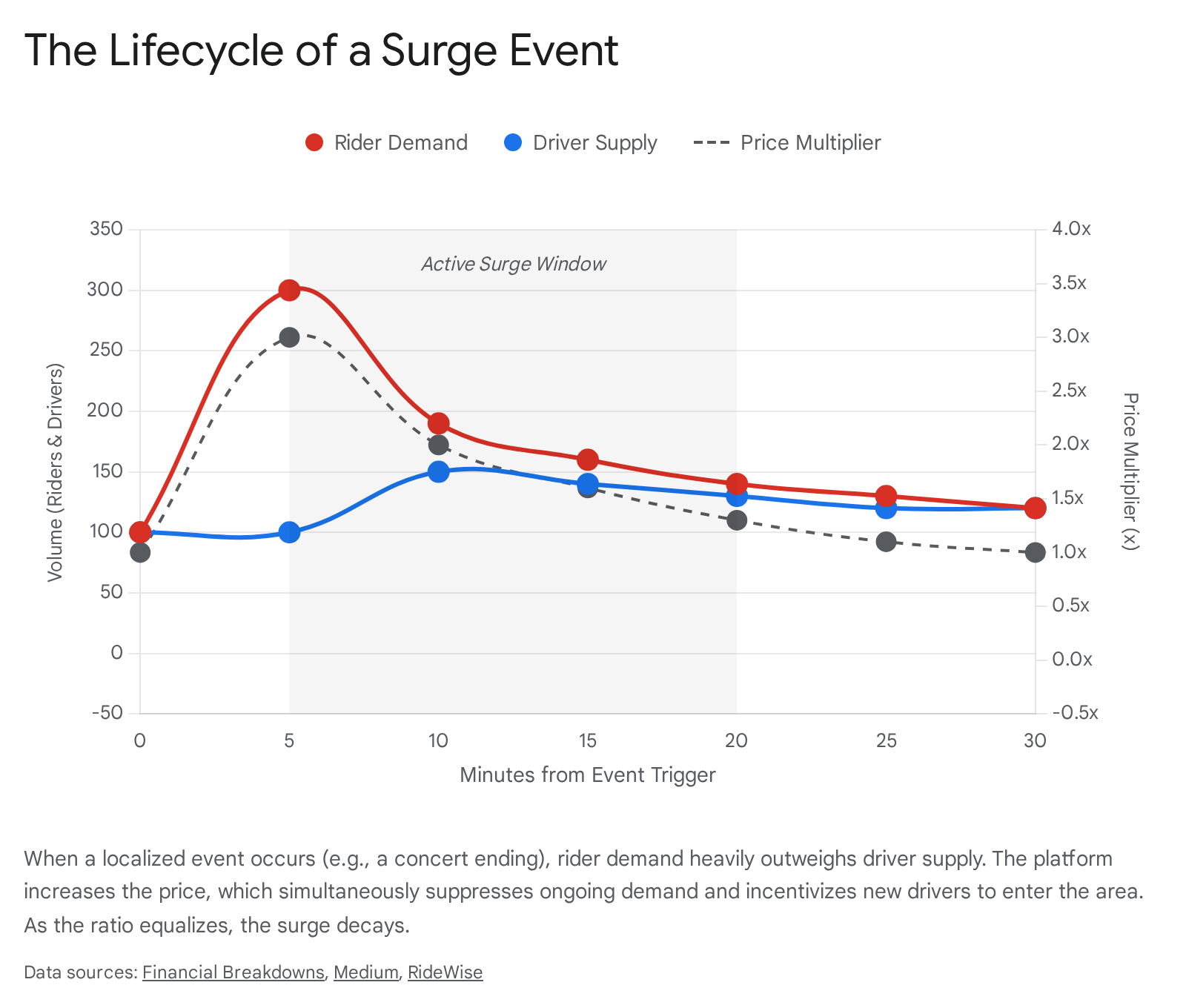
To execute these rapid calculations, platforms utilize event-streaming architectures, such as Apache Kafka, to process GPS pings, ride requests, and driver statuses in real time 7168.
The duration of these pricing events relies heavily on automated feedback loops. Once a surge multiplier goes live, the algorithm actively monitors the "conversion rate" - the percentage of users who proceed to book a ride versus those who abandon the app 12. If the app raises the fare to 3.0x the normal rate, and the algorithm detects that the conversion rate plummets from 70% to 30%, it will automatically step the surge down to a lower tier, such as 2.0x, to help the conversion rate recover 12.
Because drivers are highly mobile, these surges are often short-lived. In stable market conditions without an ongoing external trigger like a blizzard, up to 90% of localized surges fade within 15 minutes as supply arrives and demand cools 13. Historical data analysis has shown that aggressive dynamic pricing successfully clears queues; during peak surge events, wait times generally do not increase substantially, and market allocation happens efficiently 18.
From Basic Multipliers to Upfront Fares
If you used ride-hailing services in their early years, you likely remember having to explicitly type out or accept a "surge multiplier," such as 1.5x or 2.1x, before confirming a booking 2369. Today, that multiplier is largely invisible to the consumer. Instead, the app simply displays a single, unusually high upfront dollar amount.
This shift to upfront pricing represents a fundamental architectural change in how platforms manage marketplace logistics and driver behavior. Under the old multiplier model, the rider's fare and the driver's payout were inextricably linked. If a rider paid a 2.0x surge on a 10-mile trip, the driver earned 2.0x the standard distance and time rates, minus the platform's fixed percentage commission 39.
However, engineers realized this created perverse market incentives. Because the multiplier applied to both the time and distance of a trip, it encouraged drivers to reject short, necessary trips during a surge 9. Drivers would sit in a high-demand zone and decline quick rides, hoping to "lock in" the high multiplier on a long, lucrative trip to the suburbs 9.
Modern upfront pricing fully decouples what the rider pays from what the driver earns 9. The algorithm now makes two entirely separate calculations based on different data pipelines.
| Feature | The Old Multiplier Model | The Modern Upfront Pricing Model |
|---|---|---|
| Rider Experience | Rider sees a multiple (e.g., 2.5x) applied to base time and distance rates. | Rider sees a flat, guaranteed dollar price for the trip upfront. |
| Driver Payout | Driver receives the exact multiplied fare, minus a fixed commission fee. | Driver receives an "additive surge" (a flat dollar bonus, e.g., +$5.00) regardless of trip length. |
| Platform Take-Rate | Fixed percentage (traditionally 20% to 25%). | Variable. The platform captures the spread between the rider's upfront fee and the driver's algorithmic pay. |
| Incentive Alignment | Drivers cherry-pick long rides during surges to maximize multiplier payouts. | Flat additive bonuses encourage drivers to accept short trips, clearing localized crowd demand faster. |
To solve the cherry-picking problem, platforms introduced "additive surge" pricing for the supply side. Instead of multiplying a fare, the platform offers drivers a flat dollar bonus (for example, +$4.50) added to their base pay for completing any ride originating in a hot zone 9. This completely realigns the driver's incentive with the platform's goal of clearing the queue: the fastest way to make money is to accept the shortest possible trips within the surge zone, drop the passenger off, and return for another flat bonus 9. Furthermore, the algorithm now factors in the forecasted demand at the rider's destination, financially incentivizing drivers to accept trips that will terminate in upcoming hot zones 9.
The Hidden Mathematics of Your Fare
Behind the upfront price is an intricate web of variables. A standard fare is fundamentally constructed from a base rate, a per-minute rate, a per-mile rate, and regulatory booking fees 313. However, the dynamic surge premium layered on top of this base relies on deep learning architectures capable of processing massive spatiotemporal datasets.
Academic studies analyzing millions of ride-hailing data points have consistently shown that traditional linear regression models are insufficient for capturing the non-linear realities of urban traffic. Instead, platforms and researchers deploy advanced machine learning techniques, such as Gradient Boosting Regressors, Random Forests, and Convolutional Neural Networks combined with Long Short-Term Memory (CNN-biLSTM) models 1420211023. These models systematically weigh several core features to set the final price:
- Route Complexity and Friction: While distance is the most obvious predictor of price, feature importance analyses reveal that route complexity - often measured by the number of intersections crossed - is a primary driver of fare determination. Intersections act as a proxy for urban congestion, physical driving effort, and time delay 4.
- Spatiotemporal Context: Machine learning models heavily weight the hour of the day, the day of the week, and holiday schedules. Demand features high periodicity, with distinct peaks during morning and evening commutes, and late-night weekend hours 212425.
- Environmental Factors: Algorithms ingest real-time weather indices, including temperature, rainfall volume, and even air quality metrics like PM2.5 levels. Heavy rain simultaneously spikes rider demand (people seeking shelter) and depresses driver supply (drivers avoiding hazardous conditions), triggering aggressive price scaling 1122426.
- Predictive Surging: Modern platforms do not wait for a supply crisis to occur. By training algorithms on historical event data, apps can predict demand minutes or hours ahead of time 1216. If the system knows a major football game is ending at 10:00 PM based on past identical events, it will begin surging prices and pinging drivers in the vicinity at 9:45 PM, preemptively balancing the network 12168.
How Driver Behavior Influences the Algorithm
The effectiveness of these pricing algorithms relies entirely on the assumption that drivers will respond rationally to price signals. However, labor supply in the gig economy is highly elastic and influenced by complex human factors. Ride-hailing drivers are technically independent contractors who frequently "multi-home," meaning they run competitor apps (like Uber and Lyft) simultaneously and choose the platform offering the best immediate payout 2611.
Researchers analyzing driver behavior have identified specific trip features that dictate whether a driver will accept or reject a ride request. First, pick-up time is critical; drivers are significantly less likely to accept requests that require long, unpaid travel to the passenger's origin 12. Second, higher passenger ratings and the presence of a surge price strongly increase the probability of acceptance 12. Conversely, drivers frequently reject shared or pooled rides, as the minor efficiency gains are often offset by route deviations and passenger conflicts 12.
When algorithms accurately incorporate surge factors, they drastically improve allocative efficiency. A study utilizing structural analyses based on machine-learning demand predictions found that providing accurate surge price information reduced drivers' vacant roaming times by over 9% and increased the average number of completed trips per taxi 29. The ultimate goal of the pricing engine is to eliminate "deadheading" - driving an empty vehicle without a paying passenger 8.
The "Battery Level" Myth Versus Surveillance Pricing
Because algorithmic pricing operates as a proprietary black box, it has become a fertile ground for consumer suspicion. The most persistent urban legend regarding ride-hailing is that platforms access your smartphone's battery level and automatically charge you higher surge prices if your phone is about to die, exploiting your desperation to get home 11133114.
The companies involved have consistently and vehemently denied this claim. Official statements from Uber explicitly note that the platform "does not take into account the phone's battery level to calculate the price of a trip," maintaining that pricing is strictly a function of network supply and demand 131433.
The myth originated from a 2016 interview with Keith Chen, Uber's former head of economic research. Chen shared an internal observation regarding human behavior: users whose smartphone batteries were critically low were mathematically more likely to tolerate and accept high surge prices rather than wait 15 minutes for the surge to decay 311433. He explicitly clarified that the company did not use this data to push higher prices, but rather found it an interesting psychological correlation 1433. Subsequent independent tests by journalists attempting to prove the battery-pricing link have yielded mixed results, often failing to control for the fact that two phones repeatedly querying the same route simultaneously can artificially register as a spike in localized demand, triggering a micro-surge 133334.
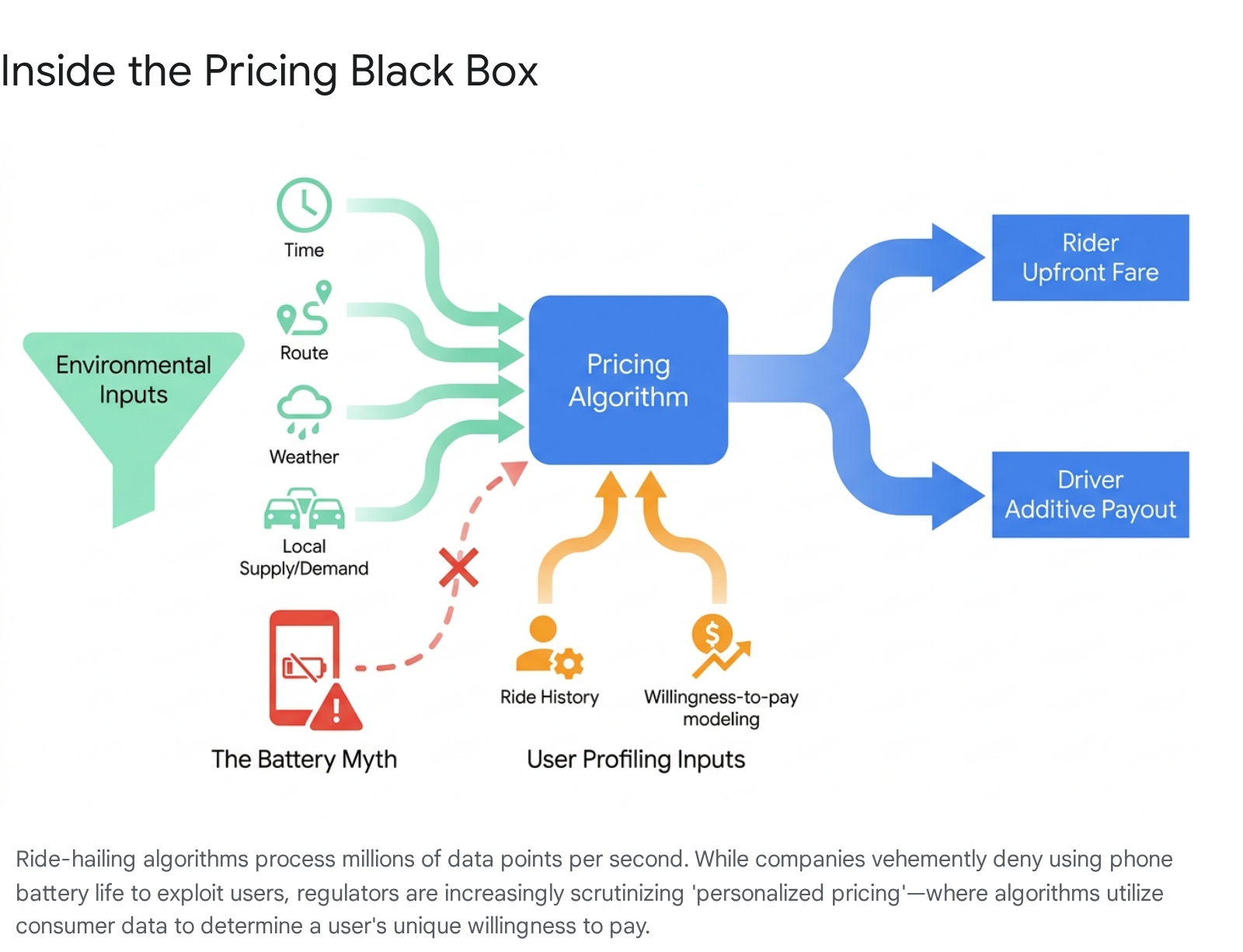
However, focusing on the battery myth distracts from a far more consequential evolution in the digital economy: the shift toward personalized pricing.
Traditionally, dynamic pricing was purely segment-based. If a surge hit 2.0x outside a stadium, every consumer standing on that block saw the same 2.0x multiplier regardless of their income or ride history 1536. Today, propelled by the massive processing capabilities of artificial intelligence, platforms across digital commerce are moving toward highly granular, individualized pricing based on a user's unique "willingness to pay" (WTP) 151617.
This involves processing vast amounts of consumer data - including past ride history, device type, destination demographics, and behavioral triggers - to construct a latent profile of price sensitivity 1415161739. The algorithm acts as an automated auctioneer, matching riders not just based on distance, but on the maximum threshold they are willing to bear 18.
The economic implications are significant. Academic modeling of personalized pricing in ride-hailing indicates that while it increases total market matching efficiency and significantly boosts platform profits, it lowers overall consumer surplus 16. In other words, consumers pay closer to their absolute maximum limit, leaving less value on the table for the rider.
This mechanism is increasingly drawing regulatory fire. In 2024, the U.S. Federal Trade Commission (FTC) launched a sweeping inquiry into what it terms "surveillance pricing," investigating how intermediaries track granular digital signals to implement opaque, individualized price discrimination 1415. Furthermore, studies show that AI-driven personalized pricing frequently triggers consumer distrust; survey data indicates that a majority of users view individualized pricing based on tracking data as fundamentally unfair 1539.
Where Does the Extra Money Go? The Squeeze on Drivers
When you pay $60 for a ride that usually costs $20, it is natural to assume your driver is having a highly lucrative shift. In the modern era of upfront pricing, this assumption is frequently incorrect.
Because algorithms now calculate the rider's fare and the driver's additive bonus entirely separately, the platform's "take-rate" - the commission it captures - has become highly variable and often asymmetrical 91920.
According to a major study published in 2025 by researchers at the University of Oxford's Department of Computer Science, in collaboration with the Worker Info Exchange (WIE), the introduction of advanced dynamic pricing algorithms has created a widening financial gap between the two sides of the market 192043. The researchers analyzed over 1.5 million trips from UK Uber drivers spanning several years. The data revealed a stark shift after dynamic upfront pricing algorithms were fully deployed in 2023: passengers began paying more per trip, but drivers' overall earnings declined 192043.
The Oxford study demonstrated that algorithmic take-rates are heavily concentrated on higher-fare trips. As the total value of the trip surges, the platform captures a larger percentage of the premium, resulting in drivers earning less per minute on expensive rides than they did under a fixed-commission structure 19. In extreme cases during peak demand, the platform retained over 50% of the total fare value 1943. Adjusted for inflation, the study found that average driver hourly income had fallen from over £22 to just over £19 before accounting for vehicle operating costs, while the time spent waiting unpaid between rides increased 19.
The compounding effect of rising fares and stagnant wages is beginning to impact consumer demand. Data analytics firm Gridwise reported that the median price of a US ride-hailing trip rose nearly 10% between late 2024 and 2025 2122. Concurrently, consumer surveys indicated that over 60% of riders were intentionally reducing their use of ride-hailing apps due to cost fatigue 2122. While the major platforms continue to post robust revenues by expanding into suburban markets and optimizing delivery logistics, the core urban ride-hailing model is testing the limits of consumer price elasticity 22.
The Industry Backlash and Zero-Commission Alternatives
The friction generated by variable algorithmic pay has sparked intense labor disputes worldwide, creating an opening for competitive disruption. Recognizing widespread driver dissatisfaction with opaque deductions, rival platforms are experimenting with entirely different revenue paradigms to secure labor supply.
In the highly competitive Indian market, ride-hailing giant Ola executed a massive structural pivot in mid-2025 by abandoning the traditional commission-based model entirely 232448. Rather than taking a 20% to 30% variable cut of every ride, Ola transitioned to a Software-as-a-Service (SaaS) subscription model 2348. Drivers are now required to pay a flat daily or monthly access fee - such as Rs 67 per day, or roughly Rs 2,010 per month - to use the dispatch network 2325.
| Global Operator | Primary Pricing & Commission Strategy | Regional Focus |
|---|---|---|
| Uber | Variable algorithmic take-rate; completely decoupled rider fares and driver additive bonuses. | North America, Europe, Global |
| Lyft | Variable algorithmic take-rate, utilizing continuous reinforcement learning to A/B test pricing resilience. | North America |
| Didi Chuxing | Commission capped at a maximum of 27% following intense regulatory pressure regarding transparency. | China, Latin America |
| Ola / Rapido | Zero-commission SaaS model. Drivers pay a flat subscription fee and retain 100% of all fares and surges. | India |
Under this zero-commission structure, the driver retains 100% of the fare directly from the passenger, without any limits on ride volume or income 232426. Crucially, this means that if a rider pays a heavy surge premium, the driver captures the entirety of that financial upside. While the driver assumes the risk of the upfront subscription cost, this model completely bypasses the black box of algorithmic wage-setting, ensuring that periods of high demand translate directly to higher driver take-home pay 4825. The move by Ola follows a similar SaaS strategy pioneered by its competitor Rapido, forcing legacy platforms to reconsider how they balance corporate margins against driver retention 24.
The Algorithm Under the Law
The disparity between consumer prices, individualized profiling, and algorithmic wage deductions has escalated beyond academic debate and corporate strategy; it is now the subject of sweeping international legal action. Ride-hailing pricing systems are facing an unprecedented wave of regulatory scrutiny aimed directly at dismantling the algorithmic black box.
In late 2025, the non-profit foundation Worker Info Exchange (WIE) served Uber with a formal legal demand, laying the groundwork for a collective action lawsuit in the Amsterdam District Court 20432728. The lawsuit alleges that the company's dynamic pay systems fundamentally violate the European Union's General Data Protection Regulation (GDPR) 204328. The plaintiffs argue that the platform unlawfully utilizes automated decision-making and profiles drivers' historical personal data to dynamically suppress their real-time pay 2043. Furthermore, the suit alleges unlawful transfers of driver data between Europe and the United States to train these pricing models without meaningful consent 4328. The WIE is demanding that the platform halt the use of AI-driven pay systems, compensate drivers for lost wages, and return to transparent, human-auditable pay structures 2043.
Simultaneously, the broader European regulatory landscape is rewriting the rules of code-driven commerce. The EU Artificial Intelligence Act, the world's first comprehensive legal framework on artificial intelligence, formally entered into force in August 2024 532930. While the regulation utilizes a staggered rollout, the core transparency obligations - embedded within Article 50 - become fully applicable by August 2026, with the strictest rules for high-risk systems following in 2027 53295657.
Crucially, the AI Act is operating in tandem with the EU's Platform Work Directive, which targets the gig economy directly. Slated for national transposition by December 2026, the Directive establishes strict new guardrails for algorithmic management 27. It requires that automated systems impacting digital labor be continuously monitored by qualified human staff, effectively banning purely automated decisions that carry significant economic consequences for workers 27. It also grants workers the explicit right to contest algorithmic decisions, forcing platforms to explain exactly how mathematical deductions were applied to specific jobs 2731.
If courts and regulators enforce these mandates rigorously, the fundamental architecture of surge pricing will have to change. Platforms will no longer be able to obscure the variable spread between what a rider pays and what a driver earns behind a wall of proprietary machine learning. Instead, they will be forced to mathematically justify how a specific surge price was calculated, what consumer data was utilized to gauge willingness-to-pay, and precisely how the resulting revenue was distributed 362731.
Bottom line
When a ride-hailing screen lights up with a surge warning, it reflects an intricate, real-time calculation weighing thousands of variables designed to balance localized supply against an influx of demand. While companies consistently deny using crude metrics like phone battery life to exploit desperation, the evolution toward upfront, personalized pricing indicates that machine learning models are increasingly tailoring fares based on behavioral profiling and willingness-to-pay. Furthermore, as platforms capture increasingly wider margins of these surges through decoupled pricing, intense driver pushback and aggressive new data privacy laws are poised to force unprecedented transparency onto the algorithmic black box.