
How a Negotiation Unfolds Move by Move
Negotiation is a structured sequence of information exchange, psychological signaling, and value creation governed by both rational game theory and human emotion. By mapping alternatives before bargaining, strategically anchoring initial offers, and utilizing decreasing concessions, individuals can systematically navigate conflict to secure durable agreements.
The Underlying Game: Rationality vs. Emotion
To understand the architecture of a negotiation, one must first look at the mathematical and psychological models that define how humans make decisions. Early economic theories assumed that humans operate as Homo economicus - perfectly rational actors who always make choices to maximize their own financial utility 12. However, modern behavioral economics has proven that negotiation is far messier, driven as much by perceptions of fairness, ego, and trust as by hard numbers.
The Ultimatum Game and the Limits of Logic
The tension between rational math and human emotion is perfectly captured by the "Ultimatum Game," an experiment first introduced by economists Werner Güth, Rolf Schmittberger, and Bernd Schwarze in 1982 123.
In this sequential bargaining game, two players must divide a set sum of money. The "proposer" makes a single, take-it-or-leave-it offer. The "responder" can either accept the split, in which case both get the money, or reject it, in which case both get nothing 13.
According to traditional game theory and the concept of the Nash Equilibrium - a state where no player can improve their outcome by unilaterally changing their strategy - the rational move for the proposer is to offer the absolute smallest amount possible (e.g., $1 out of $100) 234. The rational move for the responder is to accept it, because $1 is objectively better than $0 45.
In the real world, this almost never happens. Decades of studies show that proposers typically offer 30% to 50% of the total, and responders routinely reject offers below 20% 1. Neuroscientific research using fMRI scans reveals that when a responder receives an insulting offer, the anterior insula - a brain region associated with negative emotions like disgust - lights up 2. The responder chooses to sacrifice their own financial gain simply to punish the proposer for a perceived lack of fairness 12.
This dynamic is the invisible current running beneath every negotiation, from corporate mergers to salary discussions. An understanding of the Ultimatum Game could have potentially prevented disastrous real-world stalemates, such as the 1998 General Motors strike in Flint, Michigan, where perceived unfairness led to massive economic losses 2. If one party feels exploited, they will walk away from a deal that is mathematically in their favor just to exact a psychological toll.
Game Theory in Everyday Negotiation
The mechanics of negotiation are essentially real-world applications of game theory. Beyond the Ultimatum Game, negotiations often resemble a "Prisoner's Dilemma" or a coordination game 6.
When two competing companies (like Pepsi and Coca-Cola) negotiate their advertising budgets or pricing strategies, they are operating within a Nash Equilibrium framework 7. If both companies aggressively advertise, they spend millions only to maintain their existing market share 78. If neither advertises, they save money and keep the same market share. However, because neither can trust the other to abstain, the equilibrium dictates that both must spend heavily to avoid losing ground 78. Negotiators face similar dilemmas when deciding whether to cooperate or compete at the bargaining table.
Foundational Mindsets: Distributive vs. Integrative
Because negotiation involves both tangible resources and intangible emotions, experts categorize the process into two primary frameworks: distributive and integrative bargaining 56.
Distributive negotiation assumes a fixed pie. It is a zero-sum contest where every dollar gained by one side is a dollar lost by the other. Information is hoarded, and the relationship is secondary to the immediate win 57. This approach is often necessary for one-off transactional deals, such as buying a used car from a stranger or participating in a highly competitive procurement tender 57.
Integrative negotiation, famously popularized by the Harvard Negotiation Project as "principled negotiation" or "win-win," assumes the pie can be expanded. It focuses on underlying interests rather than stated positions. By sharing selective information, parties can uncover creative tradeoffs - giving up something they value less in exchange for something they value more 56. Trust is both a prerequisite and a byproduct of this approach 5.
| Feature | Distributive Negotiation | Integrative Negotiation |
|---|---|---|
| Core Assumption | The pie is fixed (Zero-sum / Win-Lose) | The pie can be expanded (Win-Win) |
| Primary Goal | Claim as much value as possible | Create value, then claim a fair share |
| Information Strategy | Conceal data to protect leverage | Share information to uncover interests |
| Focus | Stated positions (What they want) | Underlying interests (Why they want it) |
| Relationship | Short-term or non-existent | Long-term and ongoing |
| Ideal Use Case | One-off commodity purchases 7 | Complex partnerships, salary talks 5 |
Debunking Negotiation Myths
While the "win-win" integrative approach is generally superior for complex business, a common myth is that negotiation is always about compromise, or that "winning" means making the other side lose 1314.
Another pervasive myth is that pursuing a "win-win" is risk-free. In reality, a pure win-win mentality can sometimes cause inexperienced negotiators to concede too much early on, revealing sensitive information that a distributive opponent might exploit 14. Skilled negotiators understand that every interaction requires a fluid hybrid approach: creating value collaboratively (integrative) before eventually dividing the resources (distributive) 715.
Move 1: The Preparation Phase
Amateur negotiators believe the game begins when they sit down at the table. Experts know the game is often won or lost before a single word is spoken. The Harvard Negotiation Project outlines seven critical elements that must be mapped out during preparation: Interests, Alternatives, Options, Legitimacy, Communication, Relationship, and Commitment 16818199.
Interests vs. Positions
A position is what a party wants; an interest is why they want it 8. For example, an employee's position might be demanding a 15% salary increase. Their underlying interest, however, might be financial security, status, or paying for an impending medical expense 819. When negotiators fixate on positions, they quickly reach impasses. By asking open-ended questions to uncover interests, parties can invent new options - such as offering additional paid time off, flexible working hours, or a performance bonus in lieu of a flat salary bump 8.
Defining BATNA and ZOPA
The two most critical acronyms in negotiation architecture are BATNA and ZOPA.
Your BATNA (Best Alternative to a Negotiated Agreement) is your ideal course of action if the current talks collapse 81022. It is your fallback plan. If you are negotiating a salary for a new job, your BATNA might be staying at your current job or accepting a competing offer 2223. The strength of your BATNA dictates your leverage; a strong alternative gives you the psychological safety to walk away, which prevents you from accepting a sub-optimal deal 2425. Consequently, your BATNA defines your walkaway point - the absolute minimum threshold you will accept before pulling the plug 1011.
The ZOPA (Zone of Possible Agreement) is the overlapping area between the buyer's walkaway point and the seller's walkaway point 102211. The ZOPA exists only when the buyer's maximum threshold is higher than the seller's minimum requirement. If these walkaway points do not overlap, no durable agreement can be reached.
For example, imagine a corporate buyer wants to acquire a software startup. The buyer has a BATNA of building the software internally for $20 million, meaning their absolute maximum offer (walkaway point) is $20 million 11. The startup's founders have a BATNA of selling to a competitor for $15 million, meaning their absolute minimum acceptable price is $15 million. The ZOPA is between $15 million and $20 million. Any number inside this zone is mathematically viable for both parties 2211.
Legitimacy and Stretch Goals
To defend a position within the ZOPA, negotiators must rely on legitimacy - objective standards of fairness, such as market value, independent appraisals, or industry precedents 819.
Furthermore, while the BATNA protects you from a bad deal, a stretch goal aims you toward a great one 1012. Research into cognitive framing suggests that negotiators who focus primarily on their walkaway points end up with less favorable deals because they anchor themselves to the bare minimum. Those who map out an optimistic, best-case scenario stretch goal tend to claim more value 1012.
Move 2: The Opening Offer and the Anchoring Effect
Once preparation is complete, the parties sit down (or log on), and the first tactical dilemma arises: Who should make the first offer?
For decades, conventional wisdom warned against speaking first. The logic was that putting a number on the table revealed too much information and risked leaving money on the table if the other side was secretly willing to pay much more 1314.
However, behavioral science has largely overturned this absolute rule. The decision to move first is governed by a cognitive bias known as the anchoring effect, originally identified in the 1970s by psychologists Amos Tversky and Daniel Kahneman 1314.
The Power of the Anchor
Tversky and Kahneman demonstrated that human judgment is disproportionately influenced by the first piece of numeric information introduced into a conversation, even if that number is arbitrary 1315. In a negotiation, the first offer acts as a gravitational force, pulling all subsequent counteroffers toward it. By making the first offer, you effectively define the playing field and frame what feels "reasonable" to the opposition 131415.
A highly anticipated 2025 meta-analysis led by Professor Hannes M. Petrowsky at Leuphana University reviewed 90 previous studies on first offers. The research confirmed that making an ambitious first offer reliably leads to significant economic gains for the offer-maker .
The Risk of Impasse
Despite the economic advantage of anchoring, going first is not without peril. Petrowsky's 2025 study painted a nuanced picture, revealing that ambitious first offers significantly increase the odds of a negotiation ending in a complete impasse . Furthermore, when one party drops an extreme anchor, the counterpart often reports lower satisfaction with the final agreement and increased feelings of anxiety 14.
If you are engaged in a simple, one-off transaction where the relationship does not matter, an aggressive anchor is highly effective . But if you are negotiating a complex, multi-issue partnership where long-term trust is paramount, an extreme first offer can damage rapport and trigger defensive reactions.
The "Information Asymmetry" Rule
So when should you hold back? The decision ultimately depends on information asymmetry 1316.
If you have a strong understanding of the market value, objective standards, and the probable ZOPA, you should confidently make the first offer to seize control of the negotiation 1314. However, if the other side possesses vastly more information about the market or the asset - such as a corporate recruiter who knows the exact budget for a role, while the candidate is guessing - it is strategically wiser to let the informed party speak first to avoid inadvertently underbidding your own value 1315.
Move 3: The Concession Dance and Information Exchange
Following the opening anchor, the negotiation enters the bargaining phase. This middle stage is characterized by a delicate exchange of private information and a highly ritualized "concession dance."
Navigating Information Asymmetry
In game theory, information asymmetry occurs when one party possesses better or more data than the other, often leading to market failures or imbalances in power 1617. In a negotiation, each side holds private information about their true walkaway point, their constraints, and their underlying interests.
A common myth is that you should always hide your information to maintain leverage 34. But concealing all data limits the negotiation to a purely distributive, zero-sum fight 34. To transition to integrative, win-win bargaining, parties must share information to discover trade-offs. Game-theoretical models, such as those analyzing Stackelberg games in purchasing and supply management, demonstrate that strategically dismantling information asymmetry can lead to optimized product costs for both buyers and suppliers 1735. Further research shows that even revealing sensitive information, like the cost of searching for outside options, can sometimes mathematically benefit a buyer 36.
However, sharing information carries real risks. Research suggests a strategy of selective disclosure: negotiators should openly share their interests and priorities (e.g., "A fast delivery timeline is critical to us"), while closely guarding their power and walkaway limits 18.
The Danger of Deception
The temptation to actively deceive the counterpart - through lies of commission (fabrication) or omission (withholding) - is high. A study by Mara Olekalns and colleagues on gender dynamics in negotiation found that deception strategies vary based on trust and strategy; for instance, competitive directives led to more sins of omission 18.
Yet, a 2022 study by Rutgers University researcher Alex Van Zant found that while lying might occasionally yield short-term financial gains, it incurs heavy psychological and relational costs 19. Sellers who successfully lied in simulations reported high levels of guilt, lower overall satisfaction with the deal, and a strong reluctance to ever negotiate with that partner again 19. Furthermore, research into supplier negotiations indicates that lying is contagious; an initial lie often breeds "concealment lies" and spreads toxic behavior throughout organizational networks 39.
Tactical Empathy and Defusing Conflict
When trading information, conflict is inevitable. The Harvard model advises negotiators to "separate the person from the problem" and redirect hostile energy through "negotiation jujitsu" 4020. If a counterpart attacks your position, you do not counterattack; you ask clarifying questions to uncover the interest behind their aggression 20.
This aligns with the methodology of former FBI hostage negotiator Chris Voss, who advocates for "tactical empathy." Voss argues that negotiation is an emotional exercise, not a purely rational one 3442. By using techniques like "labeling" (e.g., "It sounds like you are under immense pressure to hit this quarter's targets"), negotiators can defuse defensiveness, making the counterpart feel heard and opening the door to logical problem-solving 4221.
The Mechanics of the Concession
As parties trade value, they make concessions. How these concessions are structured sends a powerful mathematical signal to the other side.
Research published in 2021 by Kian Siong Tey and colleagues explored the psychological impact of decreasing concessions 222324. Imagine a buyer making a series of offers: * Constant Concessions: Concedes by $100 in every round. * Decreasing Concessions: Concedes by $300, then $100, then $30, then $10.
The 2021 study demonstrated that decreasing concessions effectively signals to the recipient that the offer-maker is exhausting their flexibility and approaching their absolute limit 222447.
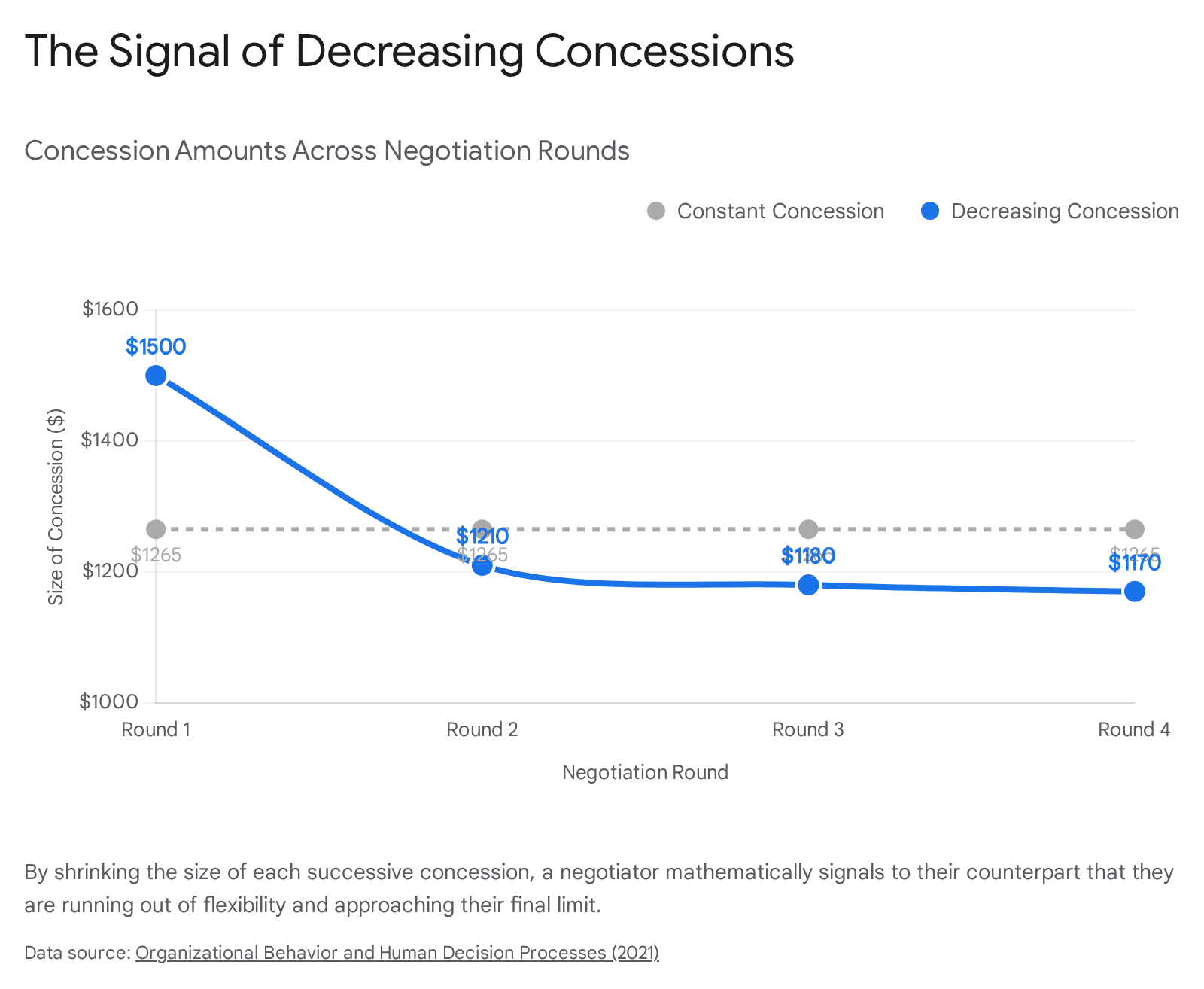
When a counterpart sees the concessions shrinking toward zero, they subconsciously adjust their expectations downward, resulting in them making less ambitious counteroffers and ultimately accepting a deal more favorable to the offer-maker 222348.
In contrast, if a negotiator saves a massive concession for the very end, it signals that they were holding back all along, which can destroy trust and invite the counterpart to push for even more 47.
The New Playing Field: Digital vs. Face-to-Face
The mechanics of the concession dance are further complicated by the medium through which the negotiation occurs. With the rise of remote and hybrid work models worldwide, negotiations increasingly happen via email, Zoom, or Slack rather than across a boardroom table 495025.
Research into the efficacy of digital versus face-to-face (F2F) negotiations reveals a complex landscape with conflicting data. A notable meta-study by Stuhlmacher and Citera found that F2F negotiations generally yielded higher economic profits than electronic media 26. Conversely, other researchers, such as Galin and colleagues, found that the medium had virtually no impact on the final economic outcomes, such as the final price or payment terms 27.
What is definitively altered by digital communication is the process and behavior of the negotiators 5027.
The Psychology of Screen-Based Bargaining
- Hostility and Ethics: Studies consistently show that electronic negotiations are more prone to hostile behavior, competitive posturing, and unethical tactics (such as misrepresentation) compared to F2F interactions 2628. Physical distance lowers empathy and accountability 49.
- Relationship Conflict: In simulations, negotiators relying on virtual channels experienced significantly higher relationship conflict and perceived lower levels of interpersonal fairness than those negotiating in person 26.
- Flexibility vs. Rapport: While email allows for asynchronous communication - giving parties time to consult data and craft careful responses - it strips away the non-verbal cues required to build rapport and trust 505556.
For simple, highly distributive transactions, email can minimize cultural friction and streamline the process 56. But for complex, multi-party integrative negotiations requiring creative problem-solving, experts advise prioritizing F2F or rich-media environments (like video calls) to establish the necessary trust 495057.
Move 4: Closing the Deal
As the ZOPA narrows and concessions dwindle, the negotiation enters the final phase: the close. Paradoxically, this is where many negotiations fail. Research suggests that up to 24% of negotiations collapse even when a mutually beneficial ZOPA exists, often due to overconfidence, unresolved minor issues, or a simple reluctance to commit 2959.
Closing a deal requires a psychological transition from expansive problem-solving to firm commitment 818. Several strategic moves facilitate this shift:
- Set Benchmarks and Deadlines: Deadlines force action. While people often fear deadlines will give the other side leverage, research by UC Berkeley professor Don A. Moore shows that deadlines generally motivate both sides equally. They force negotiators to abandon endless posturing and address the actual parameters of the deal 29.
- The "Shut-Down" Move: If talks are dragging due to a counterpart shopping your offer around, proposing a limited exclusive negotiating period can cut out external competition and force focus 29.
- Provide Options: Presenting a counterpart with two distinct but equally acceptable variations of a final deal allows them to exercise autonomy. Once they commit to their choice, the negotiation effectively concludes 60.
- Assume the Close: By summarizing the agreed-upon points and actively addressing one final, minor logistical detail (e.g., "If we can just agree on a Tuesday delivery, we can get this paperwork signed"), you signal that the substantive bargaining is over 6061.
Ultimately, the most powerful closing tactic is the willingness to walk away 1229. If the final numbers fall outside your BATNA-defined walkaway point, or if the counterpart attempts a bad-faith "nibble" (demanding an extra concession at the very last second), genuine readiness to end the discussion protects your bottom line 101260.
Bottom line
Negotiation is a structured game of psychological signaling, information management, and value exchange. Success relies heavily on rigorous preparation - specifically defining your walkaway alternatives (BATNA) and stretching toward ambitious goals. While making the first offer grants a mathematical anchoring advantage, it carries the risk of impasse if executed blindly. Navigating to a successful close requires moving past zero-sum hostility, utilizing tactical empathy to uncover true interests, and carefully shrinking concessions to signal your limits without destroying the relationship.