
How to Negotiate Your Salary According to Research
Research consistently demonstrates that negotiating a starting salary increases initial job offers by an average of 18.83%, often translating to thousands of dollars in immediate gains and hundreds of thousands in compounded lifetime earnings 1. The most effective, evidence-based approach combines a collaborative, problem-solving demeanor with competitive anchoring, utilizing precise target numbers rather than round figures to establish a psychological advantage 123. Despite the widespread fear that asking for more money will result in a rescinded offer, empirical human resources data reveals that the vast majority of employers never pull an offer due to a good-faith negotiation 45.
The Psychological Barrier: Why We Leave Money on the Table
Despite overwhelming evidence supporting the financial benefits of negotiating, the majority of professionals do not advocate for higher pay when accepting a new role. Recent surveys indicate that 55% to 64% of job candidates accept the first salary figure quoted to them without any counteroffer 156.
The primary deterrent is rooted in evolutionary psychology and cognitive bias. Human brains are hardwired for loss aversion; once an offer is extended, the candidate's amygdala - the brain's threat-detection center - frequently perceives any counteroffer as a massive risk that could destroy the opportunity 7. Job seekers fear that asking for more will make them appear greedy, trigger an "assertiveness backlash," or cause the employer to rescind the offer entirely 7. Neuroimaging research on social evaluation demonstrates that the anterior cingulate cortex, the brain's conflict-monitoring center, actively generates a genuine pain signal when individuals anticipate social disapproval during a salary ask 7.
However, human resources data strictly contradicts this fear.
The Myth of the Rescinded Offer
A comprehensive review of hiring statistics reveals that 87% to 94% of employers have never rescinded an offer simply because a candidate attempted to negotiate 4. In fact, 73% of employers explicitly anticipate that candidates will negotiate, and recruiters actively build financial headroom into their initial proposals 47.
While it is true that roughly 26% of job offers have been rescinded globally in recent years, research shows these withdrawals are almost entirely driven by macroeconomic and operational factors, not by a candidate asking for a 10% base pay increase 89. Economic uncertainty, shifting corporate revenue projections, sudden hiring freezes, and failed background checks are the true culprits behind pulled offers 59. Rescission rates vary heavily by industry, hitting highly cyclical sectors like real estate (41%) and information technology (39%) the hardest 89. Ultimately, declining to negotiate out of fear is not a display of politeness; it is a concession of capital that the employer had already earmarked for the candidate.
The Compounding Cost of Silence
The financial penalty for accepting a first offer extends far beyond the first year of employment. Because subsequent raises, annual bonuses, 401(k) matches, and future job offers are frequently calculated as a percentage of current base pay, a slightly lower starting salary sets off a negative compounding effect that dictates the trajectory of a professional's entire career 611.
To illustrate, financial models comparing two hypothetical 25-year-old employees demonstrate the sheer scale of this phenomenon. One employee accepts a starting salary of $60,000, while the other successfully negotiates a starting salary of $65,000. Assuming both remain in similar roles and receive an annual 3% raise over a 40-year career, the negotiator will earn an additional $377,000 in lifetime income 11. Of that sum, the $5,000 base difference accounts for $200,000 (the "simple difference"); the remaining $177,000 is purely the result of compounding mathematical returns 11.
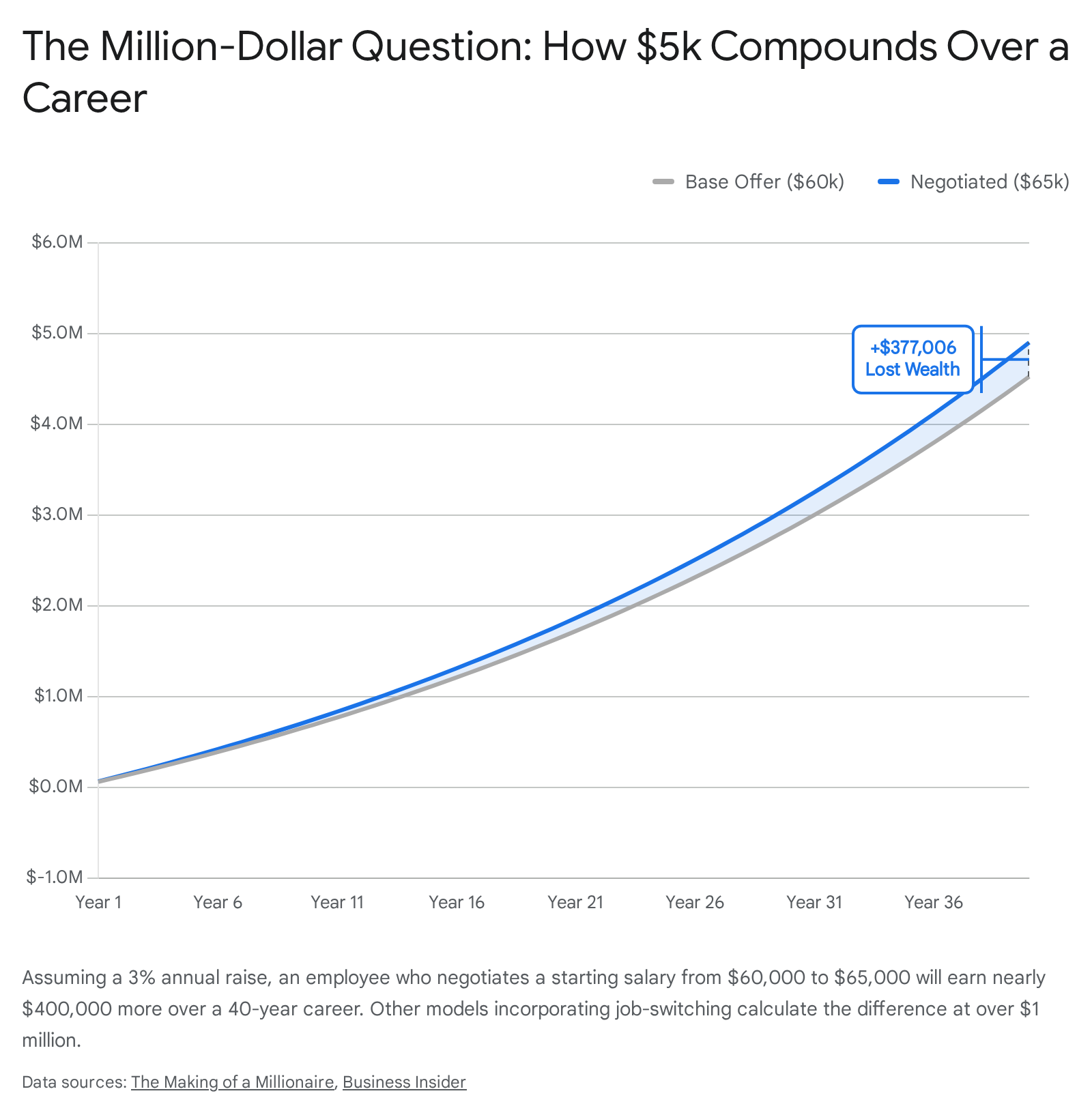
Other labor economists project even steeper losses when factoring in job-hopping. Linda Babcock, a researcher at Carnegie Mellon University, estimates that graduate students who fail to negotiate their first job offer leave between $1 million and $1.5 million on the table in lost lifetime earnings 10. This compounding effect explains why the initial salary negotiation is arguably the most highly leveraged conversation of a person's career.
Disproportionate Impact on Systemic Wage Gaps
This compounding penalty is particularly detrimental to women and marginalized groups. Data from the National Association of Colleges and Employers (NACE) indicates that the wage gap between men and women begins immediately upon college graduation 56. Because women, on average, earn 18% less than their male counterparts early on, the compounding math ensures that the disparity grows exponentially wider over the span of a career 56.
When an individual's initial salary is artificially low, it shadows them across employers, as hiring managers historically relied on previous salary history to determine new compensation offers 6. Consequently, mastering early-career salary negotiation is not merely a tool for personal wealth accumulation; it is a critical defense mechanism against systemic lifetime wage deficits.
The Preparation Framework: BATNA, ZOPA, and Reservation Price
Professional negotiators rely on a strict, objective preparatory framework to remove emotion from the bargaining table. Before entering a salary discussion, candidates must calculate three critical metrics: their BATNA, their Reservation Price, and the ZOPA 111412.
1. BATNA (Best Alternative to a Negotiated Agreement) BATNA is a negotiator's absolute best course of action if the current deal falls through 1314. It is an external reality, not an internal desire. For a job seeker, a BATNA might be a competing offer from another firm, staying at their current job, or entering a freelance contract. The development of a strong BATNA requires rigorous evaluation of alternatives based on feasibility, cost, and operational impact 14. Knowing your BATNA provides immense psychological leverage; a candidate who knows they have a viable, documented backup plan negotiates with clarity and discipline rather than desperation 1415.
2. Reservation Price (The Walk-Away Point) While BATNA is an external alternative, the Reservation Price is an internal boundary 14. It is the absolute minimum acceptable package (salary, benefits, remote flexibility) a candidate will accept before abandoning the deal to pursue their BATNA 1115. The Reservation Price must be strictly better than the BATNA; otherwise, accepting the deal would be mathematically irrational 14. Establishing a rigid Reservation Price before the negotiation prevents a candidate from caving to pressure or emotion in the heat of the moment 1516. If the employer's final offer falls below the Reservation Price, the logical decision is to walk away 1517.
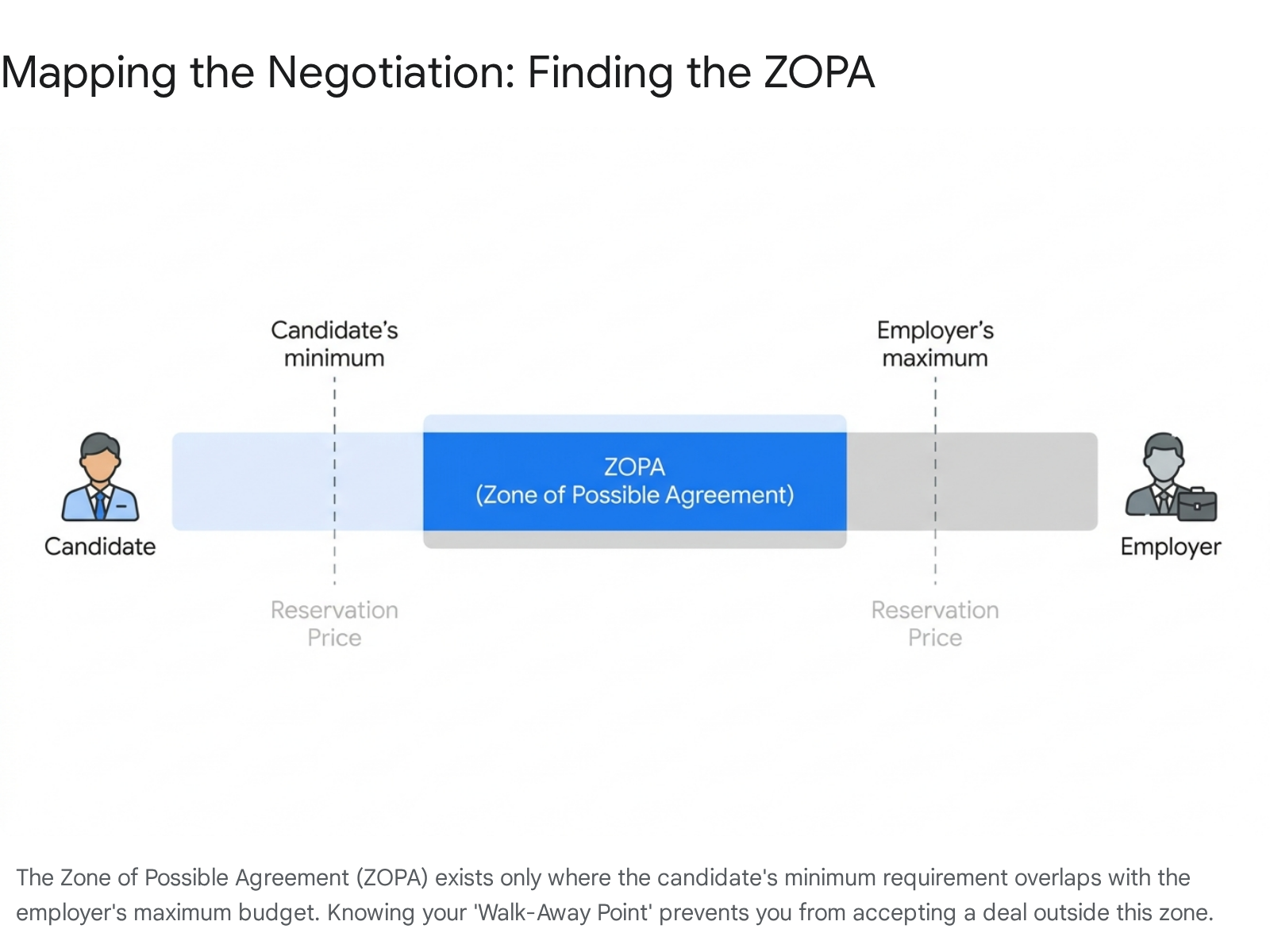
3. ZOPA (Zone of Possible Agreement) The ZOPA is the overlap between the candidate's Reservation Price and the employer's maximum budget 1216. For example, if a candidate will not accept less than $70,000, and the employer is authorized to pay up to $75,000, the ZOPA is $70,000 - $75,000. All effective haggling takes place within this invisible zone 12. Conversely, if the candidate's minimum is $80,000 and the employer's maximum is $75,000, a negative ZOPA exists, meaning no mutually beneficial deal is mathematically possible, and the parties should part ways amicably 12.
Behavioral Economics: The Power of the First Offer
A central debate in negotiation strategy is who should introduce the first number. Traditional, conventional advice often warns candidates never to show their cards first, operating under the assumption that the employer might offer a figure significantly higher than the candidate's target 22. However, modern behavioral economics heavily refutes this conventional wisdom.
The Anchoring Effect
In a seminal 1974 paper, psychologists Amos Tversky and Daniel Kahneman documented the "anchoring effect," a powerful cognitive heuristic in which the human brain relies disproportionately on the first piece of information offered when making subsequent decisions 21819. Kahneman and Tversky demonstrated that spinning a wheel of fortune to land on a random number directly influenced subjects' estimates of entirely unrelated facts, proving that anchors dictate logic, even when arbitrary 1819.
In a salary negotiation, the first number introduced to the room drops a psychological anchor. Every subsequent counteroffer, no matter how hard the opposing party tries to remain objective, will unconsciously gravitate toward that initial reference point 20. Research by Northwestern University management professor Leigh Thompson confirms that the party who makes the opening offer generally achieves a superior economic outcome 20.
A thorough analysis of negotiation experiments reveals a staggering metric: every extra dollar proposed in a well-researched first offer corresponds to roughly 50 cents more in the final agreement 27. By naming the number first, the candidate establishes the ceiling of the bargaining zone and forces the hiring manager to negotiate downward from a high baseline, rather than the candidate trying to negotiate upward from a low one 1920.
The Practitioner-Researcher Paradox
Despite the objective, mathematical advantage of anchoring, making the first offer exacts a psychological toll. Studies consistently show that negotiators who make the first offer report feeling significantly higher levels of anxiety and lower satisfaction with the negotiation process, even when they achieve better financial results .
Furthermore, researchers note a specific caveat known as the "Practitioner-Researcher Paradox." While academics advocate for the first-mover advantage, field practitioners sometimes advise moving second. A 2021 study investigated this contradiction and found that if a candidate is in a position of extreme low power, lacks alternative job options (a weak BATNA), and suffers from severe negotiation anxiety, forcing themselves to make the first offer can backfire 21. In a panicked state, a weak negotiator will often anchor too low, effectively capping their own earning potential to relieve the stress of the conversation 21. Therefore, the rule of anchoring only benefits the candidate if they have conducted rigorous market research and have the confidence to state an ambitious target without flinching 22.
Engineering the Ask: Precision and Ranges
Aiming high is only half the equation; the structural format of the number matters just as much as its magnitude. Candidates typically ask for round numbers (e.g., $110,000 or $85,000). However, research from the Journal of Applied Psychology and the Program on Negotiation at Harvard Law School demonstrates that "precise" anchors are vastly more effective 227.
When a candidate requests a highly precise, unrounded number - such as $107,500 or $108,250 - the employer's brain processes the request differently. A precise number signals that the candidate has conducted extensive, data-driven research and intimately understands the exact market value of their skills 2729. Because the candidate appears more knowledgeable, the employer's counteroffer is significantly smaller 229. In contrast, a round number like $110,000 is perceived as an arbitrary opening gambit, inviting a much steeper discount 7.
There is, however, a limit to this tactic. Columbia Business School research warns that extreme, hyper-precision (e.g., $107,514.76) conveys rigidity and inflexibility, alienating the hiring manager and damaging rapport 2. The optimal target is a moderately precise figure.
The Strategy of Ranges
If a candidate feels uncomfortable delivering a single precise anchor, they can utilize a range. However, not all ranges are created equal. Columbia University professors Daniel R. Ames and Malia F. Mason identified three common types of ranges used in bargaining, noting that expressing an offer as a carefully designed "Bolstering Range" can yield excellent outcomes .
If a candidate's true target is $90,000, they should not state a range of $80,000 to $90,000 (a "Bracketing Range"), which simply gives the employer permission to choose the bottom figure . Instead, they should use a Bolstering Range: placing their actual target at the absolute floor of the range, and extending upward to a highly ambitious ceiling (e.g., $90,000 to $105,000) . This satisfies the employer's psychological desire for flexibility while mathematically ensuring that any agreement lands near or above the candidate's true goal.
Summary of Salary Anchoring Tactics
| Strategy Type | Example (Target: $85k) | Psychological Impact on Employer | Effectiveness Rating |
|---|---|---|---|
| Round Number | "$90,000" | Perceived as an arbitrary guess. Invites large counteroffers. | Moderate. Better than no anchor, but easily dismissed. |
| Precise Number | "$87,500" | Signals deep market knowledge. Triggers smaller concessions. | Very High. Establishes strong credibility. |
| Bolstering Range | "$85,000 to $95,000" | Appears accommodating while secretly anchoring the floor at the candidate's goal. | High. Excellent for maintaining rapport while claiming value. |
| Bracketing Range | "$80,000 to $90,000" | Shows flexibility but gives the employer permission to lowball. | Low. Frequently results in the minimum figure. |
Laboratory vs. Field Experiments: The Gender Pay Gap
Much of the foundational research on salary negotiation stems from laboratory environments, where participants are placed in controlled, simulated scenarios. For instance, in laboratory settings, researchers have consistently observed that women negotiate significantly less frequently and less aggressively than men, often drawing analogies that men view negotiation as a "ball game" while women view it as a "dentist's office" visit 2223. Laboratory studies suggest that women possess a more communal self-concept, prioritizing interdependent success and fair outcomes over individual maximization, which can lead to accepting lower pay 23.
However, behavioral economists caution against relying solely on laboratory data, noting its low "ecological validity" or mundane realism 2433. In a lab, participants are aware they are being studied, which can trigger demand characteristics where they conform to expected gender roles 33.
To test these theories in the real world, researchers designed large-scale natural field experiments. A prominent randomized control trial involving nearly 2,500 actual job seekers in the U.S. tech sector sought to understand how the phrasing of job postings impacts negotiation behavior 222526. The field experiment revealed a critical nuance: when job postings did not explicitly state that wages were negotiable, men were far more likely to initiate a negotiation for a higher wage, while women were more likely to signal a willingness to work for less 26. However, when the job posting simply added an explicit statement that "wages are negotiable," the gender differences in initiation completely disappeared 26.
This suggests that the gender gap in negotiation is not an inherent lack of skill, but rather a calculated response to ambiguity and the legitimate fear of social backlash in environments where the rules of engagement are unclear.
Innovative Tactics for Overcoming Bias
Because women are frequently subjected to a "likability penalty" when they negotiate assertively, researchers have observed new, highly effective tactics emerging in the field 2327. A 2025 study published in Negotiation and Conflict Management Research analyzed real, observed behavior and identified two specific strategies successfully utilized by experienced female negotiators to circumvent implementation gaps:
- ATOP (Asking Tactically for an 'Other-Promotion'): The candidate induces the counterpart to give a performance appraisal or validate the candidate's exceptional skills before numbers are discussed. This creates a psychological commitment from the employer that provides an immediate bargaining advantage to the candidate 27.
- DEAL (Delineating Engagement and Advancing Legitimacy): The candidate thoroughly outlines the expansive future impact they will have on the company's operations, using that projected engagement to legitimize their financial requests 27.
The study noted that ATOP was clearly the most frequently and successfully implemented novel strategy, allowing negotiators to claim value without violating traditional, albeit biased, gender expectations of communal behavior 27.
Negotiation Styles: The Collaborative-Competitive Hybrid
How a candidate delivers their carefully researched anchor is just as important as the number itself. Extensive reviews of salary negotiation outcomes analyze five primary conflict management styles: Competing, Collaborating, Accommodating, Compromising, and Avoiding 13.
Candidates who adopt purely "Accommodating" or "Compromising" styles rarely achieve significant salary gains and frequently end up dissatisfied with the results 13. Conversely, candidates who are purely "Competitive" - acting aggressively, issuing ultimatums, and demanding unilateral concessions - may occasionally secure higher base pay, but they severely damage their social capital and alienate their future colleagues 37.
The data reveals that the most lucrative approach is a hybrid of "Competing" and "Collaborating" strategies 13. Candidates using this hybrid approach successfully increased their starting pay by an average of $5,000 1.
This hybrid methodology requires a candidate to be exceptionally firm and competitive regarding their goals (the target numbers) but highly collaborative and flexible regarding the process of how those goals are met 1. A collaborative problem-solver does not view the employer as an adversary; rather, they position the salary gap as a shared logistical puzzle that both parties must work together to solve 2829.
If the employer claims to have a strict departmental cap on base salary, the collaborative negotiator does not dig in their heels. Instead, they pivot to a total-package perspective, asking, "If base pay is fixed, would a signing bonus, extra equity, remote flexibility, or a professional development stipend be easier to approve?" 728. This allows the evaluator to say yes without exceeding their budget authority, bypassing the brain's defensive threat response 7.
The Medium: In-Person vs. Email Negotiation
As remote work has proliferated, the venue for salary negotiation has shifted heavily toward digital mediums. While traditional advice champions face-to-face or live video negotiations to build interpersonal rapport and read nonverbal cues, modern career strategists increasingly advocate for negotiating via email 304031.
The argument for email hinges on neutralizing the massive power dynamic between candidate and recruiter. Recruiters are professional negotiators who execute hundreds of job offers a year; the average candidate negotiates perhaps a dozen times in their entire career 31. On a phone or video call, the recruiter holds a distinct home-court advantage. Candidates are prone to nervousness, memory lapses, and the psychological pressure to fill awkward silences, often resulting in them prematurely compromising or negotiating against themselves 31.
Email alters this dynamic. It allows the candidate to meticulously craft a data-backed argument, ensuring their precise anchor and bolstering ranges are articulated perfectly. It provides the time needed to reference industry benchmarks and tone-check the message for diplomacy 3142. As executive coach Tanya Tarr points out, email purposefully strips away the emotional texture of the conversation, acting as a strategic shield for people-pleasers who might otherwise cave to a lower number in a live conversation 40.
However, email carries inherent risks. Studies note that written text, devoid of vocal inflection and body language, is 50% more likely to be misinterpreted than face-to-face communication 42. A sentence intended to sound confident can easily be misconstrued as arrogant or aggressive. Therefore, email negotiations must be overwhelmingly polite, expressing deep gratitude and enthusiasm for the role before pivoting smoothly into the counteroffer 42.
Macro Shifts: Pay Transparency and Global Culture
Two major external factors are currently reshaping the rules of salary negotiation: regional legislation and cross-cultural globalization.
The Impact of Pay Transparency Laws
Since 2023, a wave of pay transparency legislation has swept through the United States, with states like California, Colorado, New York, and Washington requiring employers to post salary ranges on job descriptions 323345. This fundamentally alters negotiation leverage. Historically, employers hoarded compensation data, operating in an asymmetrical environment of secrecy. Today, candidates enter the negotiation armed with the employer's own stated budget 3245.
Academic and economic studies indicate these laws are highly effective at leveling the playing field. In Colorado, an analysis by the University of California San Diego found that posted salaries increased by an average of 3.6% after transparency laws went into effect 33. Furthermore, studies of public-sector transparency disclosure laws in Canada found robust evidence that the mandates reduced the gender pay gap by 20% to 40% 32. Simultaneously, the U.S. federal government has moved to ban salary history inquiries - preventing agencies from using a candidate's past pay to set new wages - breaking the cycle of compounding inequality 34. For the modern negotiator, transparency removes the need to blindly guess the ZOPA; the critical anchor points are practically provided by law.
Cross-Cultural Negotiation Dynamics
For professionals negotiating in multinational environments, applying Western negotiation tactics blindly can be disastrous. Cultural norms, deeply rooted in philosophies like Confucianism or Western individualism, dictate the mechanics of the bargaining table 473549.
- The West (U.S. / Northern Europe): Low-context, direct, and outcome-driven. The negotiation is treated as an economic transaction. Direct communication, fast decision-making, and competitive anchoring are expected and respected 474936.
- East Asia (China / Japan): High-context, indirect, and relationship-driven. Negotiations prioritize long-term harmony, collective consensus, and mutual trust 4735. Overly aggressive first offers or rigid demands can be perceived as an insult to the hierarchy (high power distance) and can severely damage the relationship 3753.
- The Middle East: Defined heavily by "honor-culture." Initial interactions focus almost entirely on building trust, hospitality, and personal connection before any business is discussed 54. Once bargaining begins, however, honor-culture negotiators (such as those in the UAE or Qatar) can be highly competitive and utilize distributive tactics; candidates must adapt by proving their respect and loyalty while remaining firm on value 54.
- Scandinavia (Sweden): Highly egalitarian and consensus-driven. While anchors work effectively, they must be rigorously defended with rational data, salary surveys, and union benchmarks. Anchoring artificially high without factual justification will destroy a candidate's credibility in this data-driven culture 55.
Bottom line
Deciding to negotiate a starting salary is one of the most consequential financial choices a professional makes, capable of altering lifetime wealth by hundreds of thousands of dollars due to compounding returns. The research clearly indicates that the most successful candidates calculate their BATNA in advance, establish precise, data-backed anchors (or bolstering ranges), utilize a hybrid collaborative-competitive style, and lean on mediums like email to neutralize a recruiter's inherent advantage. While outcomes will vary based on macroeconomic conditions, pay transparency laws, and regional cultural contexts, the fear of an employer rescinding a job offer simply for a good-faith negotiation is largely unfounded by the data.