
How Much Sleep Do Adults Actually Need
Adults generally require between seven and nine hours of sleep per night to maintain optimal physiological and cognitive function, though individual needs can vary slightly based on genetics and daily exertion. Achieving restorative sleep requires uninterrupted progression through multiple 90-minute ultradian cycles, a process increasingly disrupted by interactive screen use and psychological stress. Consequently, attempting to offset chronic weekday sleep debt with weekend oversleeping or relying on unproven blue-light filtering technologies rarely compensates for the profound health deficits caused by consistent sleep deprivation.
Official Sleep Duration Guidelines Across the Lifespan
For decades, public health messaging relied on the simplistic directive to achieve a flat eight hours of sleep per night. However, sleep science recognizes that biological requirements shift dynamically across the human lifespan. Following a rigorous, multi-year review using the RAND/UCLA Appropriateness Method, the National Sleep Foundation (NSF) convened an 18-member multidisciplinary expert panel to establish evidence-based guidelines for sleep duration 112.
These guidelines form the foundation of current recommendations endorsed by organizations such as the Centers for Disease Control and Prevention (CDC) 3. The consensus underscores that while a specific target range exists for each developmental stage, there is an acceptable margin of flex time to account for individual variability.
| Age Group | Age Range | Recommended Daily Sleep | Acceptable Variance Range |
|---|---|---|---|
| Newborns | 0 - 3 months | 14 to 17 hours | 11 to 19 hours |
| Infants | 4 - 11 months | 12 to 15 hours | 10 to 18 hours |
| Toddlers | 1 - 2 years | 11 to 14 hours | 9 to 16 hours |
| Preschoolers | 3 - 5 years | 10 to 13 hours | 8 to 14 hours |
| School-aged Children | 6 - 13 years | 9 to 11 hours | 7 to 12 hours |
| Teenagers | 14 - 17 years | 8 to 10 hours | 7 to 11 hours |
| Young Adults | 18 - 25 years | 7 to 9 hours | 6 to 11 hours |
| Adults | 26 - 64 years | 7 to 9 hours | 6 to 10 hours |
| Older Adults | 65+ years | 7 to 8 hours | 5 to 9 hours |
While the recommended range for the average adult spans from seven to nine hours, more granular analyses indicate a narrower optimal window. A comprehensive review of systematic studies encompassing 4.4 million participants across 30 countries found that seven to eight hours of sleep per 24-hour period represents the physiological "sweet spot" 5. Adults consistently meeting this specific threshold demonstrated a 19% reduced risk of premature all-cause mortality, optimal cognitive performance in spatial navigation testing, and better health-related quality of life independent of other medical conditions 5.
The American Thoracic Society officially corroborates that population-level health is maximized within this 7-to-9-hour bracket 5. Deviating from this range carries measurable physiological risks. Sleeping fewer than six hours a night is definitively linked to metabolic dysfunction, weakened immunity, hypertension, and an elevated risk of cardiovascular disease 354. Furthermore, research demonstrates that logging fewer than six hours of sleep for 14 consecutive nights produces cognitive impairments equivalent to a full 24 hours of absolute sleep deprivation 1.
Conversely, habitual oversleeping presents its own epidemiological concerns. Consistently sleeping more than nine hours per night as an adult is associated with adverse cardiovascular outcomes and an increased risk of stroke 57. Researchers note, however, that excessive sleep duration in older adults (aged 54 and above) often serves as an indicator of underlying chronic illness or sleep fragmentation rather than functioning as the primary cause of poor health 58.
The Architecture of a Restful Night
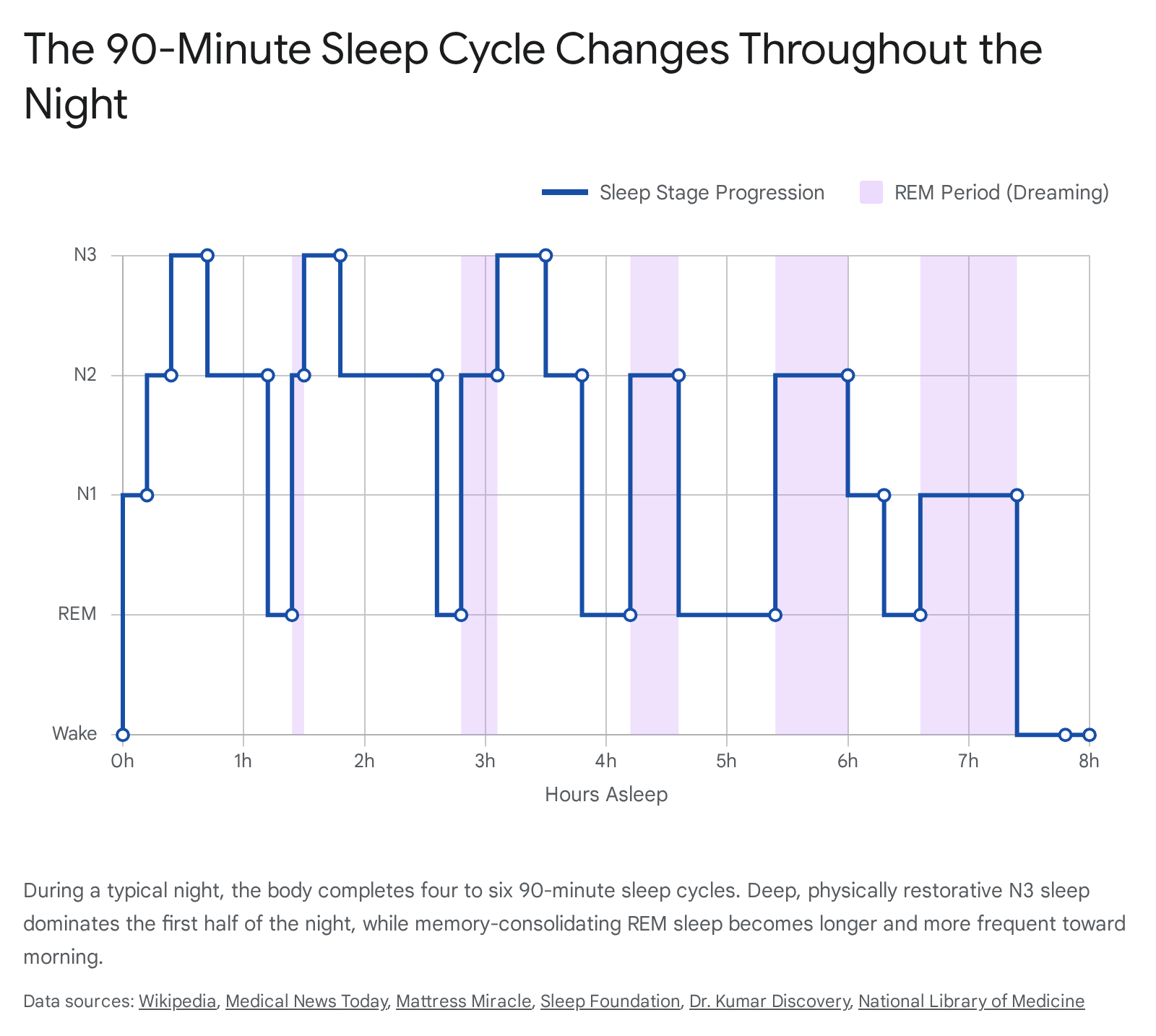
Understanding the biological necessity of seven to nine hours requires looking beyond the total duration and examining the internal structure of sleep. Sleep is not a static state of unconsciousness; it is a highly active, highly structured neurological process. The brain cycles through alternating periods of Non-Rapid Eye Movement (NREM) and Rapid Eye Movement (REM) sleep, following a characteristic ultradian rhythm that typically lasts between 90 and 110 minutes 5611.
During a healthy night of rest, an adult will complete four to six of these cycles 67. The composition of these cycles shifts dramatically as the night progresses, heavily prioritizing deep physical restoration in the first few hours before transitioning to memory consolidation closer to morning 118.
Progressing Through NREM Sleep
NREM sleep is divided into three distinct sub-stages, representing a progressive descent into deep neurological and physiological relaxation. The first stage, N1, is the lightest phase of sleep and serves as the initial transition from wakefulness. Lasting only one to seven minutes, N1 is characterized by a slowing of heartbeat and breathing, alongside a shift in brain activity from alpha waves to lower-frequency theta waves 1178. During this brief window, individuals may experience hypnic jerks - sudden, involuntary muscle contractions - and can be easily roused by minor environmental stimuli 1114.
Following this transition, the brain enters N2, which constitutes the bulk of human rest, accounting for roughly 45% to 55% of total sleep time 6715. In the N2 stage, core body temperature drops, and eye movement ceases entirely 118. Electroencephalogram (EEG) recordings during this phase reveal the presence of "sleep spindles" and "K-complexes" - distinct bursts of neural activity that help the brain resist waking from external noises and initiate the processing of new memories 11715.
The most profound stage of NREM is N3, commonly referred to as slow-wave sleep or deep sleep. This stage is dominated by slow, high-amplitude delta waves, and awakening an individual from N3 is exceedingly difficult 117. If forcibly awakened during this phase, individuals experience severe sleep inertia, characterized by prolonged disorientation and grogginess 11. Biologically, N3 is paramount for somatic recovery. Muscle tone, pulse, and blood pressure drop to their baseline minimums while the body secretes vital growth hormones, repairs muscle tissue, and consolidates the immune system 81516. N3 dominates the sleep cycles occurring in the first half of the night, with episodes progressively shortening as the night wears on 118.
The Cognitive Importance of REM Sleep
Rapid Eye Movement (REM) sleep is a stark departure from the deep relaxation of N3. Typically initiating about 90 minutes after first falling asleep, REM is defined by brain activity that closely mirrors a waking state 5714. This hyperactive neurological environment is where the majority of vivid dreaming occurs. To prevent individuals from physically acting out these dreams, the brain essentially paralyzes the skeletal muscles, a temporary state known as atonia 67.
REM sleep is the cognitive powerhouse of the sleep cycle. It is critical for memory consolidation, emotional processing, and insightful problem-solving 111415. While the initial REM periods of the night may last only a few minutes, they lengthen significantly in the early morning hours, sometimes extending up to an hour in the final sleep cycle 614. Consequently, individuals who chronically restrict their sleep to five or six hours disproportionately rob themselves of REM sleep, leading to severe deficits in emotional regulation and working memory.
The Brain's Nightly Dishwasher
To illustrate why progressing through these stages is non-negotiable, sleep researchers often rely on the "dishwasher" analogy. Throughout waking hours, neuronal activity produces metabolic waste products that accumulate in the brain. During N3 deep sleep, a highly specialized network known as the glymphatic system becomes active. This system pumps cerebrospinal fluid through the brain tissue at an accelerated rate, effectively washing away toxic byproducts, including the amyloid-beta plaques known to be primary contributors to Alzheimer's disease and other neurodegenerative disorders 11910.
When individuals habitually shorten their sleep, they essentially turn off the dishwasher before the cycle is complete. The resulting accumulation of neurotoxins manifests acutely as brain fog and impaired focus, and chronically as heightened susceptibility to long-term cognitive decline.
The Genetic Anomaly of Natural Short Sleepers
Despite the overwhelming clinical consensus that less than seven hours of sleep is deleterious, an extremely small subset of the population thrives on just four to six hours per night. These individuals exhibit a trait known as familial natural short sleep (FNSS), a condition governed entirely by rare genetic mutations rather than behavioral conditioning or sheer willpower 711.
The genetic basis for this phenomenon was first isolated in 2009 with the discovery of a mutation in the DEC2 gene (also designated as BHLHE41) 111221. In healthy individuals, the DEC2 protein acts as a crucial transcriptional repressor. As evening approaches, DEC2 levels rise and bind to specific transcription factors (such as MyoD1), which suppresses the expression of orexin - a powerful neuropeptide hormone produced in the hypothalamus that stimulates arousal, wakefulness, and appetite 721. By morning, DEC2 levels drop, allowing orexin production to resume and signaling the brain to wake up.
Individuals carrying the DEC2-P384R or DEC2-Y362H mutations possess a defective repressor mechanism. Their ability to suppress orexin is impaired, meaning their baseline arousal levels remain higher, and they require significantly less time unconscious to clear sleep pressure 711. DEC2 also interacts with the core circadian clock proteins CLOCK and BMAL1, slightly altering the 24-hour rhythm to accommodate a shorter rest period 721. Since the initial discovery, researchers have identified several other gene mutations associated with FNSS, including ADRB1, NPSR1, and GRM1, all of which alter adrenergic, immune, and neural signaling pathways to optimize short sleep phenotypes 911.
Most remarkably, individuals with FNSS do not exhibit the cardiovascular, metabolic, or cognitive detriments universally observed in the sleep-deprived public. In fact, laboratory studies utilizing mouse models genetically engineered to carry both the short-sleep mutations and dementia-inducing mutations revealed that the short-sleep subjects exhibited a profound resistance to the buildup of amyloid-beta plaques, suggesting that these specific genetic variants confer intrinsic neuroprotective benefits 911.
However, sleep scientists universally caution the public against adopting the lifestyle of a natural short sleeper. These mutations are exceedingly rare, estimated to exist in roughly 1 in 1,000 individuals 21. If an adult is sleeping five hours a night but relies on alarms to wake up and caffeine to function, they do not possess a genetic superpower; they are merely accumulating dangerous levels of sleep debt.
Can You Compensate for Lost Sleep on Weekends?
In modern society, many adults attempt to manage the demanding schedules of the workweek by intentionally accumulating sleep debt from Monday to Friday, intending to "catch up" by sleeping late on the weekends. For years, sleep medicine debated whether this compensatory sleep actually mitigated health risks or simply exacerbated circadian misalignment.
Recent large-scale epidemiological data indicates that weekend catch-up sleep does offer tangible cardiovascular and psychological benefits, but it cannot fully reverse the damage of severe weekday sleep deprivation.
A 2024 analysis presented at the European Society of Cardiology evaluated actigraphy data from over 90,000 subjects in the UK Biobank. The researchers categorized participants into quartiles based on the volume of compensatory sleep they achieved on non-workdays. The findings were striking: individuals who logged the most weekend catch-up sleep exhibited a 20% lower risk of developing heart disease compared to those who maintained a short sleep schedule throughout the entire week 1314. This protective effect was particularly pronounced among individuals who consistently slept fewer than six hours during the workweek 1315. Parallel research utilizing NHANES data confirms that moderate weekend catch-up sleep (one to two extra hours) correlates with a significantly reduced risk of clinical depression and cognitive decline, particularly in middle-aged demographics 25.
Despite these benefits, researchers emphasize the limitations of binge-sleeping. Data from the Sleep Heart Health Study indicates that the health effects of catch-up sleep heavily depend on the severity of the weekday deficit. When adults suffer from extreme short sleep during the week (under 5.5 hours), a large volume of weekend catch-up sleep fails to fully normalize their mortality hazard ratios 16. Furthermore, most people with severe sleep debt physically cannot sleep long enough on weekends to mathematically balance their deficit; only about 25% of individuals successfully offset their lost hours 25.
Additionally, excessive compensatory sleep introduces the problem of "social jetlag." By sleeping significantly later on Sunday mornings, individuals shift their circadian clock forward, making it exceptionally difficult to fall asleep on Sunday night and guaranteeing exhaustion on Monday morning 17. Consequently, the National Sleep Foundation's consensus guideline recommends limiting weekend catch-up sleep to a maximum of one to two extra hours. This provides a minor restorative buffer without violently disrupting the body's internal clock 1525.
How Screen Time Displaces and Disrupts Sleep
The persistent inability of adults to secure adequate sleep is overwhelmingly tied to the proliferation of digital devices in the bedroom. Survey data indicates that 87% of Americans sleep with their smartphone in the room, and over half engage with screens within the final hour before bed 1819.
The epidemiological impact of this habit is severe. A 2025 study examining over 122,000 adults found that daily screen use prior to bed resulted in a 33% higher prevalence of poor sleep quality and directly robbed users of roughly 50 minutes of sleep per week 17. This effect is magnified in younger populations. A 2025 Norwegian survey of 45,000 university students demonstrated that every additional hour of screen time after getting into bed was associated with a staggering 59% increased risk of experiencing clinical insomnia symptoms, alongside an average reduction in sleep duration of 24 minutes per night 1820.
The mechanism behind screen-induced sleep disruption is twofold, involving both physiological and psychological pathways.
The Melatonin Suppression Mechanism
Physiologically, the brain interprets the bright, artificial light emitted by electronic screens - particularly in the high-energy blue wavelength spectrum - as daylight. This exposure directly inhibits the pineal gland's secretion of melatonin, the neurohormone responsible for signaling to the body that it is time to initiate the sleep cycle 3121.
Experimental evidence indicates that even short periods of tablet or smartphone use in the evening significantly delay the onset of melatonin release, resulting in later bedtimes and shortened REM cycles 3121. Chronic suppression of melatonin not only causes insomnia but also disrupts the broader circadian rhythm, interfering with cellular repair, antioxidant defense, and metabolic regulation 312122.
The Psychology of Revenge Bedtime Procrastination
While light exposure is highly detrimental, researchers increasingly point to the psychological arousal of device usage as the primary driver of modern sleep loss. Much of this behavior falls under the umbrella of "revenge bedtime procrastination."
Coined to describe workers in high-stress, hyper-demanding corporate cultures (such as China's "996" schedule of working 9 AM to 9 PM, six days a week), revenge bedtime procrastination occurs when individuals consciously sacrifice necessary sleep to reclaim a sense of personal autonomy and leisure time 23. After a day devoid of free time, delaying sleep to scroll through social media or stream videos serves as a desperate, albeit maladaptive, coping mechanism 2425.
Unfortunately, this phenomenon creates a punishing negative feedback loop. By sacrificing sleep for digital leisure, individuals experience profound daytime fatigue, impaired emotional regulation, and degraded executive function. These deficits make the subsequent workday feel even more stressful and exhausting, thereby intensifying the psychological need to procrastinate bedtime the following night 232425.
Interactive Media vs. Passive Consumption
In evaluating screen time, sleep researchers draw a sharp distinction between passive media consumption and interactive digital engagement.
Passive screen time, such as watching a familiar television program from across the room, requires low cognitive effort and operates on a one-way communication stream. Interactive screen time, however, involves active engagement - such as playing video games, texting, or scrolling through algorithmically curated social media feeds. Interactive use triggers the brain's reward centers via dopamine loops, causing emotional and cognitive arousal that is fundamentally incompatible with the physiological deceleration required for sleep 2627.
| Screen Activity Type | Examples | Cognitive/Physiological Impact | Sleep Disruption Risk |
|---|---|---|---|
| Passive Use | Watching television, streaming movies, listening to audiobooks. | Low cognitive demand; lower risk of emotional arousal; primarily affects sleep via light exposure. | Moderate. Several studies show minimal to no significant reduction in sleep duration compared to interactive use 2728. |
| Interactive Use | Video gaming, social media scrolling, messaging apps. | High cognitive load; triggers dopamine loops and stress responses; fragments attention. | High. Strongly correlated with delayed sleep onset, nighttime awakenings, and shorter total sleep duration 2629. |
Comparative data robustly supports this division. An analysis of the Health Behaviour in School-aged Children (HBSC) survey revealed that adolescents who engaged in heavy computer or video game use (over four hours daily) experienced a 30% to 61% increased odds of sleep-onset difficulties. In contrast, heavy television viewing increased the odds of sleep difficulties by only 15% to 19% 29. Similarly, data from the Texas SPAN survey indicated that while heavy video game usage dramatically increased the odds of short sleep duration, television viewing had a negligible, or sometimes even slightly protective, association with total sleep time 27.
The disruptive nature of interactive devices extends well into the night. A comprehensive 2024 study on early adolescents found that leaving a smartphone ringer activated overnight drastically increased sleep fragmentation. The data revealed that 20% to 28% of youths who were awakened by a nighttime notification proceeded to actively use their device before attempting to fall back asleep, entirely derailing their sleep architecture 303132.
The Efficacy of Blue Light Glasses and Night Modes
As public awareness of screen-induced sleep disruption has grown, a massive industry has emerged marketing blue-light-filtering glasses and software-based "Night Modes" (which shift screen color temperatures to amber hues) as simple solutions for achieving better rest. However, rigorous clinical evidence suggests these interventions offer negligible benefits.
In 2023, the Cochrane Database of Systematic Reviews - the gold standard for clinical evidence evaluation - published a comprehensive analysis of 17 randomized controlled trials regarding blue-light-filtering lenses. The authors concluded that these glasses "probably make no difference to eye strain or sleep quality" in the short term when compared to standard, non-filtering lenses 3346. A subsequent 2024 meta-analysis of double-blind crossover trials confirmed this, finding no statistically significant improvements in sleep efficiency, total sleep time, or the reduction of nighttime awakenings among users of blue-blocking glasses 3435.
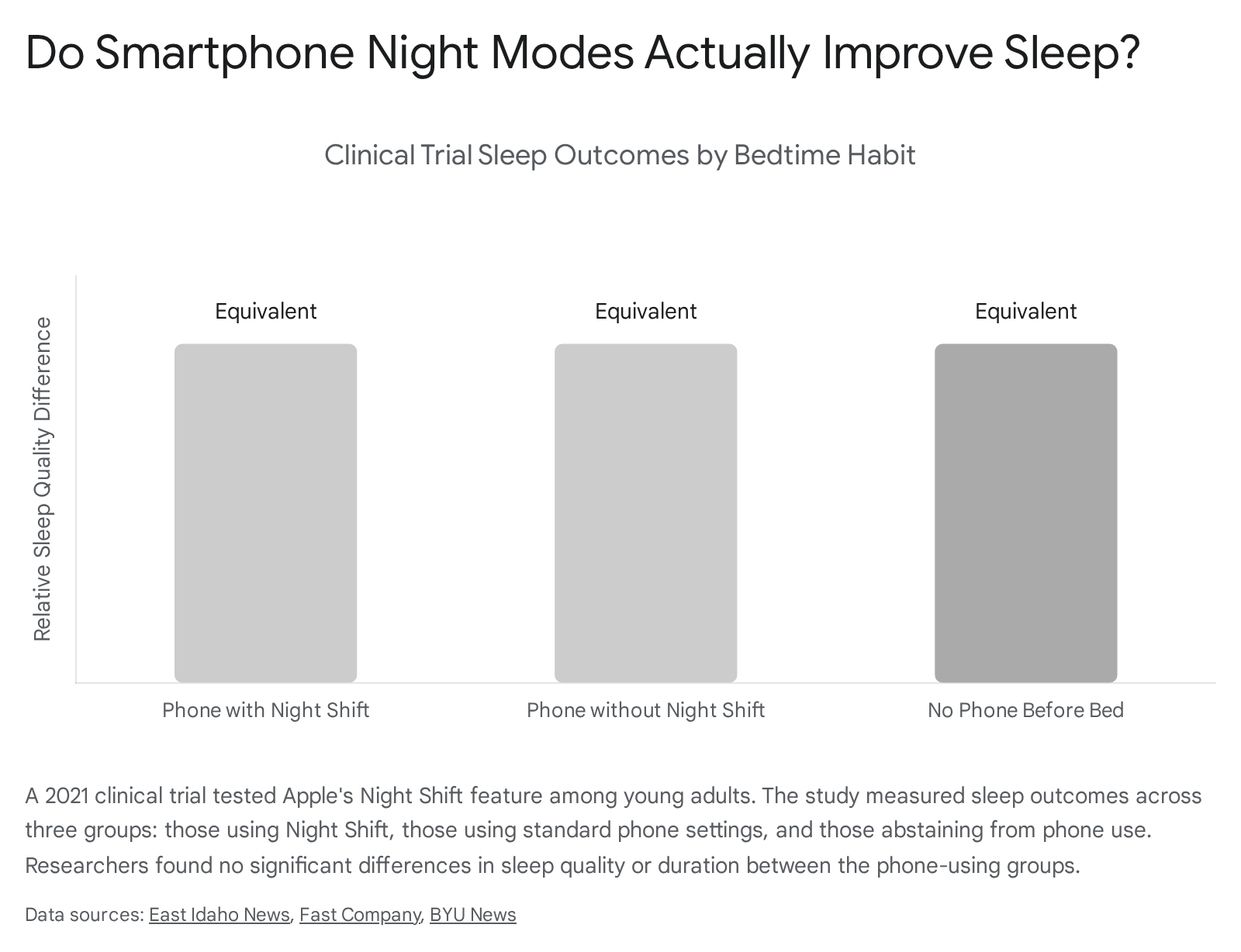
Software interventions fare no better. A 2021 randomized controlled trial conducted by Brigham Young University specifically evaluated the efficacy of Apple's "Night Shift" feature. The study divided 167 young adults into three cohorts: one using smartphones with Night Shift enabled, one using standard bright screens, and one abstaining from phone use entirely before bed. Actigraphy data revealed absolutely no significant differences in sleep outcomes between the Night Shift group and the standard screen group 363738.
The failure of these interventions is attributed to two major factors. First, standard clear or lightly tinted consumer glasses simply lack the optical density to block meaningful amounts of circadian-disrupting light. Glasses must possess a Melanopic Daylight Filtering Density (mDFD) of 1.0 or greater to successfully preserve melatonin, a specification that requires deep amber or red lenses that severely distort color and are rarely sold to mainstream consumers 463940.
Second, optical filters cannot solve behavioral problems. Even if a smartphone screen emits zero blue light, the psychological arousal generated by doomscrolling, combined with the pure time displacement of staying awake to consume content, entirely overrides any minor hormonal benefits provided by warmer screen hues 374142.
Cultural Differences in Global Sleep Patterns
While human biology demands a relatively uniform amount of sleep, geographic location and cultural norms dramatically dictate how much sleep populations actually receive. A massive analysis of over 220,000 individuals across 35 countries, conducted by the National University of Singapore and Oura Health, revealed stark disparities in global sleep habits 56.
Data universally demonstrates that citizens of East Asian and Middle Eastern countries sleep significantly less than their Western counterparts, often falling short by 30 to 45 minutes per night 564344.
| Global Region | Average Sleep Duration | Primary Cultural & Social Drivers |
|---|---|---|
| Northern Europe (e.g., Denmark, Sweden, Netherlands) | Longest (Often 7.5+ hours) | Shorter average workweeks (Denmark averages ~26 hours), strong cultural emphasis on work-life balance, and robust labor protections 4345. |
| Oceania (e.g., Australia, New Zealand) | Long (7 to 7.5 hours) | Favorable work cultures; Australia boasts the world's highest percentage of "long sleepers" (over 8.5 hours) 434446. |
| Middle East (e.g., UAE, Qatar) | Short (Often under 6.5 hours) | Late nighttime socializing, scheduling adjustments around non-fasting hours during Ramadan, and traditional midday siestas displacing nocturnal sleep 434446. |
| East Asia (e.g., Japan, South Korea, China) | Shortest (Often 6 to 6.3 hours) | Intense educational pressures, exceptionally long corporate working hours, extended commutes, and a cultural normalization of sleep deprivation 564546. |
Historically, epidemiologists assumed that countries with shorter average sleep durations would exhibit commensurately worse national health metrics. However, a fascinating 2025 study published in the Proceedings of the National Academy of Sciences (PNAS) challenged this assumption. After analyzing sleep data and health outcomes from 5,000 people across 20 countries, researchers found no direct evidence that short-sleeping nations suffered worse overall health than long-sleeping nations 4547.
Instead, the study uncovered a powerful psychological nuance: individuals who slept closer to the established cultural norm of their specific country exhibited the best health outcomes 47. This suggests that the physiological stress of deviating from societal expectations - such as the anxiety of under-sleeping in a relaxed culture, or the stigma of oversleeping in a hyper-productive one - plays a profound role in well-being. Nevertheless, the researchers issued a stark caveat: regardless of local norms, participants across all 20 countries were still sleeping an average of one hour less than the duration required for their absolute optimal physiological health 47.
Bottom line
Adults biologically require between seven and nine hours of sleep - ideally striking the optimal balance of seven to eight hours - to allow the brain to cycle through physically restorative deep sleep and memory-consolidating REM sleep. While weekend catch-up sleep offers minor cardiovascular benefits, it cannot fully reverse the profound metabolic and cognitive damage caused by chronic weekday sleep deprivation. To achieve restorative rest, individuals must abandon ineffective tech interventions like blue-light glasses and instead directly address revenge bedtime procrastination by removing interactive screens from the bedroom environment.