
How Much of Freud's Psychoanalysis Survived
Sigmund Freud's psychoanalysis introduced the revolutionary idea that unconscious thoughts, past experiences, and hidden emotional conflicts drive human behavior. While modern empirical science has thoroughly rejected many of his specific assertions - such as the existence of perfectly repressed traumatic memories and the idea that all neuroses stem from childhood sexual conflicts - his broader concepts survived by evolving. Today, modified Freudian ideas like defense mechanisms, implicit cognitive processing, and the impact of early relationships form the foundation of modern, evidence-based psychodynamic therapy.
The Birth of Psychoanalysis and the Talking Cure
At the close of the nineteenth century, the prevailing medical consensus viewed human consciousness as a rational, easily measurable phenomenon. Mental illnesses were frequently dismissed as physiological brain defects or moral failings. Sigmund Freud, an ambitious Austrian neurologist, shattered this consensus and fundamentally altered the trajectory of modern psychology.
From Neurology to Hysteria
Freud's journey began in traditional medical and scientific research. After studying medicine at the University of Vienna and completing his medical degree in 1881, he trained in neuropathology at the Vienna General Hospital 12. In 1885, Freud traveled to Paris to study at the Salpêtrière Hospital under Jean-Martin Charcot, a famous neurologist investigating hypnosis and "hysteria" - a broad historical diagnosis used to describe patients suffering from unexplained physical and emotional symptoms, such as paralysis, blindness, or convulsions without an identifiable organic cause 1.
Freud was profoundly affected by Charcot's demonstrations, which suggested that hysterical symptoms were not anatomical defects but psychological manifestations. Returning to Vienna, Freud began applying hypnosis in his own clinical work 13.
Josef Breuer and the Case of Anna O.
Freud soon began collaborating with his colleague and mentor, the physician Josef Breuer. Breuer had been treating a young woman known in clinical literature as Anna O. (later identified as Bertha Pappenheim), who suffered from severe ailments, including a stiff paralysis on the right side of her body 4.
Breuer discovered that when Anna O. was placed under hypnosis and encouraged to speak freely about her distressing and traumatic memories, her physical symptoms temporarily disappeared 4. Anna O. herself famously dubbed this process the "talking cure." Freud hypothesized that her physical symptoms were the result of psychological traumas that had been blocked from her conscious mind, only to reappear as somatic ailments. To heal the body, the mind had to experience a release of this blocked emotional energy, a process called catharsis 345.
In 1895, Freud and Breuer published Studies on Hysteria, which is widely considered the first true psychoanalytic work. They proposed the groundbreaking theory that hysterical symptoms were symbolic representations of traumatic, often sexual, memories 13.
The Shift from Hypnosis to Free Association
Despite early successes, Freud eventually found hypnosis to be an unreliable clinical tool. Not all patients could be easily hypnotized, and the symptomatic relief was often temporary. By 1896, Freud abandoned hypnosis entirely and introduced a new technique: free association 123.
Freud instructed his patients to recline on a couch, face away from him to minimize visual cues, and speak absolutely everything that came to their minds without any censorship or logical structuring. He believed that by removing the pressure of directed conversation, the patient's conscious defenses would lower, allowing the analyst to interpret the hidden conflicts and repressed traumas causing the neurosis 15. In 1896, Freud officially coined the term "psychoanalysis" to refer to this new clinical methodology and its underlying theoretical framework 12.
Freud's Architecture of the Mind
Psychoanalysis was not merely a therapy; it was an ambitious, sweeping framework intended to explain the entirety of human psychological development. To understand why psychoanalysis became a dominant cultural and medical force for much of the twentieth century, one must understand how Freud modeled the human mind.
The Topographical and Structural Models
Freud initially proposed a topographical model of the mind, dividing it into the conscious, the preconscious, and the unconscious 67. He famously used the analogy of an iceberg. The conscious mind is the small tip visible above the water, representing our current thoughts and perceptions. The preconscious sits just below the waterline, holding memories and knowledge that can be easily brought into awareness. The vast, hidden underwater mass is the unconscious, a repository of primal urges, unacceptable desires, and painful memories 87.
By 1923, Freud expanded this with his tripartite structural model, which divided the human personality into three constantly interacting and competing structural elements: the id, the ego, and the superego 78.
- The Id: Present from birth, the id represents our primal, biological instincts. It operates entirely in the unconscious and is driven by the "pleasure principle" - the relentless demand for immediate gratification of urges, primarily sexual energy (libido) and aggressive drives 6119.
- The Superego: Developing later in childhood (typically between ages three and five), the superego serves as the internal moral compass. It represents the internalized standards, values, and taboos of parents and society. The superego demands ethical perfection and punishes the individual with intense feelings of guilt when those standards are violated 119.
- The Ego: The ego is the rational, conscious mediator that bridges the gap between the internal world and external reality. Operating on the "reality principle," the ego attempts to satisfy the impulsive demands of the id in ways that are safe, socially acceptable, and free from the punitive guilt of the superego 69.
Freud often compared the ego to a rider on horseback. The id is the immensely powerful horse, providing the raw energy and forward momentum, while the ego is the rider who must hold the horse in check and guide it safely 119.
The Role of Anxiety and Defense Mechanisms
Because the id demands immediate pleasure and the superego demands absolute morality, the ego is in a constant state of internal conflict. When the ego struggles to mediate these opposing forces, the individual experiences severe anxiety 913.
To protect itself from being overwhelmed by this anxiety, the ego unconsciously deploys defense mechanisms 913. These psychological strategies - such as repression, denial, or projection - distort reality to keep unacceptable thoughts and feelings out of conscious awareness. While defense mechanisms temporarily reduce distress, Freud argued that overreliance on them leads to psychological dysfunction and neurosis.
The Epistemological Crisis: Is Psychoanalysis a Science?
Despite its massive cultural influence, psychoanalysis eventually faced a devastating intellectual reckoning. For much of the early to mid-twentieth century, psychoanalysis was the dominant paradigm in Western psychiatry. However, philosophers and research psychologists began to question whether it actually met the basic criteria of a scientific discipline.
Karl Popper and the Falsifiability Standard
The most famous and enduring critique of psychoanalysis came from the philosopher of science Karl Popper. Growing up in post-World War I Vienna, Popper was surrounded by intense intellectual debates regarding new, sweeping theories of human nature and the universe, including Albert Einstein's theory of relativity, Karl Marx's theory of history, Alfred Adler's individual psychology, and Sigmund Freud's psychoanalysis 14.
Popper became obsessed with the "demarcation problem" - the challenge of drawing a definitive line between genuine science and pseudoscience. He noted a stark contrast in how these different theories operated. Einstein's theory of general relativity made incredibly specific, risky predictions about the physical world. For instance, it predicted exactly how much light would bend around a massive object like a star. If experimental observation during a solar eclipse showed that light did not bend in that exact way, Einstein's entire theory would be disproven 141016. Einstein's theory stuck its neck out; it was fundamentally falsifiable.
By contrast, Popper observed that the psychological theories of Freud and Adler made no such risky predictions. Instead, they relied on post-hoc (after-the-fact) explanations 61410.
The Problem with Explaining Everything
Because psychoanalysis relied heavily on the concept of invisible, unconscious motivations and intricate defense mechanisms, it could bend to explain absolutely any human behavior. If a patient behaved aggressively, a psychoanalyst could claim they were acting on unbridled id impulses. If the exact same patient behaved passively, the analyst could claim they were employing the defense mechanism of "reaction formation" to successfully repress their aggressive id impulses.
Popper argued that because psychoanalytic theory could never be proven wrong by any conceivable observation, it was unfalsifiable 1410. A theory that can explain every possible outcome ultimately predicts nothing. While Popper acknowledged that psychoanalysis might contain profound insights into the human condition, he concluded that it functioned more like a closed dogmatic system or an interpretative philosophy than an empirical science 61617.
This epistemological critique severely damaged Freud's academic standing. From the 1970s onward, as the field of psychology fought to establish itself as a rigorous, data-driven "hard" science, academic departments increasingly marginalized psychoanalysis, shifting their focus toward measurable behaviorism, cognitive science, and neurobiology 1811.
What Modern Science Firmly Rejected
As experimental psychology and cognitive neuroscience matured, researchers developed the tools to rigorously test Freud's claims. While certain broad concepts survived, several core pillars of classical psychoanalytic theory collapsed entirely under scientific scrutiny.
The Myth of the Repressed Memory
Perhaps the most culturally pervasive - and scientifically damaging - concept Freud introduced was the phenomenon of repressed memory. Freud originally theorized that when a person, particularly a child, experiences a trauma too horrific for the conscious ego to process, the mind automatically and unconsciously banishes the memory deep into the unconscious 41213.
According to classical psychoanalytic theory, these memories remain perfectly intact but hidden, acting as a toxic internal agent that influences present behavior and slowly leaks out as physical symptoms, phobias, or severe anxiety 414. The therapeutic goal was to bypass the ego's defenses to "recover" these pristine memories, thereby relieving the patient of their neurosis through catharsis.
In the 1980s and 1990s, this theory sparked the highly controversial "Memory Wars." Some clinical practitioners, using suggestive techniques derived from early psychoanalysis like hypnosis, guided imagery, and dream interpretation, began helping patients "recover" alleged repressed memories of severe childhood abuse 41215. The resulting wave of accusations led to families being torn apart, false criminal convictions, and individuals serving years in prison based entirely on memories that materialized during therapy sessions 415.
Modern cognitive neuroscience and experimental psychology have largely dismantled the concept of Freudian memory repression. The scientific consensus is clear: while human beings routinely forget mundane details, and while they may actively choose to suppress thinking about painful events, there is no empirical evidence for an unconscious mechanism that neatly vaults away highly traumatic autobiographical memories 4121516.
Reconstructive Memory vs. The Video Tape Vault
Trauma research indicates that the exact opposite of repression usually occurs. The amygdala, the brain structure responsible for processing emotional threats, essentially burns traumatic events into the brain. The clinical hallmark of post-traumatic stress disorder (PTSD) is not the inability to remember trauma, but the inability to forget it, resulting in intrusive flashbacks, nightmares, and chronic hyper-arousal 41415.
Furthermore, memory researchers demonstrated that human memory does not function like a video recording that can be paused, stored, and perfectly replayed years later. Memory is inherently reconstructive 17.
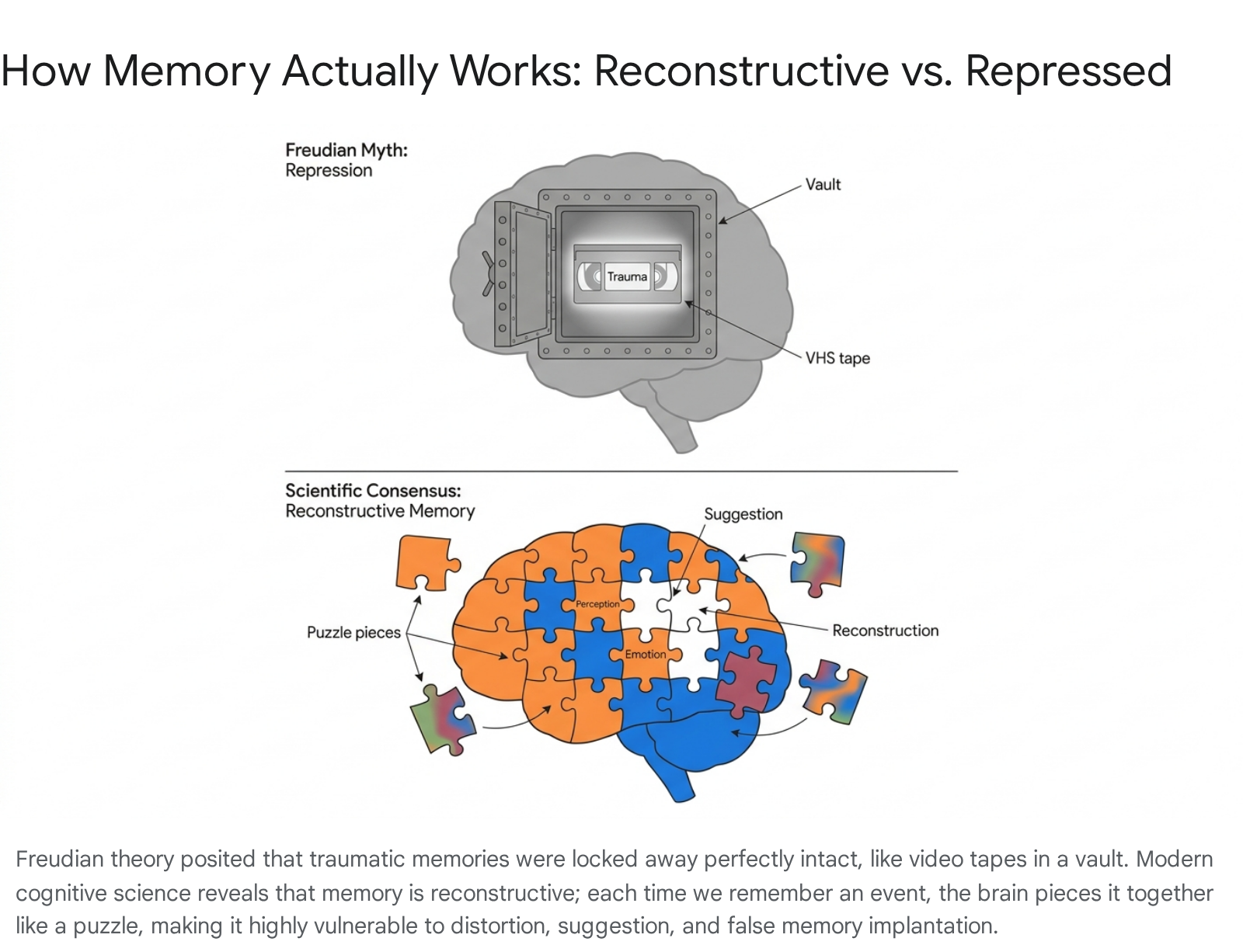
Every time we recall an episodic memory, the brain actively rebuilds the narrative by joining together disparate perceptual details, emotions, and semantic knowledge. During this reconstruction process, memory is highly susceptible to outside suggestion, individual beliefs, and current emotional states 17.
Experimental psychologists pioneered the "false memory implantation" paradigm to prove this vulnerability. In laboratory settings, researchers successfully convinced participants that they had experienced entirely fictional childhood events - ranging from getting lost in a shopping mall to taking a hot air balloon ride, and even surviving an animal attack. Depending on the study's criteria, researchers found that between 15% and 30% of participants formed full-blown false memories when subjected to suggestive interviewing techniques, and up to 70% accepted the false event to some extent 1215.
Because of the profound lack of evidence for the concept, and the proven danger of suggestive interviewing, mainstream clinical psychologists have largely abandoned the term "repressed memory." Harvard clinical psychologist Richard McNally starkly summarized the consensus, stating that the notion of repressing and recovering traumatic events is a pernicious bit of folklore that provided the theoretical basis for "the worst catastrophe to befall the mental health field since the lobotomy era" 4.
The Psycholinguistics of Freudian Slips
Freud believed in absolute "psychic determinism" - the idea that no human action is truly accidental 918. In his 1901 book The Psychopathology of Everyday Life, he introduced the concept of the parapraxis, now universally known in popular culture as a "Freudian slip."
Freud argued that accidental slips of the tongue, forgetting a name, or misplacing an object occurred when the conscious mind momentarily relaxed its strict control, allowing repressed thoughts, hostile intentions, or taboo desires to surface through language 181920. For example, calling a current romantic partner by an ex-partner's name would be interpreted not as a mistake, but as an unconscious revelation of lingering desire or dissatisfaction 2122.
Modern science approaches these linguistic errors quite differently. Comprehensive research in psycholinguistics and cognitive psychology suggests that while genuinely "Freudian" slips may occasionally happen, the vast majority of speech errors are the result of mechanical failures in language processing 2122.
Speaking is an incredibly complex cognitive task that requires the brain to rapidly conceptualize a thought, retrieve words from a vast mental dictionary (the lexicon), apply grammatical rules, and coordinate the motor functions of the mouth and vocal cords 1922. During this multi-stage process, errors frequently occur due to "lexical competition." When a speaker attempts to articulate an idea, several words that sound similar or share semantic meaning are activated in the brain simultaneously 1819. If the speaker is tired, distracted, or experiencing cognitive overload, the wrong word can simply win the race to articulation 1921.
While modern scholars concede that emotional states like stress and anxiety can influence speech production and increase the likelihood of errors, a slip of the tongue is far more likely to represent an innocent cognitive misfire than a deep, secret desire 181922.
The Rejection of Blanket Sexual Etiology
Freud shocked Victorian society by insisting that children are born with innate sexual urges and that human behavior is fundamentally driven by the libido. In his 1905 work Three Essays on the Theory of Sexuality, he proposed his highly controversial theory of psychosexual development, claiming that children pass through specific biological stages (oral, anal, phallic, latency, and genital) 2613.
Central to this developmental theory was the Oedipus complex, the assertion that young boys unconsciously desire their mothers and harbor murderous, competitive hostility toward their fathers, eventually resolving this conflict through the threat of castration anxiety 61323. Freud argued that adult neuroses were caused by getting psychologically "fixated" at one of these childhood stages 6.
Today, with over 75 years of robust developmental psychology research following Freud's death, these literal interpretations have been almost entirely discarded by the academic community. There is no scientific evidence supporting the idea that children harbor these specific innate psychosexual conflicts, nor do modern clinical psychologists trace the etiology of generalized anxiety or depression back to a toddler's repressed lust 1824. Today's psychodynamic clinicians have largely abandoned the Oedipus complex, focusing instead on how a patient's early attachment to caregivers shapes their ongoing relationship patterns 24.
What Survived: The Modern Unconscious and Defense Mechanisms
If the Oedipus complex was discarded, repressed memories debunked, and Freudian slips explained away by linguistics, why is Freud still considered one of the most important figures in modern intellectual history? Because his central, most terrifying proposition was absolutely correct: we are not fully aware of why we do what we do.
Freud fundamentally shifted human thought by proving that conscious awareness is only a fraction of the psychological experience 818. Modern cognitive neuroscience has fully embraced the concept of the unconscious, though it has stripped it of its mythological drama and reframed its function.
The Cognitive Unconscious vs. The Dynamic Unconscious
Freud envisioned a "dynamic unconscious" - a dark, active basement where the mind aggressively locked away violent, sexual, and socially unacceptable urges 2526. Modern science has replaced this concept with the "cognitive unconscious" 35.
Contemporary neuroscience confirms that the vast majority of our brain's processing occurs entirely outside of conscious awareness. Unconscious neural networks continuously decode sensory inputs, retrieve implicit memories, access goals, and drive routine behavior 83536. Rather than a hiding place for trauma, the modern unconscious is viewed as a highly efficient background processor essential for survival. It evaluates stimuli and initiates emotional processing faster than conscious thought can intervene 835.
This aligns remarkably well with modern "dual-process theories" in cognitive psychology.
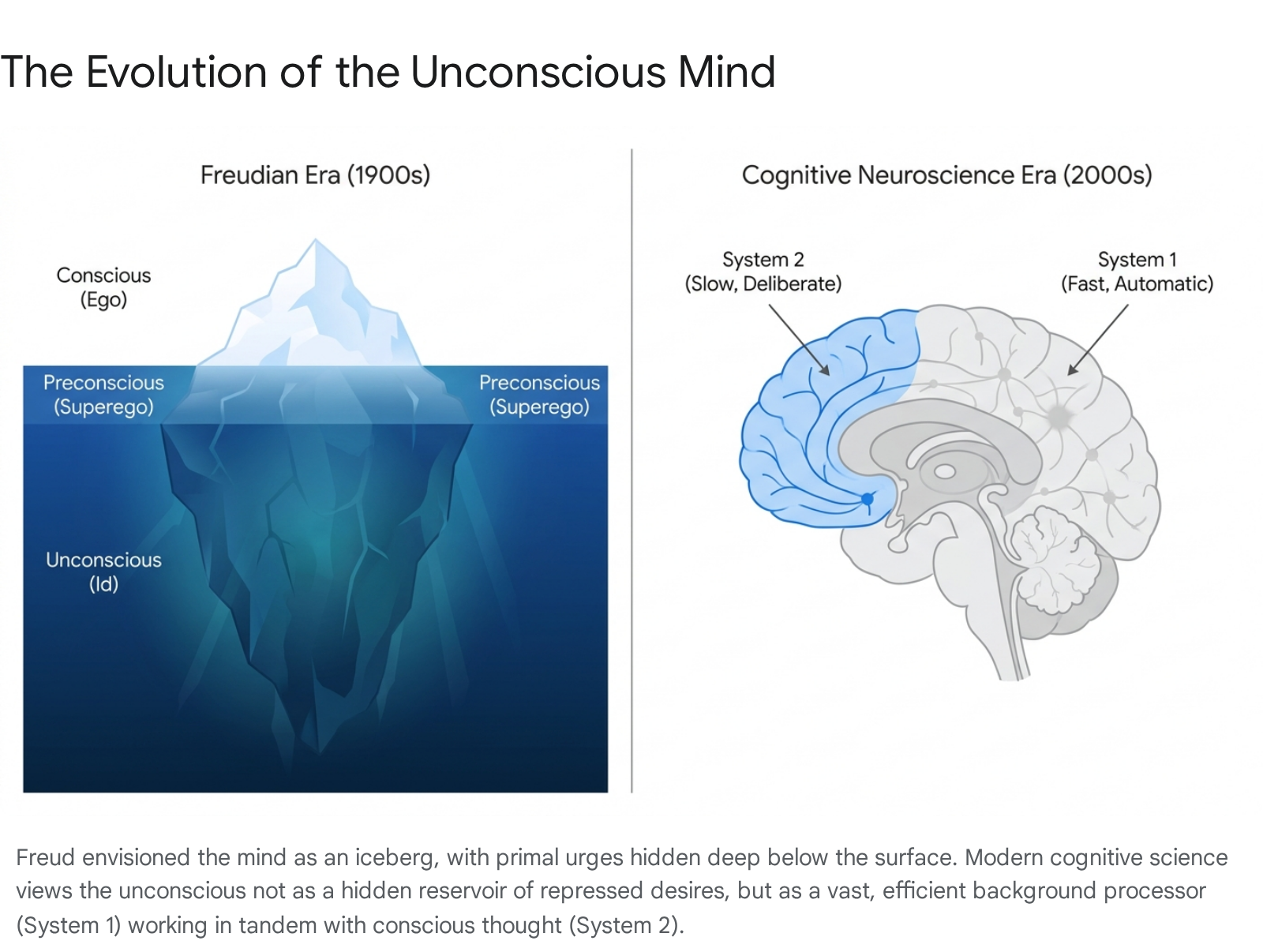
Researchers now conceptualize human decision-making as relying on two interacting systems: * System 1: Fast, automatic, intuitive, and unconscious. This system is heavily reliant on heuristics and implicit biases, functioning much like the impulsive nature of Freud's id 1137. * System 2: Slow, deliberate, logical, and conscious. This system requires working memory and cognitive effort, mirroring the regulating, problem-solving functions of Freud's ego 1137.
Furthermore, the emerging interdisciplinary field of neuropsychoanalysis seeks to map Freudian concepts onto biological brain structures. Some researchers suggest that the brain's Default Mode Network (DMN) - a network active during wakeful rest that handles self-reflection, autobiographical memory, and internal narrative - mirrors the regulatory and mediating functions Freud ascribed to the ego 38. Similarly, the top-down inhibitory control that the prefrontal cortex exerts over the highly emotional limbic system provides a biological reality to the concept of the rational ego reining in the impulsive id 2638.
Freud's Defense Mechanisms Evaluated by Modern Science
Freud, and later his daughter Anna Freud, categorized the specific defense mechanisms the ego uses to ward off anxiety and internal conflict. In 1998, social psychologist Roy Baumeister published a landmark review evaluating seven classic Freudian defense mechanisms against modern empirical laboratory data 2728.
The results indicated that while Freud was remarkably observant regarding human behavior, he was often wrong about the underlying motivation. Freud believed defense mechanisms protected the conscious mind from being overwhelmed by primitive, taboo id impulses. Modern social psychology indicates that defense mechanisms primarily serve to protect self-esteem and the conscious self-concept from external threats and emotional distress 2829.
The Status of Classic Defense Mechanisms
| Defense Mechanism | Freudian Definition | Modern Scientific Consensus |
|---|---|---|
| Reaction Formation | Converting an unacceptable impulse into its exact opposite (e.g., a person with repressed homosexual urges becoming violently homophobic). | Strongly Supported. Lab studies confirm that people threatened with negative feedback or anxiety often overcompensate by displaying the opposite behavior 2728. |
| Denial | Refusing to accept objective reality to avoid emotional pain. | Strongly Supported. Heavily documented in modern psychology, ranging from patients rejecting a terminal medical diagnosis to populations engaging in "wishful thinking" to ignore global threats like climate change 274230. |
| Projection | Attributing one's own unacceptable flaws or urges to someone else. | Supported (with modifications). Modern psychology views this through the "false consensus effect" - a cognitive bias where we assume others share our negative traits. Believing everyone else is flawed makes our own shortcomings feel less unique, protecting self-esteem 294445. |
| Undoing | Attempting to take back or "undo" an unacceptable behavior or thought through a secondary action. | Supported (with modifications). Documented heavily in the form of counterfactual thinking ("what if" scenarios), though research suggests it does not actually succeed in defending against the underlying threat 2728. |
| Displacement | Taking out frustrations on a safer, secondary target (e.g., getting reprimanded by your boss, so you go home and yell at your spouse). | Weakly Supported. While generalized physical arousal and bad moods can carry over between environments, people do not systematically redirect specific aggressive impulses to safe targets as a primary defense strategy 272842. |
| Sublimation | Channeling unacceptable sexual or violent urges into culturally acceptable, productive tasks (e.g., an aggressive individual becoming a surgeon). | Rejected. Modern empirical research has found zero reliable evidence that psychological sublimation exists as a measurable phenomenon 2728. |
Data synthesized from Baumeister et al., "Freudian Defense Mechanisms and Empirical Findings in Modern Social Psychology" 2728.
Classical Psychoanalysis vs. Modern Psychodynamic Therapy
If an individual seeks therapy today, they are highly unlikely to undergo classical psychoanalysis. The traditional image of a patient lying on a couch, talking freely while a silent analyst sits out of view taking notes, has largely faded from mainstream healthcare 4647. Classical psychoanalysis is incredibly expensive, requires an intense time commitment (often three to five sessions per week for several years), and lacks the structured empirical validation required by modern health insurance models 74731.
However, its direct descendant - psychodynamic therapy - is alive, highly relevant, and empirically supported 4731.
The Evolution of Clinical Practice
Psychodynamic therapy retains the core Freudian insight that our past experiences, particularly early childhood relationships with caregivers, unconsciously shape our current behavioral patterns, emotional responses, and interpersonal conflicts 4950. It recognizes the existence of unconscious defense mechanisms and internal resistance.
However, modern psychodynamic therapy strips away the rigid dogma and intense frequency of classical analysis. Today, psychodynamic therapists sit face-to-face with clients, engaging actively in dialogue rather than remaining a silent "blank screen." Sessions typically occur once or twice a week. Rather than a years-long archaeological dig into the patient's id, the therapy is often short-term (12 to 24 sessions) and focuses heavily on present-day relationships, recurring emotional themes, and the interpersonal dynamic occurring in the room between the therapist and the patient (known as transference) 7464732.
Comparing Therapeutic Modalities
The modern mental health landscape is frequently defined by the contrast between Psychodynamic Therapy and Cognitive Behavioral Therapy (CBT). CBT operates on an entirely different model of the mind, focusing on identifying and altering current, conscious negative thought patterns and maladaptive behaviors, rather than exploring unconscious childhood roots 4952.
While CBT is widely considered the "gold standard" in global mental health due to its highly structured, easily manualized format that lends itself well to clinical trials, recent large-scale meta-analyses have challenged the narrative that it is strictly superior 4733. Research demonstrates that psychodynamic therapy meets the criteria for empirically supported treatment, often matching CBT in short-term efficacy and occasionally demonstrating longer-lasting benefits for complex conditions like personality disorders and chronic depression 47325233.
| Feature | Classical Psychoanalysis | Modern Psychodynamic Therapy | Cognitive Behavioral Therapy (CBT) |
|---|---|---|---|
| Primary Goal | Deep exploration of unconscious conflicts, infantile drives, and total personality restructuring. | Understanding how past relational patterns and unconscious emotions influence present distress. | Rapid symptom reduction by identifying and correcting distorted conscious thought patterns. |
| Duration & Frequency | Open-ended (often years). 3 to 5 sessions per week. | Short-term (12-24 sessions) or open-ended. 1 to 2 sessions per week. | Brief and highly structured. Usually 12 to 20 sessions total. |
| Therapist Stance | Neutral, silent "blank screen," relying primarily on the patient's free association. | Active, empathetic, and flexible; highly focused on the present therapeutic alliance. | Collaborative, directive "coach" providing psychoeducation and homework assignments. |
| Physical Setting | Patient reclines on a couch; analyst sits out of the patient's line of sight. | Patient and therapist sit face-to-face. | Patient and therapist sit face-to-face in a standard clinical setting. |
Data synthesized from current psychological literature comparing therapeutic efficacy and structures 7464731495233.
The Global Divide: Where Psychoanalysis Still Dominates
While structured, pragmatic treatments like CBT have largely conquered the healthcare systems of the United States, the United Kingdom, and Australia, psychoanalysis retains a fierce, almost hegemonic grip on two major global hubs: Argentina and France 5434. In these nations, Freud's legacy is not merely a historical footnote, but a central pillar of cultural identity and psychiatric practice.
Argentina: The Therapy Capital of the World
Buenos Aires holds the unique title of the most psychoanalyzed city on earth. According to World Health Organization data, Argentina boasts roughly 222 psychologists per 100,000 people - compared to just 30 per 100,000 in the United States 3536. An estimated 46% of these practitioners reside in the capital, making therapy so ubiquitous that the trendy Palermo neighborhood is affectionately nicknamed "Villa Freud" 3658.
Psychoanalysis took root in Argentina in the 1940s with the founding of the Asociación Psicoanalítica Argentina (APA) by European immigrants fleeing World War II 37. The discipline experienced a massive cultural boom in the 1950s and 60s following the overthrow of dictatorial President Juan Perón. For the educated Argentine middle class, engaging in psychoanalysis became intertwined with intellectual prestige, self-improvement, and progressive, emancipatory politics 3661.
During the brutal military dictatorships of the 1970s, which violently suppressed collective political gatherings and targeted Marxist academics, the private, closed-door nature of the psychoanalyst's office became a rare safe haven for subversive thought and emotional survival 3661. Today, this legacy endures. Despite severe economic crises and hyperinflation that leave portions of the population struggling, Argentinians continue to prioritize psychoanalytic therapy as an essential form of emotional nourishment, viewing the exploration of the inner mind as equally important to physical healthcare 3558.
France: Jacques Lacan and the Intellectual Resistance
In France, psychoanalysis transcends medical treatment; it is deeply embedded in the nation's philosophy, sociology, literature, and political discourse 3438. The French fascination with Freud was supercharged in the mid-twentieth century by the controversial psychoanalyst Jacques Lacan.
Lacan proposed a radical "return to Freud," but he fused traditional psychoanalysis with structural linguistics, famously asserting that "the unconscious is structured like a language" 343964. Lacan's intellectual movement formed the largest contingent of French psychoanalysts, creating a deep ideological schism with the traditional International Psychoanalytical Association (IPA) 34.
Today, the Lacanian perspective remains the dominant force in French psychiatry. France maintains a high ratio of psychiatrists, with roughly half incorporating psychoanalytic techniques into their private practices 34. While the French government has attempted to reduce the number of psychiatrists and limit reimbursements to match the more pragmatic, CBT-focused model of the UK, the psychiatric establishment has fiercely resisted 34.
Many French clinicians view the Anglo-American shift toward CBT and the strict, symptom-checklist approach of the DSM (Diagnostic and Statistical Manual of Mental Disorders) as reductive and overly commercialized. For the French psychiatric community, maintaining the psychoanalytic tradition represents a heroic defense of intellectual complexity and profound human subjectivity against the globalized, pragmatic medicalization of human suffering 3465.
Bottom line
Sigmund Freud's most literal and sensational theories - including perfectly repressed traumatic memories, the Oedipus complex, and the assertion that all neuroses are rooted in childhood sexuality - have been thoroughly dismantled by modern cognitive neuroscience and empirical psychology. However, his foundational insight that our conscious minds are heavily influenced by unconscious processing, past experiences, and self-protecting defense mechanisms is undeniable and supported by modern data. While classical, couch-based psychoanalysis has faded in much of the world, its modernized offspring, psychodynamic therapy, remains a highly effective, evidence-based tool for addressing complex human suffering today.