
What the Science Says About Attachment Theory
Attachment theory explains how our earliest relationships with caregivers form a psychological blueprint that shapes how we regulate emotions, handle conflict, and experience intimacy throughout our lives. While decades of evidence confirm that these early bonds profoundly influence adult relationship patterns, modern research proves that our attachment styles are not permanent diagnoses. Today, the theory is both widely celebrated for its insights into human connection and heavily critiqued for its historically Western-centric biases and its frequent misrepresentation on social media.
The Evolutionary Origins of Attachment
The foundation of attachment theory was laid in the mid-20th century by British psychoanalyst John Bowlby. Prior to Bowlby's work, the prevailing psychological view - often referred to as the "cupboard love" theory - suggested that infants bond with their mothers primarily because the mother provides food 123. Bowlby, drawing heavily on ethology and evolutionary biology, challenged this assumption.
Bowlby proposed that human infants, born entirely helpless, are biologically pre-programmed to form emotional bonds with caregivers as a primary survival strategy 124. Just as a baby bird imprints on its mother, a human infant seeks physical and emotional proximity to a "secure base" to protect against predators and environmental threats. This drive for connection is an inherent mechanism that ensures survival. When a threat is perceived, the attachment system activates, prompting the child to seek proximity, comfort, and protection from their caregiver.
The Internal Working Model
Bowlby theorized that the thousands of micro-interactions between an infant and their caregiver coalesce into an "internal working model" 256. This model acts as a subconscious cognitive schema - a set of deeply ingrained expectations about how the world works. It primarily answers two questions: 1. Model of the Self: Am I fundamentally worthy of love, care, and attention? 2. Model of Others: Are other people reliable, safe, and emotionally available when I am in distress?
This internal working model serves as a template that a child carries into adolescence and adulthood, profoundly shaping their expectations of friendships, romantic partnerships, and even workplace dynamics 25. If a caregiver is consistently responsive, the child develops a secure internal working model. If the caregiver is inconsistent, neglectful, or abusive, the child adapts by forming an insecure working model to manage their environment 37.
Mary Ainsworth and the "Strange Situation"
While Bowlby developed the overarching theoretical framework, it was his colleague, developmental psychologist Mary Ainsworth, who provided the empirical evidence to categorize these behaviors. In the 1970s, Ainsworth designed a laboratory procedure known as the "Strange Situation" to observe how infants (typically between 9 and 18 months of age) utilize their primary caregiver as a secure base under conditions of mild, escalating stress 891.
Designing the Procedure
The Strange Situation takes place in an unfamiliar playroom equipped with toys and a one-way observation mirror. The procedure consists of eight distinct episodes, each lasting approximately three minutes, designed to activate the infant's attachment system through separations and reunions 8912:
| Episode | Participants in the Room | Description of Action | Primary Purpose |
|---|---|---|---|
| 1 | Mother, Baby, Observer | Observer introduces mother and baby to the experimental room, then leaves. | Acclimatization to the new environment. |
| 2 | Mother, Baby | Mother sits quietly while the baby is free to explore the toys. | Assessing the use of the mother as a secure base for exploration. |
| 3 | Stranger, Mother, Baby | A stranger enters, sits silently, then talks to the mother, and finally approaches the baby. | Observing the infant's reaction to a stranger (stranger anxiety). |
| 4 | Stranger, Baby | The mother discreetly leaves the room. The stranger interacts with the baby if needed. | Assessing separation anxiety and the infant's ability to be comforted by a stranger. |
| 5 | Mother, Baby | The mother returns and comforts the baby. The stranger leaves quietly. | Observing reunion behaviors and how quickly the infant is soothed. |
| 6 | Baby | The mother leaves the room, leaving the baby entirely alone. | Assessing intense separation anxiety. |
| 7 | Stranger, Baby | The stranger returns to the room and attempts to comfort the baby. | Observing whether the infant accepts comfort from someone other than the mother. |
| 8 | Mother, Baby | The mother returns, greets, and picks up the baby. The stranger leaves. | Final observation of reunion behavior and distress regulation. |
Ainsworth and her team carefully observed and coded the infants' behaviors during the reunion episodes. They focused on four specific behavioral scales: proximity-seeking, contact-maintaining, avoidance of proximity, and resistance to contact 891.
The Rule of "Good Enough" Parenting
Through her observations, Ainsworth identified that the primary determinant of a child's attachment classification was "caregiver sensitivity" - the caregiver's ability to accurately notice, interpret, and respond promptly to the child's signals 3912.
However, modern developmental psychology frequently emphasizes a concept that counters popular perfectionistic parenting standards: a secure attachment does not require flawless parenting. Research, including estimates by developmental psychologist Ed Tronick, suggests that a caregiver only needs to be attuned and appropriately responsive roughly 30 percent of the time for a secure attachment to form 13. This concept of "good enough" parenting means providing a reliable baseline of safety and repairing connection ruptures when they occur, rather than being perfectly attuned at every waking moment 413.
The Four Core Attachment Styles
Ainsworth originally identified three attachment patterns: Secure, Insecure-Avoidant, and Insecure-Resistant (Anxious) 39. In 1986, researchers Mary Main and Judith Solomon identified a fourth category, Disorganized Attachment, to account for children who exhibited bizarre or contradictory behaviors that did not fit Ainsworth's original classifications 41415.
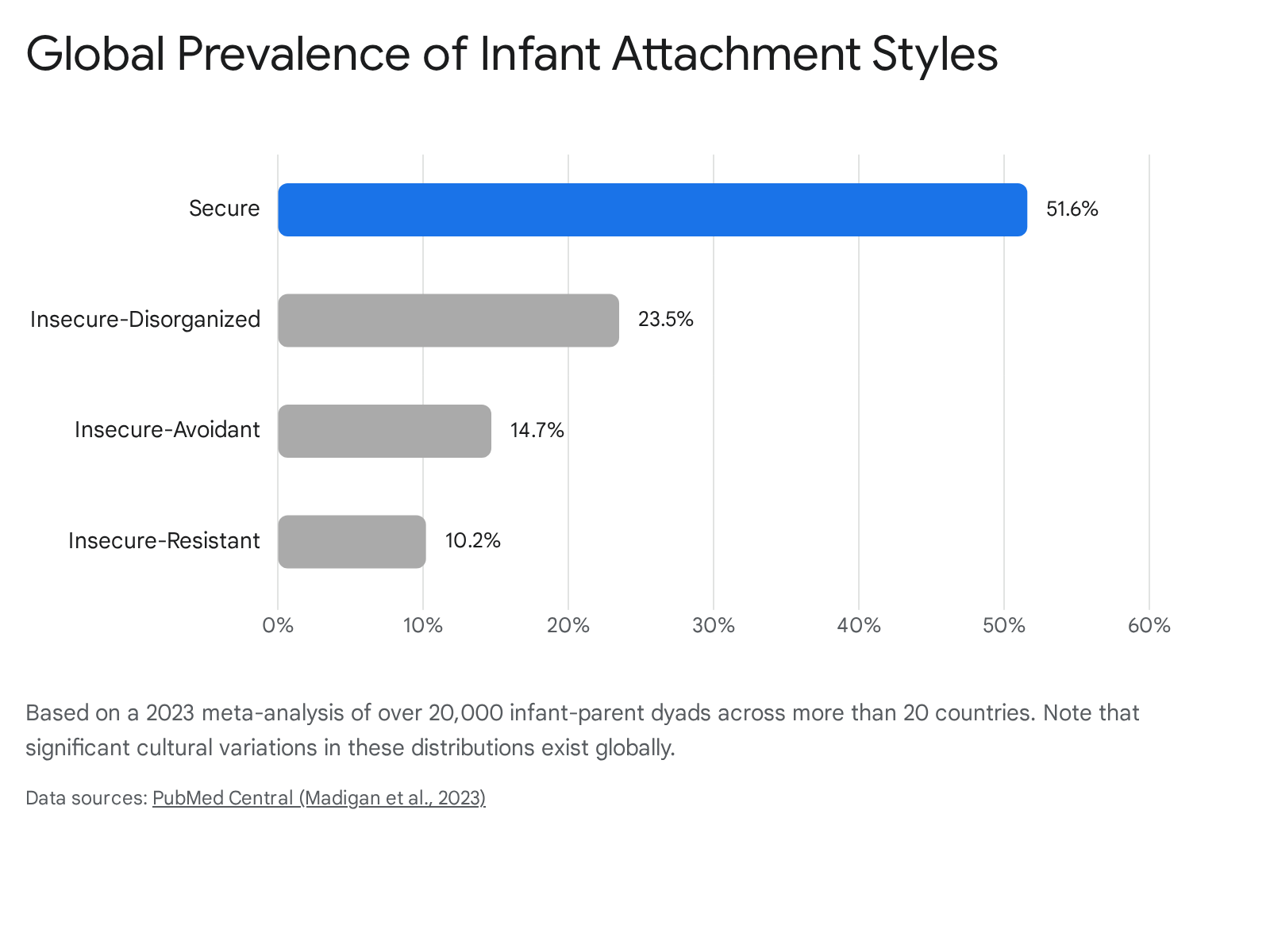
Over time, researchers mapped these childhood patterns onto adult romantic behaviors, creating a continuous lifespan framework.
Secure Attachment
Securely attached individuals learned early on that their needs would be met. In the Strange Situation, secure infants show distinct distress when their mother leaves but are quickly and effectively comforted upon her return, allowing them to resume playing 8116.
In adulthood, secure individuals (representing approximately 50 to 60 percent of the population) exhibit a healthy balance of intimacy and independence 31819. They communicate their emotions honestly, do not play games in relationships, and do not interpret their partner's need for autonomy as a threat of abandonment 182021. When conflict arises, they generally possess the emotional regulation skills to pause, reflect, and engage in constructive problem-solving without panicking or withdrawing 2022.
Furthermore, secure attachment functions as a deep psychological resource. According to the Conservation of Resources (COR) theory, secure individuals possess a baseline of relational safety that allows them to confidently take risks, explore opportunities, and seek social support during stressful periods. This advantage frequently translates into higher career satisfaction, greater resilience against burnout, and overall professional success 23.
Anxious (Preoccupied) Attachment
Anxious attachment generally stems from inconsistent caregiving. A caregiver may have been deeply attuned and warm one day, but emotionally withdrawn, overwhelmed, or intrusive the next 16244. This unpredictability trains the child to remain on high alert; because they do not know when love will be available, they maximize their emotional expressions to ensure they are seen. In the Strange Situation, these infants become intensely distressed upon separation and remain difficult to soothe upon reunion, often exhibiting anger, arching their backs, or clinging desperately 892.
In adulthood, the anxious attachment style is characterized by a deep craving for intimacy coupled with a chronic fear of abandonment 1418. Anxiously attached adults suffer from a hyperactivated attachment system. They are highly sensitive to minor shifts in a partner's tone, body language, or availability 2627. When they perceive distance, their nervous system registers a severe threat, prompting "protest behaviors" designed to force connection and elicit reassurance 2628.
In the digital age, this frequently manifests as "texting anxiety" - a state of panic induced by delayed replies, leading to urges to double-text, monitor a partner's online status, or spiral into catastrophic thinking ("They're pulling away," "I did something wrong") 212627. To avoid rejection, anxiously attached individuals may engage in severe people-pleasing, over-functioning in the relationship, or over-explaining themselves to prevent conflict, inadvertently smothering the relationship they are trying to save 2629.
Avoidant (Dismissive) Attachment
Avoidant attachment develops when a child's emotional needs are consistently dismissed, mocked, or ignored 24430. The child quickly learns that seeking comfort results in rejection. To survive and maintain proximity to the caregiver, the child adopts a strategy of deactivation - they suppress their innate attachment needs to avoid the pain of disappointment 30. In the laboratory, avoidant infants exhibit little to no outward distress when the mother leaves and actively ignore, turn away from, or avoid eye contact with her when she returns, treating her similarly to the stranger 81.
In adulthood, the avoidant style is characterized by a fierce, self-protective independence. Avoidant adults equate intimacy with a loss of autonomy and deeply fear being engulfed or controlled by a partner 182230. They tend to intellectualize their emotions rather than feel them, minimizing their own needs by adopting the stance, "I'm fine, I only need myself" 2430.
When faced with relationship conflict or a partner's demands for greater emotional closeness, the avoidant nervous system perceives intense pressure. Their default defense is to stonewall, change the subject, or physically and emotionally withdraw to regain a sense of safety 22305. This withdrawal can manifest digitally through vague texting, long gaps in communication, or ghosting entirely when a dynamic becomes too emotionally heavy 323334.
Disorganized (Fearful-Avoidant) Attachment
The disorganized attachment style, often referred to in adult literature as fearful-avoidant, is the most complex and least common classification 1415. It is frequently, though not exclusively, linked to environments characterized by abuse, severe neglect, chronic chaos, or unresolved trauma in the caregiver 1415164. In these tragic scenarios, the caregiver is the biological source of safety but also the source of terror. This creates an unresolvable biological paradox known as "fright without solution" 46. The infant's attachment system drives them toward the caregiver for comfort, but their survival instinct drives them away in fear. Consequently, in the Strange Situation, these infants exhibit contradictory behaviors, such as approaching the mother with their head turned away, freezing in a trance-like state, or collapsing to the floor 62.
In adulthood, fearful-avoidant individuals live in a state of high anxiety and high avoidance. They deeply desire profound emotional connection but are simultaneously terrified of it 24737. This creates a turbulent, chaotic "push-pull" dynamic in romantic relationships. They may fall deeply in love and pursue closeness, only to experience intense nervous system dysregulation, panic, and an overwhelming urge to escape the moment the relationship feels stable or intimate 2453738.
Fearful-avoidant adults frequently struggle with emotional regulation, extreme mood swings, and a deep-seated belief that they are unworthy of love and that others will inevitably hurt them 15538. Because their childhood environments forced them to disconnect from their distress, they may also experience dissociation during emotional conflicts, shutting down entirely as a protective measure 15.
The Anxious-Avoidant Trap
One of the most heavily documented phenomena in clinical psychology is the "anxious-avoidant trap" or the "pursue-withdraw dance" 182628. Despite their conflicting needs, anxious and avoidant individuals are frequently drawn to one another because their behaviors subconsciously validate each other's deepest internal working models 1822.
When an anxious partner perceives distance, their hyperactivated system drives them to pursue closeness (e.g., calling repeatedly, demanding to talk about the relationship). The avoidant partner interprets this pursuit as overwhelming pressure and a threat to their autonomy, causing their deactivated system to trigger withdrawal (e.g., shutting down, leaving the room, asking for space) 2628. This withdrawal serves as ultimate proof to the anxious partner that they are being abandoned, escalating their panic and driving them to pursue harder. In turn, the escalated pursuit confirms the avoidant partner's belief that intimacy is suffocating, causing them to withdraw further 182628.
Without therapeutic intervention or a high degree of self-awareness, this painful loop can persist for years, continuously reinforcing the anxious partner's fear of abandonment and the avoidant partner's fear of engulfment 2228.
Lifespan Stability: Does Your Attachment Style Change?
A central debate in developmental psychology is the degree to which our infant attachment classifications predict our adult relationship behaviors. Are we doomed to repeat the patterns of our past, or can we rewrite our neural pathways?
Meta-analytic evidence provides a nuanced answer: attachment styles exhibit moderate stability over the lifespan, but they are absolutely capable of change. A major meta-analysis synthesizing data from 127 longitudinal studies (encompassing over 21,000 attachments) examined the continuity of attachment from infancy to early adulthood 3940. The researchers found an overall correlation coefficient of r = 0.39 between childhood and adult attachment assessments 3940. This indicates a medium effect size - meaning there is a significant link between how we related to our parents and how we relate to our partners, but it is far from a fixed destiny.
The Prototype vs. Revisionist Perspectives
Psychologists typically view attachment stability through two competing lenses, both of which hold truth 41: * The Prototype Perspective: This theory posits that the early internal working model is laid down as a permanent foundational template. While new experiences are layered on top of it, the original prototype is retained and continues to exert a subtle, enduring influence on relationship behavior, especially in times of high stress 741. * The Revisionist Perspective: This theory argues that the internal working model is highly fluid and continuously updated by new environmental input. If a person's interpersonal reality changes, their working model is fundamentally revised to match that new reality 4142.
Extensive data supports the revisionist model regarding life events. If a securely attached child later experiences severe trauma, chronic neglect, the loss of a parent, or highly abusive romantic relationships in early adulthood, their attachment style can shift from secure to insecure 13643. Conversely, individuals raised in highly insecure environments can slowly transition toward security through consistent, positive relationship experiences 4344.
Research also highlights that attachment is context-dependent and relationship-specific. An individual does not possess one monolithic attachment style; they hold multiple working models 4743. A person might be highly secure in their friendships, anxious with a romantic partner, and avoidant with their parents.
Internalizing Symptoms Across the Lifespan
Interestingly, the way insecure attachment impacts mental health changes depending on a person's age. A major review of four meta-analyses investigating the link between attachment and internalizing symptoms (such as depression and anxiety) revealed a striking developmental shift 846.
In infancy and early childhood, it is the deactivating (avoidant) pattern that is most strongly linked to elevated internalizing symptoms, as the child is forced to suppress natural distress 846. However, in adolescence and adulthood, this flips: it is the hyperactivating (anxious/preoccupied) pattern that becomes heavily correlated with anxiety and depression 846. Evolutionary theorists suggest this occurs because suppressing needs (avoidance) is maladaptive when a child is physically dependent on a caregiver, but hyper-dependence (anxiety) becomes highly maladaptive in adulthood when societal norms require independence and self-soothing 846.
The Journey to "Earned Security"
Because the brain retains neuroplasticity throughout life, an insecure attachment style is not a life sentence. Developmental psychologist Mary Main pioneered the concept of "earned security" (or "earned secure attachment") to describe adults who experienced difficult, insecure, or even abusive early caregiving environments, but who nonetheless display secure attachment patterns in adulthood 44447.
The Power of Narrative Coherence
The primary mechanism for achieving earned security is not merely the passage of time, but the conscious development of "narrative coherence" 448. Research via the Adult Attachment Interview (AAI) demonstrates that the most significant predictor of adult security is not what happened to a person in childhood, but how they process and talk about it 19448.
An adult with earned security has done the psychological work to make sense of their history. They do not minimize or idealize abusive parents (a common avoidant defense mechanism), nor do they remain engulfed in unresolved, chaotic anger regarding their past (a common anxious dynamic) 448. Instead, they can tell a complex, objective, and emotionally integrated story about their early life, recognizing how those experiences shaped their protective defenses 448.
Evidence-Based Interventions
Earned security is rarely achieved in isolation; it requires corrective relational experiences 204249. Because attachment wounds are formed in relationships, they must be healed in relationships.
A primary avenue for this healing is evidence-based psychotherapy. A 2025 systematic review of 39 empirical studies confirmed that engagement in psychotherapy - even when attachment change is not the explicit target of the treatment - can result in meaningful, statistically significant shifts toward greater attachment security 50. The therapeutic alliance itself acts as a safe, consistent secure base. Therapists utilizing Cognitive Behavioral Therapy (CBT) can help anxious individuals challenge the catastrophic thoughts triggered by a delayed text message. Those utilizing somatic therapies or Dialectical Behavior Therapy (DBT) can help disorganized and avoidant clients manage the intense physiological distress that causes them to dissociate or withdraw during conflict 22.
Additionally, finding a long-term, securely attached romantic partner, friend, or mentor can fundamentally reshape an insecure internal working model. Over time, when a partner consistently responds with empathy instead of defensiveness, and reliability instead of chaos, the insecure individual's nervous system learns that vulnerability is no longer dangerous 2049. Studies show that individuals who successfully transition to earned security enjoy mental health outcomes, relationship satisfaction, and parenting capacities that are statistically indistinguishable from those who have been "continuously secure" since birth 19447.
Social Media Myths and Misinformation
In recent years, attachment theory has exploded into mainstream pop culture, fueled largely by TikTok, Instagram, and the massive commercial success of Amir Levine and Rachel Heller's 2010 book Attached 189. While this has successfully democratized psychological concepts, researchers and clinicians warn that it has also generated an epidemic of damaging misinformation. The algorithmically driven nature of social media often strips the nuance from clinical science, resulting in several pervasive myths 13910.
Myth 1: Insecure Attachment is a Pathology
A widespread misconception is that an insecure attachment style is a mental illness or a clinical diagnosis. Nowhere in the Diagnostic and Statistical Manual of Mental Disorders (DSM-5) is an attachment style listed as a disorder 43. Insecure attachment styles are highly normal, adaptive survival strategies. Given that roughly 40 to 50 percent of the global population exhibits an insecure style, it is statistically inaccurate to frame it as a rare pathology 133. Evolutionary psychologists even point out the adaptive benefits of insecurity in certain environments; for example, hyper-vigilance (anxiety) or intense self-reliance (avoidance) can be highly advantageous survival traits in genuinely threatening or scarce environments 43.
Myth 2: The Weaponization of the "Avoidant" Label
Perhaps the most damaging trend in online attachment discourse is the vilification of the avoidant attachment style. A vast amount of drama-fueling content paints avoidantly attached individuals as inherently cold, manipulative, apathetic, or equates them directly with clinical narcissists 910. This rhetoric fundamentally misunderstands the mechanism of avoidance. Deactivation is an involuntary nervous system defense mechanism born from childhood emotional neglect; it is not a calculated strategy to inflict pain 30. Social media messaging that insists avoidants must be abandoned or forced to "do the work alone" actively reinforces their core childhood trauma: the belief that they cannot rely on anyone for support 10.
Myth 3: Attachment Styles Are Immutable Identity Labels
Pop psychology frequently reduces complex human beings into rigid astrological-style categories (e.g., "I'm an Anxious, so I can't date an Avoidant") 219. This essentialist thinking turns a behavioral pattern into a permanent identity, removing agency and hope. When people believe they are "born broken" and cannot change, they lose the motivation to engage in the difficult work of emotional regulation, effective communication, and therapeutic repair 10. Attachment styles are fluid descriptions of how we manage relational stress, not permanent personality traits 134410.
Modern Critiques: The "WEIRD" Problem in Psychology
Despite its enduring clinical utility, classic attachment theory faces intense scrutiny from modern researchers, anthropologists, and cross-cultural psychologists. The primary critique is that Bowlby and Ainsworth's foundational premises are deeply ethnocentric, reflecting the values of "WEIRD" (Western, Educated, Industrialized, Rich, Democratic) societies 353.
The Western Bias of the Dyadic Model
Bowlby's original theory heavily prioritized the exclusive, dyadic bond between an infant and a single primary caregiver - usually the biological mother 311. The theory suggested that dispersing care across multiple figures would dilute the attachment bond. However, anthropological data proves that the isolated nuclear family is an anomaly in human history.
In many agrarian, traditional, and non-Western societies, infants are raised through "alloparenting," a communal approach where caregiving is widely distributed among extended family and community members 15312. For example, among the Aka foragers of Central Africa, an infant may have up to 21 different caregivers, with several providing intensive care like feeding and soothing 12. Modern attachment theory is only recently expanding to acknowledge that infants are biologically capable of forming robust, secure networks with multiple attachment figures simultaneously, rather than relying on a maternal monopoly 311.
Redefining "Competence" and "Stranger Danger"
The behaviors that Ainsworth classified as "secure" in the Strange Situation are heavily biased toward Western ideals of child development, which prioritize autonomy, emotional independence, and individuation 1113. In the United States, a "competent" secure infant is expected to detach from the mother and confidently explore the playroom 13.
However, in cultures that value interdependence and communal harmony, healthy attachment looks entirely different. In Japan, child-rearing heavily emphasizes close physical proximity, emotional enmeshment, and amae (the expectation of another's indulgence) 1314. When Japanese infants are placed in the Strange Situation, they rarely separate from their mothers to explore and experience extreme distress during separations. Using Western rubrics, researchers historically misclassified large swathes of Japanese children as "insecure-resistant" (anxious), failing to recognize that their behavior was perfectly adapted to their cultural norms 31358.
Similarly, the concept of "stranger danger" - which Ainsworth used as a metric to prove an infant's preference for their mother - does not exist universally. For instance, the Beng people of West Africa actively train their infants from birth to welcome interactions with unknown people. Consequently, placing a Beng infant in the Strange Situation yields data that cannot be accurately interpreted through a Western attachment lens 3.
When researchers conduct massive cross-cultural meta-analyses, such as the landmark study by Van Ijzendoorn and Kroonenberg encompassing 32 international studies, they consistently find that while secure attachment remains the global majority (around 70% in that specific analysis), insecure distributions vary wildly. Western countries like Germany show much higher rates of avoidant attachment (aligning with cultural pushes for early independence), while Eastern cultures show higher rates of resistant attachment (aligning with cultural pushes for interdependence) 358. This proves that what constitutes an "optimal" attachment strategy is ultimately defined by the surrounding culture 31560.
Moving from Categories to Dimensions
Finally, modern researchers are challenging the scientific standing of the four rigid attachment "boxes." Statistical analyses consistently demonstrate that attachment is not categorical; people do not fit neatly into distinct types 4616. Instead, modern psychometric tools - such as the Experiences in Close Relationships (ECR) scale - measure attachment along two continuous dimensions: 1. Attachment Anxiety: The degree to which a person worries about rejection, abandonment, and their own lovability. 2. Attachment Avoidance: The degree to which a person actively avoids intimacy, emotional expression, and dependence on others 717.
Viewing attachment as a spectrum allows clinicians and researchers to capture the nuanced, highly variable reality of human relationships, rather than forcing complex individuals into restrictive labels 4617.
Bottom line
Attachment theory provides an unparalleled psychological framework for understanding how our earliest environments program our nervous systems to approach intimacy, trust, and conflict. However, decades of empirical evidence confirm that we are not permanently shackled to the relationship blueprints of our childhood; through conscious effort, therapeutic intervention, and safe partnerships, individuals can effectively rewire their brains to achieve earned security. While the theory must continue to evolve beyond its culturally biased, Western origins and resist the rigid oversimplifications of pop psychology, its fundamental premise remains deeply true: human beings are biologically wired for connection, and healing happens in relationship.