
How Much Do Legacy Admissions Actually Help
Legacy admissions provide a massive, quantifiable advantage to college applicants, frequently multiplying their chances of acceptance by three to five times compared to non-legacy peers with identical academic profiles. While elite universities defend the practice as a crucial tool for building community and securing financial donations, mounting public pressure and a recent wave of state-level bans are forcing American higher education to abandon the controversial tradition.
What Are Legacy Admissions?
In the highly secretive and competitive world of elite college admissions, few practices generate as much controversy as legacy preferences. At its core, a legacy admission policy grants a distinct competitive advantage to applicants who have a familial tie to an institution's alumni.
The degree of preference usually depends on the proximity of the relationship. "Primary legacy" refers to applicants whose mother or father attended the university, specifically at the undergraduate level. "Secondary legacy" extends the umbrella to include grandparents, siblings, aunts, or uncles 12. The advantage bestowed upon primary legacies is remarkably potent; a study of thirty top U.S. institutions found that primary legacy applicants are, on average, 45% more likely to gain acceptance than non-legacy students, whereas secondary legacies receive a more modest 13% advantage 2.
The Historical Context
To understand the modern debate over legacy preferences, it is necessary to examine their origins. Legacy admissions were not an original feature of American higher education. The practice became prevalent in the 1920s as a deliberate mechanism employed by elite Protestant universities to limit the enrollment of Jewish students and second-generation immigrants 13. By giving explicit preference to the sons of alumni, these institutions successfully maintained a homogeneous, White Anglo-Saxon demographic without relying on overt, written quotas 1.
Over a century later, the demographics of the United States have shifted dramatically, yet the mechanics of legacy admissions remain largely intact. Because the alumni bases of the nation's oldest and most prestigious universities skew heavily wealthy and white due to decades of exclusionary practices, extending preference to the children of those alumni inherently perpetuates that historical demographic advantage 1.
Quantifying the Legacy Advantage
For decades, the exact weight of a legacy connection was a closely guarded admissions office secret. University administrators frequently minimized the practice, describing it to the public as a "light tip" or a mere tiebreaker used only when choosing between two virtually identical candidates. However, recent data disclosures, lawsuits, and massive economic studies have quantified exactly how much of a thumb is placed on the scale.
The Opportunity Insights Landmark Study
The most definitive analysis of legacy admissions emerged in 2023 from Opportunity Insights, a research initiative led by Harvard economists Raj Chetty, David Deming, and John Friedman 35. By linking anonymized internal admissions data from 12 highly selective "Ivy-Plus" colleges (the eight Ivy League schools, MIT, Duke, Stanford, and the University of Chicago) with federal income tax records, the researchers were able to isolate the exact impact of family connections on college acceptances.
The data revealed a staggering disparity. Children from families in the top 1% of the U.S. income distribution are more than twice as likely to attend an Ivy-Plus college as middle-class applicants with identical SAT or ACT scores 35. When looking for the root cause of this wealth advantage, the researchers found that 46% of the admissions advantage for the ultra-wealthy is directly attributable to legacy preference programs 4.
When adjusting for identical academic credentials, high-income legacy applicants are roughly five times more likely to be admitted to the specific Ivy-Plus college their parent attended compared to peers without a family connection 35.
The Illusion of Transferability
A common defense of legacy preferences is that the children of alumni are simply exceptional applicants. The argument suggests that these students grew up in highly educated, well-resourced households, making them naturally competitive, brilliant candidates who would earn admission anywhere. If this were entirely true, a legacy applicant's high acceptance rate should remain relatively constant regardless of where they apply.
The Opportunity Insights data systematically disproved this theory. When the researchers tracked legacy applicants who applied to other Ivy-Plus schools - institutions where they possessed identical test scores but no familial ties - their admission rates plummeted back down to the baseline average for their demographic 34. The massive admissions advantage proved entirely non-transferable. As Chetty noted, this strongly suggests that the legacy bump is not merely a reflection of a stronger overall applicant, but a mechanical advantage granted solely by bloodline 4.
Other quantitative studies reinforce these findings. A comprehensive 2005 analysis of 180,000 student records at selective colleges found that being a legacy raised an applicant's chances of admission by 19.7 percentage points within a set range of SAT scores 1. More recently, researchers using conditional logistic regression to eliminate outcome bias estimated that legacy status effectively multiplies the odds of admission by a factor of 3.13 6. In the high-stakes arena of standardized testing, experts equate legacy preference at elite colleges to adding a massive 160 points to an applicant's SAT score on a 1600-point scale 7.
Acceptance Rates by the Numbers
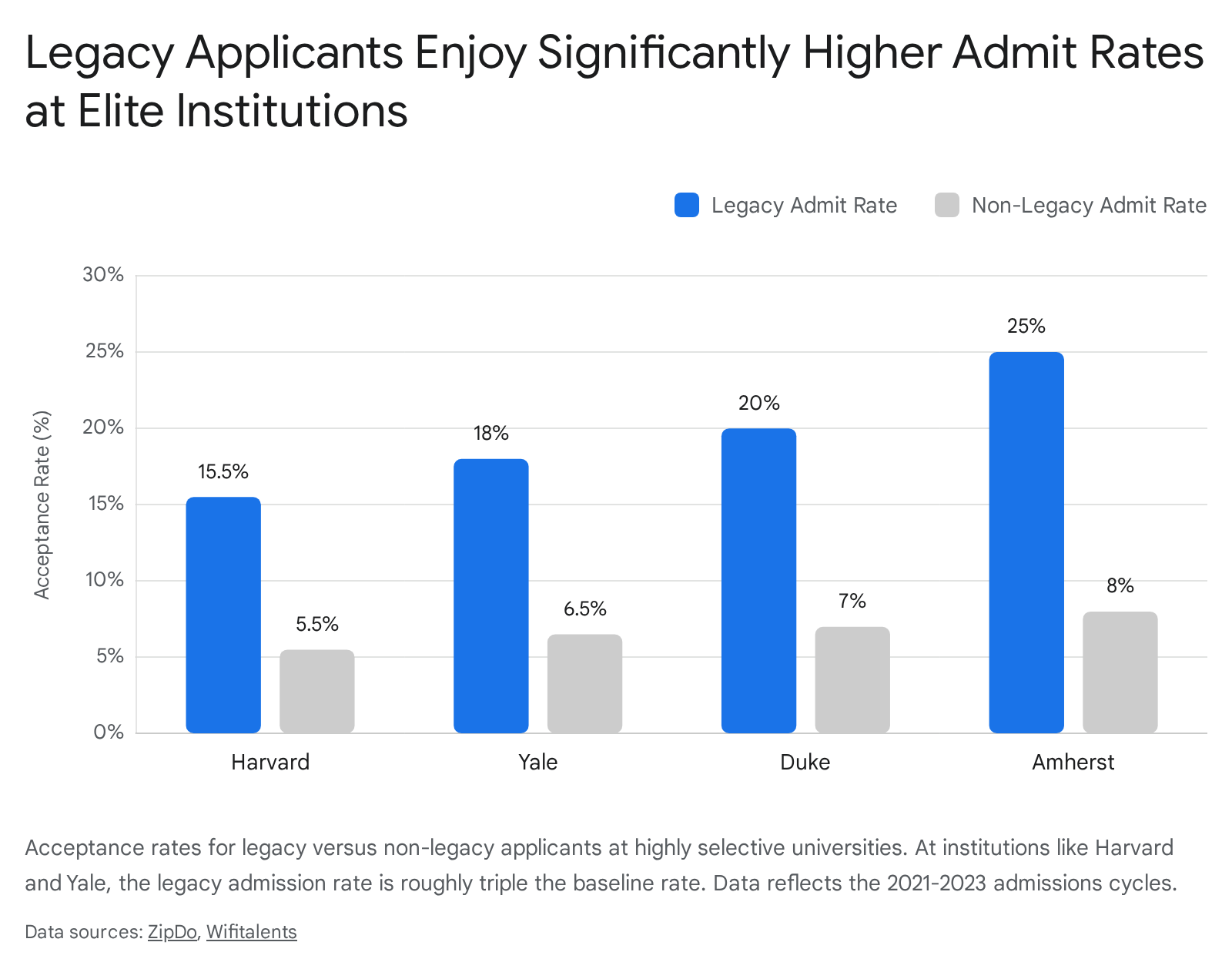
While overall acceptance rates at elite universities have plummeted into the single digits, legacy acceptance rates frequently hover in the double digits. Though many universities intentionally obscure these exact figures to avoid public backlash, data released through the Common Data Set, civil rights complaints, and student newspaper surveys paint a stark picture.
| Institution | Overall / Non-Legacy Admit Rate | Legacy Admit Rate | Estimated Multiplier |
|---|---|---|---|
| Amherst College | 8% | 25% | ~3.1x |
| Duke University | 7% | 20% | ~2.8x |
| Harvard University | 5-6% | 15-16% | ~3.0x |
| MIT (Historical) | 5% | 22% | ~4.4x |
| Stanford University | 4% | 13% | ~3.2x |
| University of Virginia | 11% | 19% | ~1.7x |
| Vanderbilt University | 8% | 22% | ~2.7x |
| Yale University | 6-7% | 18% | ~2.7x |
Note: Data reflects verified statistics from varying admissions cycles between 2020 and 2023. MIT dropped legacy preferences in recent years but historically exhibited massive disparities 8.
The data indicates that at schools admitting fewer than 10% of their total applicant pool, having an alumni parent effectively transitions a student out of a hyper-competitive lottery and into a highly favorable, distinctly separate admissions track.
The Intersection of Legacy and Early Decision
To fully grasp how the legacy advantage operates in practice, it is necessary to examine the mechanics of modern college admissions, specifically the deep interplay between legacy status and Early Decision (ED) programs.
Stacking the Multipliers
Early Decision is a binding agreement where a student commits to attending a university if admitted, pledging to withdraw all other college applications immediately. Universities heavily favor early applicants because it guarantees enrollment. At elite institutions, ED acceptance rates are routinely two to three times higher than Regular Decision (RD) rates 1112. For example, for the Class of 2028, the University of Pennsylvania admitted 14.7% of its ED applicants, compared to just 4.4% of its RD applicants. Similarly, Brown University admitted 14.8% of ED applicants versus 3.5% in the regular round 12.
Legacy status acts as a multiplier stacked directly on top of the early application multiplier. Colleges implicitly - and sometimes explicitly - demand that legacy applicants apply early to prove their loyalty and secure their preferential treatment. Until the Class of 2026 admissions cycle, the University of Pennsylvania's website explicitly featured language implying that legacies needed to apply Early Decision to receive the legacy boost 9. At Duke University, admissions consultants and historical data confirm that legacy consideration is significantly more impactful during the ED round, as it signals a firm commitment to the school 10. Former admissions leadership at Cornell University openly confirmed that legacy students have a greater chance of being accepted in the early decision round as a result of this "mutual commitment relationship" 1112.
The Socioeconomic Filter of Early Decision
The fusion of legacy preference and Early Decision creates a powerful socioeconomic filter. Because Early Decision is a binding contract, it inherently favors wealthy families who do not need to compare financial aid packages across multiple universities before committing 121713. Lower-income and middle-class students are often advised to avoid Early Decision so they can weigh competing merit scholarships and need-based aid offers in the spring.
When a university fills 40% to 60% of its incoming freshman class during the Early Decision round - as is common in the Ivy League - and disproportionately pulls legacy students from that early pool, the systemic advantage leans heavily toward affluent, generational college-goers at the direct expense of unhooked applicants 1114.
The Demographics of Legacy Students
The controversy surrounding legacy admissions is fundamentally rooted in demographics. Because elite institutions systematically favor the children of their alumni, the demographic makeup of the legacy pool mirrors the demographic makeup of graduating classes from thirty years ago.
The Concentration of Extreme Wealth
Legacy preferences overwhelmingly benefit the ultra-wealthy. Opportunity Insights data reveals that one in six Ivy League students has parents in the top 1% of the income distribution 5. This wealth concentration is distinctly magnified within the legacy cohort. According to 2023 data, 45% of legacy students admitted to Harvard come from families in the top 1% of the U.S. income bracket, compared to just 10% of non-legacy students 8. At Yale, 34% of legacy students hail from the top 1%, compared to 7% of non-legacy students. Stanford shows a similar divide, with 40% of legacy students hailing from the top 1%, versus 9% of non-legacy students 8.

The financial advantages compound further when analyzing merit aid and athletic recruitment. A 2023 study by the Urban Institute found that 48% of legacy students nationwide receive non-need-based merit aid, compared to just 8% of non-legacy students 8. Furthermore, NCAA data reveals that 40% of recruited athletes in the Ivy League are also legacy students. This highlights how elite, expensive sports - such as squash, rowing, tennis, and fencing - serve as overlapping pathways for affluent generational students to secure admission 48.
Racial Diversity Disparities
Legacy pools are consistently less racially diverse than the general applicant pool. At Princeton University, data from a self-reported Class of 2026 freshman survey indicated that 56% of legacy students identified as white, while fewer than 5% identified as Black. In contrast, within the non-legacy student body, only 43% identified as white, while 10% identified as Black and nearly 35% as Asian 20.
Across all highly selective four-year institutions in the United States that consider legacy status, the total undergraduate population is, on average, 59% white. At selective institutions that do not consider legacy status, the undergraduate population is significantly more diverse, averaging 51% white 15. Furthermore, Black students make up less than 7% of total legacy admits at Top 10 universities nationwide 7. Research indicates that high-scoring white applicants are three to six times more likely to have legacy status than high-scoring Asian American applicants, and two to three times more likely to have legacy status than high-scoring Black and Hispanic applicants 16.
For critics of the practice, these demographic realities dismantle the argument that legacy admissions are a harmless tradition. As U.S. Representative Barbara Lee noted following the Supreme Court's 2023 ruling against race-based affirmative action: "Let's be clear: affirmative action still exists for white people. It's called legacy admissions" 17.
The Academic Profile of Legacy Admits
When pressured to defend legacy admissions, universities rarely claim they admit unqualified students. Instead, they frame the practice as a "tiebreaker" in an applicant pool overflowing with exceptional talent.
Princeton University, which recently reviewed and reaffirmed its legacy policies, argues that legacy status is only used in "limited instances" between equally well-qualified applicants 18. Princeton notes that 70% of its legacy applicants are rejected, and that the preference ultimately benefits fewer than 30 students per year 1819. Similarly, Brown University's Ad Hoc Committee on Admissions Policies defended legacy preferences by stating that legacy matriculants generally have academic records that are stronger than the average enrolled student 2620. Survey data from Princeton supports this, showing that legacy students self-reported higher SAT scores (even when controlled for income) and higher college GPAs than their non-legacy peers 20.
The Subjectivity of "Holistic" Admissions
However, critics argue that the "tiebreaker" defense relies heavily on the subjective nature of "holistic" admissions. Elite universities evaluate candidates not just on test scores, but on non-academic ratings, extracurricular activities, and counselor recommendations. Wealthy students at elite private high schools systematically receive higher non-academic ratings because their schools offer boutique extracurriculars and employ guidance counselors who specialize in engineering perfect college resumes 45.
When an admissions officer uses legacy status to break a tie between two "equally qualified" applicants, they are often comparing a legacy student whose profile was meticulously optimized by expensive private resources against a lower-income, non-legacy student who achieved the same baseline metrics without those structural advantages.
Furthermore, post-graduation data challenges the notion that legacy students are inherently superior candidates. The Opportunity Insights study tracked hundreds of thousands of students over a decade and found no evidence that legacy students, recruited athletes, or those with high non-academic ratings had better long-term outcomes. In fact, legacy students were slightly less likely to reach the upper tail of the income distribution, attend an elite graduate school, or work at a prestigious firm than comparable non-legacy Ivy-Plus applicants 355. A separate study at a highly selective U.S. college (referred to anonymously as "The College" by MIT researchers) concluded that legacy applicants were, on average, not significantly more qualified than non-legacy candidates, and that giving them preference ran counter to the institution's goal of attracting the best talent 21.
Why Elite Universities Defend the Practice
Given the glaring socioeconomic inequities and intense public unpopularity - a 2022 Pew Research Center survey found that 75% of Americans oppose the practice - why do elite universities fight so hard to maintain legacy preferences 2223? The answer lies in the complex financial and operational machinery of modern higher education.
Yield Rate and Predictive Modeling
Universities are obsessed with "yield rate" - the percentage of admitted students who actually choose to enroll. A high yield rate makes a university appear highly desirable, directly influences prestigious rankings, and allows admissions offices to precisely control their incoming class size without over-enrolling or relying heavily on waitlists 242533. Furthermore, a predictable and high yield rate provides financial stability, which is scrutinized by credit agencies when determining a university's bond ratings 25.
Legacy students are highly predictable commodities in the admissions market. They yield at significantly higher rates than the general applicant pool because they possess a pre-existing familial loyalty to the institution 2620. For an admissions director attempting to shape a class and guarantee tuition revenue, legacy applicants represent a safe, highly reliable bet.
Alumni Giving and Endowment Growth
The most frequently cited justification for legacy admissions is its supposed impact on institutional fundraising. Administrators have long argued that providing an admissions boost to alumni children incentivizes alumni to donate generously, thereby funding the endowments that pay for financial aid for lower-income students 2635. At Harvard, 70% of legacy students have parents who have donated to the college, compared to just 5% of non-legacy parents 8. Furthermore, a study by MIT researchers found "strong evidence" that colleges benefit economically from admitting legacies, as they are less likely to apply for financial aid and more likely to have affluent parents capable of making significant donations 21.
However, the broader empirical evidence linking legacy admissions to overall university wealth is heavily contested. A study of top 100 national universities found no definitive connection between legacy preference policies and overall alumni giving rates 27. Furthermore, universities that have dropped legacy preferences have not seen their endowments collapse. When Johns Hopkins University quietly eliminated legacy preferences in 2014, its alumni giving remained robust, and its endowment continued to grow. Similarly, MIT and Caltech have never used legacy preferences, yet both maintain some of the largest endowments and highest alumni engagement rates in the world 2737.
Despite the mixed evidence on donations, the fear of alienating wealthy alumni networks remains a powerful deterrent for university presidents considering a policy change 335.
The Post-Affirmative Action Backlash
The debate over legacy admissions reached a boiling point in June 2023 when the U.S. Supreme Court issued its ruling in Students for Fair Admissions v. Harvard and Students for Fair Admissions v. UNC, effectively banning race-conscious affirmative action in college admissions 382840. The decision triggered an immediate and aggressive cultural backlash against legacy preferences. Lawmakers, advocacy groups, and students argued that if universities were prohibited from using race to engineer a diverse class, they could no longer legally or morally justify using ancestry to protect a privileged one 172329.
The Legislative Wave
Rather than waiting for universities to act voluntarily, state legislatures across the country have begun passing sweeping bans on legacy admissions. The movement, notably, enjoys rare bipartisan support, framing the issue as a matter of pure, unadulterated meritocracy 42.
| State | Scope of the Legacy Ban | Status / Effective Date |
|---|---|---|
| Colorado | Public colleges and universities | Enacted in 2021 2840 |
| Virginia | Public colleges and universities | Enacted in 2024 (Effective July 1, 2024) 284043 |
| Maryland | Public and private colleges receiving state funds | Enacted in 2024 (Effective July 1, 2024) 162843 |
| Illinois | Public colleges and universities | Enacted in 2024 404445 |
| California | Private and nonprofit colleges (Publics banned it in 1998) | Enacted in Sept 2024 (Effective Sept 2025) 16384044 |
The California ban is particularly consequential. Signed by Governor Gavin Newsom in September 2024, Assembly Bill 1780 (the "Merit-Based Educational Reforms and Institutional Transparency Act") specifically targets elite private institutions 3844. It legally compels powerhouse universities like Stanford, the University of Southern California (USC), and Santa Clara University to end legacy and donor preferences by September 2025 or face intense public reporting requirements 384446.
Legislative action is also currently pending in Massachusetts and New York 171628. In Washington D.C., the proposed Furthering Admissions Inclusion and Representation (FAIR) Act of 2025 threatens to strip universities like Georgetown and George Washington University of municipal tax breaks, permits, and grants if they continue to practice legacy admissions 48. At the federal level, lawmakers have introduced the MERIT Act, which seeks to end preferential treatment for donors and alumni across all institutions 42.
In response to the shifting legal and cultural landscape, dozens of institutions have preemptively dropped the practice. As of 2025, the number of four-year colleges considering legacy status has fallen to just 24%, down sharply from 49% in 2015 162326. Prominent recent defectors include Wesleyan University, Carleton College, Occidental College, and the University of Pittsburgh 2643.
Institutional Case Studies: Where the Elites Stand
Despite the mounting pressure, many of the nation's most prestigious universities have opted to weather the storm and retain their legacy preferences. Their approaches, however, vary widely in transparency and justification.
Brown University
Following the Supreme Court ruling, Brown University convened an Ad Hoc Committee on Admissions Policies to review its practices. While the committee ultimately recommended reinstating the SAT requirement and keeping binding Early Decision, it punted on the issue of legacy admissions, stating that current practices would remain unchanged while the university seeks more community input 2620. This decision was met with immediate friction on campus. A 2024 poll by The Brown Daily Herald found that nearly 60% of undergraduates oppose legacy admissions, while only 15% support it 4950. Legacy students currently make up approximately 8% of Brown's enrolled classes 2620.
Cornell University
Cornell has faced intense internal pressure to reform. In early 2024, the Cornell Student Assembly unanimously passed a resolution advocating for the end of legacy preferencing, citing that the practice inherently violates the university's founding motto of "any person, any study" 312. Despite the symbolic vote, Cornell has maintained its consideration of legacy connections. For the Class of 2025, 14.7% of students reported being descendants of Cornell alumni - a figure that outnumbered the proportion of Black students in the same class 1112.
University of Pennsylvania
UPenn has taken a notably quiet approach to modifying its policies. Leading up to the Class of 2026 admissions cycle, the university scrubbed legacy-specific information from its first-year applicant webpage, phased out legacy-specific information sessions, and removed language implying that legacies must apply Early Decision 9. Despite the removal of public-facing literature, Penn continues to acknowledge legacy relationships internally during the Early Decision round. Historically, about 13% of Penn's undergraduate body consists of legacy students 30.
Princeton University
Princeton has been one of the most vocal defenders of the practice. Following an internal review in March 2024, the university explicitly announced it would continue to consider legacy status 1852. The Board of Trustees justified the decision by arguing that legacy acts merely as a tiebreaker and has only a "small" impact on socioeconomic diversity 18. Princeton notes that 11.2% of the Class of 2028 are children of alumni, though student surveys suggest the number jumps to 18% when factoring in siblings and grandparents 52.
Georgetown University
Georgetown recently completed a two-year review of its admissions policies for 2025. While the university announced it would finally adopt the Common Application to increase accessibility, it explicitly stated it would not make any changes to its legacy admissions practices 3132. Internal presentations revealed that Georgetown typically accepts roughly 30% of legacy applicants, and that 25% of the admitted class are children of graduates 55. This stance has sparked fierce protests from student groups like "Hoyas Against Legacy Admissions," who have partnered with the D.C. City Council to push for a municipal ban 48.
Duke, Vanderbilt, and UChicago
Other elite institutions maintain legacy preferences as vital components of their early admissions strategies. Duke University, which admits 12.6% of Early Decision applicants compared to just 4.2% in Regular Decision, continues to give preference to legacy students, particularly in the binding early round 101333. Vanderbilt University actually dropped legacy admissions between 2005 and 2007, only to quietly reinstate the practice 57. The University of Chicago operates in a gray area; while the university tracks legacy status on its application, it publicly downplays its impact. Regardless, getting into UChicago remains incredibly difficult, with an overall acceptance rate of just 5.4% 335859.
Do Legacy Bans Actually Increase Diversity?
While eliminating legacy preferences removes a glaring systemic advantage for wealthy, white applicants, educational policy experts warn that a ban alone is not a silver bullet for increasing campus diversity.
A 2026 policy brief published in Education Finance and Policy by researchers at Vanderbilt University analyzed states and institutions that eliminated legacy preferences and found highly mixed results 3435. When the University of California system and the University of Georgia banned legacy preferences in the early 2000s - bans that coincided with state-level prohibitions on affirmative action - they saw negligible changes in racial and socioeconomic diversity 3435. Without the ability to actively consider race, eliminating legacy preference simply resulted in wealthy legacy students being replaced by wealthy non-legacy students with slightly higher test scores.
Conversely, when institutions pair legacy bans with proactive equity measures, the results are striking. When Johns Hopkins University voluntarily banned legacy admissions and simultaneously invested heavily in targeted financial aid and the recruitment of first-generation students, they saw significant gains in Black, Hispanic, and Asian enrollment, alongside a proportional decrease in white enrollment 35. The conclusion drawn by researchers is clear: stripping away a preference for the privileged only creates equity if a university actively builds well-funded pathways for the underrepresented.
The Global Perspective: How Europe Does It
The American defense of legacy admissions - that it is a necessary evil for maintaining institutional wealth and community - appears particularly fragile when viewed from a global perspective. The United States is effectively the only nation in the world where elite universities routinely use ancestry as a formal admissions factor 13527.
European universities, including global academic powerhouses like the University of Oxford, the University of Cambridge, the London School of Economics, and University College London, strictly forbid legacy, donor, and athletic preferences 1276263.
The admissions philosophy in the United Kingdom and continental Europe is intensely, and almost exclusively, focused on academic merit. At Oxford and Cambridge, admissions decisions are made directly by the faculty who will teach the specific subjects, not by an administrative admissions office focused on yield rates or alumni relations 63. Evaluations are based entirely on academic performance, subject-specific entrance exams, and rigorous academic interviews. Extracurricular activities, private high school pedigree, donor capacity, and family alumni ties are explicitly ignored in the evaluation process 626364.
When the last vestiges of legacy preference were swept out of Oxford and Cambridge in the mid-20th century, the institutions did not lose their prestige, their endowments did not collapse, and their alumni networks remained fiercely loyal 2737. For critics of the American system, the European model proves definitively that world-class universities can thrive both academically and financially without relying on hereditary privileges 3549.
Bottom line
Legacy admissions provide a massive, quantifiable advantage to the children of alumni, effectively multiplying their chances of acceptance at elite universities by three to five times. While universities argue that these preferences are mere tiebreakers used to protect yield rates and foster alumni donations, empirical data shows that the practice overwhelmingly benefits the wealthiest echelon of society and suppresses racial and socioeconomic diversity. As state legislatures across the country enact sweeping bans in the wake of the Supreme Court's affirmative action ruling, the era of legacy admissions in the United States appears to be rapidly coming to a close. However, eliminating legacy status alone will not automatically diversify elite campuses unless universities pair the ban with aggressive financial aid and outreach efforts.