
How Meaning-Making Helps Us Grieve
Meaning-making fundamentally transforms grief from an experience of passive suffering into an active process of psychological reconstruction. By helping the bereaved reconcile the agonizing discrepancy between a traumatic loss and their core beliefs about the world, it actively reduces emotional distress and serves as the primary buffer against the development of debilitating psychiatric conditions. Through sense-making, benefit-finding, and identity adaptation, individuals do not merely "move on" from loss, but rather integrate the deceased into an evolving, resilient life narrative.
Consider the everyday phenomenon of accidentally knocking a cherished, irreplaceable family heirloom vase off a shelf, watching it shatter into hundreds of distinct, jagged pieces across the floor. When faced with this wreckage, one instinctive approach is to attempt to glue the shards back together exactly as they were 12. However, the resulting vessel will always be visibly fractured, fragile, and fundamentally incapable of holding water as it once did. The alternative approach is to gather the broken pieces and fundamentally rearrange them to create a completely new mosaic 12. The fragments of the original vase remain, honoring the material of what was lost, but they are transformed into a different structure entirely, possessing its own unique beauty and strength. In the context of human psychology, traumatic loss abruptly shatters an individual's worldview, and the subsequent, painstaking effort to build a resilient, new mosaic out of the psychological wreckage is the precise essence of meaning-making 2.
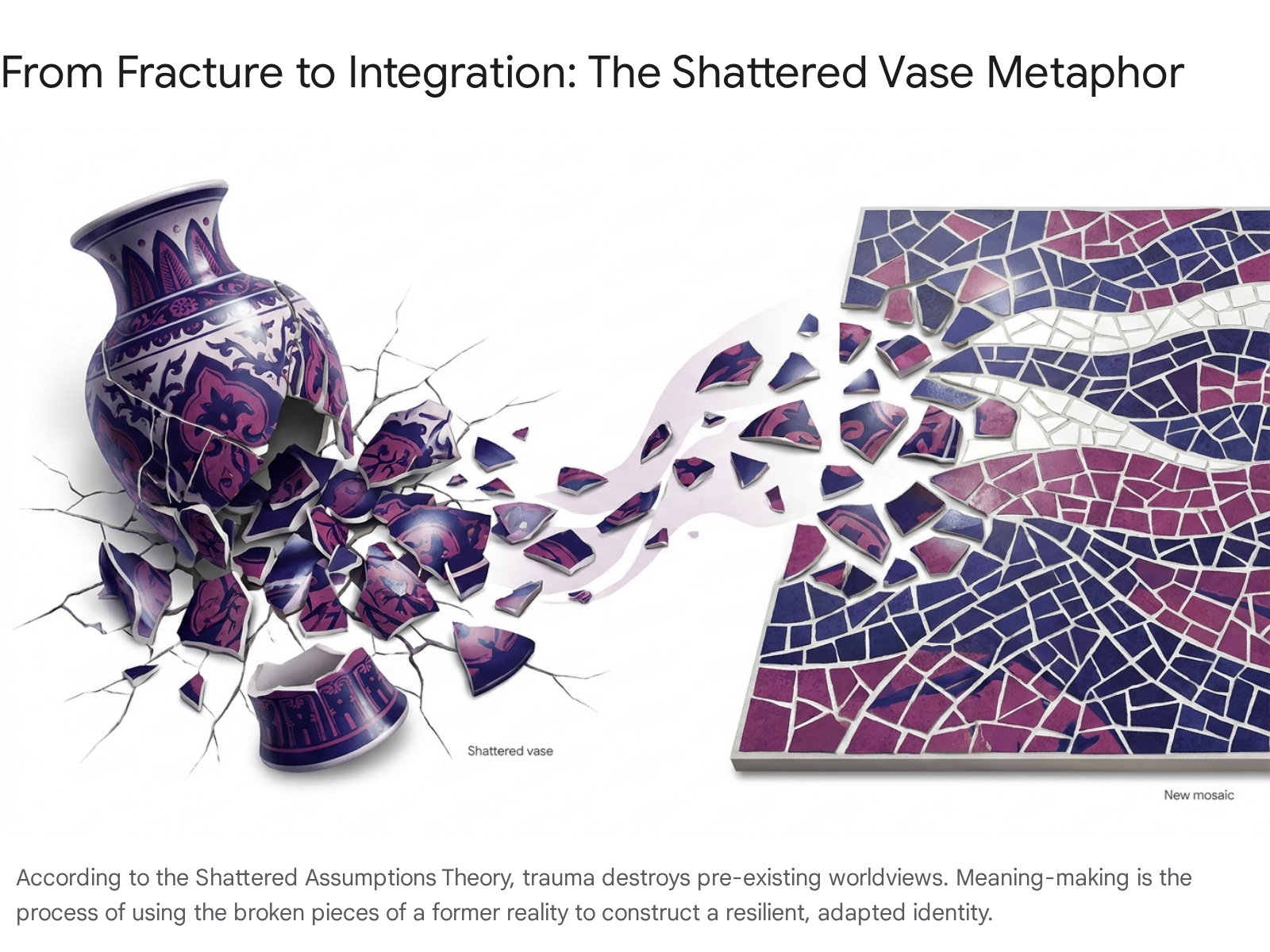
What Exactly is Meaning-Making in the Context of Bereavement?
In psychological literature, meaning-making is formally defined as the intricate cognitive, emotional, and social processes through which human beings construe, understand, and make sense of life events, relationships, and their own evolving identities 34. It is widely understood among behavioral scientists and clinicians that human beings are fundamentally meaning-making creatures, driven by a core psychological imperative to experience the surrounding world as comprehensible, significant, and purposeful 45. This drive is so fundamental that a perceived deficit in meaning can lead to severe psychological deterioration 68.
When a profound loss occurs - whether through the anticipated death of an aging parent, the sudden traumatic loss of a child, or a systemic community tragedy - it frequently violates an individual's "assumptive world." This concept, foundational to Ronnie Janoff-Bulman's Shattered Assumptions Theory, posits that humans operate on subconscious, deeply ingrained beliefs that the universe is inherently benevolent, predictable, and just, and that we have a degree of control over our destinies 2710. Catastrophic events sever the alignment between an individual's "global meaning," which constitutes their overarching belief system and life goals, and their "situational meaning," which is how they appraise the specific tragic event occurring in real-time 2610. This severe discrepancy between what one believes should happen and the agonizing reality of what has happened generates profound existential distress and cognitive dissonance 268.
Meaning-making is the psychological engine that attempts to resolve this agonizing distress. Rather than a singular epiphany, it is a multifaceted reconstructive mechanism that generally encompasses three distinct, yet overlapping, processes 7913. The first is sense-making, which involves the cognitive attempt to understand how and why the loss occurred. This requires integrating the harsh reality of the death into one's fundamental understanding of the world, which might involve accepting medical explanations, engaging in deep spiritual reflections, or acknowledging the inherent fragility and impermanence of biological life 89. Sense-making is primarily concerned with comprehensibility and coherence 514. The second process is benefit-finding, also known as significance evaluation. This involves the delicate process of identifying unintended positive outcomes, personal growth, or silver linings that emerged in the aftermath of the tragedy, without ever invalidating the agonizing pain of the loss itself 58910. Examples of benefit-finding include discovering profound inner psychological resilience, developing a deeper, more profound empathy for the suffering of others, or finding a renewed, urgent appreciation for life 8910. The final core component is identity reconstruction, which involves the necessary reorganization of the self-concept. Following a severe loss, a bereaved individual must often transition from being a spouse to a widow, or from an active caregiver to a bereaved parent. This requires a fundamental, often painful shift in how they view their daily roles, their social networks, and their future purpose in a world where the deceased is no longer physically present 78910.
These processes do not operate in a vacuum but are highly dependent on the bereaved individual's environment, cultural background, and pre-existing psychological flexibility. Researchers note that the capacity to attribute meaning to personal experiences may rest on a specialized cognitive system enabling complex causal reasoning, prompting humans to relentlessly search for the underlying purpose or reason for their life experiences 8. When this system is functioning optimally, people experience peace and life satisfaction; when it is disrupted by trauma, the resulting "meaninglessness" can be psychologically devastating 611.
How Does Meaning-Making Differ from the Traditional "Five Stages of Grief"?
For decades, popular culture, media narratives, and even standard clinical practice have relied heavily on the "Five Stages of Grief" - comprising Denial, Anger, Bargaining, Depression, and Acceptance. This model was famously introduced by the Swiss-American psychiatrist Elisabeth Kübler-Ross in her seminal 1969 book, On Death and Dying 171213. Originally designed to map the psychological experiences of patients confronting their own terminal illnesses, the model was subsequently, and perhaps erroneously, mapped onto the experiences of the bereaved who are left behind 91712.
While the Kübler-Ross framework undeniably provided a comforting, accessible vocabulary for normalizing painful emotions in an era when death was a heavily taboo subject, the theory is largely empirically unsupported as a universal, sequential, or linear pathway for general bereavement 1220. Modern grief researchers and clinicians increasingly view the stage model as overly passive and deterministic. It subtly implies that a grieving individual merely endures a sequence of emotional weather systems, waiting for one stage to pass into the next, until they finally arrive at the ultimate destination of "acceptance" 1320. Furthermore, within mainstream culture, the concept of "acceptance" is frequently conflated with the harmful expectation of "closure" - a pervasive psychological myth that suggests grief has a definitive endpoint where the emotional attachment to the deceased is severed, neatly resolved, and left entirely in the past 1020.
In stark contrast, the constructivist approach to meaning-making positions the bereaved individual as an active architect of their own psychological healing 1020. This paradigm shift was heavily influenced by Robert Neimeyer's constructivist model of grief therapy, which emphasizes that humans create a narrative that includes their underlying assumptions about the world, and that death disrupts this narrative, forcing an active reconstruction 10. Rather than moving through predictable emotional stages to reach a static endpoint, the individual engages in an ongoing, dynamic narrative reconstruction 1310. Furthermore, meaning-making does not seek to "get over" the loss or achieve a final closure. Instead, it aims to foster "continuing bonds" - a healthy, enduring psychological and emotional connection with the deceased that gracefully shifts from physical presence to internalized memory, ongoing legacy, and spiritual connection 2122.
This dynamic process is also reflected in the Dual Process Model (DPM) of coping with bereavement, which posits that adaptive grieving involves a continuous oscillation between "loss-oriented" stressors (crying, yearning, processing the death) and "restoration-oriented" stressors (learning new skills, forming new relationships, adapting to new roles) 1023. Meaning-making is seen as the central cognitive task that drives this healthy oscillation, allowing the individual to integrate the past while actively engaging with the future 1023.
| Feature | The "Five Stages of Grief" (Kübler-Ross Model) | Meaning-Making (Constructivist & Dual Process Models) |
|---|---|---|
| Origin & Foundation | Derived from qualitative observations of terminally ill patients confronting their own mortality in the late 1960s 1712. | Derived from cognitive psychology, trauma research, and modern studies on post-traumatic growth and narrative reconstruction 41010. |
| Nature of the Process | Predominantly passive and emotional. Implies individuals are swept through sequential emotional states (Denial to Acceptance) 1713. | Highly active and cognitive. The individual engages in deliberate efforts to rebuild their shattered worldview and assimilate new realities 610. |
| Expected Trajectory | Often interpreted by the public as linear, though later revised by proponents to be non-linear. Tends to inadvertently pathologize individuals who "get stuck" 171320. | Highly individualized, non-linear, and life-long. Relies on continuous oscillation between confronting the loss and restoring life functionality 2023. |
| Ultimate Clinical Goal | Acceptance and Closure: Reaching a state of emotional neutrality, letting go, or finalizing the experience of the loss 1214. | Integration and Continuing Bonds: Weaving the loss into a new identity while maintaining a healthy, psychological relationship with the deceased 1021. |
| Current Empirical Support | Widely recognized in popular culture but heavily criticized by contemporary psychologists for lacking robust, modern empirical support 12. | Extensively supported by recent clinical trials, neurobiological research, and longitudinal studies on psychological resilience and psychopathology 71015. |
Why is "Everything Happens for a Reason" Not True Meaning-Making?
As the concept of meaning-making gains prominence in therapeutic circles, a critical distinction must be made between genuine psychological integration and the modern cultural phenomenon of "toxic positivity." Toxic positivity is defined as the pervasive, often aggressive societal pressure to maintain a cheerful, optimistic facade regardless of the severity of one's circumstances 26. In the context of profound bereavement, it manifests through well-intentioned but deeply invalidating platitudes such as "just look on the bright side," "focus on gratitude," or the particularly damaging and ubiquitous phrase, "everything happens for a reason" 2728.
Psychological research indicates that the cultural compulsion to enforce toxic positivity upon the bereaved stems largely from a societal intolerance for existential anxiety 2829. Observers, feeling entirely helpless and deeply uncomfortable in the face of another person's profound suffering, rely on these cliches as a psychological bulwark to minimize their own distress 2930. By declaring that a tragedy has a preordained purpose, a superstructure is artificially created to replace chaos with order and doubt with certainty, transferring the responsibility of the tragedy to fate or the universe 29. However, this effectively silences the bereaved individual 2830. When grieving individuals are pressured to suppress genuine, messy feelings of despair, rage, and profound sadness, they experience increased isolation, deep shame, and psychological distress, which ultimately halts the natural, necessary progression of emotional processing 2628. As researchers note, individuals risk further alienation when society expects them to function as "the poster child for resilience" while they are internally choking on overwhelming sadness 30.
The idiom "everything happens for a reason" is frequently masqueraded as a form of meaning-making, but psychologically, it operates as a rigid defense mechanism 2931. It attempts to artificially impose a grand, external design onto chaotic events, stripping the bereaved of their agency and invalidating the horrific senselessness of tragic, premature, or violent losses 2932. True meaning-making, conversely, does not demand that the trauma itself was inherently good, pre-planned, or justified. Post-Traumatic Growth (PTG) is not about feeling grateful for the traumatic experience, nor does it require the belief that the suffering was a necessary prerequisite for personal development 232.
Genuine meaning-making is the antithesis of toxic positivity because it demands a rigorous, unflinching confrontation with the agonizing reality of the loss 2732. It is an honest appraisal that allows for deep emotional duality. An individual can feel total, crushing despair regarding a shattered future while simultaneously, in the very same moment, finding instances of purpose, profound interpersonal connection, and ongoing legacy 2732. As grief experts articulate, positivity and excruciating pain can and must live side by side; neither cancels out the other 2728. Furthermore, the pressure to "find the silver lining" can be particularly harmful to neurodivergent individuals or those experiencing systemic trauma, as it converts the inability to immediately find meaning into evidence of personal inadequacy 3233. True meaning-making acknowledges that some losses are simply senseless, and the "meaning" is not found in the event itself, but in the deliberate actions the survivor takes in the aftermath to rebuild their life 3233.
How Does Recent Research Connect Meaning-Making to Prolonged Grief Disorder?
While acute grief is a universal, natural, and necessary response to bereavement, extensive epidemiological and clinical data indicate that a notable subset of mourners - approximately 7% to 10% of the bereaved population - experience a debilitating, unyielding form of suffering that fails to integrate over time 341617. Recognizing the specific clinical needs of this population, the psychiatric community formally codified this severe trajectory as Prolonged Grief Disorder (PGD). It was added to the International Classification of Diseases (ICD-11) by the World Health Organization and, more recently, incorporated into the Diagnostic and Statistical Manual of Mental Disorders, Fifth Edition, Text Revision (DSM-5-TR) by the American Psychiatric Association in 2022 111819.
PGD is formally diagnosed when severe grief reactions persist and cause significant functional impairment at least 12 months post-loss for adults, or 6 months for children and adolescents 1119. The core diagnostic criteria center on intense, persistent yearning, longing, and an overwhelming preoccupation with thoughts or memories of the deceased 1117. Crucially, the DSM-5-TR highlights severe existential and cognitive disruptions as key accessory symptoms, specifically listing "feeling that life is meaningless as a result of the death," "identity disruption," and a "marked sense of disbelief about the death" 111620. Due to its polythetic diagnostic criteria, PGD can manifest in 657 possible clinical presentations, making it a highly heterogeneous and complex disorder to treat 40.
Emerging neurobiological, longitudinal, and clinical research spanning 2023 to 2026 profoundly underscores the protective and therapeutic power of meaning-making against PGD, revealing the mechanisms through which broken assumptions lead to pathology:
The Mediating Role in Traumatic Bereavement: Studies investigating high-risk populations, such as individuals bereaved by suicide or parents who have lost a child to pediatric cancer, reveal that the traumatic nature of these deaths severely impedes the innate ability to reconstruct meaning 821. The sheer violence, suddenness, or perceived unnatural order of the death leaves the assumptive world permanently fractured, making sense-making nearly impossible 842. However, recent quantitative research explicitly demonstrates that meaning-making acts as a powerful statistical mediator. A 2025 study examining individuals bereaved by suicide found that when these individuals are successfully guided to reconstruct meaning, the pathway between the traumatic event and the development of complicated grief is effectively disrupted 2143. The meaning-making process accounted for nearly 45% of the variance in reducing complicated grief and fostering post-traumatic growth, suggesting that meaning reconstruction is the central mechanism of recovery 43.
Neurobiological Underpinnings and Daily Fluctuations: Advancements in Experience Sampling Methodology (ESM) and functional Magnetic Resonance Imaging (fMRI) are illuminating the daily and neurological reality of PGD. ESM studies from 2025 and 2026, which track bereaved individuals multiple times a day, reveal that PGD is not a static state of sadness but a highly fluctuating condition 2044. Participants demonstrating high variability and instability in their grief symptoms throughout the day are at an elevated risk for severe PGD, as this instability reflects an ongoing failure to assimilate the loss into a coherent narrative 2044. Concurrently, neurobiological research highlights that PGD involves alterations in the brain's reward-attachment networks, particularly hyperactivation in the nucleus accumbens, as well as dysregulation in oxytocin levels and cortisol rhythms 341718. PGD is characterized by an agonizing, addictive neurobiological loop of longing for the deceased 1740. Meaning-making interventions actively target the cognitive frameworks that sustain this loop. By restructuring the narrative of the loss, the brain is gradually trained to shift from a state of acute, panicked separation distress to a state of internalized, secure connection 221640.
Superiority of Meaning-Focused Clinical Interventions: The clinical efficacy of interventions that force meaning-making is becoming undeniable. A pivotal 2024 randomized clinical trial compared the efficacy of grief-focused Cognitive Behavioral Therapy (CBT) against Mindfulness-Based Cognitive Therapy for individuals diagnosed with PGD 15. While mindfulness offers excellent tools for general emotional regulation, the study concluded that grief-focused CBT demonstrated significantly greater reductions in prolonged grief severity six months post-treatment, with a large effect size 1522. The superior efficacy of CBT and specific Meaning-Centered Grief Therapy (MCGT) protocols lies in their direct, unflinching targeting of maladaptive cognitions 151946. These therapies explicitly require the patient to abandon avoidance behaviors, confront the detailed narrative of the death, and actively construct new meaning, identity, and future-oriented goals 1519. As one 2025 systematic review noted, meaning-making interventions are highly effective tools for emotional regulation, psychological adjustment, and identity repair following bereavement 747.
How Do Non-Western and Indigenous Cultures Approach Collective Meaning-Making?
Western psychological frameworks have historically viewed grief through a highly individualized, clinical lens, often treating it as a private, intrapsychic problem to be solved within the confines of a therapist's office 2048. This paradigm risks deeply isolating the bereaved, placing the entire burden of meaning reconstruction on the individual, and inadvertently pathologizing natural human suffering 4849. Conversely, global clinical anthropology and cross-cultural studies reveal that many non-Western and Indigenous cultures inherently conceptualize meaning-making as a collective, communal responsibility rather than a solitary endeavor 4823.
By embedding the loss within a broader sociocultural and spiritual tapestry, these traditions automatically provide the bereaved with a structured, culturally sanctioned pathway for sense-making, emotional regulation, and identity reconstruction 4824.
North American Indigenous Traditions: Across many Native American and First Nations communities, grief is seamlessly integrated into the continuous cycle of nature, community life, and ancestral connection. The processing of loss relies heavily on guidance from Elders, who serve as the custodians of cultural protocols for end-of-life ceremonies 48. Communal storytelling circles are a cornerstone of this process. Rather than being mere entertainment, these circles operate as highly sophisticated forms of communal therapy and historical preservation 5225. When a story of trauma, survival, or remembrance is shared, it creates a secure container for collective emotional release, reinforcing principles of interconnectedness and shared humanity 5225. The Haudenosaunee perspective emphasizes achieving "Ka'nikonhrÌ:io" (a good mind) by clearing the clouded thoughts of grief through direct connection with nature and water 26. The Inuit traditions emphasize the absolute necessity of opening up and expressing emotions verbally to the community to unpack deeper feelings, expressly viewing the internal bottling of grief as unhealthy 26. Furthermore, practices such as smudging, rhythmic drumming, and honoring the land activate the parasympathetic nervous system, physiologically regulating the trauma response while fostering deep spiritual meaning and trust 5556.
South American and Mesoamerican Rituals: In the Quechua-speaking communities of the remote Peruvian Andes, the Wawa Pampay is an ancestral funeral ritual dedicated specifically to processing the profound, destabilizing grief of losing a child 2758. Rather than isolating the grieving parents in their despair, the entire community engages in the ritual, which involves transforming immense sadness into a collective act of singing, remembrance, and transition over the course of a day and night 2758. The existential dimension of the loss is articulated through the native Quechua language (runasimi), framing the deceased child as a pure spirit passing directly to heaven without sin 2758. The burial takes place in a communal space decided by local authorities, ensuring the child remains part of the community fabric 27. This intense communal support provides an immediate framework for meaning, transforming a potentially psychologically devastating loss into an event that reinforces social cohesion, passes down oral history, and preserves cultural identity 58. Similarly, the Nahua indigenous people of Mexico conduct a double burial - first for the physical body, and a second, nine days later, for the soul (the shadow), drawing crosses of lime and sand to guide the spirit, ensuring the community actively participates in the deceased's metaphysical journey 59. In Brazil's Xingu reserve, grief is processed through celebratory combat, ceremonial dances adorned in body paint and feathers, and the decoration of tree trunks representing the deceased, turning mourning into an active celebration of life 59.
African Indigenous Practices: In West Africa, the Dagara people view grief as a highly expressive, communal obligation that cannot be undertaken alone. The process involves a "Vigil" to create a sacred, safe space for the bereaved, followed by a "Healing Ceremony" 60. This ceremony involves days of intense collective crying, storytelling, and rhythmic drumming, where the community witnesses and supports the release of emotional wounds 60. The rhythmic movement and deep community trust inherent in these drum and dance circles are biologically restorative; they are documented to naturally catalyze the release of serotonin (vital for mood stabilization), oxytocin (fostering trust), and endorphins, effectively combating the severe isolation characteristic of Western grief 56. Similarly, the Umgidi feast among the isiXhosa people of Southern Africa provides a dedicated space where the community shares a meal, intertwining laughter and tears 60. By sharing stories and physical presence, the community explicitly demonstrates solidarity, carrying the psychological burden of meaning-making as a collective unit rather than leaving the immediate family to forge it alone 6028.
Oceania and Eastern Traditions: In New Zealand, the Māori Tangihanga (or tangi) is a powerful multi-day mourning process where the deceased lies in state on the marae 55. Extended family (whānau) and the broader community gather to sleep, eat, and weep intimately beside the body for days. Through karakia (prayers) and the intense, physical expression of the haka (ceremonial dance), the community provides a powerful energetic and physical container for deep, open-hearted grief 55. In the Aboriginal communities of Northern Australia, such as the Tiwi people, grief is constant due to systemic health and social inequities 62. Yet, meaning is consistently made through collective yarning, reminiscing about the deceased's specific attributes (like their sporting prowess), and participating in smoking ceremonies the day after a funeral to respectfully guide the spirit away from the physical home 62. In Hindu traditions, the Antyesti (last rites) and the subsequent highly structured 13-day mourning period culminate in the Terahvin 48. The cosmological framing of death as a transition in a grand karmic journey naturally provides a spiritual narrative of continuity, effectively bypassing the crisis of "meaninglessness" and finality that often plagues secular Western mourners 48.
What Are the Actionable Steps and Clinical Interventions for Cultivating Meaning?
While clinical therapy is essential for cases of Prolonged Grief Disorder, everyday meaning-making is accessible through deliberate, reflective practices. Drawing upon recent developments in constructivist grief therapy, including Dr. Kriti Gaur's newly synthesized 2024 "Process Oriented Meaning-Making" (POMM) model, the following actionable steps offer a framework for individuals navigating loss 206364.
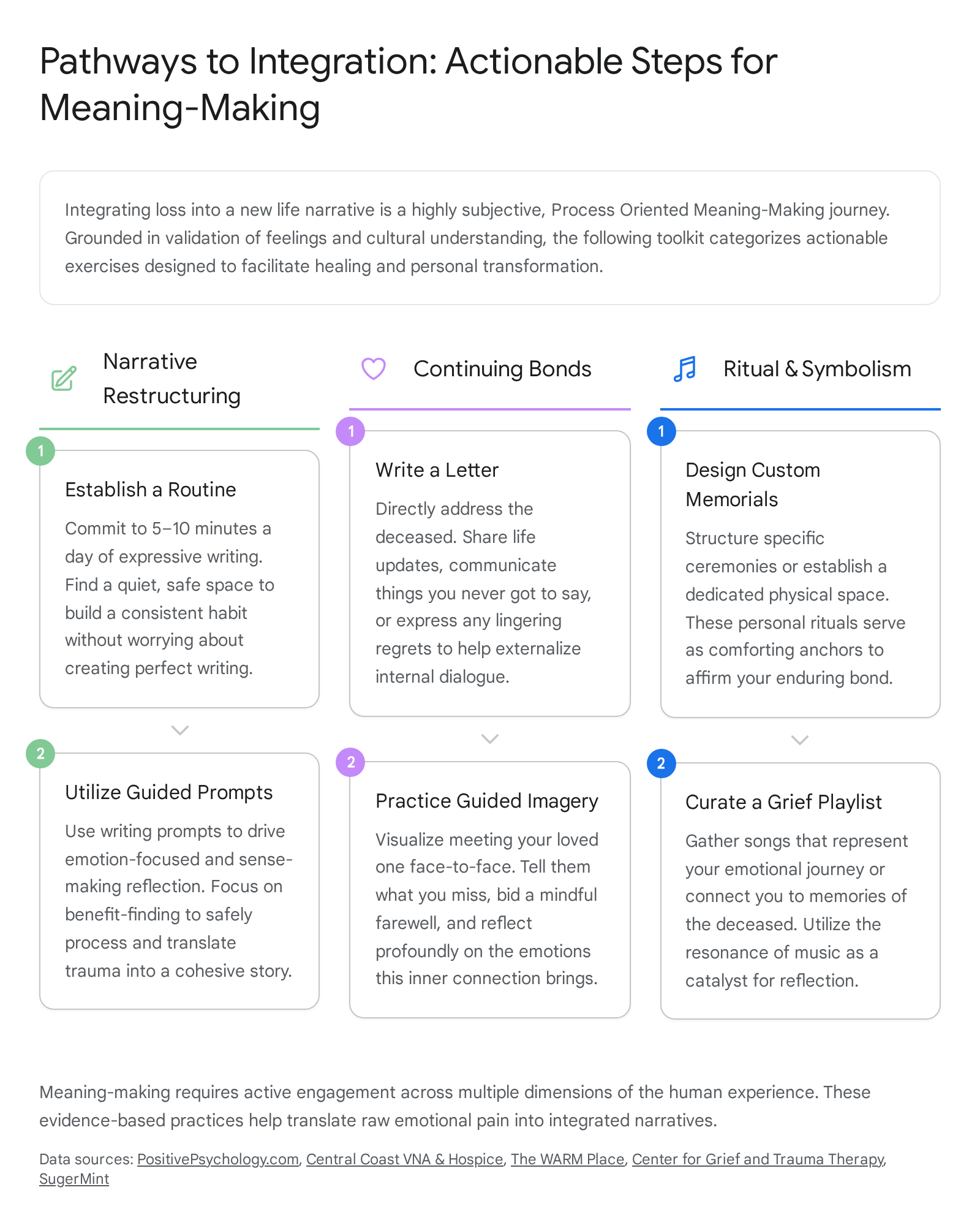
The first crucial step involves differentiated expressive journaling. Journaling is frequently recommended for grief, but effective meaning-making requires a targeted approach rather than simply venting despair onto a page 2229. The bereaved must engage in specific modes of writing. Emotion-focused writing is utilized to explore the raw, unedited pain and anger of the present moment without judgment 22. Sense-making writing tasks the individual with reconstructing the actual narrative of the event itself, arranging the timeline of the loss to reduce the chaotic trauma of the memory 22. Finally, benefit-finding writing, which is typically used later in the healing process, encourages the individual to reflect deeply on personal strengths discovered during the ordeal, or profound shifts in life priorities 22. Moving deliberately through these different styles prevents cyclical rumination and actively encourages narrative progression 2229.
The second actionable domain focuses on cultivating "continuing bonds." Because psychological healing does not require forgetting the deceased, the bereaved can actively foster an ongoing, internalized relationship 2130. This can be achieved through letter writing, where the individual composes private messages to the deceased to share ongoing life updates, express unsaid apologies, or seek internal guidance 2931. In safe, therapeutic settings, individuals can also use guided imagery to vividly visualize meeting the deceased face-to-face, having a meaningful conversation, and practicing saying a peaceful goodbye. This sensory-rich exercise helps re-establish attachment security and provides a profound sense of psychological safety 21.
The third practical application involves the creation of intentional memorial rituals. When traditional, societal mourning structures fall short or feel impersonal, creating highly personalized rituals provides a dedicated anchor for processing grief 29. This is not about public performance, but internal, emotional validation. For instance, the creation of grief playlists leverages the fact that music bypasses cognitive defenses and taps directly into emotional memory 31. Curating a specific playlist of songs that represent the deceased, or the journey of the grief itself, creates a controllable, time-bound container for feeling deep sorrow without the fear of being consumed by it throughout the entirety of the day 31. Similarly, engaging in legacy projects - such as planting a dedicated memory garden, establishing a local scholarship, painting a portrait that captures the distinct characteristics of the family dynamic, or building a traditional ancestor altar - channels the chaotic, overwhelming energy of grief into a tangible, permanent manifestation of enduring love 9602931.
Underpinning all these actions is the necessity of adopting frameworks like the Process Oriented Meaning-Making (POMM) model, which was developed to provide an 8-step, evidence-based guide for multicultural grief counseling 2063. A core tenet of POMM is the practice of "double listening" - training the bereaved and the counselor to tune into both the internal narrative of suffering and the simultaneous, quieter emerging narrative of resilience 6364. It encourages the individual to validate all emotions without moral judgment, map their shifting identity constellations, and actively engage in behaviors, such as victim advocacy or community support, that expand their personal loss into a broader, healing societal purpose 2064.
Bottom Line
The psychological and architectural paradigm of grief has fundamentally shifted in recent years. Recovery from profound loss is no longer viewed by experts as a passive wait for the myth of "closure," nor is it a forced, highly damaging march toward toxic positivity. Instead, extensive evidence-based psychology confirms that human beings must become active architects of their own healing through the rigorous process of meaning-making. By engaging in cognitive sense-making, recognizing unexpected post-traumatic growth, and forging continuing bonds, the bereaved can effectively reconstruct their shattered assumptions and protect themselves against the severe impairments of Prolonged Grief Disorder 61021.
Looking to the future, the clinical landscape of bereavement is entering a phase of calibrated uncertainty and rapid technological advancement. As neuroimaging tools like fMRI begin to map the precise biomarkers of grief severity in the brain's reward pathways 17, and ecological momentary assessments track the highly volatile daily symptom networks of the bereaved in real-time 4044, grief therapy will become increasingly personalized and precise. However, despite these modern scientific advancements, the enduring wisdom of Indigenous and global cultures clearly demonstrates that the most sophisticated psychological treatments will ultimately, and always, rely on the oldest of human technologies: community presence, intentional ritual, and the profound, healing power of shared storytelling 525632.