
Neurobiological differences between solitude and loneliness
The human nervous system is evolutionarily calibrated to depend on social integration for survival, interpreting social structures as a primary mechanism for resource acquisition and threat mitigation. Consequently, the physical absence of social interaction serves as a critical biological stimulus. However, this stimulus manifests in two radically distinct psychological and physiological trajectories: loneliness and solitude. While frequently conflated in colloquial usage and broad clinical assessments, these states represent divergent neurobiological phenotypes. Loneliness functions as an involuntary, chronic stressor characterized by a perceived social deficit, initiating autonomic hyperarousal, systemic inflammation, and accelerated cognitive decline. Conversely, restorative solitude represents an elective state of inner-directed awareness that facilitates parasympathetic recovery, cellular repair, neuroplasticity, and emotional regulation. Differentiating these two states requires an exhaustive examination of their underlying neural architectures, endocrine responses, behavioral markers, and cross-cultural frameworks.
Conceptual Definitions and Psychological Frameworks
The fundamental divergence between loneliness and solitude resides in volition, perceived agency, and affective valence. The objective physical condition of being alone is biologically neutral; the subjective cognitive appraisal of that aloneness dictates the nervous system's subsequent physiological cascade.
Volition and Perceived Social Deficit
Loneliness is defined as a distressing subjective experience arising from a perceived discrepancy between an individual's desired and actual social connections 12. It is an involuntary state of perceived isolation that operates entirely independently of objective social network size. Individuals can experience profound loneliness while embedded in dense social environments, or they may feel entirely fulfilled while physically isolated for extended periods 13. The cognitive discrepancy model of loneliness posits that the definitive criterion for this distress is subjective preference or expectation, making objective social isolation neither a necessary nor a sufficient requirement for the pathology of loneliness 3. Loneliness is fundamentally a crisis of unmet social expectations and the absence of emotional reciprocity 13.
Solitude, by contrast, is characterized by the voluntary seeking of physical or psychological separation from social stimuli. It is an intentional, self-determined state utilized for rest, reflection, and inner-directed thought 145. The autonomy inherent in choosing solitude acts as a psychological buffer against the distress of isolation, transforming the absence of others into a restorative presence of self-awareness. When solitude is chosen rather than imposed, it correlates consistently with enhanced psychological well-being, increased subjective autonomy, improved competence, and higher self-esteem 66. The voluntariness of the situation is the primary factor that tips the balance between positive solitude and the negative experience of loneliness 17.
The Spectrum of Aloneness
To accurately differentiate the clinical and biological outcomes of time spent alone, developmental psychologists and neuroscientists categorize aloneness across a spectrum of affective experiences and neurological states.
| Construct | Volition Level | Primary Affective State | Autonomic Nervous System Bias | Cognitive Network Dominance | Primary Clinical Health Outcome |
|---|---|---|---|---|---|
| Restorative Solitude | High (Elective) | Calm, peaceful, internally focused | Parasympathetic (High Vagal Tone) | Default Mode Network (Functional) | Cellular repair, emotional regulation |
| Objective Isolation | Variable | Context-dependent (Neutral to lonely) | Context-dependent | Context-dependent | Elevated cardiovascular risk if prolonged |
| Social Withdrawal | Moderate (Reactive) | Anxious, avoidant, overwhelmed | Sympathetic (Fluctuating) | Salience Network / Amygdala | Variable; elevated risk of depression |
| Chronic Loneliness | Low (Involuntary) | Distressed, hypervigilant, isolated | Sympathetic (Chronic arousal) | Altered DMN connectivity / Amygdala | Systemic inflammation, cognitive decline |
This classification highlights that the mere absence of social interaction does not unilaterally dictate health outcomes. Instead, the psychological framing of the isolation acts as a definitive biological switch 18.
Personality Correlates and the Extroversion Paradigm
A pervasive psychological misconception assumes that solitude strictly benefits introverted individuals, while extroverted individuals inevitably suffer psychological deterioration in isolation. Empirical evidence robustly refutes this binary classification. While extroverts actively seek external stimuli and emotional support through social interactions, and introverts are more prone to seeking solitary environments, the necessity for restorative solitude transcends personality typologies 10910.
Research indicates that introversion is often negatively related to aspects of psychological well-being because solitary time can promote engagement in negative patterns of thinking, such as rumination, which correlates with negative affect and loneliness 1011. Introverts require social connection to fulfill belongingness needs just as much as extroverts do 10. However, the quality of intentional solitude remains highly beneficial for extroverts. Extroverts, who frequently pursue external stimuli to manage stress, also experience significant depletion of attentional and emotional resources in highly demanding social or workplace environments 9.
Quantitative studies demonstrate that when extroverts engage in intentional, inner-directed solitude, they successfully utilize the time to downregulate high-arousal emotions, process daily events, and reset their psychological equilibrium 4911. An individual's personality may dictate the frequency and duration of solitude required, but it does not dictate the physiological efficacy of the restorative state itself. Personality traits such as introversion do not strictly correlate with a preference for time alone, concluding that personality has little to do with the self-determined, functional action of solitude 411.
Neurobiological Architectures of Loneliness
Chronic loneliness fundamentally alters the structural architecture and functional connectivity of the brain. Because the human species depends on social structures for safety, the brain interprets persistent social deficit as an acute survival threat. This triggers neurobiological adaptations that prioritize short-term self-preservation and hypervigilance at the direct expense of long-term cellular health and cognitive flexibility 1213.
Amygdala Reactivity and Threat Detection
Functional neuroimaging demonstrates that lonely individuals exhibit significantly altered activity within the "social brain," particularly in regions associated with threat detection, emotional regulation, and social cognition. Loneliness is consistently associated with heightened reactivity in the amygdala in response to social stimuli 12. This hyperactivation results in a state of chronic hypervigilance, where neutral or ambiguous social cues are rapidly misinterpreted as hostile, rejecting, or threatening.
Concurrently, the prefrontal cortex - the region responsible for executive function, inhibitory control, and the logical regulation of emotional responses - shows reduced functional connectivity with the amygdala in lonely individuals 12. Over time, chronic loneliness is linked to reduced gray matter volume in the prefrontal cortex, actively impairing an individual's ability to logically downregulate the fear response generated by the amygdala 12. Furthermore, the anterior cingulate cortex (ACC), which processes both physical pain and social exclusion, remains persistently hyperactive in lonely states 113. Research indicates that the ACC becomes especially active during perceived social exclusion, demonstrating that chronic loneliness triggers sympathetic arousal via amygdala hyperactivity and ACC engagement, signaling acute social threat. In stark contrast, restorative solitude engages parasympathetic dominance, utilizing the vagus nerve to downregulate stress and activating functional Default Mode Network pathways for introspection 1121314.
Additional research suggests complex sex-specific neurobiological effects regarding amygdala habituation. Studies have found that lonely men, but not women, demonstrated reduced amygdala habituation to repeated fearful faces and exhibited amygdala hyperreactivity during fear conditioning, pointing toward distinct physiological pathways in the manifestation of loneliness-induced anxiety 15.
Default Mode Network Connectivity and Rumination
The Default Mode Network (DMN) is a distributed collection of interconnected brain regions - including the medial prefrontal cortex, posterior cingulate cortex (PCC), and precuneus - that is typically inhibited when an individual focuses on external tasks 116. In the absence of external attention, the DMN defaults to internally focused thought processes, such as self-referential processing, autobiographical memory, and social mentalizing 1617.
In socially isolated and lonely individuals, the DMN exhibits highly irregular functional connectivity patterns. A landmark 2023 study published in Nature Neuroscience, which leveraged the Lifespan Human Connectome Project Aging dataset across a broad adult age range, utilized graph theory to map these changes. The data revealed that loneliness significantly alters the local interconnectivity of the DMN and the frontoparietal control network 218. The study found an age-dependent influence on the association between loneliness and brain network organization; younger individuals showed increased local interconnectivity associated with loneliness, while older individuals showed decreased local interconnectivity, highlighting a disruption in systems involving both internal mental processes and executive control 2.
Instead of facilitating productive self-reflection, this altered DMN connectivity in lonely individuals is associated with maladaptive rumination 121619. Recent studies have identified specific subsystems within the DMN critically involved in ruminative processes, noting that rumination-related hyperactivation is predominantly observed in the core DMN (cDMN) and dorsal DMN (dMDN) subsystems 16. The brain becomes trapped in an internally focused loop of negative self-referential thought, concentrating heavily on perceived social inadequacies. Furthermore, neural representations in the dorsal and ventral medial prefrontal cortex (dmPFC) that distinguish the self from others become blurred in lonely individuals, impairing their ability to accurately predict and interpret the mental states of peers 1517.
Cerebellar Involvement and Predictive Processing
Beyond the DMN, neuroimaging highlights the involvement of the cerebellum in the pathology of loneliness. Increased cerebellar volume, activation, and connectivity to areas of the DMN positively correlate with susceptibility to loneliness during periods of isolation 15. The posterior cerebellum is functionally connected with most areas in the social cognition network and is heavily associated with making socio-cognitive predictions 15. In lonely individuals, the synchronization between the cerebellum and the DMN is altered, disrupting the internal models used to predict the outcomes of social interactions. This misalignment contributes to the continuous mismatch between expected social integration and the perceived reality of exclusion, feeding the cognitive discrepancy that defines the lonely state.
Physiological and Endocrine Consequences of Isolation
The psychological distress of loneliness translates directly into physiological deterioration via the continuous activation of the hypothalamic-pituitary-adrenal (HPA) axis and the sympathetic nervous system. Because the brain perceives isolation as an ongoing threat, it maintains a defensive biological posture that causes severe systemic damage over time.
Hypothalamic-Pituitary-Adrenal Axis Dysregulation
Chronic social isolation acts as a persistent stressor, maintaining elevated levels of systemic glucocorticoids, primarily cortisol, in both human and animal models 122021. A study analyzing salivary cortisol levels demonstrated that forced social isolation during pandemic lockdowns intensified the positive association between momentary loneliness and cortisol spikes, reflecting the context-dependent modulation of neuroendocrine stress responses by the social environment 22.
Prolonged HPA axis activation leads to glucocorticoid receptor resistance, which subsequently disinhibits the immune system's inflammatory response 20. The transcription factor NF-κB, which plays a key function in regulating immune and inflammatory responses, becomes highly active in lonely individuals 21. The activation of the NF-κB signaling pathway induces the expression of cytokine and chemokine genes, increasing the production of pro-inflammatory markers and driving continuous microglial activation in the brain, ultimately culminating in severe neuroinflammation 21.
Systemic Inflammation and Cytokine Proliferation
A 2024 study in the Journal of Alzheimer's Research and related neuroendocrinology literature demonstrated that social isolation and loneliness elevate the production of specific pro-inflammatory cytokines 2324. While loneliness shows a stronger association with elevated Interleukin-6 (IL-6) levels, objective social isolation is more closely linked to increased C-reactive protein (CRP) and fibrinogen 24. Furthermore, levels of tumor necrosis factor-alpha (TNF-α) and Interleukin-1 beta (IL-1β) are significantly elevated under persistent isolation stress 23.
This chronic inflammatory environment is profoundly neurotoxic. The elevated cytokine load alters the expression and function of amyloid-beta and drives tau hyperphosphorylation and aggregation 2325. Animal models, specifically long-lived degus that naturally mimic sporadic Alzheimer's disease, show that chronic social isolation stress accelerates the development of these neurodegenerative hallmarks 23.
Cardiovascular and Neurodegenerative Risks
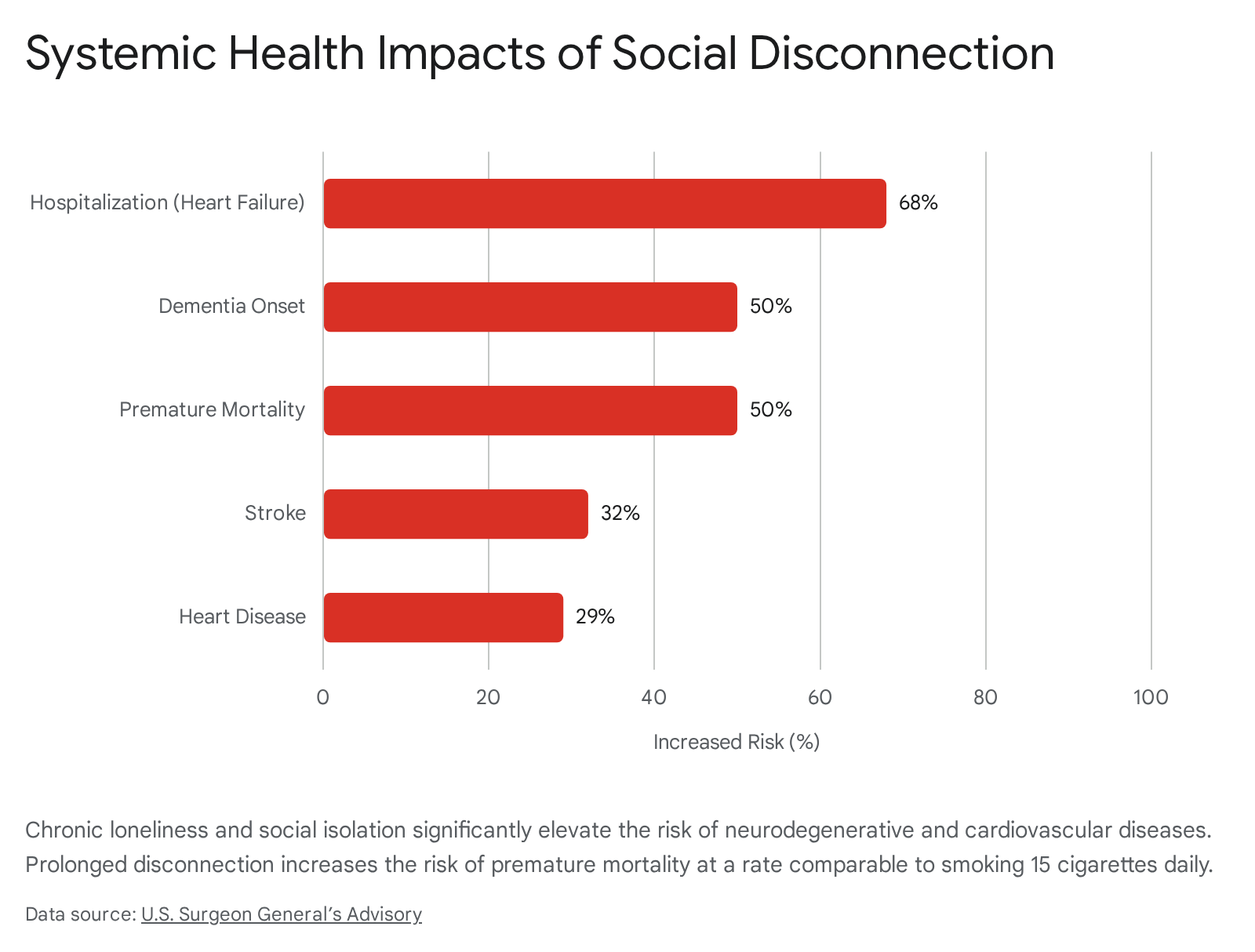
The systemic inflammation and autonomic rigidity caused by loneliness manifest in severe epidemiological outcomes. The U.S. Surgeon General's 2023 Advisory on Loneliness and Social Isolation confirmed that lacking social connection increases the risk of premature death as much as smoking up to 15 cigarettes a day 25.
Data from the Framingham Heart Study underscores this trajectory. The study found that baseline loneliness conferred a 54% increased 10-year dementia risk. Critically, this association showed distinct age dependence: participants aged 60 - 79 exhibited a three-fold increased risk among APOE ε4 non-carriers, suggesting that younger-old adults represent the peak vulnerability for isolation-induced neurodegeneration 22.
In addition to neurological decline, social isolation and loneliness significantly increase the risk of developing Metabolic Syndrome (MetS), type-2 diabetes mellitus, non-alcoholic fatty liver disease, and severe cardiovascular disease (CVD) 24. Poor social relationships are associated with a 29% increased risk of heart disease and a 32% increased risk of stroke, demonstrating that the biological mechanisms of loneliness operate on a whole-body, systemic level 25.
The Physiology of Restorative Solitude
When aloneness is intentionally chosen and perceived as a safe, unthreatening environment, the neurobiological response shifts dramatically from survival mode to restoration. The psychological perception of safety is the definitive biological prerequisite for the healing effects of solitude.
Parasympathetic Dominance and Vagal Tone
The physiological foundation of restorative solitude is the activation of the parasympathetic nervous system (PNS), responsible for the body's "rest and digest" functions. Research from the University of California, San Francisco (UCSF) in 2024 categorized this optimal solitary state as "deep rest" 14. During intentional solitude, the absence of social performance pressures and external stimuli signals profound safety to the brain, prompting a shift away from the sympathetic nervous system 14.
This safety signal is communicated systemically via the vagus nerve. Slowed, rhythmic breathing - often naturally adopted during quiet solitude or contemplative practices - increases vagal tone, which suppresses the sympathetic stress response, lowers the heart rate, and promotes muscle relaxation 14.
Heart Rate Variability as a Biological Marker
The efficacy of this parasympathetic shift is empirically measured via Heart Rate Variability (HRV), which captures the time variance between consecutive heartbeats. HRV serves as an objective index of autonomic flexibility and parasympathetic vagal tone 222926.
| HRV Parameter | Measurement Focus | Association with Loneliness | Association with Solitude |
|---|---|---|---|
| RMSSD | Vagal tone / Parasympathetic activity | Significantly reduced 2728 | Increased during recovery 29 |
| High-Frequency (HF) HRV | Parasympathetic modulation | Lower resting baseline 2728 | Elevated during deep rest 2629 |
| Low-Frequency (LF) HRV | Mixed Sympathetic/Parasympathetic | Often elevated due to stress 2228 | Stabilized 28 |
| LF/HF Ratio | Autonomic Balance | High (Sympathetic dominance) 28 | Low (Parasympathetic dominance) 29 |
In a controlled laboratory study examining 316 healthy women, greater chronic loneliness predicted significantly lower resting HRV, which is an independent risk factor for cardiovascular disease 27. Furthermore, chronically lonely women experienced maladaptive physiological responses to cognitive challenge tasks, exhibiting blunted HRV reactivity 2730. Wearable device data confirms these findings in daily life, demonstrating that causal increases in loneliness correlate with a higher LF/HF ratio and increased respiratory rates, while restorative sleep and quiet home duration mitigate loneliness and improve HRV 28. By engaging in restorative solitude, individuals actively train their autonomic nervous system to recover flexibility, counteracting the rigid hyperarousal caused by social stress.
Cellular Restoration and Metabolic Shifts
The parasympathetic dominance achieved during restorative solitude facilitates biological recovery at the microscopic level. According to the UCSF findings, the "deep rest" achieved in quiet solitude fundamentally alters cellular metabolism 14. Because the body no longer requires the hoarding of adenosine triphosphate (ATP) for potential fight-or-flight scenarios, it redirects this metabolic currency toward cellular maintenance and repair 14.
In this solitary state, cells upregulate autophagy - the biological process by which lysosomes dismantle and clear out damaged organelles. This includes mitophagy, the process of sweeping up damaged mitochondria to ensure efficient energy production and reduce the generation of harmful reactive oxygen species (ROS) 14. By clearing this cellular debris, solitude actively prevents the oxidative stress that drives biological aging. Furthermore, deep rest increases the activity of telomerase, the enzyme responsible for adding DNA back to the telomere caps at the tips of chromosomes. This directly counteracts the telomere shortening caused by chronic psychological stress, proving that restorative solitude is a fundamental biological necessity for maintaining genomic integrity 14.
Cognitive Reorganization and Productive Mind-Wandering
The divergence between loneliness and solitude extends profoundly into cognitive performance. While loneliness impairs executive function and narrows cognitive flexibility through chronic stress, intentional solitude expands the mind's associative capacities.
When an individual engages in voluntary solitude, the Default Mode Network functions optimally. Freed from the interference of intense external cognitive loads or social monitoring, the DMN facilitates functional mind-wandering, interoceptive awareness, and creative incubation 3132. The DMN acts as an internal simulator, synthesizing past experiences and forming novel connections between disparate pieces of information. Neurofeedback studies tracking resting-state fMRI have demonstrated that mindfulness in solitude alters brain connectivity, specifically increasing connectivity between the posterior cingulate cortex (PCC) and the salience network, which is linked to heightened bodily and emotional awareness . Solitude provides a respite from constant input, stimulating the DMN to foster cognitive flexibility and allowing for the consolidation of long-term memory 3237.
Clinical Markers and Behavioral Phenotypes
Because the physical presentation of solitude and loneliness can appear identical to external observers, clinical psychology must rigorously differentiate between adaptive aloneness and maladaptive social withdrawal. Misdiagnosing restorative solitude as a depressive symptom can lead to inappropriate interventions that pathologize healthy coping mechanisms.
Distinguishing Unsociability from Social Avoidance
Developmental psychology categorizes solitary behavior based on the specific interplay of approach and avoidance motivations. Understanding these motivations is critical for determining the clinical risk associated with isolation 3334.
- Shyness involves a high desire to approach others conflicting with a high fear of social evaluation, resulting in significant emotional distress and internal conflict 3334.
- Social Avoidance involves a low desire to approach others combined with a high desire to actively avoid them, often linked to trauma, social anxiety, or depressive anhedonia 3335.
- Unsociability represents a low desire to approach others paired with a low desire to avoid them. Unsociable individuals possess a high baseline preference for solitude without underlying fear, social deficit, or anxiety 3336.
Clinical studies consistently show that while shyness and avoidance correlate strongly with peer rejection, low self-esteem, emotion dysregulation, and high existential anxiety, unsociability operates as a benign and often highly beneficial trait 33343536. A study of 295 undergraduates found that people who displayed unsociability scored significantly higher on self-perceived creativity and were less likely to engage in aggressive behavior 36. Similarly, a study on emerging adults found that unsociability was associated with greater authenticity and fewer existential concerns 35. Therefore, solitary behavior crosses into clinical pathology only when driven by fear, rejection sensitivity, or an inability to self-regulate 6.
Diagnostic Criteria for Depressive Social Withdrawal
While acute, voluntary solitude is healing, prolonged and involuntary social isolation frequently precipitates clinical depression. The distinction between physical isolation and psychological withdrawal is vital for diagnostic accuracy.
A comprehensive study conducted by the Seoul Government on 5,513 socially isolated and withdrawn young adults meticulously separated these concepts. Social isolation was defined operationally by a lack of emotional connections (having no one to seek advice from) and physical connections (rare face-to-face interactions outside the family) 3738. Social withdrawal was defined as a voluntary avoidance of social interactions, such as refusing to attend work or school 3738.
The findings revealed a critical nuance: withdrawal alone did not show a statistically significant association with severe clinical depression (measured via PHQ-9 scales) 3738. However, when an individual experienced objective social isolation, or a combination of isolation and withdrawal, the risk for severe depressive symptoms skyrocketed. Prolonged isolation lasting three years or more was strongly associated with a massive increase in depression risk 39.
Furthermore, depression and loneliness operate in a reciprocal feedback loop. As depressive symptoms intensify, they precipitate feelings of loneliness, which strips individuals of the executive function required to maintain social networks 40. This leads to deeper structural isolation, exacerbating the neurochemical imbalances of the depression 40. Interventions must therefore target the structural barriers to connection while simultaneously respecting the individual's need for periodic, healthy withdrawal 3940.
Algorithmic Amplification and Digital "Cloneliness"
In the contemporary digital landscape, the pathology of loneliness is exacerbated by technological interfaces. Overuse of digital technologies is associated with reduced gray matter volume in brain areas supporting interoceptive awareness and decreased connectivity of the DMN supporting creative insights 31. The craving for external stimulation through smartphones interferes directly with the developmental capacity to tolerate and enjoy solitude, thereby paradoxically increasing baseline loneliness 31.
Sociological frameworks refer to this modern phenomenon as "cloneliness." Digital algorithms are explicitly designed to maintain user engagement by simulating social connection 41. However, because these platforms strip away the embodied, biological highs of in-person fellow feeling, they leave the user neurologically unsatisfied. The algorithms drive users to continuously seek validation from "followers," replacing the essential contingency and freedom of true solitude with a highly curated, performance-based isolation 41. This algorithmic reproduction of loneliness prevents the individual from ever entering the parasympathetic state of deep rest, locking the brain in a state of continuous, low-level sympathetic arousal 41.
Cross-Cultural Conceptions of Aloneness
The dichotomy between healing solitude and harmful loneliness is profoundly informed by macro-level cultural frameworks. The meaning assigned to being alone is socially constructed, dictating whether an individual interprets their solitude as a marker of independence, a spiritual necessity, or a symptom of social failure.
Individualistic versus Collectivistic Paradigms
Cross-cultural psychology analyzes societal structures on a spectrum from individualism to collectivism, a dimension that significantly shapes the health outcomes of living alone 4243.
| Cultural Paradigm | Core Values | View of Solitude | Health Impact of Living Alone | Primary Source of Loneliness |
|---|---|---|---|---|
| Western Individualistic (e.g., U.S., U.K., France) | Autonomy, self-reliance, extroversion | Often viewed with suspicion; equated to social failure | Strong link to poorer physical and mental health | Lack of specific friends or romantic confidants |
| Eastern/African Collectivistic (e.g., Japan, Mexico, Ghana) | Interdependence, group harmony, relational obligations | Highly positive; viewed as a necessary reprieve | Associated with lower anxiety and greater life satisfaction | Lack of family interaction or community integration |
In highly individualistic societies, there is a cultural bias toward extroversion, making the choice to be alone seem unusual or concerning 44. Because social connections are voluntary and based on personal choice, a lack of connection is internalized as a personal failure 4350. Paradoxically, despite valuing independence, living alone in individualistic nations is strongly linked to poorer health outcomes, as the societal infrastructure may lack the stable, enduring social ties that provide a baseline of security 4250.
In contrast, collectivistic cultures emphasize social interdependence and provide stronger familial support networks 4243. Because these societies exhibit lower relational mobility, social ties are stable, offering a secure sense of belonging even in the absence of cohabitation 42. Furthermore, because collectivistic social norms are tight and demanding, solitude is construed not as social failure, but as a welcomed, adaptive reprieve from constant relational obligations 42. However, when an individual in a collectivistic society is completely severed from their community, the resulting loneliness is often far more severe, as it represents a fundamental break from their expected cultural identity 50.
The Japanese Constructs of Ohitorisama and Hitori
Japanese society provides a compelling contemporary model of institutionalizing restorative solitude. Japan faces well-documented public health crises related to severe social withdrawal (hikikomori) and relation-less isolation (muen-shakai), often driven by intense academic and occupational pressures 3745. However, the culture simultaneously celebrates and facilitates highly functional independence.
The linguistic root of loneliness in Japanese, hitori, connects deeply to concepts of single, spontaneous existence. In ancient Shinto scriptures like the Kojiki, hitorigami refers to solitary gods who hid their persons, establishing an early mythological precedent for powerful, independent aloneness 4152. The Japanese concept of shizen (nature) further implies that existence unfolds spontaneously from an inner quietude or passivity, valuing the solitary state as fundamentally natural 52.
This historical context has evolved into the modern cultural trend of ohitorisama - the "party of one." Ohitorisama represents a shift that actively celebrates self-reliance and the freedom to follow personal interests without compromise 46. Establishments designed specifically for solo experiences - such as hitori-yakiniku (solo barbecue), hitori-karaoke, and solo camping - provide physical infrastructure for individuals to detach from the rigorous hierarchical demands of society 46. In these spaces, individuals engage in iyashi (healing). By normalizing solitary activities, the culture creates a "normotopia" 45 - a safe, expected environment where citizens can reset their nervous systems through restorative aloneness, existing as an archipelago of individuals coexisting in quiet harmony without the burden of social interpretation 46.
The African Philosophy of Ubuntu and Relationality
The African philosophical framework of Ubuntu, commonly translated as "I am because we are" or "A person is a person through other people," establishes that human identity and dignity are inextricably bound to community and social interconnectedness 4748. While this intensely collectivistic worldview might seem inherently opposed to the concept of solitude, deeper philosophical application reveals that Ubuntu actually provides the ultimate psychological safety net required for restorative aloneness to flourish.
By establishing an unwavering baseline of communal security, mutual aid, and belonging, Ubuntu removes the existential anxiety of abandonment 47. When individuals retreat into solitude within this framework, they do not do so to sever ties, but to engage in self-cultivation that will ultimately benefit the collective. For instance, recent research in African higher education demonstrates that structured solitary practices - such as independent research and contemplative study - foster intellectual independence and scholarly identity formation, serving as an essential disciplinary resource that complements collaborative learning 49. Furthermore, Ubuntu principles emphasize restorative justice over punitive measures, bringing community elders together to prioritize healing and reconciliation, thereby actively repairing the social fabric that prevents chronic loneliness 4850. Solitude is thus viewed as a disciplined preparation for deeper, more compassionate community engagement 50.
Spiritual Seclusion and the Sufi Practice of Khalwa
Within Islamic mysticism and Sufism, solitude is meticulously codified as Khalwa, a disciplined practice of physical and spiritual seclusion designed for intensive psychological purification 51. Historically evolving into a distinct institutionalized rite by the thirteenth century, Khalwa demands rigorous preparation and is undertaken under the strict oversight of a spiritual master (shaykh) .
The practice typically involves retreating into a small, purpose-built cell for a specified period - traditionally 40 days - emerging only for daily prayers (salah) and necessary consultations 51. The objective is not mere physical isolation, but a structured reconfiguration of the ego. The practitioner engages in dhikr (continuous remembrance and recitation) and intense self-confrontation to detach from worldly distractions (zuhd) 51.
Khalwa illustrates the ultimate psychological reframing of isolation. It serves as a crucible for clarity, forcing the individual to confront their deepest fears, suppressed emotions, and inner veils without the distraction of external social performance 52. The discomfort of this severe sensory deprivation ultimately leads to profound emotional stability, self-awareness, and a state of inner peace (fanafillah and baqaa) 53. Psychologically, the practice of Khalwa demonstrates that when extreme physical isolation is paired with intense, structured internal purpose, it yields profound emotional resilience rather than the deterioration associated with chronic loneliness 5354.
Conclusion
The profound biological and psychological divergence between loneliness and solitude is not a matter of physical proximity to other humans, but a complex interplay of cognitive appraisal, autonomic nervous system regulation, and cultural context. Loneliness exerts a toxic toll on the human body because it is processed by the brain as a chronic existential threat. This perceived deficit initiates a destructive cascade of sympathetic hyperarousal, HPA axis dysregulation, systemic inflammation, and rigid neural connectivity within the Default Mode Network, ultimately eroding physical health, cardiovascular integrity, and cognitive function.
Solitude heals because it is a fundamental act of psychological agency. By establishing an environment of subjective safety, intentional aloneness engages the parasympathetic nervous system, redirects metabolic cellular energy toward genomic repair, and opens neural pathways for creative incubation and emotional regulation. Recognizing this sharp distinction is vital for modern clinical and public health paradigms. Societies must strive to eradicate the structural and algorithmic architectures that breed involuntary isolation, while simultaneously protecting, accommodating, and destigmatizing the universal human requirement for restorative quiet.