
How Generative AI Is Changing Creative Jobs in 2026
In 2026, the creative labor market has moved past experimental generative artificial intelligence adoption into a phase of deep structural integration, characterized by a severe contraction in entry-level hiring, soaring wage premiums for AI-fluent professionals, and a rapid shift toward outcome-based business models. While mass technological unemployment has not materialized uniformly across all sectors, the industry is experiencing an acute apprenticeship crisis as routine tasks are automated, fundamentally rewiring how creative value is generated, distributed, and compensated. Whether you are streaming a hit digital series, browsing an interactive e-commerce storefront, or engaging with a global brand campaign, the creative engine behind your daily media diet is now fundamentally powered by complex, AI-assisted human labor.
Are Creative Jobs Actually Shrinking Due to AI?
A pervasive misconception in the discourse surrounding generative artificial intelligence is the binary narrative that machines are orchestrating a wholesale, one-to-one replacement of human creatives. The empirical labor market data collected between 2024 and 2026 presents a much more nuanced reality: work is not disappearing cleanly; rather, its structural composition is undergoing a profound metamorphosis driven by what economists term "seniority-biased technological change" 123.
The most acute symptom of this transformation is the collapse of the apprenticeship pipeline. At companies that have actively integrated generative AI into their workflows, entry-level hiring has plummeted by roughly 80% per quarter since 2023 2. In the United States alone, postings for entry-level jobs dropped by 35% between late 2024 and early 2026, according to research firm Revelio Labs 4. This contraction is not driven by traditional economic downturns or budget deficits, but by the explicit capabilities of the technology. Historically, junior creative roles - such as basic copywriting, first-draft coding, storyboarding, routine data processing, and initial research synthesis - served as the vital training ground for the industry. These intellectually routine, codified tasks are precisely the functions at which generative AI excels because they are derived from existing training data and follow predictable rule sets 25.
Consequently, the burden of labor market shifts lands disproportionately on early-career professionals. A landmark 2026 analysis of 66 million workers across 280,000 firms revealed that entry-level employment in highly AI-exposed occupations fell by 7% relative to less exposed roles, while senior employment in those same firms actually continued to grow 2. A parallel Stanford analysis of ADP payroll records identified a 16% relative decline in early-career workers in AI-exposed roles since late 2022 2. The work that traditionally defined entry-level positions is not just being automated; it is disappearing from job descriptions entirely. Crucially, companies are not backfilling that lost work by moving entry-level workers into more complex responsibilities; they are simply eliminating the roles 2.
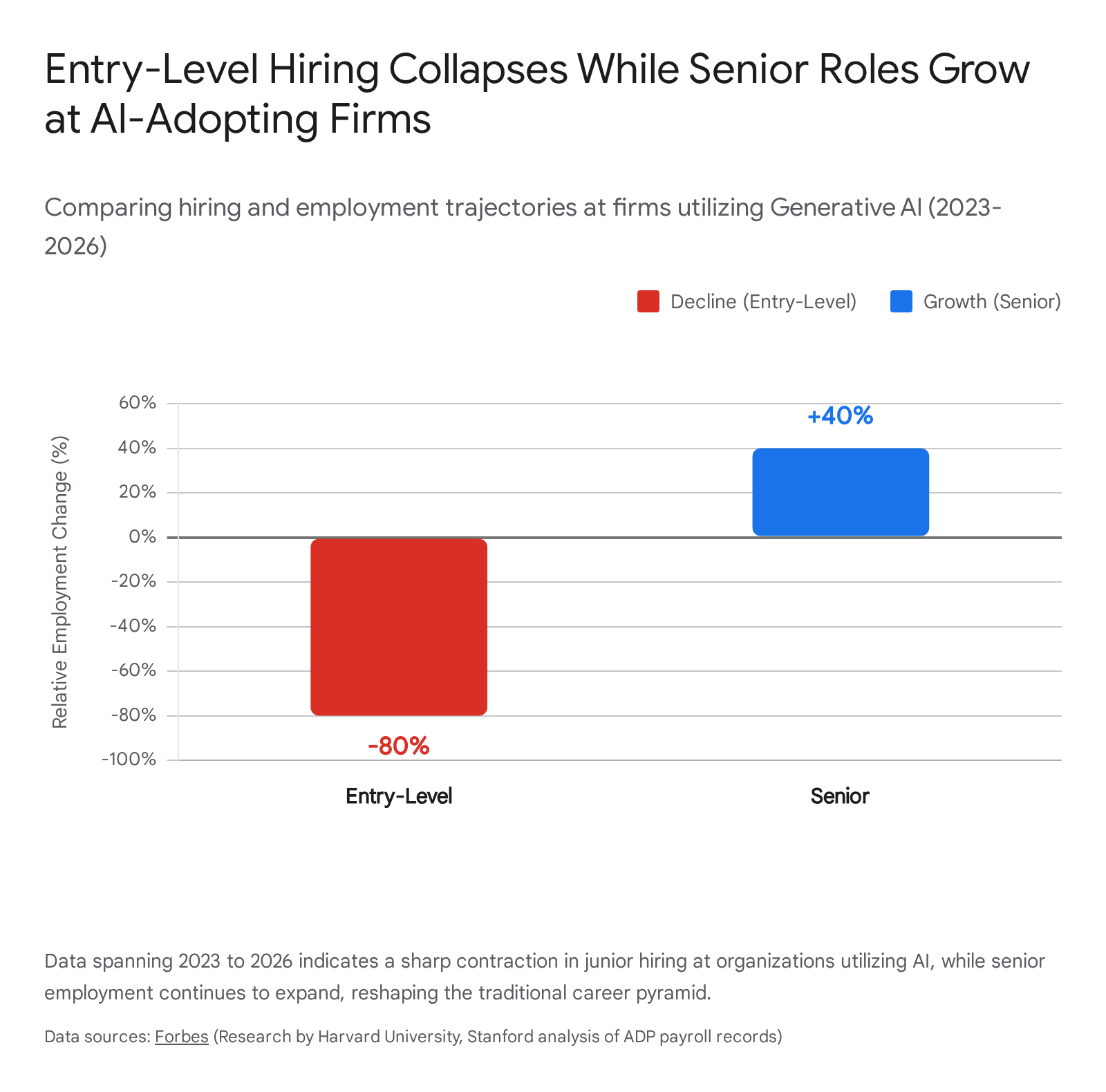
This dynamic has triggered a slow-burning crisis that extends beyond immediate hiring metrics. By utilizing AI to automate the foundational layer of creative production, experienced professionals are gaining immense leverage 3. On platforms like Claude.ai, user interaction data from 2026 shows that 53% of interactions function to augment existing work, reflecting how work is being rearranged around individuals who know how to prompt effectively 3. However, the institutional math that justifies replacing several junior workers with one AI-assisted senior employee threatens the long-term sustainability of the workforce. If junior employees are denied the repetitive practice necessary to develop contextual judgment, organizational knowledge, and domain expertise, the industry faces a looming deficit of future leadership 34. Furthermore, current middle management and senior creatives are increasingly reporting burnout and disengagement as they are forced to absorb the operational execution previously handled by entry-level teams 4.
On a macroeconomic scale, the International Monetary Fund and the International Labour Organization report that approximately 40% of global jobs are exposed to AI, a figure that rises to 60% in advanced economies 6. Global projections through 2030 anticipate the displacement of 92 million jobs, counterbalanced by the creation of 170 million new roles, yielding a net gain of 78 million positions 6. However, the transition is highly volatile. Agentic AI - systems capable of autonomous planning and execution - is now responsible for 50% of AI-related job losses, up significantly from 29% in 2023 67. Additionally, the ILO reports that 24% of clerical and support tasks face a high risk of automation, disproportionately affecting female workers in advanced economies where exposure hits 9.6% for women compared to 3.5% for men 65. The ultimate conclusion is not an apocalyptic erasure of human creativity, but a radical elevation of the barrier to entry, where human performance at a junior level is no longer an adequate proxy for readiness to assume complex, senior roles 6.
How Are Actual Agencies, Studios, and Freelancers Integrating AI into Daily Workflows?
Contrary to the dystopian vision of autonomous algorithms operating in a vacuum to render human studios obsolete, the operational reality of 2026 is one of deep, systematic hybridization. AI has migrated out of experimental browser tabs and siloed innovation labs directly into the core infrastructure of creative workflows, reshaping how global agencies and independent practitioners operate 110.
At the enterprise level, global advertising and marketing holding companies have re-architected their entire operating models to survive and thrive. WPP, one of the world's largest advertising networks, launched WPP Open, a unified platform integrating advanced AI capabilities developed through strategic partnerships with Google Cloud and Adobe 78. This integration fundamentally dismantled the traditional, highly fragmented agency model. Strategy experts, data scientists, and creative professionals now collaborate in real-time, utilizing AI to generate campaign concepts, produce multiple asset variations for distinct audience segments, and simulate campaign performance well before launch 7. Furthermore, WPP bolstered its data foundation by acquiring InfoSum, enabling privacy-safe data collaboration to fuel targeted AI insights 7. As a result, campaigns that historically required months to plan and execute are now routinely deployed in days 7.
Publicis Groupe executed a similarly aggressive structural pivot, deploying its AI platform, Marcel, as an intelligence layer connecting its 100,000 global employees 13. Prior to AI integration, finding specialized talent or previous campaign assets across the vast network was a manual, duplicative effort. Now, AI-powered search connects skills, data, and past work instantly, while simultaneously automating low-value tasks like brief summarization and research compilation 813. Massive consumer brands have followed suit. Mondelēz International invested $40 million in a proprietary generative AI production engine designed to handle everything from social media assets to full broadcast commercials, a move estimated to reduce creative production costs by up to 50% 8. Disney announced a $1 billion equity investment in OpenAI, signaling an intent to build co-creation platforms that allow users to generate content utilizing iconic proprietary characters 8. For these enterprises, AI is no longer an execution afterthought; it is the central nervous system of brand strategy.
For independent freelancers and boutique studios, the integration of AI has elegantly solved what industry analysts call the "Scale-Complexity Paradox" 14. Historically, solo practitioners faced an impenetrable ceiling: they simply could not handle enterprise-level volume without sacrificing quality or suffering extreme burnout 14. Today, generative AI and highly capable agentic systems allow a single designer to operate with the output capacity and consistency of a mid-sized agency 14. According to a 2026 Global Creative Economy Report, freelance designers who tightly integrate generative AI into their production pipelines report a 340% increase in billable output efficiency 14.
The modern freelance workflow does not entail submitting a prompt and asking the machine to "do the design." Instead, creatives utilize sophisticated tools like Claude for structural logic or custom-trained LoRA (Low-Rank Adaptation) models as collaborative sparring partners. Designers rely on these systems to architect animation flows, test layout pacing, and ensure mathematically guaranteed brand consistency across thousands of micro-variations 1415. The independent designer's role has therefore elevated from manual pixel-pushing to "Parametric Creative Direction," orchestrating complex algorithms to achieve strategic business goals 1014. In this paradigm, AI operates as a tireless virtual colleague that can browse the web, manipulate files, and build real-time project dashboards through deep agent integrations, while the human retains total control over narrative and aesthetic judgment 716.
As of 2026, the division of labor between human and machine within the creative process has become highly formalized across distinct disciplines.
| Creative Role | Primary 2026 GenAI Tools | Tasks Fully Automated by AI | Tasks Requiring Human Intervention & Direction |
|---|---|---|---|
| Animator / VFX Artist | AI-Enhanced Animation Suite 5.0, Runway Gen-4, Google Veo 3 | Instant storyboard generation, motion synthesis, rapid background rendering, and basic rotoscoping 117910. | Emotional character pacing, narrative timing, final visual polish, and complex conceptual directing 151711. |
| Copywriter / Content Strategist | Claude 3.5+, ChatLLM, Jasper, Proprietary Agency LLMs | First-draft generation, SEO keyword optimization, routine social media versioning, and brief summarization 13162122. | Strategic brand voice alignment, emotional resonance, cultural nuance, fact-checking, and high-level storytelling 2223. |
| Graphic / UI/UX Designer | Figma AI, Framer AI, Midjourney, Custom LoRA Models | Repetitive image resizing, accessibility compliance checks, base layout generation, and placeholder content population 142324. | Information architecture, empathetic user research synthesis, brand intuition, ethical constraints, and client persuasion 222324. |
The consensus among working practitioners is resolute: AI radically accelerates production and handles logistical complexity, but it critically lacks real-world context, moral judgment, and emotional intelligence. The strongest design and marketing results consistently stem from a hybrid workflow where AI explores and iterates, and the human curates and refines 222324.
Does AI-Assisted Work Pay Less? The Rise of Outcome-Based Economics
The economic impact of artificial intelligence on creative wages presents a stark duality, deeply intertwined with shifting business models. At a macro level, the broad creative industries are experiencing a period of severe wage stagnation. According to the 2026 Creative Industries Census, which analyzed over 390,000 data points, permanent salary growth in the sector dropped to a pre-pandemic low of 1.7%, while freelance day rates grew by a mere 1.2% - well below the wider private sector average 1125. Over half of creative professionals report feeling that their pay no longer reflects the expanded scope of their responsibilities, leading to a phenomenon analysts term the "Great Unrest," wherein 55% of professionals are actively seeking new employment opportunities, largely motivated by financial dissatisfaction 112526.
However, beneath this sluggish average lies a massive labor market bifurcation driven entirely by technological fluency. The market has fractured into two distinct tiers: candidates with demonstrable AI skills and those without 12. Workers who possess verifiable AI competencies - such as advanced prompt engineering, machine learning workflow integration, and parametric system design - command a staggering 56% wage premium compared to peers in identical roles lacking those skills, a massive jump from the 25% premium recorded just a year prior 613. Furthermore, industries with the highest overall exposure to AI integration are seeing aggregate wages rise twice as fast as less exposed sectors, and the revenue generated per employee in these highly exposed fields has nearly quadrupled since 2022 13.
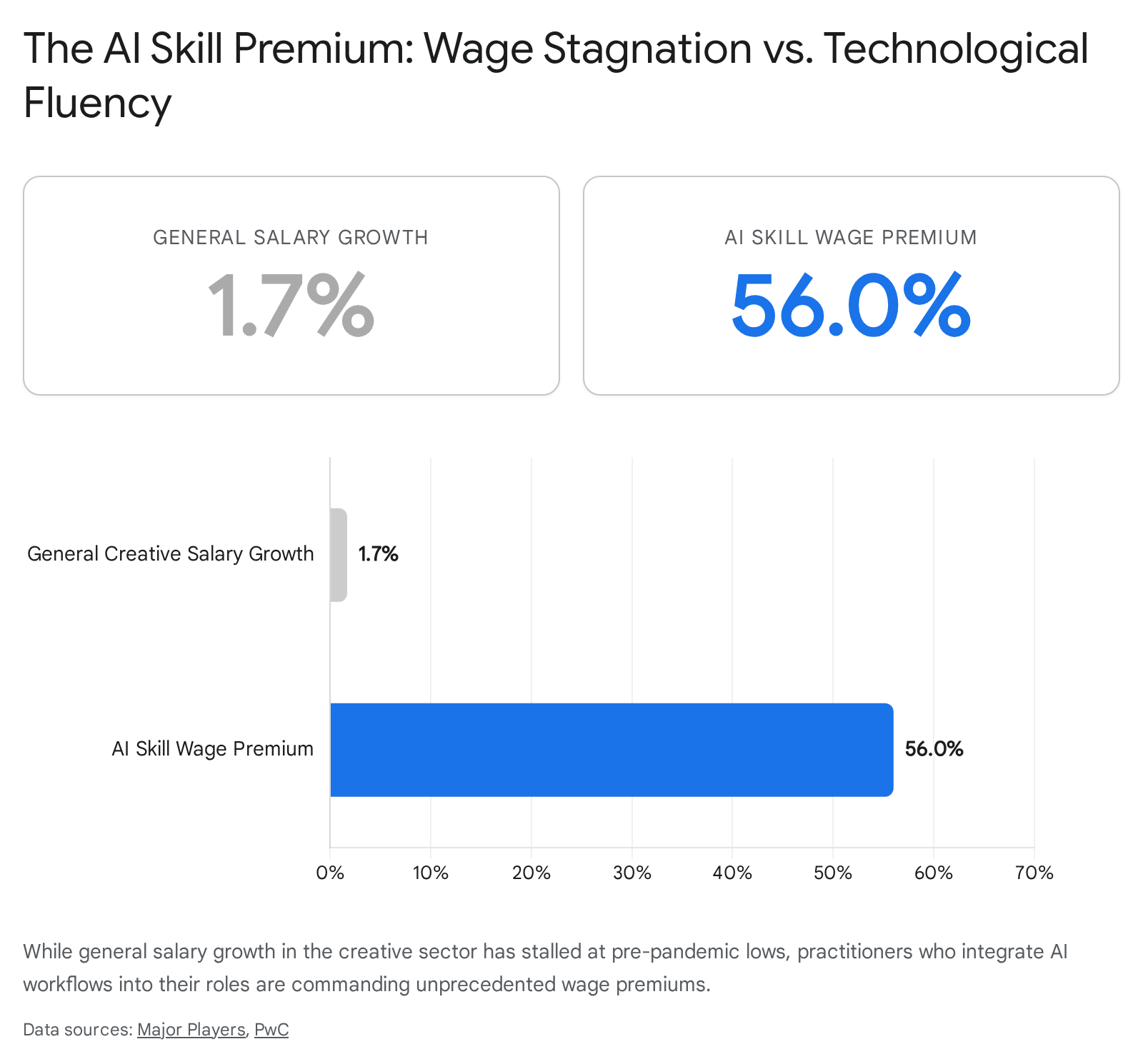
This vast divergence in compensation is not merely a reflection of individual skill; it is intricately linked to a foundational revolution in how software, services, and creative outputs are priced. The traditional "seat-based" licensing model and the hourly billing structure are rapidly dying paradigms 1430. Because AI vastly accelerates task completion, billing a client by the hour severely penalizes the most efficient, AI-augmented freelancers and agencies 14. If an AI agent can reliably execute the coding or design workload of three junior staff members in a fraction of the time, charging for human hours or traditional software "seats" drastically undervalues the economic output generated 3031.
As a result, 2026 has witnessed the mainstream adoption of "Outcome-Based" or "Resolution-Based" pricing models 3233. In this new paradigm, clients pay for a completed deliverable, a successfully resolved support ticket, or a measurable business result, completely decoupled from the human hours expended to produce it 3032. For example, enterprise tools like Zendesk AI now aggressively utilize outcome-based pricing, charging clients exclusively when a ticket is fully resolved by AI, transferring performance risk to the vendor while capturing immense value 32. Analysts term this shift "Service as Software," where software vendors and augmented agencies tap directly into lucrative corporate payroll budgets rather than constrained IT software budgets 30. By the end of 2026, an estimated 40% of enterprise applications are projected to feature autonomous AI agents, and industry forecasts indicate that 70% of software vendors will have entirely rebuilt their business models around outcomes and transactions by 2028 3032. For creative practitioners, abandoning the hourly rate and shifting to outcome-based pricing is the single most critical mechanism to capture the immense financial value generated by their AI-driven productivity gains 1433.
How Are Copyright, Fair Use, and Labor Protections Handled Now?
The rapid proliferation of generative AI has forced a highly contested collision between borderless technological capabilities and legacy legal frameworks. By mid-2026, courts, copyright offices, and regulatory bodies globally have begun to establish firmer, albeit complex, boundaries regarding copyright infringement, fair use doctrines, and labor rights in the digital age.
In the United States, several foundational questions regarding the nature of copyright have been definitively settled. In March 2026, the Supreme Court declined to review the D.C. Circuit's decision in Thaler v. Perlmutter, legally cementing the precedent that AI systems, standing alone, cannot be considered authors of copyrighted works 15. The legal threshold for copyright protection absolutely requires human authorship. However, the most economically significant battleground remains the unauthorized ingestion of copyrighted works for AI model training. In a pivotal May 2025 report, the U.S. Copyright Office declared that when AI developers train models on copyrighted works to produce generative content that directly competes in the same market as the original works, such ingestion is "unlikely to qualify as fair use" under 17 U.S.C. § 107 1516. Driven by the threat of massive statutory damages, commercial licensing of training data has shifted from being a rare exception to the default operational standard for major AI developers in 2026 1536. Similar systemic pressures exist internationally. In the UK, high-profile cases like Getty Images v. Stability AI have challenged broad text and data mining (TDM) exceptions, exposing the practical limitations of enforcing fragmented, jurisdictional copyright laws against AI training conducted across borders 17.
The European Union continues to dictate global compliance standards through the AI Act. While the Act officially entered into force in August 2024, its implementation timelines were heavily staggered 1819. A significant regulatory development occurred in May 2026 with the provisional agreement of the "AI Omnibus" legislative package 1820. To accommodate intense industry lobbying and prevent the stifling of innovation, the Omnibus officially delayed the enforcement of stringent fundamental rights safeguards for "high-risk" AI systems until December 2027, a move criticized by civil liberties advocates 20. However, vital transparency regulations are strictly enforced as of August 2026 1820. Under these new rules, providers of generative AI must ensure that AI-generated content is clearly identifiable and visibly labeled in machine-readable formats, particularly concerning deep fakes and synthetic content interacting with the public 1821. Furthermore, the EU Parliament has outlined an aggressive legislative agenda proposing a rebuttable presumption of copyright infringement if AI developers fail to comply with strict itemized transparency obligations regarding their training data crawls 22.
While lawmakers debate copyright, organized labor in the creative sector achieved historic, preemptive milestones to mitigate AI's existential threat to human employment. The Writers Guild of America (WGA) and the Screen Actors Guild (SAG-AFTRA), following their prolonged and crippling 2023 strikes, enshrined groundbreaking AI protections that are being robustly enforced and expanded upon in 2026 432324. Under the WGA's Minimum Basic Agreement, AI-generated material is explicitly barred from being classified as "literary material" or "source material" 4325. This crucial definition prevents studios from utilizing an AI to generate a rough script and subsequently paying a human writer a drastically reduced "rewrite" fee, thus safeguarding human writing credits and commensurate financial compensation 4324. Furthermore, while writers may voluntarily use AI tools to assist their process with studio consent, contracting companies are strictly prohibited from requiring a writer to use AI software as a mandatory condition of employment 432425. Companies are also legally bound to disclose if any foundational materials - such as an outline or treatment - provided to a creator contain AI-generated elements 4324. For actors, SAG-AFTRA secured innovative clauses mandating explicit prior informed consent and fair, separate compensation before studios can utilize digital replicas or synthesize voice performances 2324. Beyond collective bargaining, the guilds are aggressively shaping public policy, with the WGA filing amicus briefs in copyright infringement cases like Reuters v. Ross Intelligence and heavily supporting state-level legislation demanding transparency from AI developers 26. These union frameworks have become the gold standard, setting vital global precedents for how labor can successfully negotiate the ethical integration of automation technologies without stifling artistic progress 2324.
How is Generative AI Impacting Non-Western Creative Industries?
The mainstream narrative surrounding generative AI is overwhelmingly shaped by the economic anxieties and regulatory frameworks of Western markets, yet its most volatile and transformational impacts are currently unfolding across the Global South. Research from the ILO and the World Bank indicates a severe risk of "disruption without dividend" in developing economies 27. While advanced, high-income countries face an overall AI employment exposure rate of 30% to 32%, aggregate exposure in low-income nations sits between 10% and 15% 28. However, this macro statistic hides a critical vulnerability: workers in the Global South whose specific jobs are most vulnerable to automation - such as clerical support, basic coding, and digital administration - are precisely the demographics that are already online and digitally integrated 2728. Therefore, rapid job displacement in these regions is occurring relatively quickly, closing off historically reliable pathways to decent work and upward mobility for young people and women, long before the broader infrastructural productivity gains of AI can be realized locally 2728.
In regions historically reliant on outsourced digital labor, such as the Philippines, India, and Latin America, the global Business Process Outsourcing (BPO) industry is undergoing a radical paradigm shift. By 2026, the global BPO market is projected to exceed $400 billion, driven heavily by widespread digital adoption and intelligent automation 5051. Enterprises in the US and Europe are no longer seeking offshore partners merely as low-cost "seat-fillers" to execute repetitive tasks. Instead, they demand sophisticated partners capable of delivering AI-augmented outcomes, encompassing intelligent document processing, predictive analytics, prompt engineering, and complex model monitoring 52. Call centers in the Philippines have integrated AI to enable dynamic call routing, real-time intent recognition, and seamless multilingual support, transitioning human agents away from routine query handling toward complex, value-driven customer engagements requiring deep empathy 5051. Outsourcing providers that fail to upskill their workforce in AI literacy and cloud engineering face immediate market obsolescence, while those who adapt are successfully moving up the global value chain, offering hybrid "multi-shore" strategies to mitigate operational risks 5152.
Simultaneously, a primary limitation of dominant Western AI models (such as ChatGPT, Midjourney, or Sora) is their lack of culturally specific, localized training data, which often sidelines the unique perspectives, dialects, and artistic nuances of the Global South 929. In Nigeria, a booming hub of African creative output, local developers and government initiatives are aggressively countering this deficiency. Nigerian startups are building indigenous models - such as "Orisa Itan 1.0" and "YarnGPT" - which are specifically trained to understand African languages, Nigerian Pidgin, and highly specific local cultural contexts 954. Nigeria's adoption of a comprehensive National Artificial Intelligence Strategy (NAIS) reflects a deliberate government effort to position the country as an AI leader, integrating the technology seamlessly across its massive Nollywood film industry, vibrant social media landscape, and advanced fintech sectors 5455. Data from 2026 indicates an astonishing 88% AI chatbot usage rate among Nigerian adults, and 93% of Nigerian companies utilizing AI in some operational capacity, outpacing global averages 54. Yet, despite this enthusiastic adoption, severe infrastructural deficits - such as unreliable power grids, limited funding, and a dearth of localized training datasets - remain significant hurdles to building sustainable local AI ecosystems 55.
In Brazil, prior to the widespread AI boom, the creative economy was an immense economic engine, generating BRL 393.3 billion (roughly 3.6% of the national GDP) and employing over a million formal workers 30. Current 2025/2026 reports from Brazilian research institutes, such as Reglab, indicate that rather than causing the feared mass technological unemployment, AI is predominantly functioning as a powerful augmentative tool within the audiovisual, advertising, and design sectors 30. Brazilian creatives are utilizing AI to optimize editing, mixing, and the finalization of works, vastly reducing production costs for independent creators 30. However, Brazilian professionals echo global concerns regarding the erosion of cultural identity, the transparency of corporate training data, and the concentration of technological ownership in the hands of foreign conglomerates 30.
Conversely, India's massive creative economy reveals the darker side of unregulated AI integration. In film, media, and digital content production, AI tools are rapidly and quietly automating the tasks of junior editors, set designers, and voice actors without establishing clear transition pathways 31. The use of AI for synthetic dubbing and automated visual effects has rendered significant segments of traditional creative labor invisible and undervalued 31. Because AI tools and workflows evolve far faster than formal labor studies or policy research can track them, these workers are left in a state of extreme precarity, lacking institutional support for upskilling and entirely devoid of the robust, formalized union protections currently enjoyed by their Western counterparts in Hollywood 31.
What This Means For You: Practical Takeaways for Practitioners
The transition into a mature, AI-mediated creative economy demands a fundamental recalibration of professional strategies. For practitioners navigating the landscape in 2026 and beyond, maintaining career viability requires accepting that AI is no longer a peripheral novelty, but the core infrastructural environment in which all creative work now occurs.
First, practitioners must immediately stop competing on routine execution. The labor data definitively proves that generative AI has permanently commodified early-draft coding, basic layout generation, simple data synthesis, and standard copywriting. Competing for roles or client contracts based on raw output volume or manual speed in these domains is a mathematically failing strategy. Instead, creatives must master the art of "Parametric Creative Direction." The highest-value skill in 2026 is the ability to architect and orchestrate complex AI systems. Creatives must transition their mental model from being "makers" of singular assets to "directors" of generative engines. This involves understanding how to build localized AI models, construct multi-step agentic workflows that automate operational logistics, and meticulously guide the machine to produce outputs that are culturally resonant, mathematically consistent, and strictly brand-compliant.
Second, building verifiable "proof of work" is more critical than ever. With traditional entry-level apprenticeship pathways severely constricting, standard resumes and academic credentials hold diminishing weight with employers. Practitioners must demonstrably prove their ability to use AI as a force multiplier. Cultivating independent, publicly visible projects - such as building end-to-end applications, growing highly targeted digital audiences, or executing successful freelance campaigns using automated workflows - is the most reliable method to bypass the broken junior hiring pipeline and secure high-paying roles. Employers are desperately seeking professionals who can navigate AI tools not just as passive consumers, but as active systems builders who directly impact the bottom line.
Third, independent creatives and agencies must aggressively adopt outcome-based pricing models. The hourly billing rate is fundamentally incompatible with an AI-augmented workflow. As your AI fluency increases, your task completion time will plummet, meaning an hourly rate actively penalizes your technological efficiency. By pricing your services based on the intrinsic value of the final deliverable or the measurable business outcome achieved, you completely decouple your earnings from the clock. This is the only financial strategy that allows practitioners to capture the immense monetary upside of the productivity gains generated by AI integration.
Finally, long-term career resilience requires cultivating uniquely human capabilities. While AI adoption is mandatory, maintaining a calibrated uncertainty about the long-term viability of specific technical skills is wise, as the tools themselves will continue to evolve and automate current AI-management tasks. Therefore, practitioners must double down on skills that algorithms fundamentally lack: high-level emotional intelligence, ethical reasoning, abstract strategic synthesis, deep cultural empathy, and the ability to build interpersonal trust with clients. Roles that depend on the nuanced interpretation of social cues, contextual business judgment, and the persuasive articulation of a brand's narrative are the least vulnerable to automation and will continue to command the highest market premiums in the intelligent age.
Bottom Line
The pervasive narrative that generative AI will completely eradicate the human creative workforce is historically myopic and unsupported by global 2026 labor data. Instead, the industry is experiencing an aggressive hollowing out of the junior tier and a massive consolidation of leverage among senior practitioners who utilize AI to exponentially scale their output. While international legal frameworks, copyright offices, and labor unions are fighting intensely to secure necessary compensation guardrails and training data transparency, the daily economic reality is uncompromising: professionals who master human-AI collaboration and shift to outcome-based pricing models are reaping unprecedented wage premiums, while those clinging to manual execution and hourly billing are being rapidly priced out of the market. Surviving the next decade requires viewing AI not as an adversary, but as a deeply integrated cognitive exoskeleton for creative strategy.