The impact of artificial intelligence on human creativity
The integration of artificial intelligence into the global knowledge economy represents a fundamental restructuring of human creativity, intellectual property, and cognitive development. As generative systems evolve from experimental utilities into foundational workplace infrastructure, the binary categorization of these systems as either an existential threat to human labor or a benign creative tool has proven insufficient. Current empirical data reveals a highly complex reality characterized by concurrent cognitive augmentation and cognitive atrophy, macroeconomic productivity gains alongside acute microeconomic displacement, and a pronounced divergence in global adoption trajectories. Understanding this paradigm requires a multidisciplinary analysis of historical technological disruptions, contemporary labor market data, neuro-cognitive research, and emerging international regulatory frameworks.
Historical Precedents of Creative Disruption
To accurately assess the impact of generative artificial intelligence on modern creativity, it is necessary to contextualize the technology within the broader history of creative disruption. Historically, automation that encroaches upon human expression has consistently provoked initial labor panic, altered the underlying economics of production, and ultimately birthed entirely new creative mediums.
The Mechanical Printing Press and Knowledge Democratization
The introduction of the mechanical movable-type printing press in the mid-15th century by Johannes Gutenberg serves as the primary historical analog for generative artificial intelligence. Prior to mechanization, the reproduction of knowledge was a highly specialized, manually intensive process guarded by institutional gatekeepers, primarily monastic scriptoria and guild masters 12. Bookmakers employed trained artisans and scribes to painstakingly hand-copy and illuminate manuscripts on parchment or vellum, rendering books exceedingly rare and expensive 234.
The advent of the printing press posed an existential threat to these professions, sparking what can be viewed as early technology-driven labor disputes. Monks and scribes feared the total loss of their livelihoods, while critics, such as Abbot Johannes Trithemius in his 1492 treatise In Praise of Scribes, questioned the quality, sanctity, and moral implications of machine-made texts 1. The printing press introduced the concept that a machine could entirely replace human intellectual labor in the duplication of knowledge 34.
However, the second-order effects of this automation fundamentally reshaped global cognition and culture. By drastically reducing production costs and accelerating distribution, the press democratized access to information. In the 14th century, it is estimated that 80 percent of English adults were entirely illiterate, and by the time Gutenberg invented the press, only about 30 percent of European adults could read 4. As printed materials proliferated, literacy rates surged, reaching nearly 47 percent in England by the end of the 17th century 4. Furthermore, the printing press facilitated the standardization of language, grammar, and spelling, contributing to the decline of Latin in favor of regional vernaculars 2. Crucially, the technology provided the verifiable, reproducible data fidelity necessary for the scientific revolution; scholars could trust printed mathematical tables and formulas, such as those in Nicolaus Copernicus's texts, allowing them to devote cognitive energy to new discoveries rather than verifying transcriptions 3.
Electronic Synthesizers and Musical Evolution
A more contemporary parallel to generative artificial intelligence is the proliferation of digital synthesizers and samplers in the music industry during the 1980s. When programmable digital synthesizers, such as the Yamaha DX7 released in 1983, and early sampling keyboards like the E-mu Emulator entered the commercial market, they were met with fierce resistance from traditional acoustic musicians 56. By 1985, the American Federation of Musicians estimated that recording jobs for acoustic performers in Hollywood studios had declined by approximately 35 percent over a three-year period, largely because a single composer armed with synthesizers could simulate the full range of orchestral colors previously requiring dozens of session musicians 6.
Despite the immediate displacement of traditional labor, the synthesizer did not destroy musical creativity; rather, it exponentially expanded the available sonic palette. The manipulation of digital waveforms allowed artists to generate sounds that differed entirely from traditional rock and pop instruments 8. The standardization of the Musical Instrument Digital Interface (MIDI) in 1981 further accelerated this transformation by allowing digital instruments from competing manufacturers to communicate seamlessly 6. This technological infrastructure birthed entirely new musical genres, including synth-pop, new wave, post-punk, and electronic dance music (EDM), championed by pioneer acts like Kraftwerk and Depeche Mode, as well as jazz outfits like Weather Report 568. The synthesizer transitioned from being perceived as a job-replacement mechanism to an indispensable creative instrument, outlining a trajectory that generative artificial intelligence is currently traversing in the realms of visual art, writing, and audiovisual production.
Economic Reorganization and Labor Markets
The contemporary deployment of generative artificial intelligence has profound implications for global labor markets. Quantitative research indicates a stark contrast between projected macroeconomic productivity gains and the immediate microeconomic displacement of specific knowledge-worker demographics, fundamentally revaluing the skills demanded by employers.
Macroeconomic Projections versus Microeconomic Displacement
Long-term economic modeling suggests substantial aggregate benefits resulting from the integration of artificial intelligence. Research from Goldman Sachs estimates that generative artificial intelligence could ultimately raise global GDP by 7 percent and lift labor productivity in the United States and other developed markets by approximately 15 percent once fully adopted 78. Similarly, the McKinsey Global Institute projects that artificial intelligence could add up to $4.4 trillion in annual value across global industries, noting that up to 63 percent of current knowledge-work tasks have the potential for partial automation 7.
However, these systemic macroeconomic gains obscure significant localized disruptions. Goldman Sachs estimates that roughly 300 million full-time equivalent jobs globally face meaningful exposure to artificial intelligence automation 712. In the United States, an estimated 6 to 7 percent of the total workforce - approximately 11 million workers - may face direct displacement 812. The risk of automation varies drastically across different industrial sectors.
| Industry Sector | Percentage of Tasks Automatable | Estimated Disruption Timeline |
|---|---|---|
| Data Processing | 88% | Already underway |
| Customer Service | 63% | 2024 - 2026 |
| Financial Services | 54% | 2024 - 2027 |
| Transportation and Logistics | 52% | 2026 - 2030 |
| Insurance | 48% | 2024 - 2027 |
| Administrative / Office Support | 46% | 2024 - 2027 |
| Creative Services | 23% | Ongoing |
| Education | 22% | Ongoing |
| Healthcare | 17% | Post-2027 |
Table 1: Estimated percentage of automatable tasks by industry sector and projected timelines for major disruption. Data synthesized from Goldman Sachs and McKinsey Global Institute 2024-2025 analyses 7.
The aggregate impact of artificial intelligence on net job creation is highly complex. While some roles are entirely substituted, others are augmented, which can lower the cost per unit of output and consequently increase demand for that labor. Nevertheless, an analysis of US payrolls estimated that artificial intelligence reduced monthly payroll growth by roughly 16,000 jobs in the past year, resulting in a modest net drag on the labor market 9. Historically, temporary unemployment caused by labor-saving technologies increases the jobless rate by 0.3 percentage points for every 1 percentage point gain in productivity, an effect that typically fades as new industries absorb displaced workers 812.
Generational Disparities in Workforce Impact
The disruptive impact of artificial intelligence is not distributed evenly across age demographics; it is currently falling disproportionately on younger, less-experienced workers seeking entry-level positions. Because generative models excel at routine synthesis, basic coding, and initial drafting - tasks traditionally assigned to junior employees for training purposes - the entry-level talent pipeline is severely constricted.
According to labor research firm Revelio Labs, overall entry-level job postings declined by approximately 35 percent between January 2023 and September 2025 12. Specifically, within artificial intelligence-exposed roles, employment for workers aged 22 to 25 fell by 16 percent between late 2022 and mid-2025 12. The decline was even more pronounced among young software developers, who experienced a nearly 20 percent drop in employment, while experienced workers in the same fields remained largely insulated from these cuts 812. This dynamic corroborates warnings from industry leaders that generative models could eliminate roughly 50 percent of entry-level white-collar positions within a five-year horizon 12.
The Revaluation of Creative and Technical Skills
As artificial intelligence demonstrates increasing proficiency in routine technical tasks, the labor market is undergoing a rapid revaluation of human capital. The conventional wisdom that hard technical skills provide the surest path to career security is being actively challenged. A 2025 survey of 991 U.S. hiring managers revealed a significant pivot away from traditional technical capabilities in favor of human-centric creativity and strategic thinking 14.
When asked to compare an employee possessing strong creative thinking, communication, and storytelling abilities against one with strong technical skills such as advanced programming, 57 percent of hiring managers favored the creative worker, while only 26 percent favored the technical worker 14. Furthermore, coding is the only skill that a meaningful share of hiring managers (14 percent) explicitly stated has become less valuable over the past five years 14.
| Employer Rationale for Valuing Creative Skills | Percentage of Hiring Managers |
|---|---|
| Creative skills are difficult for AI/automation to replicate | 76% |
| Creatives contribute more to high-level strategy and decision-making | 72% |
| Creatives successfully translate complex ideas into clear narratives | 69% |
| Creatives are required to refine, edit, and improve AI-generated content | 51% |
Table 2: Primary reasons hiring managers perceive creative professionals as more valuable and resistant to artificial intelligence displacement than technical professionals. Data sourced from Resume.org 2025 survey 14.
Despite this employer preference for creative soft skills, individual workers remain deeply divided on their personal outlooks. A survey of 1,060 self-employed professionals indicated a significant split in sentiment: while 43.1 percent of tech freelancers expect artificial intelligence to positively boost their industry, creative professionals are notably more pessimistic, with 43.3 percent anticipating that artificial intelligence will negatively affect their role and long-term demand 10. This anxiety is compounded by the fact that one in three companies surveyed reported laying off creative employees in early 2026 as a direct result of artificial intelligence efficiencies 14.
The Global Divide in Technology Adoption
A critical trend emerging in the 2025 and 2026 data is the stark geographical disparity in artificial intelligence adoption. Contrary to historical technology rollouts that were predominantly led by Western economies, the integration of generative tools into daily workflows is currently accelerating fastest in the Global South.
Rapid Integration in Emerging Economies
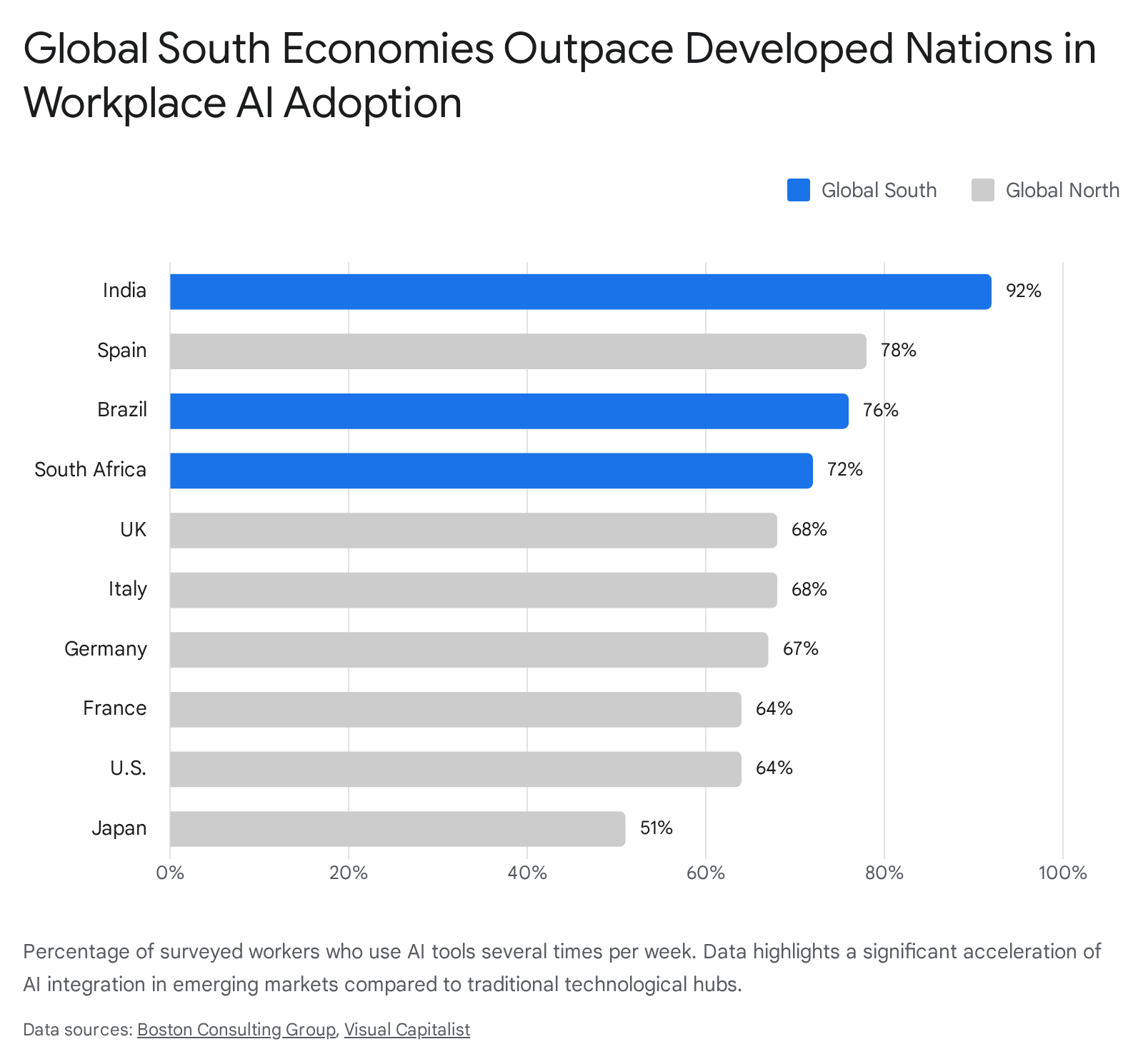
Comprehensive surveys reveal that emerging economies are adopting artificial intelligence at a pace that significantly outstrips developed nations. According to a 2025 Boston Consulting Group (BCG) and Adobe survey of over 10,600 global workers, India sits firmly at the top of global adoption rankings, with 92 percent of workers utilizing artificial intelligence tools several times per week 1112. Other emerging economies follow closely, including Brazil at 76 percent and South Africa at 72 percent 1113.
This accelerated adoption is driven primarily by economic necessity. In rapidly digitizing economies, workers and organizations are leveraging artificial intelligence to bypass legacy infrastructure, dramatically reduce operational costs, and compete on a global scale 13. The technology has shifted from a novelty to a fundamental productivity engine; in India, it is estimated that artificial intelligence could add between $550 billion and $607 billion to the economy by 2035 13.
Furthermore, app download data confirms this explosive growth in developing markets. Year-over-year artificial intelligence app download growth surged by 600 percent in Nigeria, 300 percent in Pakistan, and 267 percent in India between 2024 and 2025 14. Conversely, smaller, digitally agile nations with early national strategies - such as Singapore, Chile, and the United Arab Emirates - have achieved the highest overall population penetration rates globally 14.
Structural Resistance and the Silicon Ceiling
In contrast, the Global North exhibits significantly lower workplace adoption rates. Despite housing the majority of advanced artificial intelligence infrastructure, corporate developers, and computing power, the United States reports a 64 percent regular adoption rate, tying with France, while Japan trails the dataset at just 51 percent 1114. Spain serves as a notable outlier in Western Europe with a 78 percent adoption rate 11.
This sluggish adoption in developed nations can be attributed to several structural factors, including aging workforces, stringent corporate compliance concerns, and heightened awareness of data privacy 1314. Within Western corporations, frontline employees have hit what analysts term a "silicon ceiling," where regular usage is stagnating at around 51 percent due to a lack of adequate training and leadership support 1215. Alarmingly, this friction has given rise to a pervasive "shadow AI" problem; over 54 percent of global respondents indicated they would use artificial intelligence tools even if they were officially unauthorized by their employers, suggesting that organic employee demand is far outpacing formal corporate integration and creating significant security vulnerabilities 1215.
Infrastructure Deficits and the Artificial Intelligence Divide
While rapid adoption characterizes certain emerging markets, a severe digital divide continues to limit global equity. As of 2024, UNESCO reports that nearly one-third of the global population - approximately 2.6 billion people - still lacks internet access entirely 161718. This foundational deficit prevents the democratization of generative technologies and threatens to evolve into a deep artificial intelligence divide.
Vulnerable groups, including rural populations, persons with disabilities, and marginalized communities, bear the brunt of this exclusion 1619. Furthermore, a persistent digital skills gender gap hinders women's participation; women are currently 25 percent less likely than men to know how to use basic digital technologies, limiting their ability to capitalize on the economic restructuring driven by artificial intelligence 1719. Without deliberate investments in inexpensive internet connectivity, free public digital learning platforms, and comprehensive artificial intelligence literacy programs, the technology risks exacerbating historical inequalities rather than alleviating them 17.
Cognitive Implications of Generative Systems
Perhaps the most profound area of ongoing research is the direct impact of generative artificial intelligence on human neurobiology and cognition. Peer-reviewed literature from 2024 and 2025 presents a highly polarized reality: artificial intelligence functions simultaneously as a powerful intellectual scaffold that augments capabilities and as an enabling crutch that induces severe cognitive atrophy 20.
The Cognitive Atrophy Paradox
The "cognitive atrophy paradox" refers to the counterintuitive phenomenon wherein technological systems that successfully enhance output efficiency concurrently erode the internal mental functions required to produce that output independently 21. Because generative artificial intelligence drastically reduces the cognitive friction necessary to execute tasks, users increasingly shift from "using" the system as a tool to "thinking through" it, outsourcing critical synthesis, reasoning, and memory consolidation to the machine 21.
A pivotal 2025 study conducted by the MIT Media Lab utilized electroencephalography (EEG) to monitor the real-time neural activity of participants tasked with writing essays, both with and without the assistance of Large Language Models (LLMs). The findings were stark. While the artificial intelligence-assisted participants completed their essays 60 percent faster, their "relevant cognitive load" - the intellectual effort required to actively transform raw information into structured knowledge - fell by 32 percent 22. The EEG scans revealed a massive reduction in brain connectivity, specifically in alpha and theta waves, in the assisted group 22.
The behavioral consequences of this neural disengagement were immediate and alarming: 83.3 percent of the artificial intelligence users were unable to recall specific passages or arguments from the texts they had just ostensibly "written" 2022. Furthermore, independent assessments by educators described the machine-assisted essays as structurally sound but largely "soulless," lacking original insight and relying on highly repetitive algorithmic expressions 23. Other studies corroborate these findings; research from the SBS Swiss Business School identified a strong negative correlation (r = -0.68) between frequent artificial intelligence use and critical thinking abilities, while a Microsoft study of knowledge workers noted an increased tendency to offload mental effort entirely as trust in the automated system surpassed trust in human intuition 2022.
Cognitive Augmentation and Co-Evolution
Conversely, when artificial intelligence is deployed with intentional pedagogical constraints, it acts as a transformative cognitive augment. The defining factor is not the presence of the technology, but the nature of the human-machine interaction.
A 2025 study from the Wharton School demonstrated this dichotomy clearly. When an artificial intelligence was configured as a "GPT Tutor" - prompted strictly to utilize Socratic questioning to guide students rather than providing direct answers or completed essays - student learning performance improved by 127 percent 20. Similarly, a comprehensive meta-analysis of 51 studies found large positive effects on learning and higher-order thinking when generative tools were deployed in highly structured, guided environments 20. Furthermore, a Harvard randomized trial indicated that artificial intelligence tutoring doubled learning gains compared to traditional active learning classrooms 20.
To navigate this duality, researchers have proposed the "Cognitive Sustainability Index" (CSI), a quantitative framework designed to measure the equilibrium between human reflective engagement and machine delegation 21. The index integrates behavioral parameters including autonomy, reflection, creativity, reliance, and delegation. Maintaining a sustainable CSI requires individuals and organizations to ensure that automation enhances human reasoning and ethical responsibility, rather than replacing the necessity for independent thought 21.
Metacognition and the Extended Mind Hypothesis
The overarching concern among neuroscientists and educators is the preservation of mental discipline and neuroplasticity. Cognitive load theory dictates that reducing unnecessary demands can free mental resources for deeper, more creative thought 29. However, neuroscience also confirms that cognitive abilities are strictly shaped by repetition; skills that are practiced are reinforced, and those that are offloaded deteriorate 29.
Excessive dependence on algorithmic generation leads to homogenized thinking and a reduction in metacognition - the ability to self-evaluate and judge the quality of one's own reasoning 29. As human intelligence becomes an increasingly hybrid human-machine system, maintaining cognitive health requires active, conscious resistance against automation complacency, ensuring that humans do not forfeit the experience of productive struggle 212924.
Intellectual Property and the Economics of Culture
The explosion of generative artificial intelligence has precipitated an unprecedented crisis in international intellectual property (IP) law and the economic viability of traditional creative professions. The core legal conflicts center on the unauthorized ingestion of copyrighted material for algorithmic training and the ambiguous legal status of machine-generated outputs.
Copyright Infrastructure and Training Data Constraints
Generative models rely on massive neural architectures trained on datasets scraped indiscriminately from the internet, frequently encompassing billions of copyrighted images, texts, and sound recordings, alongside personal information and biometric data 25. As of early 2025, there are more than 40 active copyright-focused lawsuits in the United States alone challenging the legality of this mass ingestion .
The World Intellectual Property Organization (WIPO) has observed that existing global copyright infrastructure - which was built over centuries around concepts of human authorship, territorial jurisdictions, and specific licensing registries - is fundamentally ill-equipped to handle the scale, speed, and cross-border nature of generative artificial intelligence 2627. In the music industry, current systems struggle with interoperability and efficiently matching sound recordings with underlying composition rights; the introduction of generative music, which relies on complex attributions from vast training pools, threatens to break this fragile infrastructure entirely 26.
In response to these systemic threats, WIPO initiated the platform for Artificial Intelligence and Intellectual Property Infrastructure (AIII). This initiative aims to foster dialogue on scalable technical solutions, such as tracking mechanisms to distinguish between human and artificial intelligence contributions, standardizing opt-out mechanisms for creators, and ensuring transparent compensation pathways for rightsholders whose data is utilized in model training .
Patent Landscapes and Technological Concentration
The rapid advancement of these systems is reflected in an explosion of intellectual property filings. WIPO's 2024 patent landscape report on generative artificial intelligence highlights a massive acceleration in technological development over the past decade.
| Generative AI Model Type | Total Patent Families (2014-2023) | Description |
|---|---|---|
| Generative Adversarial Networks (GANs) | 9,700 | Models featuring competing generator and discriminator networks, highly utilized in image synthesis. |
| Variational Autoencoders (VAEs) | 1,800 | Models prioritizing data compression and probabilistic generation. |
| Large Language Models (LLMs) | 1,300 | Foundational text-based models driving modern conversational interfaces. |
Table 3: Patent filing volume by primary generative model architecture over a ten-year period. Data sourced from the WIPO Patent Landscape Report 2024 28.
These models are being aggressively patented across diverse industrial applications, including life sciences (5,346 patent families), document management (4,976 patent families), business solutions, and telecommunications 28. This rapid patenting ensures that the foundational technical means of production remain highly concentrated among a few powerful corporate entities, raising significant concerns among international bodies regarding digital sovereignty, market monopolies, and the preservation of diverse cultural expressions 2930.
Revenue Projections and the Two-Speed Artistic Economy
For working creative professionals, the economic outlook remains perilous. A major 2025 report from UNESCO, prepared by the Independent Expert Group on Artificial Intelligence and Culture (CULTAI) for the MONDIACULT conference in Barcelona, warns of the emergence of a "two-speed" artistic economy 303132. This paradigm severely disadvantages independent artists and creators in the Global South who lack access to advanced digital infrastructure or the legal representation necessary to defend their intellectual property 2931.
The financial implications are severe. The UNESCO report cites economic projections estimating global revenue losses of 24 percent for music creators and 21 percent for audiovisual creators by the year 2028, directly resulting from commercial markets being flooded with synthetic, machine-generated outputs 33. To combat this erosion, the CULTAI expert group established three ethical imperatives for artificial intelligence development: ensuring systems respect cultural sovereignty (Rights and integrity), countering algorithmic homogenization to protect diversity (Pluralism and equitable economies), and ensuring human creative agency remains central to prevent exploitation (Sustainable and resilient cultural futures) 2934.
International Regulatory Frameworks and Governance
Governments and international bodies are attempting to rapidly institutionalize safeguards to manage the disruption caused by artificial intelligence. However, the global regulatory landscape remains highly fragmented, characterized by a spectrum of approaches ranging from strict, comprehensive national legislation to voluntary, agile regional guidelines.
Comprehensive National Legislation and Setbacks
Several nations are attempting to implement robust, legally binding frameworks to govern the development and deployment of artificial intelligence:
- Brazil (Bill 2338/23): Brazil is advancing one of the most comprehensive regulatory efforts in Latin America. Initially debated between 2020 and 2021, a substantially revised Bill 2338/23 was approved by the Brazilian Senate in December 2024 and transitioned to the House of Representatives in 2025 4335. The legislation adopts a risk-based approach similar to the EU AI Act. Recent revisions broadened exceptions for non-economic personal use and testing, and eliminated the mandatory requirement for a corporate "AI officer" to ease the compliance burden on smaller innovators 36. Crucially, the bill explicitly mandates copyright protection and seeks to establish a remuneration scheme for creators whose works are used in training commercial models, though critics argue it currently prioritizes rightsholders over individual artists 4336.
- South Africa (Draft National AI Policy): South Africa attempted to construct a sophisticated, sector-specific regulatory model designed to balance rapid innovation with historical socio-economic equity 3738. Rather than establishing a single centralized authority, the 2026 Draft National AI Policy empowered existing bodies - such as the Information Regulator for data privacy (POPIA) and ICASA for telecommunications - to oversee artificial intelligence within their specific domains 3738. However, this framework suffered a catastrophic setback in April 2026. The national government abruptly withdrew the draft policy after journalists discovered it contained fabricated academic citations, fictitious journal articles, and non-existent authors generated by an LLM hallucination 39. The scandal, which occurred after the document had been approved by the national cabinet, left the country's digital economy in regulatory limbo and served as a stark, global warning regarding the unsupervised reliance on artificial intelligence in public governance and policy drafting 39.
Regional Coordination and Soft Law Approaches
In contrast to rigid national laws, some regions are opting for agile "soft law" frameworks designed to encourage voluntary alignment without stifling investment. The Association of Southeast Asian Nations (ASEAN) released its Guide on AI Governance and Ethics in February 2024 4041.
The ASEAN guide explicitly targets traditional, rules-based artificial intelligence systems rather than advanced generative models, prioritizing regional business competitiveness and cross-border interoperability over strict compliance mechanisms 42. The framework establishes seven core principles, including transparency and human-centricity, and introduces a risk-based categorization to determine the necessary level of human involvement in decision-making: human-in-the-loop, human-over-the-loop, and human-out-of-the-loop 40. This non-binding approach serves as a flexible foundation, allowing individual member states to customize governance to local conditions while maintaining regional cohesion 4243.
Frameworks for Human-Machine Co-Creation
Despite the well-documented cognitive risks and unresolved legal ambiguities, the creative industries are overwhelmingly integrating generative tools into their standard operational procedures. An Adobe survey conducted in late 2025 across 16,000 global creators found that 86 percent actively use generative artificial intelligence, with 76 percent reporting that the technology has accelerated their business growth or audience reach 44. Consequently, academic institutions and industry leaders are shifting focus toward developing structured operational methodologies to ensure that humans remain the primary drivers of the creative process.
The Sense-Sample-Shape-Stage Architecture
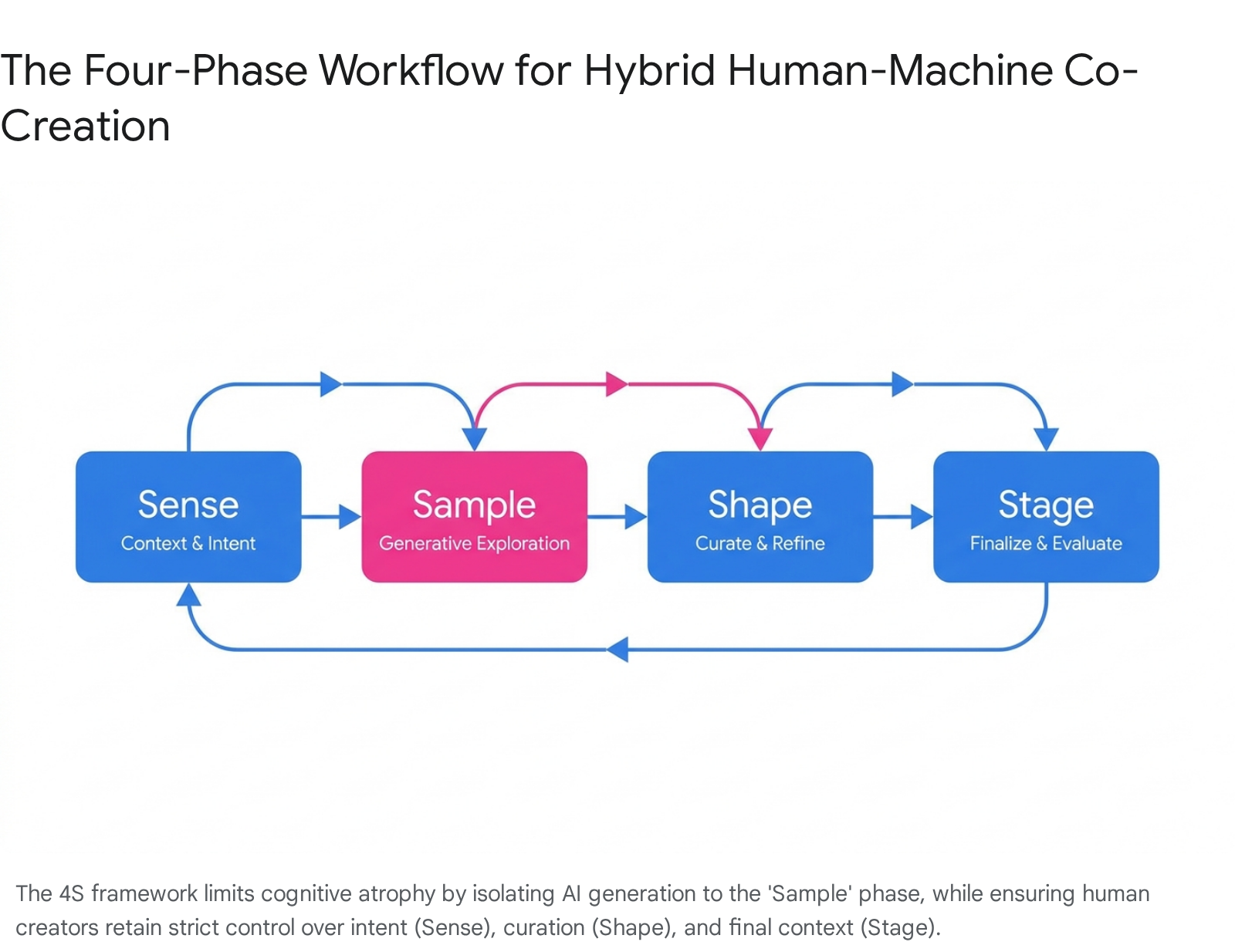
One of the most prominent and actionable operational frameworks to emerge is the "Sense-Sample-Shape-Stage" (4S) model, developed by researchers at the Immersive Lab at AP University of Applied Sciences and Arts Antwerp 454647. The 4S framework is specifically designed to structure human-machine co-creation in a manner that mitigates cognitive atrophy, enforces copyright boundaries, and retains strict authorial intent. The workflow is divided into four distinct phases:
- Sense: The human creator defines the core intent, establishes the contextual boundaries, and dictates specific ethical and stylistic constraints. In this phase, the artificial intelligence is strictly directed and constrained; it is not allowed to dictate the foundational concept or overarching narrative 4547.
- Sample: The artificial intelligence is utilized for high-volume, rapid generative exploration. This phase embraces algorithmic breadth, explicitly delegating the labor-intensive process of divergent ideation and initial asset generation to the machine 4547.
- Shape: Human judgment and critical thinking are forcefully reintroduced. The human creator curates, extensively edits, and refines the raw outputs generated by the machine, rigorously enforcing the constraints and artistic vision established during the 'Sense' phase 4547.
- Stage: The final hybrid artifact is implemented, tested, and evaluated within its intended real-world context, ensuring that the final product maintains accountability to audiences, stakeholders, and legal standards 4547.
A unique and critical feature of this workflow is the "Serendipity Capture Protocol." Rather than viewing artificial intelligence hallucinations, errors, or unexpected outputs generated during the 'Sample' phase as systemic failures, the protocol reframes them as valuable raw materials and happy accidents intended for human curation and interpretation 4647. By rigidly compartmentalizing the artificial intelligence's role to execution and broad exploration, the 4S model actively prevents the deep cognitive offloading that leads to the degradation of human critical thinking and intellectual atrophy.
Interaction Design in Co-Creative Systems
Complementing operational workflows like 4S, researchers in human-computer interaction have developed models such as the Co-Creative Framework for Interaction Design (COFI). This framework categorizes interaction models based on how humans and machines communicate and manipulate shared creative content 48. Current research utilizing COFI indicates a significant task-dependent asymmetry: while Large Language Models demonstrate superior performance in rapid execution quality and structural coherence, human agents maintain a distinct, overwhelming competitive advantage in high-demand, original ideation and contextual problem-solving 48.
Consequently, the future of creative labor relies on hybrid intelligence models. By designing systems that prioritize transparent communication and mutual feedback between the user and the artificial intelligence, developers can foster environments where interactional sense-making thrives 48. In these optimized systems, the technology serves not as an autonomous artist or a cognitive crutch, but as a responsive, highly capable partner that strictly requires human direction and emotional intelligence to function effectively.