
How We Could Engineer Life by 2040
Synthetic biology is transforming the DNA of living organisms into programmable code, allowing researchers to redesign cells to manufacture personalized medicines, climate-resilient crops, and sustainable materials. By 2040, the convergence of artificial intelligence and bio-manufacturing could create a multi-trillion-dollar global bioeconomy, fundamentally altering industrial supply chains. However, realizing this potential requires nations to rapidly scale fermentation infrastructure while navigating unprecedented biosecurity risks posed by AI-enabled biological design.
Reprogramming the Code of Life
For most of human history, humanity's relationship with biology has been observational and strictly limited by the boundaries of natural evolution. We have studied the natural world, selectively bred plants and animals, and relied on the slow, iterative processes of nature to provide our food, materials, and medicines. The development of recombinant DNA technology in the 1970s marked a turning point, allowing scientists to cut and paste existing genes to create organisms with modified traits, ushering in the era of modern biotechnology 12.
However, synthetic biology represents a far more profound paradigm shift. It is an interdisciplinary field that marries the principles of molecular biology, engineering, and computer science to redesign biological systems from scratch, or to re-engineer complex living organisms for specific, highly targeted purposes 34. If traditional genetic engineering was akin to editing a few words in an existing book, synthetic biology is the equivalent of writing entirely new chapters - or even programming a new operating language from the ground up.
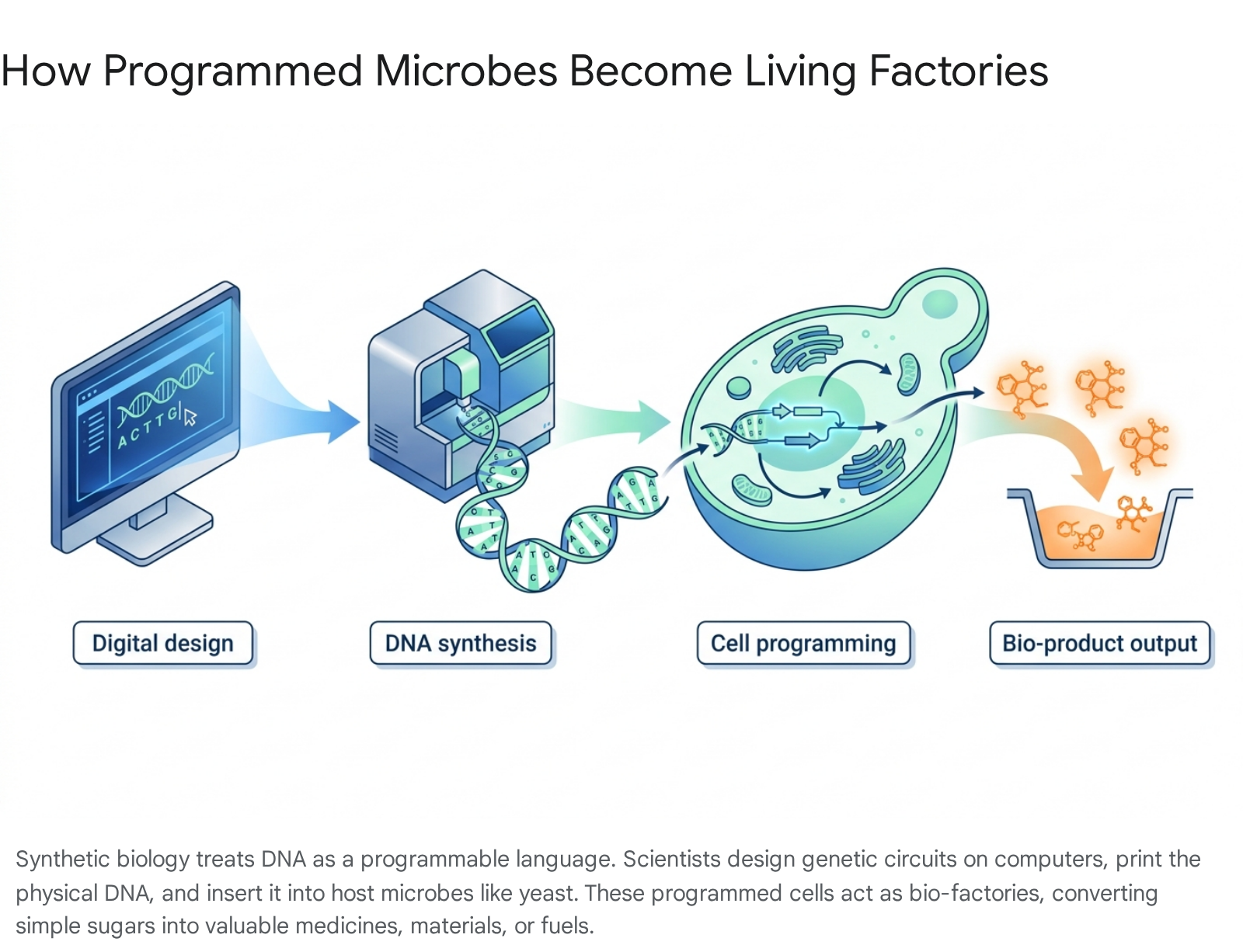
At the heart of this discipline is the recognition that deoxyribonucleic acid (DNA) functions as a literal biological programming language. Instead of the ones and zeros that drive digital software, life runs on a four-letter chemical alphabet: Adenine (A), Cytosine (C), Thymine (T), and Guanine (G) 3. Synthetic biologists treat these chemical bases as modular, standardized parts - often referred to as "BioBricks" - that can be synthesized artificially and snapped together to create complex genetic circuits 364.
By inserting these custom-built genetic sequences into host organisms like Escherichia coli (E. coli) or baker's yeast (Saccharomyces cerevisiae), researchers can reprogram these microbes to act as microscopic living factories 38. These engineered cells read the new genetic instructions and begin converting basic feedstocks, like simple sugars or agricultural waste, into high-value chemicals, pharmaceuticals, or biofuels 46.
How Does It Differ From Traditional Genetic Engineering?
To grasp the full scope of synthetic biology, it is essential to distinguish it from the earlier iterations of biotechnology. While synthetic biology exists on a continuum that began with the discovery of DNA's structure and the invention of polymerase chain reaction (PCR) technologies, its modern manifestation is defined by an engineering ethos 95.
Traditional genetic engineering typically involves transferring a single, naturally occurring gene from one organism to another. For example, early genetically modified (GM) crops were created by inserting a single bacterial gene into corn to make it resistant to pests 411. Synthetic biology, by contrast, focuses on the rational design of entirely novel pathways that do not exist in nature 339. It aims to make biology predictable, measurable, and scalable.
| Feature | Traditional Genetic Engineering | Synthetic Biology |
|---|---|---|
| Core Approach | Cut and paste existing, naturally occurring genes. | Design and build novel genetic circuits from scratch. |
| Complexity | Typically single gene modifications. | Multi-gene pathways, logic gates, and synthetic genomes. |
| Design Process | Largely manual, often relying on trial-and-error. | Computational modeling, AI-driven design, and predictive biology. |
| Standardization | Low; bespoke modifications tailored to specific organisms. | High; reliance on standardized "BioBricks" and interchangeable modular parts. |
| Primary Goal | Altering a specific trait in a host organism. | Creating programmable "living factories" or entirely synthetic cells. |
The Computing Analogy: From Mainframes to PCs
To contextualize the current state and future trajectory of synthetic biology, experts frequently draw analogies to the history of computing. In the mid-1970s, the computing world was dominated by the Cray-1 supercomputer - a multi-million-dollar machine accessible only to elite government institutions and well-funded corporations 12. Early synthetic biology existed in a similar "Cray-1 era." For instance, the 15-year, $40 million effort by the J. Craig Venter Institute to create the first synthetic organism in 2010 was a monumental, bespoke achievement that required massive institutional backing 6. The tools were prohibitively expensive, and the process was painfully slow.
Today, synthetic biology is pushing toward its "Personal Computer" revolution. Just as the development of microprocessors and standardized operating systems drove down the cost of computing and democratized software development in the 1980s, the falling costs of DNA sequencing (reading) and DNA synthesis (writing) are democratizing biology 126.
Researchers are now building biological systems using the explicit principles of digital logic. By organizing genetic parts into logic gates - such as "AND," "OR," and "NOT" gates - scientists can program cells to make complex, autonomous decisions 48. For instance, a cellular "AND" gate might be programmed so that an engineered microbe only activates a specific gene if it detects both Biomarker A and Biomarker B in its environment 48. As these genetic circuits become more standardized and reliable, the biological equivalent of programming a basic "Hello World" script is rapidly becoming a routine undergraduate laboratory exercise using E. coli 12.
Why Biology Is Not Just Software
Despite the elegance and utility of the computing analogy, it is crucial to recognize where the metaphor breaks down. Pop culture and Hollywood have heavily shaped public perception, often equating engineered biology with the instantaneous creation of cinematic monsters, apocalyptic super-bugs, or hyper-intelligent chimeras 214. The reality of synthetic biology is far more constrained, highly regulated, and infinitely more tedious.
The predominant industrial reality of synthetic biology is not a rampaging creature escaping through an air vent, but rather a cloudy flask of yeast sitting in a sterile steel fermentation tank, quietly converting sugar into a malaria drug precursor or a biodegradable plastic 1415. Furthermore, while the "DNA as code" framework is a useful shorthand, it significantly oversimplifies the messy, non-deterministic reality of living systems.
In 2004, a DNA synthesis company offered to build a 40,000-base-pair sequence for free to any scientist who could design a functional, brand-new piece of biology. No one submitted a proposal, highlighting a profound truth: scientists knew how to print the DNA, but they did not know what to write 16. Unlike a clean, deterministic computer program, a genome is a historically patched, chemically sensitive, and deeply contextual biological system 616. DNA does not operate in a vacuum; its expression is heavily influenced by epigenetics, cellular metabolism, and environmental stressors 6.
You can rewrite the genetic letters flawlessly on a computer screen, but the living cell ultimately decides whether that new code functions efficiently, grows poorly, or simply dies. As scientists make thousands of genetic edits, small disturbances in a cell's metabolic burden accumulate. The result is often a biological "software crash" where the cell simply refuses to work 16. Therefore, the path to 2040 will not be defined merely by how fast we can print DNA, but by how well artificial intelligence can help us decipher the hidden contextual rules of cellular environments.
What Will We Manufacture by 2040?
If the underlying challenges of biological complexity and scalability can be managed, synthetic biology is poised to disrupt multiple pillars of the global economy. The applications of this technology span across diverse sectors, unified by the common thread of programmability: the ability to read, write, and edit biological code to solve pressing human challenges.
Revolutionizing Medicine and Human Health
The most immediate and profound impacts of synthetic biology are already being felt in human health. We have moved far past the 1980s triumph of using engineered bacteria to produce recombinant human insulin - a milestone that freed millions of diabetics from relying on insulin harvested from the pancreases of pigs and calves 111415. Today, synthetic biology is delivering FDA-approved, highly personalized therapies that treat the root causes of disease.
By 2040, healthcare scenarios rely heavily on engineered cell therapies, in vivo gene editing, and programmable RNA medicines. Techniques utilizing CRISPR-Cas9 have already yielded functional cures for debilitating genetic diseases like sickle cell anemia (e.g., the recently approved therapy Casgevy) 378. Furthermore, Chimeric Antigen Receptor T-cell (CAR-T) therapies represent a monumental leap in oncology. This process involves extracting a patient's own immune cells, reprogramming their genetic circuitry to recognize and attack specific cancer cells, and reinfusing them as a living, targeted drug 719.
Looking toward the coming decades, the convergence of AI and biology will shift the paradigm from discovering drugs in nature to designing them computationally. AI models are already being used to design highly specific antibodies and mRNA vaccines from scratch, with the mRNA therapeutics market alone projected to reach $15 billion to $20 billion in the coming years at a 15-20% compound annual growth rate 7. Researchers are also developing microbiome therapeutics - engineered gut bacteria designed to act as internal biosensors that can detect disease markers and autonomously synthesize and release therapeutics directly into the digestive tract 87.
Agriculture, Food Systems, and Precision Fermentation
As global populations rise and the effects of climate change intensify, traditional agriculture is facing an existential crisis. The current model of heavy pesticide use, synthetic fertilizers, and resource-intensive livestock farming is ecologically unsustainable. By 2040, synthetic biology offers pathways to decouple food production from massive land and water usage, while simultaneously engineering climate resilience into traditional crops.
Companies are currently deploying engineered nitrogen-fixing microbes on millions of acres of farmland. These bio-engineered microbes act as living biofertilizers, promoting plant growth and significantly reducing the agricultural sector's reliance on synthetic, petroleum-based chemical fertilizers, which are a major source of greenhouse gas emissions 137. Simultaneously, researchers are engineering crops with synthetic genetic circuits that reprogram plant growth to withstand severe heat and prolonged drought, ensuring global food security in increasingly hostile climates 1.
Perhaps the most disruptive shift will come from precision fermentation. Instead of raising massive herds of livestock for protein, companies are engineering yeast and fungi to produce animal-free dairy proteins (like casein and whey), egg whites, and the heme proteins that give plant-based meats their authentic flavor and texture 79. This shift toward lab-grown and fermented proteins requires vastly fewer resources and emits a fraction of the greenhouse gases compared to traditional animal agriculture 4. Analysts project that the global synthetic biology market for agriculture and food could be worth up to $430 billion by 2040, fundamentally disrupting traditional dairy and meat export revenues 9.
Advanced Materials and the Circular Economy
The materials economy of 2040 will likely see a massive transition away from petrochemicals. Traditional manufacturing extracts fossil fuels and subjects them to extreme heat and pressure to create plastics, textiles, and industrial chemicals. Synthetic biology allows for the bio-manufacturing of these identical commodities at room temperature, using engineered microbes and renewable biomass (such as agricultural or forestry waste) as feedstocks 46.
The applications range from the mundane to the extraordinary. Microbes are being programmed to produce biodegradable plastics that naturally break down, replacing materials that would otherwise persist in landfills for centuries 48. In the fashion industry, startups are growing animal-free leather in laboratories and synthesizing bio-based dyes that eliminate the need for toxic chemical runoff, heavily reducing the environmental footprint of clothing production 810.
At the bleeding edge of materials science, the Engineering Biology Research Consortium's roadmap for 2040 outlines the goal of "retrobiosynthesis" - the ability to computationally predict and engineer biological systems to manufacture novel materials with highly specific desired properties, such as advanced thermal conductivity or elasticity 1112. Already, engineered microbes are being used to weave synthetic spider silk - a material stronger than steel and highly elastic - for use in advanced textiles and industrial coatings 3.
Environmental Resilience and Bioremediation
Beyond doing less harm, synthetic biology holds the promise of actively repairing historical environmental damage through advanced bioremediation. Scientists are developing highly specialized synthetic organisms designed to detoxify polluted environments. For example, bacteria have been genetically modified to break down crude oil spills, neutralize heavy metals in contaminated soils, and even consume microplastics that pollute the oceans 34313.
By 2040, engineered organisms may play a critical role in global climate change mitigation and carbon capture strategies. If scientists can successfully program microbes to efficiently capture atmospheric carbon dioxide (CO2) or methane and metabolically convert it into valuable chemical feedstocks, biofuels, or construction materials, it could create a closed-loop, carbon-negative industrial cycle 11314. Furthermore, in urban environments, synthetic biology and genetic diversity profiling are being integrated into adaptive forest management to enhance the resilience of urban trees against changing precipitation patterns and rising temperatures 26.
The Economics of Engineering Life
The financial projections for synthetic biology reflect its status as a foundational, general-purpose technology. Much like the digital revolution of the late 20th century, the bio-revolution is expected to touch nearly every sector of the physical economy.
In 2024, the global synthetic biology market was valued at roughly $12.3 billion. Fueled by rising demand for bio-based products, personalized medicine, and plunging costs for DNA synthesis, the market is projected to reach over $31 billion by 2029 (a robust CAGR of over 20%), and exceed $130 billion by 2035 1516.
When factoring in the total addressable market across all downstream industries, the economic footprint is staggering. The McKinsey Global Institute estimates that as scientific and regulatory hurdles are cleared, engineering biology could have a direct economic impact of up to $2.2 trillion annually between 2030 and 2040 17. The report notes that up to 60% of the world's physical inputs (such as materials, chemicals, and fuels) could eventually be produced using biological means 17.
| Market Segment | 2024 Estimated Size | Projected CAGR (Next 5-10 Years) | Key Growth Drivers |
|---|---|---|---|
| Healthcare & Pharmaceuticals | ~$6.3 Billion | 25-30% | mRNA vaccines, CAR-T cell therapies, AI-designed biologics, personalized genomic medicine. |
| Agriculture & Food | ~$3.1 Billion | 20-25% | Precision fermentation (animal-free proteins), nitrogen-fixing microbes, drought-resistant seeds. |
| Industrial Chemicals | ~$1.5 Billion | 12-15% | Bio-based plastics, sustainable aviation fuels, biodegradable materials, bio-dyes. |
| Tools & DNA Synthesis | ~$1.4 Billion | 20%+ | Declining synthesis costs, advanced genome engineering tools (CRISPR), biofoundry automation. |
The Plunging Cost of DNA Synthesis
This economic explosion is predicated on a dramatic drop in the fundamental costs of the technology. The primary economic driver of the synthetic biology revolution is the precipitously falling cost of reading and writing DNA, which has outpaced even Moore's Law in the semiconductor industry 6.
The cost to sequence a whole human genome has plummeted from billions of dollars during the Human Genome Project to roughly $100 today 1831. More importantly for synthetic biology, the cost of DNA synthesis (the price per base pair to physically print genetic code) is experiencing a similar collapse. Aided by advanced silicon-based synthesis chips, massive miniaturization, and parallelization, the cost to synthesize one billion base pairs is projected to drop by orders of magnitude by 2030 and 2040 3132. This reduction in the cost of raw biological "coding" allows organism engineers to design, print, and test thousands of different genetic sequences simultaneously, rapidly exploring the biological design space to find the optimal cellular program 1934.
Crossing the Biomanufacturing "Valley of Death"
However, the path to a multi-trillion-dollar bioeconomy is currently blocked by a massive physical bottleneck: biomanufacturing infrastructure.
Designing a brilliant microbial factory on a computer and proving it works in a small 5-liter laboratory flask is only the first step. To make bioplastics, sustainable aviation fuels, or animal-free dairy economically competitive with heavily subsidized petroleum and factory farming, the engineered microbes must be grown in massive commercial fermentation tanks 1718.
Currently, there is a severe global shortage of pilot-scale (1,000 liters) and demonstration-scale (20,000 to 75,000 liters) precision fermentation facilities 18. Startups frequently fall into this "valley of death" - possessing world-changing intellectual property and successful lab-scale prototypes, but lacking the physical infrastructure and capital to scale their production to commercial viability 18. Analysts note that global precision fermentation capacity must expand 20-fold in the coming years to meet the projected demand for synthetic biology products, requiring massive public and private infrastructure investment 18.
The Global Geopolitics of Biotechnology
Because biotechnology has the potential to re-engineer global supply chains from the cellular level up, it has transitioned from a purely scientific endeavor to a central pillar of national security and geopolitical competition 20. The United States, China, the European Union, and emerging bio-powers are currently locked in a race to dictate the scientific standards, control the genomic data, and capture the economic value of the bio-century.
The United States' Innovation Engine
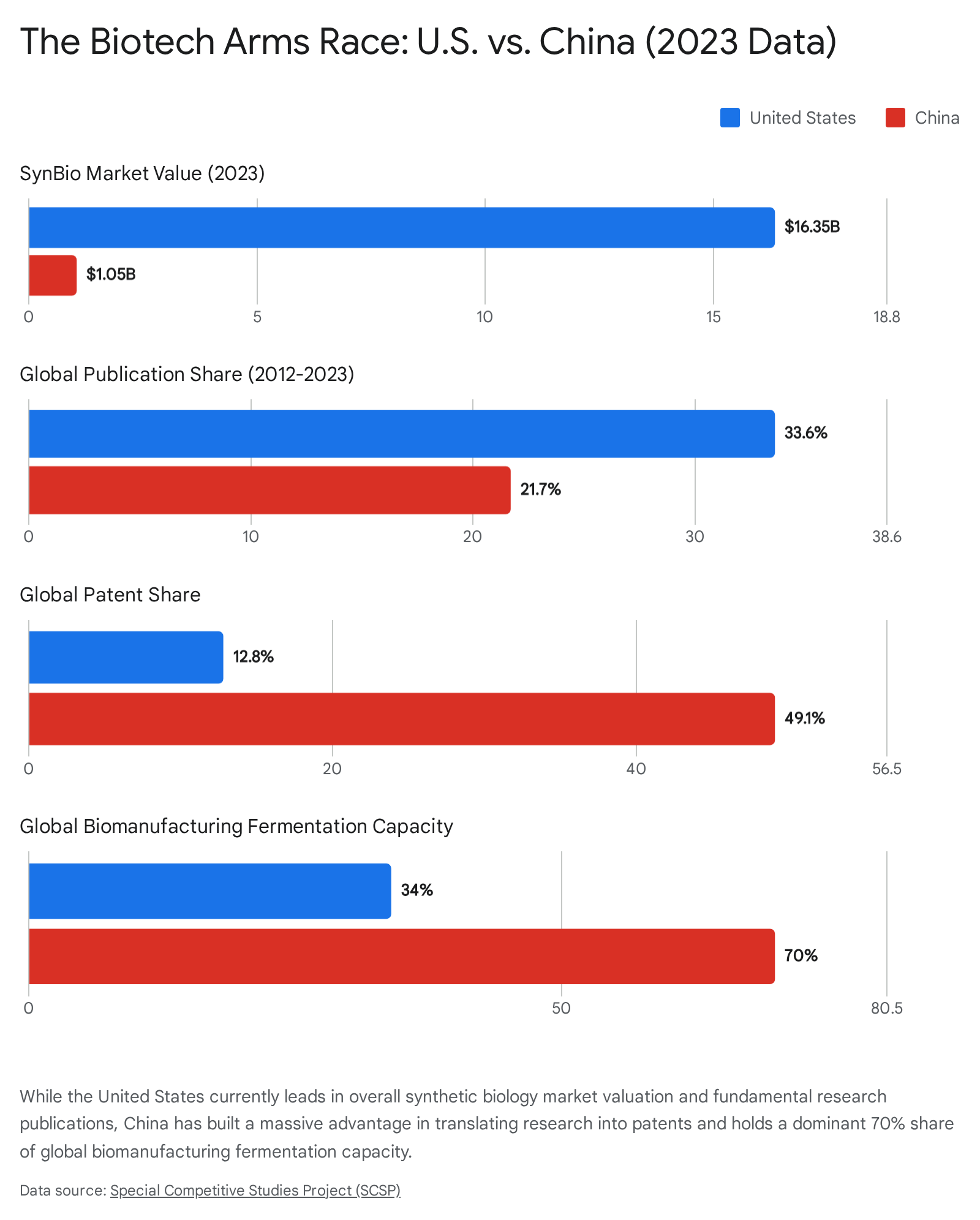
Historically, the United States has been the undisputed global leader in biotechnology 21. As of 2023, the U.S. synthetic biology market vastly dwarfed its competitors, valued at an estimated $16.35 billion, with projections pushing it toward $148 billion by 2033 18. The U.S. advantage is built on a foundation of premier academic research institutions, robust venture capital funding, and a culture of aggressive startup incubation.
Between 2012 and 2023, the U.S. generated 33.6% of global synthetic biology publications, driving foundational breakthroughs in CRISPR gene editing and synthetic genome design 18. However, U.S. momentum is somewhat fragmented by the lack of a unified, long-term national biotechnology strategy. Furthermore, reliance on volatile private venture capital can stall long-term infrastructure projects, leaving U.S. startups vulnerable to the fermentation bottleneck mentioned earlier 21. Recognizing this, recent U.S. legislative proposals, such as the Synthetic Biology Advancement Act and elements of the Intelligence Authorization Act, aim to solidify biotech as a major national security and economic focus 20.
China's Manufacturing Dominance
Conversely, China has integrated biotechnology and synthetic biology into its 14th Five-Year Plan as a core strategic priority, funneling massive, sustained state investment into genomics, bio-manufacturing, and AI-enhanced drug development 2021. While China's domestic synthetic biology market was valued at a more modest $1.05 billion in 2023, the sector has attracted immense investment, with over 1,000 deals injecting billions into the market since 2018 18.
China's greatest strategic advantage lies in its translation of basic science into industrial dominance. Today, China holds roughly 49.1% of global synthetic biology patents, compared to the U.S. share of 12.8% 18. More critically, China controls an estimated 70% of global fermentation capacity 18. This industrial-scale infrastructure allows Chinese firms to rapidly scale and commercialize synthetic biology innovations, bypassing the "valley of death" that plagues Western startups 1821.
Furthermore, China is aggressively pursuing the next generation of biotech talent. At the prestigious International Genetically Engineered Machine (iGEM) competition - the premier global proving ground for young synthetic biologists, originally founded at MIT - Chinese university teams now represent roughly 50% of all participants, signaling a massive shift in future workforce capability 142223.
The European Union and the Biotech Act
The European Union approaches synthetic biology with a focus on regulatory harmony, ethical standards, and sustainability. Historically, European policymakers have applied strict precautionary principles to genetic engineering, fueled by public skepticism regarding Genetically Modified Organisms (GMOs), which has sometimes slowed commercial momentum 2039.
However, recognizing the risk of falling behind the U.S. and China, the EU is preparing the Biotech Act (expected to be presented in 2026) 39. This flagship legislative framework aims to eliminate regulatory fragmentation across Member States, streamline approval procedures, and accelerate time-to-market for bio-innovations 3924. Crucially, the EU framework attempts to balance rapid innovation with stringent environmental and biosecurity guardrails, operationalizing dual-use risk assessments into the core of its industrial policy to ensure that biological misuse risks are mitigated proactively 39.
Emerging Bio-Strategies: UK, India, and Australia
Beyond the primary superpowers, other nations are establishing aggressive national strategies to capture the bio-dividend: * The United Kingdom: The UK has long been a pioneer in synthetic biology, publishing its foundational roadmap in 2012 and updating its ambitions with the National Vision for Engineering Biology in 2023 1725. The UK aims to establish itself as a global nexus for synthetic biology through international standardization and deep integration with the OECD Global Forum on Technology 2627. * India: In August 2024, India launched its BioE3 policy, aiming to make the country a global leader in high-performance biomanufacturing. The policy targets a $300 billion bioeconomy by 2030, focusing on public-private partnerships, bio-foundries, and AI-integrated biotech hubs to drive climate-resilient agriculture and therapeutics 28. * Australia: The CSIRO Synthetic Biology Roadmap outlines a massive opportunity for the Australian economy, projecting up to $27 billion in direct revenue by 2040. The strategy heavily focuses on agriculture, leveraging synthetic biology to diversify food exports and create new animal-free protein markets to hedge against traditional dairy and meat disruption 9.
The Convergence of AI and Biosecurity
Perhaps the most critical variable in the trajectory toward 2040 is the rapid convergence of artificial intelligence and synthetic biology. AI is fundamentally altering the pace of biological discovery. Machine learning algorithms can process massive genomic datasets, predict complex protein folding structures, and optimize genetic circuits far faster than human trial-and-error 72930.
However, this same technological acceleration has triggered profound biosecurity alarms among intelligence agencies, defense organizations (such as NATO), and bioethicists. The primary threat stems from the "dual-use" nature of biotechnology: the exact same tools used to design a targeted cancer therapeutic or a drought-resistant crop can theoretically be misused to engineer enhanced pathogens, recreate eradicated viruses, or design entirely novel biological threat agents 3031323334.
The Myth of the Instant Bioterrorist
Historically, developing biological weapons required immense "tacit knowledge" - the unwritten, highly specialized, and deeply practical laboratory skills possessed only by elite, formally trained scientists 35. Creating a pathogen was not just about downloading a DNA sequence from the internet; it required tacit expertise, complex equipment, and institutional infrastructure 53536. Therefore, the popular myth that any rogue actor could easily brew a pandemic in a garage laboratory was largely overstated 535.
However, AI threatens to rapidly lower these informational and technical barriers. Recent security assessments warn that popular Large Language Models (LLMs) are on the cusp of being able to provide novices with step-by-step guidance on how to acquire, design, and deploy biological agents, effectively bridging the tacit knowledge gap 3637. Even more concerning is the rise of Generative Biological Design Tools (BDTs). Just as generative AI can create novel images from text prompts, specialized biological AI models can design entirely novel protein sequences and biological functions that have never existed in nature 3654.
The DNA Synthesis Screening Gap
This AI capability exposes a critical flaw in current global biosecurity infrastructure. Currently, when a researcher orders synthetic DNA from a commercial provider, the company runs the requested genetic sequence through screening software. This software compares the requested sequence against a database of known, dangerous pathogens (like anthrax, Ebola, or smallpox) 54. If there is a high sequence homology (similarity), the order is flagged for human review or rejected.
However, AI-generated proteins represent a dangerous blind spot. Generative AI can design a novel protein that perfectly mimics the harmful function of a severe toxin, but does so using a genetic sequence that looks absolutely nothing like any known pathogen 3754. Because current synthesis screening relies heavily on sequence similarity rather than predicting biological function, these AI-designed threats could easily pass through conventional commercial DNA synthesis screens undetected 54.
Anticipatory Governance and Global Safeguards
Mitigating these risks by 2040 will require a layered, globally harmonized defense strategy 3655. Policymakers, including the OECD Global Forum on Technology and the World Economic Forum, are actively debating frameworks for "anticipatory governance," aiming to get ahead of technological disruption rather than reacting to it 83839.
Experts are calling for an urgent transition from sequence-based DNA screening to function-based predictive screening 54. This requires utilizing AI defensive models to evaluate what a requested DNA sequence will actually do once inserted into a cell, closing the loop on novel threats. Furthermore, governance must extend to the AI models themselves. Proposed regulations include implementing risk-tiered access for highly capable biological AI models, mandatory red-teaming for biological threats before AI models are released to the public, and stringent audit logging for high-end biological design tools 3655.
At the institutional level, laboratories are increasingly adopting standards like ISO 35001 for biorisk management, ensuring that both biosafety (preventing accidental release) and biosecurity (preventing intentional theft or misuse) are deeply ingrained in the research culture 323458. Balancing this security imperative without stifling the massive economic, medical, and environmental promise of synthetic biology represents one of the defining regulatory challenges of the 21st century 323336.
Bottom line
By 2040, synthetic biology has the potential to fundamentally rewire the global economy, transitioning human industry from extractive, petrochemical-based manufacturing to sustainable, programmable biology. The field promises profound breakthroughs in personalized medicine, climate-resilient agriculture, and advanced biomanufacturing, provided that the critical bottlenecks in physical fermentation infrastructure can be overcome. However, the trajectory remains highly uncertain due to the convergence of biology with generative artificial intelligence, which threatens to rapidly democratize access to dual-use technologies and evade current biosecurity screens. Realizing the trillion-dollar promise of the bioeconomy will ultimately depend on whether global governments can implement robust, function-based biosecurity frameworks without suffocating the pace of beneficial innovation.