
How Body Positivity and Body Neutrality Differ
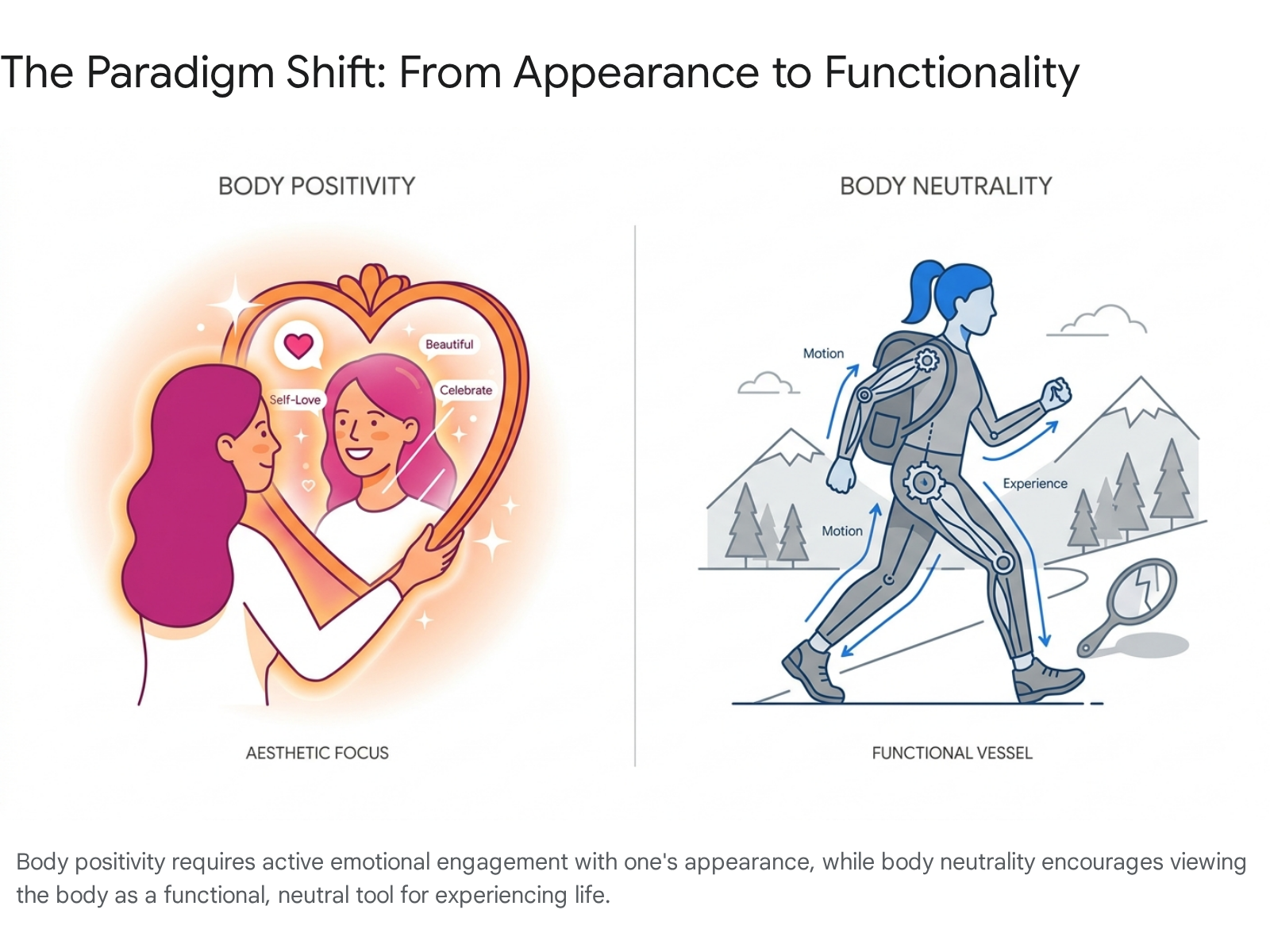
Body positivity promotes the unconditional love and active celebration of your physical appearance, challenging conventional beauty standards to assert that all bodies are inherently beautiful. Body neutrality, conversely, decenters appearance entirely, focusing instead on the body's functional capabilities and advocating for a non-judgmental respect for the physical form regardless of aesthetic feelings. While positivity requires active emotional engagement with how you look, neutrality permits indifference, easing the psychological pressure to feel beautiful at all times.
The Sociocultural Evolution of Body Image Movements
To understand the current psychological and cultural debate between body positivity and body neutrality, it is necessary to trace how these paradigms developed and how their original intentions have shifted over time in response to media and commercialization.
The Radical Roots of Fat Acceptance
Body positivity is frequently mischaracterized as a recent product of the Instagram era, but its structural roots reach back to the civil rights movements of the 1960s in the United States 12. During this era, activists such as Lew Louderback and Bill Fabrey, alongside radical feminist groups like the Fat Underground, began fighting against systemic anti-fatness, diet culture, and pervasive medical discrimination 2. These early organizers sought to raise awareness about the socioeconomic barriers faced by fat people, and as a result, the word "fat" was reclaimed as a neutral descriptor rather than a derogatory insult 3.
The primary goal of these groups - which eventually evolved into the National Association to Advance Fat Acceptance (NAAFA) - was not necessarily to force individuals to feel subjectively beautiful, but to secure equal rights, dignity, and safety for marginalized bodies, specifically fat, Black, disabled, and queer individuals 2455.
The Shift to Mainstream Radical Self-Love
As digital communities and blogs expanded in the 1990s and 2000s, the movement gained significant traction as a framework for radical self-love and psychological healing. Activists like Sonya Renee Taylor, an award-winning performance poet and the founder of the digital media and education company "The Body is Not an Apology," posited that loving oneself in a society built on anti-fatness and racism is a rebellious, transformative act of social justice 57.
Taylor's movement famously began after a conversation with a friend who had cerebral palsy and felt she could not ask a partner to use a condom because her disability made her feel sexually unworthy. Taylor's response - that the body is not an apology - birthed a framework where radical honesty, vulnerability, and empathy are used to dismantle body-based oppression 7. The movement challenged the foundational notion that a person's worth is inextricably tied to fitting a narrow, Eurocentric beauty ideal, offering instead a model of radical self-love as a balm against systemic marginalization 697.
Commercialization, Dilution, and White-Washing
When body positivity hit mainstream visual social media platforms like Instagram and TikTok in the 2010s, its core message was rapidly diluted. Researchers and early advocates noted that the movement was heavily co-opted by brands, advertisers, and influencers who largely fit conventional beauty standards - often young, white, thin, or slightly curvy, able-bodied women 3118.
Academic content analyses have quantified this shift. A 2023 study of TikTok videos using the #bodypositivity hashtag found that approximately 93% of the content still embodied Western beauty ideals to a great extent, and only 32% of the videos actually portrayed larger bodies 910. Furthermore, a 2024 analysis of 394 TikTok videos revealed that the most common body-positivity theme was simple "Body Acceptance and Love," devoid of any systemic critique 11.
Consequently, the radical demand for systemic equality morphed into a highly individualistic mandate: You must love how you look. For many individuals, the movement that was initially supposed to free them from oppressive beauty standards simply created a new, exhausting standard - the obligatory, relentless celebration of perceived physical flaws 1213.
The Inception of Body Neutrality
In direct response to the growing pressure of mandatory self-love, the concept of "body neutrality" emerged into the mainstream lexicon around 2015 1214. The term gained significant clinical popularity when Anne Poirier, a certified intuitive eating counselor and eating disorder specialist, utilized the framework to help clients build a healthier, less emotionally fraught balance between food, exercise, and self-worth 2.
Body neutrality was born from the clinical realization that unconditionally loving one's appearance is not always realistic, sustainable, or even necessary for a psychologically healthy life 19. It operates on the premise that physical appearance is simply not the most interesting or valuable facet of human existence. It effectively removes the moral imperative to feel beautiful.
Core Philosophies and Psychological Frameworks
To clearly delineate the boundaries between these two paradigms, it is crucial to examine how they handle daily inner dialogue, emotional expectations, and their primary focus of psychological attention.
| Philosophical Feature | Body Positivity | Body Neutrality |
|---|---|---|
| Primary Focus | Appearance, aesthetics, and subjective beauty. | Functionality, physical ability, and internal character. |
| Core Message | All bodies are inherently beautiful and worthy of active love. | Bodies are functional vessels; appearance does not dictate human value. |
| Emotional Expectation | Active celebration, continuous self-love, and positive feelings toward the physical self. | Non-judgmental acceptance, respect, and emotional detachment from aesthetic looks. |
| Response to Perceived "Flaws" | "I love my stretch marks; they are a beautiful part of my story." | "I have stretch marks, and that is a neutral biological fact. It does not matter." |
| Mental Health Impact | Can significantly boost confidence, but carries the risk of "toxic positivity" and emotional burnout. | Lowers emotional stakes, reduces anxiety, and provides a safe psychological space for bad body image days. |
| Diet & Exercise Motivation | Movement and eating to celebrate the body's beauty and actively overcome toxic diet culture. | Movement and eating purely for health, functionality, longevity, and how it physically feels. |
The Psychological Pitfalls of Forced Positivity
While body positivity has successfully challenged narrow beauty ideals for millions of individuals, mental health professionals increasingly point to its unintended, and sometimes harmful, psychological consequences.
The Phenomenon of Toxic Positivity
One of the primary critiques of the modern body positivity movement is that it frequently descends into "toxic positivity." In clinical psychology, toxic positivity occurs when individuals are pressured to maintain an unrealistically optimistic mindset, resulting in the forced suppression of genuine, painful, or complex emotions 1521.
When individuals are told they must love their bodies at all times, failing to do so can trigger secondary guilt and shame. If a person wakes up feeling bloated, uncomfortable, or unhappy with their reflection, the body-positive framework often implicitly suggests they are failing at feminism or self-love 1222. Suppressing negative emotions in an attempt to force a "good vibes only" mentality is clinically linked to higher levels of stress, anxiety, depression, emotional exhaustion, and physical burnout 22316. Dr. Susan Albers, a clinical psychologist at the Cleveland Clinic, notes that telling people to love their bodies when they genuinely do not can teach them to bury their true feelings, which is psychologically harmful and can even exacerbate the pathology of eating disorders 2.
The Trap of Appearance-Centric Thinking
A foundational limitation of body positivity is that it still fundamentally ties a person's worth to their physical appearance. Even if the definition of beauty is radically expanded to include all sizes, shapes, and abilities, the underlying premise remains unchanged: You are valuable because you are beautiful.
Body neutrality theorists argue that appearance should not be on the table for evaluation at all. By demanding that individuals constantly assess and affirm their physical beauty, body positivity keeps people tethered to the mirror. Body neutrality advocates argue that taking your body out of the equation entirely frees up immense cognitive load and mental energy. As one commentator noted, body neutrality gives you permission to be entirely "ordinary" about your body, allowing it to simply be the biological vehicle that carries you through life while you focus your energy on relationships, intellectual pursuits, careers, and hobbies 1213.
Social Media Impact: Algorithms and Body Image Interventions
The psychological debate between positivity and neutrality plays out daily on highly visual platforms like Instagram and TikTok. In recent years, clinical researchers have provided hard empirical data on how different types of curated social media content actually affect users' psychological states and body satisfaction.
How TikTok Shapes the Conversation
The #bodyneutrality hashtag has garnered over 1.3 billion views on TikTok, signaling a massive cultural shift among younger demographics 1718. A 2024 hybrid content and thematic analysis of TikTok videos in multiple languages revealed that creators use body neutrality discourse to explicitly normalize diverse bodies and reject the idea that appearance is fundamentally important 1819.
Interestingly, the analysis found that content creators frequently frame body neutrality as inherently "better than" or "more honest than" body positivity, frequently citing the sheer exhaustion of trying to meet the demands of constant self-love 18. The algorithm favors authenticity, and users find relief in creators who openly admit to having "bad body image days" without feeling the need to immediately correct it with a positive affirmation.
Experimental Evidence: What Actually Works?
Several recent experimental studies have rigorously tested how brief exposure to these specific social media trends impacts young women and gender-diverse individuals.
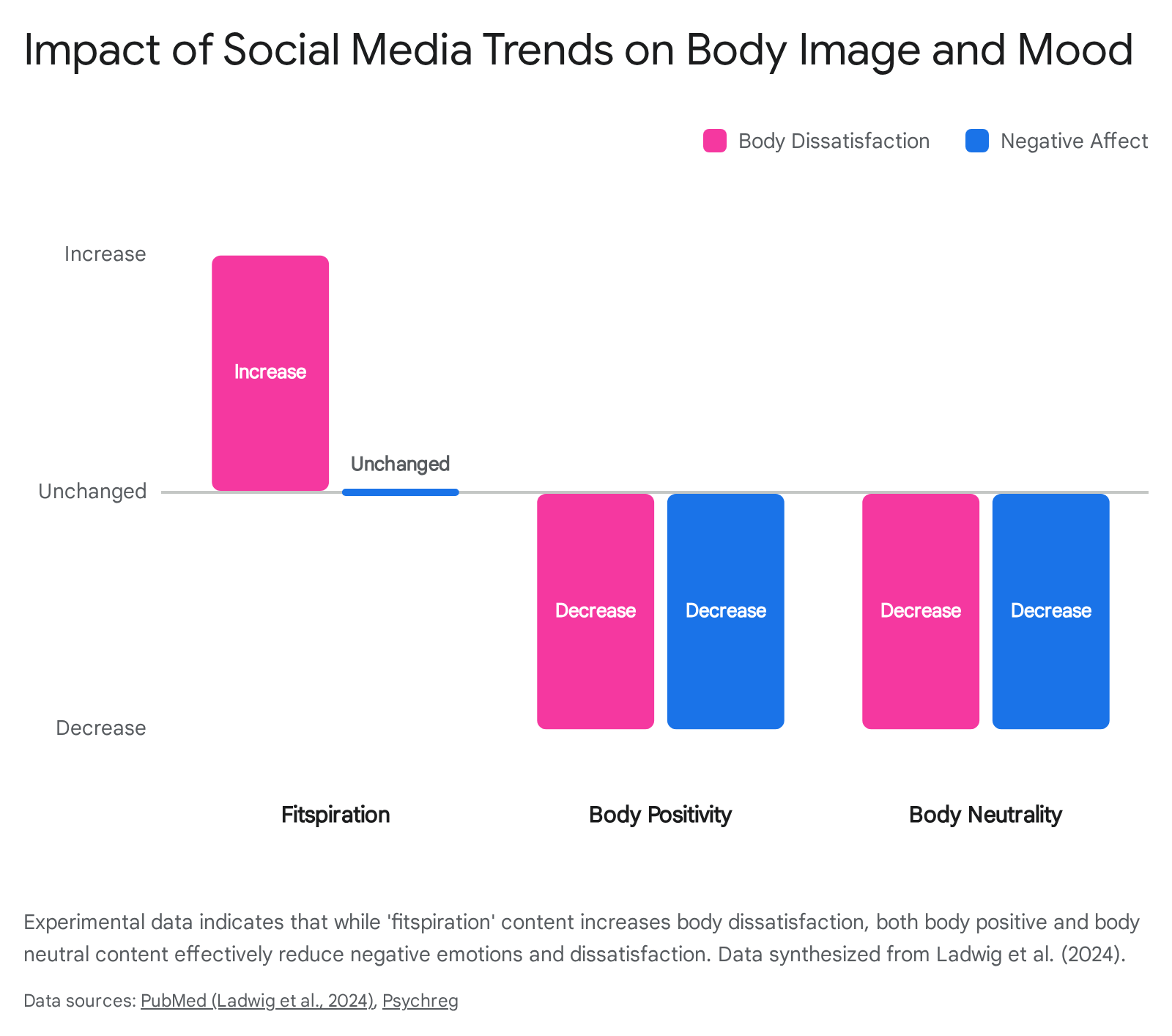
In a comprehensive 2024 study by Ladwig et al., published in Body Image, 382 women (including those with and without diagnosed eating disorders) were exposed to three types of Instagram content: "fitspiration" (thin, muscular women promoting fitness), "body positivity" (larger bodies promoting self-love), and text-based "body neutrality" (illustrations promoting body function) 2029. The empirical results were highly revealing: * Fitspiration predictably and significantly increased body dissatisfaction and decreased positive mood across all participants 2029. * Body Positivity effectively decreased body dissatisfaction and decreased negative mood, but it did not reliably boost positive mood 20. * Body Neutrality similarly decreased body dissatisfaction and reduced negative emotions. However, because its core tenet deliberately avoids emotional hype, it also did not elevate positive affect 2029.
A separate 2023 experimental study by Seekis and Lawrence focused exclusively on the TikTok algorithm. They found that young women randomly assigned to view body neutrality compilation videos reported higher appreciation for what their bodies could do (functional appreciation), higher overall body satisfaction, and fewer tendencies to engage in upward appearance comparisons relative to control groups 2131. Furthermore, brief exposure to body neutrality content on TikTok significantly increased participants' levels of self-compassion 17.
Clinical Applications in Eating Disorder Recovery
The distinction between positivity and neutrality is not merely an internet debate; it becomes particularly crucial in clinical psychology, specifically in the treatment of body dysmorphic disorder (BDD) and eating disorders (EDs).
For individuals recovering from anorexia nervosa, bulimia nervosa, or binge eating disorder, severe body dissatisfaction is often a formal diagnostic criterion and a massive therapeutic hurdle 32. In these high-stakes clinical contexts, therapists frequently find mainstream body positivity to be a detrimental goal. Expecting a patient with deep-seated body trauma, weight stigma, or intense dysmorphia to suddenly leap to a state of "loving their body" is not just unrealistic; it can reinforce the perfectionistic, all-or-nothing cognitive distortions that fuel eating disorders in the first place 322223.
Body neutrality aligns closely with evidence-based therapeutic frameworks like Dialectical Behavior Therapy (DBT), specifically utilizing the core concept of radical acceptance 35. Radical acceptance involves acknowledging reality exactly as it is, without attempting to fight it, judge it, or force a positive spin. In eating disorder recovery, body neutrality allows patients to say, "I do not like how my stomach looks today, but I am going to feed my body anyway because it requires energy to function." This approach systematically removes the friction of trying to change one's emotions, allowing the patient to focus entirely on changing their behavioral patterns 2223.
By completely de-centering appearance, body neutrality helps patients unhook their core self-worth from their weight or shape - a vital paradigm shift necessary for achieving long-term, sustainable remission from eating disorders 3536.
Intersectionality: Disability, Gender Diversity, and Culture
Neither body positivity nor body neutrality exists in a social vacuum. How an individual interacts with these psychological concepts depends heavily on their intersecting identities, including their physical ability, gender identity, and cultural background.
The Disability Rights Perspective
For many individuals with disabilities or chronic illnesses, the tenets of body positivity can feel uniquely alienating. Writer, teacher, and disability advocate Rebekah Taussig - author of Sitting Pretty: The View from My Ordinary Resilient Disabled Body - explains that disabled individuals are often immensely frustrated by the societal demand to "love" a body that routinely causes them severe pain, requires extensive medical intervention, or feels like a physical betrayal 1324.
For someone living with a progressive diagnosis or chronic pain, toxic positivity can feel invalidating. In these instances, body neutrality offers profound relief. It permits individuals to openly acknowledge their physical limitations and medical frustrations without accompanying guilt 3. Furthermore, disability advocates argue from a systemic standpoint that society should not need to view disabled bodies as aesthetically "beautiful" in order to grant them basic accessibility, equal rights, and human respect 32425.
Transgender and Non-Binary Experiences
The clinical application of body neutrality is highly debated within transgender and gender-diverse (TGD) communities. For many cisgender people, de-emphasizing appearance is a healthy way to detach from vanity. However, for transgender and non-binary individuals, physical appearance is often inextricably linked to core identity, physical safety, and psychological survival 2627.
A 2024 qualitative study examining non-binary body image found that experiencing "gender euphoria" often relies on actively cultivating a preferred body aesthetic (e.g., through gender-affirming medical care, hormone therapy, or specific clothing) 2628. For TGD individuals, appearance dictates how they are socially recognized. Furthermore, "passing" - or visibly presenting as their true gender - is frequently a matter of physical safety to avoid harassment, discrimination, or violence 27.
Therefore, instructing a transgender person to "just view your body neutrally and ignore your appearance" can unintentionally minimize or dismiss the very real distress of gender dysphoria 27. Conversely, other empirical studies show that when TGD individuals actively embrace body appreciation and gender identity pride, it acts as a significant protective buffer against disordered eating behaviors. This suggests that tailored, identity-affirming versions of positive body image remain highly relevant and necessary for this specific community 4229.
Global Perspectives and Cross-Cultural Adaptations
Cultural norms drastically alter how body image is constructed and perceived. Historically, academic body image research focused almost exclusively on young, white, Western populations. However, cross-cultural studies reveal that body ideals and the pressure to conform vary immensely across the globe.
In a recent comparative study spanning multiple continents, Black Nigerian women reported significantly higher levels of body appreciation across their lifespan compared to Western women (from the US, UK, Canada, and Australia), who reported the lowest levels of body satisfaction 30. However, rapid urbanization and the pervasive globalization of Western media are aggressively exporting the "thin ideal" globally. This has led to rising body dissatisfaction in regions where larger bodies were historically viewed as signs of affluence, health, and fertility (such as in parts of Africa and China) 303132.
In the Middle East and Arab world, the influx of Western body positivity has been met with complex sociological critiques. Scholars utilizing Rosalind Gill's concept of the "post-feminism sensibility" note that body positivity sometimes operates as a form of "compulsory empowerment." Instead of liberating women, it places a new moral demand on them: they are no longer just expected to discipline their physical bodies, but to heavily monitor and discipline their emotions about their bodies, crafting a constant display of confidence and desirability 513.
In Latin America, grassroots movements like Argentina's Movimiento Gordo (The Fat Movement), championed by philosophers and activists like Lux Moreno, operate similarly to the early US fat acceptance movement. They resist the strict medicalization of fatness - specifically criticizing the rigid global application of the Body Mass Index (BMI) - and fight the hegemonic cultural "duty" to be thin 33. Concurrently, to combat rising eating disorder rates, clinical researchers are actively culturally adapting Western prevention frameworks. For example, the "Body Project" - a cognitive dissonance-based intervention designed to critique appearance ideals - is currently being implemented and evaluated in public university settings in Mexico and across Latin America by organizations like Comenzar de Nuevo 3435.
Academic Criticisms and Debates Around Body Neutrality
While body neutrality has been warmly embraced by the general public, social media influencers, and many clinical therapists, it has faced notable pushback and clarification from academic researchers specializing in the psychology of body image.
Some prominent researchers argue that the public's understanding of "body neutrality" is based on a fundamental misunderstanding of the clinical psychological term positive body image. In a 2024 position paper published in Body Image, experts asserted that true "positive body image" - as studied in empirical psychology for decades - already includes concepts like functionality appreciation and the unconditional acceptance of the body's flaws 3637. From a strict academic perspective, the internet's version of "body positivity" is merely a commercialized, hashtag-driven social movement, whereas true positive body image is a robust, scientifically validated psychological state that is highly attainable 3738.
These academics argue that body neutrality is not actually a novel psychological construct, but rather a digital repackaging of existing functionality-appreciation metrics 3739. Furthermore, they explicitly warn against viewing neutrality as a simple "midpoint" between negativity and positivity. In psychology, emotional experiences are not mutually exclusive; a person can feel immensely proud of what their body can physically achieve while simultaneously feeling sad or frustrated about an aesthetic change 3638.
Finally, some cultural and philosophical critics worry that body neutrality sets an unacceptably "low bar" for social progress 3654. They argue that teaching women and marginalized groups to simply feel "indifferent" about their bodies is a capitulation to the status quo. Instead of actively dismantling the oppressive, patriarchal, and racist beauty standards that cause systemic body hatred, neutrality asks the oppressed to simply numb themselves to the bias, potentially resulting in apathetic self-care 1339. Critics suggest that true liberation requires tearing down the systemic hierarchies of beauty, rather than just choosing to ignore the mirror.
Bottom line
Body positivity advocates for radical self-love and the celebration of all body types as inherently beautiful, actively pushing back against narrow societal beauty standards. Body neutrality offers a more pragmatic alternative by de-centering appearance entirely, encouraging individuals to view their bodies with non-judgmental respect and focus heavily on physical functionality rather than aesthetics. While neutrality provides crucial psychological relief from the exhaustion of forced positivity - especially in eating disorder recovery and for those living with chronic illnesses - it remains debated whether ignoring appearance is a universally realistic goal, particularly for gender-diverse individuals whose physical safety and core identity are intimately tied to how they are visually perceived.