
Differences between body neutrality and body positivity
Conceptual Definitions and Historical Context
The contemporary psychological and cultural discourse surrounding human body image is heavily influenced by two distinct frameworks: body positivity and body neutrality. While these concepts are frequently conflated in popular media and consumer marketing, they emerge from different historical contexts, pursue divergent psychological objectives, and propose contrasting clinical methods for managing body dissatisfaction. Tracing the evolution of these movements is essential to understanding their current application in clinical psychology, sociology, and digital media.
The Origins of Body Positivity
The modern iterations of the body positivity movement originate from the Fat Acceptance Movement of the late 1960s. This movement was catalyzed by activists such as Lew Louderback and Bill Fabrey, who founded the National Association to Aid Fat Americans in 1969 - an organization later renamed the National Association to Advance Fat Acceptance (NAAFA) 123. Early fat liberation ideology was inherently political, drawing heavily from Black feminist thought and intersectional activism to identify fatphobia as a mechanism of systemic oppression intrinsically linked to racism, sexism, and ableism 43. The movement's original objective was not the promotion of individualized aesthetic self-love, but rather the dismantling of societal barriers, the destigmatization of marginalized bodies, and the demand for equitable access to healthcare, employment, and social dignity 4.
However, the movement underwent significant commercialization during the 2010s, propelled by social media platforms and the proliferation of hashtags such as #BoPo. As the movement transitioned into the digital sphere, its focus was gentrified, shifting from radical political liberation and structural change toward individualized aesthetic accommodation 43. Mainstream body positivity evolved into a philosophy asserting that all bodies are inherently beautiful and deserve to be celebrated, inadvertently placing the burden of psychological healing on the individual's capacity to love their physical appearance unconditionally 567.
The Emergence of Body Neutrality
Body neutrality emerged in the mid-2010s - gaining significant public traction around 2015 through the work of body image coaches and activists - as a direct response to the perceived unrealistic expectations of mainstream body positivity 289. Rather than demanding constant aesthetic celebration, body neutrality advocates for a non-judgmental acceptance of the body as a functional vessel. The framework seeks to decouple an individual's self-worth entirely from their physical appearance, moving away from aesthetic evaluation altogether 1810.
Pellizzer and Wade (2023) operationalized the definition of body neutrality through a rigorous synthesis of existing literature, identifying three core elements that define the construct. The first element entails a mindful acceptance that feelings about the body fluctuate constantly and should be observed without judgment. The second involves a central appreciation for the body's functionality and what it enables the individual to achieve. The third element requires the acknowledgment that self-worth encompasses intrinsic qualities and extrinsic passions, thereby de-emphasizing physical appearance as a metric of personal value 1112.
Core Divergences Between the Frameworks
The fundamental divergence between body positivity and body neutrality lies in their emotional demands and focal points. Body positivity remains appearance-centric, aiming to expand the definition of beauty, whereas body neutrality is function-centric, aiming to render the concept of beauty irrelevant to personal value 713.
| Dimension | Body Positivity | Body Neutrality |
|---|---|---|
| Primary Focus | Expanding the definition of aesthetic beauty to be inclusive of all forms. | Appreciating the functional capabilities of the body. |
| Core Philosophy | Every body is beautiful and deserves celebration. | The body is a functional vessel; appearance does not dictate worth. |
| Emotional Expectation | Unconditional self-love and positive affect toward one's body. | Non-judgmental acceptance; acknowledging that aesthetic feelings fluctuate. |
| Relationship to Appearance | Appearance-centric (shifting evaluation from negative to positive). | Appearance-decentralized (shifting focus away from aesthetics entirely). |
| Historical Origin | 1960s fat liberation and Black feminist activism. | Mid-2010s psychological response to the pressures of "toxic positivity." |
Psychological Mechanisms and Cognitive Correlates
Recent empirical research highlights that body positivity and body neutrality are not merely cultural buzzwords but distinct psychological constructs with differing clinical outcomes. While both frameworks aim to mitigate body dissatisfaction, they operate through different cognitive pathways and neurological mechanisms.
Differential Effects on Body Image and Affect
Experimental studies evaluating the impact of social media exposure demonstrate that both frameworks yield beneficial, yet distinct, psychological results. A 2024 experimental study assessing women's reactions to curated Instagram and TikTok content found that exposure to body positivity significantly decreased negative affect and enhanced positive affect 1415. Conversely, exposure to body neutrality content was uniquely effective at reducing self-objectification and negative affect, though it did not necessarily generate high levels of positive affect 141516.
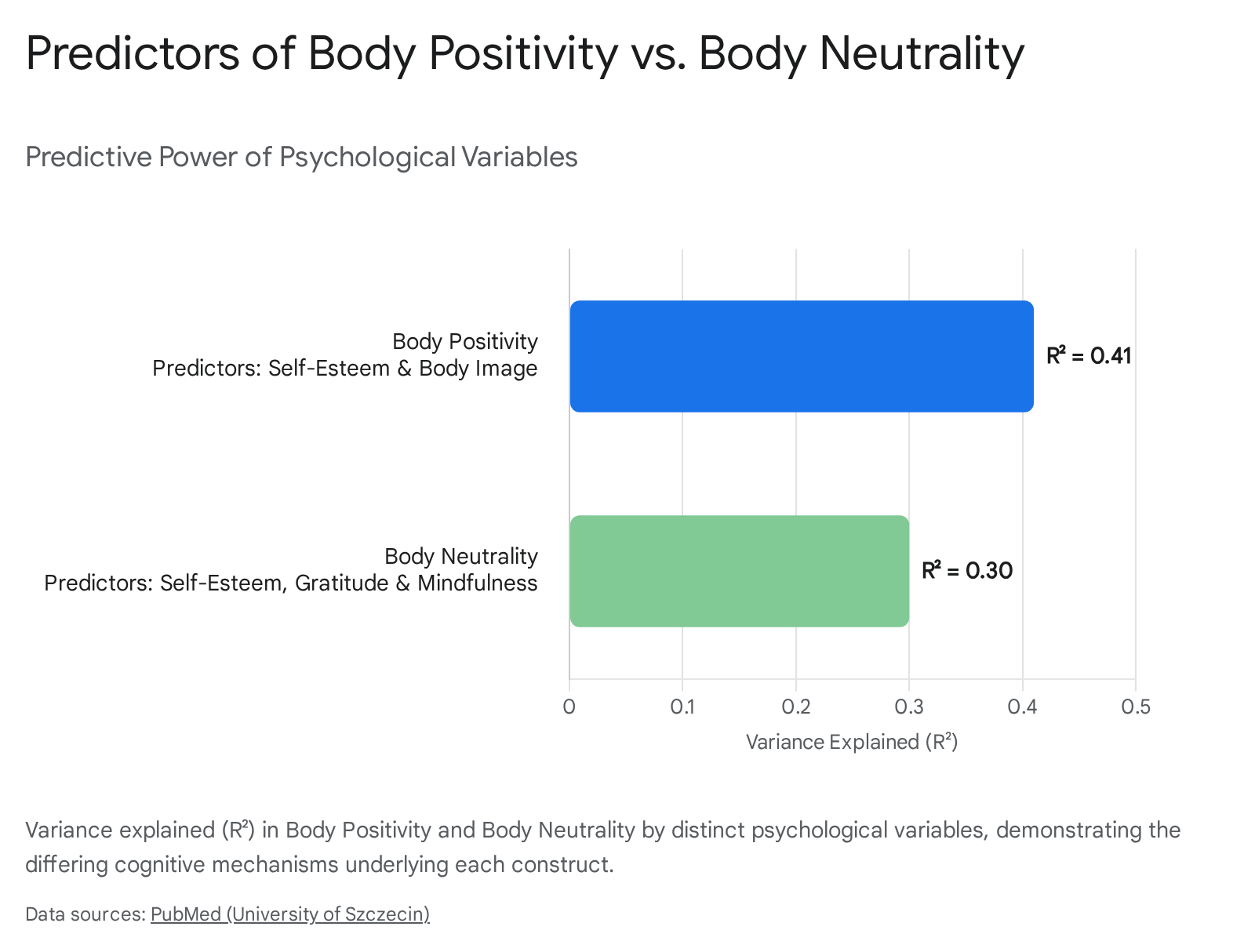
Structural modeling indicates that the two concepts maintain separate cognitive profiles. A 2025 study examining the psychological correlates of these movements reported a shared variance coefficient of only 0.23 between body positivity and body neutrality, confirming them as distinct constructs 1718. The study found that body positivity was strongly predicted by a combination of self-esteem and body image evaluation. In contrast, body neutrality was predicted by a combination of self-esteem, gratitude, and trait mindfulness 17.
Neurological Correlates and Mindfulness
The effectiveness of body neutrality relies heavily on mindfulness and interoceptive awareness. Mindfulness practices disrupt negative mental frames and promote positive appraisal without forcing an immediate emotional shift 1920. Neuroimaging studies correlate the cultivation of interoceptive awareness - central to body neutrality's focus on functional appreciation - with activity in the insula, anterior cingulate cortex, temporoparietal junction, and medial prefrontal cortex 2021.
By practicing mindfulness, individuals learn to observe bodily sensations and appearance-related thoughts neutrally, allowing for a state of cognitive dereification. In this state, mental phenomena are treated as transient events rather than literal truths 2022. This neuro-mechanistic shift supports the psychological flexibility required to disengage from appearance-based self-worth, allowing individuals to experience an emotional catharsis that transitions into a durable state of functional appreciation.
Therapeutic Applications in Clinical Psychology
Clinical psychologists and eating disorder specialists frequently integrate the tenets of body neutrality into established evidence-based therapies. The framework is highly compatible with third-wave cognitive behavioral therapies, primarily Acceptance and Commitment Therapy (ACT) and Dialectical Behavior Therapy (DBT).
Acceptance and Commitment Therapy (ACT)
ACT aligns seamlessly with body neutrality because it emphasizes psychological flexibility and cognitive defusion rather than thought modification. In traditional cognitive-behavioral models, a patient might be encouraged to challenge a negative thought regarding their appearance with a positive reappraisal - a strategy reflective of body positivity 25. In contrast, ACT posits that attempting to suppress or combat entrenched negative thoughts often magnifies their psychological impact, increasing physiological arousal and leading to depressive rumination 2327.
Through cognitive defusion, ACT teaches individuals to create linguistic and psychological distance from their self-evaluations. A patient learns to reframe a thought by prefixing it, transforming the assertion into an observation. This strips the thought of its literal authority and reduces the patient's cognitive fusion with the negative evaluation 2728. This mechanism supports body neutrality by allowing individuals to accept the presence of negative body image without being controlled by it. It shifts the therapeutic focus toward values-based actions, such as pursuing physical health or engaging in joyful movement, irrespective of the patient's current aesthetic satisfaction 2528.
Dialectical Behavior Therapy (DBT) and Distress Tolerance
For individuals experiencing acute body dissatisfaction, body dysmorphia, or the intense psychological discomfort associated with eating disorder recovery, the demand to love the body can trigger severe emotional dysregulation. In these instances, DBT utilizes Distress Tolerance skills, which operationalize the philosophy of body neutrality during crisis management 2930.
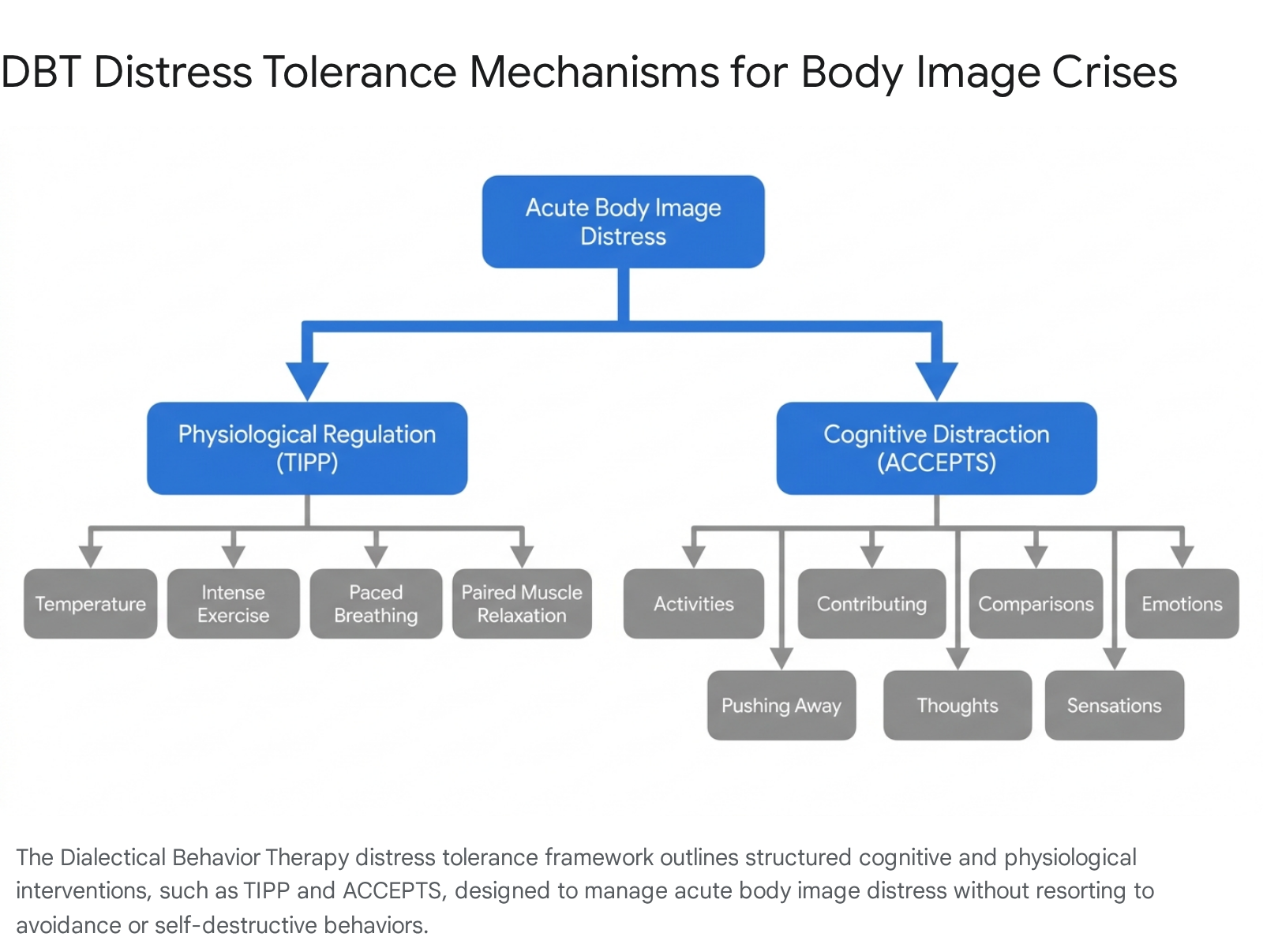
Distress tolerance does not aim to resolve the underlying psychological issue immediately. Instead, it seeks to help the patient survive the emotional crisis without engaging in self-destructive behaviors, such as extreme caloric restriction, binge eating, or self-harm 2930. The integration of body neutrality into DBT relies on several key interventions. Radical Acceptance requires the patient to acknowledge reality exactly as it is, without endorsement or approval. Applied to body image, this involves accepting the body's current state without the prerequisite of loving it 2930.
To manage the acute physiological arousal associated with body hatred, practitioners utilize the TIPP framework. This involves altering body temperature using cold water to activate the mammalian dive reflex, engaging in intense exercise to burn off stress hormones, utilizing paced breathing, and practicing paired muscle relaxation 2931. Furthermore, cognitive distraction techniques encapsulated in the ACCEPTS acronym (Activities, Contributing, Comparisons, Emotions, Pushing away, Thoughts, Sensations) are deployed to steer the mind away from acute bodily distress until the patient achieves a baseline level of psychological stability 3132.
The Phenomenon of Toxic Positivity and Influencer Fatigue
The proliferation of body positivity on digital platforms has led to a clinical and cultural counter-reaction driven by the psychological burden of "toxic positivity." Toxic positivity is defined as the compulsive suppression of authentic negative emotions in favor of a superficially optimistic facade, invalidating genuine psychological distress 232434.
Emotional Suppression in Body Positivity
When individuals are continually instructed to celebrate perceived physical flaws, those who cannot achieve this emotional state often experience compounded guilt, viewing their ongoing body dissatisfaction as a personal moral failure 224. Clinical research indicates that the emotional suppression inherent in toxic positivity can precipitate increased physiological arousal, heightened anxiety, and depressive symptoms 12334. For patients with low self-esteem, repeating positive affirmations that they do not genuinely believe can backfire, entrenching their negative self-perception because the subconscious mind rejects the inauthentic statement 135.
Social Media Dynamics and Upward Comparison
Sociologist Erving Goffman's impression management theory provides a framework for understanding how toxic positivity operates on social media. Users and influencers curate idealized versions of body positivity, often presenting an inherently flawless narrative of self-love 2425. This environment ironically fosters the same harmful behaviors it intended to cure, including body checking and upward social comparison 2537.
A qualitative analysis of Nigerian social media users highlighted a dual effect of influencer-led campaigns. While body positivity empowered some, 45.2% of users found the content motivational but fundamentally unrealistic. Consequently, a significant portion of users reported engaging in restrictive eating behaviors, skipping meals, or feeling guilt after eating immediately after viewing curated "positive" content 38. This influencer fatigue demonstrates that visual representations of positivity, without structural support or psychological flexibility, can exacerbate eating disorder vulnerabilities.
Sociocultural Critiques and Desirability Politics
While body neutrality offers a reprieve from toxic positivity, it has attracted substantial critique, particularly from the marginalized communities that spearheaded the original fat liberation movements. The debate centers on the intersection of desirability politics, systemic prejudice, and the privilege inherent in being able to ignore one's body.
Erasure and Depoliticization
Critics argue that body neutrality operates as a neoliberal, post-feminist framework that individualizes structural inequalities 39. By encouraging individuals to simply stop focusing on their bodies, body neutrality fails to challenge the systemic prejudices - such as thin privilege, white supremacy, ableism, and cisnormativity - that devalue specific bodies in the first place 339. For fat, Black, Indigenous, and disabled communities, the societal penalties of living in a marginalized body, which manifest in tangible disparities like wage gaps and medical discrimination, are objective realities that cannot be neutralized by internal cognitive reframing 3940.
Advocates of radical body positivity argue that marginalized bodies require active celebration and visibility to counter systemic erasure. They assert that advocating for body neutrality over body positivity is akin to advocating for racial neutrality instead of racial justice, or queer neutrality instead of queer pride 41. True inclusion requires society to value diverse bodies unapologetically, rather than asking marginalized individuals to quietly endure an aesthetic hierarchy 4042.
Therapeutic Sanctuaries for Specific Populations
Conversely, for other demographics, body neutrality remains a vital psychological sanctuary. Transgender and gender-diverse individuals experiencing gender dysphoria may find the body positivity mandate to love their physical form impossible and invalidating 816. For these populations, neutrality allows them to inhabit a body that feels misaligned with their identity without the added pressure of aesthetic celebration 816.
Similarly, individuals with chronic illnesses or physical disabilities whose bodies routinely cause them pain may find it emotionally abusive to be told they must love a body that they feel has betrayed them. Appreciating the body's baseline functional survival becomes a much more attainable, compassionate, and stabilizing goal 58.
Non-Western Frameworks and Cross-Cultural Perspectives
The dichotomy between body positivity and body neutrality is largely a construct of Western academic and cultural media. When transposed onto non-Western societies, the manifestation of body image dissatisfaction and the applicability of these movements shift significantly based on local sociopolitical and cultural histories.
Body Image in India and South Asia
In India, body image cannot be separated from the deeply entrenched structural hierarchies of caste, class, and religion. Traditional Western models of body positivity often overlook the compounded oppression faced by Dalit women, whose bodies are subjected to intersecting vectors of physical, economic, and psychological violence under graded patriarchies 2644. Furthermore, post-colonial desirability politics have institutionalized colorism, where fair skin is associated with purity, status, and employability, while dark skin is systematically stigmatized 327. A body positivity movement that merely focuses on weight while ignoring caste-based aesthetic discrimination is inherently incomplete in the Indian context 3.
Addressing these issues requires decolonizing mental health care. The Eurocentric biomedical model often pathologizes individual distress while ignoring the socio-religious environment 46. Integrating Indian Traditional Knowledge (ITK) - including Ayurveda, yoga, and community-based healing - provides a holistic, culturally resonant framework that aligns closely with the functional appreciation aspects of body neutrality. By treating the mind and body as interconnected entities, ITK bypasses the superficial aesthetic focus of Western body positivity to address the holistic well-being of the individual 4628.
East Asian Collectivism
In East Asian societies, such as Japan and China, cultural norms surrounding collectivism deeply influence body image. In collective societies, individual appearance is frequently viewed as a reflection of the family or community rather than a purely personal attribute 29. Studies indicate that Japanese populations generally report lower overall body esteem compared to their American or European counterparts, driven by stringent societal pressures and high thin-ideal internalization 2930. The heavy emphasis on conformity in these regions often renders individualistic movements like Western body positivity culturally dissonant, suggesting that the functional, pragmatic approach of body neutrality may offer a more culturally syntonic pathway to mental well-being 3031.
Latin American and Indigenous Contexts
Research in Latin American and Indigenous rural communities reveals the coexistence of competing aesthetic frameworks. In many traditional models, robust and curvilinear bodies are heavily associated with fertility, functional strength, and prosperity 32. However, increasing globalization, market integration, and exposure to Western media have introduced the thin-ideal, leading to rising acculturative stress and body dissatisfaction among younger generations 3132. Body image interventions in these regions must carefully navigate this duality to avoid imposing Western therapeutic frameworks that erase indigenous body epistemologies 32.
| Cultural Context | Prevailing Body Image Dynamics | Application of Positivity vs. Neutrality |
|---|---|---|
| Western Societies | High internalization of thin/athletic ideals; highly individualized aesthetic standards. | Origination point for both movements; heavy polarization between aesthetic celebration and functional neutrality. |
| India & South Asia | Intersection of caste, class, and pervasive colorism. Stigma tied to traditional hierarchy. | Positivity is often criticized for ignoring caste dynamics. Neutrality aligns better with Indian Traditional Knowledge (ITK) mind-body integration. |
| East Asia | Collectivist culture where appearance reflects familial and communal standing. High thin-ideal internalization. | Individualistic self-celebration (positivity) often causes cultural dissonance. Neutrality offers a more pragmatic, community-aligned approach. |
| Latin America & Indigenous | Duality of traditional robust ideals (fertility/strength) competing against globalized thin-ideals. | Interventions require extreme cultural sensitivity; functional appreciation prevents the erasure of indigenous epistemologies. |
Corporate Commodification and Global Marketing Trends
The tension between body positivity and body neutrality is not confined to clinical and cultural spheres; it has fundamentally reshaped corporate marketing and global consumer markets.
The Commercialization of Body Positivity
Throughout the late 2010s, major brands recognized that diversity and inclusion metrics appealed to politically conscious Gen Z consumers, leading to the rapid commodification of body positivity 4. Corporations utilized the rhetoric of the fat liberation movement to sell retail products, effectively gentrifying the movement 43. Brands championed diverse marketing but often limited this representation to palatable, hourglass figures that marginally deviated from the thin-ideal, rather than embracing radical size diversity or addressing systemic discrimination 43.
Brand Transitions Toward Body Neutrality
As consumer awareness of toxic positivity and corporate performativity grew, market sentiment shifted. AI anthropological analyses of consumer trends in 2022 revealed that body positivity was increasingly associated with unrealistic expectations and the objectification of women, whereas body neutrality was linked to authentic mental health outcomes and inclusivity 52.
Corporations subsequently pivoted their messaging to align with functional appreciation. In 2021, Pinterest updated its global ad policy to prohibit all weight-loss language and imagery, resulting in a 20% year-over-year decrease in weight-loss searches and a corresponding spike in searches related to emotional awareness 53. Unilever removed the word "normal" from all personal care branding to dismantle rigid aesthetic baselines 53. Similarly, athletic brands like Asics launched body-neutral campaigns that stripped away aesthetic transformation narratives, focusing entirely on the neurological and mental health benefits of exercise, which successfully yielded a 22% increase in positive media coverage 53.
Regression in Advertising Diversity
However, recent data suggests a troubling regression in corporate commitment to diverse representation, indicating that the shift toward neutrality may be utilized to justify homogeneous casting. According to Kantar data from 2025/2026, the global proportion of advertisements depicting diverse female body types fell from 15% to 12%, with severe drops in markets like the UK, where representation plummeted from 28% to 15% in a single year 33. Despite definitive market data showing that campaigns featuring diverse creators drive higher retail sales, the retreat to status-quo stereotypes indicates that the corporate embrace of these movements remains fragile and highly susceptible to changing macroeconomic trends 33.
Theoretical Reconciliations and Future Directions
The polarization between body positivity and body neutrality is increasingly viewed by academic researchers as a false dichotomy. In a 2024 comprehensive review, Wood-Barcalow, Alleva, and Tylka argued that the fundamental tenets of body neutrality - such as valuing the body for its functionality and acknowledging that body image fluctuates - have actually been embedded within the scientific conceptualization of "positive body image" since its inception 343536. These researchers assert that framing neutrality as entirely separate from positive body image ignores decades of academic literature that defined body positivity not as unconditional aesthetic love, but as profound respect, adaptive self-care, and the rejection of appearance ideals 3436.
The academic consensus suggests that individuals and clinicians do not need to adhere strictly to a single permanent framework. Instead, psychological flexibility is paramount. Patients may utilize the distress tolerance and cognitive defusion techniques of body neutrality as a necessary baseline when grappling with severe psychological distress, trauma, or illness, and gradually move toward body positivity and radical celebration in moments of empowerment and systemic advocacy 101837. By moving past rigid aesthetic expectations and embracing body compassion, clinical interventions can provide nuanced, culturally responsive care that respects the diverse realities of the human physical experience 5960.