
What Happens to the Brain in Deep Focus and What Breaks It
Deep focus is not a passive state of mental lockdown, but a highly active, predictive rhythm where the brain continuously suppresses expected environmental noise to maintain a state of cognitive flow. When an unexpected stimulus shatters this delicate neurological synchronization, neural networks must completely reorient their active state - a jarring and energetically expensive process that leaves behind lingering cognitive residue and requires significant time for full recovery.
The Architecture of Attention: Beyond the Brain as a Computer
For decades, scientists and the public alike relied on convenient metaphors to describe human cognition. The brain was frequently compared to a sophisticated digital computer, or perhaps a grand symphony orchestra guided by a single, master conductor orchestrating attention 12. Modern neuroscience reveals that both analogies fall short of biological reality. The human brain is neither strictly analog nor digital; it does not process information using binary logic, binary addressable memory, or error-free sequence execution 1. Instead, information in the brain is represented through statistical approximations and non-deterministic estimations 1.
The metaphor of the "neural orchestra" originated as early as the 1810s with phrenology and evolved through the discovery of synapses and electrophysiology to describe the electrical and chemical "orchestration" of localized cortical areas 2. However, contemporary neuroscientists argue that consciousness and deep focus emerge from 86 billion neurons improvising together more like a jazz combo than a conducted symphony 11. This decentralized processing framework brilliantly captures two of the brain's most profound features: decentralized processing and neuroplasticity 1.
The macroscopic functional stability and high efficiency of a focused brain depend on the coherent, synchronized oscillations of assemblies containing millions of neurons, rather than the isolated properties of single cells 1. During deep concentration, there is no central "conductor" commanding the mind to pay attention to a difficult document or a complex coding problem. Instead, vast networks of neurons synchronize their electrical firing, essentially out-competing other neural assemblies for limited metabolic resources - such as nutrients and physical space - in a process often referred to as "neural Darwinism" or the "Jungle Ecosystem" analogy 1.
When an individual slips into a state of deep focus, the brain is actively orchestrating a precarious balance between integrating necessary new information and blocking out the irrelevant noise of the surrounding environment. Understanding how the brain determines what to ignore requires exploring a paradigm shift in cognitive neuroscience regarding how the mind predicts the future.
The Mechanics of Concentration: Predictive Coding
Historically, neuroscientists viewed the brain as a reactive engine: sensory organs receive a stimulus, the brain processes it, and the organism reacts. In recent years, the "Predictive Coding" (or predictive processing) framework revolutionized this perspective, proposing that the brain acts as a continuous forecasting machine 1234.
Rooted in the Bayesian brain hypothesis and tracing its theoretical ancestry back to Hermann von Helmholtz's 1860 concept of "unconscious inference," predictive coding posits that the brain constantly generates and updates top-down "mental models" of the environment 34. These models are used to predict incoming sensory signals. The brain compares its internal predictions against the actual bottom-up sensory data arriving from the eyes, ears, and skin. When the sensory input matches the prediction, the mental model is confirmed, and the brain maintains a highly efficient, low-energy state 234.
However, when an event occurs that does not accord with this internal model, a "prediction error" is generated 25. Classical predictive coding models suggested that these prediction errors are encoded in layer 2/3 pyramidal neurons of the lower sensory cortex and are then fed forward up the cortical hierarchy to update the internal models 26. Under this model, focus is essentially the successful attenuation of expected stimuli, while distraction is the processing of an unpredicted error 27.
The Paradigm Shift to Predictive Routing
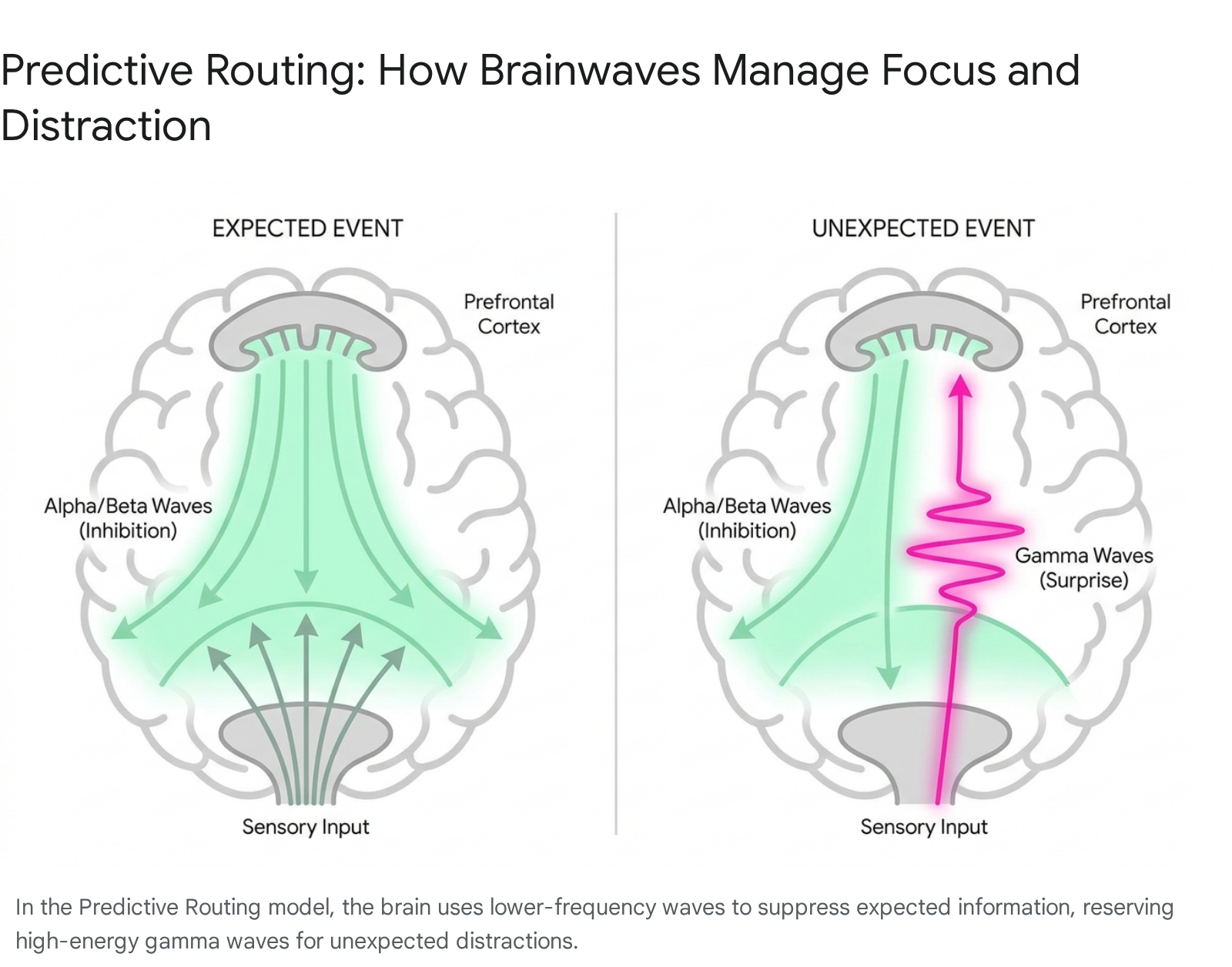
While classical predictive coding dominated computational neuroscience for years, groundbreaking 2024 and 2025 research utilizing advanced laminar recording technologies has refined this theory into a new framework known as "Predictive Routing" 267.
By recording neural spiking and local field potentials across multiple layers of the cerebral cortex in non-human primates and mice - often utilizing the Allen Institute's OpenScope platform - researchers discovered that "genuine" prediction errors do not originate primarily in the lower sensory areas 27811. Instead, these signals emerge in higher cognitive centers, such as the prefrontal cortex 26. This implies that predictive processing is a deeply cognitive mechanism rather than a strictly sensory one 26.
Furthermore, predictive routing suggests that the brain does not possess specialized, dedicated neural circuits solely for computing mathematical prediction errors 2712. Instead, the brain utilizes the same cortical circuitry used for general sensory processing and working memory, managing the flow of information through the modulation of specific brainwave frequencies 7.
The Rhythms of Focus: Alpha, Beta, Gamma, and Theta Waves
To maintain deep focus, the brain relies on a highly synchronized "push-pull" dynamic between different oscillatory rhythms 11.
During periods of sustained concentration in a predictable environment, the prefrontal cortex and other higher-order areas generate lower-frequency alpha (8 - 14 Hz) and beta (15 - 30 Hz) rhythms 2711. These waves act as a proactive, top-down filter. They literally "prepare" the neural pathways by selectively inhibiting the specific circuits in the sensory cortex that would normally process the expected, predictable background noise of the environment 27. Because the environment is accurately predicted, it requires less overall neuronal activity and energetic output, allowing the individual to sustain attention on the task at hand 27.
However, when a truly unpredictable stimulus occurs - such as a sudden loud noise, a smartphone notification, or a colleague speaking - it hits these "unprepared" cortical areas. This mismatch triggers a sudden burst of high-frequency gamma waves (40 - 90 Hz) and an increase in neuronal spiking 2711. The gamma rhythms break through the alpha/beta inhibition, forcing the brain to feed this new, unpredicted sensory information forward up the cortical hierarchy 711. Additional research notes that theta (4 - 8 Hz) oscillations may also engage to signal slower, longer-scale temporal prediction errors 11.
This precise neurophysiological sequence represents the exact moment deep focus breaks. The brain's elegant, energy-efficient predictive rhythm is shattered by a high-energy alert, forcing a sudden reallocation of cognitive resources.
| Feature | Classical Predictive Coding | Predictive Routing (Newer Model) |
|---|---|---|
| Core Mechanism | The brain subtracts predictions from sensory data; arithmetic differences are fed forward. | The brain uses oscillatory rhythms to actively suppress expected inputs and route unexpected ones. |
| Location of "Errors" | Layer 2/3 pyramidal neurons in the lower sensory cortex. | Higher-order cognitive areas, specifically the Prefrontal Cortex (PFC). |
| Role of Brainwaves | Not the primary functional mechanism in foundational models. | Alpha/Beta waves suppress expected noise; Gamma/Theta waves flag sudden distractions. |
| Implication for Focus | Focus is managing the sheer volume of incoming sensory data. | Focus is the active, rhythmic, and targeted suppression of the environment. |
Table 1: A comparison of cognitive frameworks based on 2025 neurophysiological data derived from multi-area laminar recordings 2711.
What Breaks Focus: The Anatomy of a Distraction
The biological mechanisms of attention evolved over millennia to keep humans safe in a natural environment, perfectly tuned to ignore the continuous rustle of wind but snap to high alert at the sudden snap of a twig. Today, those identical survival-based neural circuits are subjected to the relentless, artificial stimuli of the modern digital workspace.
The Illusion of Multitasking and "Supertaskers"
A primary reason modern individuals struggle to maintain the alpha/beta oscillatory states required for deep focus is the pervasive attempt to multitask. Cognitive science unequivocally demonstrates that true multitasking - processing two cognitively demanding tasks in parallel - is a biological illusion for the vast majority of the population 915. The human brain is fundamentally a serial processor; what is commonly referred to as multitasking is actually rapid task-switching 9.
Research from the University of Utah indicates that only about 2.5% of the population are genuine "supertaskers" who can handle two cognitively demanding tasks simultaneously without a measurable drop in performance . Neuroimaging studies reveal that these rare individuals exhibit reduced prefrontal cortex activation during dual-task scenarios . Their brains possess a unique neural efficiency that allows them to process complex information without working harder - a neurological trait that does not appear to be trainable for the general public .
For the remaining 97.5% of people, habitual context-switching is a learned behavior with severe cognitive consequences . According to reviews by the American Psychological Association, rapid task-switching can reduce effective productivity by up to 40% on complex tasks . Every time an individual toggles away from a primary document to check an email or a messaging application, they incur a "switch cost" - a measurable degradation in both speed and accuracy .
These switch costs accumulate insidiously throughout the day. Frequent attention switching correlates directly with elevated stress markers; physiological tracking reveals that rapid context-switching drives up blood pressure and decreases heart rate variability, keeping the nervous system in a low-level state of "fight or flight" 910.
The 23-Minute Distraction Tax
The most damaging aspect of a digital distraction is not the few seconds it takes to read a push notification. The true cost lies in the "resumption lag" - the cognitive energy and time required to gather scattered mental resources, recall the previous operational context, and plunge back into the depths of the original thought process 181920.
Extensive field research conducted by Dr. Gloria Mark, a Chancellor's Professor of Informatics at the University of California, Irvine, established what is now widely known as the 23-Minute Rule 1821. Through rigorous observation in corporate environments, researchers found that after a single interruption, it takes a person an average of 23 minutes and 15 seconds to fully regain deep focus on their original task 18192111.
If an individual is interrupted just five times in a standard workday, they lose nearly two hours of peak cognitive productivity purely to this recovery tax 21.
When interrupted, humans rarely bounce straight back to their primary work. Behavioral tracking shows that people typically engage in an average of two intervening tasks - such as checking a different website, responding to an unrelated message, or organizing physical items on a desk - before finally navigating back to their original objective 1123. Furthermore, the physical and digital layout of the workspace often changes during a distraction (new browser tabs are opened, new documents obscure previous ones), adding a heavier cognitive load to the process of reconstructing the prior mental state 11.
Self-Interruption and Cognitive Fatigue
While it is common to blame external forces - colleagues, algorithmic feeds, and vibrating smartphones - for breaking focus, empirical data reveals a more complex reality. Approximately half of all workplace interruptions are actually self-interruptions 19242512.
This behavior is driven by psychological conditioning and the depletion of finite attentional resources. If an individual experiences a high volume of external distractions early in the day, their brain adapts to that rapid pace. When those external distractions suddenly cease, the individual experiences a void; accustomed to rapid dopamine hits and the frantic pace of context-switching, they turn inward and begin interrupting themselves 1525. People frequently abandon complex work to check digital feeds out of habit, boredom, or sheer cognitive exhaustion 1525.
Attention exists on a spectrum, categorized by researchers into distinct states such as focused, rote, bored, and frustrated 2312. Deep, sustained focus is energetically taxing. Just as muscles cannot lift weights continuously without a rest period, the brain cannot hold sustained focus indefinitely without draining its executive function 2527. Self-interruption is often a subconscious attempt by an exhausted brain to seek a "rote" or mindless activity to temporarily replenish its overspent attentional capacity 152527.
The Modern Collapse of the Attention Span
The combination of biological vulnerability to novel stimuli and an environment saturated with digital interruptions has led to a measurable collapse in human attention spans. Over two decades of observational research in "living laboratories" - where scientists track actual technology use in real-world environments rather than isolated clinical settings - reveals a stark downward trajectory 1927.
In 2004, researchers literally shadowed office workers with physical stopwatches and found that the average time spent focusing on any single screen or window before switching was roughly 150 seconds (2.5 minutes) 91019.
By 2012, as technology advanced and researchers transitioned to using sophisticated computer logging software, that average had plummeted by half, reaching 75 seconds 91019.
In recent years, analyzing data from 2016 through the post-pandemic era of 2024, the average attention span on a single screen has stabilized at a mere 47 seconds 91019242729.
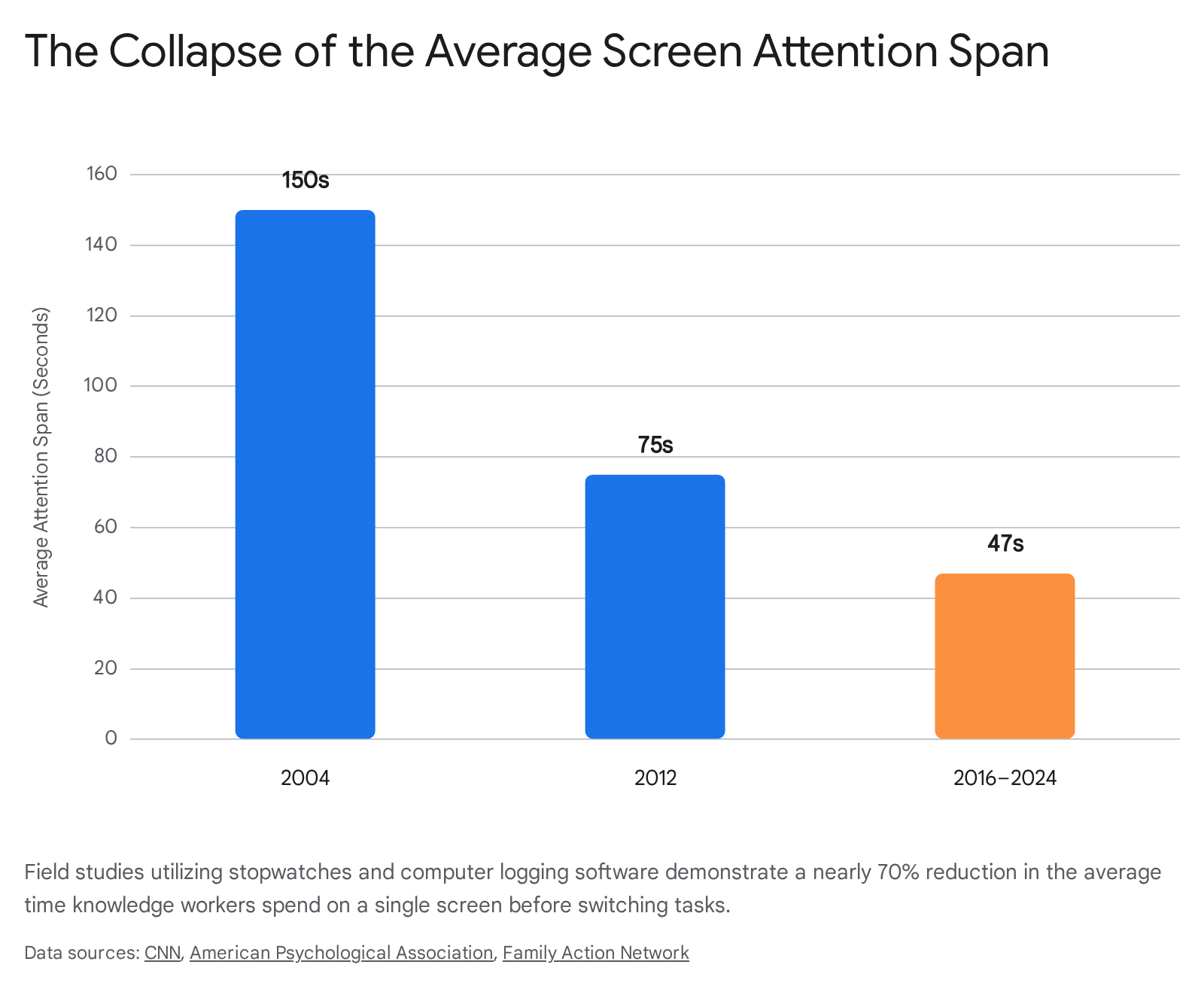
Even more alarming is the statistical median, which currently sits at just 40 seconds. This indicates that half of all observed screen interactions are abandoned or switched away from in under 40 seconds 10.
Digital Neuroplasticity and the Dopamine Cycle
This erosion of focus is particularly pronounced among younger generations who have grown up in a fully saturated digital environment. A 2025 international study spanning Singapore and Australia surveyed youth aged 13 to 25 alongside their parents, utilizing AI-powered interview platforms to capture candid responses 1314. The findings reveal a generation grappling with profound cognitive fragmentation.
Sixty-8 percent of young respondents reported that social media severely harms their ability to focus, with many stating they struggle to engage with content longer than a single minute 1314. Fifteen percent admitted to habitually consuming video content at double speed (2x), effectively training their brains to expect constant, rapid-fire novelty 14.
Neurobiologically, short-form video platforms exploit the brain's dopamine reward system 1516. The rapid delivery of novel stimuli triggers dopamine release, creating a feedback loop that requires increasing levels of stimulation to achieve the same feeling of satisfaction - a pattern structurally identical to behavioral addiction 1317. As the brain's neural pathways optimize for quick-switching rather than deep processing, users experience a phenomenon known as "scroll fatigue," characterized by emotional volatility, anxiety, and a diminished capacity for sustained thought 13141618.
Chronically heavy media multitaskers exhibit measurable neurological changes. Research utilizing structural MRI scans has shown that individuals who frequently engage in media multitasking display reduced grey matter density in the anterior cingulate cortex - a key brain region responsible for executive function, decision-making, and emotional regulation 1419.
| Demographic Group | Primary Attention Metric | Key Behavioral and Cognitive Impacts |
|---|---|---|
| Infants (0 - 2 years) | Daily screen exposure time. | Higher screen time correlates with delayed decision-making and increased anxiety later in adolescence 20. |
| Children (7 - 10 years) | Standardized attention tests (e.g., CPT). | Average attention span of ~29 seconds during continuous tests; high exposure linked to structural brain changes 2921. |
| Teens (13 - 18 years) | Task-switching frequency. | Toggle apps every ~40 seconds; 68% report social media impairs their ability to focus on schoolwork 1318. |
| Adults (Workplace) | Time spent per screen/window. | Average of 47 seconds per screen; incur a 23-minute resumption lag after interruptions, leading to high stress 101821. |
Table 2: The generational impact of digital distraction on cognitive metrics 102913182021.
Clinical Implications of Fractured Attention
The consequences of constant interruption extend far beyond lost workplace productivity; they pose significant challenges to long-term neurodevelopment and mental health.
Neurodevelopment and Early Screen Exposure
The plasticity of the human brain is at its peak during the first two decades of life. When a child's primary mode of interaction with the world involves rapid-fire digital stimuli, their neural architecture adapts accordingly 9.
A 2025 study conducted in Japan analyzed data from over 11,000 school-aged children, utilizing advanced magnetic resonance imaging alongside parent-reported behavioral assessments 21. The results provided clear evidence of a developmental link: longer daily screen time at baseline was a significant predictor of increased Attention-Deficit/Hyperactivity Disorder (ADHD) symptoms two years later, even after controlling for initial symptom severity 21. Crucially, the excessive screen time was also associated with measurable abnormalities in the volume and thickness of several key brain structures 21.
Similarly, the GUSTO (Growing Up in Singapore Towards healthy Outcomes) cohort study tracked children for over a decade 20. Researchers found that children exposed to high levels of screen time before the age of two showed changes in brain development that were directly linked to slower decision-making and increased anxiety by the time they reached their teenage years 20. However, the study also provided a protective mechanism: for children whose parents frequently read to them from age three, the negative link between infant screen time and altered brain development was significantly weakened, emphasizing the reparative power of engaged, sustained attention tasks 20.
Atypical Predictive Processing in Mental Health
Returning to the predictive coding and routing frameworks, scientists are increasingly utilizing these models to understand various psychiatric and neurodevelopmental conditions 3439. When the delicate balance between top-down predictions and bottom-up sensory information is disrupted, individuals struggle to adapt to their environments 39.
- ADHD: In the context of Attention-Deficit/Hyperactivity Disorder, research suggests that the brain may disproportionately weigh incoming sensory information over its own internal predictions 439. Because the brain treats too many environmental signals as unpredicted "surprises" that must be processed, the individual becomes easily and continuously distracted by peripheral stimuli 39.
- Autism Spectrum Disorder (ASD): Conversely, some theories suggest that in ASD, the brain may weigh its internal predictions too heavily, resisting the integration of new sensory information 3439. This can manifest as a strong resistance to change or difficulty processing dynamic, unpredictable social interactions 39.
- Depression: Predictive models are also being applied to mood disorders. In clinical depression, it is hypothesized that the brain's internal predictions become rigidly negative 39. The brain over-weighs these pessimistic priors and fails to update its mental model even when presented with positive, contradictory sensory evidence from the environment 39.
Evidence-Based Strategies to Rebuild Concentration
Recognizing the steep biological and temporal costs of broken focus, both individuals and the medical community are seeking scientifically validated interventions. However, the data indicates that simply relying on willpower or popular software hacks is often insufficient.
The Limits of "Do Not Disturb"
A universal recommendation for reducing digital distraction is to silence push notifications using smartphone "Do Not Disturb" (DND) features. Surprisingly, empirical evidence challenges the efficacy of this approach in general settings.
A 2024 randomized controlled trial tracked the smartphone behavior of 205 participants during a one-week notification-disabling intervention 22. Utilizing objectively logged smartphone data, researchers found that turning off notifications did not significantly reduce overall screen time or checking frequency 22. Because digital checking has become deeply habitual, removing the external trigger simply forces the user to rely on internal triggers. In fact, the absence of notifications actually led to an increase in the Fear of Missing Out (FOMO), as users experienced "phantom" notification anxiety 1822. While participants reported that their phone checking felt more "intentional" rather than reactive, the intervention failed to improve overall digital well-being or perceived productivity 22.
Context, however, dictates efficacy. While DND may fail to curb generalized phone addiction, it is highly effective in high-stakes environments where singular physical focus is required. A 2025 study by the AAA Foundation for Traffic Safety found that when drivers activated DND modes, smartphone interactions decreased by a massive 41% 2324. Similarly, large-scale clinical trials testing financial incentives and gamified social comparison successfully reduced dangerous handheld phone use while driving by up to 56 seconds per hour 25.
Mindfulness-Based Attention Training and Metacognition
If external software blocks are insufficient, individuals must train the brain's internal regulatory systems. Mind wandering - when attention drifts away from the task at hand - is a primary disruptor of sustained focus 26.
Mindfulness-Based Attention Training (MBAT) has emerged as an evidence-based intervention rooted in cognitive neuroscience 26. Unlike general relaxation techniques, MBAT specifically targets the attentional skills involved in recognizing and regulating mind wandering. During focused-attention practices, individuals train to maintain focus on a specific target and, crucially, to notice the exact moment their attention drifts to an internal thought or external distraction 26.
In multiple longitudinal studies assessing MBAT, participants demonstrated significant improvements in meta-awareness and sustained attention 26. When tested using the Sustained Attention to Response Task (SART), individuals who completed the training exhibited lower response time variability, indicating a more stable, less erratic application of focus 26. Essentially, mindfulness trains the prefrontal cortex to recognize prediction errors and suppress them more rapidly. Similar metacognitive training programs have shown significant near and far transfer effects in children with ADHD, improving objective assessments of working memory and inhibition 45.
Lifestyle Interventions and Brain Health
The capacity for deep focus is intrinsically linked to the overall physical health of the brain's vascular and metabolic systems. In 2025, the landmark U.S. POINTER randomized clinical trial (published in JAMA) demonstrated that a structured, multi-domain lifestyle intervention can actively protect and improve cognitive function in older adults 2728293031.
Building on the success of the European FINGER study, the U.S. POINTER trial tracked 2,111 older Americans over two years 3132. Participants were divided into a self-guided group and a highly structured intervention group. The structured group engaged in 38 facilitated peer meetings and adhered to a rigorous regimen across four domains: aerobic and resistance exercise, the MIND diet (emphasizing leafy greens, berries, and healthy fats), computerized cognitive training, and cardiovascular health monitoring 283133.
The results were unequivocal: participants in the structured intervention showed statistically significant improvements in global cognition compared to the self-guided control group 3031. Crucially, ancillary studies revealed that the structured program's benefits were heavily tied to improved sleep quality (fewer breathing-related sleep disturbances) and better blood-pressure regulation 34. A healthy cardiovascular system ensures efficient blood flow and oxygen delivery to the prefrontal cortex, optimizing the exact brain regions responsible for routing predictions and sustaining focus 234.
Environmental Interventions: Nature and Neuro-Acoustics
Modifying the physical environment can also induce physiological states conducive to concentration.
Nature Exposure: The modern urban environment places a constant, draining demand on the brain's executive attention network. A 2025 study published in Scientific Reports evaluated the cognitive impacts of forest walks compared to urban walks 54. Brain imaging utilizing EEG revealed that urban walks forced greater frontal midline theta activity, indicating high cognitive load, while nature walks left those attentional resources intact 54. Repeated exposure to natural environments also produced lower cumulative hair cortisol concentrations, a biological marker of chronic stress 54. Review data suggests that even brief, 20-minute exposures to nature are sufficient to produce measurable restoration of directed attention 54.
Auditory Entrainment: Rather than relying on generic "focus playlists," researchers are utilizing Neural Resonance Theory to understand how specific acoustic parameters physically influence the brain 35. Rhythmic auditory stimulation can modulate neural oscillations through a process called brain entrainment, literally causing brain waves to synchronize with the rhythm of the audio 35. Purpose-built functional music is designed to modulate autonomic nervous system arousal - dampening the sympathetic "fight or flight" response - thereby smoothing out erratic brainwaves and reducing distractibility without demanding active attention 35.
The Frontier: Deep Brain Stimulation and Explainable AI
For individuals suffering from severe neurological or psychiatric conditions that fundamentally inhibit focus and emotional regulation, emerging deep tech interventions offer novel pathways.
Traditionally, Deep Brain Stimulation (DBS) required invasive surgical craniotomies to implant electrodes. However, emerging techniques like "DeepFocus" are exploring anatomical access through the nasal cavity to deliver focal electrical stimulation directly to deep brain regions implicated in mood and reward, such as Brodmann area 25 and the medial orbitofrontal cortex 36. While still preclinical, such targeted neuromodulation represents a paradigm shift toward minimally invasive restoration of neural circuitry 36.
Furthermore, as the datasets mapping attention and brain connectivity grow exponentially, neuroscientists are increasingly relying on Explainable Deep Learning (XDL) models 37. Unlike traditional "black box" AI, XDL provides interpretable models that help researchers map the complex interactions between top-down predictions and bottom-up sensory processing, driving a deeper understanding of how the human brain maintains focus in a chaotic world 37.
Bottom line
Deep focus is not a passive state, but an active, metabolically expensive rhythm driven by the brain's predictive routing pathways, which utilize alpha and beta waves to continuously suppress expected environmental noise. When this delicate synchronization is shattered by an unexpected distraction, it takes a heavy cognitive toll, requiring an average of 23 minutes for neural networks to fully reorient back to complex tasks. Because modern technology has conditioned the human brain to self-interrupt and crave rapid context-switching, reclaiming concentration requires more than simply silencing digital notifications. It demands strategic cognitive rest, environmental curation, mindfulness training to build meta-awareness, and a holistic lifestyle approach to optimize the physical health of the prefrontal cortex.