
How to Ask for a Strong Letter of Recommendation
To secure a strong letter of recommendation, candidates must strategically select a referee who knows their work intimately, request their support at least four to six weeks in advance, and provide them with a highly detailed brag sheet that highlights specific, verifiable anecdotes. Furthermore, applicants must explicitly waive their confidentiality rights to ensure the letter's credibility, initiating the process with a meticulously structured email that outlines the application's context and deadlines. A flawlessly executed recommendation strategy transforms a generic endorsement into a decisive, authenticated narrative of human potential.
A generic recommendation letter can actively harm an otherwise stellar application by signaling to selection committees that the candidate failed to cultivate meaningful professional or academic relationships during their tenure. Conversely, a highly specific, anecdote-rich letter often serves as the ultimate deciding factor in competitive arenas, separating an exceptional candidate from a merely competent one. In an era where transcripts are standardized and essays are heavily scrutinized or even algorithmically generated, the recommendation letter remains the singular, unfiltered lens through which decision-makers assess a candidate's true character, resilience, and trajectory.
The 2023+ Paradigm Shift: AI, ChatGPT, and the Premium on Human Authenticity
The proliferation of generative artificial intelligence (GenAI) and large language models (LLMs) like ChatGPT since 2023 has fundamentally altered the landscape of college admissions, graduate school selection, and professional recruitment. Historically, the personal statement or application essay served as the primary vehicle for evaluating a candidate's authentic voice, emotional maturity, and character 1. However, as AI tools have become ubiquitous for brainstorming, drafting, and refining application materials, the intrinsic value of the essay as a measure of unique human ingenuity has significantly diminished. For instance, Duke University recently announced it would no longer assign a numerical value to undergraduate college admissions essays when scoring an applicant, specifically because the widespread use of generative AI has diminished the essay's reliability as a reflection of independent writing ability and personal motivation 1.
Institutions have responded to this technological disruption by deploying AI detection software, such as Turnitin's AI module, GPTZero, and ZeroGPT, to scan incoming applications 23. However, these detection systems are notoriously unreliable. Studies indicate that AI text detectors suffer from profound inaccuracy, with accuracy rates dropping as low as 17% under certain manipulation techniques, and frequently flagging authentic human writing - particularly from non-native English speakers - as machine-generated 4. Consequently, top-tier institutions like MIT, Stanford, and Harvard have cautioned against relying solely on AI detectors for admissions decisions 4.
As the credibility of the personal essay wavers, universities and employers are shifting their evaluative weight toward third-party endorsements. Admissions officers are increasingly utilizing letters of recommendation to cross-reference and verify the claims made in an applicant's essay 35. This dynamic is further accelerated by the integration of AI on the evaluator's side. Platforms like Slate, a pervasive information management system in higher education, now offer "Reader AI" functionalities designed to quickly analyze and identify pertinent details in letters of recommendation, cross-referencing the language and tone against the student's self-reported activities 5. If an AI-assisted essay is highly polished but the recommendation letter describes a candidate with average communication skills, the discrepancy is immediately flagged.
This paradigm shift extends deeply into the corporate and human resources spheres. The Society for Human Resource Management (SHRM) reports that as AI automates routine HR screening, resume parsing, and candidate sourcing, recruiters are pivoting toward "skills-based resourcing" 23. Because AI can easily fabricate or optimize a resume to match a job description, hiring managers lean heavily on human-to-human references to evaluate soft skills, adaptability, and leadership potential - attributes that AI cannot accurately simulate or verify 238. Therefore, an anecdote-rich recommendation letter now functions as an authenticity insurance policy. It provides unassailable, third-party human corroboration of a candidate's distinct capabilities, protecting them from algorithmic skepticism and distinguishing them in a sea of AI-assisted, homogenized applications 1910.
Who is the best person to ask?
A pervasive myth in both academic and professional applications is that securing a signature from a famous, high-ranking individual - such as a university president, a corporate CEO, or a renowned politician - will automatically impress a selection committee. In reality, this strategy frequently backfires. Admissions offices and hiring managers are acutely aware of prestige-chasing tactics. When a high-ranking official writes a letter for a candidate they barely know, the resulting text is inevitably vague, relying on generic platitudes rather than concrete observations 1112.
Committees prioritize the depth of the relationship over the recommender's organizational title. The ideal referee is a direct supervisor, a principal investigator, or a professor who has closely monitored the candidate's work, witnessed their reaction to failure, and evaluated their intellectual growth over time 414. Elite institutions operate on the premise that past behavior is the best predictor of future success. For example, William Fitzsimmons, Dean of Admissions at Harvard College, notes that recommendation letters are projected onto large screens during committee reviews because they illuminate personal qualities such as character, leadership, and intellectual curiosity - factors that differentiate applicants within a pool where nearly everyone is academically qualified 15. A distant executive cannot authentically speak to these micro-interactions.
The selection of a recommender should also be meticulously aligned with the specific requirements of the program. For instance, when applying to highly quantitative programs like the Philosophy, Politics and Economics (PPE) course at Oxford, a recommendation from an English teacher highlighting rhetorical analysis, while flattering, may inadvertently signal a weakness in mathematical or analytical subjects 16. Conversely, Harvard Business School (HBS) explicitly requires recommenders to provide specific examples of a candidate's performance compared to well-qualified peers, and to detail how the candidate responded to a specific instance of constructive feedback 171819. Only a direct manager or immediate academic supervisor possesses the granular observational data required to answer such precise prompts effectively.
| Evaluative Metric | The High-Ranking Official (Low Connection) | The Direct Supervisor/Educator (High Connection) | Impact on Selection Committee |
|---|---|---|---|
| Anecdotal Depth | Relies on resume summaries and generic adjectives (e.g., "hard worker", "dedicated"). | Provides highly specific examples (e.g., "stayed late to debug the core algorithm prior to the Q3 launch"). | Advantage: Direct Supervisor. Specificity verifies the candidate's authentic impact and protects against AI-generated generalizations 521. |
| Response to Setbacks | Cannot comment on the candidate's resilience, emotional intelligence, or coachability. | Can detail specific instances of constructive feedback and the candidate's subsequent behavioral adjustments. | Advantage: Direct Supervisor. Documented resilience is crucial for elite MBA programs and holistic university admissions 1722. |
| Comparative Analysis | Lacks the operational context to benchmark the candidate against relevant peer cohorts. | Can rank the candidate accurately based on historical data (e.g., "top 5% of analysts I have managed in my ten-year tenure"). | Advantage: Direct Supervisor. Committees rely heavily on contextualized, realistic peer rankings 1218. |
| Name Recognition | High. May briefly catch the reader's attention during initial triage. | Low to Moderate. The focus remains entirely on the substantive content of the letter. | Advantage: Tie. While a famous name draws the eye, empty content immediately diminishes the application's overall credibility 11. |
The optimal strategy involves selecting individuals who can enthusiastically validate the specific traits the candidate wishes to highlight across the entire application portfolio. If multiple letters are required, the selection should be complementary to ensure a holistic view. One letter might focus on rigorous quantitative research skills and independent problem-solving, while another highlights community leadership, empathy, and collaborative teamwork 423.
How far in advance should I ask?
Timing is one of the most critical elements of a successful recommendation request. Academic professionals and corporate managers routinely manage heavy workloads, and writing a customized, thoughtful letter of recommendation requires significant cognitive effort and dedicated time 116. Asking for a letter at the last minute signals poor planning, disrespects the referee's time, and frequently results in a rushed, generic letter that actively weakens the application 115.
The established industry standard dictates that requests should be made a minimum of four to six weeks prior to the earliest application deadline 115. For highly competitive programs, such as PhD fellowships, medical school, or elite MBA programs, securing the recommender's agreement two to three months in advance is highly advisable, particularly if the request falls during peak academic periods like the end of the fall semester 25.
To alleviate anxiety on both sides of the process, candidates should implement a structured, transparent timeline. One highly effective approach utilized in academic circles is the "Less Stressful Protocol," which establishes clear milestones and a designated grace period for follow-ups 7. This protocol ensures that the candidate is not left in a state of uncertainty as the deadline approaches, while simultaneously protecting the recommender from premature, anxiety-driven reminder emails.
| Timeframe | Applicant Action | Strategic Rationale |
|---|---|---|
| 8-12 Weeks Prior | The Preliminary Ask: Approach the potential recommender in person (if possible) or via a brief preliminary email to gauge their willingness to provide a strong endorsement 148. | Allows the referee to gracefully decline if they lack the time or depth of knowledge required. Secures a psychological commitment before the peak application season rush 1428. |
| 4-6 Weeks Prior | The Formal Request: Send the structured request email containing the Brag Sheet, resume, draft application essays, and clear logistical instructions (links, deadlines, submission formats) 529. | Provides the recommender with all necessary materials in a single, organized repository, eliminating back-and-forth communication and lowering the barrier to entry 146. |
| 3 Weeks Prior | The Implementation of the 72-Hour Protocol: Send a polite message confirming receipt of materials and establishing that a final reminder will be sent exactly 72 hours before the deadline if the portal does not show completion 7. | Shifts the dynamic from "nagging" to a mutually agreed-upon professional timeline. Reduces applicant anxiety by defining exactly when intervention is appropriate and expected 7. |
| 72 Hours Prior | The Emergency Follow-up: If the letter is not submitted, execute a gentle, polite reminder email or phone call to check on the status 145. | Serves as a critical safety net. If a recommender has genuinely forgotten, 72 hours is usually sufficient time to draft and submit the document without causing a missed deadline 7. |
| Post-Deadline | The Gratitude Phase: Send a handwritten thank-you note immediately. Later, update the recommender on the final outcome of the application process (acceptance/hiring) 145. | Maintains the professional relationship. Recommenders invest significant social capital in their endorsements and highly appreciate knowing the return on that investment 14. |
The Anatomy of a Perfect Request Email
If an in-person request is impossible, or when formally following up on a verbal agreement, the request email serves as the foundational document for the recommender. It must be concise, informative, and meticulously structured. Academic and professional referees receive dozens of such emails annually; those that are disorganized, overly lengthy, or demanding are naturally deprioritized. According to guidance from Harvard University and various graduate writing experts, a flawless request email minimizes the administrative burden on the letter writer, effectively doing the "secretarial work" for them 625299.
A highly effective request email is built upon several specific structural components designed to elicit a positive response while maintaining professional boundaries 1125299.
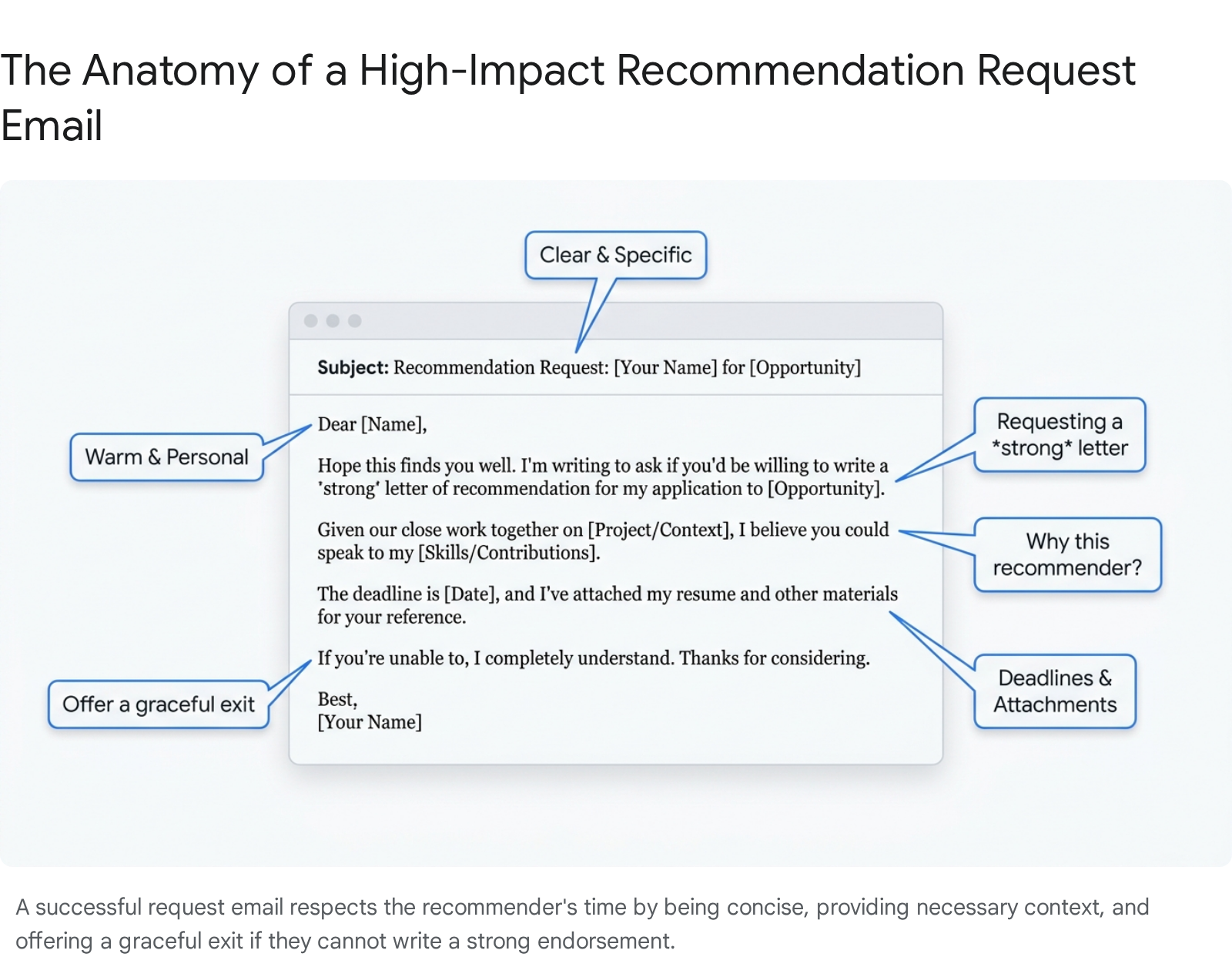
The communication must begin with a clear, descriptive subject line. A generic subject line like "Hi" or "Recommendation" fails to provide context for a busy professional parsing through a crowded inbox. The subject line must immediately indicate the email's purpose without sounding presumptuous, including the applicant's name and the specific course or role through which they are known. A highly effective subject line reads: "Request for Letter of Recommendation - John Doe (Advanced Biology 401)" 1125.
Following a professional salutation, the email should open warmly by recalling a specific, positive interaction or project that grounds the relationship. This brief contextualization jogs the recommender's memory and sets a positive, collaborative tone 31. Immediately following this context is the core request, which requires careful psychological phrasing. The applicant must not demand a letter; rather, they must ask if the referee feels comfortable writing a strong letter of recommendation. Using the word "strong" is a critical strategic maneuver. It provides the referee with a polite exit strategy. If they do not remember the candidate well, harbor reservations about the candidate's performance, or simply lack the time to do the letter justice, they can decline by stating they cannot provide a sufficiently strong endorsement. This saves both parties from the disastrous outcome of a mediocre, lukewarm letter being submitted to a competitive program 432.
The email must then transition into the justification phase, briefly explaining why this specific referee was chosen. Connecting the referee's unique expertise or a specific class project to the applicant's future goals validates the referee's importance to the candidate's journey and signals that the request is personalized, not a mass mailing 23. Finally, the email must conclude with a logistical blueprint. It should clearly state the exact deadline, the target institution or company, and the submission method (e.g., an automated portal link or direct email address). The applicant should explicitly mention that essential documents - such as the Brag Sheet, CV, and draft personal statements - are attached to assist in the writing process, thereby eliminating any friction for the recommender 1129.
The Strategic Brag Sheet: Ghostwriting the Narrative Framework
Even a professor or manager who deeply admires a candidate will struggle with "blank page syndrome" when sitting down to write. Recommenders manage hundreds of students or employees; they cannot be expected to remember the precise details of a project completed eighteen months prior. The "brag sheet" is a strategic document designed to solve this exact cognitive bottleneck. It is not simply a regurgitation of a standard resume; it is a carefully curated highlight reel designed to feed the recommender the exact anecdotes, themes, and quantitative metrics they need to construct a compelling, highly personalized narrative 333435.
The primary failure of most student brag sheets is an over-reliance on generic adjectives and capital-letter "Impressive" statements that mimic corporate jargon, ultimately resulting in a letter that sounds artificially generated 35. Admissions counselors consistently advise that a brag sheet must prioritize specific, quiet moments of character, distinct challenges overcome, and verifiable impacts 35. To build a high-impact brag sheet, candidates should employ the SCAR method (Situation, Challenge, Action, Result) - a framework highly favored by institutions like Harvard Business School - to outline their specific stories concisely 1722.
By providing a meticulously structured brag sheet, the applicant essentially ghostwrites the conceptual foundation of the letter, ensuring that the final product aligns perfectly with the broader narrative of their application portfolio 35. While utilizing AI tools responsibly to brainstorm or organize the structural formatting of the brag sheet can save time, the candidate must actively inject highly personal, authentic anecdotes that an AI algorithm cannot fabricate or deduce 3637.
| Brag Sheet Component | Content Strategy and Objective | Effective Application Example |
|---|---|---|
| Administrative Snapshot | Provide full legal name, preferred pronouns, contact information, target programs, and explicit deadlines. Consistency here prevents administrative errors and misaligned submissions 2334. | Name: Jane Doe |
| The "Why I Chose You" Rationale | Reiterate the specific traits the candidate hopes this recommender will highlight. Directing the recommender prevents redundant overlap with other submitted letters 23. | "I chose you because your Honors Biology class sparked my interest in research, and you witnessed my transition from struggling with initial concepts to leading peer study groups." 22 |
| SCAR Anecdotes (Academic/Professional) | Replace vague claims of leadership with micro-narratives using Situation, Challenge, Action, Result. Provide concrete details allowing the recommender to easily adapt verifiable facts 223335. | "Situation: Semester-long environmental physics project. Challenge: Group lacked consensus on methodology. Action: Facilitated structured debate and mediated conflict. Result: Earned the highest grade in the cohort." 22 |
| Overcoming Setbacks & Constructive Feedback | Elite institutions actively look for candidates demonstrating resilience and coachability. Detail a time of struggle and the specific steps taken to adapt and succeed 172235. | "After the failed Q1 presentation, you advised me on executive presence. I enrolled in Toastmasters, restructured my data visualization approach, and successfully secured the Q2 client." 17 |
| Future Trajectory and Core Motivations | A brief outline of what the candidate intends to study or achieve in the target program. This allows the recommender to connect past performance directly to future potential 3335. | "Curious about how tech can scale mental health care. I plan to study neuroscience with a minor in design to build accessible virtual therapy models." 35 |
Should I waive my FERPA rights?
In the context of United States educational applications, the Family Educational Rights and Privacy Act (FERPA) of 1974 (also known as the Buckley Amendment) is a federal law that protects the privacy of student education records and grants enrolled students the right to view those records once matriculated 3839. During the application process, centralized platforms like the Common Application explicitly ask candidates if they wish to waive their right to review their confidential letters of recommendation 10.
The strategic imperative in this scenario is absolute: applicants must always waive their FERPA rights.
The logic dictating this requirement is deeply rooted in the perceived credibility of the endorsement. Admissions committees operate on the fundamental assumption that recommendation letters are strictly confidential communications between educators. When a candidate waives their right to read the letter, it signals to the admissions office that the recommender was free to provide a candid, unvarnished, and objective evaluation of both strengths and weaknesses, without fear of reprisal, strained relationships, or awkwardness from the student 381041.
Conversely, if an applicant exercises their legal right and refuses to waive their FERPA protections, it raises an immediate and significant red flag. Admissions officers may view the letter as compromised, operating under the assumption that the referee artificially inflated the praise, censored their true opinions, or withheld valid critiques because they knew the applicant would eventually read the document 384142. The psychological impact of an un-waived letter is profound; it signals to the institution that the candidate either does not trust their recommender or fails to understand the standard protocols of academic evaluation 38. Furthermore, many experienced educators, high school counselors, and professionals will flatly refuse to write a recommendation letter unless the FERPA rights have been explicitly waived, as they rely on the absolute protection of confidentiality to maintain their own professional integrity and reputation with university admissions offices 104143. Ultimately, waiving this right demonstrates maturity, confidence in the selected recommender, and a sophisticated understanding of academic norms 4142.
Differing Expectations: UK UCAS References and EU GDPR Norms
When applying outside the United States, the legal frameworks, structural requirements, and cultural expectations surrounding recommendation letters shift significantly. Applicants navigating international systems must dynamically adapt their strategies to avoid critical missteps.
The United Kingdom and the UCAS System
For undergraduate applications in the UK via the Universities and Colleges Admissions Service (UCAS), the "reference" differs fundamentally from an American recommendation letter. A UCAS reference is highly academic and is usually written collaboratively by the school, designed to function as one unified voice rather than a personal endorsement from a single mentor 44. The final document is typically edited and submitted by a Head of Sixth Form or a school counselor 44. Unlike the holistic American system, which values deep dives into character, extracurricular leadership, and overcoming adversity, the UK system focuses intensely on the candidate's suitability for a specific degree subject, their current academic performance, their ability to write well-structured arguments, and their predicted exam grades 164411.
Crucially, the UCAS system is designed so that the applicant generally does not have control over the reference and typically does not see it before submission 4446. This embeds confidentiality natively into the process without requiring a specific, student-initiated FERPA-style waiver 4612. For US students applying to the UK, referees must be explicitly instructed to shift their writing style, focusing on academic preparedness for the specific course, contextualizing the US high school curriculum (such as AP exams), and providing concrete academic predictions rather than generalized praise regarding community involvement 48.
The European Union and GDPR Access Rights
Within the European Union, the General Data Protection Regulation (GDPR), enacted in 2018, significantly complicates the concept of perpetual confidentiality for recommendation letters. Under Article 15 of the GDPR (the "Right of Access"), data subjects (the applicants) have broad, legally enforceable rights to request access to personal data held by organizations. This explicitly includes qualitative evaluations such as academic recommendation letters and corporate employment references 131451.
While some EU member states and specific institutions have attempted to implement domestic exemptions to protect the confidentiality of employment references given in confidence, the overarching framework of the GDPR suggests that a European applicant possesses strong legal avenues to eventually gain access to the contents of a reference letter post-submission 13515253.
This legal reality, combined with historical academic traditions, creates a profound cultural shift in how letters are written. European reference letters tend to be strictly objective, restrained, and highly factual compared to the enthusiastic, heavily inflated, and hyperbolic style routinely expected in American letters 125455. US academics reading European letters must continually calibrate their expectations, understanding that a "good" European reference may read as lukewarm or even critical by American standards simply because it frankly outlines weaknesses alongside strengths, adhering to a culture of transparency influenced by these legal and cultural norms 125455.
For applicants navigating international waters, understanding these nuances is critical for success. An American applicant to a UK or EU university must ensure their recommender focuses heavily on objective academic metrics and subject-specific aptitude 1611. Conversely, a European applicant to a US institution must proactively manage their European recommenders, gently encouraging them to adopt a more effusive, detailed, and unequivocally positive tone to ensure the candidate remains competitive in the US holistic review process, where understatement can be fatal to an application 5455.
Bottom line
Securing a high-impact letter of recommendation requires treating the process as a strategic, multi-phase project rather than a last-minute administrative chore. As the unchecked rise of generative AI tools increasingly homogenizes application essays and resumes, admissions committees and corporate employers are relying heavier than ever on the verified, human voice of recommenders to assess a candidate's true potential and authenticity.
To maximize the probability of success, candidates must bypass the temptation of high-ranking strangers in favor of direct supervisors or educators who possess the intimate knowledge necessary to speak to specific instances of growth, resilience, and leadership. The request must be initiated four to six weeks in advance using a highly structured, polite communication protocol that respects the recommender's time. Most importantly, candidates must arm their recommenders with a comprehensive, SCAR-formatted brag sheet to essentially ghostwrite the narrative foundation, while unequivocally waiving their legal rights to read the final document. By meticulously executing these steps, applicants empower their mentors to write highly specific, credible, and ultimately decisive endorsements that elevate the entire application portfolio above the noise of automated mediocrity.