
The Gnostic Tradition in Western History
The study of Gnosticism encompasses a complex array of religious, philosophical, and esoteric movements that first flourished in the Mediterranean world during the early centuries of the Common Era. Characterized broadly by a dualistic cosmology, a belief in an alienated divine spark trapped within human materiality, and a reliance on direct, experiential revelation for salvation, the Gnostic tradition has exerted a recurrent influence on Western history. Despite centuries of suppression by orthodox religious institutions, the core architectural elements of Gnostic thought have repeatedly resurfaced, animating medieval sectarian movements, Renaissance esoteric philosophies, modern political ideologies, and contemporary technological mythologies.
The Scholarly Debate on Gnosticism
For nearly two millennia, the primary sources available for understanding Gnosticism were the polemical treatises written by early Christian heresiologists, including Irenaeus of Lyons, Tertullian, Hippolytus, and Epiphanius 123. These proto-orthodox church fathers constructed the category of "Gnosticism" primarily as a rhetorical foil to delineate and defend the boundaries of emerging orthodox Christianity 112. In treatises such as Irenaeus's second-century work Against Heresies, diverse sectarian groups were grouped together under the umbrella of "falsely so-called knowledge," accused of radical theological deviations, extreme asceticism or libertinism, and the proliferation of illicit mythologies 213. Because these accounts were written by theological adversaries intent on eradicating rival interpretations of the Christian message, early modern historical understanding of Gnosticism was heavily distorted by polemical caricature 234.
Early modern scholarship, beginning with theologians like Adolf von Harnack in the late nineteenth century, accepted the heresiological premise that Gnosticism was a unified phenomenon, defining it as the acute Hellenization of Christianity 14. This view posited that Gnosticism was an internal Christian heresy resulting from the radical blending of early Christian theology with Greek philosophy 1. Conversely, the History of Religions School challenged this by arguing that Gnosticism possessed pre-Christian, Oriental roots, drawing heavily on Persian Zoroastrianism and Hellenistic Judaism 18.
The discovery of primary Gnostic texts in the twentieth century precipitated a massive scholarly paradigm shift, culminating in a fierce debate over whether Gnosticism ever existed as a coherent historical entity. Scholars such as Michael Allen Williams and Karen L. King have argued that the category of Gnosticism is a modern fabrication that obscures the immense diversity of early Christian thought 95. In his 1996 work Rethinking "Gnosticism": An Argument for Dismantling a Dubious Category, Williams demonstrated that the sects traditionally labeled Gnostic lacked a unified self-definition 6. No ancient group called themselves "Gnostics" as a denominational identifier; rather, the term was applied inconsistently by their enemies 967. Williams dismantled the prevailing stereotypes regarding Gnostic anticosmic world-rejection, hatred of the body, and ethical extremism, suggesting that the umbrella term should be replaced with more precise typologies, such as biblical demiurgical traditions 614.
Karen L. King furthered this deconstruction by tracing how modern scholars inadvertently reinscribed the ancient orthodox-heresy binary 1415. King argued that Gnosticism was not a separate religion or a unified heresy, but rather a diverse stream of early Christian identity formation that shared common ground with Hellenistic Judaism and Platonism 415. For these critical scholars, the term functions as an artificial interpretive lens that improperly lumps together texts and communities that may have had little historical connection 19.
While the deconstructive wave gained significant traction, other historians of religion maintained that a specific, historically identifiable phenomenon warrants a distinct classification. Scholar David Brakke, building on the work of Bentley Layton and Hans-Martin Schenke, has argued against the total abandonment of the term. Brakke proposes identifying a specific Gnostic school of thought 278. Brakke and Layton identify the Sethian tradition, which traced its spiritual lineage to Seth, the third son of Adam and Eve, as the original and distinct group of ancient Gnostics 217. By narrowing the definition from a broad theological tendency to a specific network of myth-makers and ritual practitioners, scholars can recognize Gnosticism as an actual religious stream in late antiquity without falling into the generalizations condemned by Williams and King 27.
Core Theological and Cosmological Tenets
The foundational premise of the Gnostic worldview is a radical cosmic dualism that distinguishes between the ultimate, transcendent God and the creator of the physical universe 3919. The true God is entirely alien to the material world, often described in negative theology as the Monad, the Depth, or the unfathomable Light 1920. From this supreme, hidden source emanates a series of divine beings or powers known as Aeons. Together, the Monad and the Aeons constitute the Pleroma, or the divine Fullness 92122.
The narrative engine of Gnostic mythology is a cosmic catastrophe occurring within the Pleroma. The lowest of the Aeons, typically identified as Sophia, desires to comprehend the unknowable Father or to create independently without her divine consort 92223. This unauthorized emanation results in a flawed product that is expelled from the Pleroma. In her distress and ignorance, Sophia accidentally brings forth the Demiurge, the flawed creator of the lower material realm 92224. Consequently, human beings are conceived as dualistic entities. While the physical body and lower soul are the handiwork of the Demiurge, a divine spark of the true spiritual light remains trapped within humanity 926. This divine spark is asleep, suffering from a cosmic amnesia induced by the material realm 2426.
Central to Gnosticism is the concept of the Demiurge. While classical philosophy posited a benevolent craftsman who fashioned the cosmos as a beautiful reflection of eternal forms, Gnostic traditions inverted this concept, characterizing the Demiurge as an ignorant, arrogant, or explicitly malevolent entity 9222710. Often named Yaldabaoth, Samael, or Saklas, this false god is frequently identified by Gnostic texts with the God of the Hebrew Bible 9192122. According to the Apocryphon of John, the Demiurge boasts that he is a jealous God and there is no other God beside him, a statement that Gnostics interpret as proof of his blindness to the true, higher God above him 2227. The Demiurge does not rule alone; he spawns a series of lesser rulers known as Archons, who govern the planetary spheres and enforce the physical and moral laws of the cosmos 2229. To the Gnostics, the material universe is an intricate prison designed by the Archons to entrap the divine spark and subject it to the endless cycles of fate, suffering, and death 92729.
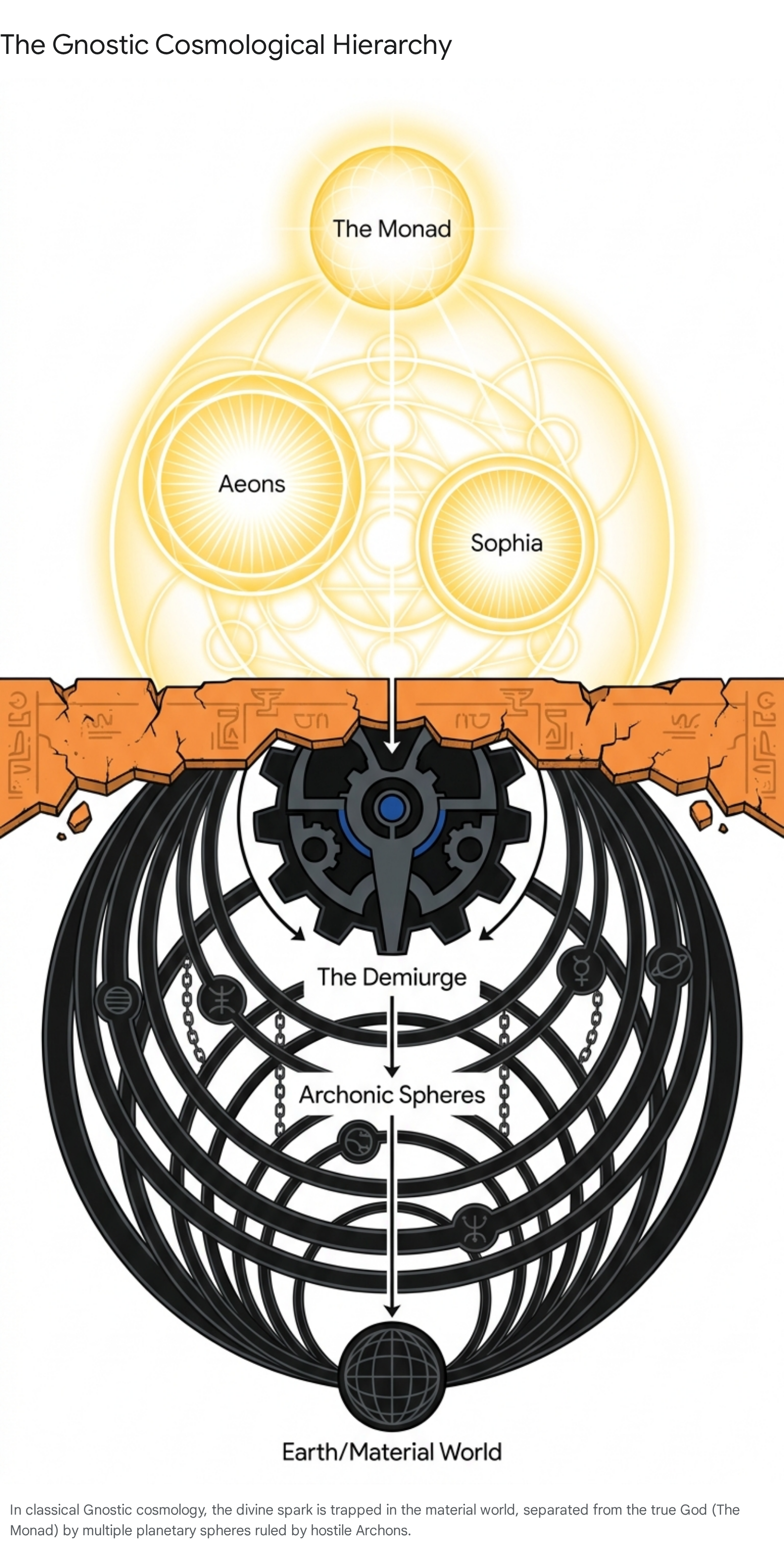
Because the material world is fundamentally flawed, salvation in the Gnostic framework cannot be achieved through bodily resurrection, moral obedience to the Demiurge's laws, or ecclesiastical rituals 20. Instead, salvation is strictly epistemological and mystical. It is achieved through experiential awakening to one's true divine origins 32029. A transcendent revealer descends from the Pleroma into the material world to deliver this liberating knowledge 3820. By recognizing their alienation from the physical world and remembering their home in the Pleroma, Gnostic initiates awaken the divine spark 929. Upon physical death, the enlightened soul is equipped with the secret knowledge required to navigate past the hostile Archons and return permanently to the divine Fullness 29.
Primary Textual Discoveries
Before the mid-twentieth century, direct access to Gnostic literature was extraordinarily limited. Scholars relied heavily on a few Coptic codices acquired in the eighteenth and nineteenth centuries 111232. Among these early discoveries was the Askew Codex, purchased by the British Museum in 1785, which contained the sprawling esoteric text known as Pistis Sophia 113313. Similarly, the Bruce Codex, acquired in Upper Egypt in 1769 by James Bruce, provided access to the Books of Jeu and an untitled apocalyptic text 111233. In 1896, the Berlin Gnostic Codex was discovered, containing portions of the Gospel of Mary, the Apocryphon of John, and the Sophia of Jesus Christ, though its publication was delayed until 1955 due to global conflicts 321436. These initial texts offered glimpses into a complex cosmological system but were insufficient to construct a comprehensive historical picture.
The paradigm shifted entirely in 1945 with the discovery of the Nag Hammadi Library in Upper Egypt 21437. Hidden in a sealed clay jar, local peasants found thirteen leather-bound papyrus codices containing fifty-two early Christian and esoteric treatises, dating primarily to the fourth century CE, though the original Greek texts were composed in the second and third centuries 21415. These documents provided scholars with unfiltered access to Gnostic mythology. The collection includes gospels, secret apocalypses, and revelation discourses, demonstrating a complex blending of pagan, Jewish, and Christian ideas 1415. The burial of this library was likely prompted by Bishop Athanasius's Easter letter in 367 CE, which formally condemned non-canonical books and forced monastic communities to hide texts deemed heretical 14.
Further expanding the corpus, the Codex Tchacos emerged on the antiquities market in the late 1970s and was critically published in 2006 following a tumultuous history of theft, freezing, and decay 143916. This fourth-century Coptic manuscript contained the long-lost Gospel of Judas, a text originally condemned by Irenaeus around 180 CE 3916. The text radically subverts proto-orthodox narratives by depicting Judas Iscariot not as a betrayer, but as the only enlightened disciple who understood Jesus's true spiritual nature, assisting the Savior in shedding his physical body 3917. The codex also contains the Letter of Peter to Philip, the First Apocalypse of James, and a fragmentary treatise titled Allogenes 3916.
Comparisons of Ancient Esoteric Schools
The analysis of these primary texts reveals that early esoteric spirituality was highly differentiated. While heresiologists grouped these sects together, modern textual analysis demonstrates distinct theological, cosmological, and practical boundaries. The table below outlines the theological distinctions among the primary ancient movements often studied under the rubric of Gnosticism, including Hermeticism, which shares elements with Gnosticism but maintains distinct cosmological views 82324104243.
| Esoteric Tradition | View of the Demiurge | View of the Material World | Mechanism of Salvation | Key Associated Texts |
|---|---|---|---|---|
| Sethianism | Malevolent and ignorant (Yaldabaoth). An arrogant tyrant who traps divine souls. | An inherently evil prison designed to keep the divine spark trapped in physical matter. | Awakening via esoteric knowledge brought by a transcendent revealer (often Seth or Christ). | Apocryphon of John, Three Steles of Seth, Gospel of Judas 17233918 |
| Valentinianism | Ignorant but not fully evil. Serves an unwitting role in the divine plan of redemption. | Flawed, but structured tripartite (spirit, soul, matter) to facilitate cosmic education. | Integration of spirit. Initiates return to the Pleroma; psychic Christians achieve a middle rest. | Gospel of Truth, Tripartite Tractate, Ptolemy's Letter to Flora 234318 |
| Mandaeism | A lesser creator (Ptahil), heavily associated with planetary archons and darkness. | A place of suffering and pollution; human bodies encase the soul in darkness. | Frequent ritual purification (baptism in flowing water), moral living, and esoteric knowledge. | Ginza Rabba, Mandaean Book of John, Haran Gawaitha 45192021 |
| Hermeticism | The Divine Mind (Nous). The craftsman operates in harmony with the ultimate God. | A beautiful, sacred reflection of the divine. Humanity is a microcosm of the macrocosm. | Transfiguration through philosophical contemplation, alchemy, and inner awakening to Nous. | Corpus Hermeticum, Asclepius, Emerald Tablet 2410424922 |
A critical distinction exists between Sethian and Valentinian theology regarding the nature of the Demiurge and the cosmos. Sethian texts exhibit a radical, antagonistic dualism, portraying the Demiurge as willfully evil and the material world as an absolute trap 82327. Conversely, Valentinianism, founded by the second-century theologian Valentinus, offers a more moderate approach. Valentinians viewed the Demiurge as ignorant rather than actively malicious, maintaining that he acts as an intermediary who unwittingly aids the spiritual element's return to the Pleroma 232743. Furthermore, while Sethians strictly divided reality into spirit and matter, Valentinians utilized a tripartite structure - spirit, soul, and matter - applying this division to human beings to explain varying capacities for spiritual salvation 43.
Hermeticism, which developed contemporaneously in Hellenistic Egypt, provides another profound contrast. While sharing the Gnostic belief in a transcendent God and the pursuit of hidden knowledge, Hermetic philosophy generally rejects the anticosmic pessimism of the Sethians 424922. Hermeticists view the material world not as an evil mistake, but as a sacred creation governed by divine love, viewing human embodiment as an opportunity for spiritual transfiguration rather than a state of imprisonment 241022.
Mandaeism as a Surviving Tradition
While Sethianism and Valentinianism were eventually eradicated or absorbed by emerging orthodoxies in late antiquity, Mandaeism represents the only continuous Gnostic tradition surviving to the present day 192151. The origins of Mandaeism are heavily debated, but historical and textual evidence suggests the community originated in the Jordan Valley region around the first century CE 2023. Facing persecution, the Mandaeans migrated to the Median hills and eventually settled in the marshes of southern Mesopotamia, encompassing modern-day southern Iraq and the Iranian province of Khuzestan 452023.
Mandaeism is an intensely dualistic ethnic religion. The theology divides existence into a World of Light, ruled by a supreme life force, and a World of Darkness 4524. The material creation is executed by a demiurgic figure named Ptahil, whose characteristics are heavily influenced by Old Testament depictions of chaos monsters like Leviathan 4521. Distinctively, Mandaeans revere figures such as Adam, Seth, and Shem as prophets, but hold John the Baptist as their greatest and final prophet, while firmly rejecting Jesus and Abraham as false prophets 205124. The Ginza Rabba (The Great Treasure) and the Mandaean Book of John serve as their primary scriptures, composed in classical Mandaic, an Eastern Aramaic dialect 451920.
For Mandaeans, salvation is secured through continuous ritual baptism (masbuta) in flowing, living water 5124. This ritual purification is essential for cleansing the soul in preparation for its eventual ascent back to the Lightworld 5124. Despite surviving the rise of Christianity, the Islamic conquests, and centuries of regional conflict, the Mandaean community currently faces an existential crisis. Following the 2003 invasion of Iraq and the subsequent rise in sectarian extremism, Mandaeans were subjected to severe persecution, including forced conversions, kidnappings, and murder, due to their pacifist religious tenets and their historical association with the goldsmith trade 452023. Consequently, the population in Iraq has plummeted, forcing the majority of the community into a global diaspora 2023.
Historical Transmission and Medieval Re-emergence
In the third century CE, the Persian prophet Mani synthesized elements of Gnosticism, Christianity, Zoroastrianism, and Buddhism into Manichaeism, a highly organized and aggressively missionary religion 3925. Manichaeism formalized Gnostic dualism into an absolute cosmic struggle between two co-eternal, equally powerful principles: Light and Darkness 2745. Due to extensive merchant and missionary activity, Manichaeism became one of the most successful religions of late antiquity, spreading across the Roman Empire in the West and traversing the Silk Road to the East 2725. Facilitated heavily by Sogdian merchants, Manichaean texts and art spread deep into Central Asia, eventually becoming the state religion of the Uyghur Khaganate in the eighth century and establishing a strong presence in China during the Tang and Yuan dynasties 2526.
The underlying mechanisms of Gnostic dualism resurfaced powerfully in medieval Europe between the twelfth and fourteenth centuries, most notably in the Cathar movement in the Languedoc region of southern France and northern Italy 272858. Scholars trace the transmission of this neo-Gnostic theology from the Armenian Paulician sects, through the Bogomils of the Balkans, and into Western Europe via established trade routes 32758. The Cathars professed a radical anticosmic dualism nearly identical to their ancient predecessors 32758. They believed in two opposing deities: the benevolent God of the New Testament who ruled the invisible realm of spirit, and a malevolent creator who forged the physical world to imprison angelic souls in physical bodies 272858.
Because all matter was viewed as intrinsically evil and corrupt, the Cathars rejected orthodox Catholic sacraments, the physical incarnation and crucifixion of Christ (viewing him instead as a purely spiritual entity), and procreation, which they saw as a mechanism that trapped additional souls in the cycle of reincarnation 272829. Salvation was achieved through a single sacrament, the consolamentum, a spiritual baptism that elevated an ordinary believer to the status of a Perfect, demanding an ascetic life of absolute purity 2728. Viewing the movement as a catastrophic theological and political threat, the Roman Catholic Church launched the Albigensian Crusade in 1209, followed by the establishment of the Medieval Inquisition, which systematically persecuted and virtually eradicated the Cathars by the mid-fourteenth century 3272858.
Modernity and Political Gnosticism
While theological Gnosticism was suppressed, the structural logic of the Gnostic worldview - profound alienation from the status quo, the identification of a systemic flaw in the architecture of reality, and the promise of salvation through elite knowledge - has been recognized by political theorists as a recurring blueprint for modern revolutionary movements 303132.
The most prominent articulation of this thesis belongs to the political philosopher Eric Voegelin. In works such as The New Science of Politics (1952) and Science, Politics, and Gnosticism (1968), Voegelin argued that the defining characteristic of modernity is the secularization and re-divinization of Gnostic impulses 323334. Ancient Gnosticism was profoundly cosmological; it despaired of the material world and sought an escape to a transcendent spiritual realm 3234. Modern Gnosticism, however, immanentizes the eschaton 32. It transfers the desire for ultimate salvation out of the spiritual afterlife and directly into the historical process 3234.
According to Voegelin, ideologies such as Marxism, Fascism, scientism, and various utopian progressivisms follow a distinctly Gnostic pattern. They begin with a profound dissatisfaction with human existence, attributing the misery of the human condition not to inherent human frailty or original sin, but to the intrinsically poor organization of the world - be it capitalism, systemic oppression, or biological limitations 3132. Crucially, they believe that the order of being can be fundamentally changed through human action guided by the specialized knowledge of an enlightened intellectual vanguard 303234. Just as the ancient Gnostics sought to overthrow the Archons, the modern political Gnostic seeks to dismantle the oppressive structures of society to engineer a perfect, utopian reality on Earth 303435.
This secular Gnostic paradigm thrives in periods of severe social and epistemological crisis. The modern Gnostic critique relies on a radical form of alienation, viewing traditional moral, legal, and institutional frameworks as illusory mechanisms of control designed to maintain the power of an elite 3036. The Marxist objective of overcoming alienation and realizing humanity's true potential mirrors the Gnostic recovery of the divine spark from the alien God of capital 36. The underlying persistence of Gnosticism throughout history, therefore, is not necessarily an unbroken chain of secret esoteric transmission, but rather the continual psychological re-emergence of an anti-structural rebellion directed at the prevailing conditions of reality 303236.
Technological Gnosticism and the Digital Age
In the late twentieth and early twenty-first centuries, the Gnostic impulse has found perhaps its most literal modern articulation in cyber-culture and transhumanism. In his analysis of information technology, cultural critic Erik Davis explores how modern tech-culture is heavily imbued with the transcendent, escapist fantasies of ancient Gnosticism 3768.
The digital realm functions structurally as a new Pleroma - an immaculate, weightless world of pure information, standing in stark contrast to the decaying, flawed material world of the physical body 356838. Transhumanist ambitions to upload human consciousness into computer substrates replicate the ancient Gnostic desire to liberate the divine spark from the prison of the flesh 383940. Here, technology replaces esoteric ritual as the salvific mechanism; the algorithm is elevated to a divine status capable of offering immediate knowledge and an experience of ultimate reality unburdened by material constraints 373840.
Furthermore, the ancient concept of the Demiurge has been remarkably resurrected in the contemporary Simulation Hypothesis. Popularized by philosopher Nick Bostrom, the hypothesis posits that the physical universe is likely an artificial construct, a high-fidelity computer simulation generated by technologically advanced posthuman programmers 387241. The parallels between Simulation Theory and classic Gnosticism are structurally precise 29727442. In both frameworks, the reality perceived by the human senses is an illusion engineered by higher, unseen forces 293841. The posthuman programmers operate identically to the Gnostic Archons and the Demiurge: they are finite, potentially flawed entities who control the parameters of the physical world but are not the ultimate reality themselves 277241. The modern dread of being trapped within a computational matrix, combined with the desire to perceive base reality, is the precise digital equivalent of attaining esoteric knowledge to escape the Demiurgic prison 272938.
The Gnostic tradition resists simple categorization. While critical scholarship warns against treating the phenomenon as a monolithic ancient church, the recurring thematic architecture of Gnostic thought demonstrates extraordinary resilience. It repeatedly emerges as an ontological protest against the conditions of physical existence and social structures. In antiquity, it provided a radical theological alternative; in the medieval era, it offered a language to critique ecclesiastical excess; in modernity, its eschatological urgency was secularized into revolutionary ambition; and in the technological era, it frames the limits of human biology as code to be rewritten. The tradition endures as a perennial psychological and philosophical orientation, maintaining the enduring suspicion that the visible world is an illusion and that liberation lies in the relentless pursuit of hidden truth.