
False consensus effect in market preference evaluation
The false consensus effect constitutes a pervasive cognitive bias wherein individuals systematically overestimate the degree to which their own beliefs, values, characteristics, and behaviors are shared by the broader population 1123. First formalized by Ross, Greene, and House in 1977, the phenomenon demonstrates that people tend to view their own behavioral choices and judgments as relatively common and appropriate to existing circumstances, while viewing alternative responses as uncommon, deviant, or inappropriate 3456.
In the domains of applied economics, product development, and market research, the false consensus effect operates as a critical distortion mechanism. It leads both the architects of market offerings - marketers, executives, and product designers - and the targets of those offerings - consumers - to systematically misjudge mass preference. For marketers, this manifests as egocentric decision-making, where strategic planning is unduly influenced by the internal preferences of the corporate hierarchy rather than objective consumer data 78. For consumers, the bias distorts product evaluation, brand loyalty, and behavioral choices, often culminating in the rejection of non-conforming prescriptive recommendations or susceptibility to echo-chamber marketing 91011.
Cognitive Mechanisms Underlying Consensus Projection
The persistence of the false consensus effect across diverse demographic and professional cohorts indicates that it is deeply rooted in fundamental human cognition. Research highlights three primary psychological drivers responsible for this projection bias: the availability heuristic, self-esteem maintenance, and naïve realism 231213.
The Availability Heuristic in Decision Environments
The availability heuristic is a cognitive shortcut in which individuals evaluate the frequency, probability, or prevalence of an event based on the ease with which relevant examples can be retrieved from memory 231314. Human memory networks inherently prioritize the retrieval of an individual's own thoughts, attitudes, and recent experiences, rendering this information highly salient during decision-making processes 31516.
When a marketer or consumer attempts to forecast mass preference, their neurological architecture executes a rapid, subconscious data retrieval operation. The most accessible data points are invariably their own preferences and the preferences of their immediate social or professional circles 1718. The cognitive ease of accessing self-referential data creates a structural distortion, equating "easily remembered" with "universally prevalent." For example, a product developer operating within a technology hub will effortlessly recall instances where complex technological novelty was rewarded by peers, leading to a profound overestimation of the general population's demand for advanced features 2019. The availability heuristic demonstrates that human decision-making relies heavily on vivid, immediate examples rather than abstract statistical base rates 1620.
Motivational Drivers and Self-Esteem Maintenance
Beyond cognitive heuristics, motivational factors heavily influence the false consensus effect. Terror management theory and broader self-evaluation maintenance models propose that humans possess an intrinsic drive to validate their own cultural worldviews and personal choices 12202122. Believing that one's attitudes are widely shared provides a psychological buffer, reinforcing self-esteem and confirming the perceived rationality of one's decisions.
In a commercial context, if a marketing executive advocates for a specific strategic direction, their professional identity becomes tethered to that strategy. To maintain self-esteem and project competence, the executive unconsciously overestimates the market consensus supporting their strategy 1223. Discovering that the mass market radically diverges from one's own meticulously developed preferences induces severe cognitive dissonance. To avoid this psychological discomfort, the brain exaggerates the prevalence of agreeing consumers and systematically discounts, scrutinizes, or ignores dissenting market data 2724. This results in a confirmation bias loop where market research is weaponized to validate the self rather than measure the market.
Naïve Realism and Epistemological Assumptions
Naïve realism represents the implicit epistemological assumption that one's sensory and cognitive apparatus perceives the world objectively, without bias or distortion 2. An individual operating under naïve realism assumes that any rational person exposed to the exact same information will inevitably arrive at the same conclusion.
If a consumer prefers a specific brand of organic food after reviewing its health benefits, naïve realism leads them to assume that the majority of informed consumers will also prefer it 210. When the market reality contradicts this assumption, the individual typically attributes the discrepancy to the ignorance, irrationality, or bias of the opposing majority, rather than recognizing the inherent subjectivity of their own preference 2. This cognitive rigidity prevents both marketers and consumers from adjusting their preference models when presented with contradictory evidence.
Delineation from Related Social Perception Biases
To accurately diagnose market misjudgments, the false consensus effect must be strictly delineated from related social perception errors, specifically pluralistic ignorance and the false uniqueness effect. While all three involve a distortion of social reality, their mechanisms and consequences diverge significantly 5252627.
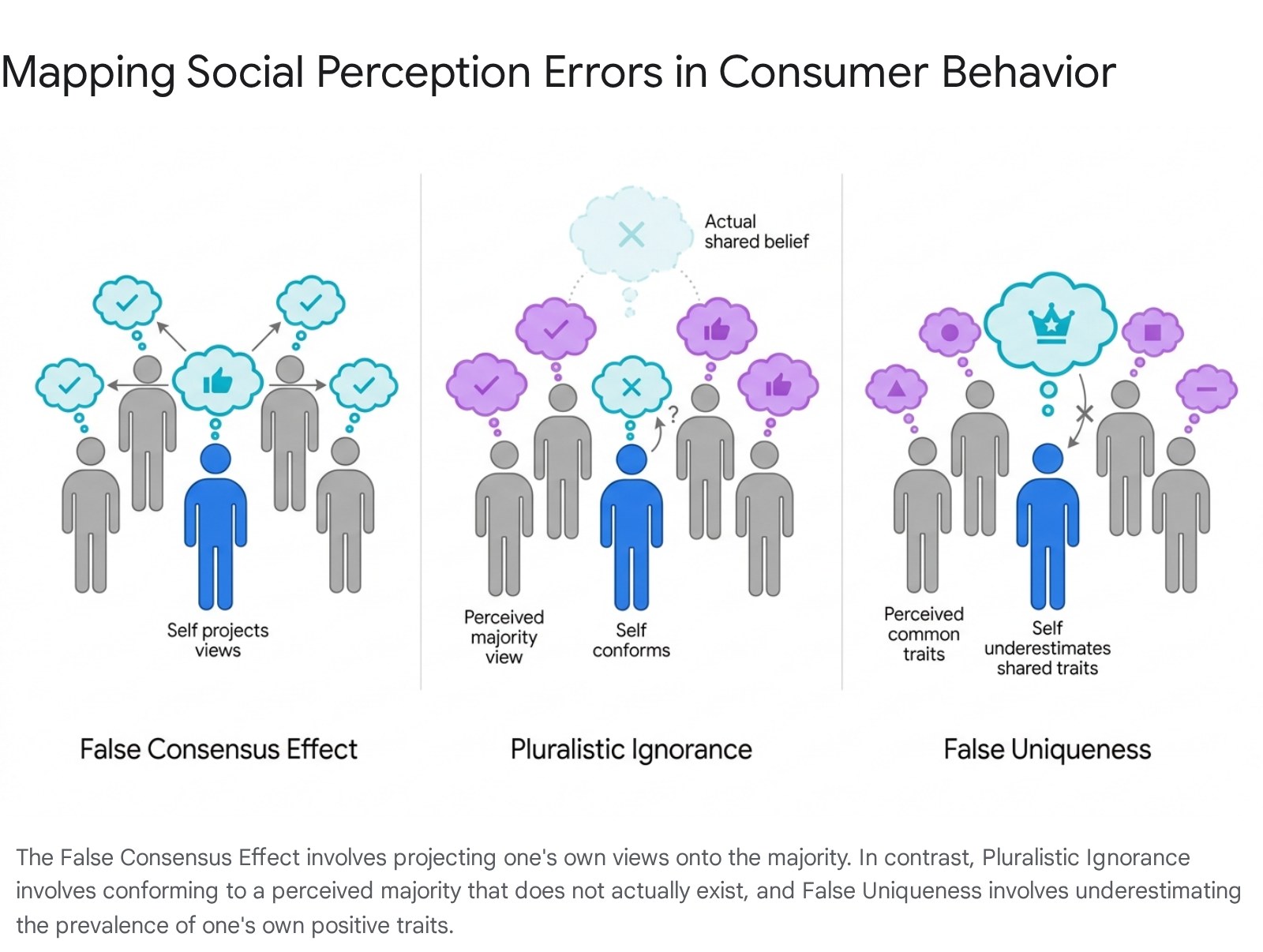
Pluralistic ignorance occurs when a majority of group members privately reject a norm, but incorrectly assume that most others accept it, leading to widespread public conformity 52627. In consumer markets, pluralistic ignorance can sustain artificial demand for a product that no individual genuinely prefers, but everyone purchases due to perceived social pressure or fear of ostracization 26. Conversely, the false uniqueness effect describes the tendency to underestimate the commonality of one's desirable traits or behaviors, driven by a desire to feel exceptional or morally superior 527.
While false uniqueness applies primarily to attributes involving high competence or morality, false consensus dominates matters of general opinion, aesthetic taste, and product preference 27. Furthermore, false consensus and false uniqueness are individual-level biases, whereas pluralistic ignorance is fundamentally a collective phenomenon requiring shared systemic misperception 2627.
Cross-Cultural Variations in Projection
The magnitude of the false consensus effect is not uniform across global populations; it is heavily moderated by cultural frameworks, specifically the spectrum of individualism versus collectivism. Empirical investigations reveal that East Asian populations (who traditionally exhibit higher levels of interdependent self-construal) demonstrate a significantly stronger false consensus effect compared to European American populations (who exhibit independent self-construal) 422.
In traditional false consensus paradigms involving behavioral choices, Korean participants projected their personal choices onto the broader population to a greater extent than their American counterparts 4. This is attributed to the collectivist emphasis on social harmony and normative alignment; individuals in these cultures anchor their life satisfaction and behavioral choices deeply in perceived group norms, amplifying the cognitive need to perceive a consensus surrounding their actions 4. Understanding these cultural variances is critical for multinational corporations executing global market research, as standard predictive models may underestimate projection bias in collectivist regions 28.
Marketer Vulnerability and Egocentric Decision-Making
Despite possessing extensive formal training, rigorous methodological frameworks, and access to vast troves of consumer data, marketing professionals demonstrate profound susceptibility to the false consensus effect. Because the core function of marketing is to anticipate and fulfill consumer needs, the projection of personal preferences onto target demographics constitutes a severe structural failure, termed "egocentric decision-making" 1724.
Empirical investigations provide substantial evidence of this phenomenon. A comprehensive series of six studies conducted by Herzog, Hattula, and Dahl (2021), featuring a sample of 714 marketing executives, established both the overwhelming prevalence of the bias and the mechanisms professionals attempt to use to combat it 82429. The research revealed that marketing professionals generally recognize the danger of projection, yet struggle to operationalize that awareness effectively.
Statistical Prevalence Among Marketing Executives
In the pilot phases of the Herzog et al. research, which surveyed 100 high-level marketing executives, the data demonstrated an acute awareness of the cognitive vulnerability.
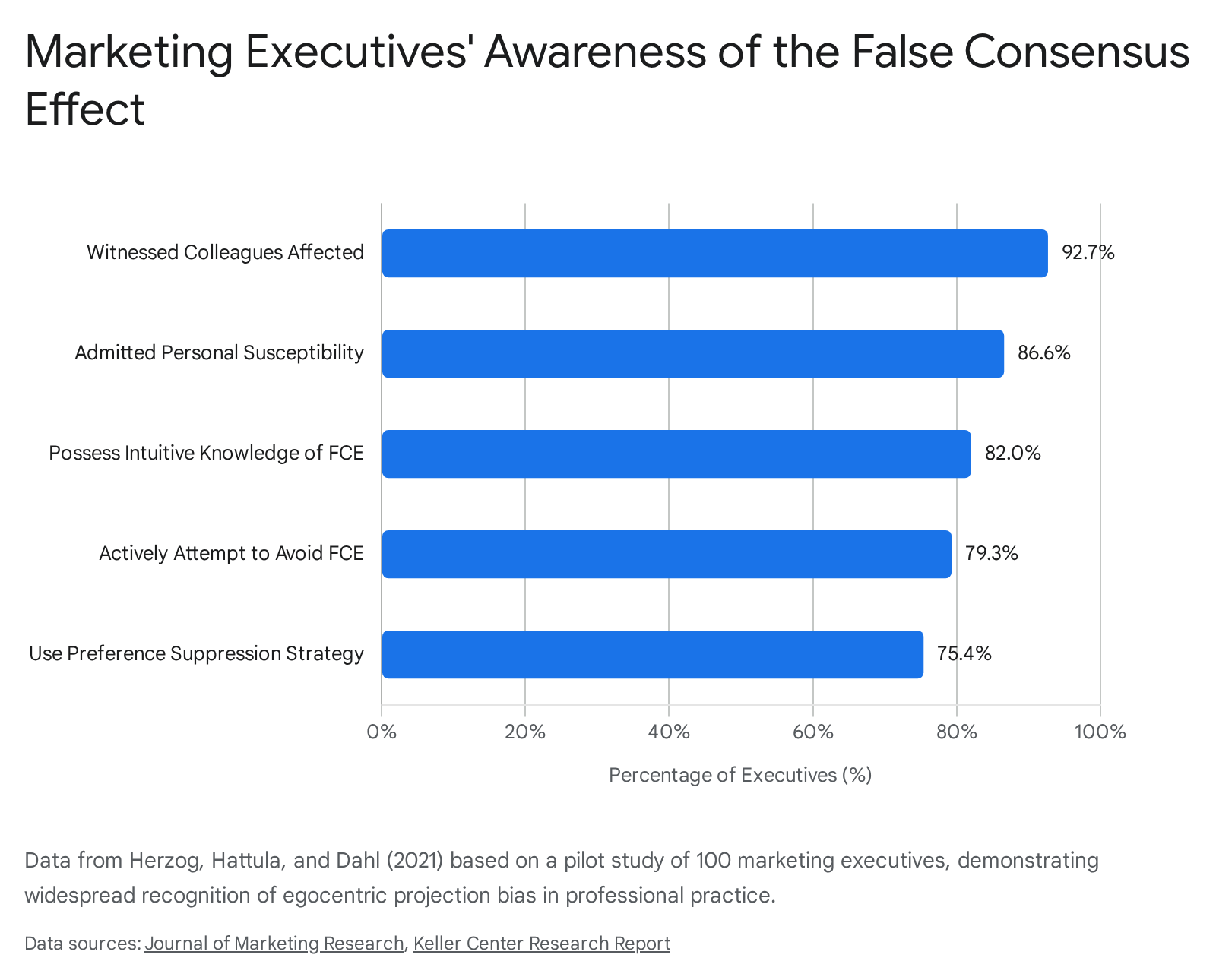
| Metric Regarding the False Consensus Effect | Percentage of Executives Affirming |
|---|---|
| Witnessed colleagues recently affected by the bias | 92.7% |
| Admitted personal susceptibility to the bias | 86.6% |
| Possess intuitive knowledge of the phenomenon | 82.0% |
| State that marketers should actively avoid the bias | 79.3% |
| Attempt to actively avoid it when predicting preferences | 79.3% |
| Utilize "preference suppression" as their primary mitigation tactic | 75.4% |
Data sourced from the empirical findings of Herzog, Hattula, and Dahl (2021) mapping executive self-reporting 724.
The data indicates that the false consensus effect is not a product of ignorance; marketing professionals view it as a severe operational hazard. However, the primary mechanism utilized to mitigate this hazard - preference suppression - has been proven to be inherently unstable.
The Paradoxical Mechanics of Preference Suppression
To counteract their own biases, three-quarters of marketing managers utilize a seemingly logical cognitive strategy: they attempt to deliberately ignore or "suppress" their personal preferences during the decision-making process 72429. However, advanced behavioral science indicates that this intuitive mitigation strategy is fundamentally flawed and frequently exacerbates the very bias it intends to neutralize.
This phenomenon is grounded in ironic process theory, originally developed by psychologist Daniel Wegner to explain the mechanics of thought suppression 2930. The theory posits that attempting to suppress a specific thought engages two distinct cognitive mechanisms: an intentional operating process that searches for mental distractors, and an unconscious monitoring process that constantly checks whether the suppressed thought is surfacing 30. Under conditions of cognitive load - which are ubiquitous in complex corporate strategy environments involving stress, time pressure, and competing data streams - the intentional system fails. However, the automated monitoring system remains active, continuously bringing the suppressed preference into the marketer's working memory 30.
Consequently, the act of trying to actively ignore one's personal preference makes that preference hyper-salient. The executive becomes fixated on the very bias they are attempting to avoid, leading to a stronger, largely unconscious projection of that preference onto the consumer 729.
The Moderating Role of Preference Certainty
The empirical research further demonstrates that the backfire effect of preference suppression is not universal, but is heavily moderated by the marketer's individual level of preference certainty - defined as the clarity and conviction with which a personal preference is held 72429.
When a marketer possesses low preference certainty (i.e., their own aesthetic tastes or functional desires regarding a product are ambiguous or weakly formed), attempting to suppress those preferences triggers massive ironic rebound effects. Their susceptibility to the false consensus effect drastically increases because the cognitive effort required to identify and suppress an unclear preference exhausts executive function, leaving them highly vulnerable to projecting it 72429.
Conversely, when a marketer possesses high preference certainty (their personal tastes are rigidly defined), the suppression tactic is highly effective. The defined nature of the preference allows the cognitive monitoring system to easily identify and isolate it without exhausting mental bandwidth, successfully reducing the false consensus effect and cutting prediction errors by more than 50% 724.
The Perils of Managerial Empathy and Network Centrality
A related and equally paradoxical finding involves the concept of managerial empathy. Conventional marketing doctrine and design thinking methodologies dictate that managers should actively empathize with target consumers - attempting to "step into their shoes" - to accurately predict their behavior. However, empirical studies reveal that explicitly instructing marketing managers to empathize with consumers actually increases their susceptibility to the false consensus effect 7243132.
Psychologically, intense empathy effectively reduces the perceived distance between the self and the target, blurring the boundaries of individual identity. As the marketer conceptually merges with the consumer, they default to projecting their own desires, values, and constraints onto the consumer, leading to highly inaccurate, egocentric market forecasts 7.
Furthermore, false consensus is often amplified by rigid organizational structures. Individuals occupying broker positions within corporate advice networks (those with high "betweenness centrality") frequently overestimate the degree to which colleagues and the broader market share their ethical and strategic views 3334. Despite having access to diverse information flows, their powerful central position inflates their sense of normative alignment. Because they filter extensive amounts of organizational communication, they assume their synthesized view is universally held, leading to uncalibrated strategic deployments 34.
Consumer Decision-Making and Echo Chamber Validation
While corporate executives project preferences downward onto the market, end-users systematically overestimate the prevalence of their own purchasing habits, brand loyalties, and lifestyle choices, assuming their behaviors represent a universal consumer baseline 341035.
Perceived Consensus in Algorithmic Ecosystems
In contemporary digital marketplaces, the false consensus effect severely distorts how consumers interact with user-generated content, product reviews, and social media marketing. Consumers naturally gravitate toward like-minded individuals (homophily), and digital algorithms optimize for sustained engagement by feeding users content that strictly aligns with their pre-existing beliefs, generating highly insulated echo chambers 392635.
Within these curated digital environments, a consumer who prefers sustainable, eco-friendly apparel will be disproportionately exposed to similar viewpoints. The availability heuristic activates, and the consumer falsely deduces that the vast majority of the public demands ethical fashion 926. This distortion has immediate macroeconomic consequences: it influences willingness to pay, alters the perception of brand value, and dictates how consumers evaluate peer-to-peer platform services 1036.
When consumers inevitably encounter mass-market behavior that contradicts their assumed consensus - such as the massive continued profitability of fast-fashion conglomerates - they experience intense cognitive dissonance. This often leads to polarization, a sudden loss of trust in broader market indicators, and the assumption that the opposing consumer base is either manipulated or irrational 29.
Resistance to Non-Conforming Prescriptive Recommendations
Consumer susceptibility to the false consensus effect becomes highly visible when they encounter prescriptive marketing algorithms, targeted advertising, or salesperson recommendations that violate their internal sense of normative consensus. Because consumers view their own choices as standard and appropriate, targeted marketing that implies they belong to a different, less desirable demographic triggers consumption-based offense 311.
For example, if a consumer views themselves as a mainstream normative buyer, but an algorithm recommends a niche, highly specific out-group product based on subtle behavioral tracking, the consumer perceives this as an identity threat 11. The false consensus effect has convinced the consumer that their actual preferences are the societal default. The algorithmic recommendation shatters this illusion, resulting in an active rejection of the brand, negative word-of-mouth, and decreased future purchase intent. The marketing intervention fails precisely because it accurately measured the consumer's behavior, but failed to account for the consumer's egocentric perception of themselves relative to the broader population.
Institutional Manifestations of the False Consensus Effect
When the false consensus effect infiltrates the highest levels of corporate strategic planning, bypassing both qualitative research and financial forecasting, it results in catastrophic product launches and massive capital destruction. The following historical case studies illustrate how egocentric projection, uncalibrated market research, and insulated corporate hierarchies systematically misjudge mass preference.
The Coca-Cola Reformulation (1985)
The launch of "New Coke" in April 1985 remains the definitive case study of the false consensus effect blinding corporate leadership to consumer reality. Facing a severe decline in market share against Pepsi - dropping from a dominant 60% post-WWII to roughly 24% by 1983 - Coca-Cola executives panicked 3738. They invested $4 million in product development and executed an unprecedented 200,000 blind taste tests, surveys, and focus groups 373839. The empirical data appeared decisive: consumers consistently preferred the sweeter taste of the reformulated New Coke over both the original formula and Pepsi 373840.
However, the executives fell victim to a devastating projection bias. They valued pure functional utility (performance in a blind, single-sip test) over emotional, cultural, and historical attachment, and projected this rationalist valuation onto the American public. During the focus groups, researchers noted that 10% to 12% of participants exhibited intense anger and alienation at the prospect of losing the original formula, stating they would abandon the brand entirely 373839.
Due to groupthink and the false consensus effect, Coca-Cola's leadership dismissed this highly vocal cohort as an irrational minority. The executives assumed the broader public would naturally align with their own internal logic that "better taste equals higher overall satisfaction" 374041. Upon launch, the company was paralyzed by the backlash, receiving up to 8,000 complaint calls per day 41. The public reaction was visceral, driven by a perceived violation of cultural heritage that the executives had entirely failed to weight in their models. Within 79 days, the company was forced to humiliatingly reintroduce the original formula as Coca-Cola Classic. The failure stemmed not from a lack of data, but from an egocentric misinterpretation of what that data meant in a real-world, non-blind context 4041.
Amazon Fire Phone and Feature Projection
In July 2014, Amazon entered the highly consolidated smartphone market with the Fire Phone, a device fundamentally crippled by the false consensus effect at the product design and engineering level. The phone featured an innovative "Dynamic Perspective" UI utilizing four front-facing cameras to track user movement, and a physical "Firefly" button designed to instantly scan real-world items for immediate purchase on Amazon 19.
Amazon's engineering and executive marketing teams projected their own enthusiasm for deeply integrated, novel technological gimmicks and retail ecosystem lock-in onto the broader consumer base. Operating from within an insulated corporate environment that prioritized hardware innovation, they assumed the mass market would value these unique features enough to justify a flagship price of $649 (off-contract) and exclusivity to the AT&T network 1944.
The mass market overwhelmingly rejected the device. Consumers prioritized established app ecosystems (specifically iOS and standard Android), sleek design, battery life, and aggressive pricing over 3D interface novelties and a dedicated shopping button 19444243. Following its release, the Fire Phone captured an abysmal 0.02% of the North American smartphone market in its first 20 days, with estimated sales of a mere 35,000 units 19. Within months, Amazon was forced to slash the price to 99 cents with a contract, and by October 2014, the company announced a staggering $170 million inventory write-down, possessing over $83 million worth of unsold inventory, ultimately discontinuing the product entirely 1944.
Burger King Satisfries and Value Misalignment
In 2013, Burger King attempted to capitalize on rising macroeconomic health-consciousness trends by launching "Satisfries," a crinkle-cut french fry variant formulated with a novel batter that absorbed less oil. The product boasted 30% fewer calories and 40% less fat than standard fries 444849.
Corporate strategists projected their own sophisticated understanding of evolving dietary trends onto their core, everyday demographic. However, they drastically misjudged the primary drivers of fast-food consumption: indulgence, immediate taste satisfaction, and extreme affordability 444945. Satisfries were priced at a premium - roughly $1.89 for a small order compared to $1.59 for regular fries - and offered a noticeably different texture and flavor profile 484946.
The false consensus effect blinded management to the fact that while urban, high-income demographics might willingly pay a premium for reduced-calorie options, the standard value-menu consumer viewed the price increase as entirely unjustified for a marginal health benefit (a reduction of roughly 40 calories for a small serving compared to competitors) 4946. Furthermore, the marketing was confusing, earning the product the online moniker "Saddest Fries." Faced with stagnant sales and massive franchisee resistance - only 2,500 of approximately 7,400 North American locations opted to keep the item - Burger King was forced to discontinue Satisfries in less than a year 44494546.
Ford Edsel and Insulated Strategic Planning
The Ford Edsel, introduced in late 1957, represents one of the most financially catastrophic examples of insulated corporate projection in automotive history. Ford invested over $250 million (equivalent to nearly $2.9 billion adjusted for modern inflation) in development, manufacturing, and marketing, relying heavily on initial market research conducted years prior that indicated a booming demand for medium-priced, highly styled vehicles 52474849.
Ford executives became so enamored with their internal creation that they failed to update their assumptions as macroeconomic conditions violently shifted. The executives projected their own aesthetic preferences and corporate optimism onto the market, willfully ignoring the severe economic recession of 1957 - 1958 and a sudden consumer shift toward smaller, fuel-efficient vehicles like the Volkswagen Beetle 524750.
Furthermore, the Edsel's radical styling - particularly its controversial vertical horse-collar grille - was pushed through without adequate external aesthetic validation 4749. The pricing structure was highly confusing, positioned bizarrely within the new Mercury-Edsel-Lincoln (M-E-L) division, causing it to cannibalize sales from Ford's own established lines 524748. Ford forecasted sales of 200,000 units in the first year alone, but managed to sell only roughly 116,000 units over three entire model years. The brand was unceremoniously shuttered in November 1959, securing a $350 million total operational loss and cementing the Edsel as a synonym for marketing failure 52474850.
Comparative Analysis of Projection Outcomes
To systematically address the false consensus effect, it is necessary to map how cognitive mechanisms distinctly disrupt marketer strategies versus consumer behaviors, as well as the historical financial outcomes of these disruptions. The following tables synthesize the structural divergence between the cohorts and the resulting market failures.
Table 1: Structural Divergence in Consensus Projection
| Cognitive Mechanism | Manifestation in Marketers (Producers) | Manifestation in Consumers (End-Users) | Primary Market Consequence |
|---|---|---|---|
| Availability Heuristic | Over-reliance on internal corporate culture and peer feedback during product design; dismissing external data as statistical outliers. | Extrapolating personal daily experiences and algorithmic social media feeds to represent universal mass demand. | Product-market mismatch; failure to scale beyond niche demographics. |
| Self-Esteem Maintenance | Ego-investment in a strategic direction. Rejection of negative market testing to protect professional identity. | Validation of lifestyle choices. Rejection of prescriptive algorithms that imply membership in an undesirable out-group. | Sunk-cost fallacy in R&D; consumption-based offense and brand abandonment. |
| Naïve Realism | Assumption that if a product's utility is technically superior, the consumer will logically recognize and purchase it. | Assumption that personal ethical or aesthetic preferences are objective standards that all rational actors share. | Underestimating the power of emotional branding; polarizing brand politics. |
| Ironic Thought Suppression | Attempting to "ignore" personal preferences without preference certainty, leading to hyper-salience of personal bias. | Not applicable; consumers rarely attempt to suppress their own preferences during routine purchasing. | Paradoxical increase in egocentric market forecasting among executives. |
| Forced Empathy | Explicit instructions to take the consumer's perspective blurs identity boundaries, leading to higher self-projection. | High susceptibility to peer-influence algorithms; conforming to perceived (but often false) group norms. | Marketer "blind spots" resulting in tone-deaf advertising campaigns. |
Table 2: Historical Case Studies of Executive Projection Bias
| Product Initiative | Corporate Projection | Actual Market Reality | Financial/Operational Outcome |
|---|---|---|---|
| Coca-Cola "New Coke" (1985) | Assumed functional utility (blind taste preference) superseded emotional and cultural brand loyalty. | Consumers violently rejected the alteration of a cultural staple, prioritizing heritage over sweetness. | 8,000 daily complaints; forced reversal in 79 days; massive PR crisis. |
| Amazon Fire Phone (2014) | Assumed mass market desired proprietary 3D interfaces and dedicated retail integration at flagship prices. | Consumers demanded established app ecosystems (iOS/Android) and battery efficiency. | $170M inventory write-down; estimated 35,000 units sold in 20 days. |
| Burger King "Satisfries" (2013) | Projected urban health-consciousness trends onto the core fast-food demographic seeking indulgence. | Core consumers rejected the 30-cent price premium for a marginal 40-calorie reduction. | Discontinued in under a year; rejected by ~4,900 out of 7,400 franchises. |
| Ford Edsel (1957) | Assumed sustained demand for large, stylized vehicles despite a shifting macroeconomic landscape. | Consumers shifted to smaller, fuel-efficient vehicles amid the 1957-1958 economic recession. | $350 million total loss; sold only ~116,000 units against a 200,000 year-one forecast. |
Methodological Interventions and Structural Debiasing
Addressing the false consensus effect requires structural changes to how data is collected, interpreted, and integrated into decision-making frameworks. Because cognitive biases operate beneath conscious awareness, mere educational awareness is insufficient to alter outcomes.
Advancements in Neuroscientific Market Research
Market research must shift away from methodologies highly susceptible to projection and groupthink. While focus groups and self-reported surveys are foundational to consumer research, they are frequently contaminated by the false consensus effect; survey participants assume their answers represent the norm, and researchers inevitably project their own hypotheses onto ambiguous qualitative feedback 37515253.
To mitigate this, quantitative researchers are increasingly utilizing advanced physiological and neuroscientific measures - such as electroencephalography (EEG) and eye-tracking (ET) - to assess true consumer preference independent of self-report biases 5254. Machine-learning models utilizing frontal alpha asymmetry (FAA) provide highly accurate, non-conscious evaluations of emotional responses to marketing stimuli, effectively stripping away the researcher's ability to egocentrically interpret verbal feedback 52. Additionally, incorporating implicit association measures alongside explicit self-reports helps isolate genuine behavioral intent from socially desirable or projected responses 2254.
Structural Adjustments to Executive Decision-Making
For marketing executives, the empirical findings dictate specific procedural safeguards. Before executives attempt to predict consumer preference, they must first formally audit their own preference certainty 72429. If a manager does not have a clearly defined personal preference regarding a product, they should explicitly not be instructed to suppress their preferences, nor should they be instructed to empathize with the consumer, as both tactics will ironically inflate egocentric projection through cognitive overload 729. Instead, organizations must rely strictly on external algorithmic data and hard market analytics for those specific decisions.
Furthermore, corporate strategy teams should intentionally construct formal "red team" protocols. This involves assigning individuals or autonomous committees to explicitly argue the opposing viewpoint, or to operate under the assumption that the target demographic holds preferences entirely antithetical to the corporate consensus 2955. This procedural requirement forces the availability heuristic to retrieve alternative data points, breaking the psychological echo chamber of the executive boardroom and mitigating the influence of network centrality 333456. By anchoring decisions in diverse, externally validated data rather than internal intuition, organizations can insulate themselves from the costly illusions generated by the false consensus effect.