
Exposure and health effects of per- and polyfluoroalkyl substances
Introduction and Chemical Profile
Per- and polyfluoroalkyl substances (PFAS) represent a highly complex and diverse class of over 12,000 synthetic aliphatic compounds characterized by carbon chains where hydrogen atoms are fully or partially replaced by fluorine atoms 12. The carbon-fluorine (C - F) bond is recognized as one of the strongest in organic chemistry, conferring exceptional thermal stability, chemical resistance, and amphiphilic properties - meaning they repel both water and lipids 13. These unique physicochemical characteristics have driven their widespread application since the 1940s across industrial sectors and consumer product manufacturing, serving as foundational chemicals in aqueous film-forming foams (AFFF), non-stick cookware, waterproof textiles, and specialized food packaging 112.
However, the very properties that make PFAS industrially valuable also render them highly recalcitrant to environmental degradation, leading to their colloquial designation as "forever chemicals" 13. The historical reliance on long-chain perfluoroalkyl acids (PFAAs), particularly perfluorooctane sulfonate (PFOS) and perfluorooctanoic acid (PFOA), has resulted in ubiquitous environmental contamination and human bioaccumulation on a global scale 13. In response to regulatory phase-outs of legacy C8 compounds, the chemical industry introduced shorter-chain alternatives and perfluoroalkyl ether carboxylic acids (PFECAs), such as hexafluoropropylene oxide dimer acid (HFPO-DA, commercially known as GenX) and dodecafluoro-3H-4,8-dioxanonanoate (ADONA) 345. Recent toxicological and epidemiological evidence indicates that these replacement chemistries present comparable, and in some instances more pronounced, environmental health risks, maintaining high environmental mobility and systemic toxicity 45.
Primary Pathways of Human Exposure
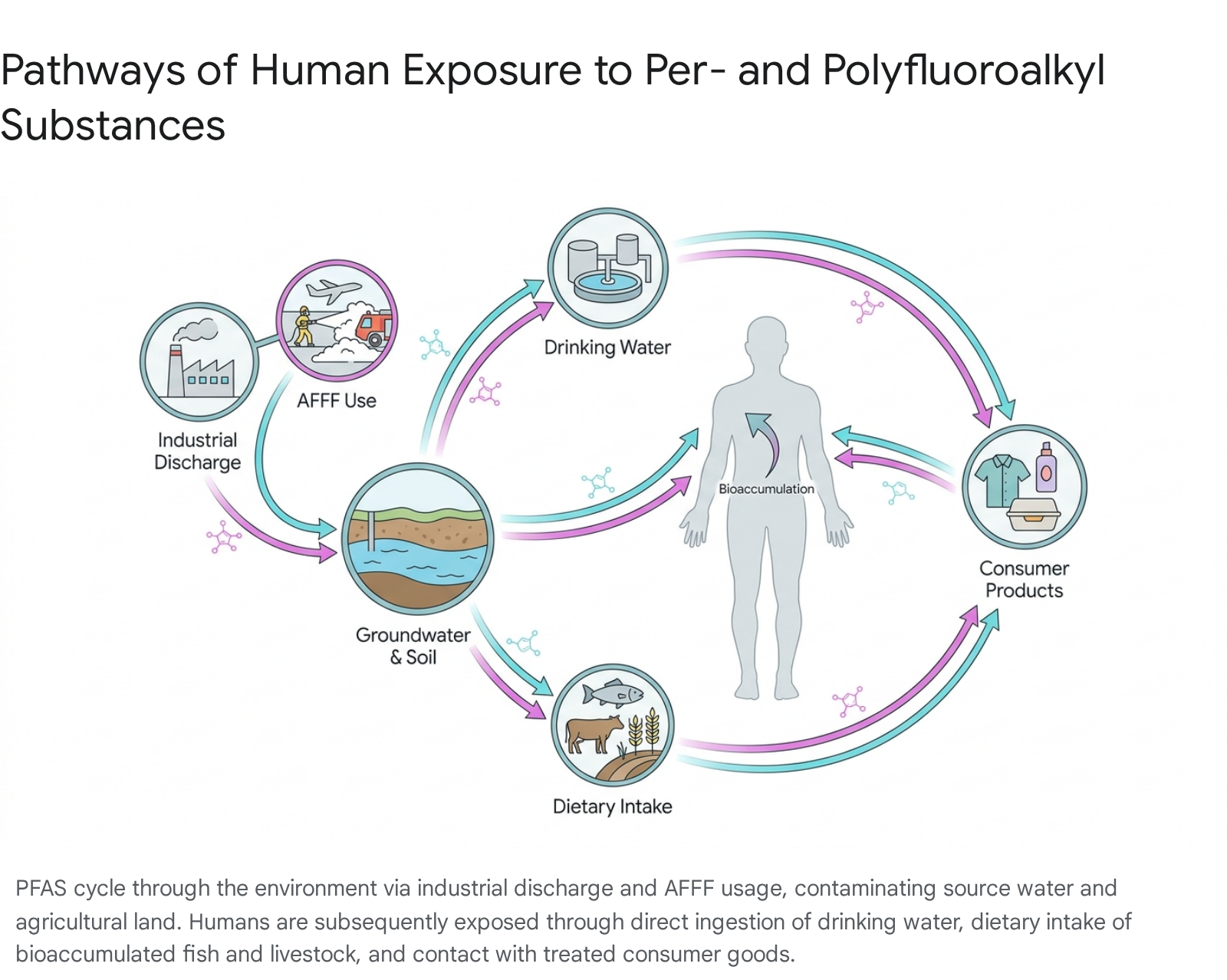
The extreme persistence of PFAS allows them to migrate continuously through soil and aquatic systems, infiltrating multiple vectors of human exposure. The primary determinants of internal PFAS body burdens are drinking water consumption, dietary ingestion, and direct or incidental contact with treated consumer goods 678.
Drinking Water Contamination and Groundwater Transport
Drinking water represents the most significant continuous exposure pathway, particularly for populations residing near industrial manufacturing sites, military bases, civilian airports, and wastewater treatment plants 139. Environmental contamination primarily originates from the historical and ongoing deployment of AFFF during fire-training exercises, as well as unmitigated industrial wastewater discharges into surface water and groundwater aquifers 1.
Because short-chain PFAS variants are highly water-soluble and exhibit low soil sorption, they readily leach into deep groundwater reserves, establishing vast contamination plumes 310. Globally, extensive groundwater monitoring has revealed that a substantial percentage of source water samples contain PFAS concentrations exceeding established or proposed health hazard indices 11. For instance, testing in Australia identified over 73,000 residents exposed to PFAS levels above the 2025 drinking water guidelines, with pronounced contamination clusters surrounding defense facilities like the Williamtown RAAF base and Katherine, Northern Territory 17. Once drawn into municipal treatment systems, conventional water purification processes - such as coagulation, flocculation, standard filtration, and chlorination - fail entirely to degrade or effectively separate the strong C - F bonds 12.
Dietary Ingestion and Food Contact Materials
Dietary intake constitutes a major exposure route, often surpassing drinking water in regions without heavily contaminated municipal supplies. PFAS bioaccumulate in agricultural soils, irrigating waters, and aquatic ecosystems, transferring efficiently into the food web 1314. Long-chain PFAS partition strongly into protein-rich tissues rather than adipose tissue, leading to significant bioaccumulation in the liver, blood serum, and muscle tissue of livestock and wild-caught freshwater fish 71321.
Furthermore, food contact materials and packaging act as direct vectors of dietary contamination. PFAS are heavily utilized to impart grease, oil, and water resistance to paperboard packaging, fast-food wrappers, microwave popcorn bags, and pizza boxes 621. Elevated temperatures and the presence of lipids accelerate the migration of perfluoroalkyl substances from the packaging matrix directly into the consumed food item 79.
Cosmetics, Personal Care, and Dental Hygiene Products
Consumer exposure via household items occurs through both direct dermal absorption and incidental ingestion. Personal care products, particularly cosmetics, have been identified as substantial sources of unmonitored exposure. A comprehensive 2026 study by the United States Food and Drug Administration (FDA) analyzed data on over 430,000 cosmetic products marketed in the U.S., revealing that 51 individual PFAS compounds were intentionally added to roughly 1,744 unique products 15. These chemicals are utilized to enhance water resistance, product durability, and skin-smoothing properties 15. Polytetrafluoroethylene (PTFE) was the most frequently identified fluoropolymer, appearing prominently in eye shadow (20.5% of tested products), facial and neck skin care (15.9%), eyeliner (8.4%), and mascara 15. Independent industry reviews acknowledge that commercial grades of PTFE are frequently contaminated with legacy compounds like PFOA and PFOS 15.
In addition to cosmetics, dental hygiene products present a unique ingestion and mucosal absorption risk. Laboratory testing of 39 popular dental floss brands found that one-third contained detectable levels of total organic fluorine, an indicator of PFAS, with concentrations ranging from 11 parts per million (ppm) to 248,900 ppm 2316. Epidemiological data drawn from the National Health and Nutrition Examination Survey (NHANES) demonstrated a statistically significant association between the use of specific PTFE-coated dental flosses (such as Oral-B Glide) and elevated serum concentrations of perfluorohexane sulfonic acid (PFHxS) in a cohort of women 1718. While establishing definitive causation from cross-sectional NHANES data involves inherent uncertainties, the direct migration of PFAS from coated hygiene products into the highly vascularized oral mucosa remains a verified mechanism of chronic low-dose exposure 1618.
Inhalation and Indoor Dust Accumulation
The application of PFAS in consumer textiles - such as stain-resistant carpeting, upholstery, and waterproof outerwear - results in the gradual degradation and shedding of fluorinated microfibers and volatile precursor compounds into indoor environments 621. These substances accumulate heavily in household dust. Consequently, the inhalation and incidental ingestion of contaminated dust serve as significant secondary exposure routes, particularly for infants and toddlers who exhibit high hand-to-mouth behaviors and inhabit environments closer to the floor surface 719.
Toxicokinetics and Bioaccumulation Mechanisms
The toxicokinetics of per- and polyfluoroalkyl substances are defined by their profound resistance to mammalian metabolism and their high affinity for serum proteins. Unlike many traditional persistent organic pollutants (POPs) that are lipophilic and partition into adipose tissue, PFAS are amphiphilic and bind non-covalently to serum albumin and liver fatty acid-binding proteins 1420. This preferential binding dictates their physiological distribution, leading to disproportionate accumulation in highly perfused organs, particularly the liver, kidneys, and vascular compartments 714.
Furthermore, the biological half-lives of legacy long-chain PFAS in humans are exceptionally protracted compared to other mammalian species. Elimination relies almost entirely on renal and biliary excretion, but high rates of renal tubular reabsorption prolong retention 1421. The estimated half-life of PFOA in humans ranges from 2 to 4 years, while PFOS ranges from 3 to over 8 years, facilitating continuous bioaccumulation and systemic burden escalation even from trace, low-dose environmental exposures 1321.
Measured Human Health Effects
Extensive epidemiological research and in vivo toxicological studies have established clear associations between elevated PFAS body burdens and multi-systemic adverse health outcomes.
Table 2: Documented Human Health Effects Associated with PFAS Exposure
| Biological System | Associated Health Outcomes | Identified Implicated Compounds |
|---|---|---|
| Hepatic (Liver) | Hepatomegaly, elevated ALT/AST enzymes, dyslipidemia, steatosis | PFOA, PFOS, PFHxS, GenX |
| Immunological | Suppressed vaccine antibody response, decreased disease resistance | PFOA, PFOS, PFHxS, PFDA |
| Developmental | Decreased birth weight, accelerated puberty, bone variations | PFOA, PFOS, PFNA |
| Reproductive | Pregnancy-induced hypertension, preeclampsia, decreased fertility | PFOA, PFOS |
| Endocrine | Thyroid hormone disruption, altered sex hormones | PFHxS, PFBS, F-53B |
| Oncological | Increased risk of renal cell carcinoma and testicular cancer | PFOA |
Hepatotoxicity and Lipid Metabolism Disruption
The liver serves as the primary target organ for PFAS toxicity, acting as the main repository for circulating fluorinated compounds 322. Chronic exposure induces hepatomegaly (liver enlargement), hepatocellular hypertrophy, and elevated serum concentrations of key hepatic enzymes, specifically alanine aminotransferase (ALT) and aspartate aminotransferase (AST) 423.
At the molecular level, PFAS function as potent agonists for the peroxisome proliferator-activated receptor alpha (PPAR-α), a critical nuclear receptor that regulates lipid homeostasis 424. In vivo transcriptomic studies reveal that PFAS exposure upregulates genes associated with fatty acid transport and oxidation (e.g., CD36, CPT1β, ACOX1) while simultaneously downregulating glycogen synthesis pathways 423. This metabolic dysregulation drives the accumulation of triglycerides and total cholesterol in hepatic tissues, contributing to clinically significant dyslipidemia, steatosis, and an increased risk of non-alcoholic fatty liver disease (NAFLD) 425.
Immunotoxicity and Vaccine Response Suppression
PFAS are profound systemic immunotoxicants. The U.S. National Toxicology Program (NTP) and the Agency for Toxic Substances and Disease Registry (ATSDR) classify PFOS and PFOA as presumed immune hazards to humans, based on robust epidemiological and controlled in vivo evidence 82426.
The most clinically documented and sensitive physiological endpoint is the suppression of adaptive immunity, specifically the blunting of specific antibody responses following routine pediatric vaccinations 2627. Elevated maternal and pediatric serum concentrations of PFOS, PFOA, and PFHxS correlate directly with significantly reduced circulating antibody titers against diphtheria, tetanus, and rubella 82627. The exact immunotoxic mechanism remains under investigation, but it appears to involve PFAS targeting B-cell maturation and downregulating nuclear factor kappa-light-chain-enhancer of activated B cells (NF-κB) signaling pathways, alongside broad suppression of natural killer (NK) cell functionality 824. Consequently, individuals with high PFAS body burdens may exhibit diminished overall disease resistance and require longer durations to clear common infections 89.
Reproductive, Developmental, and Endocrine Toxicity
Maternal-fetal transfer of PFAS occurs readily across the placental barrier, exposing the developing fetus to systemic contamination 614. Postnatal exposure continues intensely via breast milk, though major health organizations maintain that the benefits of breastfeeding generally outweigh the risks of trace PFAS exposure 69.
Elevated maternal PFAS serum levels are strongly associated with pregnancy-induced hypertension and preeclampsia 1425. In fetal development, exposure correlates with statistically significant, albeit small, reductions in infant birth weight, estimated at a decrease of up to 20 grams for every 1 ng/mL increment of PFOA or PFOS in maternal serum 1425. Furthermore, specific PFAS variants demonstrate powerful endocrine-disrupting capabilities, altering circulating levels of sex hormones and thyroid hormones, which can prompt cascading metabolic and developmental disruptions 911.
Carcinogenic Potential
Regarding oncology, leading epidemiological panels, including the International Agency for Research on Cancer (IARC) and the U.S. Environmental Protection Agency (EPA), have identified specific legacy PFAS as probable or likely human carcinogens. Prolonged occupational and environmental exposure correlates with statistically elevated incidences of renal cell carcinoma (kidney cancer) and testicular cancer 925.
Toxicological Profiles of Replacement Chemicals
Due to the regulatory phase-out and voluntary discontinuation of PFOA and PFOS manufacturing, the chemical industry transitioned heavily to short-chain analogs and ether-based fluorinated structures. These replacements were engineered to maintain the desired surfactant and hydrophobic properties while exhibiting faster human clearance rates 313. However, emerging toxicological data indicates these substitutes exhibit comparable, or in certain endpoints enhanced, toxicity profiles compared to their legacy predecessors.
GenX (HFPO-DA) and Short-Chain Carboxylates
GenX (hexafluoropropylene oxide dimer acid) was introduced commercially by the Chemours Company in 2009 as a direct processing aid replacement for PFOA in fluoropolymer manufacturing 336. Featuring six carbon atoms compared to PFOA's eight, GenX has a significantly shorter biological half-life in humans 3. However, its reduced bioaccumulation is offset by extremely high environmental mobility, leading to rapid contamination of surface and groundwater downstream of manufacturing facilities 34.
Toxicologically, GenX induces comparable hepatotoxicity to PFOA. In controlled murine models, gestational exposure to GenX induced maternal liver damage and triggered cellular DNA damage alongside cell cycle arrest in the livers of offspring 2336. Transcriptomic analyses of GenX-exposed tissues identified severe disruption in over 637 differentially expressed genes (DEGs) primarily related to intestinal mucosal barrier integrity and liver lipid metabolism 23. This strongly challenges the regulatory hypothesis that shorter biological retention inherently equates to physiological safety 2336.
ADONA and Chlorinated Polyfluorinated Ether Sulfonates
ADONA (dodecafluoro-3H-4,8-dioxanonanoate), another prominent PFOA substitute used as an emulsifier, exhibits significant hepatotoxic potential and possesses complex ether functional groups 528. Similarly, the PFOS replacement known as F-53B (comprising 6:2 and 8:2 chlorinated polyfluoroalkyl ether sulfonic acids) demonstrates pronounced endocrine disruption, specifically targeting the thyroid gland at low environmental concentrations 5. Notably, biomonitoring studies suggest that F-53B exhibits a higher bioaccumulation potential in certain mammalian tissues than the legacy PFOS it was explicitly designed to replace 5.
Analytical Methodologies and Biomonitoring Challenges
The structural diversity of over 12,000 distinct PFAS compounds - combined with their presence at trace parts-per-trillion (ppt) concentrations - presents immense analytical challenges for environmental monitoring and human biomonitoring 129. The reliance on highly fluorinated materials in laboratory equipment itself further complicates analysis by introducing pervasive background contamination 30. Current analytical methodologies are broadly categorized into targeted analysis, precursor conversion assays, and total fluorine screening 3031.
Table 3: Comparison of Analytical Methodologies for PFAS Detection
| Analytical Method | Primary Target / Output | Limitations & Challenges |
|---|---|---|
| Targeted LC-MS/MS | Precise quantification of 20-50 known PFAS compounds (e.g., EPA 1633). | Highly specific; misses hundreds of uncharacterized precursors and short-chain variants. |
| TOP Assay | Oxidizes precursors into measurable terminal PFAAs. | Ether-based replacements (ADONA, F-53B) resist oxidation; incomplete conversion rates. |
| TOF / AOF / EOF | Bulk parameter screening for all organic fluorine (CIC method). | Non-specific; captures fluorinated pharmaceuticals (Prozac) and agricultural pesticides. |
| Non-Targeted (NTA) | Identifies novel/unknown PFAS using High-Resolution MS (HRMS). | Extremely high cost; lacks standardized reference libraries; complex data processing. |
Targeted Liquid Chromatography-Mass Spectrometry (LC-MS/MS)
Targeted LC-MS/MS, typically guided by isotope dilution, represents the strict regulatory gold standard for quantifying specific PFAS compounds down to ppt or parts-per-quadrillion (ppq) limits of detection 31. Standardized environmental protocols, such as EPA Method 533, EPA Method 537.1, and the comprehensive EPA Method 1633, rely fundamentally on this technology 232. While highly accurate, targeted LC-MS/MS suffers from analytical "myopia" - it only quantifies compounds for which purified analytical reference standards are available 2843. Because commercial reference standards exist for only a fraction of the market, targeted analysis systematically underestimates the total environmental PFAS burden, ignoring thousands of emerging alternatives and uncharacterized degradation intermediates 3133.
Total Oxidizable Precursor (TOP) Assay
To circumvent the limitations of targeted lists, the Total Oxidizable Precursor (TOP) assay was developed. This method utilizes a heated alkaline persulfate oxidative digestion to artificially "weather" a sample, converting hidden polyfluorinated precursor compounds into measurable, terminal perfluoroalkyl acids (PFAAs) 2831. By comparing pre-oxidation and post-oxidation targeted LC-MS/MS results, analysts can estimate the concentration of previously hidden precursors 2845. However, the TOP assay is analytically imperfect; ether-based replacement PFAS (like ADONA and F-53B) frequently resist oxidative conversion, leading to substantial false negatives 28. Furthermore, matrix interferences in complex biological or wastewater samples can consume the oxidant prematurely, leading to incomplete conversion 28.
Total Organic Fluorine (TOF) Screening
To capture the absolute magnitude of fluorinated contamination, laboratories increasingly utilize bulk parameters like Total Organic Fluorine (TOF), Extractable Organic Fluorine (EOF), and Adsorbable Organic Fluorine (AOF). These methods generally employ Combustion Ion Chromatography (CIC) to measure the cumulative fluorine content after separating out naturally occurring inorganic fluoride 3045.
While TOF offers a rapid, cost-effective screening tool to capture the "dark matter" of PFAS (including ultra-short-chain compounds and inert polymers like PTFE), it is fundamentally non-specific 304534. Furthermore, TOF methodologies are susceptible to substantial positive interference from non-PFAS sources. Over 360 FDA-approved fluorinated pharmaceuticals (e.g., fluoxetine/Prozac, atorvastatin/Lipitor) and over 100 EPA-approved fluorinated agricultural pesticides contain organic fluorine bonds and will register as positive hits in a TOF assay, confounding environmental risk assessments 30.
Non-Targeted Analysis (NTA)
To bridge the gap between broad total screening and narrow targeted quantification, Non-Targeted Analysis (NTA) utilizing High-Resolution Mass Spectrometry (HRMS) - such as orbitrap or time-of-flight MS - is emerging 1033. NTA enables researchers to identify novel PFAS structures, isomers, and degradation products based on exact mass and fragmentation patterns without requiring a priori reference standards 10. While NTA provides the most comprehensive picture of environmental contamination, its widespread regulatory adoption remains constrained by high instrumentation costs, geographical biases in research deployment, and immense data processing requirements 1033.
Evolution of Global Drinking Water Regulations
The evolving epidemiological consensus regarding PFAS toxicity has triggered a profound, albeit highly fragmented, shift in global regulatory frameworks. Historically managed through non-enforceable health advisories, leading regulatory bodies are now instituting stringent, legally enforceable maximum contaminant levels (MCLs), though methodologies for calculating safe exposure diverge significantly.
United States Federal Standards and Revisions
In April 2024, the U.S. EPA established a landmark National Primary Drinking Water Regulation under the Safe Drinking Water Act (SDWA) 3536. The rule finalized highly stringent, legally enforceable MCLs for PFOA and PFOS at 4 parts per trillion (ppt) each, and set limits for PFHxS, PFNA, and HFPO-DA (GenX) at 10 ppt 136. Furthermore, it introduced a novel Hazard Index approach to address the cumulative and synergistic risks of specific chemical mixtures 36.
However, the regulatory compliance timelines and the scope of these rules are undergoing significant, highly contested revisions. In May 2026, the EPA proposed a formal extension of the compliance deadline for public water systems to meet the core PFOA and PFOS limits, shifting the mandatory compliance requirement from April 2029 to April 2031 3537. Concurrently, the agency announced its intent to completely rescind and reevaluate the standards set for PFHxS, PFNA, GenX, and the Hazard Index mixture, citing procedural challenges regarding public comment periods under the SDWA and the need to re-review underlying scientific determinations 373839. Despite these proposed compliance extensions and rescissions, the mandatory initial source monitoring and public reporting requirements remain actively enforceable and must be completed by 2027 3639.
Canadian and Australian Thresholds
International regulatory bodies reflect varying strategies for managing the complexity of thousands of unique PFAS compounds.
In August 2024, Health Canada formally transitioned from individual chemical guidelines to a group-based objective, establishing a comprehensive target of 30 nanograms per litre (ng/L or ppt) for the sum concentration of 25 specific PFAS detected in drinking water 4041. This limit was established based on the practical achievability of current municipal water treatment technologies rather than a direct toxicological health-effect derivation, reflecting the rapidly evolving nature of the science and the lack of consensus on mixture toxicity 40.
Conversely, Australia manages drinking water safety through the National Health and Medical Research Council (NHMRC). In June 2025, the NHMRC finalized significantly reduced health-based guideline values after extensive public consultation. The updated guidelines lowered the limit for PFOS to 8 ng/L, PFOA to 200 ng/L, and PFHxS to 30 ng/L, while introducing a new limit for PFBS at 1000 ng/L . The NHMRC explicitly concluded that current toxicological data remains insufficient to establish a reliable health-based guideline value for GenX chemicals in Australia 17.
World Health Organization Guidance
The World Health Organization (WHO) is currently undertaking a broader assessment to finalize its Guidelines for Drinking-Water Quality regarding PFAS 1. The WHO's draft guidance previously drew intense criticism from the scientific community for proposing provisional values of 100 ppt for PFOA and PFOS individually - limits significantly higher and less protective than those set by individual nations like the U.S. and Denmark 42. The WHO explicitly justified these provisional values not as definitive health-based safety limits, but as pragmatic concentrations that are technically achievable globally, particularly prioritizing resource-limited countries lacking advanced filtration infrastructure 43. The finalized WHO principles urge Member States to pursue contamination levels "as low as reasonably practical" while crucially balancing PFAS remediation against the primary necessity of maintaining adequate public water supply and mitigating immediate microbial safety risks 1.
Table 4: Comparative Summary of Current Global PFAS Drinking Water Standards (as of 2026)
| Regulatory Body / Country | Framework Type | PFAS Compound(s) Targeted | Established Threshold Limit |
|---|---|---|---|
| U.S. EPA (2024 Rule) | Enforceable MCL | PFOA / PFOS | 4 ppt (ng/L) individually |
| U.S. EPA (Proposed 2026) | Rescission / Reevaluation | PFHxS, PFNA, GenX | 10 ppt (ng/L) currently under review |
| Health Canada (2024) | Drinking Water Objective | Sum of 25 specified PFAS | 30 ppt (ng/L) total |
| Australia NHMRC (2025) | Health-based Guideline Value | PFOS | 8 ppt (ng/L) |
| Australia NHMRC (2025) | Health-based Guideline Value | PFOA | 200 ppt (ng/L) |
| Australia NHMRC (2025) | Health-based Guideline Value | PFHxS | 30 ppt (ng/L) |
Water Filtration and Remediation Technologies
Achieving the stringent regulatory limits delineated above requires the implementation of advanced separation technologies. Because the carbon-fluorine bond allows PFAS to resist standard chemical degradation processes - such as traditional municipal advanced oxidation processes (AOP) - remediation relies heavily on physical separation and adsorption 358.
Efficacy of Residential and Municipal Water Filtration
Three primary technologies dominate PFAS removal at both the municipal utility scale (Point-of-Entry) and the residential scale (Point-of-Use): Granular Activated Carbon (GAC), Ion Exchange Resins (IEX), and Reverse Osmosis (RO) membranes 3444546.
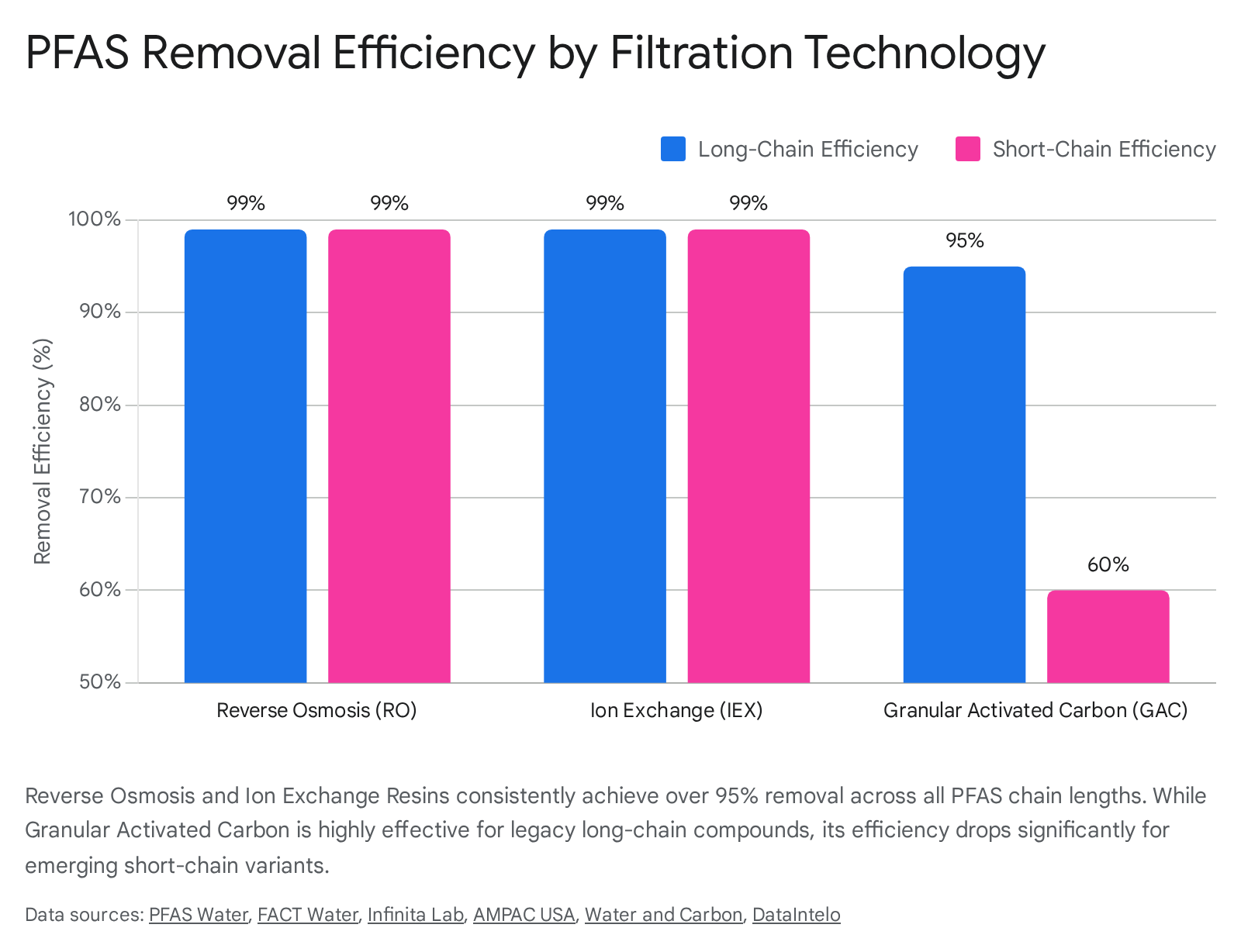
1. Granular Activated Carbon (GAC): GAC is the most mature, widely understood, and extensively deployed treatment technology, accounting for nearly 40% of the municipal treatment market 346. It functions via hydrophobic interactions, physically trapping PFAS molecules within its highly porous carbon structure as water flows through the bed 1244. GAC is highly cost-effective and efficient at capturing legacy long-chain PFAS (e.g., PFOA, PFOS), routinely achieving >90% removal when the media is fresh 358. However, short-chain PFAS possess a fundamentally lower hydrophobic affinity for carbon media; consequently, they break through the filter bed much faster, necessitating frequent and costly high-temperature thermal reactivation (at 900°C) or complete media replacement to prevent contamination spikes 5847.
2. Ion Exchange Resins (IEX): Single-use, PFAS-selective anion exchange resins rely on chemical substitution, swapping innocuous ions (like chloride) for the negatively charged functional groups (sulfonates and carboxylates) of PFAS 5844. Specialized resins featuring quaternary ammonium functional groups demonstrate excellent, rapid removal kinetics across the entire spectrum of PFAS chain lengths, routinely achieving >99% removal 5846. They significantly outperform GAC in capturing challenging short-chain compounds 5844. However, resin sites can be rapidly occupied by competing background environmental anions (particularly high concentrations of sulfate), reducing their lifespan, and disposal of the spent resin requires specialized, highly expensive incineration (>1,100°C) 5848.
3. Reverse Osmosis (RO) and Membrane Filtration: RO operates via pressure-driven membrane filtration, physically rejecting contaminants through extreme size exclusion and charge repulsion at the membrane surface 158. Independent laboratory analyses demonstrate that point-of-use RO systems are the most universally effective residential solution, consistently achieving 90% to >99% rejection of virtually all PFAS compounds, regardless of chain length or isomer structure 14464. The primary drawback of RO is its high capital and operational energy costs, alongside a slow flow rate and the generation of a high-volume, PFAS-concentrated brine (wastewater) that requires secondary treatment or careful environmental disposal 34445.
Emerging Destructive and Advanced Technologies
Because physical separation methods like RO and IEX do not destroy PFAS - but rather concentrate it into a smaller volume of waste - research into destructive technologies is accelerating. Electrochemical Oxidation utilizing boron-doped diamond (BDD) electrodes has demonstrated laboratory success in generating highly reactive hydroxyl radicals capable of mineralizing the C-F bonds of PFOA and PFOS, achieving >90% removal, though commercial scalability remains low 5845. Furthermore, research funded by the U.S. National Science Foundation (NSF) recently demonstrated the viability of organic, porphyrin-based molecular nanocages. These highly selective chemical filtration systems removed 80% to 90% of a broad spectrum of PFAS from raw sewage and groundwater, operating with significantly lower energy requirements than RO and outperforming traditional GAC 49.
Consumer Avoidance and Mitigation Strategies
Because definitive federal PFAS regulation primarily targets municipal drinking water at the source, reducing human exposure from consumer goods relies heavily on informed purchasing decisions, at-home mitigation, and corporate material phase-outs.
Textile Certifications and Industry Phasing Out
Textile and apparel consumers are advised to avoid garments marketed with generic claims of being "stain-repellent," "water-resistant," or "moisture-wicking," as these features are traditionally achieved via fluorinated Durable Water Repellent (DWR) finishes 66. Instead, consumers can rely on third-party manufacturing certifications that mandate rigorous supply-chain chemical testing.
The OEKO-TEX Standard 100 certification actively tests finished garments for over 1,000 harmful substances, including newly strengthened screening thresholds specifically targeting total PFAS 6750. Additionally, the Bluesign certification focuses on input stream management rather than just output testing. As of January 2026, the Bluesign standard comprehensively restricted intentionally added PFAS across all approved materials and consumer products 26751. This mandate has forced major partnered outdoor brands to adopt bio-based waterproofing alternatives, transitioning the technical apparel industry away from fluorinated chemistries 2. These private certifications are operating in tandem with aggressive state-level bans; for example, California, New York, and Washington have all implemented phased bans on intentionally added PFAS in textiles and apparel taking effect between 2025 and 2027 251.
Household and Dietary Adjustments
At the household level, consumers utilizing municipal water or private wells with known contamination can significantly reduce their primary exposure vector by installing under-sink reverse osmosis systems certified to NSF/ANSI Standard 53 or 58, which verify the reduction of PFOA and PFOS to below strict health advisory limits 475253.
In personal care, consumers should actively screen ingredient lists for formulations containing the prefixes "fluoro," "perfluoro," or "PTFE" 1315. To avoid mucosal exposure, individuals can opt for uncoated nylon, silk, or natural wax dental flosses rather than those marketed as utilizing proprietary "glide" technology 2316. Finally, frequent vacuuming using machines equipped with True HEPA filters significantly mitigates secondary exposure caused by the shedding of PFAS-treated carpet and upholstery fibers into the ambient household dust 21.
Conclusion
The pervasive integration of per- and polyfluoroalkyl substances into modern industrial processes has resulted in a global environmental health challenge of unprecedented scale. As advanced biomonitoring and epidemiological data continue to unequivocally link both legacy long-chain and emerging short-chain PFAS replacements to severe hepatotoxicity, profound immune suppression, and metabolic disruption, the global regulatory landscape is shifting from passive advisories to stringent, enforceable phase-outs and maximum contaminant limits.
However, mitigating the human health impact of these "forever chemicals" is significantly hindered by deep analytical limitations in quantifying the full spectrum of fluorinated compounds, as well as the substantial infrastructural and capital costs associated with implementing advanced Reverse Osmosis and Ion Exchange filtration at scale. Comprehensive risk reduction ultimately requires a multifaceted, unified approach: aggressive upstream supply-chain interventions to halt the manufacture of non-essential fluorinated products, widespread consumer education regarding daily exposure vectors, and the rigorous, well-funded modernization of downstream municipal water treatment facilities.