
Evolution of disruptive innovation and Christensen Institute research
Introduction
Since its formal introduction in the mid-1990s through the scholarship of Joseph L. Bower and Clayton M. Christensen, the theory of disruptive innovation has achieved an unparalleled level of influence in modern management science and corporate strategy 123. Originally formulated as a diagnostic framework to explain the paradox of why exceptionally well-managed, industry-leading firms frequently fail when confronted by specific technological and market shifts, the theory has undergone a profound evolution over the subsequent three decades 45. Far from remaining a static business model construct, disruptive innovation theory has been continually refined, subjected to rigorous academic critique, and expanded into a comprehensive lens for analyzing macroeconomic development, public policy, and societal transformation 367.
Following the passing of Clayton Christensen in early 2020, the stewardship of this intellectual framework has been carried forward by the Clayton Christensen Institute for Disruptive Innovation 8910. Functioning as a nonpartisan, nonprofit think tank, the Institute operates under the contemporary leadership of President and CEO Ann Christensen, alongside Co-founder and Chairman Michael B. Horn 101011. Rather than merely preserving historical concepts, the post-2020 agenda of the Institute has been characterized by an aggressive expansion into the social sciences 1112. The contemporary research apparatus is explicitly focused on leveraging disruptive innovation, alongside complementary frameworks such as Jobs-to-Be-Done and Modularity Theory, to engineer systemic solutions in three primary pillars: Education, Health Care, and Global Prosperity, with a particular geographic emphasis on Low- and Middle-Income Countries (LMICs) 121314.
This comprehensive report provides a detailed analysis of the current state of disruptive innovation theory and the Christensen Institute's post-2023 research agenda. The analysis systematically addresses the persistent colloquial misconceptions of the theory, maps the classic trajectory of disruption, and evaluates the most rigorous academic critiques regarding the theory's predictive power and inherent survivorship biases. Furthermore, it extensively examines the Institute's application of the theory to contemporary challenges, including the integration and macroeconomic impact of artificial intelligence across various social sectors.
The Formal Architecture of Disruptive Innovation Theory
Resolving the Colloquial Misconception
A defining challenge for academic researchers and the Christensen Institute has been mitigating the widespread colloquial misuse of the term "disruption." As the concept permeated the mainstream business lexicon, the "disruptive" label began to be applied indiscriminately to describe virtually any novel technology, any aggressive market entry by a well-funded startup, or any generalized market turbulence that caused incumbent firms to stumble 151617. This semantic dilution threatens the utility of the theory; when disruptive innovation is utilized to describe every market shift, it loses its explanatory and prescriptive power 71518.
In a pivotal 2015 intervention published in the Harvard Business Review titled "What is Disruptive Innovation?", Christensen, Michael Raynor, and Rory McDonald systematically re-anchored the theory to its strict academic definitions 115. The researchers emphasized that disruption must be understood as a process over time, rather than an isolated event or a static product 115. Furthermore, the academic definition strictly dictates that a genuinely disruptive innovation must originate in one of two highly specific market footholds 1719.
The first origin point is a low-end foothold. This dynamic occurs in existing markets where incumbent firms predictably allocate their resources toward sustaining innovations - incremental improvements designed to satisfy their most demanding, and inherently most profitable, tier of customers 151719. Driven by an inherent pursuit of higher profit margins, incumbents progressively overshoot the actual performance requirements of the broader, less-demanding mainstream market 1520. This relentless upward trajectory creates a vacuum at the bottom of the market. A disruptive entrant capitalizes on this vacuum by introducing a product that is often technologically inferior to the incumbent's offering but is "good enough" in performance, significantly more affordable, and characterized by superior convenience or accessibility 151719.
The second origin point is a new-market foothold. In this scenario, the entrant does not compete for the incumbent's existing customers at the low end but instead creates an entirely new market segment by targeting "nonconsumers" 1719. These are populations that previously lacked the financial resources, technical skills, or physical access required to participate in the established market 1322. By democratizing access through radical simplicity and affordability, the entrant cultivates a new value network entirely outside the incumbent's purview 1922.
To illustrate this strict boundary, the 2015 analysis prominently utilized Uber as a counter-example. While widely celebrated in the popular press as the ultimate disruptor of the taxi industry, Uber fails the strict academic test for disruptive innovation 116. Uber did not originate in a low-end foothold; it initially launched in San Francisco as UberBlack, a premium, high-end black-car service 1. Furthermore, it did not target nonconsumers; it primarily targeted existing users of taxi and limousine services 1. Consequently, within the precise taxonomy of the theory, Uber represents a highly successful sustaining innovation, which predictably elicited a fierce, combative response from incumbent taxi networks rather than the characteristic indifference that incumbents initially exhibit toward true disruptive entrants 11618.
The Classic Disruption Trajectory: Incumbent vs. Entrant Performance
The foundational mechanism of disruptive innovation relies on comparing two intersecting trajectories: the pace of technological progress engineered by incumbent firms versus the trajectory of performance improvement that mainstream customers can actually utilize 41523.
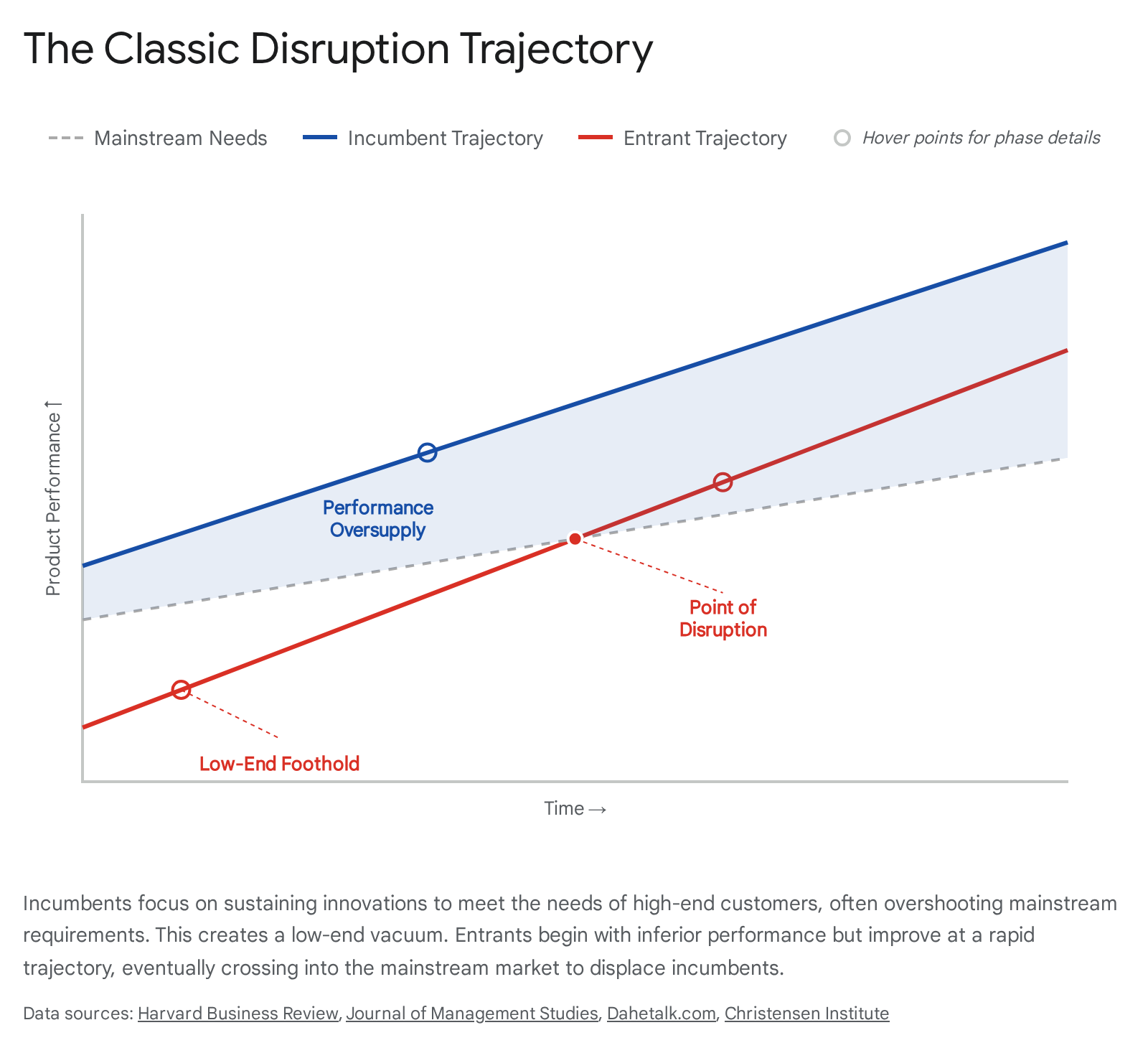
Incumbent firms, bound by their established value networks and the demands of their premium client base, introduce sustaining innovations at a pace that is almost universally faster than the rate at which customers' needs evolve 4623. This dynamic predictably leads to performance oversupply. The entrant, beginning at the low-end or new-market foothold, initially offers a product that the mainstream market rejects due to inferior performance on traditional metrics 14. Because the entrant's business model is optimized for profitability at low price points, incumbent leaders - rationally analyzing their own margin requirements - choose to ignore the entrant, essentially ceding the least profitable market segments to focus on higher-tier clients 41517.
However, the entrant's product improves at a rapid rate. Eventually, the performance of the disruptive innovation intersects with the mainstream market's baseline requirements 123. At this critical juncture, mainstream customers enthusiastically adopt the entrant's offering because it is more convenient and cost-effective, while finally meeting their core performance needs 1519. The disruption is considered complete when the entrant's offerings dominate mainstream volume, leaving the incumbent isolated in a shrinking, hyper-premium niche or driving them to failure 151719.
The Expanded Taxonomy of Innovation
As the Christensen Institute pivoted toward macroeconomic applications, it became necessary to expand the theoretical architecture beyond the binary distinction of sustaining versus disruptive. The contemporary research agenda relies heavily on a trinary taxonomy of innovation, which evaluates innovations based on their impact on capital deployment, job creation, and systemic economic growth 182324. This framework is pivotal for understanding why certain types of economic development initiatives succeed while others predictably fail 22.
| Innovation Category | Definitional Mechanism | Primary Audience | Macroeconomic & Capital Impact |
|---|---|---|---|
| Sustaining Innovation | Enhances the performance of existing products and services along established engineering metrics to maintain competitive parity or dominance. | The existing, highly profitable, and demanding mainstream customer base. | Capital is heavily deployed to replace outdated product lines. While critical for corporate survival, it generates minimal aggregate new macroeconomic growth, as new sales simply cannibalize old sales 18222324. |
| Efficiency Innovation | Optimizes internal processes, supply chains, and management methodologies to execute identical functions with fewer resources, thereby reducing operational costs. | Existing markets and established customer bases. | Drastically increases corporate free cash flow and profitability. However, at a macroeconomic level, it frequently results in job elimination, capital consolidation, and resource extraction 18222324. |
| Market-Creating Innovation | Transforms historically complex, expensive, and exclusive products into simple, radically affordable solutions, cultivating entirely new value networks. | "Nonconsumers" who were previously excluded from the market due to financial, geographic, or skill-based barriers. | Acts as the primary engine of macroeconomic growth. Generates massive net-new capital, creates widespread employment, and organically pulls in requisite infrastructure and regulatory frameworks 222324. |
Academic Critiques and Theoretical Controversies (2014 - 2026)
Despite its ubiquitous presence in corporate strategy, disruptive innovation theory has been subjected to rigorous academic interrogation. The Christensen Institute's current methodologies have evolved significantly as a direct response to these critiques, which have questioned the theory's predictive validity, empirical generalizability, and underlying cognitive biases.
The Debate on Predictive Power and Empirical Generalizability
In 2014, Harvard historian Jill Lepore published a highly critical examination of the theory in The New Yorker. Lepore's primary contention was that the theory rested upon an unstable foundation of handpicked case studies and anecdotal historiography 1325. She argued that disruptive innovation "makes a very poor prophet" and serves primarily as an ex-post rationalization for corporate failure rather than an ex-ante predictive scientific model 3.
This qualitative critique was subjected to robust empirical testing in 2015 by researchers Andrew A. King and Baljir Baatartogtokh, who published their findings in the MIT Sloan Management Review 525. To evaluate the theory's generalizability, King and Baatartogtokh analyzed the 77 foundational cases of disruptive innovation cited in Christensen's defining texts, The Innovator's Dilemma and The Innovator's Solution 525. The researchers interviewed 79 subject matter experts - comprising academics, industry participants, and financial analysts - to determine if each historical case genuinely met the four mandatory conditions of the theory: that incumbents were improving along a trajectory, that this pace overshot customer needs, that incumbents had the capability to respond but failed to exploit it, and that incumbents ultimately floundered 52025.
The empirical findings revealed profound limitations. King and Baatartogtokh discovered that only a marginal fraction - approximately 7% - of the 77 foundational cases corresponded perfectly with all four theoretical elements 2021. Notably, 78% of the interviewed experts rejected the premise that the incumbent companies in their respective fields had produced products that overshot customer needs, and 31% expressed deep skepticism regarding the existence of any meaningful trajectory of sustaining innovation prior to the disruptive event 20. The researchers concluded that while the theory provides a highly valuable conceptual warning against managerial myopia, its application as a deterministic, predictive formula is fundamentally flawed, urging strategists to rely on fundamental competitive analysis rather than strict adherence to the disruptive analogy 2022.
Survivorship Bias and Outcome Bias
Subsequent academic scholarship between 2020 and 2026 has focused extensively on the cognitive biases inherent in both the formulation and application of the theory. A seminal 2024 paper by Shaz Ansari at the University of Cambridge's Judge Business School identified profound "outcome bias" in the broader literature surrounding disruptive innovation 32324. Outcome bias occurs when theorists and researchers judge a framework's validity based predominantly on the success or failure of its subjects, thereby skewing the underlying methodology 3.
Ansari's research deconstructs this systemic outcome bias into two distinct, problematic sub-biases that have historically distorted the theory: 1. Incumbent Survivor Bias: The traditional framework disproportionately focuses on a binary outcome regarding the incumbent: whether established firms succumb to disruptors or manage to survive the threat 3. This intense focus on the incumbent ignores the vast, undocumented graveyard of entrepreneurial entrants that attempted to execute a disruptive trajectory but failed. By exclusively studying the successful disruptors, the theory suffers from severe survivorship bias, making the disruptive strategy appear far more viable and deterministic than empirical failure rates would suggest 3. 2. Pro-Innovation Bias: This bias involves the inherent, uncritical assumption that a disruptive innovation is universally positive, socially beneficial, or inherently superior to the system it replaces 3. Ansari's critique highlights that DIT frequently glorifies challengers while ignoring disruptive innovations that may actively degrade societal structures, destabilize vital markets, or negatively impact long-term ecosystem health 324.
To counteract these biases, recent academic literature advocates for adopting a "challenger-incumbent perspective." This modernized approach shifts the analytical focus away from the isolated firm - whether incumbent or entrant - and broadens the unit of analysis to encompass the entire innovation ecosystem 32324. It necessitates investigating the dynamic interplay, strategic partnerships, and complex sharing of complementary assets between disruptors and incumbents, acknowledging that disruption is rarely a clean, asymmetric victory 324.
The Macroeconomic Trend of Declining Disruptiveness
Adding layers of complexity to the theoretical debate is a growing body of quantitative evidence indicating a fundamental macroeconomic shift in global innovation patterns. A comprehensive 2026 synthesis authored by Cao, Cai, and colleagues analyzed 105 distinct studies spanning scientific papers, patents, commercial products, and legal precedents 3031. The synthesis revealed a highly consistent, multi-domain decline in the actual "disruptiveness" of innovation over recent decades 3031.
This macro-decline is attributed to several systemic factors: the increasing "burden of knowledge" which necessitates massively scaled teams to achieve even incremental advancements, the growing dominance of elite researchers and established corporate monopolies, and the active suppression of paradigm-deviating work through entrenched peer-review and capital allocation systems 31. This data suggests that the aggressive, rapid disruption trajectories observed in the late 20th century - the era that birthed Christensen's theory - may be flattening out, requiring theorists to adapt to an era defined more by capital concentration than by agile market entry 31.
The Post-2020 Christensen Institute Research Agenda
In the wake of Clayton Christensen's passing, the Institute has systematically reoriented its focus. While maintaining its intellectual roots in corporate management, the contemporary research agenda predominantly deploys disruptive innovation, alongside Jobs-to-Be-Done (JTBD) theory, to diagnose and engineer solutions for systemic social deficits. The Institute operates three primary research verticals - Education, Health Care, and Global Prosperity - supplemented by an open-door "Emerging Research" track dedicated to cross-sector technological shifts, most notably artificial intelligence 1225.
| Research Vertical | Core Strategic Focus (2024 - 2026) | Theoretical Application & Key Frameworks | Leading Scholars |
|---|---|---|---|
| Education | Reimagining K-12 and postsecondary education by dismantling lockstep, time-based learning models in favor of personalized, choice-filled ecosystems. | Utilizing DIT to identify technologies that scale access without scaling isolation; analyzing AI as a catalyst for systemic reinvention rather than a sustaining tool. | Julia Freeland Fisher, Michael B. Horn, Thomas Arnett 10122627. |
| Health Care | Addressing the paradox of extreme national health care expenditure yielding inferior population outcomes by transforming underlying business models. | Shifting focus from technological disruption to business model disruption; aligning capital incentives to address Drivers of Health (DOH) via novel value networks. | Ann Somers Hogg 102829. |
| Global Prosperity | Shifting macroeconomic development paradigms in LMICs from pushing resources (foreign aid) to pulling infrastructure via local entrepreneurship. | Promoting Market-Creating Innovations (MCIs); analyzing corruption as an economic solution; mapping the mechanisms that transform nonconsumers into active market participants. | Efosa Ojomo 101337. |
| Emerging Research (AI Focus) | Anticipating the systemic impacts of artificial intelligence, automated algorithms, and digital transformation across various sectors. | Applying value network theory to map how capital incentives, rather than philosophical intent, dictate the trajectory and existential risk of leading AI laboratories. | Thomas Arnett, Michael B. Horn 2530. |
Reimagining Education in the Era of Artificial Intelligence
The Institute's education track, directed by Julia Freeland Fisher, focuses intensively on dismantling outdated, lockstep models of K-12 and postsecondary education 1012. A massive portion of the 2024 - 2026 agenda has been dedicated to mapping the integration of Artificial Intelligence into the educational value network.
Senior Research Fellow Thomas Arnett posits that the true potential of AI in education is grossly misunderstood by the mainstream establishment 27. Currently, the educational sector treats AI predominantly as a sustaining innovation - utilizing tools to draft lesson plans, expedite administrative grading, or marginally improve existing classroom mechanics 27. Arnett argues that AI's disruptive trajectory will eventually render traditional lecture-and-assignment models obsolete, replacing them with highly personalized, conversational learning journeys (e.g., Khanmigo) that transform the fundamental architecture of schooling 27.
However, the Institute applies a highly critical lens to the mechanisms of AI scaling. Freeland Fisher's seminal 2025 research report, "Navigation & Guidance in the Age of AI," highlights a profound sociological paradox inherent in educational technology 26. Based on structured interviews with leaders at over 30 education-to-career tech organizations, the research examines the application of AI chatbots in college and career advising - areas historically crippled by punishing student-to-staff ratios 26.
The research warns that while AI can efficiently scale access to logistical information, it carries a severe, unintended consequence: it makes isolation highly convenient 26. Human connection and access to social capital networks are becoming increasingly vulnerable as digital intermediaries replace human touchpoints 26. To achieve true disruptive success without societal degradation, the Institute advocates for "hybrid advising" models 26. In these optimized value networks, AI bots absorb the burden of logistical routing and basic querying, intentionally freeing human educators to execute deep, relational coaching and facilitate access to professional networks 26.
Health Care: Transforming Business Models Beyond Technological Disruption
The United States currently exhibits a severe systemic paradox: it spends roughly 600% more on medical care than is economically justified and allocates the highest percentage of its Gross Domestic Product (GDP) to the sector among all high-income countries, yet consistently yields the worst population health outcomes within that peer group 29. Directed by Ann Somers Hogg, the Institute's 2025 - 2026 health care research vertical tackles this crisis by stringently separating technological advancements from fundamental business model innovations 1028.
Hogg's foundational 2026 thesis, provocatively titled "No, disruption isn't a strategy," emphasizes that injecting advanced technology into a fundamentally flawed fee-for-service business model inevitably results in cost inflation rather than systemic disruption 1728. The Institute's research underscores that the vast majority of human health outcomes are dictated by "Drivers of Health" (DOH) - social determinants such as food security, the built environment, economic stability, and social connection 2831.
The prevailing hospital-centric business models are structurally incapable of addressing DOH 1228. They are optimized for acute intervention, not holistic prevention. Consequently, the Institute's agenda focuses on fostering entirely new value networks 31. This entails analyzing how self-insured employers - who absorb the immense financial burden of a chronically ill workforce - can bypass traditional insurers to directly contract for holistic, preventative health services 28.
Furthermore, Hogg's research asserts that Artificial Intelligence, in its current medical deployment paradigm, operates strictly as a sustaining innovation 31. AI tools that make radiology faster or clinical documentation more efficient serve only to improve the margins of existing hospital business models; they do not fundamentally alter the value proposition or how providers are monetized at scale 31. The Institute argues that true health care disruption will only materialize when AI is embedded into novel, preventative business models operating outside the traditional acute-care value network 31.
Global Prosperity and LMICs: The Market-Creating Innovation Paradigm
Arguably the most profound expansion of Clayton Christensen's legacy is the Global Prosperity track, presently directed by Efosa Ojomo 1013. Rooted in the acclaimed 2019 publication The Prosperity Paradox: How Innovation Can Lift Nations Out of Poverty, this research branch systematically deconstructs and challenges traditional macroeconomic development models and foreign aid paradigms applied to Low- and Middle-Income Countries (LMICs) 243740.
The core thesis of this vertical posits that decades of institutional development aid - characterized by "pushing" resources such as water wells, Western-style educational facilities, and imported legal frameworks into impoverished regions - have largely failed because they attempt to alleviate the symptoms of poverty rather than engineer the mechanisms of prosperity 133740. The Institute's data indicates that approximately 70% of these top-down, resource-pushing reforms yield lackluster, unsustainable results 13. The failure occurs because the local market lacks the established absorptive capacity and supporting ecosystems to maintain the pushed infrastructure 13.
In stark contrast, the Institute advocates for "pull innovation," exclusively driven by Market-Creating Innovations (MCIs) 132437. When local entrepreneurs identify massive pools of "nonconsumption" - everyday struggles where citizens lack adequate solutions - and build radically affordable, accessible products, they inherently "pull" the necessary infrastructure into existence to support their business models 132437. The organic growth of these enterprises forces the development of local supply chains, physical infrastructure, and eventual regulatory frameworks 24.
The 2024 - 2026 Global Prosperity research agenda is defined by several critical, often counterintuitive tenets: * Corruption as an Economic Solution: A highly controversial but analytically rigorous finding of the Institute is that in emerging markets, corruption is not an anomaly to be eradicated through moral instruction or policy mandates; rather, it is a functional "solution" that people hire to make progress when legitimate institutional avenues are blocked 13. Societies do not develop because they proactively eliminate corruption; they eliminate corruption because market-creating innovations establish viable, legal, and more efficient pathways to prosperity 13. * Deep Listening and Systemic Empathy: In 2026, Ojomo's research heavily emphasized the strategic necessity of humility in macroeconomic development 32. Utilizing a case study of Figorr, a Nigerian cold-chain technology enterprise, Ojomo demonstrated how Western development models consistently confuse correlation with causation 32. When a region lacks cold storage, the traditional reflex is to fund the construction of more warehouses (a supply push) 32. However, deep listening revealed that the existing infrastructure was chronically underutilized due to a fundamental misunderstanding of local demand mechanisms and usage patterns 32. True innovation requires a disciplined inquiry into the localized struggle of the nonconsumer rather than blindly supplying imported infrastructure 32. * Moving "Beyond Aid": Recent studies within the Institute synthesize the severe limitations of Official Development Assistance (ODA). The Institute aligns with emerging macroeconomic critiques suggesting that foreign direct investment, domestic job creation, and local entrepreneurship provide the dignity, independence, and long-term tax bases absolutely required for sovereign development, whereas sustained humanitarian aid frequently fosters structural dependency 42333445.
Emerging Research: AI Value Networks and the Forces Shaping the Future
Recognizing that cross-sector technological shifts dictate the future of market dynamics, the Christensen Institute maintains an agile "Emerging Research" vertical 2535. In 2026, Senior Research Fellow Thomas Arnett published critical analyses applying disruptive innovation and value network theories to the explosive, global proliferation of Generative AI 2530.
In the comprehensive 2026 report "What actually determines AI's impact on humanity? Incentives, value networks, and the forces shaping AI's future", Arnett systematically dismantles the popular discourse surrounding AI existential risk and creator intent 30. Utilizing Christensen's theory of value networks, the analysis demonstrates that the ultimate trajectory of AI development by leading laboratories (such as OpenAI, Anthropic, Google, and Meta) is not dictated by the philosophical intentions or stated safety goals of their founders 30.
Instead, the trajectory is relentlessly governed by the gravitational pull of their financial incentives 30. Capital markets, demanding revenue models, and intense competitive pressures force these entities to behave rationally within systems that inherently reward speed, massive scale, and market dominance over caution and long-term alignment 30. By mapping these invisible, structural market forces, the Institute argues that any effective regulatory and policy interventions must target the economic incentives of the AI value network itself, rather than attempting to police the algorithmic outputs directly or relying on the goodwill of technology executives 30.
Conclusion
The theory of disruptive innovation has undergone a profound, multi-decade metamorphosis. Originating as a highly specific diagnostic tool utilized to explain the failure of disk-drive manufacturers and integrated steel mills, it has been refined through an intense academic crucible. The rigorous empirical critiques of scholars like King and Baatartogtokh (2015) successfully stripped the theory of its unearned status as an infallible, deterministic predictive oracle 52025. Furthermore, contemporary researchers like Ansari (2024) have successfully recalibrated the framework to account for severe survivorship and outcome biases, ensuring a more holistic, ecosystem-wide view of the mechanics of innovation 324.
Today, the Clayton Christensen Institute honors this intellectual legacy not by rigidly defending the 1997 iteration of the theory, but by dynamically adapting its underlying principles - resource allocation, the targeting of nonconsumption, and systemic business model transformation - to address the most pressing humanitarian and economic crises of the 21st century 1011. Whether issuing prescient warnings against the isolating effects of artificial intelligence in education, diagnosing the deeply misaligned financial incentives in American health care, or fundamentally redefining global macroeconomic development through the lens of market-creating innovations, the Institute continues to demonstrate the theory's enduring relevance. Their contemporary agenda underscores that true disruption is not merely about dismantling established corporate markets, but about engineering entirely new paradigms of human accessibility, equity, and sustainable prosperity.