
Embodied Cognition and Classical Theories of the Mind
The Embodied Paradigm
For the latter half of the twentieth century, the dominant paradigm within cognitive science, linguistics, and the philosophy of mind was computationalism. Rooted in the cognitive revolution that arose alongside the development of the digital computer, the classical view posited that the human mind functions fundamentally as a disembodied information-processing system 12. Under this framework, cognition is conceptualized as the algorithmic manipulation of abstract symbols, isolated from the physical hardware of the organism's body 34. The brain was treated as an isolated central command center, passively receiving sensory input, calculating internal representations of the objective world, and subsequently transmitting motor outputs to the physical body 56.
The theory of embodied cognition represents a profound structural shift away from this disembodied model. The embodied cognition framework asserts that cognitive processes are not restricted to the neural circuitry of the cranial brain, but are deeply rooted in the body's physical morphology, sensory systems, motor capacities, and affective interactions with the external environment 17. Rather than viewing the body as a peripheral actuator that merely executes the brain's commands, embodied cognition maintains that the physical characteristics of the organism play a constitutive or significant causal role in shaping thought itself 37.
The implications of this paradigm challenge the foundational assumptions of fields ranging from developmental psychology to artificial intelligence 89. If cognition is grounded in physical experience, then phenomena such as learning, memory recall, language comprehension, and social reasoning cannot be accurately modeled or fully understood without accounting for the physical organism navigating its ecological niche. This report examines the theoretical architecture of embodied cognition, its neurobiological evidence base, the methodological controversies surrounding its empirical testing, and its reception across global intellectual traditions.
Dimensions of 4E Cognition
Embodied cognition is frequently discussed within contemporary cognitive science under the broader theoretical umbrella of "4E Cognition." The 4E framework consolidates several related but distinct theoretical movements that critique classical cognitivism. While these theories share a family resemblance and a mutual rejection of Cartesian mind-body dualism, they differ in their specific ontological commitments regarding the precise boundaries separating the mind, the body, and the world 101112.
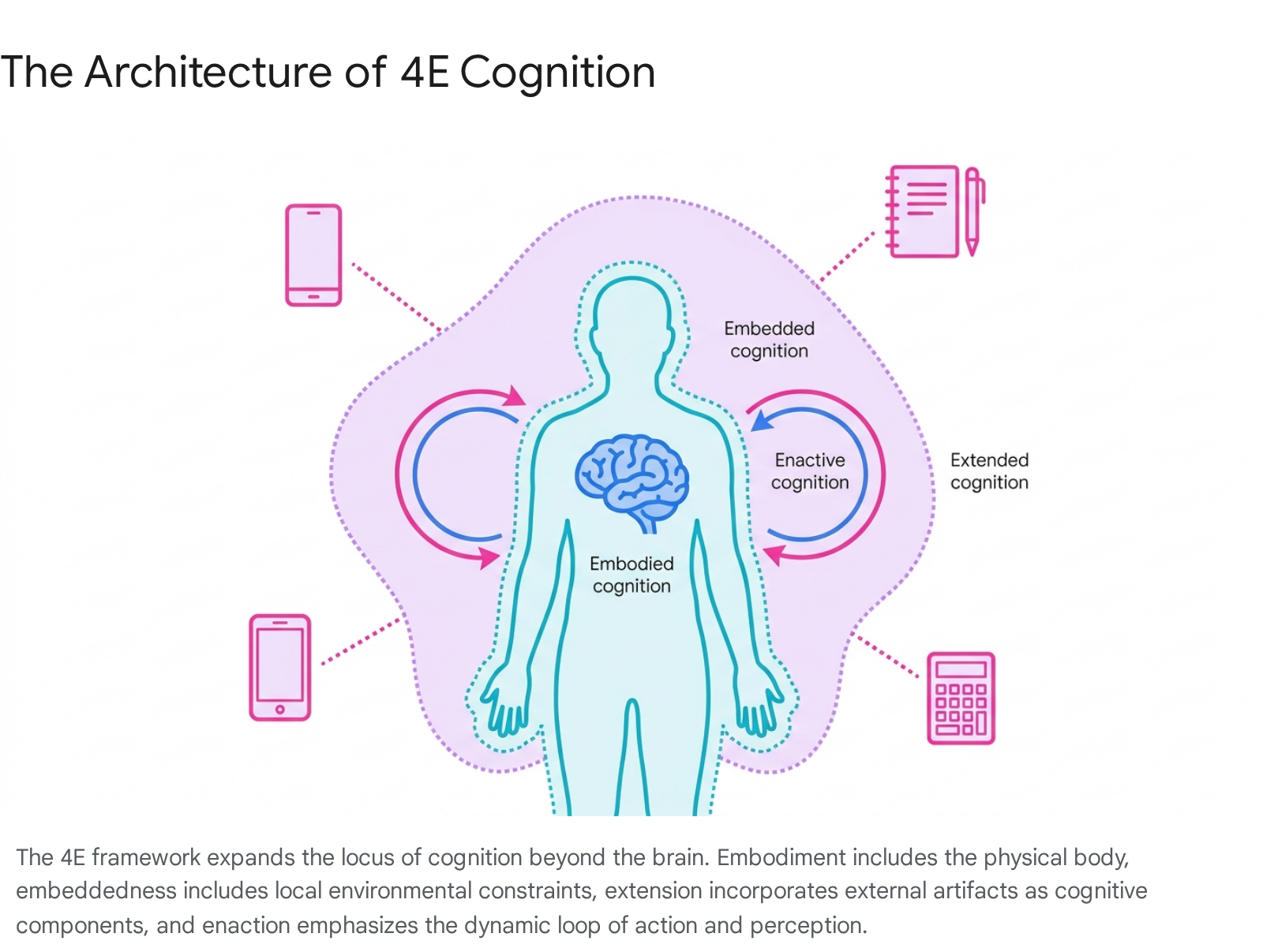
| Dimension | Core Premise | Relationship to Classical Cognitivism |
|---|---|---|
| Embodied Cognition | Cognition is fundamentally shaped, constrained, and informed by the anatomy, morphology, and sensorimotor capacities of the physical body 12. | Complements or replaces computationalism depending on the "radical" nature of the specific claim; rejects the brain-as-sole-processor metaphor. |
| Embedded Cognition | Cognitive processes depend heavily on the organism's surrounding environmental, situational, and structural contexts 12. | Maintains the internal mind/external world boundary, but emphasizes environmental offloading and situational constraints on cognitive load. |
| Extended Cognition | The boundaries of the mind physically encompass external artifacts, tools, and environments that serve as functional elements of cognition 1112. | Rejects the intracranial boundary of the mind; asserts that external devices (e.g., calculators, notebooks, language) are literal components of the cognitive system. |
| Enactive Cognition | Cognition is an active process of "sense-making" that arises through the dynamic, autonomous interactions between an organism and its environment 1112. | Radically rejects representationalism; views cognition not as processing passive inputs, but as bringing forth meaning through continuous, goal-directed physical action. |
Among the 4E approaches, enactivism is frequently viewed as the most radical departure from traditional cognitive science. Originating from the foundational work of Francisco Varela, Evan Thompson, and Eleanor Rosch, enactivism draws heavily upon cybernetics, theoretical biology, and the phenomenological tradition of Edmund Husserl and Maurice Merleau-Ponty 41213. Autopoietic enactivism posits that cognition is not fundamentally about constructing internal, symbolic representations of a pre-given, objective reality 1215. Instead, cognition is the process of "sense-making" that emerges from an autonomous biological organism's need to maintain its own organization (autopoiesis) in a precarious, unpredictable environment 12.
From a phenomenological and enactivist perspective, perception and action are intrinsically coupled mechanisms. An organism does not passively perceive its environment, halt to calculate a logical response, and then formulate an action. Rather, the organism perceives the world directly through its actions, achieving an "optimal grip" on its surroundings 4. This dynamic view emphasizes that knowledge is an ongoing, relational process of attunement between the agent and its ecological niche, fundamentally undermining the utility of static, symbolic mental models 415.
Neurobiological and Developmental Evidence
Empirical support for embodied cognition spans multiple disciplines, yet some of the most compelling foundational evidence emerges from cognitive neuroscience and developmental psychology. These fields demonstrate how purportedly abstract, high-level cognitive tasks rely heavily on the activation of primary sensory and motor cortices.
Classical models of language comprehension argue that understanding a word involves accessing a disembodied, abstract semantic network. Embodied theories of language, conversely, propose that understanding action-oriented words relies on "mental simulation" - the covert, subthreshold reactivation of the brain's sensorimotor pathways associated with physically performing the described action 27. The cognitive processing pathways of action language closely resemble those of actual motor execution.
Neuroimaging and behavioral studies involving the subthreshold processing of manipulative actions provide strong empirical evidence for this overlap. Research utilizing event-related potentials (ERPs) and functional magnetic resonance imaging demonstrates that when individuals process action verbs (e.g., "grasp," "kick," "lick"), the specific motor areas of the brain corresponding to the hand, foot, or mouth exhibit somatotopic activation 14. This localized activation suggests that the semantic processing of action language is deeply grounded in the motor system, validating the "two-action system theory," wherein the neural pathways utilized for recognizing actions overlap significantly with the pathways utilized for executing them 14. The cognitive act of comprehending language is thus physically entangled with motor execution networks.
From a developmental perspective, embodied cognition theorists posit that complex cognitive traits are directly scaffolded upon early bodily interactions with the physical world. Longitudinal research examining developmental pathways indicates that basic psychomotor functions in infancy - such as the ability to grasp, crawl, and coordinate bodily movement - are foundational prerequisites for the later emergence of higher-order cognitive, social, and self-regulatory skills 15.
Structural equation modeling using data from large, representative birth cohorts reveals robust prospective associations between infant gross motor and communicative functions at nine months of age and the development of stable personality meta-traits in late adolescence, specifically traits surrounding behavioral plasticity and stability 15. Reaching for objects or coordinating limbs requires attention, spatial awareness, and real-time problem-solving. Through these iterative, trial-and-error sensorimotor experiences, the developing brain lays down the neural architecture that later supports abstract reasoning. This indicates that human cognition is not separate from the sensory and motor systems, but actively emerges from them across the lifespan 1516.
The integration of bodily movement and cognitive function extends well into late adulthood. Meta-analyses investigating mind-body exercises (MBE) - such as yoga, tai chi, and qigong - reveal measurable improvements in cognitive domains for older adults. Specifically, regular engagement in MBE demonstrates moderate positive effects on visual-spatial construction (Hedges' g = 0.46) and smaller, yet significant, effects on verbal memory, processing speed, and executive function 17. Furthermore, these improvements are frequently more pronounced in participants diagnosed with mild cognitive impairment (MCI) compared to healthy controls, reinforcing the hypothesis that physical, sensorimotor engagement can actively modulate higher-order cognitive decline 17.
Mechanisms of Metaphor and Somatic Processing
Embodied cognition researchers have formulated specific hypotheses to explain the mechanical transition from physical bodily states into abstract thought and complex decision-making. Two of the most heavily scrutinized mechanisms in the contemporary literature are Conceptual Metaphor Theory and the Somatic Marker Hypothesis.
Conceptual Metaphor Theory
Formulated initially by linguist George Lakoff and philosopher Mark Johnson in the 1980s, Conceptual Metaphor Theory (CMT) asserts that human thought is fundamentally metaphorical, and that our conceptual systems are inextricably grounded in bodily experiences 1819. According to CMT, individuals understand abstract, complex conceptual domains (the target domain) by systematically mapping them onto familiar, concrete, and physically grounded domains (the source domain) 1920.
Evidence for this cognitive mapping is pervasive in human language. Affection and emotional proximity are consistently conceptualized as physical warmth ("she received a warm welcome" or "he was cold to her"); time is conceptualized in terms of spatial movement ("the deadline is approaching"); and interpersonal arguments are conceptualized as physical combat ("he attacked my position") 1820. CMT theorists argue that these expressions are not merely decorative linguistic ornaments, but rather structural features of cognition driven by pre-linguistic "image schemas" - mental patterns formed during early childhood from physical interactions with gravity, containment, balance, and locomotion 1820.
However, the empirical status of CMT in the context of neural processing remains complex and actively debated. While early theorists posited that metaphorical mapping was an automatic, effortless cognitive process functioning entirely in the background of thought, recent neurophysiological data challenges this assumption of cognitive ease. Event-related potential (ERP) studies measuring electrical brain activity during reading tasks show that metaphorical expressions require significantly greater cognitive-neural effort than literal paraphrases. Specifically, processing emotional metaphors elicits widespread N400 effects (indicating semantic processing load) and Late Positivity/Late Negativity waves compared to neutral, literal sentences 21. This suggests that while abstract concepts may be tethered to bodily metaphors, processing them actively recruits substantial semantic and emotional neural resources, contradicting the assumption of effortless, automatic simulation 1821.
Furthermore, comprehensive neuroimaging meta-analyses indicate that while highly concrete concepts heavily activate sensorimotor cortices, highly abstract concepts rely more significantly on linguistic, emotional, and social associations encoded in heteromodal neural systems 22. This has led to the consensus that a hybrid approach is likely necessary to solve the "scaling up" problem in cognitive science: concrete concepts emerge directly from sensorimotor interactions, whereas highly abstract concepts arise through an extended combination of metaphorical bodily projections and complex linguistic and cultural elaboration 22.
The Somatic Marker Hypothesis
In the realm of affective neuroscience and decision-making, Antonio Damasio's Somatic Marker Hypothesis (SMH) serves as a cornerstone of embodied cognitive theory. The SMH proposes that emotional processes, specifically visceral bodily sensations (somatic markers), strongly influence or bias human behavior and decision-making, particularly under conditions of high uncertainty and complexity 23.
Classical economic and psychological theories frequently modeled human decision-making as a purely rational endeavor devoid of emotion, operating solely on conscious cost-benefit calculations 23. The SMH contradicts this, arguing that when an individual faces a complex choice, the nervous system rapidly simulates the potential outcomes, triggering autonomic nervous system responses (e.g., changes in skin conductance, heart rate, endocrine release, or gastrointestinal activity) 232425. These physiological responses are processed in the ventromedial prefrontal cortex (vmPFC) and the amygdala, "marking" specific options as emotionally positive or negative before conscious logic can fully process the scenario 23. Damasio categorizes this mechanism into two distinct pathways: the "body loop" (where actual physiological changes occur in the periphery and are fed back to the brain) and the "as-if body loop" (where the brain simulates the expected bodily response without requiring actual peripheral activation) 2627.
The classic empirical test of the SMH is the Iowa Gambling Task (IGT), a psychological paradigm wherein participants must learn through trial and error to avoid disadvantageous card decks that yield high short-term rewards but massive long-term penalties 2325. Healthy participants routinely generate anticipatory skin conductance responses (SCRs) before selecting from a risky deck, guiding them toward safer choices even before they can consciously articulate the rules of the game 2527. Conversely, patients with localized damage to the vmPFC fail to generate these somatic markers; they continue making poor decisions and fail to demonstrate anticipatory physiological arousal, despite maintaining normal intellect and working memory 2325.
Despite its historical prominence, the SMH remains controversial and is frequently subjected to methodological critique. Critics argue that the task design of the IGT conflates emotional intuition with cognitive learning. Furthermore, researchers point out that the standard repeated-measures statistical methods traditionally used to evaluate the IGT may misrepresent the relationship between intra-individual SCR variations and risk-taking 28. Applying multilevel logistic models to disaggregate intra-individual and inter-individual variance has revealed that the relationship between physiological arousal and risk avoidance is highly context-dependent and varies significantly across the duration of the task 28.
Nonetheless, updated neurophysiological models of the SMH continue to find relevance by exploring specific anatomical pathways, such as the vagus nerve's role in afferent feedback. Current research focuses heavily on interoceptive awareness - the ability to perceive one's own internal bodily signals. Individuals with high interoceptive awareness demonstrate greater susceptibility to somatic markers, relying more effectively on bodily feedback to navigate complex, goal-directed behaviors compared to individuals with impaired interoception 26.
Methodological Challenges and the Replication Crisis
The transition of embodied cognition from a nuanced philosophical framework into mainstream experimental psychology has been fraught with structural difficulties. Over the past decade, a growing chasm has emerged between rigorous cognitive science and popularized "pop psychology" interpretations of embodiment 2930. Furthermore, several high-profile behavioral findings that purported to prove direct, unconscious links between superficial bodily states and abstract social judgments have collapsed under the weight of the psychological replication crisis.
Physical Warmth Priming
One of the most widely cited findings in the history of embodied social psychology was Williams and Bargh's 2008 study concerning physical warmth and interpersonal judgment. The researchers claimed that briefly holding a hot cup of coffee caused participants to judge a hypothetical target person as having a significantly "warmer" and more generous personality, compared to participants holding a cold beverage 3132. The theoretical justification posited that the physical experience of temperature activated a shared neural architecture for social warmth, bypassing conscious awareness entirely 31.
However, subsequent attempts to replicate this phenomenon in high-powered, pre-registered studies have overwhelmingly failed. The original experiment featured a highly localized sample (N=41) and barely statistically significant results with disproportionately large effect sizes 3233.
The data below summarizes the collapse of the physical warmth priming effect when subjected to rigorous replication standards 323334.
| Study | Sample Size (N) | Methodology | Reported Effect Size (r) | Conclusion |
|---|---|---|---|---|
| Williams & Bargh (2008) - Exp 1 | 41 | Single-blind, field setting | 0.31 | Physical warmth significantly increases perception of social warmth. |
| Williams & Bargh (2008) - Exp 2 | 53 | Single-blind, field setting | 0.28 | Physical warmth significantly increases prosocial behavior. |
| Chabris et al. Replication - Exp 1 | 128 | Double-blind, pre-registered | -0.03 | Failed to replicate; near-zero effect. |
| Chabris et al. Replication - Exp 2 | 177 | Double-blind, pre-registered | 0.02 | Failed to replicate; near-zero effect. |
As demonstrated, robust replications utilizing more than triple the sample size and strict double-blind procedures yielded near-zero effect sizes (r = -0.03 and r = 0.02) 323334. Furthermore, Bayesian analyses of these replication attempts reveal that there is substantially more statistical evidence for the null hypothesis (that physical warmth has no effect whatsoever on social judgment) than for the original priming hypothesis 3132. Similar failures occurred when researchers attempted to replicate findings that ambient room temperature or hot therapeutic pads increase prosocial behavior, leading to the conclusion that the initial findings were likely statistical anomalies or the result of uncontrolled experimental variables 3134.
Expansive Posture and Hormonal Claims
A parallel methodological controversy surrounds the concept of "power posing" - the theory that adopting expansive, open postures can rapidly increase testosterone, decrease cortisol, and trigger behavioral risk-taking 3538. Introduced by Carney, Cuddy, and Yap in a 2010 study published in Psychological Science, the concept quickly became a massive cultural phenomenon. It promised profound psychological and physiological shifts through brief, two-minute postural adjustments 3539.
Rigorous replication attempts, however, dismantled the most significant physiological claims underpinning the theory. A high-profile 2015 conceptual replication by Ranehill et al. utilizing a much larger sample size (N=200) and a balanced gender mix found absolute no evidence that power posing alters hormonal levels or changes behavioral risk-taking 3936.
A subsequent 2020 systematic review and meta-analysis encompassing 48 separate studies sought to clarify the conflicting literature. The meta-analysis concluded that while expansive postures do reliably increase subjective feelings of power and self-esteem, they do not produce consistent, measurable physiological or behavioral changes 38. The consensus in the scientific community has since shifted away from viewing posture as an immediate physiological intervention. Researchers now largely classify the original hormonal claims as severe overstatements, likely influenced by widespread methodological flaws of the era, such as p-hacking, small sample sizes, and publication bias 3837.
Theoretical Validity and Critiques
These highly public methodological controversies have led cynics to question the viability of embodied cognition as a legitimate scientific discipline. Hardline critics argue that "mild embodiment" theories are unacceptably vague, offering little predictive power beyond the trivially true observation that the body interacts with the environment 3038. Conversely, critics assert that "radical" embodiment theories are fundamentally nonsensical if taken to the extreme view that all abstract thought is strictly dependent on physical action 3038. Critics historically parallel this to Noam Chomsky's critique of B.F. Skinner's behaviorism, asserting that attributing all complex cognition to physical movement disguises a retreat from the rigorous mapping of internal representations that advanced classical cognitive psychology 38.
Defenders of the framework counter that the replication crisis primarily affects superficial "priming" studies in social psychology, rather than the core tenets of the 4E framework. When properly constrained, embodied cognition is not a singular, easily falsifiable task, but a broader philosophy of nature and an interdisciplinary research paradigm 1139. The failure of a participant to feel "warm" toward a stranger after holding a hot cup of coffee does not negate the robust neuroimaging data showing sensorimotor activation during language processing, nor does it invalidate the role of environmental coupling in human evolutionary development 1339. Scholars advocate for large-scale, pre-registered team science to systematically test well-defined embodied cognitive tasks, separating the rigorous neurobiological mechanisms from the popularized psychological life-hacks 39.
Global South and Non-Western Perspectives
While the formalized terminology of 4E cognition developed predominantly within Western academic institutions in the late 20th century, the foundational premise - that the mind, the body, and the environment form an indivisible, integrated whole - has deep historical roots in non-Western and Indigenous philosophies 404142. Incorporating these perspectives is increasingly viewed by scholars as vital to decolonizing cognitive science and improving the ecological validity of the embodied paradigm.
African Philosophy of Mind and Communitarian Personhood
African philosophical discourse presents a highly sophisticated model of consciousness that historically rejects the Cartesian dualism endemic to Western thought. In traditional African frameworks, such as Bantu and Yoruba philosophy, consciousness is not viewed as an isolated property emerging from complex neural arrangements within an individual brain. Instead, it is conceptualized as a dynamic, relational force - often referred to in scholarship as élan vital or vital force 41.
This ontological framework yields the concept of "communitarian personhood." Prominent African philosophers outline a distinct trajectory for human cognition and identity that requires physical and social embodiment.
| Philosopher | Core Philosophical Contribution to Personhood | Embodied / Relational Implication |
|---|---|---|
| John Mbiti | Personhood is not inherent at birth but requires rites of passage and integration into communal life ("I am because we are"). | Identity is an active, physical achievement requiring interaction, rather than an isolated mental state 43. |
| Ifeanyi Menkiti | Personhood is an "ontological progression" toward moral maturity shaped by communal norms and responsibilities. | The mind develops through adherence to physical and social practices; failure to engage reduces personhood 43. |
| Kwame Gyekye | Acknowledges an inherent baseline of personhood, but argues it is augmented and refined through communal practices. | Rejects exclusionary views of personhood, allowing for a foundation that is still expanded by social embodiment 43. |
| Kwasi Wiredu | Introduces a dialectical model where personhood is socially conferred through language, ethics, and reciprocity. | Personhood is vulnerable to loss through moral failure, requiring communal, physical restoration 43. |
This African communitarian perspective encapsulates an embedded and enactive view of the mind, where personal identity arises solely through physical and spiritual interconnectedness with human, non-human, and environmental reality 4143. Furthermore, indigenous knowledge systems provide alternative models for behavioral neuroscience. The literary works of Nigerian author Amos Tutuola, which integrate physical transformation and deeply contextualized environmental interactions, are analyzed by scholars not merely as folklore, but as culturally grounded cognitive archives 44. These narratives model adaptive strategies for navigating uncertain environments, aligning closely with contemporary enactive principles regarding how culture physically shapes neural and behavioral regulation 44.
Indigenous Sensory Knowledge and Latin American Enactivism
Similarly, Indigenous Australian epistemology, such as Dharug sensory knowledge, radically decentralizes the brain as the sole seat of cognition. This perspective emphasizes that cognition originates from the continual interplay between external senses (sight, touch, smell) and internal senses (body thinking, spiritual connection) 40. Unlike Western learning paradigms that prioritize abstract concepts, Indigenous learning emphasizes direct experience, sensory immersion, and the holistic integration of body, mind, and place, treating the physical body as the primary vessel of knowing 40.
In Latin America, the principles of enactivism and embodiment have been operationalized within sociology, political science, and digital activism. Researchers observing youth digital activism in Brazil and Portugal note that social media influencers utilize their physical bodies - displaying vulnerability, historical oppression, and resistance - as primary tools of political mobilization 45. In this context, connective engagement is anchored heavily in affectivity and embodiment; the physical body, marginalized by hegemonic structures, is projected into the digital space to perform embodied resistance 45.
Furthermore, Latin American feminist pracademics (scholars bridging academia and activism) leverage embodied knowledge to transform institutional teaching and research approaches. By recognizing fieldwork as a fundamentally embodied and sensory practice, researchers incorporate sensory methodologies and excursions into education 4647. These scholarly movements highlight that the body's role in cognition extends deeply into the realms of political action, systemic socio-cultural structures, and pedagogy, proving that cognitive processes cannot be untangled from the physical realities of race, gender, and geography 47.
Artificial Intelligence and Critical Analysis
As cognitive science accelerates into the mid-2020s, the theoretical principles of embodied cognition are increasingly colliding with the development of Artificial Intelligence (AI). The traditional pursuit of Artificial General Intelligence (AGI) relied almost entirely on disembodied Large Language Models (LLMs) that process text purely as statistical correlations. However, researchers now broadly recognize that achieving true, human-like reasoning requires physical grounding. The rapidly emerging field of Embodied AI focuses on integrating Multi-modal Large Models (MLMs) and World Models (WMs) into physical robotic agents 4853.
These embodied agents rely on real-time simulators and Vision-Language-Action (VLA) models to perceive visual environments, execute physical interactions, and adapt from simulated physics to real-world physics 485455. If an AI system cannot physically interact with an environment to experience friction, gravity, affordances, and the physical consequences of its actions, its "understanding" of language and logic remains fundamentally ungrounded. This mirrors the exact critique that embodied cognition theorists levied against classical computational psychology decades ago: without a body to interact with the world, symbols lack inherent meaning 4950.
Simultaneously, the 4E framework is undergoing a necessary "critical turn" within philosophy. Early 4E research optimized for the evolutionary benefits of agent-environment interactions, focusing on how extending the mind through tools made humanity smarter. However, "Critical 4E Cognitive Science" applies a normative lens to examine the severe downsides of our embeddedness in the modern era 10. This includes prudential critiques, which examine how engineered digital environments and algorithms manipulate our cognitive processes against our own interests, and political critiques, which analyze how specific physical and digital architectures shape cognition to reinforce unjust social forces and systemic biases 10. By understanding cognition as highly porous to the environment, Critical 4E researchers recognize that whoever controls the environment ultimately exerts control over the extended mind.
Conclusion
Embodied cognition represents a necessary, albeit highly complex, recalibration of how science and philosophy understand the mind. By rejecting the classical metaphor of the brain as an isolated, disembodied computer, the embodied and 4E paradigms have successfully integrated the physical morphology of the organism, the affordances of the environment, and the dynamic loop of action and perception into the fundamental definition of thought.
While the field has suffered reputational damage due to the methodological failures of specific, sensationalized social psychology experiments - such as physical warmth priming and expansive power posing - the core neurobiological evidence remains highly robust. The sensorimotor involvement in action language processing, the developmental links between psychomotor action and long-term personality traits, and the absolute necessity of embodiment in advanced AI systems demonstrate that cognition cannot be divorced from physical execution.
Furthermore, the alignment of the embodied framework with global, non-Western philosophical traditions underscores the universal intuition that human minds are inextricably bound to human flesh. Ultimately, the body is not merely a peripheral vehicle for a commanding mind; it is the fundamental mechanism through which the mind comprehends, interacts with, and brings meaning to the world.