
Does Multitasking Actually Work
The human brain is neurologically incapable of processing two cognitively demanding streams of information simultaneously. What we perceive as multitasking is actually rapid task-switching, a highly inefficient biological juggling act that significantly increases error rates, depletes working memory, and can reduce overall productivity by up to 40%. The scientific consensus confirms that focused single-tasking is the only sustainable way to perform complex cognitive work without incurring severe neurological and economic penalties.
Picture this scenario: You are sitting in a virtual project update meeting, politely nodding at the screen, while simultaneously drafting an urgent email to a client on your second monitor. You feel highly efficient, seamlessly navigating the interconnected demands of the modern workplace. You hit "send" just as the meeting concludes, satisfied that you have conquered two objectives in the time allotted for one. However, empirical evidence from cognitive psychology and neuroscience paints a vastly different picture of this interaction. When you review that email later, you might notice a missing word or a slightly disjointed tone. More importantly, if asked to recall the nuanced details of the video meeting, your memory will likely be fragmented. We live in an era that celebrates the juggler, where job descriptions universally demand the ability to "wear many hats" and modern work environments actively encourage constant digital availability. Yet, over two decades of rigorous scientific research demonstrate that our pursuit of parallel processing is fundamentally incompatible with the biological architecture of the human brain.
This report comprehensively analyzes the extensive body of research surrounding multitasking, from foundational cognitive psychology to the latest 2024 and 2025 studies on digital distractions, remote work cognitive load, and cross-cultural media habits. By dissecting what actually happens inside the brain when we attempt to do it all, we can adopt evidence-based strategies to protect our cognitive health and optimize sustainable productivity.
Clarifying the Terms: The Myth of True Multitasking
To understand the science of divided attention, it is necessary to first clarify our terminology and debunk the pervasive myth of "true" multitasking. The term "multitask" was not originally applied to human beings; it first appeared in a 1965 IBM paper describing the capabilities of their S/360 mainframe computers to process multiple tasks concurrently 1. Over time, this computer science terminology was co-opted into everyday language to describe human behavior. But whether applied to machines or human brains, the colloquial understanding of the term is a profound misnomer.
Even a standard computer processor does not truly process multiple complex commands at the exact same millisecond. Instead, a processor divvies up each clock cycle and apportion a microscopic slice of time - such as 200 milliseconds - to each task, rapidly toggling between them in a loop until everything is complete 2. The inherent inefficiency of having to split up processor time is precisely why a computer bogs down the more simultaneous applications you ask it to run 2.
The human brain operates in much the same way, though with significantly less bandwidth. The human brain operates at a ridiculously slow speed of about 120 bits (approximately 15 bytes) per second 3. Listening to just one person speak consumes about 60 bits per second, utilizing half of our available cognitive bandwidth 3. Consequently, attempting to follow two people speaking at once, or reading an email while listening to a meeting, quickly maxes out our fixed operating capacity 3.
The brain's prefrontal cortex - the region responsible for higher-level executive functions like planning, concentration, and decision-making - cannot fully focus on multiple complex tasks at once 4. When confronted with simultaneous cognitive demands, the brain does not process them in parallel. Instead, it engages in rapid task-switching 456. Task-switching is a complex process that requires the brain to disengage from one set of rules, reconfigure its cognitive resources, and re-engage with another 78. This biological toggling relies on several major brain areas working in tandem. The prefrontal cortex manages the actual attention shift and the selection of the task, while the posterior parietal lobe is engaged to understand the rules of the new task 9. The anterior cingulate gyrus is activated for error recognition and monitoring, and the putamen acts as a coordinator, helping the brain smoothly transition from one task to another to ensure actions remain as efficient as possible during the switch 910. Furthermore, the Frontoparietal Network (FPN) plays a significant role in maintaining focus and dividing attention, helping prioritize focus to prevent the system from becoming completely overwhelmed 10.
Every single switch carries a hidden tax on speed, accuracy, and mental energy, commonly referred to as the "switch cost" 467.
Categorizing the Attention Deficit
Not all forms of divided attention exert the same toll on the brain. Researchers generally categorize multitasking behaviors into three distinct modalities, each carrying specific cognitive costs.
Concurrent multitasking, or dual-tasking, occurs when an individual attempts to perform two tasks at the exact same time 14. True concurrent multitasking is only biologically possible if the tasks utilize entirely different neural pathways - for instance, a highly automated physical action like walking combined with a cognitive task like listening to a podcast 95. Habitual motor tasks do not share the same neural substrates as goal-directed cognitive tasks, allowing them to run concurrently without massive interference 9. However, attempting to perform two cognitively demanding tasks simultaneously results in immediate and severe performance degradation 513.
Rapid task-switching is the most common form of workplace multitasking. It involves moving sequentially from one task to another in rapid succession - such as writing a line of code, checking a messaging platform, and returning to the code 54. Each transition forces the brain through a reorientation phase that drains mental energy and introduces delays.
Continuous partial attention is a state of constant, low-level vigilance where an individual maintains a superficial awareness of multiple information streams without dedicating deep focus to any of them 14. Common in the digital age, this manifests as keeping multiple browser tabs open, leaving email alerts on, and intermittently glancing at a smartphone 14. Unlike rapid task-switching, which is often goal-oriented, continuous partial attention is driven by a desire not to miss anything, leading to a state of chronic cognitive strain and an inability to encode deep, long-term memories 1415.
The following table synthesizes the distinctions between these paradigms and their associated empirical costs.
| Paradigm | Description | Neurological Mechanism | Empirical Cognitive Cost | Real-World Example |
|---|---|---|---|---|
| Concurrent Multitasking | Attempting two tasks simultaneously. | Overloads working memory and prefrontal cortex bandwidth. | 50% increase in error rates; effective IQ temporarily drops by 10 points. | Reading an analytical report while actively participating in a conference call. |
| Rapid Task-Switching | Toggling attention quickly between different tasks. | Requires sequential goal-shifting and rule-activation. | Up to 40% productive time loss due to "switch costs"; mental fatigue. | Pausing data entry to reply to a text, then returning to the spreadsheet. |
| Continuous Partial Attention | Maintaining superficial awareness across multiple inputs. | Chronic activation of the stress response; divided frontoparietal network. | Diminished sustained attention; shallow information processing; structural brain changes. | Leaving an inbox open on a second monitor while working on a primary document. |
Is Being a Good Multitasker a Myth?
Despite the overwhelming laboratory data, surveys consistently show that a vast majority of professionals believe they are effective multitaskers 7. This disconnect between perception and reality is one of the most troubling aspects of the multitasking phenomenon 7. The neurological illusion of productivity often masks a severe degradation in cognitive performance, leading individuals to continually engage in behaviors that actively undermine their output.
The Foundational Mechanics of Switch Costs
The empirical dismantling of the multitasking myth began in earnest with foundational research conducted by cognitive psychologists Joshua Rubinstein, Jeffrey Evans, and David Meyer in 2001 416176. Through a series of experiments involving over 100 participants, individuals were asked to alternate between classifying geometric objects and solving math problems under varying conditions 846.
The researchers established that the brain's executive control processes handle task-switching in two distinct, complementary stages 416. The first stage is "goal shifting," which represents the conscious or subconscious decision to do one thing instead of another. In this stage, the brain adds and deletes goals from its working memory so other components of the cognitive system know what the current task is 416. The second stage is "rule activation," triggered by a pause between goal shifting and response selection. This stage disables the cognitive rules for the previous task and turns on the rules for the new one 416.
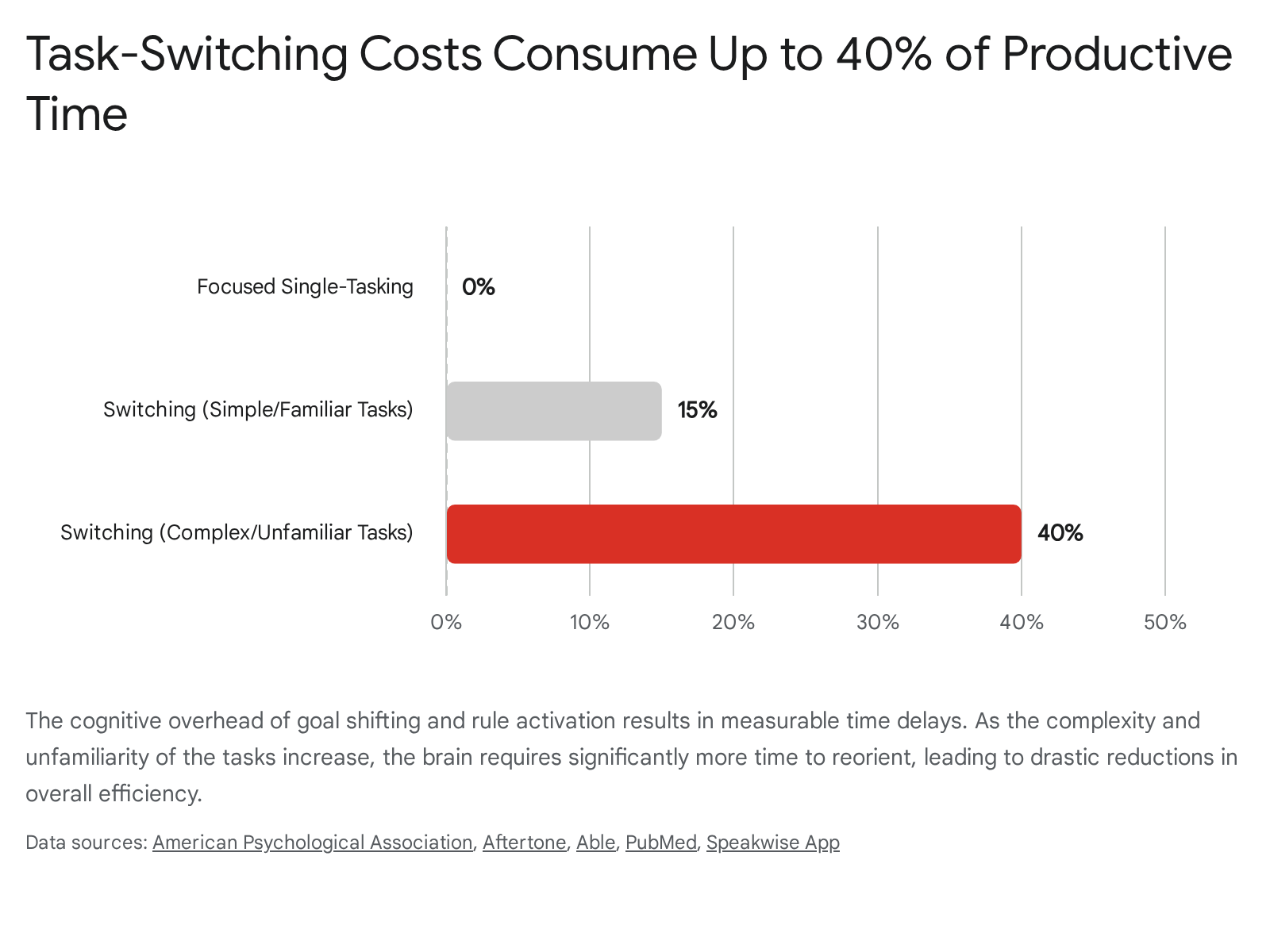
Rubinstein, Meyer, and Evans found that for all tasks, participants lost time when they had to switch 46. More critically, the time costs scaled dramatically with task complexity. As the tasks became more complex or less familiar, the brain required significantly more time for rule activation 746. When visual cues indicating which task to perform were removed, the switching costs rose even further 7. While an individual switch might only take a few tenths of a second, these micro-penalties accumulate massively across a workday. Meyer estimated that the mental blocks created by shifting between tasks can cost as much as 40% of an individual's productive time 841617.
Furthermore, task-switching leaves behind "attention residue." When you switch from one task to another, the brain does not instantaneously sever its connection to the previous task. A portion of cognitive capacity remains lingering on the prior activity, severely impairing performance on the new one 819. This carry-over effect means that even if you prepare for a switch, you are still operating with a compromised working memory 419. According to Cal Newport, a computer science professor at Georgetown University, even minor context switching is "productivity poison." Simply looking at an email inbox for 15 seconds initiates a cascade of cognitive changes that disrupt deep thought long after the inbox is closed 2.
The Media Multitasking Paradox
If humans are inherently poor at divided attention, a logical assumption might be that individuals who practice it constantly - such as "heavy media multitaskers" who routinely consume multiple streams of digital content - would eventually train their brains to become more efficient at the process. In a landmark 2009 study, researchers Eyal Ophir, Clifford Nass, and Anthony Wagner at Stanford University tested exactly this hypothesis 7822910.
The researchers developed a trait Media Multitasking Index (MMI) to categorize participants as Heavy Media Multitaskers (HMMs) or Light Media Multitaskers (LMMs) 71011. They theorized that the heavy multitaskers would exhibit superior cognitive control, perhaps possessing a heightened ability to filter out distractions, store information, or rapidly organize inputs 8.
The empirical results were entirely counterintuitive. The heavy media multitaskers performed worse across nearly every established dimension of cognitive control 7810. During tests requiring participants to filter environmental distractions - such as identifying red rectangles while ignoring surrounding blue rectangles - HMMs were unable to ignore the irrelevant stimuli, whereas LMMs processed the relevant information seamlessly 811. As researcher Clifford Nass bluntly summarized, heavy multitaskers are "suckers for irrelevancy" 28.
When tested on working memory management, which required participants to remember sequences of alphabetical letters, HMMs performed increasingly worse as the test progressed. They struggled to keep the information sorted in their brains and could not filter out interference from irrelevant representations in memory 7811. Most surprisingly, heavy media multitaskers were actually worse at task-switching than light multitaskers 711. When asked to switch between classifying numbers as even/odd and letters as vowels/consonants, HMMs exhibited larger switch costs and slower response times because they could not help thinking about the task they were not actively doing 811.
The Stanford research concluded that chronic media multitasking is associated with a "breadth-biased" approach to information processing 11. Rather than developing a robust top-down attention filter, chronic multitaskers develop a reliance on exogenous, bottom-up attentional control. Their attention is easily hijacked by whatever new stimulus appears in their environment 1011. The people who multitask the most frequently are demonstrably the worst at it 7. Neuroscientists have even found structural differences in the brains of heavy multitaskers, including reduced gray-matter density in the anterior cingulate cortex, a region critical for cognitive and emotional control 67.
Recent research continues to refine these findings. A 2025 study by the Department of Psychology at Lingnan University in Hong Kong explored the specific cognitive mechanisms utilized across different multitasking paradigms 12. Testing concurrent multitasking, rapid task-switching, and complex multitasking (monitoring multiple data sources under pressure), the researchers found that multitasking is not a singular skill, but a composite of distinct cognitive abilities 12. While all multitasking relies on baseline processing speed and response inhibition, complex multitasking heavily taxes unique skills like working memory capacity to integrate multiple streams of changing information 12. The study noted a minor gender difference, with males scoring slightly higher in the general multitasking ability underlying the paradigms, though no significant gender differences were observed in the abilities specific to concurrent or complex multitasking 12.
Are Some People Actually Supertaskers?
While the vast majority of the population suffers severe cognitive degradation when attempting concurrent tasks, research has identified a microscopic statistical outlier. In 2010, psychologists Jason Watson and David Strayer from the University of Utah investigated cognitive bottlenecks using a high-fidelity driving simulator 13142915.
A cohort of 200 undergraduate participants was asked to perform a simulated freeway driving task while simultaneously completing a demanding auditory version of the Operation Span (OSPAN) task, which required them to memorize words and solve complex math problems over a hands-free cell phone 131415.
For 97.5% of the participants, the results aligned perfectly with established cognitive theory 131415. When forced to dual-task, their performance plummeted to a level comparable to the impairment seen in legally intoxicated drivers 15. The majority took 20% longer to hit the brakes, their following distances behind a pace car stretched out by 30%, their memory performance declined by 11%, and their math accuracy fell by 3% 1315.
However, Watson and Strayer discovered that exactly 2.5% of their sample - just five individuals - exhibited absolutely no performance decrements in either the driving or the cognitive tasks when combining them 11415. In some instances, the memory abilities of these individuals actually improved by 3% under dual-task conditions 1315. Furthermore, these individuals scored in the top quartile on single-task baseline measurements as well 114.
These individuals were classified as "supertaskers" 114. Rigorous Monte Carlo simulations confirmed that their existence was not a statistical fluke, fundamentally challenging the rigid "response-selection bottleneck" theory that posited an immutable, universal cap on human parallel processing 11429. Neurological investigations suggest that the brains of supertaskers function differently, perhaps recruiting distinct functional networks or utilizing a more flexible allocation of resources in the prefrontal cortex, allowing them to process information without the standard sensory interference 11315.
Despite this fascinating discovery, the scientific consensus remains a stark warning for the general public. As Watson noted, the odds of being a genuine supertasker are roughly equivalent to flipping a coin and getting heads five times in a row 15. For the 97.5% of the population who are not supertaskers, attempting to mimic this behavior - especially in high-stakes environments like driving or complex knowledge work - is a profound cognitive risk 72915.
The Modern Toll: Cognitive Load in Remote and Hybrid Work Environments
The transition to remote and hybrid work environments has exacerbated the multitasking epidemic. Without the physical boundaries of an office or the social constraints of in-person meetings, the temptation to divide one's attention has skyrocketed 31331. Recent studies highlight exactly how remote work environments manipulate our cognitive load, drive digital exhaustion, and degrade performance.
The Illusion of Video Call Efficiency
During online meetings, employees frequently attempt to clear their inboxes, edit documents, or monitor instant messaging platforms. A 2024 study published in Computers in Human Behavior Reports investigated this exact scenario, asking participants to follow a video meeting and take notes, while half were given a secondary task of correcting an urgent text 13.
The results starkly validated cognitive load theory: the multitaskers performed significantly worse across the board 13. Their notes were less complete, and they missed far more errors in the text 13. The brain cannot solve the problem of competing language processing and working memory demands by magically becoming "more efficient" 13. Strikingly, despite their objectively poorer performance, the multitaskers did not rate their own performance any lower than the control group, showcasing the enduring disconnect between perceived and actual productivity 13.
Furthermore, the study revealed that multitasking is a primary driver of what is colloquially known as "Zoom fatigue" 313. Participants who multitasked experienced significantly higher levels of general, motivational, emotional, and social fatigue compared to those who single-tasked 13. Video meetings inherently require higher cognitive effort to parse digital audio packets, read compressed facial expressions, and manage the mental strain of looking at an array of participants 332. Adding the switch costs of multitasking on top of this fragile baseline turns remote meetings into a structural stressor that drains mental energy rapidly 13.
Research also highlights the impact of "mirror anxiety," the cognitive burden of constantly monitoring one's own appearance on screen 332. Early survey data suggested women felt disproportionately fatigued by this compared to men (14% vs 6%) 3. However, subsequent biometric studies utilizing EEG brain wave patterns revealed that both men and women experience significant and equal mental exhaustion when their own image is visible on screen, as this self-monitoring forces the brain to split its attention, diverting critical resources away from the meeting itself 32.
Mental Underload vs. Mental Overload
The relationship between virtual meetings and fatigue is highly nuanced. A 2023 study from Aalto University monitored the heart rate variability of 44 knowledge workers across nearly 400 virtual and face-to-face meetings 5. The researchers found that sleepiness during virtual meetings is often linked to mental underload and boredom, particularly among employees who are disengaged or less passionate about their work 5. Highly engaged workers, conversely, remained active and alert during virtual sessions 5.
To combat the underload of a boring meeting, employees often turn to multitasking to stimulate their brains. However, if the secondary task requires cognitive attention, the brain rapidly swings into a state of mental overload due to the continuous switching tax 5. The researchers noted that the only form of multitasking that successfully boosted energy without compromising auditory attention was pairing the meeting with a highly automated physical activity, such as walking 5. Walking engages separate motor networks, allowing the prefrontal cortex to remain focused on the meeting's content 5.
The Economic Cost of the Juggle
In the aggregate, the financial and temporal costs of digital task-switching are catastrophic. A 2023 study by the Workplace Research Foundation revealed that the average office worker switches tasks or contexts more than 300 times per day 731. Workers utilize approximately 10 different applications daily, switching between them roughly 25 times 7. Each switch forces the brain to reload context, recall where it left off, and re-engage with a fundamentally different type of cognitive demand 7.
At 300 switches per day, even if each switch incurs a modest 30-second cognitive overhead, the accumulated daily loss exceeds two and a half hours of productive time per employee 7. Globally, organizational multitasking - the practice of assigning employees to multiple concurrent projects and expecting rapid context switching - is estimated by consultancy Realization to cost the global economy $450 billion annually 73133. These losses stem from extended project timelines, increased rework due to a 50% spike in error rates, and the profound cognitive overhead of constant reorientation 733. The physiological toll is equally severe; researchers estimate that chronic multitasking can temporarily lower effective IQ by 10 points, a cognitive impairment more severe than losing a full night of sleep 7.
Do Cultural Differences Influence Multitasking Habits?
While the biological architecture of the human brain is universal, the behavioral manifestations of multitasking are heavily influenced by cultural norms, educational environments, and business etiquette. Recent geographic studies demonstrate how digital multitasking habits diverge and converge across borders.
Educational Contexts and Mobile Dependence
In academic settings globally, habitual smartphone use has become the primary driver of digital multitasking, leading to increased extraneous cognitive load and diminished academic performance 16173618. A 2023 cross-national analysis noted that universities in France, the United States, and Australia have struggled with the impact of mobile phone dependence in classrooms 16. Students with higher levels of mobile phone dependence are more likely to engage in non-study-related digital multitasking and are significantly more resistant to institutional policies restricting phone use 16.
Cognitive Load Theory - which categorizes working memory demands into intrinsic (task difficulty), extraneous (distractions), and germane (processing resources) - provides a framework for understanding these behaviors 173619. Studies in Asian contexts emphasize a fascinating nuance: academically relevant media multitasking, such as looking up a supplementary concept while watching a lecture, can actually enhance processing efficiency by reallocating resources toward germane cognitive load and promoting a "flow" state 1719. However, even goal-oriented searching can induce extraneous load through interface switching 17. Conversely, irrelevant multitasking, like checking social media, universally increases extraneous load, breaking concentration and impairing learning outcomes 161736.
Cultural Views on Time and Business Etiquette
Cross-cultural comparative studies also reveal differing societal tolerances for multitasking behavior. A study comparing American and Malaysian college students found that Malaysians reported higher frequencies of overall electronic media use and multitasking while studying, though in both cohorts, social networking use was strongly correlated with distractibility and impulsiveness 39.
In the business world, the dichotomy between European and Asian commercial cultures heavily influences how multitasking and focus are perceived and managed 404142. Western and Northern European business cultures tend to be highly individualistic, task-oriented, and bound by a linear approach to time 4142. Punctuality, structured agendas, and single-task focus during meetings are heavily prioritized to maximize efficiency and respect deadlines 4042. Communication in these regions is typically direct, prioritizing clarity over nuance 42.
Conversely, many Asian business cultures operate on a more fluid, polychronic view of time, where relationship-building (guanxi in China, nemawashi in Japan) takes precedence over strict adherence to sequential scheduling 4042. Communication relies heavily on high-context, non-verbal cues and implicit messages to maintain harmony 404220. While this fluid approach can accommodate a broader, more interconnected style of negotiation that naturally involves tracking multiple contextual threads, the underlying biological cognitive limitations remain identical. A human brain attempting to process a complex financial spreadsheet while actively decoding high-context negotiation cues will incur the exact same neurological switch costs regardless of cultural upbringing 15.
Can You Train Your Brain to Multitask?
Given the profound limitations of human attention, a central question in cognitive neuroscience is whether neuroplasticity can be leveraged to improve multitasking performance. If an individual practices juggling tasks, do they eventually drop fewer balls?
The evidence suggests that targeted brain training can lead to specific improvements, but the underlying mechanisms and the generalizability of these skills are highly debated and require calibrated uncertainty 212223.
The Mechanisms of Cognitive Training
When individuals are repeatedly trained on two specific concurrent tasks, their performance metrics reliably improve over time 2122. For years, scientists debated how the brain achieved this. In a pivotal brain-imaging study involving 100 participants, researchers Paul Dux and Kelly Garner from the University of Queensland sought to uncover the neural mechanisms of multitasking adaptation 22.
They discovered that training does not bypass the bottleneck of the prefrontal cortex. Instead, the brain employs a "divide-and-conquer" strategy 22. The training increased the distinctiveness of the neural representations for the component tasks 22. By separating the neural responses in the frontoparietal lobe and subcortex, the brain reduced direct competition for neural resources, making it better at processing each specific task separately but in rapid sequence 22. Other analyses of brain training suggest that extensive practice simply increases the speed of information processing within the posterior prefrontal cortex, allowing the two stages of task-switching (goal shifting and rule activation) to occur in much faster succession, thereby minimizing the switch cost delay 21.
More recently, a 2025 clinical trial conducted by McGill University found that specialized high-speed cognitive training games could induce a 2.3% upregulation of acetylcholine - a critical neurotransmitter essential for focus, alertness, and maintaining brain plasticity 47. This chemical alteration suggests that certain forms of intense cognitive training can have a systemic impact on the brain's ability to sustain attention and delay age-related cognitive decline 47. Furthermore, meta-analyses from 2024 and 2025 demonstrate that dual-task training (combining a physical exercise with a cognitive task) significantly improves cognitive flexibility and working memory in stroke survivors, providing a vital therapeutic avenue for neurorehabilitation 232425.
The Limits of Transferability
While the data on task-specific improvement is robust, the scientific community expresses significant calibrated uncertainty regarding "far transfer" - the idea that training your brain on a specific set of multitasking games will make you a better multitasker in real-world, generalized settings 2247.
As Dux noted, getting faster at alternating between a specific shape-recognition game and a sound-recognition game in a laboratory does not inherently mean you will be better at managing your email while talking on a Zoom call 22. The brain optimizes for the specific neural circuits being taxed. Therefore, while targeted brain training and commercial applications show promise in specialized, high-stakes environments - such as training military personnel, elite athletes, or air-traffic controllers who perform highly predictable, repetitive dual-tasks - the average knowledge worker is unlikely to eliminate their innate cognitive bottleneck through an app 224750.
Practical Strategies for Minimizing Switching Costs
Since the vast majority of the population cannot fundamentally alter their neurobiology to become supertaskers, the most effective intervention for increasing productivity and reducing cognitive fatigue is modifying our interaction with our environment. By aligning our work habits with the brain's natural limitations, we can mitigate the hidden tax of task-switching 431.
The following evidence-based strategies are recommended by organizational psychologists and cognitive scientists to protect executive control and optimize output:
1. Task Batching and Context Clustering
Because the "rule activation" stage of task-switching consumes the most time and energy when tasks are complex and dissimilar, grouping identical tasks together entirely bypasses this cognitive hurdle 4163126. Context clustering involves dedicating specific blocks of time to similar cognitive demands 161926. For example, instead of answering emails intermittently throughout the day (which forces the brain to constantly shift context from deep work to communication), a worker should batch all correspondence into a single time block at the end of the day 1619. This keeps the brain operating under a single set of rules for an extended period, eliminating hundreds of micro-switch costs 193126.
2. Implementation of Deep Work and Time Blocking
Techniques like the Pomodoro method (working in focused 25-minute intervals followed by short breaks) leverage the brain's capacity for sustained attention 1931. By strictly allocating time periods to a single goal and deliberately utilizing the Pareto principle (the 80-20 rule) to focus energy on the most impactful tasks, individuals reduce the anxiety and cognitive fragmentation of the "continuous partial attention" state 141631.
3. Digital Defenses and Tab Audits
The modern digital environment is actively hostile to single-tasking. Mitigating distractions requires proactive environmental design 1631. * Tab Audits: Closing every browser tab once a day and reopening only what is strictly necessary for the next task. This visual reset acts as a psychological cue that primes the brain for intentional focus and reduces the extraneous cognitive load of seeing unrelated information 26. * Notification Silencing: Disabling social media, email, and chat notifications during deep work blocks to prevent the exogenous, bottom-up hijacking of the attention system 10161931.
4. Strategic Pauses to Clear Attention Residue
When a switch is unavoidable, attempting to immediately jump into a new complex task guarantees failure due to attention residue 8. Taking a "strategic pause" - even just 60 seconds to write down a mental bookmark of where you left off on the previous task - allows the brain to officially offload the goals of the prior task from working memory, making it significantly easier to fully engage the rules of the new task 101926.
5. Managing Remote Meeting Hygiene
Given the compounding cognitive load of video meetings, organizations must establish "IT mindfulness" 1332. This includes normalizing shorter meetings, setting clear agendas, and creating explicit cultural expectations that attendees are not required to monitor peripheral communication channels (like email) while on a call 1332. Furthermore, allowing workers to adjust elements like audio-only options can reduce the mirror anxiety and visual exhaustion associated with prolonged on-camera time, freeing up cognitive bandwidth for actual comprehension 32.
Bottom line
The scientific consensus on multitasking is definitive: the human brain is not built for the parallel processing of complex information. What we commonly refer to as multitasking is actually rapid task-switching, a biologically expensive process that leverages the prefrontal cortex to constantly shuffle goals and activate new rules 44166.
This continuous cognitive friction results in a measurable, drastic degradation of performance. Chronic task-switchers suffer from impaired working memory, slower completion times, and a heightened susceptibility to irrelevant distractions 5791011. In the modern digital landscape - characterized by remote video meetings, dual-screening, and an endless stream of notifications - this phenomenon manifests as severe mental fatigue, heightened stress, and hundreds of billions of dollars in lost global productivity annually 75133133.
While a microscopic fraction of the population possesses the unique neurological architecture of "supertaskers," and targeted brain training can marginally improve specific dual-task efficiencies under controlled conditions, the 97.5% majority cannot override their biological limits 131522. To thrive in an economy of endless distraction, we must abandon the illusion of the ultimate juggler. True productivity, accuracy, and long-term cognitive health are not achieved by doing more things at once, but by fiercely protecting our biological capacity to focus deeply on one thing at a time 641931.