
Effects of artificial deadlines on productivity
The modern knowledge economy is characterized by a relentless acceleration of information flow, task fragmentation, and a pervasive culture of immediacy. Within this environment, individuals and organizations frequently deploy artificial deadlines and self-imposed urgency as mechanisms to enforce focus, combat procrastination, and drive productivity 123. However, the psychological, behavioral, and neurobiological consequences of chronic, engineered urgency reveal a highly complex dichotomy. While structured time constraints can successfully harness eustress - positive, mobilizing stress - to optimize cognitive performance and generate necessary operational momentum 25, the indiscriminate application of artificial urgency exacts severe, compounding costs on executive function, working memory, and long-term psychological well-being 345.
This exhaustive report analyzes the behavioral, cognitive, and neurobiological dimensions of artificial deadlines and self-imposed urgency. By synthesizing empirical research across organizational psychology, behavioral economics, and cognitive neuroscience, the analysis delineates the mechanisms through which time pressure alters human decision-making and creative output. Furthermore, the report examines the systemic organizational impact of "urgency addiction" and "hustle culture," detailing the precise cognitive switching costs associated with task fragmentation, the biometric methods utilized to quantify mental workload, and the moderating personality traits that dictate whether an individual thrives or collapses under pressure 9101112.
The Behavioral Mechanics of Deadlines: Structuring Time and Performance
Goal-Setting Theory, Parkinson's Law, and Temporal Structuring
The foundational behavioral understanding of deadlines is rooted in Parkinson's Law, the famous adage stating that "work expands so as to fill the time available for its completion" 136. Behavioral studies demonstrate that individuals temporally adjust their pacing to match available deadlines, regardless of the objective time required for the task. When presented with excessive time to complete an assignment, a phenomenon known as the "deadtime effect" occurs: workers spontaneously decrease their work pace as the task progresses, heavily discounting the value of idle time until the deadline becomes proximate 6.
Goal-Setting Theory, pioneered by researchers Locke and Latham, contextualizes deadlines as specific, challenging objectives that reliably yield higher performance than vague, qualitative directives such as "do your best" 7. Extensive meta-analytical data confirms that specific goals, including firm time-bound deadlines, produce robust effect sizes ranging from .42 to .80 in performance enhancement 7. Deadlines function effectively by providing an external referent that eliminates the idiosyncrasies of self-paced work, channeling cognitive resources toward immediate execution and bridging the gap between intention and action 78.
The Efficacy of Self-Imposed versus Externally Imposed Deadlines
The degree to which deadlines enhance performance depends heavily on their origin - specifically, whether they are externally mandated or autonomously self-imposed. The seminal research conducted by Ariely and Wertenbroch (2002) systematically quantified this dynamic through comprehensive studies analyzing academic performance and complex proofreading tasks 1.
In their first study within a university classroom setting, students subjected to externally imposed, evenly spaced deadlines achieved a mean course grade of 88.76 1. Conversely, students granted the autonomy to set their own self-imposed deadlines achieved a significantly lower mean grade of 85.67 1. The data indicated that while absolute flexibility was preferred by the participants, students routinely failed to set optimal deadlines to maximize their own performance.
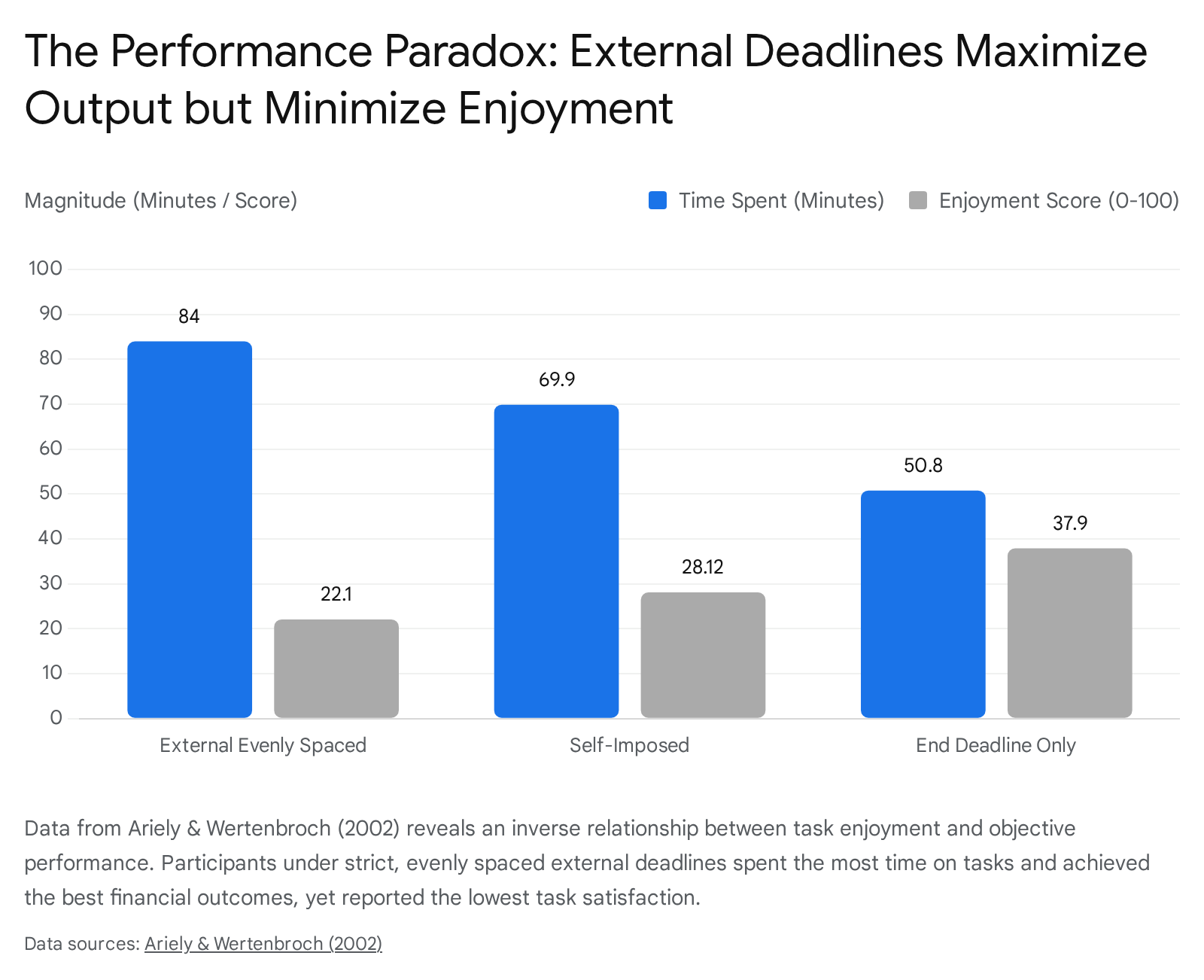
In a subsequent controlled proofreading task with financial incentives directly tied to error detection and delay penalties, the superiority of external deadlines was reaffirmed. Participants under external, evenly spaced deadlines detected the highest number of errors, exhibited the lowest submission delays, and earned the highest financial rewards, spending an average of 84 minutes on the task 1. However, their subjective enjoyment was the lowest among all cohorts, scoring 22.1 on a 100-point scale 1. Those with self-imposed deadlines demonstrated intermediate performance and moderate enjoyment (28.12), spending 69.9 minutes on the task 1. Finally, participants with only a single end deadline and no interim milestones detected the fewest errors, suffered the highest delays, and earned the least, spending merely 50.8 minutes on the task, despite reporting the highest subjective enjoyment score of 37.9 1.
The Ariely and Wertenbroch findings robustly establish that people are generally willing to self-impose costly deadlines as a commitment device to curb procrastination 117. However, recent replication attempts and field experiments by Bisin and Hyndman (2024) introduce a critical caveat to this behavioral model. Their research confirms a robust demand for commitment devices among students, but actively challenges the premise that self-imposed deadlines uniformly increase completion rates 9. Bisin and Hyndman assert that self-imposed deadlines frequently cause measurable harm due to a psychological phenomenon termed "partial naïveté" - an overconfidence at the initial deadline-setting stage regarding one's future ability to persevere through task friction after early failures 9.
Therefore, artificial urgency acts as a powerful behavioral constraint, but its effectiveness is highly contingent upon its structural rigidity and external enforcement. An artificial deadline without material consequences or social accountability rapidly loses its psychological efficacy, functioning similarly to a medical placebo 3. Without genuine teeth, self-imposed deadlines routinely fail to overcome the brain's innate temporal discounting, ultimately leading to delayed action and diminished operational output 3610.
The Illusion of Productivity: The Mere Urgency Effect and Precrastination
The Mere Urgency Effect
When examining the psychology of artificial urgency, a critical cognitive bias emerges: the human tendency to prioritize tasks with short, spurious deadlines over tasks of genuine long-term importance. This phenomenon is formally termed the "mere urgency effect" 11. Zhu, Yang, and Hsee (2018) conducted a series of highly controlled experiments demonstrating that illusory expiration times heavily skew human decision-making, compelling individuals to choose urgent tasks even when those options yield objectively inferior rewards 11.
| Experiment Context (Zhu, Yang, & Hsee, 2018) | Control Condition (No Spurious Expiration) | Urgency Condition (Spurious 10-Min Expiration) | Statistical Significance |
|---|---|---|---|
| Experiment 1: Low-Payoff Candy | 13.3% chose the low-payoff task | 31.3% chose the low-payoff task | $\chi^2(1) = 5.69, p = .017$ |
| Experiment 2A: Financial Bonus (Thought Coding) | 13.9% chose the low-payoff task | 35.3% chose the low-payoff task | $\chi^2(1) = 11.43, p < .001$ |
| Experiment 2B: Financial Bonus (Direct Ratings) | 7.3% chose the low-payoff task | 48.1% chose the low-payoff task | $\chi^2(1) = 41.27, p < .001$ |
| Experiment 3: Outcome Nonsalient | 9.8% chose the low-payoff task | 33.7% chose the low-payoff task | $\chi^2(1) = 16.87, p < .001$ |
In these quantitative studies, attentional focus was identified as the primary mediator of the irrational choices. Participants in urgency conditions mentioned task expiration times at a profoundly higher rate (41.2% versus 1.0% in control groups) and focused significantly less on the actual payoffs (69.6% versus 82.2%) 11. Notably, this effect is severely exacerbated by perceived busyness. A floodlight analysis from their fourth experiment revealed that individuals who perceive themselves as highly busy are significantly more susceptible to the mere urgency effect, falling into a psychological trap of executing low-value, urgent tasks simply for the immediate dopamine release and emotional relief of task completion 1121.
Precrastination: Clearing the Cognitive Deck
Intimately related to the mere urgency effect is the concept of "precrastination" - the counterintuitive tendency to initiate or complete tasks at the earliest possible opportunity, even when doing so incurs unnecessary physical or cognitive costs 1213. Discovered and formalized in 2014 by Rosenbaum et al., precrastination demonstrates that individuals will willingly carry a physical object, such as a heavy bucket, for a longer distance simply to complete the sub-goal of "picking it up" sooner rather than waiting for an optimal point closer to the destination 14.
Psychologically, precrastination is driven by the CLEAR hypothesis, which posits that the behavior is an urgent desire to reduce working memory load 1213. Holding an uncompleted task, or even the intention to complete a future task, in working memory exacts a continuous, draining cognitive toll. By completing a task prematurely, individuals immediately alleviate this mental burden, trading physical effort for cognitive relief 1215.
In the modern workplace setting, precrastination manifests through the immediate answering of non-urgent emails, the rapid completion of superficial administrative tasks, and the premature submission of incomplete analyses 15. Quantitative analyses of university students reveal that precrastination is highly correlated with the personality trait of conscientiousness, as highly conscientious individuals prioritize order and completion 1216. However, the behavior is negatively moderated by fluid intelligence. Individuals with higher fluid intelligence possess greater working memory capacities, buffering them against the urge to prematurely execute tasks solely for the sake of cognitive offloading 1216. Consequently, what is frequently praised in corporate environments as rapid "efficiency" is often a maladaptive coping mechanism designed to relieve cognitive overload at the expense of strategic prioritization 1314.
Cognitive Fragmentation: Multitasking, Task-Switching, and Attention Residue
The systemic reliance on artificial urgency drastically alters the nature of modern knowledge work, fundamentally shifting labor away from sustained concentration and toward rapid, frantic task-switching. The psychological and temporal costs of this fragmentation are immense, destroying both accuracy and output velocity.
The Myth of Multitasking and the 40% Deficit
Neurobiologically, the human brain is entirely incapable of seamlessly processing multiple demanding cognitive streams simultaneously; instead, it engages in rapid context-switching, moving executive focus rapidly between distinct neural networks 2717. This constant shifting between a primary strategic task and urgent interruptions - such as instant messages, digital notifications, and immediate demands - degrades performance through a neurological mechanism known as "task-switching cost" 1729. During this process, the brain is forced through two distinct cognitive stages for every switch: goal shifting and rule activation, both of which burn metabolic energy and time 30.
A landmark 2009 study from Stanford University determined that heavy media multitaskers suffer from severely degraded cognitive control. Contrary to the belief that practice improves juggling ability, heavy multitaskers were significantly worse at filtering irrelevant information, maintaining working memory, and executing task switches compared to light multitaskers, rendering them highly susceptible to distraction 1730. The American Psychological Association and related cognitive research consistently establish that multitasking reduces overall productivity by up to 40%, increases error rates by an astonishing 50%, and can temporarily lower effective IQ by 10 points - a cognitive impairment greater than the deficit documented from losing a full night of sleep or utilizing cannabis 273031. For a standard eight-hour workday, this task-switching overhead consumes approximately 3.2 hours of lost productive output per individual, resulting in an estimated $450 billion annual loss to the global economy 30.
Attention Residue and the 23-Minute Rule
The duration of productivity loss extends far beyond the few seconds spent checking an urgent notification or responding to a sudden demand. Research by Dr. Sophie Leroy at the University of Washington identified a highly disruptive phenomenon called "attention residue." When an individual switches from Task A to Task B, cognitive fragments and unresolved thought patterns of Task A linger in the working memory, creating persistent mental static that actively impairs the brain's ability to fully concentrate on the new activity of Task B 113233.
Research originating from the University of California, Irvine, accurately quantified this recovery window: it requires an average of 23 minutes and 15 seconds to fully refocus, clear the attention residue, and rebuild the intricate mental model of a complex task following an interruption 11293234. Given that the average modern knowledge worker toggles between applications up to 1,200 times a day and experiences digital or physical interruptions approximately every 3 to 4 minutes, attention residue creates a cascading effect, locking the worker into a state of perpetual cognitive handicap where deep focus is mathematically impossible 112933.
Deep Work versus Shallow Work
To counteract the cognitive erosion caused by artificial urgency, organizational psychologists heavily advocate for prioritizing "Deep Work," a conceptual framework popularized by Georgetown University professor Cal Newport 35. Deep work constitutes professional activities performed in a state of distraction-free concentration that push cognitive capabilities to their absolute limits, creating novel value that is difficult to replicate 3536. Conversely, "shallow work" comprises non-cognitively demanding, logistical tasks performed while distracted, which merely keep an organization running without advancing its strategic goals 3637.
Neurological studies confirm that sustained deep work induces positive neuroplasticity. Repeated immersion in focused work physically increases gray matter density in the prefrontal cortex - the anatomical region responsible for complex problem-solving, sustained attention, and emotional regulation 35. The human capacity for deep work is finite, generally capping at roughly four hours per day even for highly trained professionals 38. However, four hours of deep, uninterrupted focus yields exponentially greater organizational value, strategic insight, and personal fulfillment than eight or ten hours of fragmented, urgency-driven multitasking 3738.
Urgency and the Modulation of Creativity: Convergent versus Divergent Thinking
Beyond mere productivity and task execution, artificial urgency profoundly alters the mechanisms of human creativity. The relationship between time pressure and creative output hinges on how the brain processes threat stimuli and allocates working memory 18.
Cognitive psychology distinguishes between two primary modes of creative thought: divergent thinking and convergent thinking 181920. Divergent thinking requires generating numerous unique, original ideas or solutions to vaguely defined problems, relying heavily on cognitive flexibility and lateral neural connections 1819. Convergent thinking, by contrast, relies on the quick identification of a clearly defined problem to systematically evaluate options and select the single best, logical solution, depending heavily on cognitive persistence and analytical processing 1819.
When individuals are subjected to artificial urgency, the time pressure acts as an acute stressor or threat stimulus, commanding immense cognitive resources 1821. Research indicates that priming individuals with analytic processing requirements or placing them under time constraints significantly promotes convergent thinking performance 21. However, this same pressure simultaneously decreases fluency, originality, and flexibility scores on divergent thinking tasks, such as the Alternative Uses Test 21. Because divergent thinking is polythetic and requires the free association of ideas, the cognitive load imposed by impending deadlines artificially narrows the mind's focus, stripping the individual of the mental space required for original ideation 2122. Therefore, while artificial urgency can force a team to rapidly finalize a known solution, it actively suppresses the cognitive flexibility required to invent a truly novel one.
The Pathology and Physiology of Hustle Culture
When artificial deadlines, multitasking, and chronic urgency transcend individual projects and become the default operating system of an organization, these behavioral shifts rapidly transition into systemic psychological pathologies.
Urgency Addiction
"Urgency addiction" represents a self-destructive behavioral pattern wherein individuals become biochemically and psychologically dependent on the adrenaline rush of continuous crisis management 4423. Rather than pursuing long-term, strategic objectives that require sustained, quiet effort, these individuals gravitate toward high-pressure, immediate tasks to secure quick dopamine releases and an external sense of relevance and heroism 214446. Stephen R. Covey famously categorized urgency addiction as a catastrophic failure of self-management, noting that urgency addicts derive their identity from handling crises while entirely lacking the capacity for proactive, preventative planning 2346.
In high achievers and executives, prolonged exposure to this state leads to structural nervous system adaptation. The body compensates for constant physiological overload by numbing internal signals of exhaustion 44. Fatigue is dangerously misidentified as boredom or a lack of drive, prompting the individual to seek out even more pressure and artificial deadlines to feel adequately engaged 4446. Once a major success is achieved and external pressures are temporarily removed, these individuals frequently experience a profound loss of internal gravity, confusing peace with emptiness, having never learned to operate outside of a high-friction crisis framework 44.
Hustle Culture and Self-Determination Theory
At a macro-societal level, urgency addiction is culturally codified as "hustle culture" - a contemporary phenomenon that aggressively glorifies relentless work, sleep deprivation, and the constant, visible pursuit of productivity 92425.
Viewed through the psychological lens of Self-Determination Theory (SDT), human motivation requires the fulfillment of three core psychological needs: autonomy, competence, and relatedness 92650. When urgency and hustle are driven by deep intrinsic motivation, skill variety, and a profound sense of ownership over the work, they can foster adaptive eustress and sustainable high performance 2526. However, modern hustle culture largely operates on extrinsic motivation - seeking peer validation on social media, avoiding failure, demonstrating loyalty to pacesetting leadership, and adhering to socially constructed badges of honor 24252728.
When extrinsic validation dominates an individual's drive, their sense of autonomy is rapidly depleted 2453. Longitudinal and meta-analytical studies of both corporate employees and young entrepreneurs demonstrate that while endorsement of hustle culture may predict short-term financial or operational success, it is consistently and positively associated with severe burnout, emotional exhaustion, decreased job satisfaction, and elevated levels of perceived life distress 252729. Furthermore, contrary to its core premise, chronic overwork yields diminishing returns; OECD data and rigorous four-day workweek trials reveal that excessive working hours frequently result in lower productivity per hour due to fatigue-induced errors, impaired judgment, and physiological deterioration 55.
The Long-Term Costs of Toxic Leadership and Organizational Fatigue
The normalization of artificial urgency is frequently propelled from the top down by "dark" or toxic leadership traits - including Machiavellianism, psychopathy, and narcissism 330. Such leaders manufacture high-pressure environments, demand constant availability, and employ aggressive pacesetting behaviors to extract short-term productivity gains and immediate cost efficiencies, often to secure their own advancement 32730.
However, the organizational psychology literature unequivocally categorizes this approach as trading long-term institutional sustainability for short-term optics 33132. Artificial urgency orchestrated by toxic or hyper-demanding leadership initiates a cycle of "change capacity erosion" and "adaptation stress." A longitudinal study tracking 89 major organizational transformations revealed that companies plagued by change fatigue suffered 31% lower implementation success rates, 28% longer time-to-value realization, and 43% higher failure rates on subsequent initiatives 59. Ultimately, this systemic exhaustion leads to the modern phenomenon of "quiet quitting," a psychological withdrawal where employees, entirely drained of cognitive resources and emotional investment, fulfill only the bare minimum of their contractual obligations to protect their mental and physical health from the prevailing hustle culture 6033.
The Neurobiology of Urgency: Arousal, Executive Function, and Metabolic Costs
The psychological phenomena of urgency addiction, attention residue, and burnout are not mere behavioral choices; they are anchored in specific, quantifiable neurobiological and physiological processes that govern human energy expenditure.
The Yerkes-Dodson Law and the Arousal Curve
The fundamental relationship between pressure (arousal) and cognitive performance is modeled by the Yerkes-Dodson Law, originally formulated in 1908 based on conditioning experiments 34633565. The law posits an inverted U-shaped function: performance improves as stress and stimulation increase, but only up to an optimal point of moderate arousal 343565.
In the modern context of knowledge work, this optimal, highly productive zone is referred to as eustress 2566. Within this optimal band, mild stress from a reasonable deadline triggers the beneficial release of adrenaline and cortisol, enhancing mental focus, alertness, and cognitive processing speed without overwhelming the system 56636. However, if the artificial urgency is too high, unmanageable, or sustained for too long without recovery, the individual crosses the apex of the curve into distress. Beyond this tipping point, anxiety, decision fatigue, and cognitive overload precipitate a rapid and severe decline in task performance 53565.
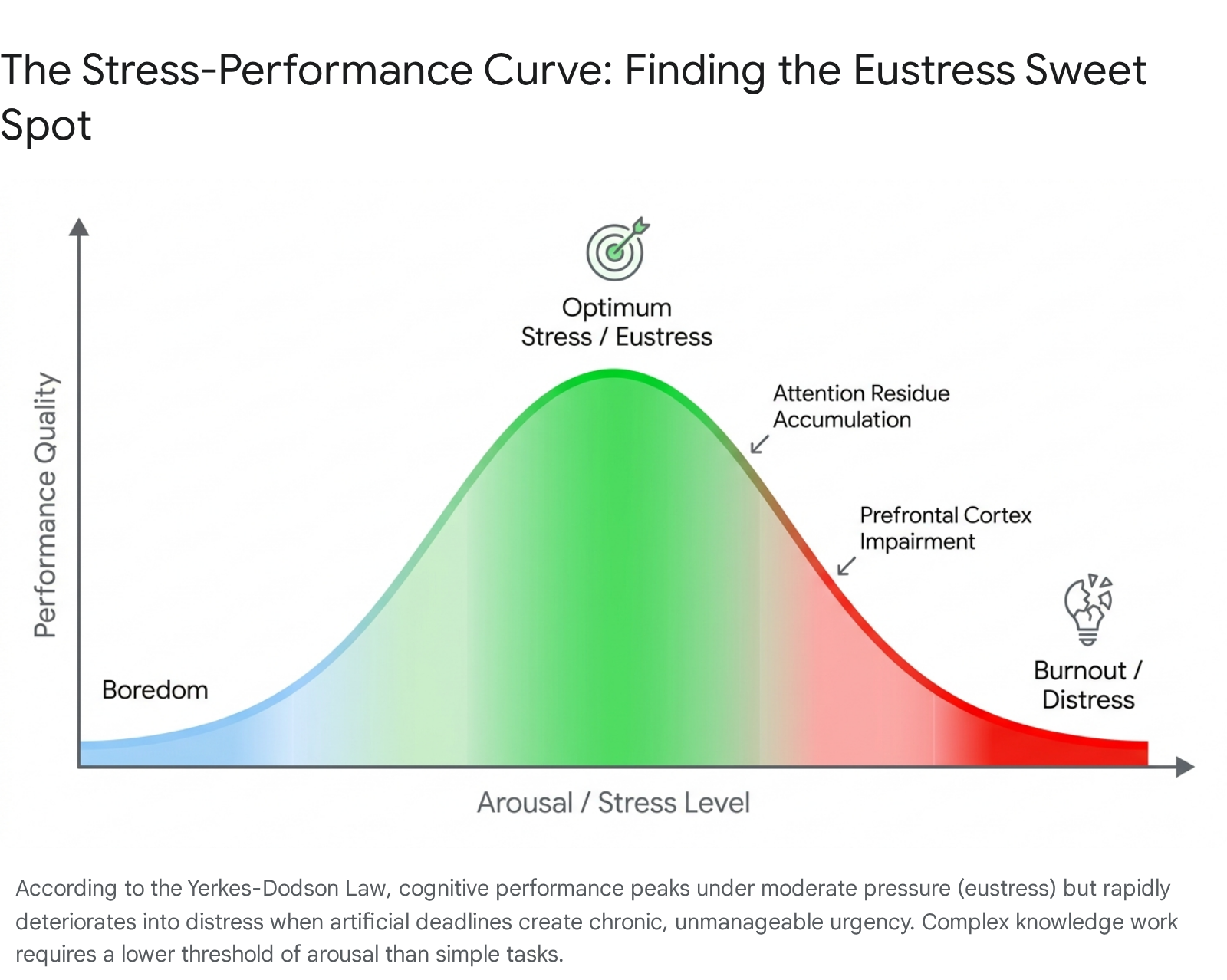
Crucially, the corollary known as "Dodson's Law" clarifies that the optimal peak shifts depending on task complexity: highly complex cognitive tasks require lower arousal states for peak performance, while simple, routine logistical tasks can tolerate higher stress levels 6365.
The Prefrontal Cortex and Chronic Stress
The sophisticated executive functions necessary for navigating deadlines - working memory, attention regulation, impulse control, and cognitive flexibility - are governed by the Prefrontal Cortex (PFC) 4537. Functionally, the PFC relies on coherent neuronal firing, particularly in the gamma frequency band (30 - 70 Hz), to actively maintain internal goals and suppress immediate, low-value distractions 438.
Under acute, manageable eustress, the PFC functions efficiently, aided by the mobilization of the Hypothalamic-Pituitary-Adrenal (HPA) axis 39. However, chronic stress induced by relentless artificial urgency triggers toxic neurobiological cascades. Prolonged exposure to high levels of cortisol leads to excessive glutamate release, resulting in excitotoxicity 39. In rodent models and human imaging, this manifests as the physical reduction of apical dendrites, the debranching of pyramidal neurons, and severe dendritic spine loss in the medial prefrontal cortex 539. Simultaneously, chronic stress causes the hippocampus (critical for learning and memory formation) to shrink due to reduced neurogenesis, while inducing hyperactivity and structural dendritic enlargement in the amygdala (the brain's primitive threat-detection center) 3739. Consequently, an employee subjected to constant artificial urgency literally loses the structural neural architecture required for deep work, becoming increasingly reactive, emotionally volatile, and prone to severe anxiety disorders 3739.
The Metabolic Cost of Cognitive Control
The brain is fundamentally organized to minimize energy consumption while maximizing complex neural computation 4072. Although the brain represents only roughly 2% of body mass, it consumes approximately 20% of resting metabolic energy 72. The total metabolic power potentially available through glucose oxidation is about 17.0 W, with roughly 6.19 W available for actual biochemical work 40. While the absolute metabolic increase during intense cognitive tasks is marginal - only 1% to 5% above baseline brain function - the subjective perception of "cognitive fatigue" after prolonged focus is profound 7273.
The debate surrounding this fatigue centers on whether it is a literal depletion of resources or a motivational shift. The MetaMotiF framework suggests that cognitive fatigue during sustained urgency acts as an integrative homeostatic protection mechanism, potentially tracking the accumulation of neurotoxins like glutamate or adenosine 73. Conversely, researchers like Inzlicht argue against strict metabolic depletion, positing that fatigue is driven by diminishing marginal utility; as high-pressure executive tasks continue, the brain evaluates the required cognitive effort against the reward, eventually determining that the cost of executive control outweighs the benefit, leading to subjective exhaustion 73. Both perspectives conclude that evolutionary mechanisms prevent the dangerous over-allocation of neural resources, explaining exactly why knowledge workers cannot sustain highly pressurized, urgency-driven focus indefinitely without experiencing significant performance degradation and burnout 387341.
Objective Biometrics: Measuring the Toll of Time Pressure
To move beyond subjective, self-reported surveys of stress such as the NASA Task Load Index (NASA-TLX), modern researchers employ sophisticated psychophysiological biometrics to measure the exact, real-time impact of time pressure and multitasking on cognitive load.
Eye-Tracking: The Window to Cognitive Strain
Eye-tracking provides high-resolution temporal data regarding visual attention, mental effort, and information processing strategies 104276. The precise allocation of gaze operates as a direct physiological proxy for cognitive strain under artificial urgency. * Fixation Duration and Frequency: Under severe time pressure (which induces high perceptual load), researchers observe that fixation frequency significantly increases while fixation duration decreases. The individual engages in rapid, superficial visual scanning to gather as much information as possible before the deadline expires 4344. Conversely, during complex multitasking without time pressure (high cognitive load), fixation duration increases as the brain struggles to process and hold competing information streams in working memory 44. * Pupil Dilation: Pupil diameter is tightly correlated with autonomic nervous system arousal. Larger pupil dilations consistently indicate higher cognitive load, stress, and emotional arousal induced by looming deadlines 42434479. * Saccadic Behavior and Blinks: Rapid, erratic saccades (the rapid jumps between fixations) indicate scattered attention and confusion. Suppressed blink rates occur during intense visual engagement; however, prolonged individual blink duration is a strong indicator of acute cognitive fatigue and impending mental overload 42447980.
Electroencephalography (EEG) and Neural Oscillations
When paired with eye-tracking, EEG provides a comprehensive, multimodal view of cognitive resource allocation by measuring the electrical activity of the cerebral cortex 107645. Spectral EEG indices, such as frontal theta and parietal alpha waves, and specifically the theta-to-alpha ratio, serve as highly sensitive, robust indicators of mental workload 4243.
During tasks demanding high artificial urgency and multitasking, specific Event-Related Potentials (ERPs) shift predictably. For example, the amplitude of the P300 wave frequently decreases under high cognitive load, reinforcing the hard limits of the brain's information processing capacity when overwhelmed by complex time constraints 4243. Machine learning models utilizing combined EEG, eye-tracking, and performance data can now classify user cognitive load with over 80% to 94% accuracy (AUC), providing irrefutable objective proof of the physiological strain caused by fragmented, urgency-driven work environments 4345.
Moderating Variables: Personality, High-Performance Advocacy, and Team Context
The psychological impact of artificial urgency is not uniform; it is heavily moderated by individual personality traits, team dynamics, and the framing of the urgency itself. A comprehensive meta-analysis encompassing 82 independent samples and over 25,000 participants evaluated the relationship between time pressure and various employee outcomes 4647.
The analysis revealed a nuanced relationship: time pressure generally facilitates speed but impairs accuracy in cognitive tasks 47. Notably, the effect of time pressure on innovation performance follows a J-shaped curve, where low to moderate pressure stifles innovation through boredom, but higher pressure can occasionally yield positive innovative outcomes if properly supported by developmental feedback from leadership 4648.
Specific Big Five personality traits drastically alter an individual's response to artificial deadlines: * Conscientiousness: Highly conscientious individuals frequently experience a negative relationship between time pressure and job performance. Their intrinsic desire for order, precision, and thorough completion is disrupted by artificial urgency, leading to severe frustration and cognitive blockades 4950. * Extraversion and Agreeableness: Extraverted individuals and those high in agreeableness generally demonstrate higher organizational citizenship behaviors (OCB) and creative performance under pressure, utilizing social coping mechanisms and communication to navigate stress 4950. * Fluid Intelligence: As observed in precrastination studies, individuals with higher fluid intelligence and robust working memory capacities are more resilient against the cognitive panic induced by artificial deadlines, allowing them to prioritize effectively rather than succumbing to the mere urgency effect 1216.
Furthermore, cultural and structural contexts matter immensely. In high-interdependence teams and collectivist cultures, time pressure is more frequently appraised as a shared, motivating challenge, mitigating individual cognitive load and fostering proactive, prosocial behaviors 46.
The High-Performance Defense: Structure Over Chaos
To fully understand artificial urgency, one must address the perspective of high-performance coaching, which defends certain aspects of "hustle culture" not as an inherent evil, but as a necessary framework when applied correctly. From this perspective, professionals who understand systems recognize that high performance relies on engineering predictability and momentum, rather than relying on chaotic emotional motivation 12.
Proponents argue that true high performance uses self-imposed deadlines and tracking metrics as architecture to dismantle chaos and convert potential into certainty 12. When a deadline is integrated into a personal belief system and backed by empirical evidence of past success, it ceases to be an external stressor and becomes a tool for calibration 12. In this framing, the failure of hustle culture is not the presence of hard work, but the worship of motion over precision - glorifying exhaustion while lacking the structured routines, real-time feedback loops, and defined boundaries that transform raw urgency into sustainable, high-velocity execution 1255.
Strategic Conclusions and Organizational Implications
The synthesis of behavioral economics, organizational psychology, and cognitive neuroscience provides a clear, multidimensional perspective on the utility and inherent dangers of artificial deadlines.
First, deadlines, when applied judiciously and authentically, are indispensable psychological tools. By defining clear temporal boundaries, they harness eustress, combat temporal discounting (Parkinson's Law), and provide the external referent necessary for high-level execution and operational momentum 16736.
Second, the systemic abuse of artificial urgency - characterized by relentless interruptions, spurious expiration times, and false deadlines - forces the human brain into chronic multitasking. This triggers massive task-switching costs, pervasive attention residue, and up to a 40% loss in baseline productivity, ultimately costing the global economy hundreds of billions of dollars annually 1130313233.
Third, continual exposure to the distress of unmanaged hustle culture and urgency addiction does not yield sustainable high performance. Instead, it prompts a neurotoxic cascade of cortisol that degrades the physical architecture of the prefrontal cortex, impairs executive function, suppresses divergent creativity, and drives widespread emotional exhaustion 5213339.
Finally, to optimize knowledge work and human capital, organizations and individuals must transition from a paradigm of "constant urgency" to one of strict "cognitive resource management." This requires safeguarding periods of uninterrupted deep work, eliminating toothless artificial deadlines to restore psychological trust in actual deadlines, and aligning task demands with the hard neurobiological realities of the human brain 3355951. The competitive advantage in the modern era will not belong to those who operate with the highest baseline panic, but rather to those who meticulously architect their environments to protect sustained attention, leveraging strategic deadlines solely to catalyze, rather than crush, human cognitive potential.