
Does Breathwork Actually Reduce Stress and Anxiety
Yes, a robust and growing body of clinical evidence demonstrates that deliberate breathwork significantly reduces subjective stress, anxiety, and depression by physically shifting the autonomic nervous system out of its "fight-or-flight" state. While techniques that emphasize slow, extended exhalations yield the most immediate physiological relief, researchers caution that breathwork is best utilized as a fast-acting adjunct to conventional therapies rather than a standalone medical cure for severe psychiatric disorders.
The Neurobiology of the Breath-Brain Connection
Breathing is unique among the body's vital functions because it is the only physiological process that operates both autonomously and under conscious, voluntary control 11. This dual nature makes the breath a direct, mechanical lever for regulating the human nervous system.
When a person experiences chronic stress or an acute anxiety trigger, the sympathetic nervous system (SNS) activates. This triggers a well-documented physiological cascade: heart rate accelerates, bronchioles dilate, and the hypothalamic-pituitary-adrenal (HPA) axis floods the bloodstream with cortisol 235. Left unchecked, this state of hyperarousal impairs executive function in the prefrontal cortex and heightens the reactivity of the amygdala, the brain's fear center 545.
Breathwork directly interrupts this stress cascade through several measurable biological mechanisms:
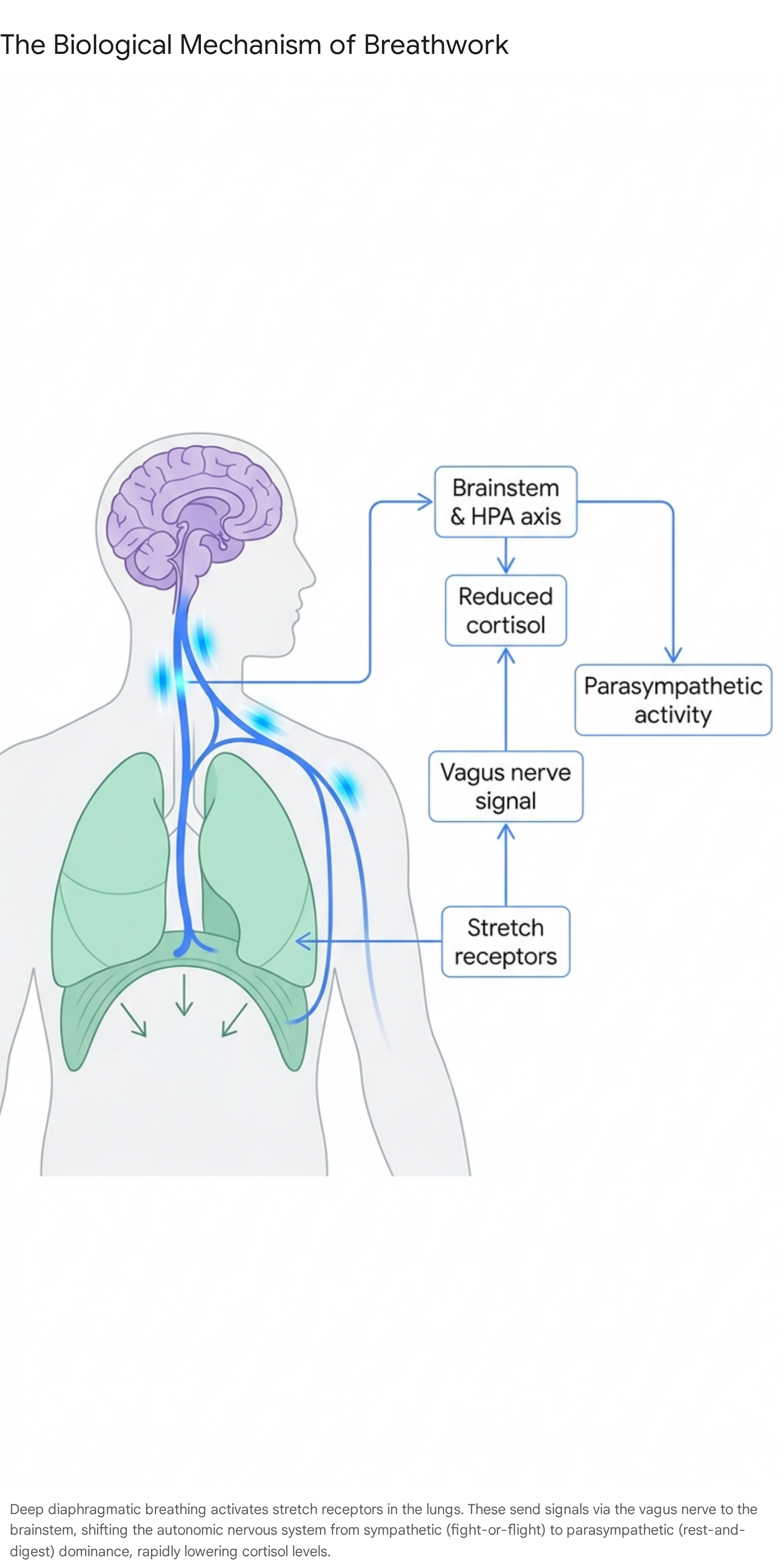
- Vagal Nerve Stimulation: Slow, diaphragmatic breathing activates mechanoreceptors in the lungs that detect expansion. These receptors send information via the afferent fibers of the vagus nerve directly to the brainstem. This stimulates the parasympathetic nervous system (PNS) - the "rest and digest" network - which subsequently inhibits HPA axis activity and halts excessive cortisol production 358.
- Heart Rate Variability (HRV) and Sympathovagal Balance: Controlled breathing, particularly at a resonance rate of around 5.5 to 6 breaths per minute, synchronizes the cardiovascular and respiratory systems. This state, known as cardiorespiratory coupling or cardiovascular coherence, maximizes Heart Rate Variability (HRV) 96. High HRV is a widely accepted biomarker of psychological resilience, emotional regulation, and autonomic flexibility, correlating strongly with lower baseline anxiety 4712.
- Chemoreceptor Resetting: Anxiety and panic are intimately tied to blood gas levels, specifically carbon dioxide (CO2). Chronic stress often causes imperceptible hyperventilation (shallow, rapid breathing), leading to hypocapnia (abnormally low CO2 levels) 478. Intentional breathing practices alter end-tidal CO2, signaling central chemoreceptors in the brain to cause a parasympathetic response and reduce the physical sensation of breathlessness 7915.
What the Latest Clinical Meta-Analyses Reveal
While breathing techniques have been foundational to Eastern spiritual traditions for millennia, rigorous Western psychiatric evaluation of these practices has surged recently. Over the past five years, major universities have published extensive trials validating breathwork as a scalable, non-pharmacological intervention for mental health 161617.
A landmark 2023 meta-analysis published in Scientific Reports (Fincham et al.) reviewed 12 randomized controlled trials (RCTs) encompassing 785 adults to gauge the efficacy of breathwork against non-breathwork control groups 101112. The researchers found a significant small-to-medium mean effect size for breathwork in reducing subjective stress ($g = -0.35$), as well as for lowering anxiety ($g = -0.32$) across 20 trials, and depressive symptoms ($g = -0.40$) across 18 trials 10.
A subsequent 2024 meta-analysis (Bahi et al.) corroborated these findings using both psychological and physiological markers. Analyzing 14 studies, this research reported a pooled standardized mean difference (SMD) of -0.56 for stress reduction - indicating a moderate effect size - alongside significant physiological reductions in salivary cortisol levels (SMD = -0.38) and improvements in heart rate variability (SMD = 0.32) 13.
Despite these highly promising figures, researchers consistently issue a critical caveat. The field of breathwork research is currently plagued by a "moderate risk of bias" due to characteristically small sample sizes, a lack of standardized breathing protocols across studies, and the inherent impossibility of running truly double-blind trials on physical breathing exercises 101213. Consequently, researchers warn against a "miscalibration between hype and evidence," urging that breathwork be viewed as an accessible therapeutic tool rather than a standalone medical cure 12.
Head-to-Head: Which Techniques Work Best?
Because the umbrella term "breathwork" encompasses dozens of mechanical techniques with entirely different physiological targets, matching the correct protocol to the specific psychological goal is vital 36. Interventions that emphasize the exhale reliably increase vagal tone and parasympathetic dominance, making them ideal for anxiety 1. Conversely, hyperventilation techniques intentionally drive sympathetic activation.
The Stanford Study: Cyclic Sighing vs. Meditation
A 2023 RCT published in Cell Reports Medicine by researchers at Stanford University - including neurobiologist Andrew Huberman and psychiatrist David Spiegel - provided some of the most compelling comparative data regarding acute stress reduction 2214.
The trial divided 111 healthy volunteers into four groups, assigning them five minutes of daily practice for one month: 1. Mindfulness Meditation (passive observation of the breath without altering it). 2. Box Breathing (equal durations of inhaling, holding, exhaling, and holding). 3. Cyclic Hyperventilation (longer inhales, shorter exhales with breath retentions). 4. Cyclic Sighing (a double inhale through the nose, followed by a prolonged, sighing exhale through the mouth).
The study found that while all groups experienced improved mood and reduced anxiety, the groups that intentionally controlled their breath outperformed the passive mindfulness meditation group in enhancing positive affect 2415. Notably, the cyclic sighing group demonstrated the most significant daily improvements in mood and the greatest reduction in physiological arousal, objectively measured by a consistently lowered resting respiratory rate over the 28 days 141526. This suggests that active, mechanical manipulation of the breath - specifically by emphasizing the exhale to rapidly offload CO2 and engage the parasympathetic nervous system - may be more effective for immediate stress regulation than mindfulness meditation 1526.
The Brigham Young University Study: Nuances in Ratios
While complex ratios like 4-7-8 and Box Breathing are heavily promoted in clinical psychotherapy, they may lack unique empirical superiority over simpler methods. A 2025 study from Brigham Young University compared square (box) breathing, 4-7-8 breathing, and standard resonance breathing (6 breaths per minute) in 84 adults 9.
The study revealed that breathing at a simple, continuous 6 breaths per minute (without prolonged holds) increased HRV more effectively than the complex 4-7-8 or box patterns, yielding small to medium effect sizes. Interestingly, none of the breathing conditions in this specific cohort resulted in meaningful acute changes in blood pressure or mood, and the researchers noted that 6 bpm carried a slightly higher risk of mild over-breathing (reducing CO2 too much) 915. This highlights that highly rigid breath architectures are not universally perfect for every physiology.
Comparing the Architecture of Calming Breathwork
Understanding the mechanical cadence of popular breathing techniques helps clarify why they produce different results. Techniques aimed at relaxation typically feature prolonged exhalations. For instance, the 4-7-8 method dedicates the vast majority of its 19-second cycle to holding and releasing breath, maximizing parasympathetic activation, whereas Box Breathing uses a balanced cadence to provide cognitive focus.
| Technique | Phase 1: Inhale | Phase 2: Hold | Phase 3: Exhale | Phase 4: Hold | Primary Mechanism & Use Case |
|---|---|---|---|---|---|
| Cyclic Sighing | Double inhale (full lungs) | None | Prolonged, slow sigh | None | Reopens collapsed alveoli; rapid vagal stimulation. Best for acute stress spikes 2627. |
| Resonance / Coherent | ~5 seconds | None | ~5 seconds | None | Synchronizes cardiovascular and respiratory rhythms. Best for baseline HRV optimization 969. |
| Box Breathing | 4 seconds | 4 seconds | 4 seconds | 4 seconds | Balances O2/CO2 levels; provides cognitive distraction. Best for focus in high-stress scenarios 52816. |
| 4-7-8 Breathing | 4 seconds | 7 seconds | 8 seconds | None | Extreme parasympathetic activation due to doubled exhale ratio. Best for sleep preparation 1316. |
| Cyclic Hyperventilation | Rapid, deep inhale | Brief retention | Short, unforced | Extended post-exhale | Induces transient acute stress; spikes sympathetic nervous system. Best for building resilience 91417. |
Ancient Traditions in Modern Medical Settings
Modern science is largely isolating and validating practices that originated thousands of years ago. Breathwork - often placed under the umbrella term Pranayama in Indian Vedic traditions and Qigong in Chinese Taoist traditions - has long viewed breath regulation as a bridge between physical vitality and mental clarity 163132. Today, these ancient protocols are being utilized in formal clinical interventions for severe stress and burnout.
Sudarshan Kriya Yoga (SKY) for Occupational Burnout
Sudarshan Kriya Yoga (SKY) is a comprehensive breathing and meditation program featuring specific cyclical, rhythmic patterns of breath 183536. Its efficacy was recently tested in a 2024 randomized clinical trial published in JAMA Network Open, which tracked 129 practicing physicians struggling with severe occupational burnout across multiple countries 1819.
Physicians in the SKY group practiced for approximately 30 minutes daily. After two months, the SKY group showed statistically significant reductions in stress, anxiety, and depression - decreasing by 4 to 6 points on the 42-item Depression, Anxiety, and Stress Scale (DASS-42) - and a 3-point decrease in insomnia on the Regensburg Insomnia Scale, vastly outperforming the control group that received standard stress management education 1819. Previous independent studies have similarly documented substantial relief from depression (with remission rates up to 73%) for individuals practicing SKY, demonstrating the profound systemic impact of structured, long-term pranayama 3536.
Traditional Chinese Medicine (TCM) and Qigong
Qigong combines conscious, diaphragmatic breathing with gentle physical movement and mental focus 20. A 2025 systematic review and meta-analysis of 31 eligible studies involving over 2,500 older adults found that Traditional Chinese Exercises like Qigong and Tai Chi produced significant improvements in clinical anxiety (SMD = -0.93) and depression (SMD = -1.14) when compared to control groups 2122. The analysis found that optimal results for anxiety occurred with 40 to 60-minute sessions practiced three to four times per week 21. While Western reviews often note that the methodological quality of some older TCM trials can be poor, the sheer volume of positive data supports Qigong's efficacy as a low-impact adjunct therapy for psychological well-being 2324.
The Paradox: When Breathwork Triggers Anxiety
While the prevailing wellness narrative frames breathwork as a universal remedy for anxiety, clinical nuance is required - particularly for individuals diagnosed with Panic Disorder or severe trauma 43.
Dysfunctional breathing, especially chronic hyperventilation, is a hallmark of anxiety disorders 24. Patients with clinical anxiety often exhibit hypersensitivity in the amygdala to fluctuations in carbon dioxide 4. Consequently, breathing techniques that involve rapid, deep breathing (such as cyclic hyperventilation, Holotropic breathwork, or intense forms of Pranayama like Bhastrika) can drastically alter pCO2 levels, inadvertently exacerbating fear and even triggering full-blown panic attacks 4344.
A pivotal 2010 clinical study highlighted the efficacy of Capnometry-Assisted Respiratory Training (CART) for panic disorder patients. By using biofeedback devices to monitor CO2 levels, patients were taught to breathe slower and more shallowly to reverse chronic hyperventilation and safely raise their CO2 tolerance. The study found that CART was actually more effective at altering hyperventilation and reducing panic symptoms than traditional cognitive therapy 8. Instructing someone to simply "take a deep breath" during a panic attack can often backfire by worsening hyperventilation; instead, individualized, gradual breathwork skill-building is essential for safety 43.
Guidelines and Professional Recommendations
Because of the physiological complexity of anxiety, major psychiatric and medical bodies maintain measured guidelines regarding breathwork. The UK's National Institute for Health and Care Excellence (NICE) recommends evidence-based psychological interventions, primarily Cognitive Behavioural Therapy (CBT), as the first-line treatment for anxiety disorders 2526.
However, breathing exercises are widely supported as complementary, adjunctive therapies to assist in acute symptom management 4748. For adults experiencing acute anxiety, pursed-lip breathing (inhaling through the nose, exhaling slowly through pursed lips for 4-6 seconds) is heavily evidenced to increase vagal tone without the risks of hyperventilation 47. Similarly, the American Psychological Association (APA) regularly promotes slowed breathing techniques to allow the body to recalibrate and lower physiological arousal during acute stress 27.
Bottom line
The scientific consensus confirms that deliberate breathwork is a highly effective, accessible, and low-cost tool for reducing stress and anxiety. By utilizing techniques that emphasize slow, prolonged exhalations, individuals can consciously stimulate the vagus nerve, rapidly lowering cortisol and shifting the body out of a heightened state of stress. However, while techniques like the physiological sigh offer excellent acute relief, individuals with severe panic disorders should strictly avoid rapid hyperventilation techniques in favor of professionally guided, slow-paced respiratory training.