
Does the 10,000-Hour Rule Actually Work
The 10,000-hour rule is a massive oversimplification of cognitive science, and rigorous meta-analyses demonstrate that merely accumulating practice time accounts for only a small fraction of performance differences among individuals. While a highly focused, feedback-driven method known as "deliberate practice" is essential for developing expertise, true mastery is ultimately governed by a complex interplay of genetic predispositions, working memory, cultural training infrastructures, and highly variable domain-specific timelines.
The Origin of a Persistent Myth
The concept that achieving world-class expertise requires exactly 10,000 hours of practice is deeply embedded in modern cultural consciousness. However, the rule itself is a popularized misinterpretation of complex cognitive psychology. The origin of the figure traces back to a seminal 1993 study conducted by cognitive psychologist K. Anders Ericsson, Ralf Krampe, and Clemens Tesch-Römer at the West Berlin Music Academy 12341.
The researchers sought to understand the mechanisms that separated elite, world-class violinists from their less accomplished peers. By analyzing the practice histories of students, they found a stark divergence based on total accumulated hours of solitary, highly focused practice 1312. By the age of 20, the top-tier violinists - those deemed to have the potential for international solo careers - had accumulated an average of roughly 10,000 hours of this specific training 1312. By comparison, the "good" students had logged around 8,000 hours, and those studying to become music teachers had accumulated fewer than 5,000 hours 21.
Gladwell's Translation to the Masses
The public's understanding of Ericsson's research fundamentally shifted with the publication of Malcolm Gladwell's 2008 bestselling book, Outliers: The Story of Success 1232. Gladwell extracted the 10,000-hour average from the Berlin Academy study and framed it as a universal "magic number of greatness" applicable to almost any field 1323.
To illustrate the concept, Gladwell relied on compelling historical anecdotes. He estimated that The Beatles had accumulated roughly 10,000 hours of performance time during their exhausting residencies in Hamburg clubs in the early 1960s 12. Similarly, he argued that Bill Gates achieved his programming prowess because he was granted exceptional, prolonged access to a high school mainframe computer, allowing him to log 10,000 hours of coding before founding Microsoft 12.
The Architect's Rebuttal
For the remainder of his career, Anders Ericsson spent considerable energy clarifying that Gladwell's popular interpretation was a distortion of the original science 128. The 10,000-hour figure was never intended to be a universal threshold; it was merely a statistical average observed in a single, highly structured domain (classical music) at a specific age cutoff 123. Ericsson noted that to actually win international piano competitions, a more accurate estimate of accumulated practice time would be closer to 25,000 hours 3.
More importantly, the popular narrative conflated the quantity of experience with the quality of practice. Gladwell's examples included public performances and general work experience, which violated Ericsson's strict criteria for skill development 3. The original 1993 research never claimed that 10,000 hours of just any repetitive activity produces expertise. Rather, it demonstrated that elite performers engaged in thousands of hours of a very specific, taxing methodology known as "deliberate practice" 438. Quantity of hours without quality of method is mostly wasted effort 8.
What Deliberate Practice Actually Means
To understand why simply clocking hours fails to build expertise, it is necessary to distinguish between naive repetition and deliberate practice.
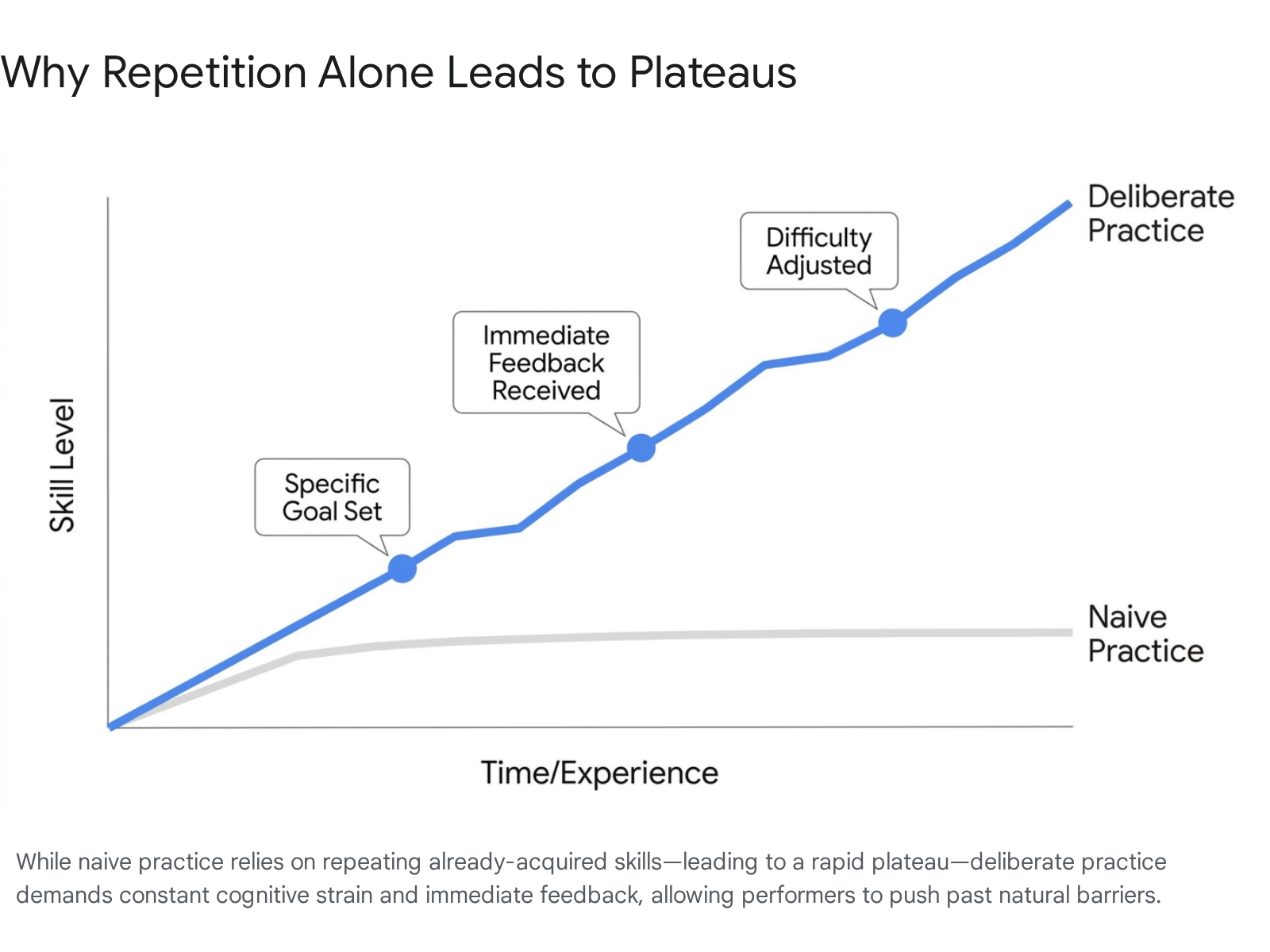
When an individual repeats a task they already know how to do - such as an amateur tennis player rallying on weekends, a driver commuting to work, or a typist hunting and pecking at a keyboard - they are reinforcing mediocrity rather than building excellence 910.
Deliberate practice is a highly structured, task-centered methodology designed specifically to push an individual beyond their current capabilities 189104. Research indicates that appropriately designed deliberate practice can accelerate skill development three to five times faster than conventional practice by aggressively eliminating inefficient or counterproductive activities 10.
The Core Components of Skill Acquisition
True deliberate practice rests on several non-negotiable components that separate it from mere "play" or "structured practice" 125.
First, the practice must involve the isolation of specific subskills. Deliberate practice requires breaking a complex skill down into micro-components. Instead of a vague goal like "get better at presenting," a practitioner focuses on a highly specific benchmark, such as "state the main point in one single sentence before expanding" 895. Goal-setting is integral because it informs the mind's mental representation of the desired outcome 95.
Second, the system relies on an immediate and actionable feedback loop. Because individuals often cannot objectively evaluate their own mechanical or cognitive flaws in real-time, this feedback is traditionally provided by an observing expert, coach, instructor, or mentor 8910126. Without instantaneous correction, a learner risks automating bad habits. Deliberate practice is often highly individualized, best delivered through a one-on-one process where the teacher assigns specific training tasks tailored to the student's current weaknesses 126.
Third, the methodology requires operating in a state of cognitive strain and discomfort. The difficulty is not incidental; it is the fundamental mechanism of growth. Deliberate practice requires operating just beyond the edge of current competence. If a skill feels automatic, it is no longer being practiced deliberately 8910.
The Limits of Human Focus
Because of the intense cognitive and physical demands of this methodology, the volume of deliberate practice an individual can sustain is strictly limited. The human brain cannot maintain peak concentration indefinitely.
Research on expert performers reveals that cognitive performance degrades significantly after four to five hours of genuine deliberate practice per day 8. Pushing beyond this limit without sufficient recovery results in exhausted repetition, which yields no measurable improvement and actively increases the risk of burnout, injury, or resentment 812. Therefore, the path to 10,000 hours cannot be sprinted; it must be accumulated through highly concentrated, time-bounded sessions spread over many years 285.
The Meta-Analyses: Debunking the Magic Number
For nearly two decades, Ericsson's deliberate practice framework dominated the scientific understanding of expertise. The prevailing belief suggested that anyone could achieve world-class status if they simply logged enough high-quality hours 29. However, a major paradigm shift occurred when researchers began rigorously testing whether practice time alone could entirely account for the vast differences in human performance.
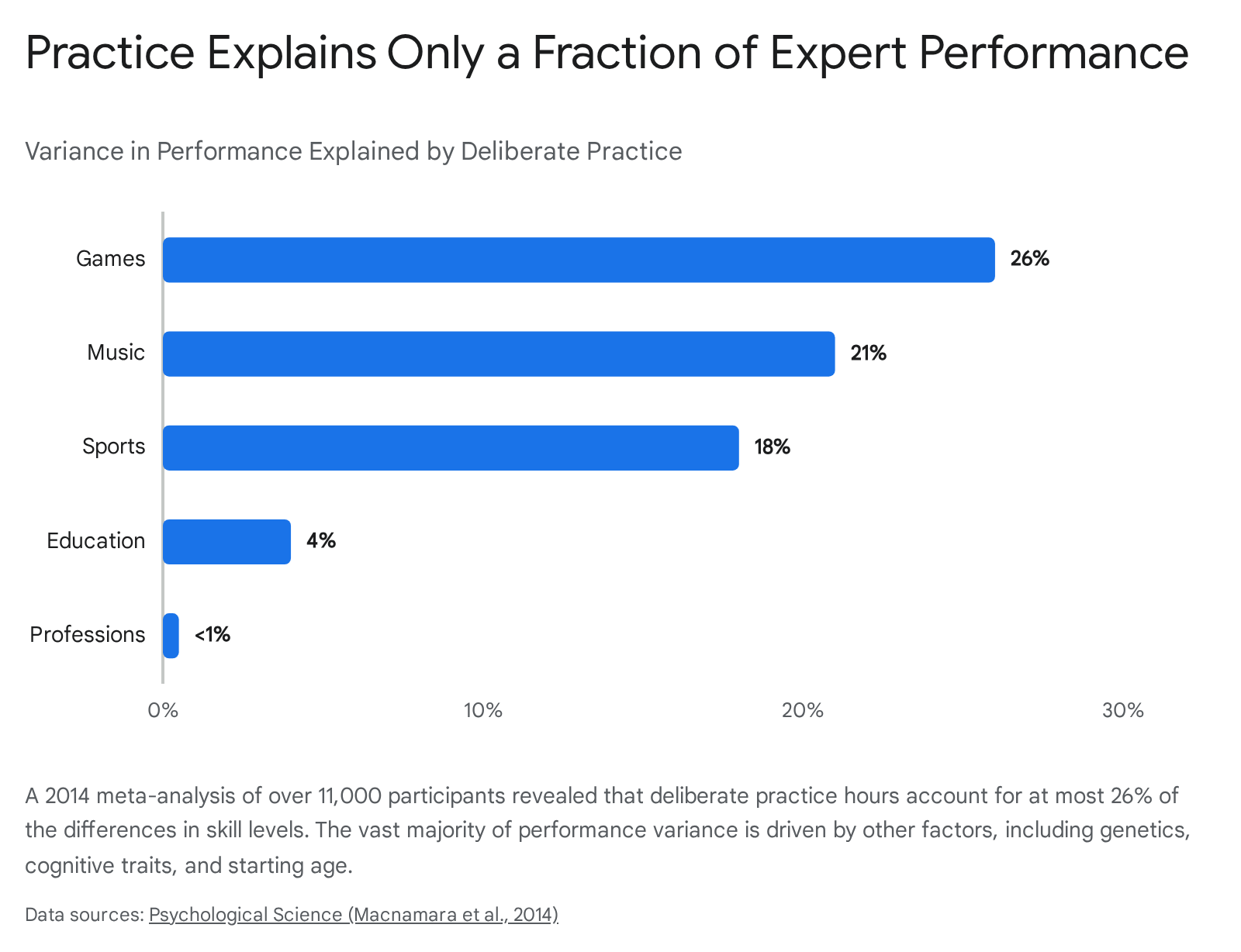
The most significant challenge to the deliberate practice monopoly came from psychologists Brooke Macnamara, David Hambrick, and Frederick Oswald. In 2014, they published a comprehensive meta-analysis evaluating 88 studies with over 11,000 total participants across the major domains of human performance (sports, music, games, education, and professions) 447. The researchers set out to determine exactly how much of the variance in human skill could be statistically explained by the amount of deliberate practice an individual had accumulated 137.
The findings fundamentally disrupted the "practice makes perfect" narrative. The meta-analysis revealed that deliberate practice accounted for a surprisingly modest percentage of the variance in performance, leaving the vast majority of expertise differences completely unexplained by practice time 447.
The 1% Elite Variance
Even more striking was a subsequent 2016 meta-analysis by Macnamara and colleagues focusing strictly on sports. While practice accounted for 18% of the variance among athletes as a whole, it accounted for a mere 1% of the variance in performance among elite-level competitors 189.
This finding starkly contradicted the notion that the podium at the Olympics is simply awarded to the athlete who logged the most hours in the gym 138. If everyone at the elite level engages in massive amounts of deliberate practice, practice hours cease to be the primary differentiating factor. At the highest echelons of performance, the deciding factors shift heavily toward genetic, psychological, and environmental advantages 238.
The Ericsson Rebuttal
Anders Ericsson fiercely debated these conclusions until his passing in 2020. He argued that Macnamara's meta-analyses included studies that measured general "structured practice" rather than strictly defined deliberate practice 436. Ericsson noted that summing up hours spent in group activities, watching games, or playing competitive matches violated the core tenets of deliberate practice, which must be highly individualized, supervised, and targeted at specific weaknesses 36.
Ericsson posited that if studies rigorously adhered to his exact definitions, practice time would explain significantly more variance 3. However, even when researchers attempt to strictly control for Ericsson's rigid definitions, the data consistently shows that deliberate practice - while statistically and theoretically necessary - is simply not sufficient to explain the totality of human expertise 447.
How Long Does Mastery Actually Take?
If 10,000 hours is not a universal law, how much time does expertise actually require? Research demonstrates that the timeline to mastery is highly domain-specific and subject to massive inter-individual variability.
The 728-Hour Chess Master
In the realm of chess, cognitive psychologists Fernand Gobet and Guillermo Campitelli found staggering differences in the time required to reach "master" status. While the overall average was around 10,000 hours, individual times ranged from a highly efficient 728 hours to an arduous 16,120 hours 2. This means some players required 22 times more practice than others to achieve the exact same level of international proficiency 2. Earlier foundational research in 1973 by Herbert A. Simon and William G. Chase estimated that a chess grandmaster likely spent between 10,000 and 50,000 hours staring at positions, whereas a "Class A" player might only need 1,000 to 5,000 hours 2.
Training Surgeons and Programmers
In other technical fields, functional expertise arrives much faster. A 2020 survey of professional software developers found that the median time to achieve professional programming competence was between 3,000 and 4,000 hours of practice, though mastering specialized sub-domains requires additional time 1.
The medical field offers highly quantified data on the acquisition of life-or-death physical skills. An analysis of general surgical residents found that over a five-year training period, residents devoted an average of 3,963 hours to operative training, which accounts for roughly 20.6% of an 80-hour work week 1011. To perform independently, spine surgeons reported needing to complete an average of 12 to 15 basic posterior lumbar spine surgeries under supervision, and fewer than 10 for other highly specific procedures 12. Surgical expertise relies heavily on simulation, wet-laboratory practice, and "frame-of-reference" training to build psychomotor skills before operating extensively on patients 101314.
| Domain / Field | Average Estimated Time to Competence/Mastery | Notes on Skill Acquisition |
|---|---|---|
| Classical Violin | 10,000 hours by age 20 | Solitary deliberate practice separates top performers from teachers 123. |
| Chess (Master Status) | 728 to 16,120 hours | Massive variance; some achieve grandmaster status by age 13 12. |
| Software Programming | 3,000 to 4,000 hours | Median time to achieve professional, hireable competence 1. |
| General Surgery | ~3,963 hours over 5 years | Time spent actively in operative training during residency 1011. |
| Competitive Darts | 6 to 18 months (Pub Level) 5 to 10 years (Pro Level) |
Daily limits apply; pros cap practice at 3.5 hours focused daily 2324. |
| Professional Typing | 2 to 3 months (60+ WPM) | Requires short 15-20 min daily drills to build muscle memory 252627. |
Optimizing the Learning Machine: Why Repetition Fails
Because deliberate practice hours are limited by physical and cognitive fatigue, the efficiency of that time becomes paramount. The science of skill acquisition points to several counterintuitive strategies that optimize learning and accelerate mastery.
Contextual Interference and Variable Practice
A common misconception is that mastering a skill requires repeating the exact same motion endlessly under the exact same conditions (constant practice). The martial artist Bruce Lee famously remarked that he feared the man who practiced one kick 10,000 times, rather than 10,000 kicks once 28. However, cognitive science suggests that from a learning perspective, strict repetition is deeply flawed.
Research demonstrates that "variable practice" - practicing a skill in varied contexts, with different constraints, or interleaved with other skills - results in far more robust and adaptable learning 28291516. For example, a tennis player will develop a better backhand if a coach intersperses backhand shots with forehand shots, rather than feeding 100 identical backhands in a row 28. This "contextual interference" forces the brain to actively retrieve the correct motor program for each shot, strengthening neural pathways 28.
While it feels more frustrating and leads to more errors during the practice session itself, variable practice reduces long-term training time and allows the learner to generalize the skill to novel, real-world scenarios 2829.
The Spacing Effect and Rest Periods
The scheduling of practice also dramatically impacts the speed of mastery. Research indicates that shorter, more frequent practice sessions yield significantly better results than marathon sessions 32. During recording sessions with elite orchestral musicians, researchers found that playing accuracy faded significantly after 200 minutes, even with ten-minute breaks every hour 2333.
In sports requiring fine motor control, like darts, experts recommend practicing no more than 3.5 hours per day, broken down into small 20- to 25-minute bursts separated by short breaks - mirroring the Pomodoro productivity technique 233317. Extended, unbroken sessions (often called "massed practice") lead to neurological fatigue, sloppy form, and the cementing of bad habits 2317. Furthermore, groundbreaking neurological studies show that during rest intervals and sleep, the human brain replays the learned activity at rapid speeds, physically solidifying the neural connections formed during practice 32.
Biology and the Baseline of Talent
Because deliberate practice leaves the vast majority of elite performance variance unexplained, researchers must look to biological and cognitive factors to complete the puzzle. The modern scientific consensus supports a multifactorial perspective on expertise: deliberate practice is absolutely necessary to reach an individual's genetic potential, but genetic potential dictates the absolute ceiling of that performance 41819.
The ACTN3 "Speed Gene"
Nowhere is the genetic influence more measurable than in explosive sports. The ability of skeletal muscles to produce high-velocity force is strongly dictated by the ACTN3 gene, colloquially known as the "speed gene" or "sprinter gene" 2021. This gene provides instructions for producing alpha-actinin-3, a protein expressed exclusively in fast-twitch (Type-II) muscle fibers. These fibers are responsible for explosive movements like sprinting, jumping, and weightlifting 202122.
A common genetic variation (polymorphism R577X) results in three distinct genotypes that directly impact athletic destiny 202122. Individuals with the R/R genotype produce normal levels of the protein and possess a biological advantage for explosive muscle power 2122. Those with the R/X genotype produce partial amounts, resulting in balanced capabilities 2022.
Conversely, individuals with the X/X homozygous genotype (roughly 16% to 20% of the population) produce none of this protein due to a premature stop codon 21. While the X/X genotype does not harm general health, and may even confer slight advantages in endurance running, it is associated with a distinct lack of explosive power and higher rates of exercise-induced muscle damage 2122. No amount of 10,000-hour deliberate practice can synthesize alpha-actinin-3 in an athlete whose DNA lacks the instructions to build it 2122.
The Growth Mindset Controversy
If physical limits are genetically bound, what about psychological limits? For years, educational psychology has heavily promoted the concept of a "growth mindset" - the belief that abilities are malleable and can be developed through effort, rather than being fixed innate traits 940. Proponents claimed that teaching students to adopt a growth mindset would lead to large gains in academic achievement and skill development 40.
However, the efficacy of growth mindset interventions has recently come under intense scientific scrutiny. In a massive 2022/2023 meta-analysis of 63 studies involving nearly 100,000 students, Brooke Macnamara and Alexander Burgoyne found that the apparent benefits of growth mindset interventions were vastly overstated 4023. The analysis revealed major shortcomings in study designs and significant publication bias (where authors with financial incentives to report positive findings published significantly larger effects) 40.
Across all studies, the overall effect size of growth mindset interventions on academic achievement was a tiny, statistically insignificant d = 0.05 40. When looking only at the highest-quality, rigorously controlled evidence, the effect size dropped to d = 0.02 40. This suggests that while maintaining motivation is helpful for enduring thousands of hours of practice, simple psychological interventions cannot override cognitive or systemic limitations 4023.
Environmental and Pedagogical Frameworks
While biological mechanisms of learning are universal, the structured environments in which expertise is forged dictate how effectively deliberate practice is applied. Analyzing different training paradigms reveals how institutional philosophy shapes performance.
The Suzuki vs. Traditional Methods in Music
In classical music training, two dominant pedagogical frameworks illustrate how different approaches to early practice yield different types of expertise. The Suzuki method, developed in Japan, immerses very young children (often starting at age 3) in music through passive listening and active parental involvement 424344. It operates on the philosophy of native language acquisition: children learn to play by ear and memorize pieces through immense repetition long before they are introduced to formal sheet music 4244. This method relies heavily on group classes to foster ensemble skills and motivation 42.
Conversely, the Traditional (Western) method prioritizes formal music theory, sight-reading, and individual, one-on-one instruction from day one 4243. While Suzuki students often develop superior ear training, rapid memorization skills, and strong tone early on, Traditional students excel in sight-reading and versatile repertoire adaptation, making them highly effective in orchestral settings 4243.
| Feature | Suzuki Method | Traditional Classical Method |
|---|---|---|
| Starting Age | Very early (ages 3 - 5) 43 | Generally older (ages 6+) 43 |
| Initial Focus | Ear training, imitation, memorization 4244 | Music theory, sight-reading, notation 4244 |
| Parental Role | High involvement; parent acts as daily practice coach 42 | Lower involvement; relies on student commitment 42 |
| Structure | Blends individual lessons with mandatory group playing 4244 | Primarily focused on one-on-one individual instruction 42 |
| Strengths | Superior socioemotional growth, tone, and musical intuition 43 | Superior sight-reading, discipline, and technical independence 4243 |
Cultural Engines of Expertise
At the macro level, examining different national training paradigms reveals how cultural infrastructure acts as a force multiplier for deliberate practice. When a culture optimizes for a specific domain, it produces a disproportionate number of experts.
Effort vs. Innate Talent in East Asian Mathematics
Large-scale international assessments, such as PISA, frequently show East Asian students (from regions like China, Japan, South Korea, and Singapore) drastically outperforming their Western peers in mathematics 242547. Research suggests this is partly due to cultural attitudes toward practice. In many Western cultures, mathematical ability is often viewed as an innate trait - you are either a "math person" or you are not 4849.
Conversely, East Asian educational philosophies, influenced by values like filial piety, tend to view mathematical proficiency as a procedural skill acquired through persistent effort and systematic practice 244849. East Asian pedagogy frequently employs "teaching with variation." Rather than mindless rote repetition, students are given a set of exercises that vary systematically, allowing them to gain competence in procedural rules while actively uncovering underlying mathematical concepts 2924. Additionally, cultural factors such as the linguistic transparency of East Asian number words and systematic finger-counting habits (which map cleanly onto base-10 structures) provide early cognitive advantages in arithmetic fluency 2549.
The 15-Hour Grind of South Korean eSports
South Korea is globally recognized as the epicenter of competitive video gaming (eSports). The dominance of South Korean teams in complex games like League of Legends is driven by the cultural acceptance of gaming as a rigorous professional pursuit, backed by a grueling training infrastructure 50515226.
Top South Korean professionals are notorious for pushing the physical boundaries of practice, often training 12 to 15 hours a day, sacrificing sleep and social lives to maintain their mechanical skills and tactical knowledge 505126. Professional teams utilize specialized high schools and academies, live-in training houses, deep coaching infrastructures, and "sister teams" that allow for high-level, secretive scrimmaging 522627. While Western players also practice extensively (often 8 to 10 hours a day), the sheer volume, cultural infrastructure, and institutionalized rigor of the South Korean system produce a noticeable competitive gap 5152.
Polarized Training in Kenyan Distance Running
In long-distance running, Kenyan athletes - particularly those from the high-altitude Rift Valley - exert a profound global dominance 5556. While genetic factors and altitude living play a critical baseline role, their specific training methodology is highly optimized.
Kenyan training follows a polarized model: approximately 80% of their running volume is conducted at a very easy, conversational pace, which builds a massive aerobic base without causing musculoskeletal breakdown 5657. However, they separate themselves from international competitors through their application of high-intensity deliberate practice. A comparative study found that world-class Kenyan runners accumulated significantly more distance in high-intensity "tempo runs" and short intervals compared to European elite runners 5728. This specific, targeted imposition of physiological demand improves exercise economy, lactate threshold, and maximal oxygen consumption ($VO_2 max$) far more efficiently than moderate-intensity volume 5557.
The Soviet Legacy of Periodization and Psychology
During the Cold War, the Soviet Union developed a highly scientific, state-sponsored approach to physical culture that forever altered global sports. While American gymnastics traditionally evolved to heavily emphasize power, acrobatics, and high difficulty scores via intense conditioning 596061, the Soviet system treated gymnastics as an aesthetic form of physical culture deeply intertwined with ballet 5960.
Soviet sports scientists pioneered concepts that are now standard in global athletics. They formalized "periodization" - the practice of breaking training into yearly, monthly, and weekly cycles to manage fatigue, optimize recovery, and ensure the athlete peaks exactly in time for major competitions 2963. Researcher Yuri Verkhoshansky developed "shock training," now globally known as plyometrics, to translate raw strength into explosive, sport-specific power 2964.
Furthermore, the Soviet philosophy heavily integrated sports psychology. Researchers like Avksenty Puni prioritized mental control, spatial awareness, and "flow state" preparation long before sports psychology was normalized in the West, ensuring athletes could execute thousands of hours of physical practice under the intense psychological pressure of Olympic competition 2965.
The Future of Expertise: Artificial Intelligence and Skill Decay
As the scientific understanding of expertise evolves, technology is radically altering how deliberate practice is administered. In high-stakes fields like healthcare, aviation, and industrial safety, immersive technologies like Virtual Reality (VR) and Augmented Reality (AR) are bridging the gap between theoretical knowledge and physical performance 30. A 2025 meta-analysis demonstrated that immersive digital simulations effectively transfer "macrocognitive" skills - such as rapid decision-making, attention management, and team coordination - from the digital environment directly into live physical operations 30.
However, the rapid integration of Artificial Intelligence introduces a novel, unprecedented threat to expertise: widespread skill decay. A 2024 study led by Brooke Macnamara investigated the impact of AI assistance on cognitive skill development 31. The research suggests that relying heavily on AI tools (such as automated code generators, analytical dashboards, or medical diagnostic aids) can actively impair a user's conceptual understanding and debugging abilities, often without the performer's awareness 31.
In medicine, clinicians are already expressing anxiety that an over-reliance on AI for transcribing notes, generating letters, or analyzing radiology images will lead to "de-skilling" among junior doctors 68. If an AI machine consistently flags anomalies on a scan, human practitioners may lose the perceptual expertise that is only built through thousands of hours of visual, high-strain deliberate practice 68. The challenge for the future of expertise is ensuring that AI is utilized to handle mundane, repetitive tasks - ushering in a "human with machine" paradigm - while preserving the cognitive strain, friction, and active problem-solving required for the human brain to achieve true mastery 3168.
Bottom line
The 10,000-hour rule is a compelling but scientifically inaccurate oversimplification of how expertise is forged. While highly focused, feedback-driven deliberate practice is an absolute requirement for developing elite skills, meta-analyses prove it accounts for less than 30% of the performance differences between individuals - and barely 1% at the highest echelons of elite sports. True mastery relies on a complex, highly individualized alchemy: maximizing the quality and variability of practice sessions, leveraging genetic and cognitive predispositions, and operating within culturally optimized training infrastructures.