
Genetic basis of human intelligence
Introduction
The genetic basis of human intelligence represents one of the most rigorously studied and heavily debated domains within the biological and behavioral sciences. For over a century, researchers have sought to quantify the extent to which cognitive abilities are inherited, tracing a methodological arc from early familial and twin studies to contemporary genome-wide association studies involving millions of participants 123. The resulting data has consistently affirmed that intelligence is a highly heritable trait. However, translating this high statistical heritability into a mechanistic understanding of specific genetic pathways has proven exceptionally difficult.
In the public sphere, the science of cognitive genetics is frequently distorted by reductionist media narratives that suggest the existence of deterministic "intelligence genes" or imply that human intellectual capacity is permanently fixed at birth 45678. In reality, contemporary genomic research reveals a vastly more complex architecture. Intelligence is a highly polygenic trait influenced by thousands of genetic variants, each contributing an exceptionally minute effect to the overall phenotype 12. Furthermore, these genetic predispositions do not operate in a biological vacuum; they are continuously interacting with, shaped by, and expressed through environmental contexts via dynamic mechanisms such as gene-environment correlation and epigenetic modification 910111213.
This report provides an exhaustive, expert-level analysis of the current scientific consensus regarding the genetics of intelligence. It thoroughly explores the polygenic architecture of cognitive traits, the shifting dynamics of heritability across the human lifespan, the critical role of environmental interplay, and the shifting global trajectories in cognitive test scores. It also critically examines the methodological limitations of current genomic databases - most notably Eurocentric bias - and addresses the persistent, scientifically invalid conflation of within-group heritability with between-group population differences.
Polygenic Inheritance and Genome-Wide Association Studies
Early genetic research relied heavily on classical twin and adoption studies to estimate the heritability of intelligence. By comparing the cognitive similarities of monozygotic (identical) twins, who share nearly 100% of their genetic sequence, with dizygotic (fraternal) twins, who share approximately 50%, behavioral geneticists consistently concluded that the heritability of intelligence falls generally between 0.40 and 0.80, depending heavily on the population and the specific age group studied 114.
While measuring heritability through kinship establishes the presence of genetic influence, it does not identify the specific biological sequences responsible for a trait. The advent of Genome-Wide Association Studies (GWAS) allowed researchers to scan millions of single nucleotide polymorphisms across the genomes of massive populations to find statistical correlations between specific genetic variants and cognitive performance 2. What these massive studies revealed is that intelligence is exceptionally polygenic. There is no single gene for intelligence. Instead, cognitive ability is influenced by thousands of distinct genetic loci, with each individual variant typically explaining less than 0.02% to 1% of the overall variance in intelligence 215.
| Genomic Concept | Definition in the Context of Cognitive Genetics |
|---|---|
| Heritability | A statistical estimate of the proportion of phenotypic variation in a trait (such as IQ) within a specific population that can be attributed to genetic variation among individuals in that same population 1216. |
| Genome-Wide Association Studies (GWAS) | Large-scale observational studies that scan entire genomes across hundreds of thousands or millions of people to find common genetic variations associated with a particular trait 23. |
| Single Nucleotide Polymorphisms (SNPs) | The most common type of genetic variation, representing a difference in a single DNA building block. Thousands of SNPs contribute cumulatively to cognitive phenotypes 2. |
| Polygenic Score (PGS) | A single calculated numerical value that aggregates the estimated effects of thousands of genetic variants across an individual's genome, used to predict the genetic propensity for a specific trait 2. |
To aggregate the tiny effects of individual SNPs into a measurable variable, researchers construct Polygenic Scores (PGS). The predictive power of these scores for intelligence has advanced significantly as GWAS sample sizes have expanded into the millions. By 2025 and 2026, state-of-the-art polygenic scores achieved notable predictive milestones. For example, recent validation studies utilizing advanced models like SBayesRC achieved an out-of-sample prediction that explained approximately 16% to 18% of the variance in general cognitive ability within European-ancestry cohorts, such as the UK Biobank 171819. This corresponds to standardized effect sizes of roughly β = 0.41, representing a substantial advance over earlier models that struggled to exceed 10% variance explained 1719.
Despite this progress, a persistent phenomenon known as "missing heritability" complicates the field. Twin studies estimate the heritability of adult intelligence to be as high as 80%, yet the most advanced SNP-based polygenic scores can only explain a fraction of this variance 114151920. This significant gap is hypothesized to stem from several overlapping factors. Current GWAS methodologies may lack the statistical power to detect ultra-rare genetic variants with substantial effects, they frequently fail to capture non-additive genetic effects such as genetic dominance and epistasis, and they are inherently limited by the complexities of gene-environment interactions that traditional twin studies implicitly bundle into their broad heritability estimates 11420.
Direct Genetic Effects and Genetic Nurture
Researchers caution against interpreting polygenic scores as pure, unadulterated biological indicators of innate intelligence. The predictive power of a population-level polygenic score captures both "direct" genetic effects (the biological influence of the variants inherited by the individual) and "indirect" environmental effects 15182122.
Studies comparing siblings within the same family reveal that population-level polygenic scores often attenuate when applied strictly within families 1718. This attenuation occurs because population-level scores inadvertently capture "genetic nurture." Genetic nurture describes the phenomenon where parents' genes shape the environment they provide for their children, which in turn influences the child's cognitive development independent of the child's own inherited genome 11152223. For example, a genetically highly intelligent parent is likely to pass on variants associated with intelligence, while simultaneously providing a cognitively enriched home environment filled with books, an expansive vocabulary, and abundant educational resources.
Thus, a polygenic score for educational attainment or intelligence reflects an inseparable mixture of inherited biology and systematically correlated environmental advantages 18. Even when utilizing within-sibship GWAS to isolate direct genetic effects, researchers note that direct effects remain environmentally specific. A direct genetic effect on educational attainment in one specific societal context may be completely abrogated by a shift to a different environment or through targeted educational interventions 21. This highlights the fundamental reality that genetic prediction of cognitive abilities reflects both random genetic differences between individuals and systematic family-level advantages that are merely indexed by DNA 18.
Heritability Dynamics Across the Human Lifespan
The Wilson Effect
One of the most counterintuitive and widely replicated findings in behavioral genetics is that the heritability of intelligence is not static over time; it increases significantly and linearly as individuals age 11424. This phenomenon is formally termed the "Wilson Effect," named after researcher Ronald Wilson, who provided the first compelling longitudinal evidence of the developmental trend 2425.
In early infancy and childhood, the heritability of intelligence is relatively low, typically estimated at approximately 20% to 30%, while the influence of the shared family environment is substantial 11426. However, as individuals transition through adolescence and into early adulthood, the genetic influence on cognitive variation magnifies. By ages 18 to 20, heritability reaches an asymptote of approximately 80% 14242526. The data illustrates a clear developmental crossing point: as the heritability of intelligence rises steadily from early childhood to reach approximately 80% in adulthood, the variance explained by the shared family environment simultaneously decays to near zero, while non-shared environmental influences remain relatively stable 2426.
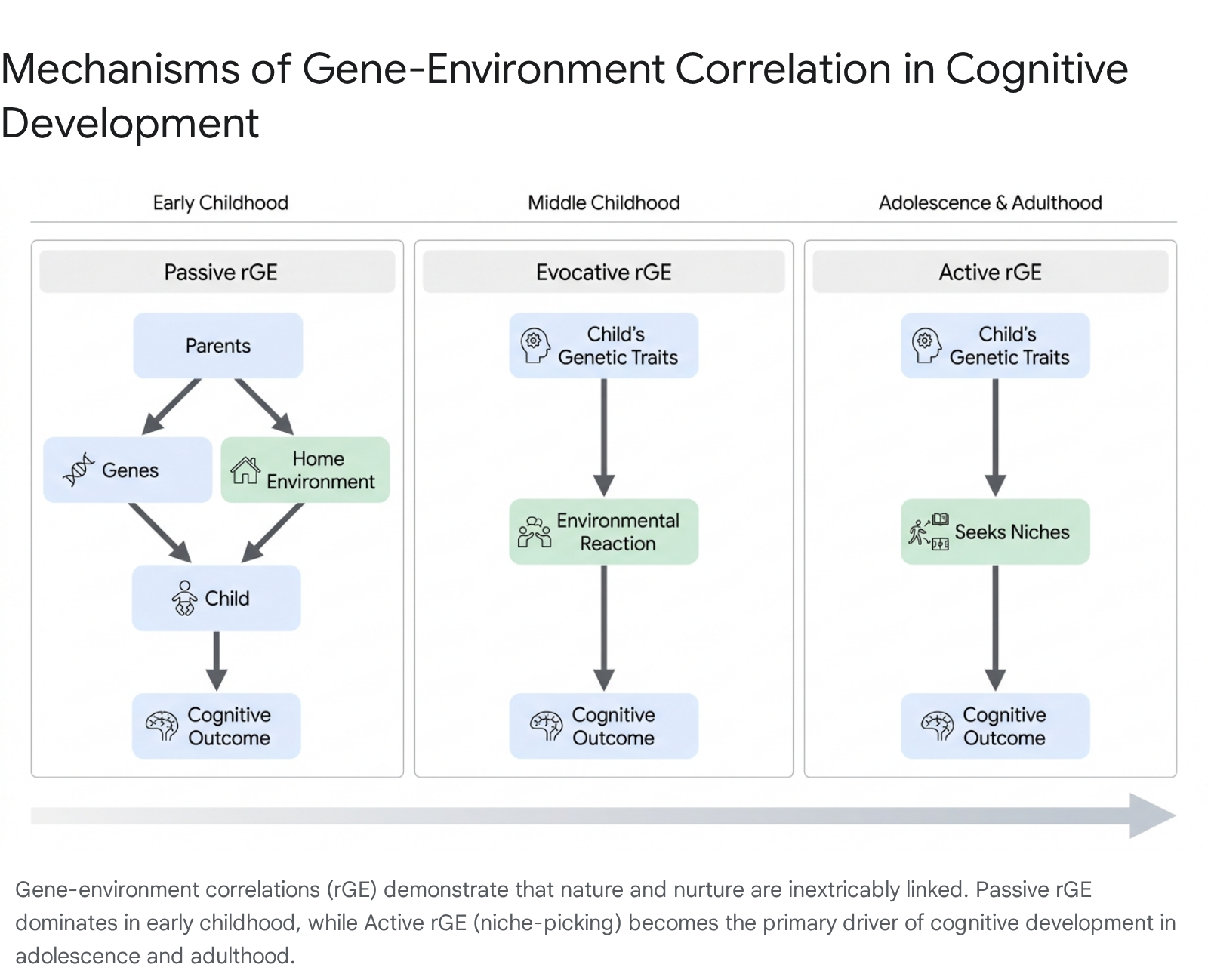
The primary mechanism driving the Wilson Effect is believed to be active gene-environment correlation, often referred to as "niche-picking" 11114. In early childhood, cognitive environments are largely dictated by parents and socioeconomic circumstances. However, as individuals mature and gain autonomy, they actively select, shape, and create environments that align with their inherent genetic predispositions 911. A child with a high genetic propensity for cognitive ability may independently seek out complex literature, intellectually stimulating peer groups, or advanced educational opportunities, thereby amplifying their initial genetic advantage 1. By adulthood, individuals have curated environments that perfectly reflect their genotypes, causing genetic variance to account for the vast majority of phenotypic variance in intelligence 11426.
Evolutionary biologists also propose a developmental timing hypothesis for the Wilson Effect. Highly polygenic traits like intelligence and height tend to have small heritability in early childhood because the organism is highly vulnerable to illness while the immune system is actively training. It is hypothesized that the final building genes for the brain are systematically delayed and fully switched on only after the immune system is established in adolescence, contributing to the surge in heritability 26.
Domain-Specific Heritability in Later Life
While general cognitive ability maintains high heritability into midlife, the trajectory of specific cognitive domains diverges significantly in late adulthood.
| Cognitive Domain | Age Trend and Heritability Estimates |
|---|---|
| General Cognitive Ability (IQ) | Increases from ~20% in infancy to ~80% in early/mid-adulthood; generally stabilizes but may modestly decline to ~60% in late adulthood due to accumulated environmental variance 114. |
| Verbal Ability | Peaks in midlife at an estimated heritability of 0.61; demonstrates a significant decline after age 60 to a minimum of 0.28 14. |
| Spatial Ability | Shows stability or small increases in midlife, followed by a modest decline after age 60 14. |
| Executive Function | Highly heritable in adulthood, though data on late-life trajectories present equivocal results, with some models suggesting steep declines 14. |
The modest decline in heritability for specific cognitive domains after age 60 is generally attributed to the accumulation of unique environmental assaults and varying life experiences. As individuals age, non-shared environmental factors - ranging from occupational hazards to individual health choices - begin to override genetic baselines, driving down twin similarity and resulting in decreased heritability estimates 14.
Gene-Environment Interplay and Epigenetic Mechanisms
The traditional dichotomy of "nature versus nurture" has been entirely discarded by modern genomics in favor of the framework of gene-environment interplay. Genes do not independently determine intelligence; rather, they provide a probabilistic developmental blueprint that strictly requires environmental interaction to be realized 4101622.
Gene-Environment Correlation
Research identifies three primary mechanisms of gene-environment correlation (rGE) that obscure the boundaries between biology and socialization 911. Passive rGE occurs when a child inherits both their parents' genes and the specific environment their parents create, leading to a spurious relationship between the environment and the outcome 11. Evocative rGE happens when an individual's genetically influenced behavior evokes specific responses from the environment; for example, an exceptionally articulate child may elicit more complex vocabulary from teachers than a quieter peer 11. Finally, Active rGE occurs when an individual possesses a heritable inclination to select specific environmental exposures, effectively niche-picking their way into environments that amplify their genetic traits 11.
DNA Methylation and Epigenetic Adaptation
At the molecular level, the environment interacts with the genome through epigenetics. Epigenetic mechanisms, particularly DNA methylation and histone modification, act precisely at the interface of genes and the environment, altering how genes are transcribed and expressed without changing the underlying DNA sequence 910122728.
DNA methylation involves the addition of methyl groups to the cytosine rings of DNA at CpG dinucleotides. This process is catalyzed by DNA methyltransferases (DNMTs), such as DNMT1 which maintains existing patterns, and DNMT3a/3b which establish new patterns in response to environmental cues 28. The addition of these methyl groups generally results in transcriptional repression, effectively silencing specific genes 28. Severe environmental factors - such as early childhood adversity, maternal psychosocial stress, severe malnutrition, or exposure to environmental neurotoxins - can induce pathological epigenetic tags that permanently alter neurodevelopmental trajectories 92729.
Conversely, an enriched cognitive environment can promote epigenetic states that optimize the expression of genes related to synaptic plasticity and neurogenesis 9. Human DNA exhibits complex, non-linear methylation patterns over the lifespan. While there is a general tendency toward demethylation with aging, genome-wide analyses of over 10,000 individuals have identified inverse U-shaped methylation curves at specific CpG sites that peak during middle age, suggesting programmed mechanisms that promote or suppress specific genes at critical developmental timings 29. This dynamic interaction highlights the fallacy of genetic determinism: the genomic sequence outlines biological potential, but the epigenetic state - dictated heavily by the lived environment - determines the actual transcriptomic output 1013.
Epigenetic Clocks and Cognitive Decline
Recent advancements in molecular biology have utilized DNA methylation patterns to measure "epigenetic age," calculating the biological aging of human tissues relative to chronological age. Studies spanning 2022 to 2026 have increasingly utilized specialized "epigenetic clocks" - ranging from first-generation models like Horvath and Hannum to advanced models like PhenoAge, GrimAge, and DunedinPACE - to predict long-term cognitive trajectories 3032333431.
Research indicates that accelerated epigenetic aging is a robust predictor of late-life cognitive decline. In longitudinal analyses such as the Coronary Artery Risk Development in Young Adults (CARDIA) study, the Berlin Aging Study II (BASE-II), and the WHIMS cohort, biomarkers measuring the rapid pace of biological aging demonstrated that accelerated epigenetic aging in midlife significantly predicted lower scores on neuropsychological assessments up to seven years later 30323431.
Specifically, the DunedinPACE clock and AgeAccelGrim2 biomarker have been consistently associated with poorer performance on tasks like the digital Clock Drawing Test, and correspond to a higher risk of incident mild cognitive impairment (MCI) and probable dementia, independent of chronological age 32333431. These findings suggest that the environmental stressors responsible for accelerating epigenetic aging systematically degrade the biological infrastructure required to maintain fluid intelligence in late adulthood, reinforcing the inseparable link between environmental health and cognitive longevity.
Global Trajectories of Intelligence Test Scores
If intelligence were a rigidly hardwired genetic trait, population-level intelligence quotients would remain entirely static over short evolutionary timeframes. Instead, the 20th and 21st centuries have witnessed dramatic, generation-over-generation shifts in global IQ scores, proving the profound malleability of cognitive performance across different environmental eras.
The Flynn Effect
Throughout the 20th century, intelligence test scores rose consistently and remarkably across the developed world, a phenomenon termed the "Flynn Effect" after researcher James R. Flynn, who first systematically documented the trend in the 1980s 32373334. Global scores increased by an average of 3 points per decade, accumulating a massive 30-point shift from 1900 to 2000 323740.
Crucially, the Flynn Effect was not uniform across all cognitive domains. The most significant gains, frequently reaching 5 to 6 points per decade, occurred in tests measuring fluid intelligence and abstract, non-verbal reasoning, such as Raven's Progressive Matrices 32374035. Improvements in crystallized intelligence, such as rote memory and arithmetic vocabulary, were far more modest 3240.
Because genetic evolution operates over millennia, this rapid single-century gain is universally attributed to environmental and societal improvements 323336. The primary drivers of the Flynn Effect include the eradication of severe malnutrition and micronutrient deficiencies (particularly iodine), which allowed childhood neurodevelopment to reach its biological potential 323537. The massive expansion of formal, mandatory schooling shifted cognitive habits away from concrete, experiential thinking toward hypothetical, rule-based, and symbolic reasoning required by modern tests 324035. Furthermore, the phasing out of environmental neurotoxins, particularly the removal of leaded gasoline and paint, contributed an estimated four to five IQ points to American scores between the 1970s and 2000s, removing a severe biological impediment to brain development 3244.
While the Flynn Effect may be plateauing in the West, it continues apace in much of the developing world. Meta-analyses reveal that BRIC nations (Brazil, Russia, India, and China) are currently experiencing the greatest gains, averaging 2.9 points per decade 44. Studies have documented continuing Flynn effects in Kenya, South Africa, Nigeria, and across Southeast Asia, reflecting the ongoing improvements in education and nutrition in the Global South 4438.
The Reverse Flynn Effect
In stark contrast to the historical trend, longitudinal data indicates that the Flynn Effect has stagnated or outright reversed in highly industrialized nations 443839. Starting in the mid-1990s, mandatory military conscription testing in Nordic countries (Norway, Denmark, Finland) revealed a clear and sustained decline in average IQ scores 3233343940. In Norway, scores peaked with the 1975 birth cohort and subsequently began declining at an alarming rate of roughly 6 to 7 IQ points per decade 3244. Similar declines have been documented in the United Kingdom, the Netherlands, Australia, and France 323440.
| Cognitive Phenomenon | Target Geography and Era | Primary Cognitive Impact | Hypothesized Environmental Causes |
|---|---|---|---|
| The Flynn Effect | 1900 - 1990s (Western Nations); Ongoing in the Global South (e.g., BRIC nations, Kenya, Nigeria) 324438. | Rapid, linear gains in fluid intelligence and abstract reasoning (~3 to 6 pts/decade) 3237. | Eradication of malnutrition, expansion of formal schooling, removal of lead toxins, and complex urbanization 323536. |
| The Reverse Flynn Effect | 1990s - Present (Nordic countries, UK, Australia, parts of Western Europe) 32333440. | Declines primarily in fluid reasoning, working memory, and Piagetian stage test performance 3540. | Educational simplification, saturation of nutritional benefits, cognitive offloading to digital environments, degraded attention spans 353644. |
The Reverse Flynn Effect cannot be attributed to genetics. Compelling within-family studies in Norway demonstrated that younger brothers scored lower than their older brothers despite sharing the same family genetics and parentage 323648. This sibling data definitively rules out demographic shifts, immigration, or "dysgenic fertility" (the hypothesis that less intelligent individuals are having more children) as the primary causes 323648.
Instead, the reversal points squarely to shifting environmental conditions. Researchers hypothesize that the "generational tailwinds" of the 20th century have saturated in the developed world; nutrition and basic schooling have reached adequate levels and cannot yield further dramatic gains 4449. Concurrently, new environmental headwinds have emerged. Evidence from Piagetian stage tests (such as the Volume and Heaviness test) suggests basic reasoning skills are deteriorating 40. Heavy reliance on digital environments and screen time strongly encourages cognitive skimming, multitasking, and the "offloading" of memory tasks to external devices, weakening sustained attention and deep fluid reasoning 3537443839. Additionally, some researchers theorize that modern endocrine-disrupting chemicals leaching from plastics may be subtly impairing neurological development in these populations 48.
Methodological Limitations and Bias in Genomic Databases
While polygenic scores provide unprecedented insight into human cognitive architecture, the foundational data powering these metrics suffers from severe demographic imbalances that severely limit their global scientific validity and clinical utility.
Genomics research exhibits a profound and persistent Eurocentric bias. As of 2021, an overwhelming 86.3% of participants in genome-wide association studies were of European descent. By contrast, individuals of East Asian (5.9%), African (1.1%), South Asian (0.8%), and Hispanic/Latino (0.08%) ancestries remained vastly underrepresented in the foundational databases 414243.
This massive data imbalance is not merely a sociopolitical issue; it represents a critical scientific failure 44. Human populations possess differing linkage disequilibrium patterns, allele frequencies, and complex mutational constraints due to distinct demographic and evolutionary histories 424354. When a polygenic score is trained almost exclusively on European populations, its predictive accuracy decays severely when applied to non-European groups due to increasing genetic distance from the original study cohort 414254. For instance, a Eurocentric polygenic risk score can be up to 2-fold less accurate for individuals of East Asian ancestry, and a staggering 4.5-fold less accurate for individuals of African ancestry 42.
If science relies on WEIRD (Western, Educated, Industrialized, Rich, and Democratic) and Eurocentric databases to understand the genetics of cognitive traits, it risks establishing biological reference points that are fundamentally skewed 414454. Applying these models clinically or academically across diverse populations without correction leads to weaker predictions, misidentifications, and exacerbates health and scientific disparities. As researchers note, relying on such highly skewed datasets makes the translation of precision genetics "dangerously incomplete, or worse, mistaken" 414244.
Between-Group Differences and Within-Group Heritability
The most pernicious misunderstanding in the science of intelligence - and one repeatedly exploited to support racist ideologies - is the logical fallacy that high heritability within a population implies that differences between populations are genetically determined 141645.
Mathematical and Evolutionary Fallacies
Mathematical, evolutionary, and statistical geneticists categorically reject the premise that within-group heritability (for example, the observation that IQ is 80% heritable among White Americans) can be used to infer the etiology of mean IQ score differences between different socially defined racial or ethnic groups 4546474849.
The statistic of heritability only captures variance within a uniformly distributed environment. If the environment varies systematically between two groups, heritability estimates become mathematically uninformative regarding the cause of the gap 164648. Evolutionary biologist Richard Lewontin illustrated this via a famous analogy: Imagine a handful of genetically diverse seeds randomly divided into two batches. Batch A is planted in rich, fertilized soil with optimal sunlight; Batch B is planted in toxic, depleted soil. Within each batch, the plants will grow to varying heights based purely on their genetics (100% within-group heritability). However, the average height of Batch A will be vastly greater than Batch B entirely due to the environmental disparity, despite the absolute heritability within each group 1648.
In human societies, race is a sociopolitical construct heavily correlated with structural stratification, wealth inequality, exposure to neurotoxins (like lead), and massive disparities in educational quality 16455051. The environmental processes that directly impact cognitive development are systematically aligned with social ancestry categories. Consequently, between-group differences in cognitive test performance mirror the structure of societal stratification, not a biological inevitability 16224551. Advanced simulation studies in evolutionary quantitative genetics have explicitly proven that aggregate heritable variation within groups cannot separate among-group differences into genetic and environmental components 464749.
The American Society of Human Genetics Consensus
The scientific community is increasingly reckoning with the history of how genetic research has been weaponized to validate social inequalities. In early 2023, the American Society of Human Genetics (ASHG), the largest professional society of its kind, issued a landmark report titled Facing Our History - Building an Equitable Future 525354555657.
The report acknowledged and explicitly apologized for the Society's historical complicity in the American eugenics movement. It specifically criticized the Society's failure to decisively denounce prominent researchers - such as Arthur Jensen and William Shockley in the 1960s and 1970s - who promoted the fallacy that genetics determined differences in intelligence between racialized groups, despite those researchers having no formal background in genetics 50525657.
The ASHG officially reiterated that human populations cannot be divided into biologically distinct subcategories or "races," and emphasized that it is entirely "inaccurate to claim genetics as the determinative factor in human strengths or outcomes when education, environment, wealth, and health care access are often more potent factors" 51. The field now explicitly disavows hereditarian claims regarding racial intelligence gaps, noting they rest on profound methodological and conceptual flaws 48505158.
Societal Implications and the Ethics of Genomic Prediction
Media Portrayal and Genetic Determinism
The extreme nuance of genomic science is frequently lost in science journalism. Driven by the necessity of capturing reader attention, popular media often sensationalizes genetic discoveries, generating headlines that imply direct causal linkages between a newly discovered genetic variant and complex cognitive behaviors 468.
When a new GWAS discovers a locus associated with educational attainment, headlines often proclaim the discovery of "intelligence genes," stripping away the essential context of minuscule effect sizes, gene-environment interplay, and the probabilistic nature of polygenic scores 46. This inaccurate reporting inadvertently fuels "genetic determinism" - the public belief that our destinies and capacities are rigidly hard-wired in our DNA 48. Such coverage not only misinforms the public but can subtly legitimize "hereditarian" social policies that view educational inequalities as biologically justified rather than socially constructed, creating unwarranted fears and disrupting the development of informed public policy 478.
Polygenic Embryo Screening
The commercialization of genomic testing has brought the complex ethical debates surrounding the genetics of intelligence out of academia and directly into reproductive clinics. As of 2023 and 2024, private companies like Orchid Biosciences and Herasight have begun offering Polygenic Embryo Screening (PES) to prospective parents undergoing in-vitro fertilization (IVF) 195960. Unlike traditional preimplantation genetic testing (PGT-M) which flags severe monogenic disorders like Cystic Fibrosis, PES utilizes AI-assisted algorithms to calculate polygenic risk scores for complex conditions, including diabetes, schizophrenia, and potentially non-clinical traits like physical appearance and intelligence 596173.
The ethical and scientific implications of screening embryos for cognitive or behavioral traits are profound and highly contested:
| Ethical and Scientific Concern | Description of the Issue in Polygenic Embryo Screening |
|---|---|
| Scientific Validity and Certainty | Polygenic scores are highly probabilistic and strictly dependent on environmental context. Selecting an embryo based on a high score for intelligence ignores epigenetic development; the embryo is not guaranteed to express the trait due to unpredictable gene-environment interplay 5961. |
| Eugenics and Hyper-Parenting | The ability to select for traits like intelligence or athleticism evokes strong concerns regarding consumer eugenics. Parents who select for a specific trait may subject the child to "hyper-parenting" and immense psychological pressure to fulfill their genetically "purchased" destiny 596173. |
| Pleiotropy | Because genes influence multiple traits simultaneously (pleiotropy), selecting an embryo optimized for intelligence may inadvertently select for an elevated risk of associated autoimmune or psychiatric disorders 59. |
| Societal Inequality and Regulation | Because PES is an expensive technology and remains largely unregulated in jurisdictions like the United States (unlike Germany, Italy, and the UK which heavily restrict it), its widespread adoption threatens to commodify human life and exacerbate societal inequalities by allowing only wealthy families to purchase probabilistic genetic advantages 596061. |
| The Expressivist Critique | Disability rights advocates argue that selecting against certain polygenic traits implies a lower worth of individuals who possess those traits, increasing societal stigma and reinforcing the mistaken belief that neurodivergence is a problem to be solved rather than a form of human variation 5973. |
Conclusion
The scientific understanding of intelligence has matured far beyond simple, deterministic calculations of heritability. Current genomic research reveals that human cognition is supported by a highly complex, polygenic architecture that relies fundamentally on continuous environmental interaction for its expression 2922. From the epigenetic markers that respond to early childhood adversity and alter neurodevelopment, to the active curation of environments that drive the Wilson Effect in adulthood, the genome acts not as a strict developmental blueprint, but as a dynamic mechanism of lifelong adaptation 1101314.
The ultimate malleability of intelligence is empirically proven by the dramatic global fluctuations in IQ scores observed through the Flynn and Reverse Flynn Effects 3233. These sweeping generational trends underscore a critical societal reality: when nations invest heavily in nutrition, health, and formal education, collective cognitive capacity rises significantly; when environments stagnate or introduce new neurodevelopmental hurdles, such as excessive digital offloading or chemical exposures, capacity declines 32364448.
Realizing the full promise of genomic science requires actively confronting its methodological limitations and historical misuses. This necessitates diversifying genomic databases to eliminate crippling Eurocentric biases 4244, maintaining strict regulatory oversight over emerging, ethically fraught technologies like Polygenic Embryo Screening 6173, and aggressively combating the pseudoscientific weaponization of genetics to explain socially engineered group differences 45464851. The genetics of intelligence is ultimately a testament to human adaptability, reinforcing the scientific conclusion that maximizing cognitive potential requires a relentless societal commitment to equality of environmental opportunity.