
Scientific research on the 10,000-hour rule and skill acquisition
Introduction
The pursuit of human mastery and the origins of exceptional performance have provoked rigorous debate within the scientific community for over a century. Historically, this discourse was dominated by two diametrically opposed perspectives. The early hereditarian view, championed by Francis Galton in the nineteenth century, posited that eminence in domains such as science, music, and sports was primarily dictated by innate, biologically inherited talent. Conversely, the behaviorist movement, propelled by figures like John B. Watson in the early twentieth century, argued that environmental conditioning and intensive practice were the sole determinants of genius, effectively rendering innate talent a negligible factor 1.
In recent decades, this academic debate was distilled into the public consciousness through the popularization of the "10,000-hour rule." Widely disseminated by mainstream literature, this heuristic suggests that the accumulation of approximately 10,000 hours of practice is both necessary and sufficient to achieve world-class expertise in any complex domain 234. However, contemporary psychological science, behavioral genetics, and neurobiology reveal a far more nuanced reality. While intensive, structured practice is an undeniable prerequisite for high-level performance, empirical consensus demonstrates that practice alone cannot explain the vast inter-individual differences observed among top-tier performers. The acquisition of skill is a multifactorial phenomenon governed by a dynamic interplay of deliberate practice, genetic predispositions, structural neuroplasticity, early developmental sampling, and sociocultural contexts. This report provides an exhaustive analysis of the scientific literature surrounding skill acquisition, evaluating the quantitative limits of practice and outlining the integrated mechanisms that drive human expertise.
The Origin and Misinterpretation of the 10,000-Hour Rule
The widespread belief that 10,000 hours of practice guarantees mastery is largely an artifact of popular science writing, most notably popularized by Malcolm Gladwell's 2008 publication, Outliers: The Story of Success. The foundation for this assertion was a 1993 study conducted by psychologist K. Anders Ericsson, Ralf Krampe, and Clemens Tesch-Römer, which investigated the role of practice in the acquisition of expert performance among musicians at an elite academy in Berlin 2356.
In the original study, Ericsson and colleagues asked violinists of varying skill levels to retrospectively estimate the amount of solitary practice they had engaged in per week throughout their careers. The researchers found that by the age of 20, the most accomplished students had accumulated an average of roughly 10,000 hours of practice. This was significantly higher than the averages for the less accomplished groups, with "good" students accumulating around 7,800 hours and the least accomplished group (those studying to become music teachers rather than soloists) accumulating approximately 4,600 hours 1367.
The subsequent translation of this finding into a universal rule introduced several severe methodological and conceptual misconceptions that pervade public understanding today:
Firstly, the 10,000 figure was an average among the top-tier group of violinists, not a strict minimum threshold required for mastery. By age 18, this same elite cohort had accumulated an average of only 7,400 hours 3. Furthermore, these 20-year-old violinists were promising academy students, not universally recognized international masters of their domain 35.
Secondly, the popularization of the rule created an illusion of guaranteed outcomes. It propagated the notion that the relationship between practice duration and performance outcome is strictly linear and universally applicable, implying that any individual who logs the requisite hours will inevitably achieve elite status 34.
Finally, the heuristic diluted the concept of "practice" itself. The popular rule often conflates standard repetition, routine work experience, or recreational play with the highly specific construct of deliberate practice. As Ericsson repeatedly clarified in subsequent literature, simply performing a skill for 10,000 hours - such as driving a car daily or playing recreational chess - does not result in elite expertise, because routine execution leads to automated mediocrity rather than continuous improvement 24.
The Construct of Deliberate Practice
To accurately assess the science of expertise, it is necessary to distinguish general experience from the specific psychological construct of deliberate practice. Ericsson defined deliberate practice as engagement in highly structured activities created specifically to improve the current level of performance in a domain 688.
True deliberate practice requires several distinct, highly demanding components. Activities must be goal-directed, designed specifically to target and rectify an individual's current weaknesses rather than simply repeating already-mastered skills 25. This typically necessitates the presence of a knowledgeable coach, mentor, or expert teacher who can provide objective, immediate, and actionable feedback. Without such external correction, performers risk reinforcing mechanical errors and plateauing 345.
Furthermore, deliberate practice requires profound cognitive exertion. It is highly effortful, demands intense concentration, and is often inherently unenjoyable 911. As the practitioner's performance improves, the difficulty of the practice tasks must continuously scale to force the performer out of their zone of proximal development, preventing premature automation of subpar techniques 310.
Despite the precision of this theoretical definition, ensuing scientific literature has frequently debated how deliberate practice should be empirically measured. Some researchers argue that retrospective logs of solitary practice are highly susceptible to recall bias, while others contend that the broader definitions of practice utilized in large-scale meta-analyses dilute Ericsson's original, rigorous construct 68. This definitional friction forms the basis of the most significant modern challenge to the deliberate practice framework.
The Quantitative Meta-Analytic Paradigm
Over the past decade, rigorous meta-analyses have sought to quantify precisely how much variance in human performance can be attributed to deliberate practice. The findings consistently demonstrate that while practice is a statistically significant predictor of skill, it leaves the vast majority of performance variance entirely unexplained.
Domain-Specific Variance in Performance
The most comprehensive investigation into the deliberate practice framework to date was conducted by researchers Brooke Macnamara, David Hambrick, and Frederick Oswald in 2014. Analyzing 157 effect sizes extracted from 88 studies with a cumulative sample size exceeding 11,000 participants, the researchers assessed the correlation between accumulated practice hours and objective performance across multiple disciplines 1711.
The meta-analytic average correlation between deliberate practice and performance was calculated at r = 0.35 (95% confidence interval [0.30, 0.39]). When this correlation coefficient is squared to calculate the percentage of variance explained, the data revealed that deliberate practice accounts for an average of only 12% of the total variance in human performance, leaving 88% of the variance unexplained by practice hours alone 112.
The impact of deliberate practice was found to be highly domain-dependent, moderated heavily by the predictability and structural consistency of the task environment.
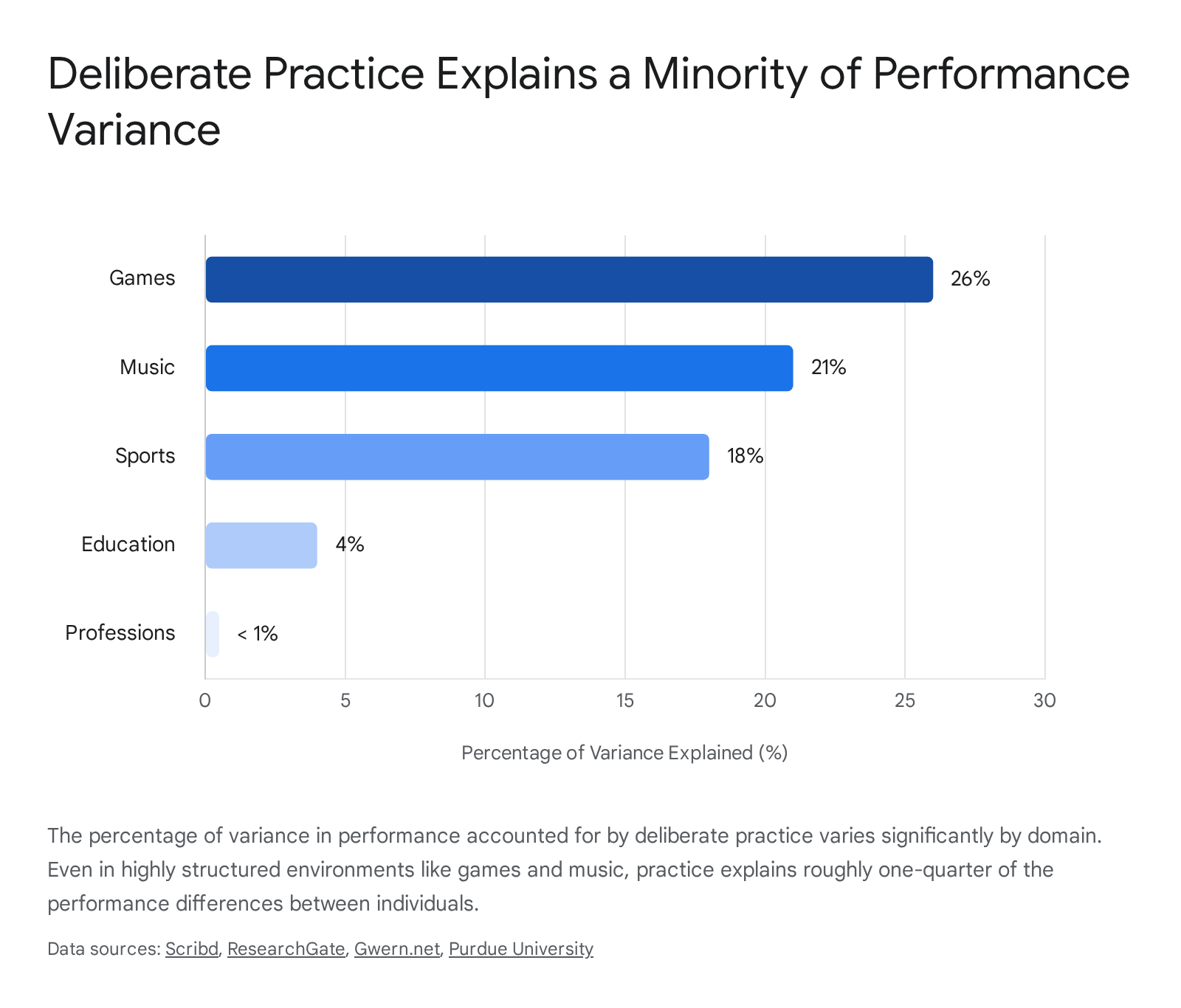
| Performance Domain | Variance Explained by Practice | Characteristics of the Task Environment |
|---|---|---|
| Games (e.g., Chess) | 26% | High predictability; closed systems with fixed, immutable rules; discrete outcomes 1713. |
| Music | 21% | High predictability; standardized notation; relies on repetitive, reproducible physical mechanics 1713. |
| Sports | 18% | Moderate predictability; dynamic environments; highly variable opponent interactions; shifting physical demands 1713. |
| Education | 4% | Low to moderate predictability; diverse cognitive demands; varying pedagogical structures 1713. |
| Professions | < 1% | Low predictability; highly dynamic, complex, and unscripted environments; reliance on adaptive problem-solving 1713. |
These findings highlight that practice is most effective in environments where the rules are static and the feedback loops are perfectly consistent. In highly complex, unpredictable domains such as aviation, corporate leadership, or software engineering, the volume of practice offers virtually zero predictive validity regarding ultimate performance outcomes 17.
The Elite Threshold Effect
Perhaps the most disruptive finding from recent meta-analyses concerns the role of practice at the absolute highest echelons of skill. In a 2016 follow-up meta-analysis focused strictly on athletic performance, researchers found an average variance explanation of 18% across all athletes. However, a critical moderation effect was discovered based on skill level 1114.
While deliberate practice accounted for 19% of the variance among sub-elite athletes, it accounted for only 1% of the variance among elite-level performers (e.g., Olympians versus national-level competitors) 111214. This phenomenon indicates that a strict threshold effect occurs at the boundaries of human performance. A massive accumulation of practice is a necessary prerequisite to enter the elite tier; therefore, almost everyone in that tier has logged an extreme amount of training. Because practice hours are relatively homogeneous among elites, the variables that ultimately separate a gold medalist from an average professional are determined by factors entirely separate from accumulated practice time 1115.
The variance in learning efficiency is similarly stark in cognitive domains. Research by Gobet and Campitelli analyzing chess players revealed that the total amount of deliberate practice required to reach "master" status varied astronomically across individuals - ranging from 3,016 hours to over 23,600 hours. Astonishingly, some players achieved master status with fewer hours of practice than the average intermediate player possessed, explicitly dismantling the concept of a uniform 10,000-hour threshold 111.
Methodological Defenses and Rebuttals
Proponents of the deliberate practice framework have rigorously contested these meta-analytic findings. Ericsson and colleagues argued that the meta-analyses conducted by Macnamara and Hambrick included studies that measured general domain experience, unstructured play, or group training, rather than strictly defined, individualized "deliberate practice" 68.
Subsequent reanalyses attempting to correct for measurement unreliability found that the variance explained by practice could be adjusted upwards - to approximately 36% in music and roughly a third in chess. However, even these corrected estimates leave the majority (roughly 64% to 70%) of performance variance unexplained 12. Further empirical evidence suggests that the specific didactic quality and individualization of practice heavily influence outcomes. A study examining 178 chess players found that when practice was highly individualized and structured, the effect size was more than three times higher than practice of average quality, indicating that raw hour counts frequently mask the underlying efficiency of the training process .
Behavioral Genetics and the Heritability of Potential
If deliberate practice explains only 1% to 26% of performance variance, the remaining variance must be attributed to an amalgamation of genetic predispositions, structural neurobiology, cognitive traits, and broader environmental contexts 11. Advances in quantitative genetics and molecular biology have definitively established that innate "talent" possesses a tangible biological substrate.
The Heritability of Athletic Status and Physical Activity
Twin studies, which compare the phenotypic similarities of monozygotic (identical) and dizygotic (fraternal) twins, serve as the standard epidemiological approach to distinguish genetic from environmental effects. Research utilizing genome-wide linkage analysis has estimated that the heritability of achieving elite athlete status is approximately 60% to 70% 1617. In a landmark study involving 4,488 British adult female twins, achieving elite athletic status demonstrated a 66% heritability estimate 18.
Furthermore, an individual's innate propensity to even engage in practice - their baseline physical activity behavior - is genetically mediated. A meta-analysis of twin and family studies encompassing self-reported and device-based assessments revealed that the broad sense heritability for physical activity across the lifespan averages 43% to 48%. This indicates that the willingness to endure the physical rigors of 10,000 hours of training is itself influenced by genetic predispositions affecting reward pathways and exercise enjoyment 19.
Specific physiological phenotypes critical to sports performance show exceptionally high heritability metrics:
| Physiological Phenotype | Estimated Heritability | Biological Implication |
|---|---|---|
| Muscle Cross-Sectional Area | ~91% | Dictates maximum absolute force production and hypertrophic potential 18. |
| Lean Body Mass | 60% - 80% | Influences power-to-weight ratios essential for gymnastics, combat sports, and sprinting 18. |
| Aerobic Capacity (VO2 Max) | ~50% | Determines baseline cardiovascular endurance; the response to aerobic training is also highly heritable 18. |
| Type I Muscle Fiber Proportion | ~45% | Predisposes individuals to endurance (Type I) versus explosive power (Type II) disciplines 18. |
Genomics research has identified over 250 DNA polymorphisms linked to athletic status, shifting the scientific paradigm away from the search for a single "sports gene" toward understanding complex polygenic profiles 17. For example, the aerobic response to training is highly polygenic; a panel of 21 specific DNA variants identified via genome-wide association studies (GWAS) accounts for 49% of the variance in VO2 max trainability alone 18.
Specific genetic variants have been robustly associated with divergent performance outcomes. The ACTN3 gene (rs1815739 polymorphism), which encodes the alpha-actinin-3 structural protein expressed in fast-twitch muscle fibers, is heavily linked to power and sprinting capabilities. Individuals with the XX genotype lack this protein, predisposing them toward endurance rather than explosive sports 171820. Similarly, the Insertion/Deletion (I/D) polymorphism in the ACE gene regulates the renin-angiotensin system, with the Insertion allele heavily associated with superior metabolic efficiency and endurance performance 1721.
Genetic advantages extend to cognitive processing under pressure. Variants in the COMT (rs4680) and BDNF (rs6265) genes, which modulate dopaminergic signaling and neuroplasticity, are significantly overrepresented in elite athletes. These variants optimize executive function, working memory, and rapid decision-making during high-stakes competition 2223.
Genetic Susceptibility to Injury: The Biological Limiter
The role of genetics in skill acquisition extends beyond establishing maximum performance ceilings; it heavily influences an individual's ability to survive the training process itself. Because deliberate practice requires immense, sustained physical or cognitive load over a minimum of ten years, an athlete's susceptibility to injury acts as a strict biological limiter on practice accumulation.
Meta-analyses demonstrate that susceptibility to soft tissue injuries - such as muscle strains, ligament ruptures, and tendinopathies - possesses a robust polygenic component. Genetic variations in structural genes, notably COL1A1 and COL5A1 (which encode for collagen in the extracellular matrix), are significantly associated with ligament and tendon integrity. Individuals carrying specific at-risk polymorphisms face an average 29% increased likelihood of suffering musculoskeletal injuries compared to non-carriers 161824.
Similarly, athletes possessing the XX genotype of the ACTN3 gene not only exhibit differences in power output but also demonstrate a higher incidence of non-contact muscle injuries. Furthermore, when injuries occur, XX carriers require significantly longer recovery times - an average of 36 days to return to play, compared to 17 to 20 days for those with the RR or RX genotypes 20. Therefore, genetic endowments regulate the exact chronological dosage of deliberate practice an individual can safely tolerate without experiencing career-ending breakdowns.
Cognitive Investment and General Intelligence
In cognitive and academic domains, general mental ability (often measured as g or intelligence) has been shown to predict the speed and efficacy of skill acquisition. Longitudinal studies tracking chess players across their lifespans indicate that intelligence significantly influences skill acquisition during the initial phases of learning inconsistently mapped tasks. Among unranked or novice players, intelligence explains a meaningful portion of performance variance (r = 0.33) 25.
However, as task execution becomes increasingly automated at elite levels, the predictive power of general intelligence diminishes. In ranked adult samples, the correlation between intelligence and chess skill drops to non-significant levels (r = 0.04 to 0.10) 25. This suggests that high cognitive capacity accelerates the early absorption of domain knowledge and complex pattern recognition, allowing gifted individuals to extract higher quality adaptations per hour of practice compared to their peers. Furthermore, investment traits - such as the Need for Cognition (NFC), which dictates an individual's intrinsic motivation to engage in effortful cognitive activities - moderate how effectively a learner applies their intelligence during protracted practice sessions 26.
Neurobiological Mechanisms of Deliberate Practice
While genetics establishes the structural baseline and upper limits of human potential, deliberate practice serves as the environmental catalyst that forces the central nervous system to physically adapt. Over the past decade, advanced neuroimaging and cellular biology have demystified the physical mechanisms underlying behavioral repetition, demonstrating that the brain undergoes profound structural and functional reorganization - a macro-process known as neuroplasticity 2728.
Structural Neuroplasticity and Adaptive Myelination
Historically, neuroplasticity was understood primarily through the lens of synaptic plasticity - such as Long-Term Potentiation (LTP) - where the strength of connections between individual neurons increases with repeated synchronous activation 29. However, recent breakthroughs reveal that structured practice triggers macroscopic changes in the brain's white matter through a process called adaptive myelination 3031.
As an individual repetitively practices a specific skill, specialized glial cells called oligodendrocytes generate new myelin - a lipid-rich insulating sheath - and wrap it around the axons of the highly active neural circuits 3031. This adaptive myelination serves to insulate the axon, preventing electrical leakage and exponentially increasing the velocity and efficiency of action potentials traveling through the circuit.
This physical insulation process provides the biological explanation for the transition from conscious, effortful execution (novice behavior) to automatic, rapid execution (expert behavior).
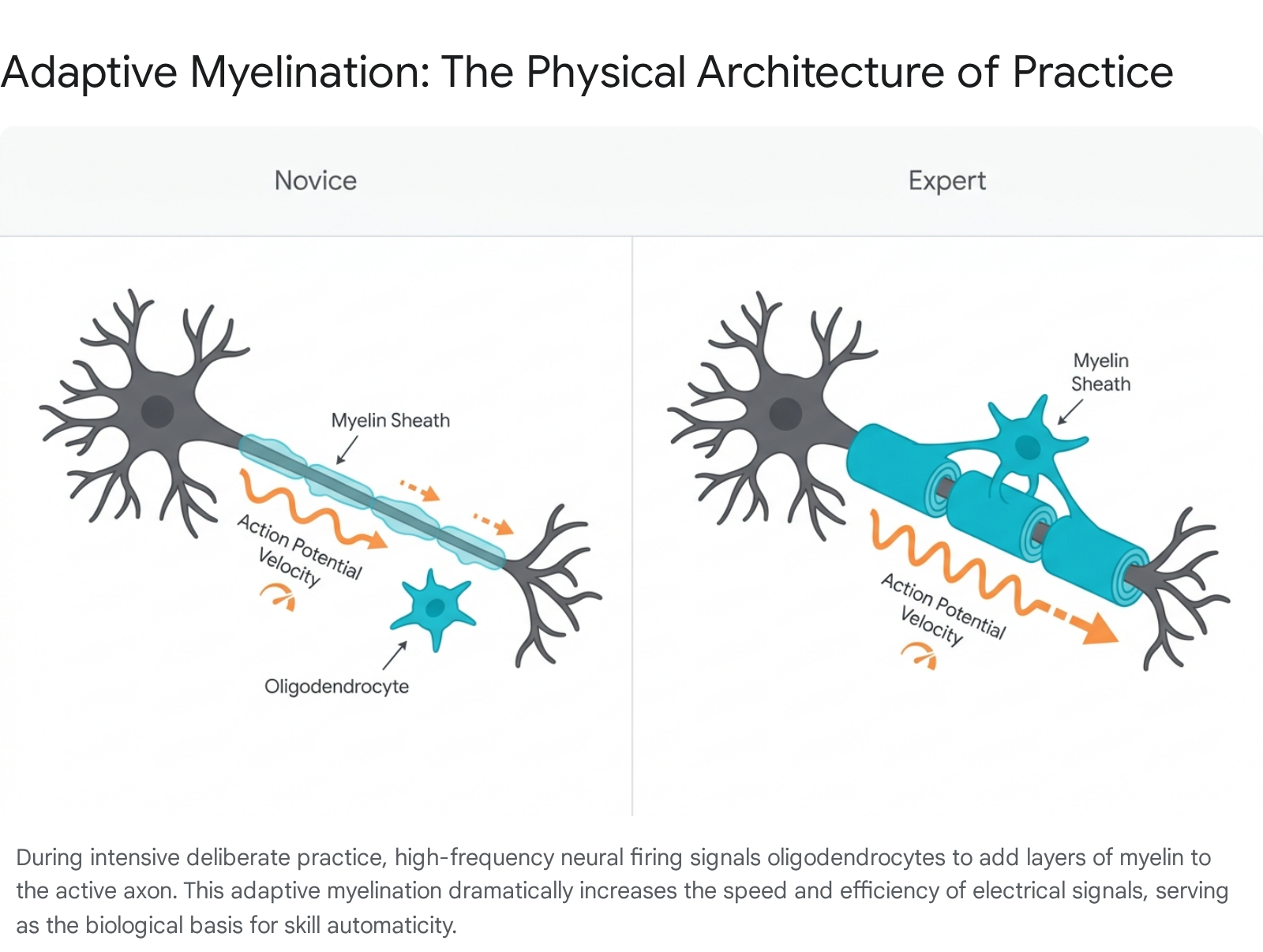
Crucially, adaptive myelination requires highly specific conditions to trigger: it relies on intense, localized neural activity (the hallmark of deliberate practice) and is biochemically mediated by neurotrophic factors such as Brain-Derived Neurotrophic Factor (BDNF) 3031.
Cortical Restructuring and Dopaminergic Modulation
In addition to white matter adaptations, deliberate practice induces localized thickening of cortical gray matter. Longitudinal structural MRI studies examining adults practicing complex visual-spatial problem-solving tasks (such as the computer game Tetris) demonstrate that three months of intensive practice leads to a measurable increase in cortical thickness in specific brain regions, notably the left Brodmann areas 6 and 22/38 3236.
Interestingly, concurrent functional MRI data indicates that as structural thickness increases in these regions, overall brain activation (measured via the BOLD signal) significantly decreases in broader prefrontal areas during task execution 36. This dichotomy suggests that as the brain builds dedicated physical infrastructure for a skill, it becomes metabolically highly efficient, expending less overall energy to execute complex cognitive or motor patterns.
The psychological components of deliberate practice - specifically the persistent engagement with tasks just beyond one's current ability level - are intimately tied to the brain's dopaminergic reward system. Frustration and error-making are vital neurobiological signals that trigger circuit reorganization. When an individual attempts a challenging task, makes an error, adjusts their behavior, and subsequently approximates the correct technique, the brain releases dopamine 37. This neurochemical response not only provides a subjective sensation of reward but directly facilitates the synaptic plasticity required to lock in the new motor or cognitive pattern.
However, functional imaging research reveals that an inverted-U relationship exists between cognitive load and neuroplasticity. Optimal neural adaptation occurs when cognitive load is maintained at approximately 50% to 70% of an individual's capacity. Exceeding this threshold pushes the performer into a state of excessive stress, which activates amygdala-driven threat responses that inhibit prefrontal learning mechanisms 33. Practices such as Mindfulness-Based Stress Reduction (MBSR) and Loving-Kindness Meditation (LKM) have been shown to increase cortical thickness in the insula and hippocampus while reducing amygdala reactivity, thereby cultivating the emotional regulation and attentional stability required to sustain optimal cognitive load during protracted deliberate practice sessions 343536.
Alternative Frameworks: Ecological Dynamics and Skill Acquisition
As the limitations of the strict deliberate practice framework have become apparent, alternative theories have gained significant traction within sports science and cognitive psychology, most notably the Ecological Dynamics approach.
The deliberate practice model inherently assumes an information-processing view of human cognition, wherein skills are viewed as "acquired entities" built through repetitive drills and stored as complex mental representations 10. Consequently, traditional coaching methodologies derived from this framework rely heavily on blocked, repetitive drills designed to automate precise mechanical movements in isolation.
In stark contrast, the ecological dynamics perspective posits that skill is not a stored entity inside the brain, but rather an emergent, functional relationship between the performer and their specific environment 1037. Under this framework, learning is conceptualized as a non-linear process of "attunement." Athletes do not memorize perfect, rigid motor patterns; instead, they learn to perceive "affordances" - opportunities for action presented dynamically by the environment, such as the specific speed of an approaching opponent or the trajectory of a ball 1037.
This perspective fundamentally alters how optimal practice should be structured. Rather than isolated, repetitive drilling, the ecological dynamics model advocates for high contextual interference and representative design 37. Training environments are manipulated using constraint-led approaches (altering rules, field dimensions, or equipment) to force the learner to actively solve emergent movement problems rather than passively repeating a coach's rigid instructions. Systematic reviews and meta-analyses demonstrate that while high contextual interference may lead to more errors and poorer performance during practice sessions, it results in significantly superior long-term retention and far-transfer of motor skills compared to blocked, repetitive practice 3738.
Developmental Trajectories: The Specialization Paradox
The mathematical simplicity of the 10,000-hour rule naturally incentivizes early specialization. The prevailing assumption has been that to accumulate the required ten years of practice by early adulthood, a child must select a single domain in early childhood and practice it exclusively, forsaking all other activities. However, recent massive-scale reviews of developmental pathways definitively contradict this assumption.
A 2025 comprehensive review analyzing data from top-tier athletes, scientists, and musicians uncovered a profound developmental paradox: young exceptional performers and adult world-class performers belong to largely discrete, non-overlapping populations 44.
The empirical evidence indicates that early, exclusive specialization - logging massive discipline-specific practice hours in youth - is indeed associated with rapid early progress and junior-level exceptional performance. However, this early specialization acts as a negative predictor for long-term elite adult status. By contrast, individuals who ultimately achieve the highest echelon of adult world-class performance exhibit an entirely different developmental signature.
| Developmental Pathway | Practice Characteristics in Youth | Long-Term Outcome |
|---|---|---|
| Early Specialization | Extensive discipline-specific deliberate practice; low multidisciplinary exposure; highly structured adult-led coaching. | Rapid early progress; high likelihood of junior-level success; elevated risk of physical burnout and overuse injuries; lower likelihood of elite adult status 4439. |
| Early Sampling | Limited discipline-specific practice; extensive multidisciplinary practice (sampling various sports, instruments, or fields); high amounts of unstructured deliberate play. | Gradual early progress; lower junior-level rankings; highly predictive of attaining elite, world-class status in adulthood 4439. |
This divergence suggests that early sampling and generalized physical and cognitive literacy provide a more robust, adaptable foundation for the extreme, specialized practice required later in life. Systems such as Japan's local talent identification (L-TID) programs embrace this model, emphasizing early multi-sport exposure and sport transitioning before initiating specialized talent transfer pathways, protecting young athletes against psychological exhaustion and localized physical breakdowns 39.
Cross-Cultural Perspectives on Expertise Development
The overwhelming majority of research on skill acquisition, intelligence, and psychological traits has been conducted using WEIRD (Western, Educated, Industrialized, Rich, and Democratic) samples, which historically account for over 95% of participants in major psychological studies 404142. Extrapolating the 10,000-hour rule and Western deliberate practice frameworks globally ignores profound cross-cultural variances in how knowledge, practice, and mastery are conceptualized and executed.
Cultural Dimensions and Performance Management
While comprehensive meta-analyses utilizing databases like MetaBUS indicate that raw performance outcomes are relatively stable across cultural models - meaning that frameworks like Hofstede's dimensions or the Competing Values Framework (CVF) explain only marginal variances in absolute, objective performance metrics - culture heavily dictates the efficacy of how practice and feedback are managed 434445.
For example, the classical deliberate practice framework relies heavily on constant, critical feedback, individual autonomy, and self-regulation. In Western, highly individualistic cultures characterized by low power distance, multi-source feedback (evaluations from peers, supervisors, and subordinates) is highly effective, culturally expected, and well-received 4647.
In stark contrast, in societies with high power distance and high in-group collectivism (e.g., several East Asian and Middle Eastern cultures), learning and organizational behaviors are often managed via strict top-down hierarchies. In these contexts, athletes and students may prefer authoritative, less transparent assessments from a single master. Constructive, argumentative feedback - often encouraged in Western settings to foster autonomy - may be viewed as a breach of group harmony or a sign of disrespect rather than a tool for individual improvement 4647. Consequently, Western leaders or coaches attempting to apply individualistic autonomy or radical transparency in collectivist environments frequently encounter significant performance friction 47.
Epistemological Differences in Mastery
At a foundational level, Western science approaches skill acquisition as an individual, cognitive pursuit: knowledge is propositional, objective, and inherently separated from the self 54. Conversely, many Indigenous, Latin American, and non-Western epistemologies view learning and mastery as inherently communal, embodied, and holistic. In these frameworks, truth and skill are not merely argued or mechanically drilled, but are felt and validated through community integration and shared experience 425448.
Empirical studies examining Chinese physical education and music settings highlight how culturally embedded traits modify the practice process. In these contexts, the application of deliberate practice is heavily intertwined with specific motivational constructs such as task persistence, perceived challenge, and metacognitive beliefs. Chinese students who display high cognitive confidence and intrinsic motivation utilize metacognition to self-regulate their practice, acting as necessary mediators that translate structured, repetitive effort into actual creative performance 495051. Thus, attempting to transplant a rigid, Western-defined 10,000-hour protocol into a non-Western context without adjusting for local epistemologies, communication norms, and motivational drivers often results in systemic friction and vastly reduced efficacy.
Conclusion
The scientific evidence emphatically demonstrates that the 10,000-hour rule is a reductionist myth that fails to capture the true complexity of human expertise. While the accumulation of structured, effortful practice is an inescapable requirement for reaching high levels of proficiency, it is entirely insufficient as a standalone mechanism for world-class mastery.
Extensive meta-analytic research proves that deliberate practice explains, on average, a minority of the variance in human performance. Its impact ranges from roughly a quarter of the variance in highly constrained domains like chess and music, down to a mere 1% among elite athletes, and virtually zero in complex, unpredictable professional environments. The journey to world-class expertise is strictly governed by biological constraints, including the highly heritable nature of physical traits, baseline cardiovascular trainability, cognitive processing speeds, and innate susceptibility to injury.
Furthermore, the qualitative nature of practice heavily outweighs the raw quantity of accumulated hours. Effective practice requires careful management of cognitive load to trigger specific neurobiological adaptations, such as adaptive myelination in white matter and targeted cortical thickening in gray matter. Longitudinal data upends traditional developmental assumptions, proving that early multidisciplinary sampling, rather than immediate hyper-specialization, forms the most reliable pathway to enduring, world-class mastery. Ultimately, science dictates that experts are neither exclusively "born" nor simply "made" - they are the emergent result of rare genetic predispositions meticulously optimized through highly specific, individualized, and culturally attuned environmental interactions.