Do Workday Breaks Actually Improve Productivity
Extensive occupational psychology research definitively debunks the myth that continuous, uninterrupted work yields higher total output, revealing instead that strategic, structured breaks are essential for sustaining cognitive function and preventing neurological fatigue. While the exact optimal rhythm varies based on task complexity and individual chronotypes, evidence indicates that true restorative breaks - which strictly exclude digital context-switching like social media - dramatically reduce mental depletion and are increasingly recognized as a fundamental human labor right in global regulatory frameworks.
The Human Energy Crisis in the Hybrid Era
Picture the modern knowledge worker at 3:00 PM: staring blankly at a high-resolution screen cluttered with dozens of open tabs, toggling frantically between a complex spreadsheet, an incoming barrage of team messaging notifications, and a video conference link. Despite having been tethered to the workstation for six consecutive hours in a determined effort to push through the workload, this worker feels a profound sense of exhaustion, yet struggles to identify a single meaningful task completed that day. This scenario is not anecdotal; it is the statistical reality of the modern workplace. In 2024, researchers from the University of California, Irvine, tracked knowledge workers and found they switched between different windows and tabs an average of 566 times per day 1. Each of these micro-switches contributes to a mounting cognitive load, leaving workers feeling perpetually behind, chronically fatigued, and victims of a modern epidemic of digital depletion 1.
As the global workforce navigates the complexities of 2026 - characterized by hybrid work models, the ubiquitous integration of artificial intelligence, and a growing emphasis on human sustainability - the traditional paradigm of the eight-hour continuous workday has fractured 132. The relentless pursuit of efficiency at all costs has inadvertently birthed a human energy crisis, wherein heavy workloads and always-on connectivity impede the brain's biological capacity for energy renewal 3. The World Economic Forum and major workforce analysts increasingly frame productivity not as an operational challenge, but as a human sustainability issue 2. Over the past year alone, high-profile organizations embracing startup-style cultures characterized by aggressive performance management and minimal flexibility have experienced severe cultural dissonance, resulting in regrettable retention losses as disengaged employees burn out in silence 4.
This comprehensive analysis synthesizes peer-reviewed research from occupational psychology, neuroscience, and major institutional frameworks, including the American Psychological Association (APA), the World Health Organization (WHO), and the International Labour Organization (ILO). By shifting the focus from outdated metrics of continuous output to evidence-based restorative protocols, this investigation explores the cognitive mechanisms of breaks, individual variations in optimal timing, and the diverse cultural and legislative approaches to protecting rest across the globe.
Debunking the Myth: Does Continuous, Uninterrupted Work Actually Yield Higher Total Output?
For decades, industrial-era management philosophies have equated physical presence and continuous activity with maximum productivity. However, contemporary cognitive science fundamentally dismantles this premise. The human brain is not a computational machine capable of infinite, linear output; rather, it is a biological organ optimized for depth and cyclical effort 7. Persistent, uninterrupted cognitive activity inevitably leads to changes in motivation, severe mental fatigue, and a quantifiable deterioration in executive function 5.
The Cognitive Cost of Context Switching and the Toggle Tax
When individuals attempt to work continuously, they inevitably succumb to the necessity of managing multiple streams of information simultaneously, a behavior frequently mislabeled as multitasking. Decades of task-switching experiments demonstrate that true multitasking is a neurological illusion. A landmark cognitive study revealed that only about 2.5% of individuals can perform two complex tasks simultaneously without a noticeable drop in performance quality 6. For the remaining 97.5% of the population, attempting to process multiple workstreams results in context switching: the mental act of stopping one task, deactivating one set of cognitive goals, loading the context of another, and attempting to resume without losing momentum 10.
The financial and cognitive toll of this behavior, frequently referred to as the Toggle Tax, is staggering. Research indicates that chronic context switching consumes between 40% and 67% of a person's potentially productive time 111. When a worker is interrupted, the cognitive residue from the previous task lingers, competing for working memory capacity 10. Studies have shown that after a significant interruption, it takes an average of 23 minutes and 15 seconds to fully regain focus and return to the original task at the same level of depth 1101213.
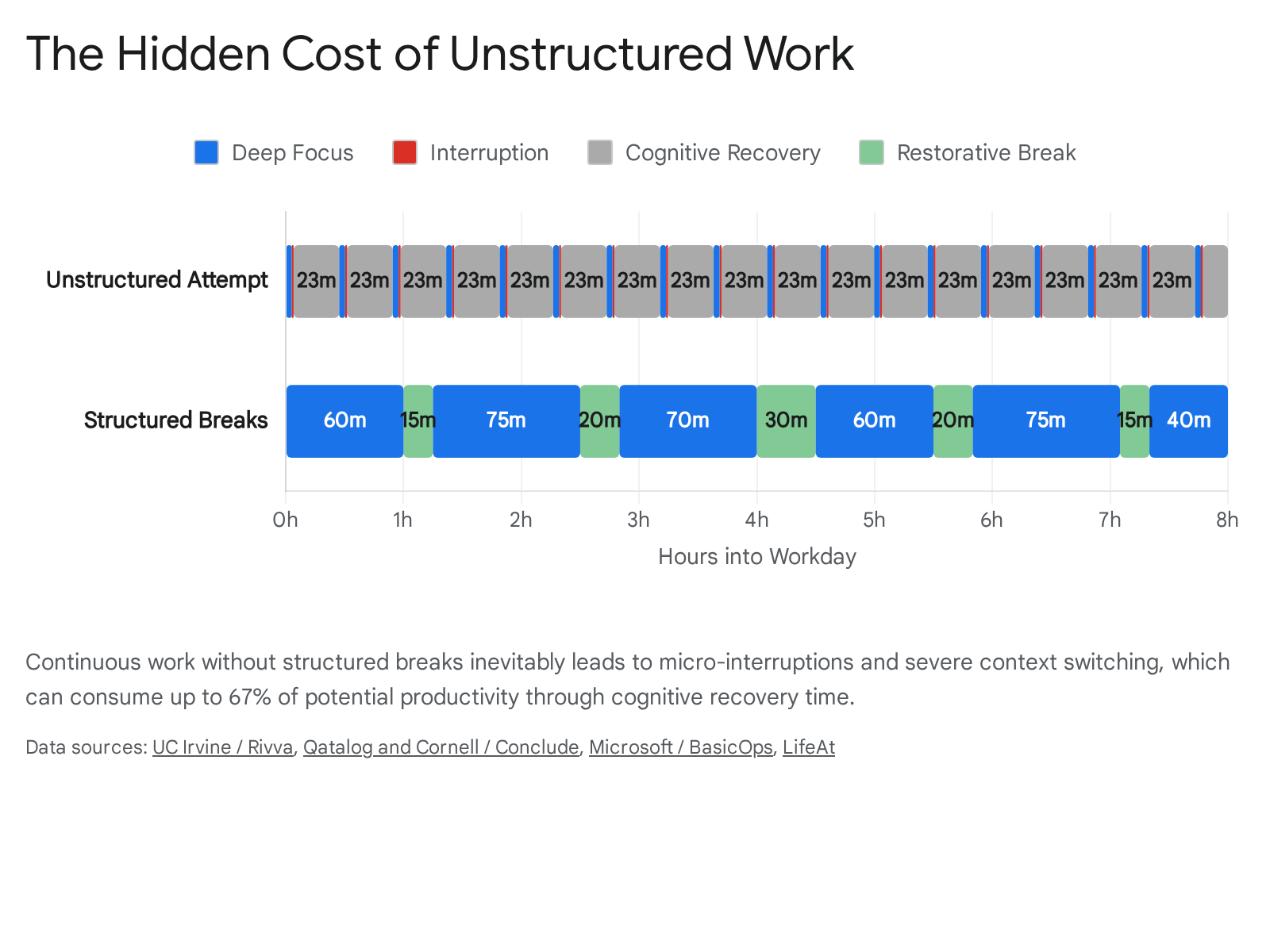
Even brief interruptions, such as a five-second glance at a smartphone notification, have been shown to triple the error rate in complex cognitive work 10.
The impact extends far beyond mere time loss. Repeated task-switching overloads working memory and impairs overall executive function. In extreme cases, a 2024 study highlighted that heavy multitasking can simulate a cognitive decline equivalent to a drop of up to 10 IQ points, fundamentally reducing a worker's ability to think clearly and solve complex problems 11. Furthermore, as artificial intelligence applications increasingly take over routine execution work, the remaining human tasks are heavily skewed toward strategy, critical thinking, and complex judgment - activities that are highly susceptible to cognitive fragmentation 32.
Vigilance Decrements and the Illusion of Speed
A fascinating, yet insidious, layer uncovered by cognitive researchers is that under constant interruptions, workers often complete tasks faster to compensate for the lost time, initially making it appear that performance has not declined 6. However, this acceleration is not an organic increase in efficiency; it is driven by a persistent sense of time scarcity and short-term biological mobilization. The brain relies on a constant state of alert, pumping stress hormones to maintain speed without the necessary recovery periods 610.
This dynamic leads to a sharply increased level of stress that differs fundamentally from traditional work stressors, such as tight deadlines or excessive volume. Context-switching stress emerges even when the total workload remains static, simply because the work is heavily fragmented 6. The brain is denied the time to complete cognitive cycles, consolidate information, and recover between efforts. Over time, this unresolved cognitive fragmentation leads to diminished decision quality, cynicism, emotional exhaustion, and severe burnout 7610.
Advanced psychological modeling provides granular insight into this decay. Utilizing the Sustained Attention to Response Task (SART) combined with Drift-Diffusion Modeling (DDM), researchers have measured the phenomenon known as the vigilance decrement - the natural decline in performance during tasks requiring ongoing detection of critical signals 7. The data reveals that continuous work without breaks inevitably leads to a decline in overall accuracy and an increase in mind-wandering, as perfect sustained attention is fundamentally impossible due to inherent neural, biological, and cognitive limitations 78. Similarly, investigations into intra-individual variability dispersion (IIV-d) in neuropsychological testing show that individuals forced to maintain continuous attention exhibit higher variability in reaction times, indicating lapses in executive control and temporary cognitive impairment similar to those observed in clinical populations with attention deficits 910. Therefore, the premise that powering through tasks yields more output is a biological fallacy; it yields faster, highly variable, and lower-quality output at the direct expense of the worker's long-term cognitive sustainability.
The Evolution of Rhythms: How Often and How Long Should We Really Disconnect?
If continuous work is structurally counterproductive, the logical inquiry turns to the timing and duration of work intervals. What does occupational research reveal about the optimal rhythm of effort and recovery? An examination of productivity data across the last decade reveals that optimal break ratios are not static; they evolve in response to macroeconomic shifts in work environments.
From 52/17 to 75/33: The Data-Driven Evolution
Over the past ten years, extensive data analytics and time-tracking studies have attempted to quantify the ideal work-to-break ratio. These frameworks provide a window into how the context of work dictates the rhythm of rest.
The pre-pandemic baseline was established by the widely cited 52/17 framework. In 2014, productivity tracking software DeskTime analyzed the computer usage logs of its top 10% most productive users. The data revealed a striking pattern: the highest performers did not work eight-hour continuous days. Instead, they worked in highly focused sprints of exactly 52 minutes, followed by a complete break of 17 minutes 1819. This aligns remarkably well with the biological concept of ultradian rhythms - natural cycles of high alertness and recovery that occur roughly every 90 to 120 minutes 19. The success of this ratio hinged on strict adherence; top performers used the 52 minutes for absolute focus and the 17 minutes for total detachment, completely stepping away from their workstations 1911.
However, the transition to mass remote work severely disrupted this equilibrium. In 2021, amidst the global shift to fully remote operations during the COVID-19 pandemic, the same methodology yielded a radically different result. The optimal ratio among top performers had shifted to 112 minutes of work followed by a 26-minute break 1821. Researchers attributed this to the isolation of remote environments; stripped of natural office interruptions like water cooler chats or commuting, workers were able to sustain much longer periods of deep focus. However, these extended, 1.5-times-longer sprints required 1.3-times-longer recovery periods to stave off severe cognitive depletion 2223.
By 2024 and 2025, as hybrid work models stabilized as the dominant corporate paradigm, the ratio evolved once more. The latest data indicates an optimal cycle of 75 minutes of work followed by a 33-minute rest 2223. This shift suggests a return to more balanced working habits, leveraging the social dynamics and natural interruptions of the physical office to encourage more frequent, slightly longer intervals of mental rejuvenation, offsetting the deep isolation of the fully remote era 22.
The Pomodoro Controversy and the Role of Task Complexity
Perhaps the most famous time-management framework is the Pomodoro Technique, developed in the late 1980s, which mandates 25 minutes of focus followed by a 5-minute break 1224. While highly popular for combating procrastination and breaking large tasks into manageable segments, recent peer-reviewed research presents a nuanced view of its universal efficacy.
A 2024 comparative study published in Behavioral Sciences challenged the assumption that rigid, structured timers always produce superior outcomes. The study investigated self-regulated learning environments, finding no significant difference in actual productivity, task completion, or flow states between students using the Pomodoro technique, the Flowtime technique, and entirely self-regulated breaks 2512. Surprisingly, the study revealed that rigid Pomodoro breaks led to a quicker increase in fatigue and a faster decrease in motivation compared to self-regulated breaks 2512. Forcing a cognitive halt at an arbitrary 25-minute mark can severely disrupt a flow state, working against the brain's natural recovery patterns if the individual is deeply engaged in complex problem-solving 25.
Conversely, in domains requiring intense, highly demanding cognitive effort combined with heavy memorization - such as medical anatomy education - a 2025 scoping review of randomized controlled trials found that structured Pomodoro intervals consistently resulted in approximately 20% lower fatigue, a 0.5-point improvement in distractibility, and a 0.4-point increase in motivation compared to self-paced schedules 13.
This contradiction highlights a critical occupational insight: the optimal break frequency is heavily moderated by task complexity. A comprehensive meta-analysis of micro-breaks (breaks under 10 minutes) encompassing 22 independent samples of over 2,300 participants found that while short pauses reliably boost vigor and reduce fatigue, they only significantly improved actual performance for tasks with lower cognitive demands, such as clerical or routine creative work 3. The more complex a task is, the more mental effort is required, increasing neural activity and metabolic demands on the brain. For highly depleting, complex cognitive tasks, working memory becomes overloaded, and a 5- or 10-minute micro-break is simply insufficient for neural recovery 328.
Comparison of Popular Break Frameworks
The scientific backing for various break frameworks reveals that personalization and task alignment are paramount.
| Break Framework | Work/Rest Duration | Core Methodology & Recommended Activities | Scientific Backing & Contextual Efficacy |
|---|---|---|---|
| Pomodoro Technique | 25 min work / 5 min break (longer break after 4 cycles) | Rigid structure designed to overcome initial procrastination. Activities: Standing, stretching, short walks. | Moderate/Mixed: Effective for routine tasks and anatomy learning, but can disrupt flow states and increase fatigue in complex knowledge work 251213. |
| 52/17 Rule | 52 min work / 17 min break | Based on big-data analysis of top performers. Aligns with ultradian rhythms. Activities: Complete detachment from screens 181911. | High: Strongly supported by time-tracking data and biological rhythms. Ideal for mixed office environments and general knowledge work 1911. |
| Flowtime (Self-Regulated) | Variable (Work until focus wanes / Break length scales with work time) | Empowers individuals to listen to biological cues. Break length is strictly proportional to the preceding work sprint 2512. | High: Supported by 2024 studies showing reduced fatigue and higher motivation maintenance compared to rigid timers for complex, deep work 2512. |
| 75/33 Ratio | 75 min work / 33 min break | Emerged in 2024/2025 as the hybrid work standard. Activities: Socializing, physical movement, eating 2223. | Emerging: Reflects the modern reality of hybrid schedules, balancing in-office social dynamics with adequate recovery time 2223. |
| Micro-Breaks | Variable (Few seconds to < 10 mins) | Frequent, brief pauses to manage physical strain. Activities: Gaze shifting (20-20-20 rule), standing, deep breathing 38. | Strong for Well-being: Statistically significant improvements in vigor and fatigue, but definitively insufficient for restoring performance after intense cognitive depletion 3. |
The Anatomy of Recovery: Does Scrolling Social Media Actually Count as a Cognitive Break?
Understanding when to take a break is only half the equation; the specific activity performed during the break dictates its restorative value. A pervasive modern habit is the digital break - closing a work spreadsheet only to open a smartphone and scroll through social media feeds. The scientific consensus on this practice is unequivocal: it acts as a cognitive drain rather than a cognitive break.
The Digital Doom Loop and Cognitive Stagnation
A pivotal pilot study conducted at Swinburne University explored the neurological impacts of social media scrolling as a break mechanism. The research revealed that exposure to phone screens for just three minutes caused crucial brain activity levels to slump, resulting in measurable, immediate drops in focus, cognition, and emotional state 14. Furthermore, using electrodes to track oxygen levels, researchers found that while social media usage caused the largest increase in blood flow to specific brain regions (surpassing both television and gaming), this oxygen was not actively utilized by the brain for engagement or problem-solving 14. The brain was flooded with stimuli, yet cognitively stalled - a phenomenon users often describe as the doom scroll, which leaves them feeling less productive, highly tense, and unable to refocus on work tasks 14.
If digital context-switching constitutes a fundamental waste of resources for the brain, true recovery must rely on different mechanisms.
Active vs. Passive Restoration
Research into the efficacy of different break activities points toward two highly effective modalities: passive nature exposure and active physical movement.
A 2024 Harvard T.H. Chan School study and comprehensive reviews of environmental psychology demonstrate that even brief, passive exposure to nature - whether walking outside or viewing simulated natural environments via 2D video or virtual reality - provides the strongest evidence for directed attention restoration 52815. Across educational and corporate levels, cognitive benefits consistently emerge regarding selective attention, sustained attention, and working memory following contact with green environments, actively mitigating the mental fatigue associated with prolonged focus 15.
Alternatively, integrating physical activity (e.g., stretching, brisk walking, or cycling) during rest periods yields significant physiological benefits. Active breaks increase cerebral blood flow, elevate neurochemical levels such as dopamine and brain-derived neurotrophic factor (BDNF), and regulate stress responses through improved heart rate variability (HRV) 1617. A 2025 systematic review analyzing active break interventions noted strong effect sizes for attention enhancement and decision-making quality, particularly emphasizing that 30-minute sessions showed the largest effect size (0.98) for cognitive improvement 2816.
However, a critical insight from recent meta-analyses indicates that physical movement works through mechanisms distinct from pure cognitive restoration. While active breaks vastly improve energy, mood, and long-term psychological resilience, acute physical exercise during a short micro-break does not automatically enhance performance on complex cognitive tests immediately following the break 28161718. Electroencephalogram (EEG) studies have shown that while walking breaks increase attention-related brain activity (indicated by a higher P3 amplitude), immediate behavioral performance on complex tasks often remains unchanged 18.
Ultimately, the underlying theme of successful recovery is complete psychological detachment from work demands. Researchers studying the 52/17 method noted that top performers exhibited a strict discipline during their 17 minutes of rest: they completely disconnected from technology, refusing to check emails or engage in digital multitasking, thereby allowing the autonomic nervous system to genuinely decompress 11.
Biological Alignment: How Do Individual Chronotypes Influence the Timing of Work and Rest?
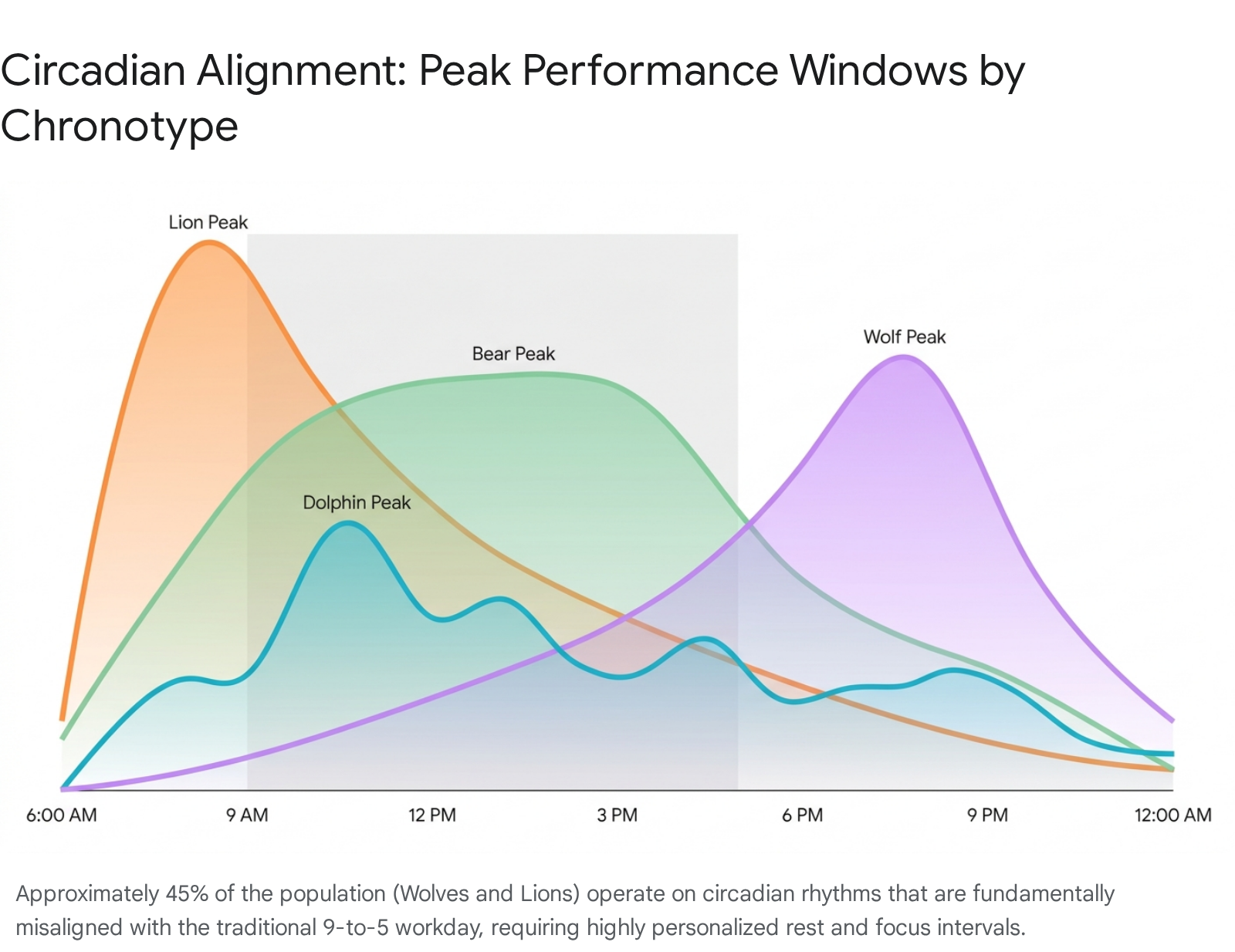
Standardized break frameworks often fail because they ignore profound physiological differences in human energy regulation. Every human body operates on a 24-hour internal clock known as the circadian rhythm, which governs the release of hormones like cortisol and melatonin, metabolism, and cognitive performance 1920. The subjective behavioral expression of this rhythm is an individual's chronotype - their natural, genetically linked inclination for sleep, wakefulness, and peak cognitive output 203621.
Clinical sleep expert Dr. Michael Breus categorizes the population into four distinct chronotypes: * Lions (15%): Early risers who experience peak cognitive performance from dawn until noon, but suffer significant energy depletion by mid-to-late afternoon 203839. * Bears (50-55%): Individuals whose energy aligns closely with the solar cycle, peaking in mid-morning to early afternoon, followed by a post-lunch slump 203839. * Wolves (15-30%): Classic night owls who struggle with early mornings. Their cognitive peak for creativity and complex analytical work often occurs in the late afternoon or evening 203839. * Dolphins (10%): Light, erratic sleepers who often peak mid-morning but require flexibility due to inconsistent energy levels and higher risks of insomnia 203839.
The traditional 9-to-5 workday structurally discriminates against late chronotypes. Research from the University of Oulu in Finland, utilizing a major population database of over 12,000 individuals followed for decades, found that night owls forced into early work schedules were twice as likely to underperform compared to early birds. These individuals accumulate social jetlag and run a significantly heightened risk of health-related early retirement, short sleep duration, and insomnia 21.
When individual work schedules and break times are misaligned with a worker's biological preference, the cognitive consequences are severe and measurable. A 2025 Central European study utilizing the Morningness-Eveningness Questionnaire (MEQ) demonstrated that aligning work start times and cognitive tasks with an employee's chronotype could raise perceived productivity by more than 10% per hour of misalignment, resulting in total output gains exceeding 20% in some cases 40. Furthermore, researchers at the University of Washington found an ethical dimension to this misalignment: larks (morning types) are more prone to unethical behavior or critical errors late at night, whereas owls exhibit these tendencies early in the morning 22.
Therefore, optimal break frequency cannot be universally mandated. A Lion may require intense macro-breaks in the mid-afternoon to recover from cognitive decline and cortisol drops, whereas a Wolf may require extended breaks in the early morning to manage grogginess before initiating deep work later in the day 193823. The long-term implications of hybrid work suggest that chronoworking - allowing employees to set start, stop, and break times according to their genetic circadian rhythms - will be a primary driver of retention and cognitive sustainability 394043.
Legislating Rest: How Do Global Break Cultures Contrast With Western Workplace Norms?
As the scientific consensus solidifies around the absolute necessity of restorative breaks, governments globally are transitioning these physiological needs into codified labor rights. An examination of global legislation, guided by reports from the International Labour Organization (ILO), reveals deeply entrenched regional attitudes toward work, rest, and human sustainability.
The European Union's Vanguard: The Right to Disconnect
The European Union operates under the Working Time Directive (EWTD), a sweeping piece of legislation that sets rigorous minimum standards across member states. The EWTD mandates a maximum average workweek of 48 hours (including overtime), a minimum of 11 consecutive hours of daily rest, and explicitly entitles workers to an uninterrupted rest break of at least 20 minutes if their workday exceeds six hours 4445462448. Following a pivotal 2019 European Court of Justice ruling in the Deutsche Bank case, member states are now actively enforcing strict electronic time-recording systems to ensure these breaks are genuinely taken, with nations like Denmark implementing mandatory daily tracking as of July 2024 444548.
Beyond basic breaks, Europe is pioneering the Right to Disconnect. Recognizing that digital connectivity effectively nullifies off-hours rest, France implemented pioneering legislation in 2017 requiring companies to negotiate terms allowing employees to ignore digital communications without reprisal outside defined hours 4925. As of 2026, nine European nations have statutory frameworks protecting this right. Belgium extended it to civil servants and companies with over 20 employees 4925, Ireland enforces it via a formal Workplace Relations Commission Code of Practice with tribunal backing 4951, and Luxembourg has instituted aggressive administrative fines ranging from €251 to €25,000 for employers who fail to establish a disconnection regime, fully enforceable as of July 2026 51.
Latin America and the Global South: Rapid Adaptation
Latin American nations have aggressively adopted telework protections and disconnection rights, viewing overwork strictly as an occupational health and safety crisis. In 2022, Colombia's Congress issued Act 2191, mandating all employers to establish internal policies guaranteeing the right to disconnect 4952. In a landmark 2023 ruling (C-331), Colombia's Constitutional Court elevated this right to a fundamental human right, radically ruling that it applies to all employees - including upper-level management and trust positions, who are traditionally exempted from overtime laws globally 5354. Similarly, Peru mandates that non-exempt teleworkers receive 16 continuous hours of rest in a 24-hour period, explicitly blocking employer contact 5355, while Mexico and Argentina have tailored strict teleworking laws to avoid employees being contacted during nonworking hours or leave 4955.
In Africa and Asia, statutory approaches vary. The ILO notes that while legislated rest breaks are statistically least common in Africa, emerging economies are shifting. Where breaks are mandated (e.g., Nigeria, Angola, South Africa), they tend to be robust, often guaranteeing one hour or more, particularly for arduous labor 26. Kenya is leading the digital frontier on the continent, proposing the Employee Amendment Bill to legally protect workers from answering calls or emails during weekends or holidays, backed by $4,000 fines for corporate violations 25. In Asia, nations like Vietnam explicitly mandate a 30-minute consecutive break for a six-hour workday, extending to 45 minutes for night shifts, alongside strict weekly 24-hour rest minimums 27.
The United States: The Regulatory Outlier
In stark contrast to the EU and Latin America, the United States remains a glaring outlier among industrialized nations. At the federal level, the Fair Labor Standards Act (FLSA) explicitly does not require employers to provide lunch or coffee breaks 28. While the law stipulates that if an employer chooses to offer a short break (5-20 minutes), it must be paid as compensable time, larger meal breaks are generally unpaid and completely unprotected at the federal level 28. Protection is relegated to a patchwork of state laws; for instance, Washington state mandates a paid 10-minute break for every four hours worked, scheduled near the midpoint of the shift, and explicitly requires a 30-minute meal break for shifts over five hours 29. The U.S. has virtually no federal momentum for a Right to Disconnect, reflecting a prevailing corporate culture that often prioritizes rapid response times and uninterrupted availability over regulated cognitive recovery 55.
Global Statutory Break Regulations and Disconnection Rights
| Region / Nation | Mandated Workday Break Standards | Right to Disconnect (RTD) Status | Enforcement & Penalties |
|---|---|---|---|
| European Union (EWTD) | Minimum 20 mins for shifts over 6 hours; 11 hours daily rest 4424. | 9 member states have statutory RTD frameworks in 2026 51. | Strict time tracking mandated. Fines vary (e.g., up to €200,000 in Spain for grave violations, €25,000 in Luxembourg) 445153. |
| Colombia | Standard lunch/rest breaks per labor code. | Deemed a fundamental human right by Constitutional Court (applies to managers) 5354. | Fines from the Ministry of Labour; violations treated as workplace harassment 5254. |
| United States | No federal requirement. Left to state law (e.g., WA requires 10 mins per 4 hours) 2829. | No federal legislation. Highly dependent on specific corporate culture 5528. | N/A federally. State-level wage and hour claims apply only where state laws exist 29. |
| Vietnam | Minimum 30 mins for 6-hour shift; 45 mins for night work 27. | No formal national RTD, but strict overtime caps (max 200/300 hours yearly) 27. | Ministry of Labour inspections; financial penalties for exceeding strict overtime limits 27. |
| Australia | Standard modern award breaks. | Enacted August 2024 (taking full effect 2025 for small business) 49. | Fair Work Commission stop orders; financial penalties for breach 55. |
The 2026 Workplace: How Have Hybrid Models Transformed the Implementation of Rest?
The modern debate surrounding breaks is inextricably linked to the physical location of the worker. In 2026, workforce data unequivocally confirms that a hybrid model - typically three days in the office and two days remote - is not just an employee preference, but the empirically superior model for organizational productivity and retention 13306131.
Stanford economist Nicholas Bloom's randomized control trials reveal that hybrid workers show zero decline in productivity, performance reviews, or promotion rates compared to fully in-office peers, while resignation rates plummet by 33%, saving corporations millions in turnover and recruitment costs 1330.
This structural shift completely alters daily break dynamics. Remote days excel at providing deep, uninterrupted focus, yielding 18% fewer disruptions and saving workers roughly 6.5 hours a week in context-switching recovery time 13. Consequently, remote workers naturally operate on longer continuous sprints, but they risk severe isolation, prolonged sedentary behavior, and digital burnout if they fail to self-regulate their breaks 1361. Conversely, in-office days are characterized by increased social friction. DeskTime data from 2025 shows that office workers take more frequent breaks (an average of four per day, up from three during peak pandemic remote work) 22. While these micro-interruptions (coffee chats, impromptu meetings) fragment deep focus, they are vital for team cohesion, mental rejuvenation, and psychological safety 2263.
Recognizing this dichotomy, forward-thinking organizations in 2026 are redesigning corporate culture to prioritize digital detox and intentional rest. Emerging trends include: * Sensory Breakroom Design: Moving away from sterile, minimalist kitchenettes, organizations are designing environments for genuine emotional reset, featuring soft lighting, acoustic separation, comfortable seating, and subtle olfactory elements (e.g., cedar or light citrus) proven to lower stress and encourage a true pause from the intensity of the workday 64. * Digital Detox Corporate Retreats: Replacing jam-packed itinerary conferences with micro-retreats that strictly limit device usage. These focus on mindfulness, nature immersion, and unmediated human connection to repair the cognitive fatigue of constant hybrid communication 65666768. * AI Fatigue Management: With 39% of employees reporting productivity gains from AI, the technology is rapidly becoming a teammate rather than just a tool 32. However, the proliferation of AI slop - where employees are pressured to adopt AI without autonomy - has become a top productivity drain. Organizations are now using AI intentionally to manage cognitive load rather than simply generating more content to review 468.
Actionable Workday Strategies: Designing an Evidence-Based Rest Protocol
Shifting from abstract research to practical application requires acknowledging that there is no singular perfect break schedule. Because cognitive load, chronotype, and environmental factors vary wildly, organizations and individuals must adopt strategies built on calibrated uncertainty - providing structured frameworks that allow for personalized flexibility.
To optimize personal cognitive sustainability, individuals must first map and respect their chronotype. By surveying energy levels throughout the week, a worker can identify their natural peaks and troughs, scheduling complex, high-friction analytical tasks during their biological peak (e.g., morning for Lions, late afternoon for Wolves) 382332. Routine administrative tasks and email processing should be relegated to biological troughs 23. Furthermore, the duration of the break must scale with the complexity of the task. Rigid timers like the 25-minute Pomodoro should be discarded during deep, complex knowledge work, as interrupting a flow state accelerates fatigue 25. Instead, a Flowtime approach is superior: work until focus naturally wanes (often between 50 and 90 minutes), and scale the subsequent break proportionally 1912. Above all, workers must enforce true cognitive detachment; scrolling social media exacerbates cognitive load, whereas optimal breaks involve walking, stretching, or passive nature viewing 2814.
At the organizational level, leaders must shift from time metrics to output and effort metrics. Managers must stop equating fast response times and packed calendars with high productivity, recognizing them instead as symptoms of cognitive fragmentation and imminent burnout 46. To accommodate varying chronotypes and protect deep work, teams should establish core collaboration hours (e.g., 10:00 AM to 2:00 PM) where all members are available for synchronous communication, granting employees total autonomy outside these hours to schedule their work and rest 3839. Finally, even in regions without legal mandates, organizations should proactively implement internal Right to Disconnect policies. Leadership must model this behavior by utilizing schedule send features for late-night emails, effectively eliminating the ambient anxiety of the always-on culture and fostering a resilient, sustainable workforce 6768.
Bottom line
The pervasive corporate ethos demanding continuous, uninterrupted effort is a fundamental misunderstanding of human neurobiology. The extensive occupational data is incontrovertible: powering through tasks without breaks destroys focus, increases error rates, and accelerates burnout through severe context-switching fatigue. True productivity is achieved not through endless exertion, but through the strategic orchestration of intense focus paired with uncompromising, digitally disconnected rest. Aligning task complexity with adequate recovery time, respecting the biological realities of diverse chronotypes, and legally protecting the right to disconnect are the defining hallmarks of sustainable, high-performing workforces in the hybrid era.